Join us for Moments That Matter: Meet the Modern Helpdesk
September 10 at 12PM EST.
Save your seat


TL;DR:
In 2025, chat’s growth outpaced email by 2.5x quarter over quarter. Chat has become our most powerful customer experience tool for how shoppers discover products, ask questions, and decide to buy.
We knew it needed an upgrade, so we reimagined the entire experience from the ground up.
The result is 36% more engagement with product recommendations, nearly 2.25x more shoppers add-to-cart, and 7.3% more customer engagement.
In this post, we'll walk you through our thinking, what’s new in Chat, and how brands are already seeing big gains.
Chat has outpaced email support. Today’s shoppers prefer the speed of quick chat conversations over email. And when shoppers make a new move, we watch, listen, and move with them.
This behavioral shift isn’t happening in isolation. It aligns with the rise of conversational commerce and proves a universal move toward real-time conversations in ecommerce.
In fact, the signals were already there. Two years of building AI Agent showed us just how much design shapes behavior. The interface is the experience, and we knew that pushing chat experiences to closely resemble human interactions would transform how shoppers engage.
Our new and updated chat brings that vision to life. We believe that shopping is moving from static pages to conversations. This new update is built for how people actually want to shop.
The new design turns live chat into an interactive shopping surface made for modern shoppers. We've brought together multiple ways for shoppers to jump into chat, added clickable replies instead of typing, browsable product cards right in the conversation, and quick cart access.
Let's walk through what's new.
Chat now comes in a softer color palette that adapts to your store’s branding. We removed message bubbles in favor of an airy design that brings in the familiarity of speaking to your favorite conversational AI assistant. Every interaction now has the breathing room for deeper conversation and personalization.
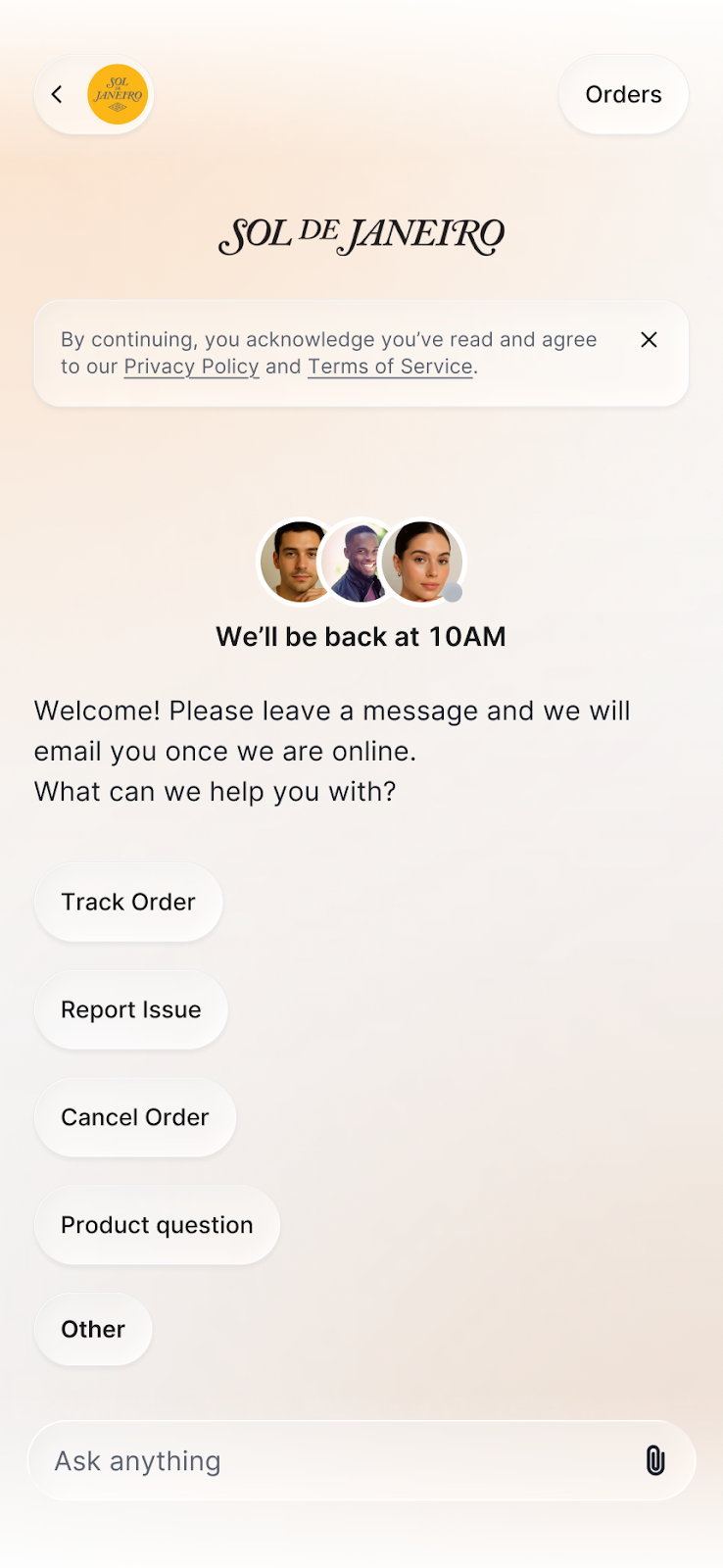
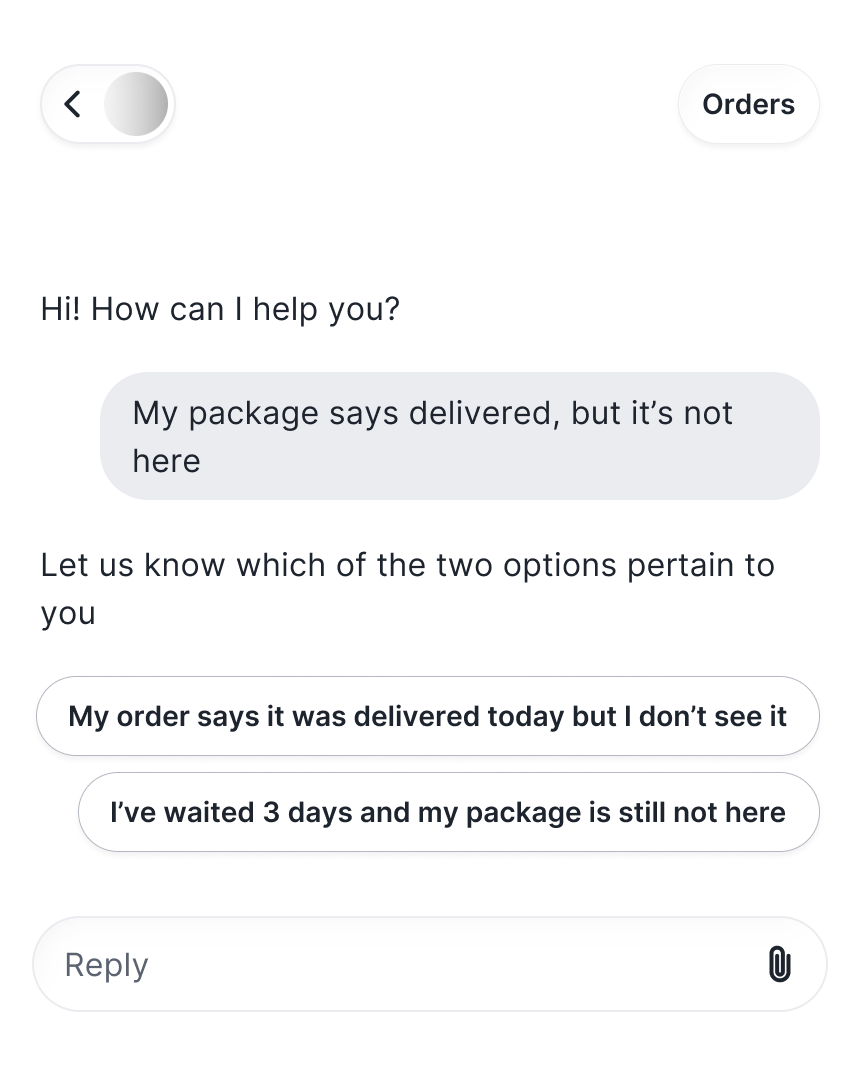
It’s now easier for shoppers to get an answer with quick reply buttons and suggested questions in Chat. This replaces the tree-based flows of the previous Chat, removing the need to follow a fixed path. Shoppers can find answers faster without typing text-heavy explanations.
Browsing and buying within Chat is now possible. Previously, it only supported product links that would open in a new page. With the upgrade, you can view item details without leaving the conversation. Shoppers can browse, compare products, and add to cart in one place.
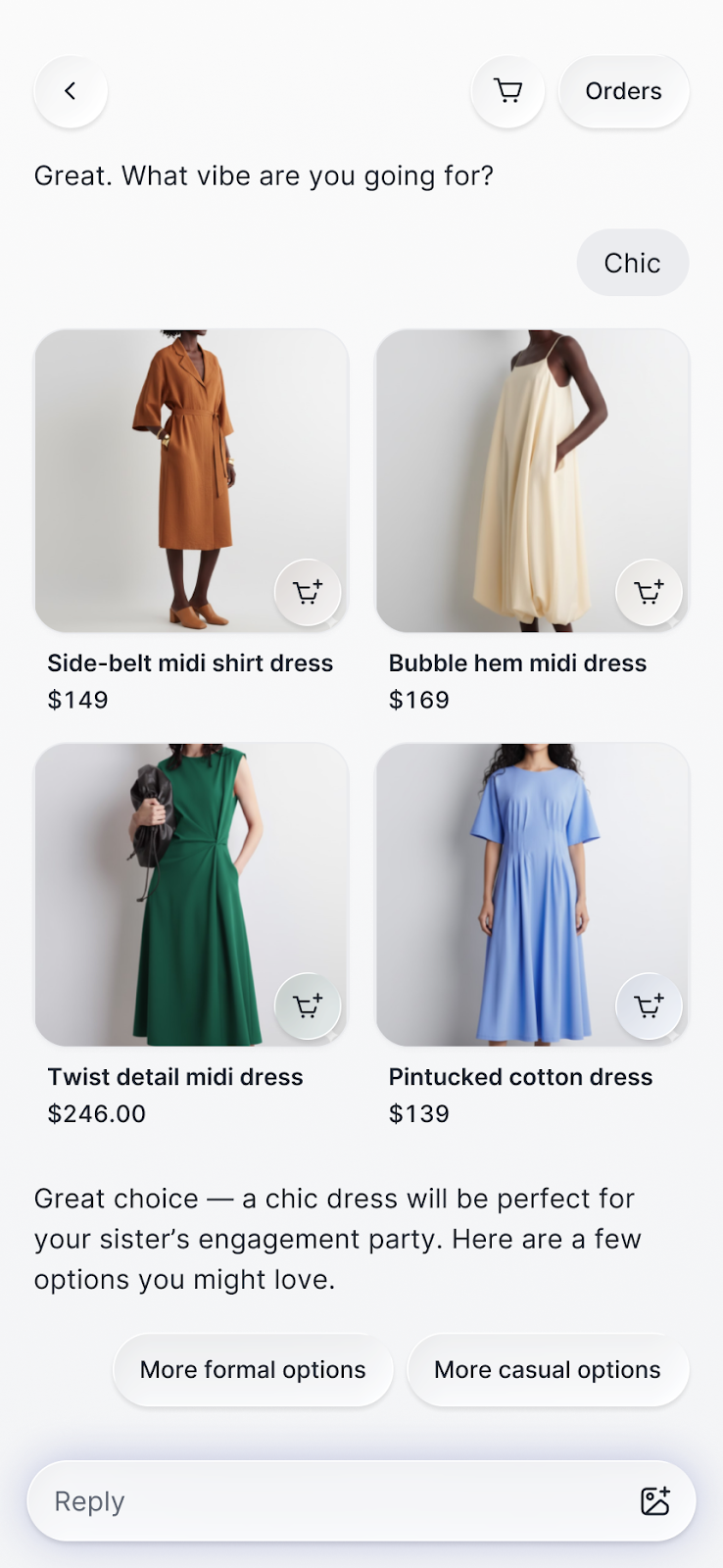
We’re keeping the context by removing the external redirects. The new interface lets shoppers browse product recommendations right in chat. View key product details, images, descriptions, variants, and pricing without opening a new tab.
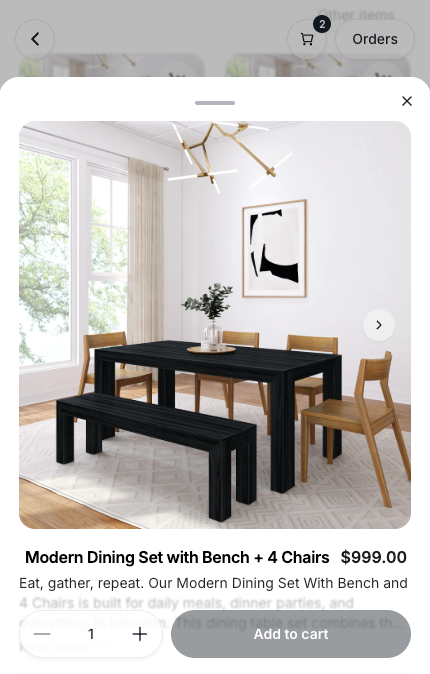
Chat adds clickable questions on product pages — like “Is this true to size?” or “What’s the difference between shades?” — designed to match what a shopper is likely wondering in the moment. These context-aware prompts help remove buying hesitation before shoppers even think to ask.
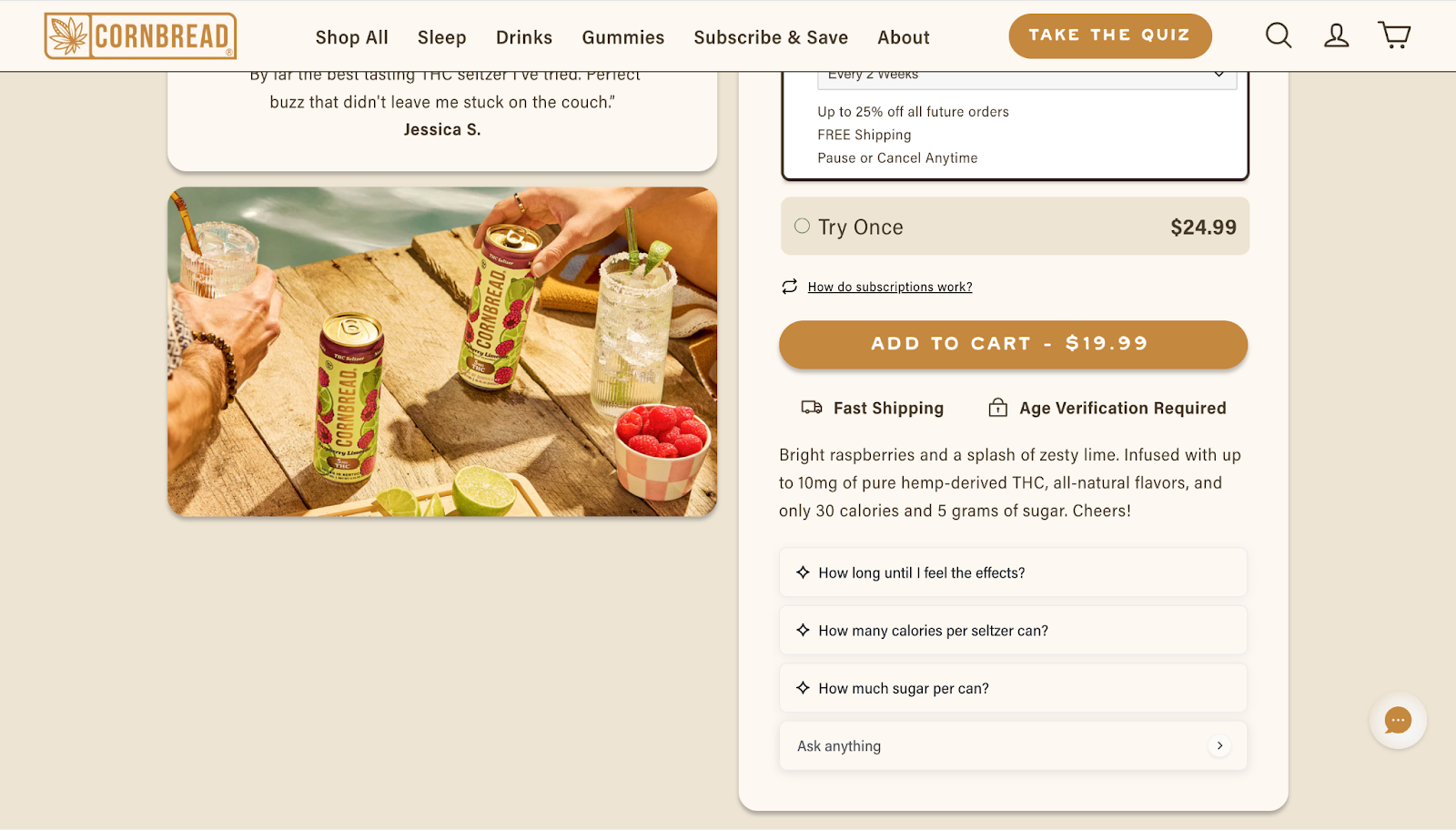
Chat adds instant access to shopper actions, like a cart button and an orders button for returning customers. Shoppers can jump straight to their cart or check on an existing order without waiting for an agent to give them a status update.
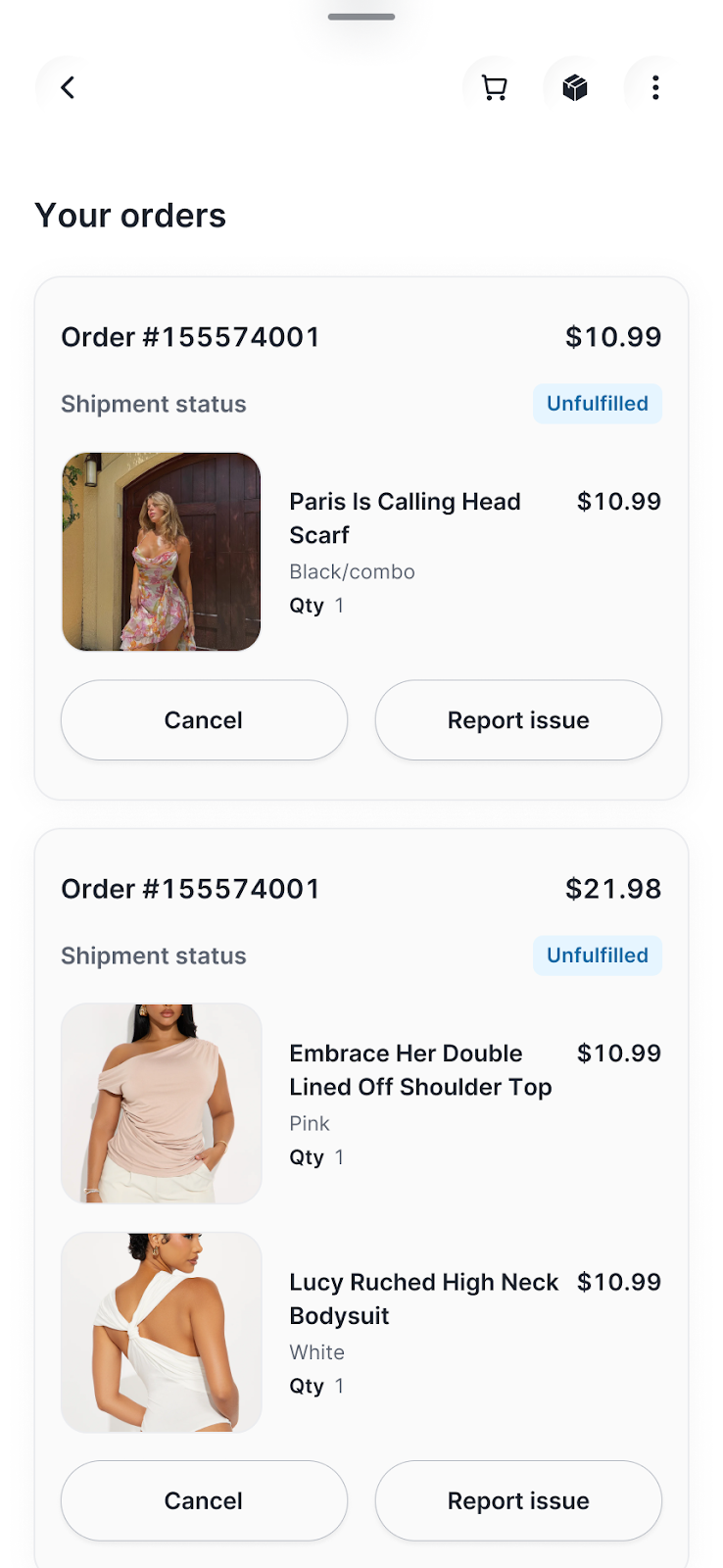
Every update in Chat drives performance. We didn’t simply give it a makeover, we also fine-tuned its underlying mechanics.
When product suggestions are easy to browse, shoppers interact with them more. The new product cards make shopping feel natural, allowing customers to explore items at their own pace. That convenience led to a 36% increase in engagement with recommended products.
Chat keeps the entire shopping journey inside the conversation, from browsing and asking questions, to adding to cart and checking out. This new layout removes the usual tab-switching between chat and the website. Less friction has led to more than double add-to-cart actions than before the redesign.
Chat's cleaner design and contextual entry points make it easier for shoppers to start a conversation. With suggested questions on product pages and quick reply buttons, more visitors are choosing to engage earlier in their journey. This has resulted in a 7.3% lift in chat engagement.
Conversational commerce has moved from concept to reality. Chat makes it part of the everyday shopping experience, letting shoppers browse, ask questions, compare products, and check out in one interaction. It brings the ease of the in-person shopping experience into the digital world.
We built Chat to redefine the shopping experience. We hope you see it reflected in your customers’ journeys.
Book a demo to see what's possible with the new experience.
The best in CX and ecommerce, right to your inbox


TL;DR:
Rising customer expectations, shoppers willing to pay a premium for convenience, and a growing lack of trust in social media channels to make purchase decisions are making it more challenging to turn a profit.
In this emerging era, AI’s role is becoming not only more pronounced, but a necessity for brands who want to stay ahead. Tools like Gorgias Shopping Assistant can help drive measurable revenue while reducing support costs.
For example, a brand that specializes in premium outdoor apparel implemented Shopping Assistant and saw a 2.25% uplift in GMV and 29% uplift in average order volume (AOV).
But how, among competing priorities and expenses, do you convince leadership to implement it? We’ll show you.
Shoppers want on-demand help in real time that’s personalized across devices.
Shopping Assistant recalls a shopper’s browsing history, like what they have clicked, viewed, and added to their cart. This allows it to make more relevant suggestions that feel personal to each customer.
The AI ecommerce tools market was valued at $7.25 billion in 2024 and is expected to reach $21.55 billion by 2030.
Your competitors are using conversational AI to support, sell, and retain. Shopping Assistant satisfies that need, providing upsells and recommendations rooted in real shopper behavior.
Conversational AI has real revenue implications, impacting customer retention, average order value (AOV), conversion rates, and gross market value (GMV).
For example, a leading nutrition brand saw a GMV uplift of over 1%, an increase in AOV of over 16%, and a chat conversion rate of over 15% after implementing Shopping Assistant.
Overall, Shopping Assistant drives higher engagement and more revenue per visitor, sometimes surpassing 50% and 20%, respectively.
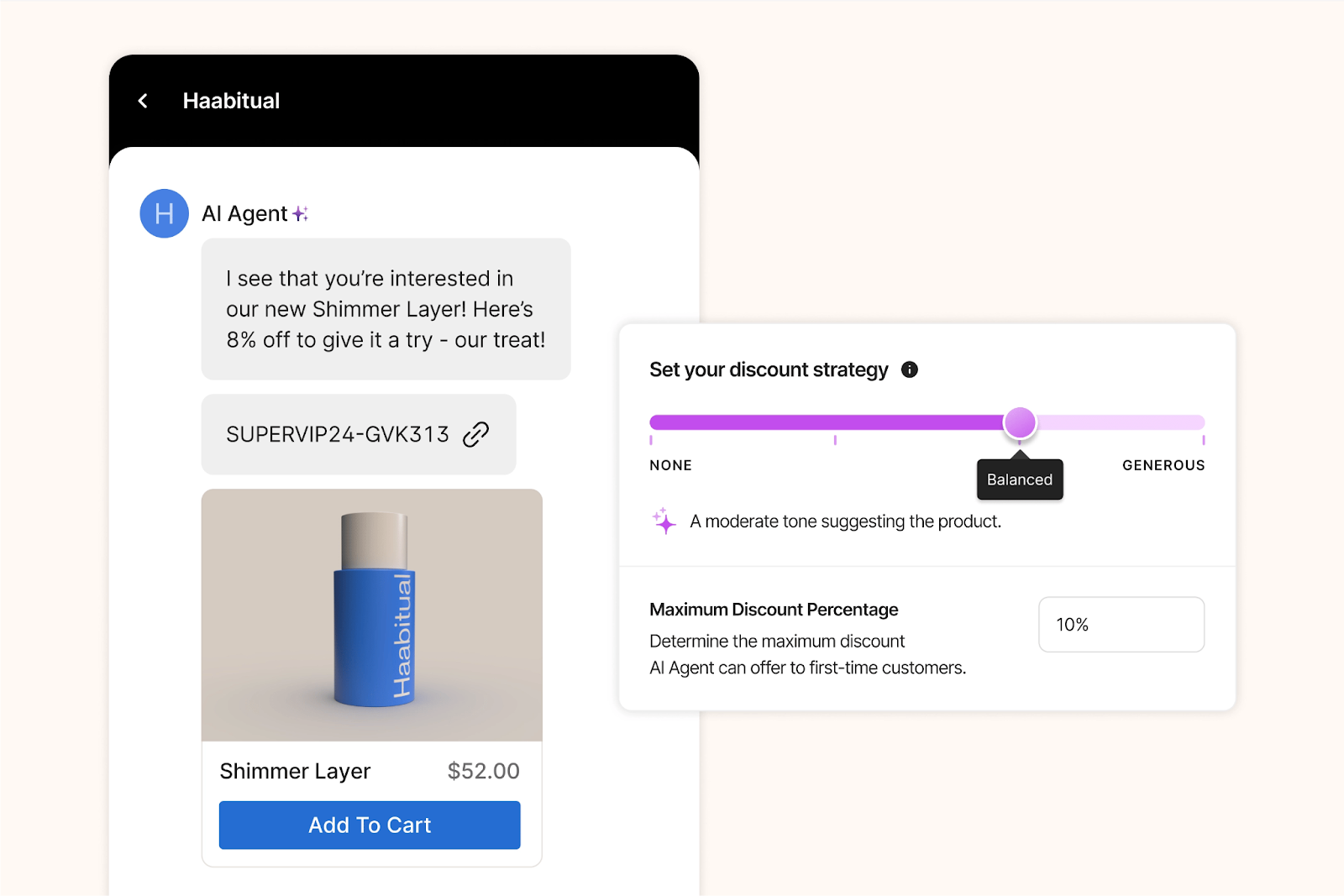
Shopping Assistant engages, personalizes, recommends, and converts. It provides proactive recommendations, smart upsells, dynamic discounts, and is highly personalized, all helping to guide shoppers to checkout.
After implementing Shopping Assistant, leading ecommerce brands saw real results:
Shopping Assistant drives uplift in chat conversion rate and makes successful upsell recommendations.
“It’s been awesome to see Shopping Assistant guide customers through our technical product range without any human input. It’s a much smoother journey for the shopper,” says Nathan Larner, Customer Experience Advisor for Arc’teryx.
For Arc’teryx, that smoother customer journey translated into sales. The brand saw a 75% increase in conversion rate (from 4% to 7%) and 3.7% of overall revenue influenced by Shopping Assistant.
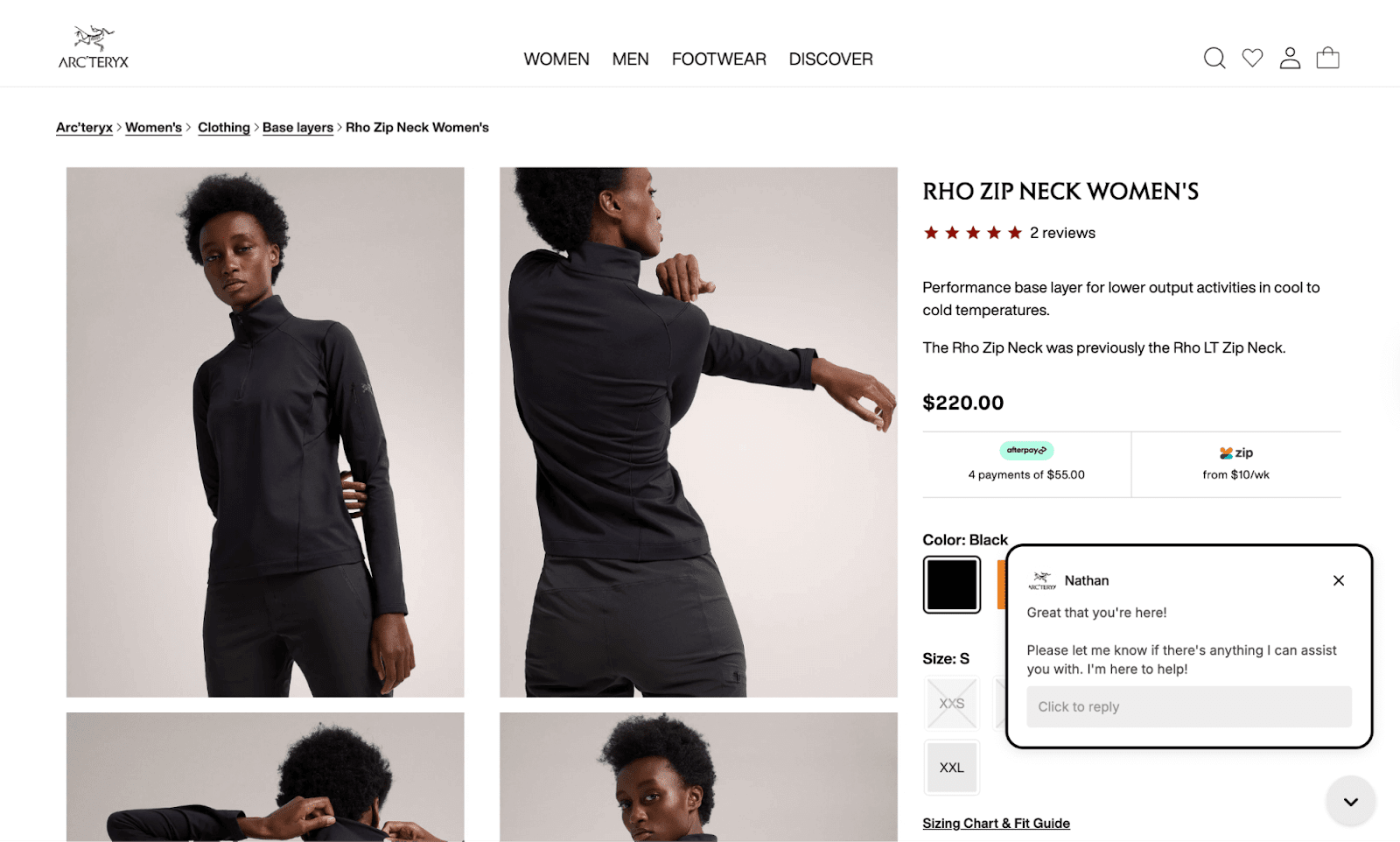
Because it follows shoppers’ live journey during each session on your website, Shopping Assistant catches shoppers in the moment. It answers questions or concerns that might normally halt a purchase, gets strategic with discounting (based on rules you set), and upsells.
The overall ROI can be significant. For example, bareMinerals saw an 8.83x return on investment.
"The real-time Shopify integration was essential as we needed to ensure that product recommendations were relevant and displayed accurate inventory,” says Katia Komar, Sr. Manager of Ecommerce and Customer Service Operations, UK at bareMinerals.
“Avoiding customer frustration from out-of-stock recommendations was non-negotiable, especially in beauty, where shade availability is crucial to customer trust and satisfaction. This approach has led to increased CSAT on AI converted tickets."
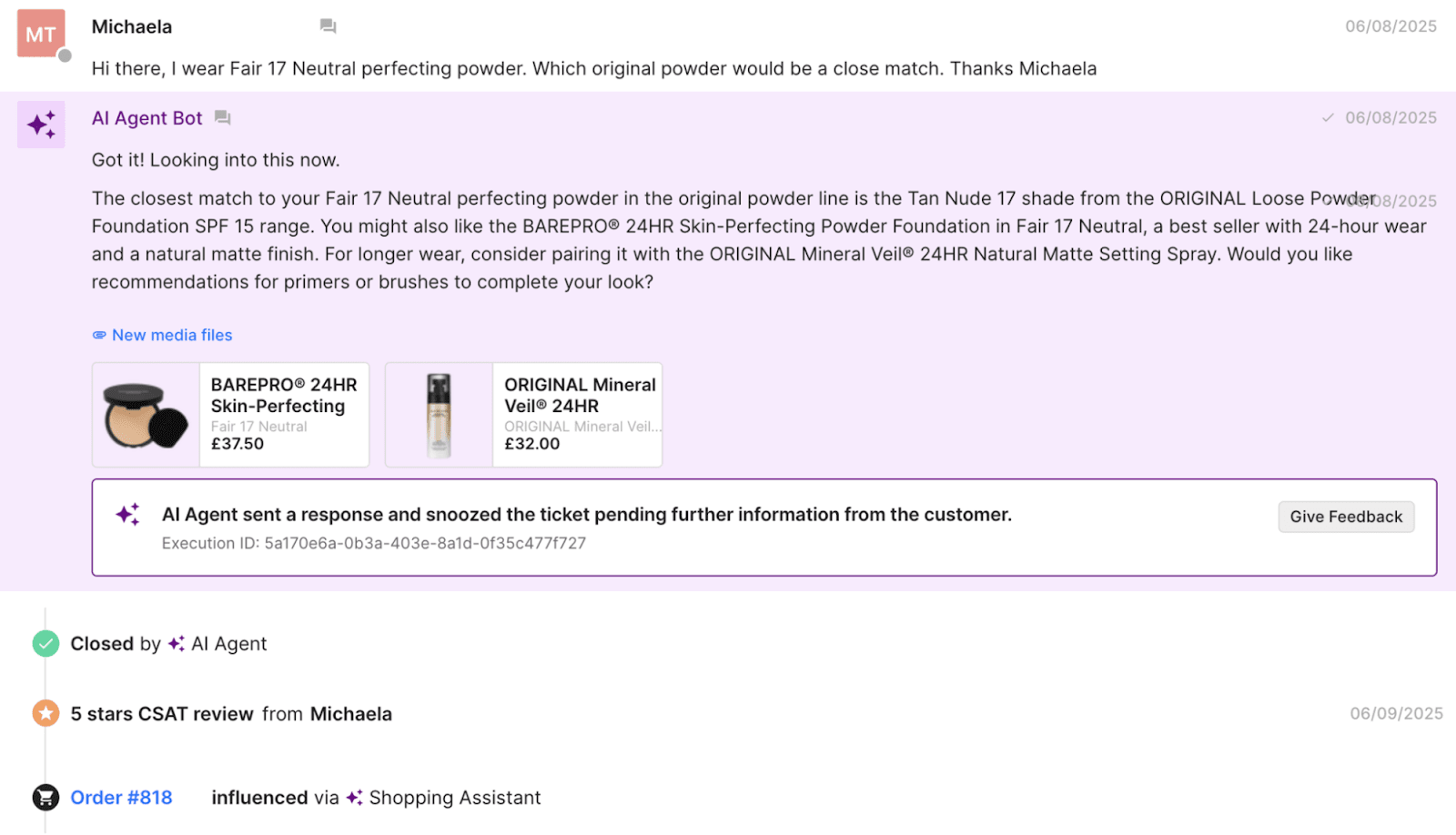
Shopping Assistant can impact CSAT scores, response times, resolution rates, AOV, and GMV.
For Caitlyn Minimalist, those metrics were an 11.3% uplift in AOV, an 18% click through rate for product recommendations, and a 50% sales lift versus human-only chats.
"Shopping Assistant has become an intuitive extension of our team, offering product guidance that feels personal and intentional,” says Anthony Ponce, its Head of Customer Experience.
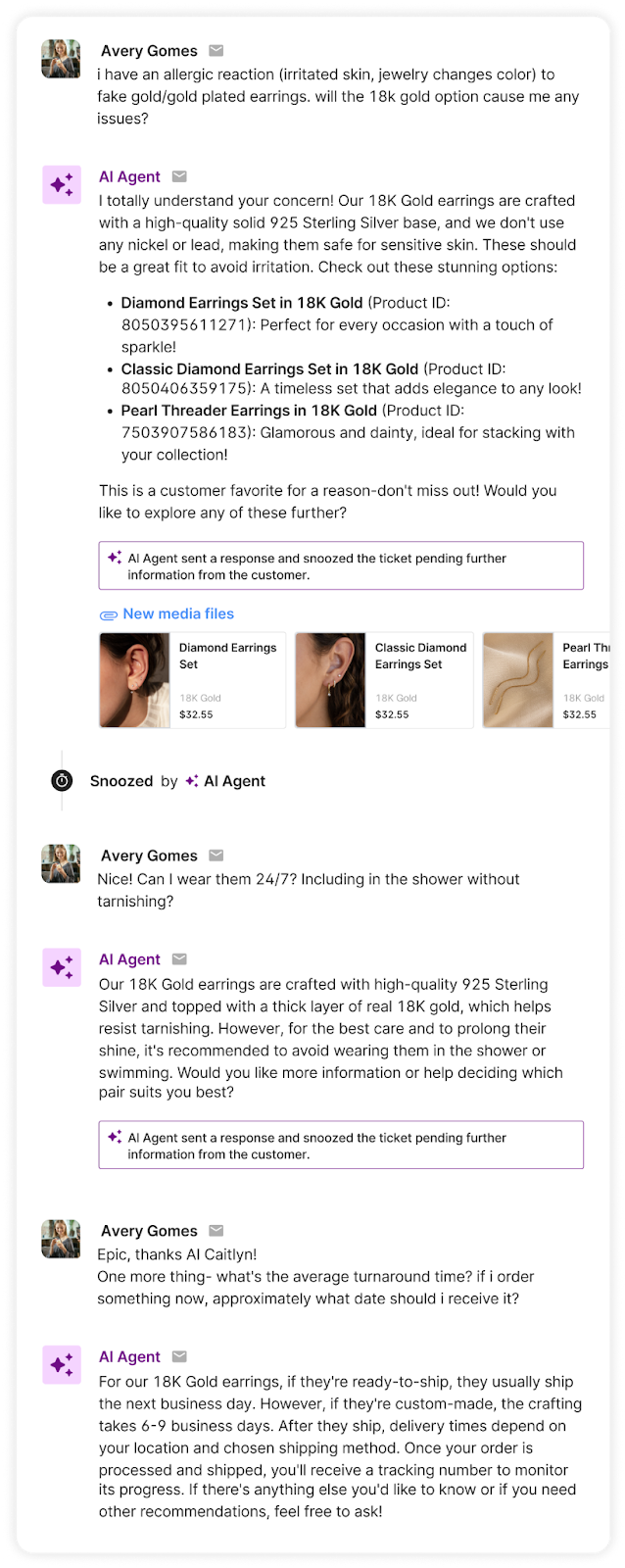
Support agents have limited time to assist customers as it is, so taking advantage of sales opportunities can be difficult. Shopping Assistant takes over that role, removing obstacles for purchase or clearing up the right choice among a stacked product catalog.
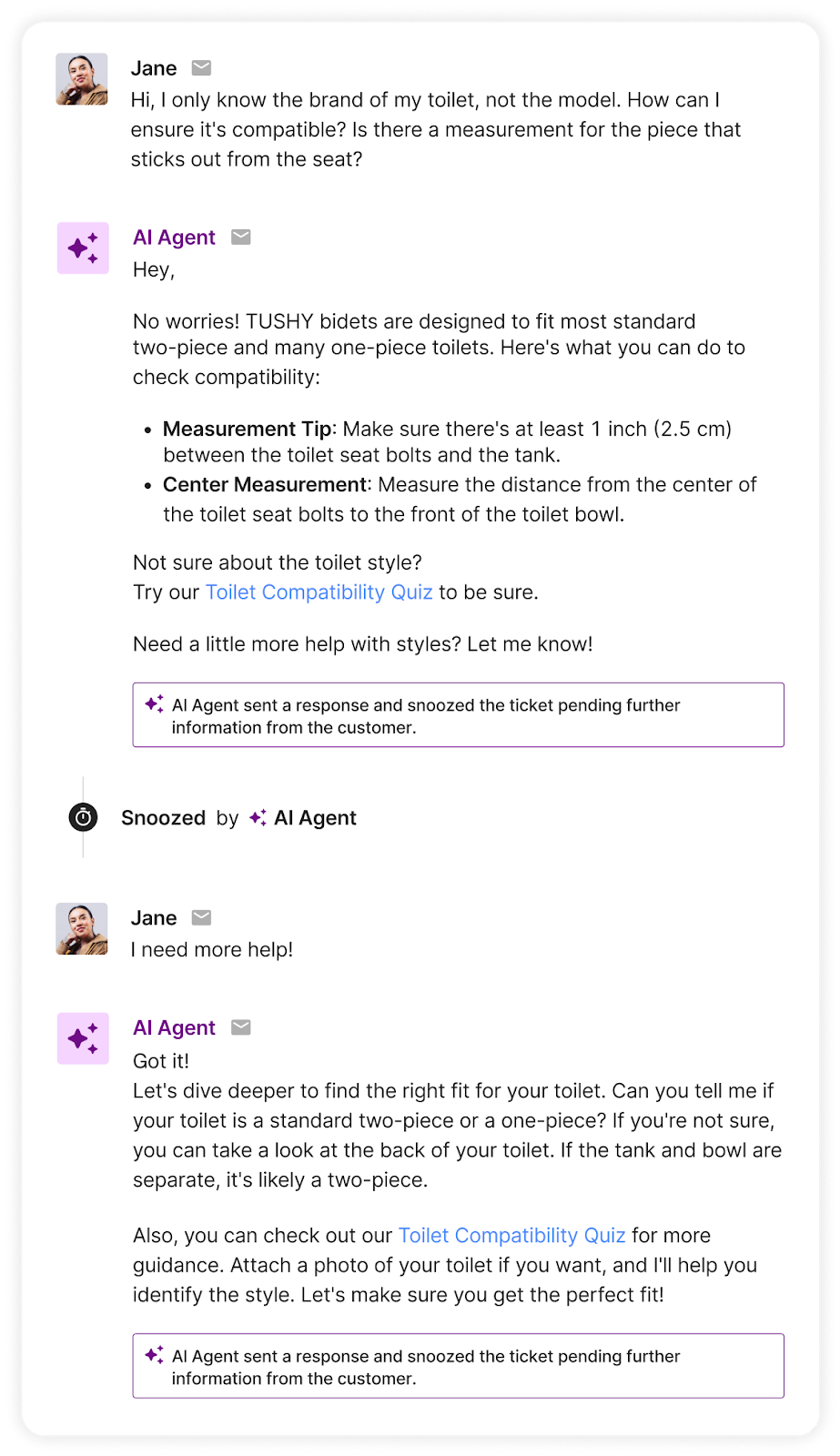
With a product that’s not yet mainstream in the US, TUSHY leverages Shopping Assistant for product education and clarification.
"Shopping Assistant has been a game-changer for our team, especially with the launch of our latest bidet models,” says Ren Fuller-Wasserman, Sr. Director of Customer Experience at TUSHY.
“Expanding our product catalog has given customers more choices than ever, which can overwhelm first-time buyers. Now, they’re increasingly looking to us for guidance on finding the right fit for their home and personal hygiene needs.”
The bidet brand saw 13x return on investment after implementation, a 15% increase in chat conversion rate, and a 2x higher conversion rate for AI conversations versus human ones.
Customer support metrics include:
Revenue metrics to track include:
Shopping Assistant connects to your ecommerce platform (like Shopify), and streamlines information between your helpdesk and order data. It’s also trained on your catalog and support history.
Allow your agents to focus on support and sell more by tackling questions that are getting in the way of sales.
{{lead-magnet-2}}


As brands have begun to evolve due to COVID-19, subscription offerings have been impacted tremendously. Many founders are baffled about what to do. But, you’re not alone. Learn about the trends we’re seeing with Shopify Subscription businesses and what successful brands are doing as they explore these new waters.
Read on to learn what’s happening in the subscription service realm and how you can better navigate through the muck to a thriving company in a post-Coronavirus economy.
What happened in the eCommerce space due to COVID-19? In our helpdesk ticket platform, we’ve seen the following trends in subscription business customer service:
Now, partial refund requests are going down -- these requests were for shipping costs, specific discounts, and other related transactions.
On the macro level, overall subscription order processing is up. However, on the micro level, a number of merchants aren’t weathering the storm as well as others.
Subscription offerings in the higher-value, hobby space seem to be a bit slower than usual. Yet, merchants who offer subscriptions for essential consumer packaged goods have to hustle to keep up with demands.
And, this is not surprising at all. Many people had a knee-jerk reaction to the pandemic while others had a change in priorities. Right now, people are more reserved about making snap-decisions. We can likely expect purchasers and merchants to make more calculated decisions now and into the future.
Now that we’re working from home, we need new essentials like office supplies and furniture. Plus, for some of the essentials like health and beauty products, we’re now turning online for where we might have gone to a brick and mortar shop before.
Now, people can’t really hop into the store to pick up tp and other essentials on the way home anymore. So, consumers are looking to find the most convenient way to have them delivered. And, they want to know they have a reliable source of essential products.
For example, at the beginning of this pandemic, everyone knows there was a tremendous run for toilet paper. And, merchants who offered this product saw 10-15X increases with toilet tissue sales.
Who Gives a Crap is an Australia-based, charitable toilet paper subscription company.

When this crisis started, Who Gives a Crap held back stock to accommodate subscribers rather than allowing new customers to order. They chose to prioritize loyalty over acquisition.
This brand is now thriving because of a steady uptick in consumable goods online. And, while the 10-15X trend may not last, long-term retention and increased revenue are likely. People will want to subscribe to receive preferential treatment.
We don’t have the exact numbers, but just because you offer higher-ticket hobby products doesn’t mean you’re doomed. There are multiple causes for high order cancellations and refunds.
For example, the supply chain is a key issue. If you don’t have inventory because you’re non-essential or shipping is too slow, you may have to cancel orders and offer full refunds. This happens because you don’t have the ability to fulfill an order, not because of an economic downturn.
Consumers are also leveraging the freedom to skip shipments and utilize subscription flexibility in other ways. Some people have overstocked or stockpiled on certain products. Then, they realized they didn’t need the quantity, so they now want to pause while still maintaining a relationship with a subscription company.
The UK Independent noticed a trend with sex toys, which fall into the non-essential category -- sales have tripled across the board. While it may have been predictable in retrospect, this isn’t a typical trend for an economic crisis. But, with social distancing, people can’t really go in Tinder dates and they have a lot of time on their hands. So, consumers are spending more money on at-home entertainment.
(Yet, if your supply chain runs out, no matter your niche, you may still see an increase in order cancellations.)
Supermarkets aren’t able to service people at their homes in many cases. So, consumers are turning online for many of their daily needs and wants. What we’ve seen is an increase in subscriptions for nearly anything that you use at home. Specifically, here are the products we’ve noticed are in high-demand.
Underwaterpistol, a leading Shopify Plus service provider, is working with a new client who was planning to launch a natural cosmetic and well-being subscription box prior to the pandemic. While Coronavirus has added some red tape to the logistics of the operations, consumer demand has accelerated rollout for these products.
Keep in mind that, over the next few weeks, we are sure to see more changes and it will be important to watch them.
Some of the tactics we see successful brands using are the same across the board. Know what they are so that you can thrive in the subscription business world.
Preferential treatment is one of the most effective business tactics for subscription companies because it aligns with the core of why people subscribe in the first place: exclusivity. Who Gives a Crap “guaranteed” subscribers would get their products, which motivated people to subscribe.
Pre COVID-19, we did this at Gorgias and we can attest to the power behind the process. Our subscribers were grandfathered-into specific prices and features. And, we experienced high retention because of this. You will have similar results with consumer packaged goods subscriptions.
Most subscription box companies have core consumable items. They sell between one to three variations of a product. But, many of the successful brands we see leverage add-ons, either relevant to the core offering or not.

A one-time product add-on is trending right now, especially on longer-time use items. So, if your core offering is toilet tissue, which people go through quicker, and you add another product to your offering that might take longer to use, like toothpaste, it can help you increase one-time sales. This is a smart move even if it feels negative that someone wants to cancel their subscription the next month.
If you can no longer offer your supplies because of a supply chain issue, you have choices:
For example, some sellers can no longer use Amazon’s warehouses for fulfillment (which aren’t only for sales on amazon.com) because the company is only accepting essential items, at least temporarily. So, some of those sellers stop offering their products through FBA. Those merchants lose a ton of business.
On the other hand, there have been sellers in similar positions who flew out to their suppliers and negotiated dropshipping solutions. And, guess what? These brands’ sales haven’t skipped a beat.
Amazon Prime members get expedited shipment on purchases and discounts. Likewise, subscription companies can offer fringe benefits and free gifts to their subscribers.
Freshly Picked is an infant moccasin company that implements this strategy well.

Freshly Picked offers “The Fringe,” a membership that costs $10 month. Fringe members get expedited delivery, discounts, and the $10 is redeemable in the store. So, customers can apply their membership cost to purchases. Using this method, you create a perceived discount without giving up your margins.
You have your customers who believe in you. Then, you have your non-believers who have objections about why they don’t order or why they don’t upgrade. When you know what causes people not to convert, you can make better business decisions.
So, find out what makes people NOT order from you. Then, add value to your membership offer by providing those perks exclusively. Look to your customer service requests to discover what some of your audience’s greatest problems are, then solve them.
First of all, it’s super important to make sure the tools you use are compatible with one another. Next, you need to use reliable platforms. Third, make sure you leverage the features that are available to you.
The following tools work well alone, together, and with Gorgias to power subscription businesses.

A constant, consistent message is key. And, Klaviyo can help you deliver this by automating crucial analytics, email flows, and sequences.
Advanced Tip: It can work wonders to push for a new subscription after a customers’ second order.

Recharge is a must for anyone who wants to process recurring payments at scale in today’s market.

You need to be tracking and monitoring visitor and user behavior. Leverage Little Data for advanced and relevant analytics.

Reduce customer churn with failed payment recovery options from ChurnBuster.

Create data-driven loyalty programs to generate more engagement and subscriber retention.
Email isn’t dead, but you now have an unprecedented opportunity to get in front of people where they are -- on social media and on their phones. Worldwide since the start of Coronavirus 45% of consumers are spending more time on messaging apps like WhatsApp and Facebook Messenger. And, brands are paying attention.
As a subscription service offering, you should use social media and SMS for order updates, upsells, and other customer communications. Don’t limit yourself to email. And, choose tools that enable you to meet your customers where they are.
As always, your brand message is central to your success. Right now more than ever, people want to hear from you. And, if you stay consistent and connected, your customers will stick with you now and into the future.
Be mindful that each detail is aligned across all communication platforms including your website, social media, email, and offline messaging. You have an unprecedented opportunity to be remembered if your messaging strategy is aligned across all channels.
Brands that know how to incentivize see higher returns in business. To illustrate, many new subscription companies launch aggressively with 20% discounts for new users. And, while they believe they’re offering more incentive for customers or members to purchase, they’re actually only making a cut to their own profits. 10-15% discounts offer the same psychological incentive at less cost to the merchant.
One incentive that does work well is to offer a small discount for the new subscriber and the same discount for a friend. This works well because it creates a sense of community and giving for the customer and generates a referral for the business.
The bottom line is that successful companies seem to inform themselves about incentives that work and apply creative strategies that show proven results.
The online shopping ecosystem is evolving, but that doesn’t mean it’s all doom and gloom. There are actionable steps you can take to stay in the game now and into the future. Stay informed and roll with the punches. Remember that a bit of extra effort now can have a lasting impact on the long-term outcomes of your business.

You spoke and we listened. We’re excited to tell you that, we are ready to launch out of beta. Now, you can connect your Magento 2 store with your Gorgias account. Access your Gorgias and Magento data from one dashboard.
The simplistic interface will enable you to display customers, orders, shipments, and credit memo data from your Magento eCommerce store next to your Gorgias support tickets. Learn more about the features you can take advantage of.

Magento users now have access to the fundamental and performance-boosting advantages of the Gorgias help desk platform.


Soon, we will add actions like ‘refund’ or ‘cancel order’ to the dashboard as well.
Our extension was created for compatibility with the updated Magento 2 platform. So, Magento 2.2 users may need to upgrade to version 2.3 to properly access all of Gorgias’ help desk features.

By integrating with Magento 2, we are excited to serve a new rank of online sellers. We hope to recreate the satisfaction we’ve given our existing users. Here’s what you can do now.
Cheers!

For the past 4 years, we've been building Gorgias with Alex and our amazing team. Both of us are automation nerds and our initial idea was to automatically respond to simple support questions. Over the last 2 years, we've been focusing heavily on helping Shopify merchants manage all their customer service in one place. We've grown from 0 to 2000 customers, including fast-growing brands like Rothys, MVMT and Steve Madden.
Today, we're raising a $14M series A to transform customer service into a profit center using conversational commerce.
I'm not a fan of celebrating fundraising events too much, as it's more of a promise than an achievement in itself, but I want to take advantage of this milestone to reflect on what we've learned:
Over the last 10 years, Amazon has reached an impressive 50% market share in eCommerce. They were able to do it thanks to 3 key pillars: customer experience, logistics and pricing. As a result, they grew 10x in the last 10 years.

However, as we've been building Gorgias, we've witnessed a second trend that has been quieter until last year: brands are going direct to consumers. It happened because of two key factors. One, millennials want to buy from brands they can relate with. For instance, Rothy's makes shoes out of recycled plastic bottles. Two, brands want to build an experience that they control. That's why Nike decided to pull out from Amazon last week.

This direct-to-consumer shift actually started around 2013. Around that time, Shopify started empowering more and more entrepreneurs to launch their own brand online. Ad costs on Facebook, Instagram and Google were relatively low, which allowed for lots of eCommerce entrepreneurial success stories like MVMT Watches.
As more and more brands launched, competition on ad buying has become fierce. The new battleground is no longer Cost of Acquisition but Lifetime Value.

Lots of merchants using Gorgias are now focusing on building a brand. They create differentiated products, they want to interact directly with their customers over online communities like the 310 Nutrition Facebook group with 300,000 members.
Brands are bringing Main Street back, and want to offer a real alternative to Amazon. Apps like Shopify (storefront and soon fulfillment), Klaviyo (email marketing), Yotpo (reviews) and us too at Gorgias have been working on empowering merchants to build large scale and independent businesses.
Here's how we want to help merchants with customer service. The pillar value proposition of Gorgias has been to allow to provide the best customer experience through a 360 degree view of the customer. Agents can respond to chats, emails, Instagram comments while seeing previous conversations, and order data. This way, customers get assistance faster. Everyone wins.

Though, we think there's a larger opportunity for merchants. As a visitor is going to browse a online store during Black Friday, some objections are going to pop up in their mind. Is this shoe the right size? Will it fit?
In 2020, we want to empower merchants to grow through conversational commerce. Support teams can now leverage all the context they have about the customer to guide them toward the buying journey.
One of the challenges here is that support teams are already under a lot of pressure during the holiday season. People wonder if their order will arrive on time for Christmas, or how they can return this gift that was not the right size. That's why we're also focusing on automating the first response to these questions. This way, agents have more time to assist visitors with their purchase.

We're super grateful to the whole team that has joined the adventure, it's been a hell of a ride from the first customer to the 2000th. Jason has been incredibly helpful as our main investor so far. Today we're excited to welcome Auren, Tod and Jeff from Flex Capital, along with François from Alven, Andrew from Klaviyo as part of the team.
At each stage of the journey, there's a new product-market fit to find and new challenges ahead, this fundraising is the beginning of this new chapter to generate more sales through conversational commerce.
PS: if you run an eCommerce store, give Gorgias a try and let me know whats you think


The Peak Season is a stressful period for most merchants. According to a recent study, 75% of them are concerned about the rising customer service needs during that time of the year. Let’s walk through some of the best practices to make the most out this increase in customer service needs.
 |
But first, let’s read about a customer support story that happened a while ago.
Dan is hanging-out in his kitchen when he realizes that his fridge is no longer working. He decides to contact the customer support team of the fridge merchant and waits for an answer. Unfortunately for Dan, this happens a week before Black Friday and the merchant team is lost under the huge spike in tickets.
 |
So Dan waits three days before his request is taken care of by a contractor hired two days ago to help with the workload. Dan gets redirected to the manufacturer of the fridge and, also after 3 days, gets a first answer.
Dan gets into what is called ‘the maze’ and gets redirected to another person. Seven days after he first contacted the merchant, he finally gets a technician to come at his place fix his fridge. The technician comes over but realizes he need some parts to fix the fridge that take another 7 days to be delivered. The parts that arrive are not the right ones and a new order needs to be made.
It’s been more than two weeks since Dan first tried to get help and this makes him crazy. He goes back to the fridge merchant to ask for a fridge replacement and gets a response after 4 days. He gets told that replacements cannot be made as it goes against the merchant policy.
Dan starts telling the story on social media to kill the merchant reputation. The story goes viral and eventually Dan gets his fridge replaced.
Nobody wins in this story, and this terrible situation could have been avoided with a few of the coming tips.
What’s the open rate of your email promotions? 5, 10, 20%? And what’s the open rate of customer service messages? Probably close to 100%. So what if you made these promotions in those customer support tickets to leverage on the support you’re making?
 |
Make sure your customer support heroes provide the same experience to your potential customers as if they were physically going to a store and being advised. You’ll end up making relationships with your customers and turning them into ambassadors for your brand.
We pulled out the tickets of 600 customers to understand some of the most common questions that your team can expect to receive. Here are the results we got.
 |
Those make up for 40% of your requests. You can actually prepare for it to decrease your response time. There are three ways to do so:
People usually expect you to answer within two hours if not more. By responding in a few minutes you’ll make your customers amazed by your efficiency and will prevent them from going to your competitors. Best, they’ll spread the word on how professional you are and you might end up gaining a few more customers on the way. Here’s an interesting graph we came up with using our customer service statistics.
 |
The repeat rate is the % of your customers who are going to make a new purchase after they already made an order. As you can see, people who already called for the customer service help and got a good experience out of it are way more likely to make a new purchase.
You might want to hire a few temporary people to handle the spike in tickets. Bear in mind however that these guys don’t know your product so make sure to train them a few days before accordingly. Make it a rule that if one of your support guys can’t answer a question within five minutes, then it’s best for them to pass it over to somebody else, instead of rushing into giving a wrong answer and end up like Dan in our fridge story.
While your team maybe be stressed out by the workload, make sure you build a system that highlights the best reviews and show them they are making people happy and doing a good work.
By increasing the number of people on your customer support team (tip #5) to handle the tickets spike and focusing on not only answering requests fast to impress them (tip #4) using of macros and other tools (tip #3) but also giving them a proper experience (tip #2), you’ll be sure to turn your customers into ambassadors for your brand but also increase your repeat rate. Make sure to also leverage the support spike by including promotions in your requests answers (tip #1). Finally, don’t forget to cheer up your team by creating a wall of love (tip #6) to let them know about the great reviews they get from happy customers.

Being a support agent has got to be one of the most trying jobs a person can have. Dealing with unhappy customers in your helpdesk isn’t anyone’s idea of a good time. So, if you want your team to treat your customers as invited guests, even under tense circumstances, it’s your job to motivate them. These excellent customer service quotes can help.
Whether you’re a support team manager or the owner of your company, you know that keeping your staff encouraged and upbeat at work is crucial to efficient customer service operations, especially in the face of challenging interactions with frustrated customers. It’s one way to reduce the load on your support team. So, you need to do what you can to keep your environment cheerful.
Think of your team as a group of football players and yourself their cheerleader. You need to use positive language, words of affirmation, and other motivational tactics to keep your support machine well-oiled and increase customer loyalty. So, where do customer service quotes come in?
 |
Yes, offices still use whiteboards or chalkboards. If you’re one of them, this might be the best way to deliver your quotes. If you work in an office with your team, you can use a chalkboard or whiteboard, posted in a visible place, to display your motivational tidbits for the month. You don’t need any animations or tricks to get the point across — just make sure the quote is written legibly.
 |
Email is one of the most commonly used communication channels in every business. So, alternatively, if you work with a remote team, a monthly email with a quote followed by your own thoughts can help promote an optimistic vibe within your operations. Your staff is likely checking emails all day anyway. So, you can be sure they’ll see your message, and they can save it to their personal desktop if they want to. (By the way, check out these 16 email templates to help your agents deliver quality service quickly.)
 |
Everyone has a desk, right? If this is true, and if your team is small enough, you can give (by hand or mail, depending on where your staff works) each employee a poster or card to display at their own desk. They can pin it to the wall behind their workspace or keep it in a drawer to remind them each time they open it.
 |
And, if you’re feeling creative, you can create custom desk calendars with a new quote displayed for each month of the year. This idea is nice because it’s functional as well as fun. Plus, it gives staff the feeling that they’ve gotten a gift. Gifts in themselves are pretty effective workplace motivators.
 |
Finally, if you want to leverage technology, consider setting up a staff opt-in for an SMS campaign wherein you send the quotes directly to the mobile phones of your support agents. Or, send a text message to each support agent individually. The great thing about this idea is that your agents are likely on their phones when they’re not working, so it keeps your operations at the front of their minds.
Now, let’s look at a year’s worth of quotes to keep your team feeling like their perky, happy selves. Whether you’re sending out a monthly email all year long, or posting your quote next to the portrait on the wall of your employee of the month, you’ll need twelve of them -- one for each month of the year. So, here you go!
January is the beginning of a new year. In most places, it’s still cold outside, the holidays are over, and your staff are just getting back into the swing of things after the holiday rush at work and festivities at home. When it comes to an inspiring customer service quote, you need one that sets the stage for the rest of the year.
What better place to start than reminding your staff that their performance at work will affect the entire company. The above quote is from David J. Greer, coach and author of Wind in Your Sails: Vital Strategies That Accelerate Your Entrepreneurial Growth. In this book, Greer uses sailing metaphors and experiential wisdom to convey some powerful business messages.
 |
The above quote should warm your team up nicely. And, it should remind them that, at the end of the day, a review can make or break your business. So, their job is to deliver the kind of experience that enhances your company’s word-of-mouth marketing, not harms it.
The second month of the year is a time of romance. February 14th is Valentine’s Day. At this time, most people across the globe celebrate their love in remembrance of St. Valentine, the patron of affianced couples. So, your quote for the month should at least attempt to reflect this. And, it should inspire the team to want to lean-in more intimately to customers’ needs.
Fortunately for you, the late Steve Jobs, magnate, entrepreneur, investor, and co-founder of Apple, said just what your team needs to hear. His advice is to get close to the customer. You and your team can use the tokens of affection you see around you as reminders of how to treat shoppers that come to you with their problems.
 |
This customer service quote serves as a reminder that the relationship between your brand and your shoppers should feel like a personal one -- there should be a spark ready to ignite. And, when you really care about people, you naturally want what’s best for them. Since you’re theoretically the experts in everything related to your product offering, you should know what to offer before their questions are even asked.
March is the month for St. Patrick’s Day (and my great grandmother’s birthday) celebrations and Spring Equinox. In a nutshell, festivities and fun happen in March. People are getting out and having a good time. So, this month’s customer service quote should reflect this.
And, guess what? Jeff Bezos, entrepreneur, investor, and CEO/ founder of Amazon, can shine some light on what you need. Follow his lead and be amazing hosts to your party guests. You can’t offer your shoppers drinks, but you can give them an experience that they won’t forget. And, if your team is having fun, so will your customers. Make each day better than the last.
 |
Help you support team imagine that your brand is a party and everyone on the other end of the line is a welcomed friend. Cultivating a great shopping and support experience is a surefire way to increase your eCommerce conversion rates and make every day more enjoyable. When everyone is having fun, everyone wins!
April showers bring May flowers. The word April is derived from Latin aperit, which means “open.” And, one of the most important customer service skills your agents can possess is the ability to be open to the needs of your shoppers. At the very least, the needs of the customer must come before those of the support staff. So, remind your team with the perfect customer service quote.
Gene Buckley has you covered. The senior director of customer success, health, and life sciences at Microsoft knows the right time to be smart -- in the shower. The right time to be smart is not when your customer needs you. Actually, when you’re working, you need to be humble.
 |
Here’s a brighter, more emotional way to say the customer is always right. Save your critical thinking for the moments when you’re alone -- before you fall asleep at night and in the shower. When you’re serving, be present and serve. Listen and make sure the customer knows you’re listening.
In May, flowers are starting to bloom, Spring is officially in the air, and people are experiencing more happiness in general. For some people, life seems more colorful. So, this month, you might want to keep things simpler than usual. You might want to inspire agents with a quote that gets straight to the point.
The retail success story, Katherine Barchetti was Pittsburgh’s retail success story. While her stores are no longer open, her wisdom lives on. She built an empire based on the idea that the customer was much more important to success than sales. In reality, the two go hand-in-hand. But, her words are a great reminder for any support agent.
 |
Envision your customer as a person, not a series of dollar signs. You don’t like being treated like a thing, and neither do your shoppers. Help your agents remember this wisdom with the above quote. In the end, this is the simplest idea at the core of every successful customer service ecosystem.
June is the first month of Summer. Children are getting out of school, barbecues are starting, and people are getting outdoors more. They’re also spending. And, if you focus on the right things, you could be a major player in where they spend. And, the right things aren’t what most people think. How can you remind your agents what the right frame of mind is at this time of year?
Henry Ford, the magnate behind Ford motors, requires no introduction, as his empire is strong even decades after his passing. What did Ford have to say about customer service? Basically, he said it is everything. Absolute devotion to service is his idea of the key ingredient for success. And, it would be unwise to disagree. So, share his wisdom with your agents in June.
 |
Let this serve as a reminder of how truly important the job of a support agent is in the big picture. Service is the heart of a thriving brand.
July is when freedom rings. In the United States, independence day falls in July, when people are getting together playing games and lighting off fireworks. Hint: this happens every year, consistently. And, people continue to celebrate the same way each time. So, it might be a helpful idea to share a reminder with your staff about the value of consistencye, potentially with the help of call scripts. But, how?
Take a look at this quote from Shep Hyken, who speaks nationwide to expert audiences about customer service and experience. He says that consistent positivity is what drives retention and loyalty from shoppers. Hyken has been featured on major television channels and is trusted and endorsed by enterprise brands. His advice is worthwhile for any support team.
 |
Not only is the job of a support agent to be positive and make customers happy -- true satisfaction also stems from a consistent experience of your brand. When people know what to expect from you, they begin to trust you. And, when people trust you, they want to put effort into maintaining a relationship.
Your support agents, by delivering a consistent, positive experience, play a major role in the success of your company. Share this quote to remind them.
August is the time of year when parents are getting ready to send their kids back to school. Schedules are being rattled yet again. And, it’s the time of year when people are soaking up the last of their Summer vacations, which might cause a bit of anxiety. There’s so much going on that consumers might be a bit more on-edge than usual. How can you help your agents cope?
Your go-to for this month, Bill Gates -- principal founder of the Microsoft corporation -- provides an excellent reminder of the fact that not every learning opportunity comes wrapped in a pretty package. In fact, the dissatisfied customers you come across can be the best teachers. Use this as a reminder to find the silver lining and take everything you can from every situation.
 |
Not every support experience within your operations is going to feel pleasant. So, use dissatisfaction as an opportunity to learn about products, service tactics, and communication. Your agents should be learning how to transmute tense situations into opportunities to optimize your brand experience. So, this month use the above quote to remind them of this.
Ah, September -- the beginning of Fall and prep time for your final quarter operations. You’re probably getting ready for the busiest season of the year. While you’re trying to figure out how to cut costs, your support agents are still plugging away at their jobs, wondering if they’re going to have to help train the new prospects showing up for your customer service interviews. What’s a good quote to share with your team?
Sally Gronow is the head of customer service at Dŵr Cymru Welsh Water in the UK. And, while you may not have heard of her, she has a simplistic yet genius answer. Your support staff could find great wisdom in the reminder that a crappy experience is going to cost so much more than a great one, even if it takes more effort to provide it; use the idea to keep your service team motivated this month.
 |
Sometimes, it can feel like a lot of work to help a customer through an emotionally mucky issue. But, in the end, it will take a lot more effort to dig yourself out of the hole created when you fail to help them. Poor reviews, loss of retention, and devastating negative word of mouth can kill your business. The responsibility of going the extra mile to deliver satisfaction falls on your support team.
October is a time for harvest; this is the time of year when people come together to reap the rewards of the past year’s efforts. Community is one of the main themes of the month outside the office. So, you should try to create the same theme inside your company. And, luckily, just the quote exists to remind your support team.
The CEO of Zappos (an outrageously successful online shoe and clothing retailer), Tony Hsieh, said something that fits perfectly with the idea of community. He said that customer service is more than just one group of people within a company, that it should be everyone in the company. And, his wisdom is the perfect reminder for this time of year.
 |
You may or may not be able to depend on the other forward-facing departments to have the same level of impact as the service team. But, remember that a support agent’s job is the backbone of the company. And, together, your team can move mountains. In the end, the ability to serve the customers well is the central indicator of a successful company.
For every retailer, Black Friday and Cyber Monday are days you’ve been prepping for all year. And, your support team knows this. If you participate in the promotions, these days are going to be your busiest days of the year, especially where customer support is concerned. It might be a good idea to get your team ready by flipping the script -- what are consumers (not CEOs and support experts saying?
Larry Winget, author and self-proclaimed “Pitbull of Personal Development,™” encourages consumers to speak out when their expectations aren’t met by customer service teams and brands. The people are cheering each other on with empowering words to ‘say something’ when they’re dissatisfied. So, while your team is under enough pressure to succeed already, it’s crucial that they know how a bad experience could affect your operations.
 |
Just to stir things up a bit, throw in a customer service quote from a consumer. Make sure your support staff knows that everything they say and do will be scrutinized by the customers they are serving. And, it also has the potential to be seen and heard by the public. So, remind your team to give people something positive to talk about!
You’ve made it through Black Friday, but your year isn’t over. Consumers are still shopping for last-minute holiday gifts and they’re celebrating. They’re giving each other gifts, sharing time together, and partying it up this time of year. What they’re trying to do is exceed their loved ones’ expectations to express their love.
Sam Walton, founder of Walmart and Sam’s Club, said something that fits the sentiment perfectly. He said that companies should go above and beyond the expectations of their shoppers. And, that’s how he grew a small kingdom for himself, from the ground up.
 |
Here’s a little reminder that the best practice for agents is to take each interaction a step further than expected -- from dissatisfaction to delight. Keep your team reminded of this and you might be able to crown yourself as well.
What other customer service quotes do you use to motivate your team?
Interested in an easy, full-featured support system for your online store? Start your free trial of Gorgias today.