

72% of Gorgias Uses AI for Decisions: How We Did It
Four months ago, our analysts were dealing with a barrage of questions. "What's our ARR by segment?" "Build me a dashboard for this quarter's pipeline." Quick asks piled up behind complex deep dives. Stakeholders waited for answers that should have taken seconds, and analysts spent their time fielding requests instead of doing the strategic work that creates the most value.
Today, anyone at Gorgias can ask a question in plain language and get an accurate, contextualized response in seconds. Not from a colleague or dashboard, nor from a generic answer from the internet. But a response built on our business context. We call it Cortex, our flagship internal AI agent.
In two months, Cortex went from an idea to fielding thousands of questions every week, recommending actions across the business, and deprecating the need for manual dashboard creation. While most companies right now are treating AI as an initiative — at Gorgias, AI is already part of how we work. 72% of Gorgias employees use Cortex each week, and that number is only growing.
We didn’t achieve this by simply plugging a large language model into our stack. LLMs are a critical part of the equation, but they aren't the driving force — it’s everything else under the hood: the infrastructure, context, platform architecture, and the team that brings it all together.
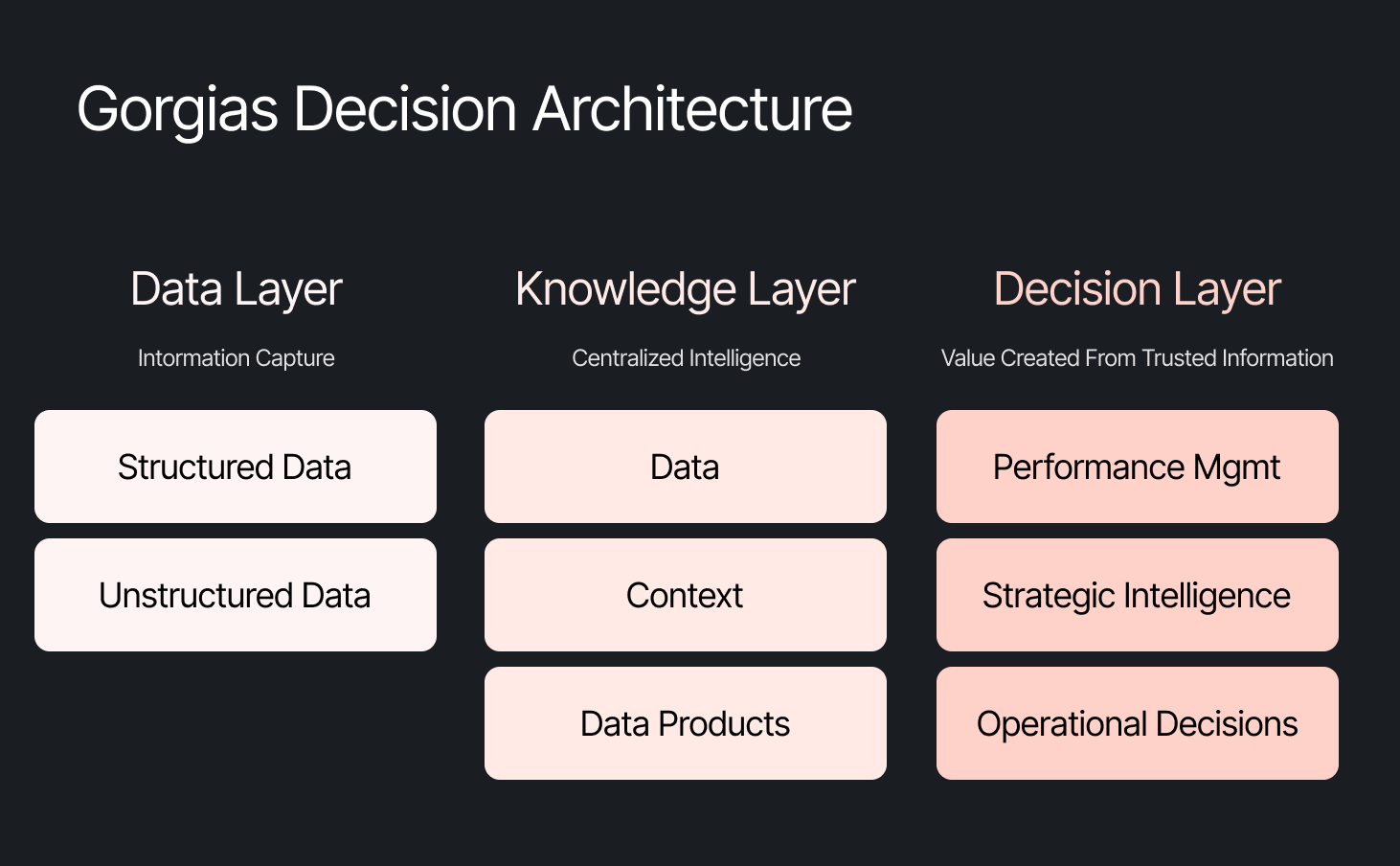
The framing problem most companies get wrong
The instinct across many companies today is to start with the model, pick a provider to solve a specific challenge, or invest heavily in getting the data right. All reasonable starting points, but most of them solve for one use case. Underneath that approach is a framing problem: seeing AI as an initiative — something you assign and measure. Seeing AI as another tool your company uses versus how your company operates.
We started somewhere different. Every company is built on four pillars: customers, people, product, and decisions. AI investments tend to place heavy emphasis on the first three. We started with the fourth. Our bet was that if we built everything around the need to make effective decisions first, asking what Gorgias needed to know to operate well, then our AI would become dramatically more powerful.
Cortex is that philosophy in practice
Cortex is our flagship internal AI agent, and the product where we established the tenets that now run through everything else we build: composable and modular infrastructure, governed context, and accessible from wherever decisions happen. Cortex lives in Slack, as well as across LLM vendors, in its own browser extension, and even on its own dedicated internal site.
Cortex doesn’t stop at answering questions. It can read and write to Notion, file Linear tasks, create HTML apps, automate signal delivery, and more. It operates across every layer of our stack, from dashboards to data pipelines, because we designed it as one integrated system. It is this connection that adds remarkable depth to what people can ask, and what they get in return.
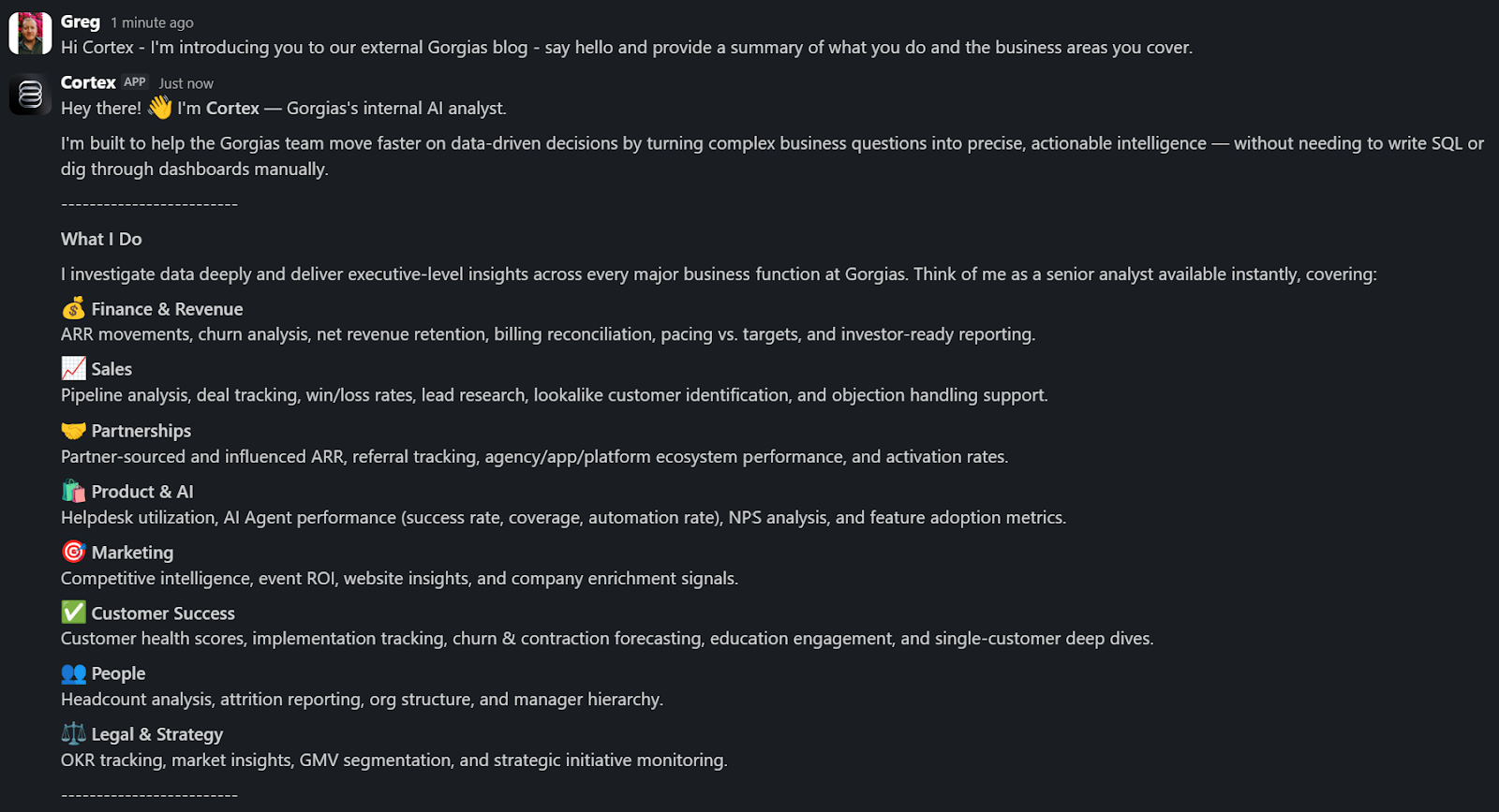
A Sales Lead is pitching and asks Cortex for the full picture of the merchant. In a customized PDF, Cortex lists coverage gaps, pre-sale intent signals, and product fit options. Everything the sales lead needs to walk in with confidence.
A Senior Product leader asks, "How are we performing against OKR #1, and what can my team do to help accelerate it?" Cortex returns a full ARR breakdown, projected end-of-month attainment, segment-level findings, and connects it all back to company-level strategies. A suite of recommendations customized to the leader, the performance, and the signals that bridge how they can support our goals. The kind of answer that used to take someone a week to put together.
These aren't simple lookup queries. They require deep business context spanning multiple areas. Cortex handles these because its Decision Engine gives it the information to reason against governed data, metric definitions, and business context, turning a generic answer into a credible one.
Overnight, teams have built Cortex into how they work. They’re spending less time searching and more time finding answers, not because they were told to, but because Cortex reduced the distance between question and decision.
Flexibility as the foundation
Cortex’s modular infrastructure allows us to experiment and add new capabilities freely. We’ve already built two more internal AI agents made for entirely different use cases, but using the same Decision Engine as Cortex.
GAIA, our internal experimentation AI Agent, helps our customers identify opportunities in their AI Agent Guidance design. It takes institutional knowledge across our teams and turns it into a scalable system that drives automation and value to our customers. Our CEO, Romain Lapeyre, has been its most vocal advocate since day one.
When we needed a platform for investor readiness and board preparation, we built Oracle. Our board decks and talk tracks are informed and built with the same AI, and our numbers are validated every step of the way.
We’re continuing to expand new AI agents internally, exploring how they can create value for customers and our own teams.
AI has transformed how data teams create value, and we’ve already shifted to account for it
When AI handles thousands of analytical questions each week, the highest-value work for a data team shifts permanently. Late 2025, we repositioned from a Data Analytics function into a Decision Intelligence function — a structural change in what we own and how we operate.
Today, our analysts focus on the most sensitive, complex, and forward-looking decisions and analyses. They partner more deeply with stakeholders by driving next steps from signals. They're even building entirely new capabilities that didn't exist in their role descriptions months ago. Things like AI skills for Cortex, context curation, and insight and recommendation delivery. The role of the analyst hasn't diminished. It's expanded to encompass the most meaningful work an analyst can do: driving outcomes and ensuring those decisions can achieve them.
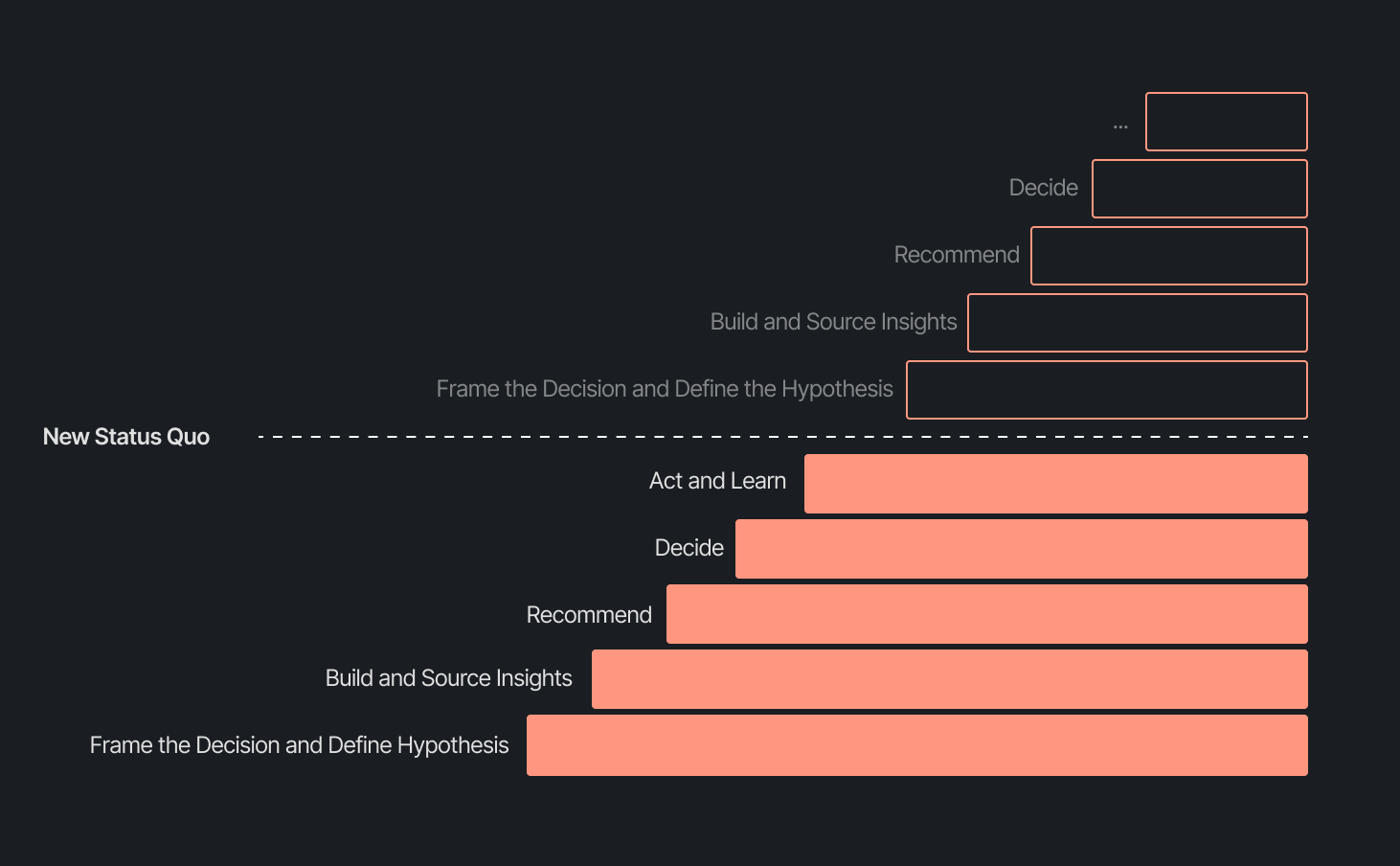
Our business support model has changed, too. Instead of embedding analysts and dedicated engineers within functional teams, we align capacity to the highest-impact company objectives and move fluidly across them. This model works even better because Decision Intelligence brings together both analytics and engineering teams under one roof.
Elliot Trabac leads our Data, Context and AI Engineering teams. The Decision Engine, Cortex, GAIA, and the platforms I've described exist because of the infrastructure his team innovated and built from the ground up. Noemie Happi Nono leads our Decision Strategy and Operations team, driving decision outcomes with stakeholders, advancing the development of Cortex skills and capabilities, and pushing into new areas of analysis every day.
Together, they're shaping what a modern data function looks like when AI becomes a standard building block for how a company operates.
What’s next for the Decision Intelligence team
The question of ROI is long gone. AI has opened the floodgates to more trusted and meaningful signals than ever. The natural next evolution is Proactive Intelligence, signals surfaced toward what you need to know, before you ask. And we're already building this because our architecture is designed to support it.
In the coming weeks, members of the Decision Intelligence team will go deeper into themes I've touched on here. Yochan Khoi, a Senior Analytics Engineer on our team, recently published a technical walkthrough of our context layer and will go further into building context strategies that scale. Others will cover infrastructure, analytical partnerships, evolving data assets into decision assets, and the cost and efficiency gains that make sustained AI investment viable.
AI hasn't changed the most important element of data and analytics functions — delivering outcomes — but it has raised the bar for what it looks like and how far we can take it. We’re just getting started.
TL;DR:
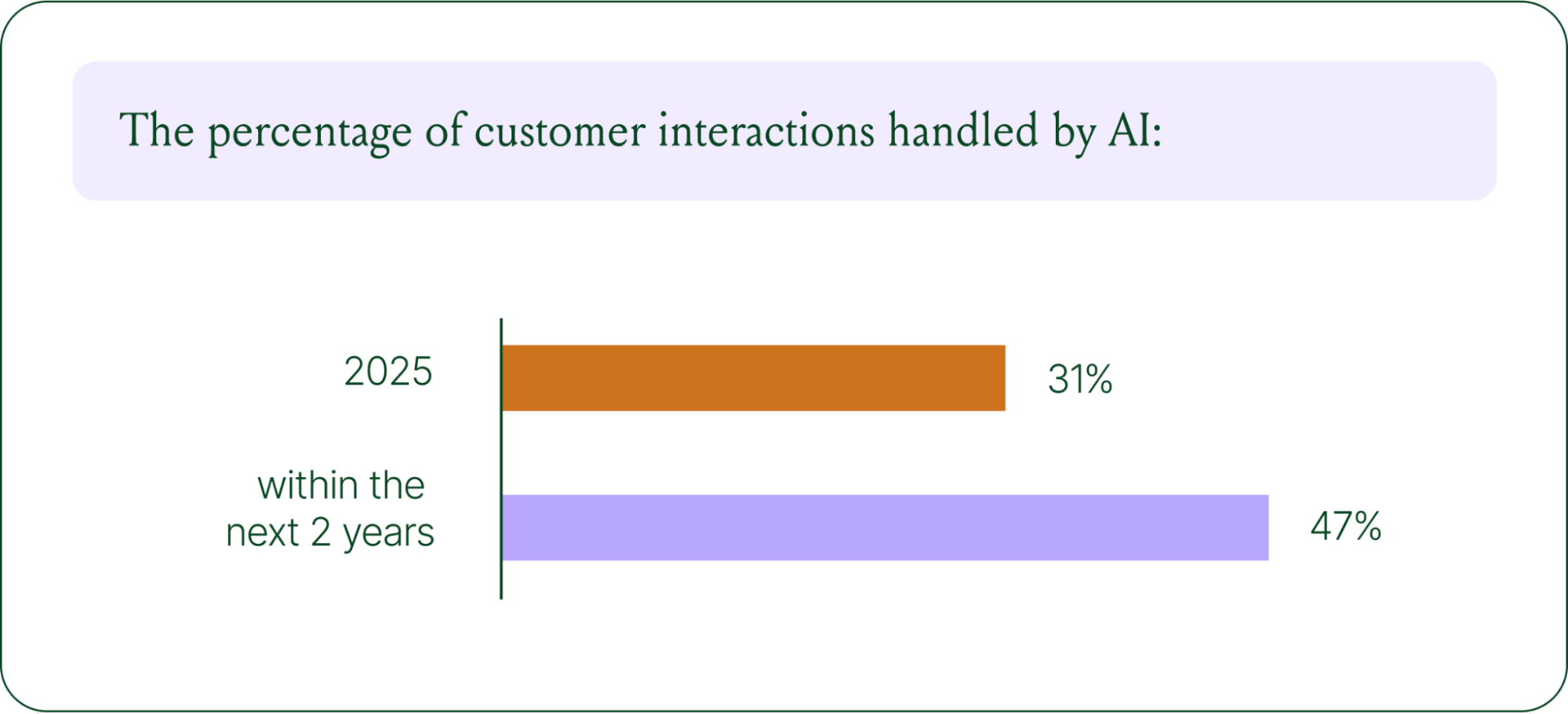
- AI is resolving tickets, not just replying. AI now handles 31% of customer interactions for ecommerce brands, and that number is expected to nearly double within two years.
- Every channel is becoming a storefront. Conversations are replacing the traditional browse-and-buy journey, with 79% of brands reporting sales from AI-driven interactions.
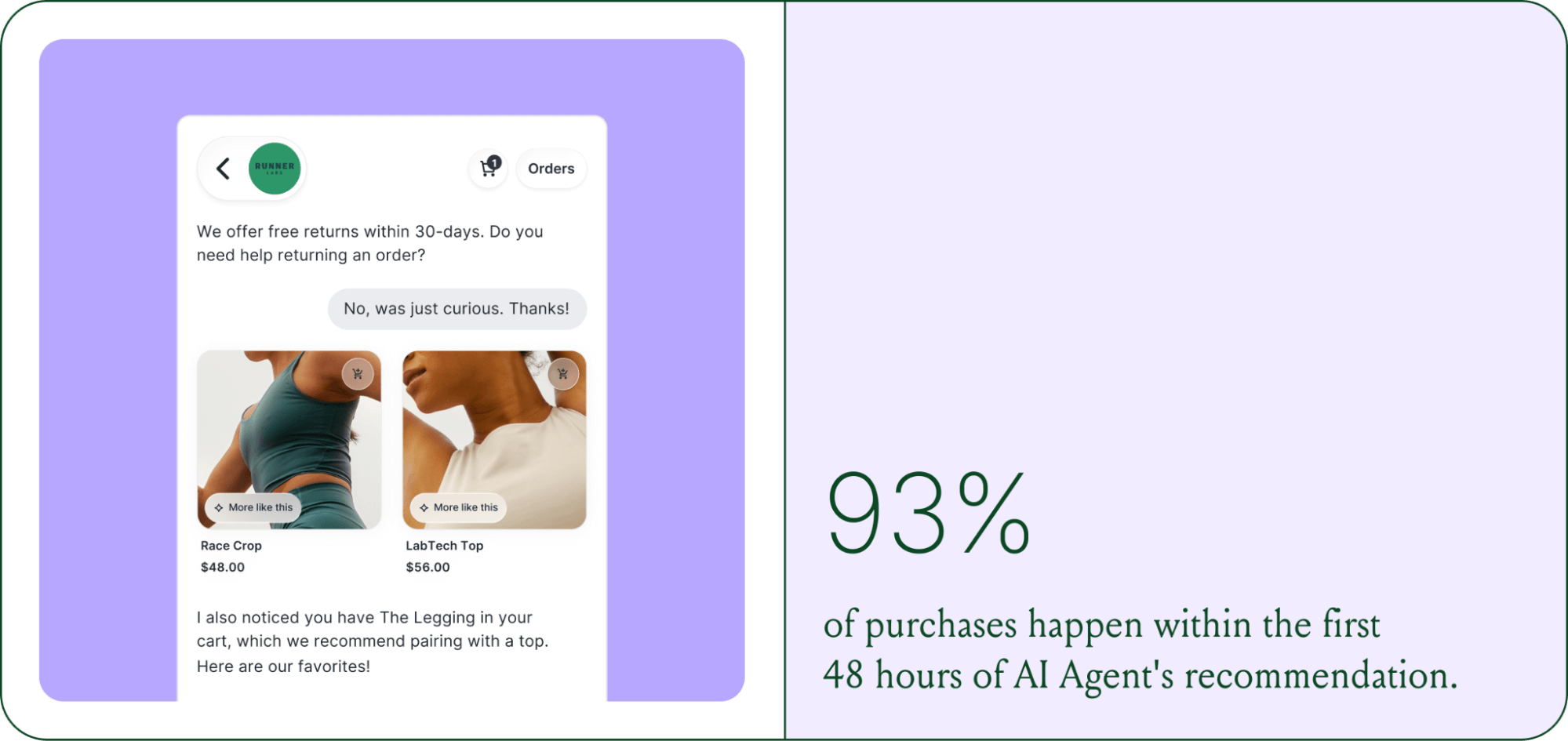
- AI is shortening the buying cycle. 93% of AI-influenced purchases happen within the first 48 hours of the conversation.
- CX teams are changing, not shrinking. Ecommerce brands are actively hiring for more technical roles to implement, coach, and maintain AI.
- The winning model is hybrid. AI handles volume and speed, while humans handle complexity and judgment.
The way shoppers buy online has shifted and customers are at the center.
They no longer want to scroll through product pages, dig through FAQs, or wait 24 hours for an email reply. They open a conversation, ask a specific question, and expect a useful answer in seconds. Brands that can’t deliver these experiences at scale are seeing customer hesitation turn into abandoned carts and lost revenue.
This shift has a name: conversational commerce. It's the practice of using real-time, two-way conversations as your primary sales channel, through chat, AI agents, messaging apps, and voice.
What started as an experiment for early adopters has become a key growth lever, with 84% of ecommerce brands treating conversational commerce as a strategic pillar this year vs. last year.
We surveyed 400 ecommerce decision-makers across North America, the U.K., and Europe to understand how conversational commerce and AI are reshaping the ecommerce landscape. These findings are complemented by aggregated and anonymized internal Gorgias platform data from 16,000+ ecommerce brands.
The State of Conversational Commerce in 2026 trends report breaks down all of the findings, including five key trends shaping the ecommerce landscape.
{{lead-magnet-1}}
Trend 1: AI is table stakes for ecommerce and it’s no longer just about efficiency
A few years ago, adding an AI chatbot to your site that could provide tracking links and Help Center article recommendations was a differentiator. Today, it's table stakes. McKinsey found that 71% of shoppers expect personalized experiences, and 76% get frustrated when they don't get them.
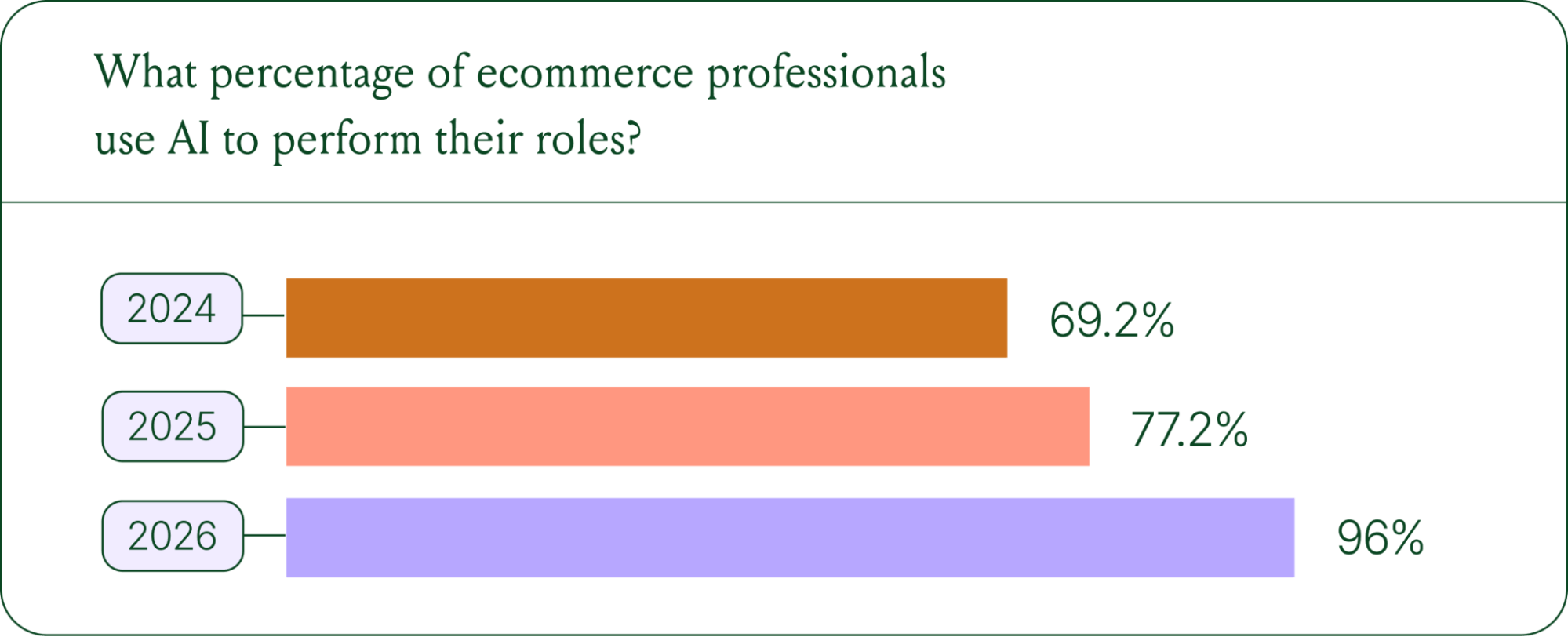
Right now, most ecommerce professionals use AI, with 93% having used it for at least 1 year. Enthusiasm is accelerating quickly, with only 30% of ecommerce professionals rating their excitement for AI at 10/10 in April 2025. Similarly, while AI adoption rose steadily year over year, it reached a clear peak in 2026.
The use cases driving this adoption are practical and high-volume:
- Order tracking and status updates
- Returns, exchanges, and refund requests
- Shipping FAQs and delivery estimates
These are the tickets that flood brands’ inboxes every day. AI agents resolve them instantly, without pulling teams away from conversations that actually require human judgment.
Explore AI adoption and use case data in more depth in the full report.
Trend 2: Conversations are the new path to checkout
The traditional ecommerce funnel, visit site, browse products, add to cart, check out, is losing ground. Shoppers now discover products on Instagram, ask questions via direct message, and complete purchases without ever visiting a website.
Conversational AI is actively increasing revenue, with 79% of brands reporting that AI-driven interactions have increased sales and conversion in their business.

The practical implication is that every channel is becoming a storefront. Creating personalized touchpoints with customers earlier in the journey, through proactive engagement, is impacting the bottom line.
Read the full report to explore how AI conversions have increased QoQ by industry.
Trend 3: AI is accelerating the purchase cycle
Pre-purchase hesitation is one of the biggest conversion killers in ecommerce. A shopper lands on your product page, has a question about sizing or compatibility, can't find the answer quickly, and leaves. That's a lost sale that had nothing to do with your product.
Conversational AI changes that dynamic. When a shopper can ask a question and get an accurate, personalized answer in real time, the friction disappears.
Brands using Gorgias saw this play out at scale in 2025. When AI Agent recommended a product, 80% of the resulting purchases happened the same day, and 13% happened the next day.
Brands are further accelerating the buying cycle through proactive engagement. On-site features such as suggested product questions, recommendations triggered by search results, and “Ask Anything” input bars drove 50% of conversation-driven purchases during BFCM 2025.
Explore how AI is collapsing the purchase cycle in Trend 3 of the report.
Trend 4: AI is making CX teams more technical
There's a persistent narrative that AI is making CX teams redundant. The data tells a different story. 62% of ecommerce brands are planning to grow their teams, not cut them. But the scope of those teams is changing.

New roles are emerging around AI configuration and quality assurance. Teams are investing in technical members to write AI Guidance instructions, develop tone-of-voice instructions, and continuously QA results.
CX teams are also bridging the gap between support goals and revenue goals, as the two functions increasingly overlap.
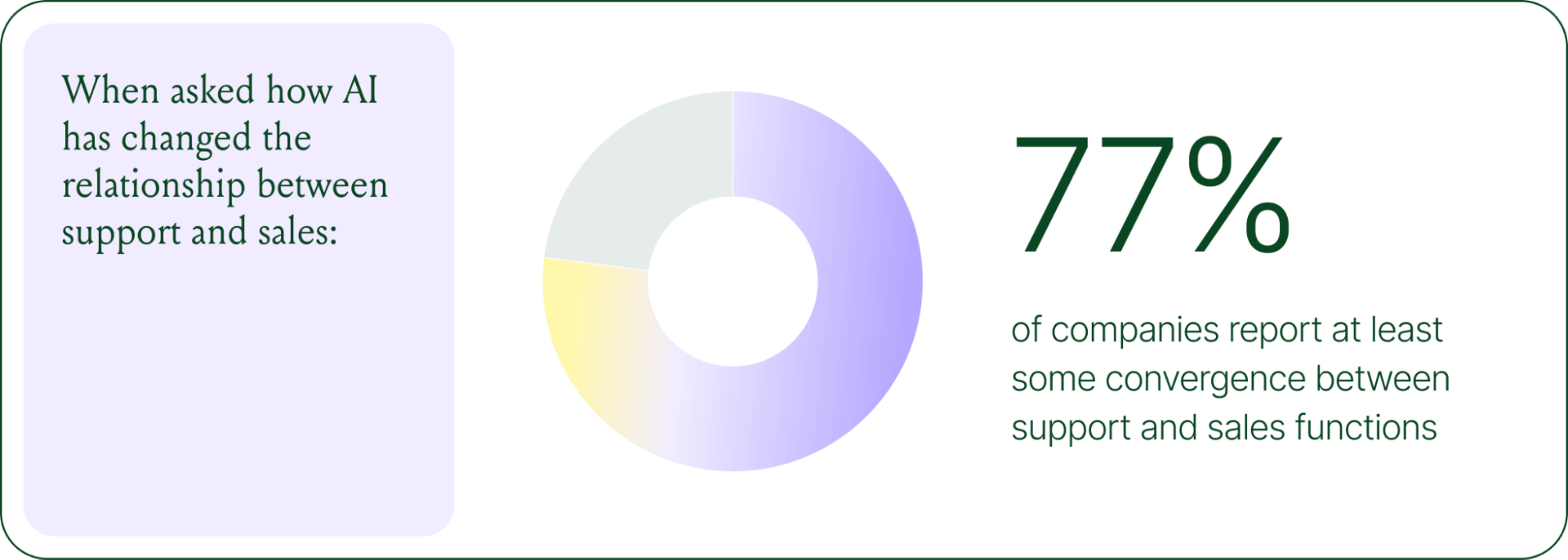
The result is CX teams that are more technical than they were before. Agents who once spent their days answering repetitive tickets are now spending that time on higher-value work: complex escalations, VIP customer relationships, and improving the AI systems and knowledge bases that handle the volume.
Learn more about the evolution of CX roles in Trend #4.
Trend 5: The future is hybrid: AI-first, humans when it counts
Despite increasing AI adoption, data shows that ecommerce brands shouldn’t strive for 100% automation. Winning brands are building systems in which AI handles repetitive tier-1 tickets, and humans handle complex, sensitive cases.

AI handles speed and scale. It resolves order-tracking requests at 2 a.m., processes return-eligibility checks in seconds, and answers the same shipping question for the thousandth time without compromising quality.
Human agents handle conversations that require context, empathy, or decisions that fall outside the standard playbook. There are several topics where shoppers still prefer human support.
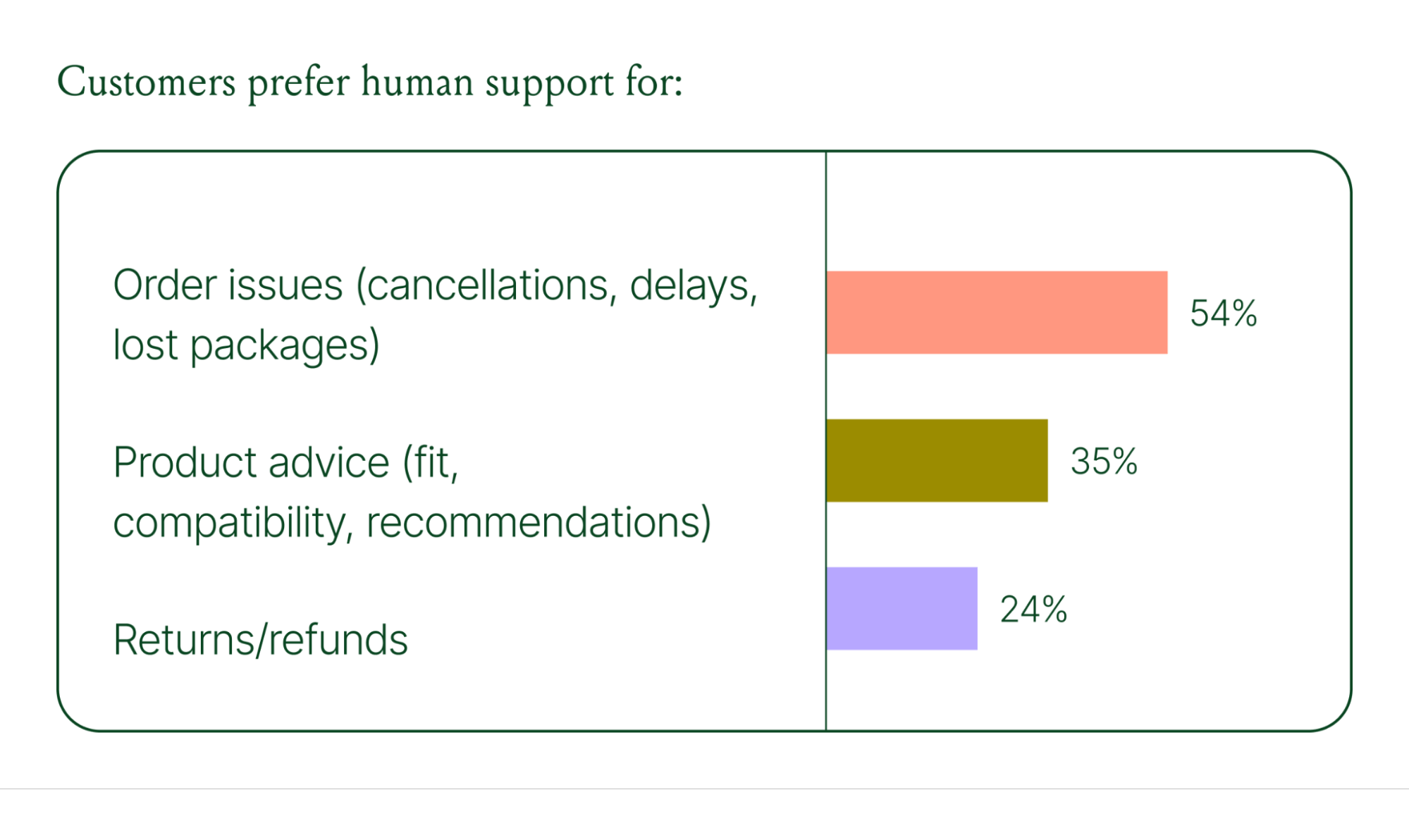
Successful hybrid systems require continuous iteration, meaning reviewing handover topics, Guidance, and reviewing AI tickets on a weekly basis.
Discover how leading brands are balancing human and AI systems in Trend #5.
Where conversational commerce is heading by 2030
The 2026 trends are about expansion and standardization. The 2030 predictions are about what comes next.
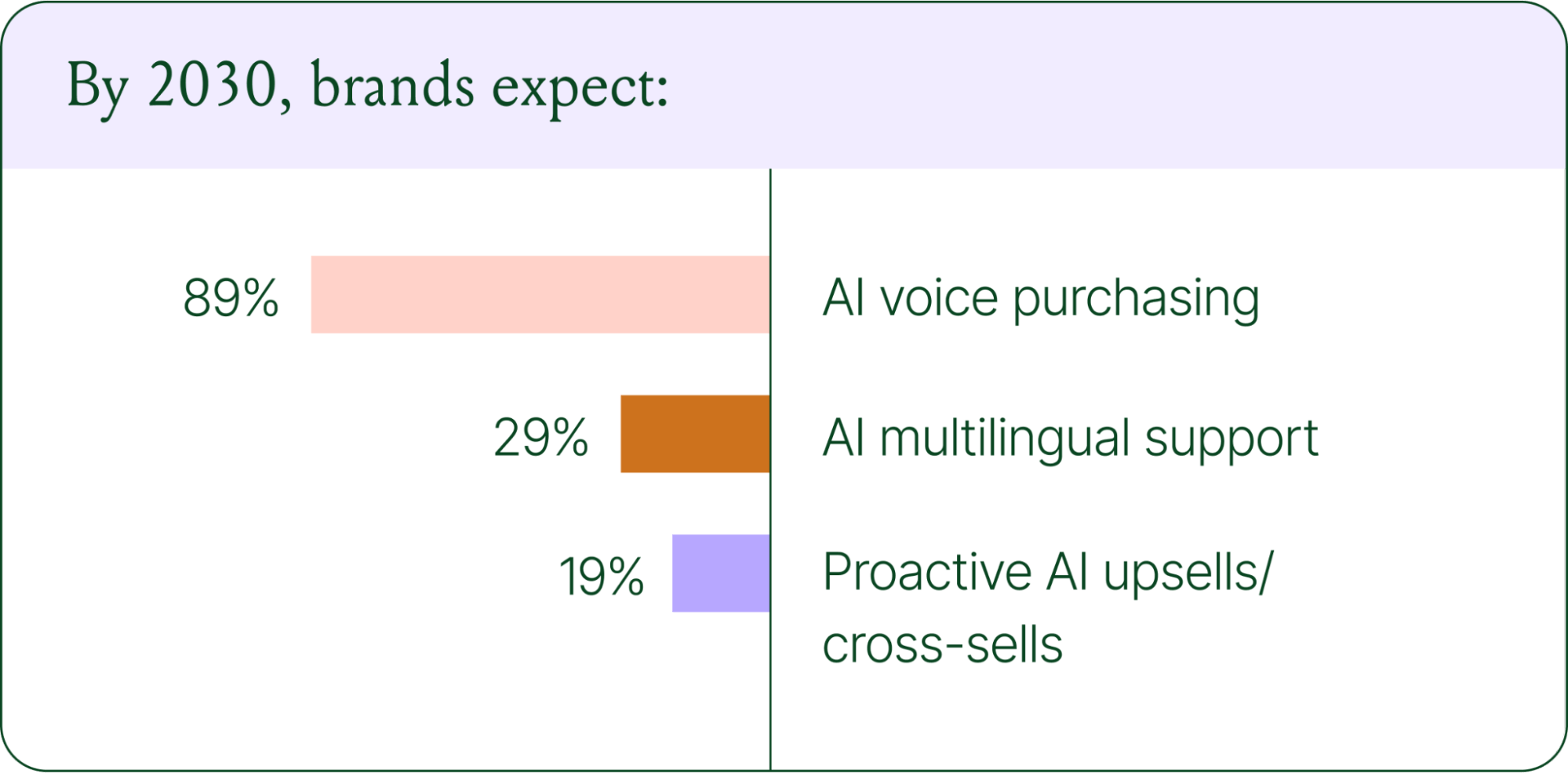
Voice-based purchasing is the biggest bet on the horizon. Only 7% of brands currently use voice assistants for commerce, but 89% expect it to be standard by 2030. The vision is a customer who can reorder a product, check their subscription status, or manage a return entirely over the phone.
Proactive AI is the other major shift. Rather than waiting for a customer to reach out, AI will anticipate needs based on browsing behavior, purchase history, and where someone is in their relationship with your brand. Think of it as the digital equivalent of a sales associate who remembers what you bought last time and knows what you're likely to need next.
Explore where ecommerce brands are allocating their AI budgets in the full report.
Start building your conversational commerce strategy today
The brands winning in 2026 are creating smart, scalable systems where AIhandles volume and humans handle nuance. They’re treating every conversational channel as an opportunity to serve and sell.
The data is clear: AI adoption is accelerating, customer expectations are rising, and the revenue impact of getting this right is measurable.
{{lead-magnet-1}}
Newsletter Signup
The best in CX and ecommerce, right to your inbox
Featured articles

Conversations Are Becoming a Revenue Channel: The Data Proves It
TL;DR:
- Customer journeys are collapsing to a single conversation. The traditional browse-and-buy journey is giving way to AI-guided shopping that moves from discovery to purchase in a single exchange.
- 79% of brands say AI-driven conversational commerce has increased their sales and purchase rates.
- AI-only influenced orders grew 63% in a single year, from 2.7 million in Q1 to 4.4 million in Q4.
- Brands treating conversation as a revenue channel. They’re not just a support function, generating higher AOV, shorter buying cycles, and stronger retention.
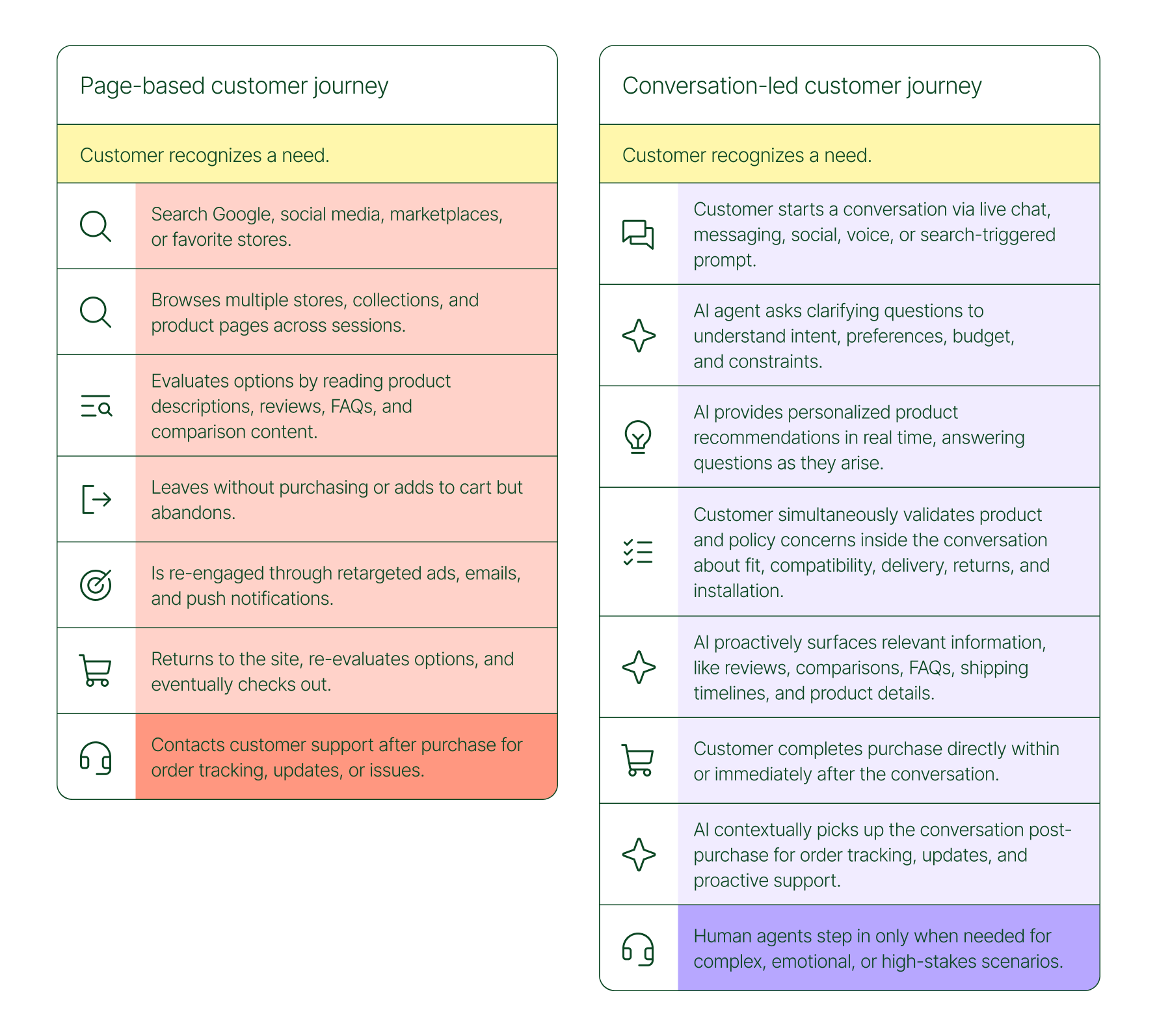
The page-based shopping experience dominated for decades. Customers would search, browse, compare, abandon, get retargeted, return, and eventually buy (sometimes).
That journey is no longer the only option.
Shoppers are turning to chat, messaging, and AI-powered tools to find what they need. Instead of clicking through product pages or reading static FAQs, they ask questions, have back-and-forth conversations, and get answers that move them closer to a purchase in real time. The path to checkout has changed, and the brands that recognize this are pulling ahead.
Read our 2026 State of Conversational Commerce Report to learn more about conversation commerce trends from 400 ecommerce decision-makers and 16,000+ ecommerce brands using Gorgias.
{{lead-magnet-1}}
The shopping journey has collapsed into a single thread
The traditional shopping journey was a solo experience. A shopper had a need, searched for options, browsed across sessions, and eventually made a decision — often days later, after being retargeted multiple times. Support only entered the picture after the purchase.
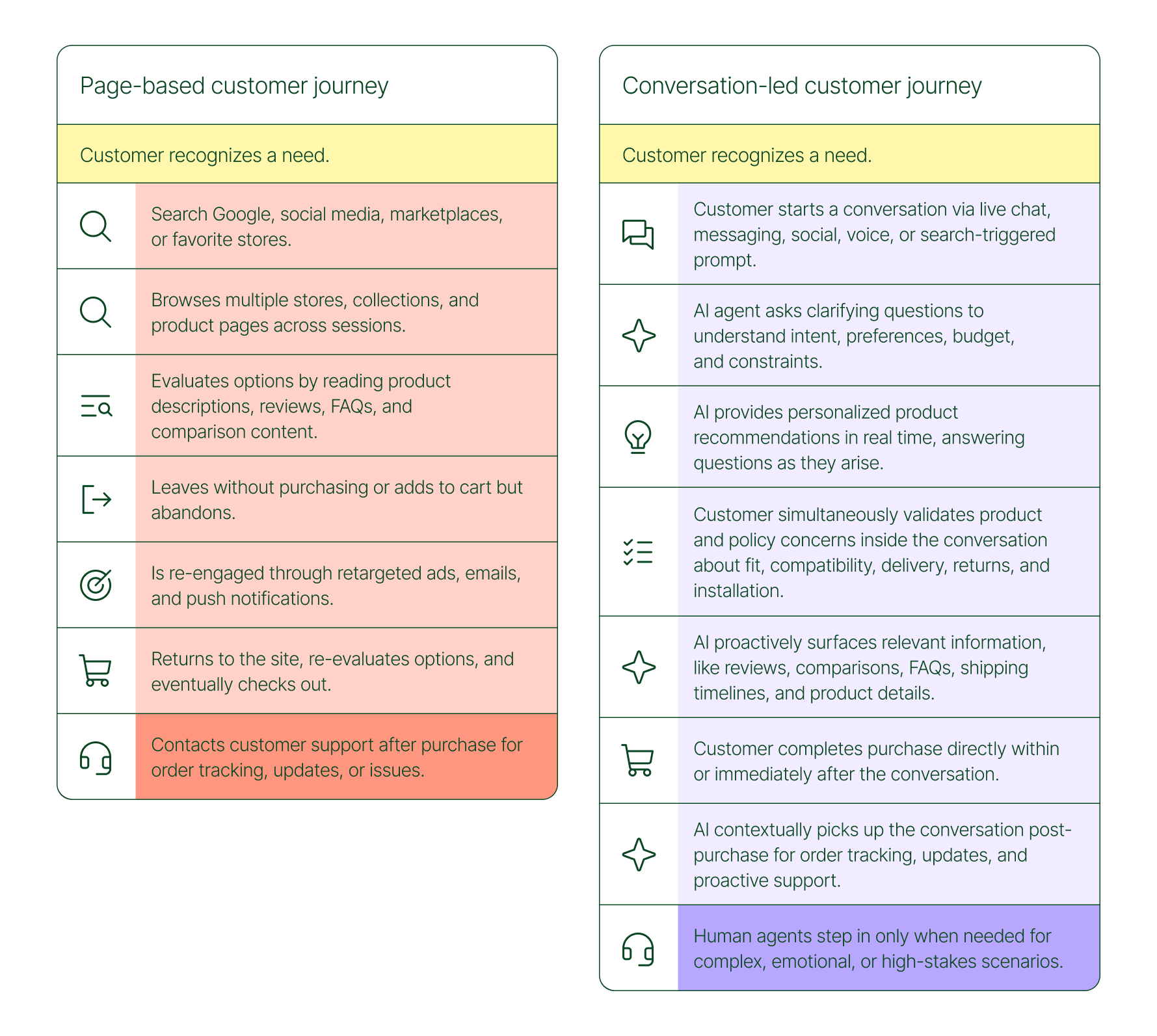
The conversation-led journey collapses that timeline:
- A shopper recognizes a need and starts a conversation via chat, messaging, or a search-triggered prompt
- An AI agent asks clarifying questions about preferences, budget, and constraints
- The AI provides personalized product recommendations in real time
- The shopper validates concerns about fit, compatibility, delivery, and returns, all inside the conversation
- The shopper completes the purchase directly within or immediately after that exchange
- The AI picks up the conversation post-purchase for order tracking and proactive support
- A human agent steps in only when the situation calls for it
What used to take days now takes minutes. Discovery, evaluation, and purchase happen in a single thread.
Conversation is a revenue strategy, not a support upgrade
79% of brands agree that AI-driven conversational commerce has increased sales and purchase rates in their business. When brands were asked to rank the highest-return areas:
- 38% cited improved customer support efficiency
- 23% pointed to higher customer retention and loyalty
- 20% saw improved purchase rates
Those numbers reflect something important: the value of conversation compounds. Faster support reduces friction. Better retention raises lifetime value. More confident shoppers buy more often and spend more per order.
The brands seeing the biggest returns aren't just using AI to deflect tickets. They're using it to create one-to-one shopping experiences at scale.
What the data shows about AI-influenced orders
Looking at AI-only influenced orders across key verticals like Apparel and Accessories, Food and Beverages, Health and Beauty, Home and Garden, and Sporting Goods, the growth across a single year was significant.
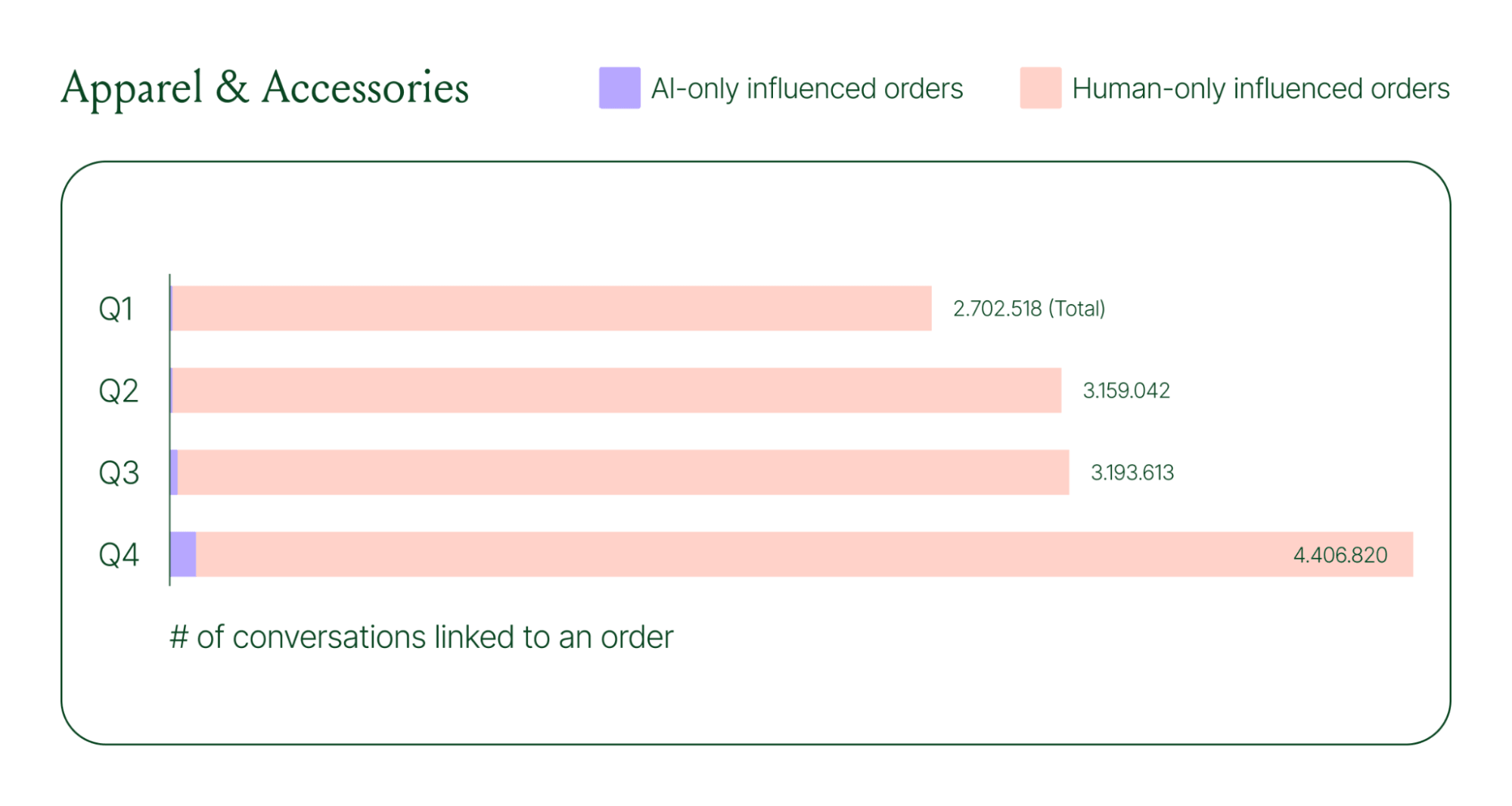
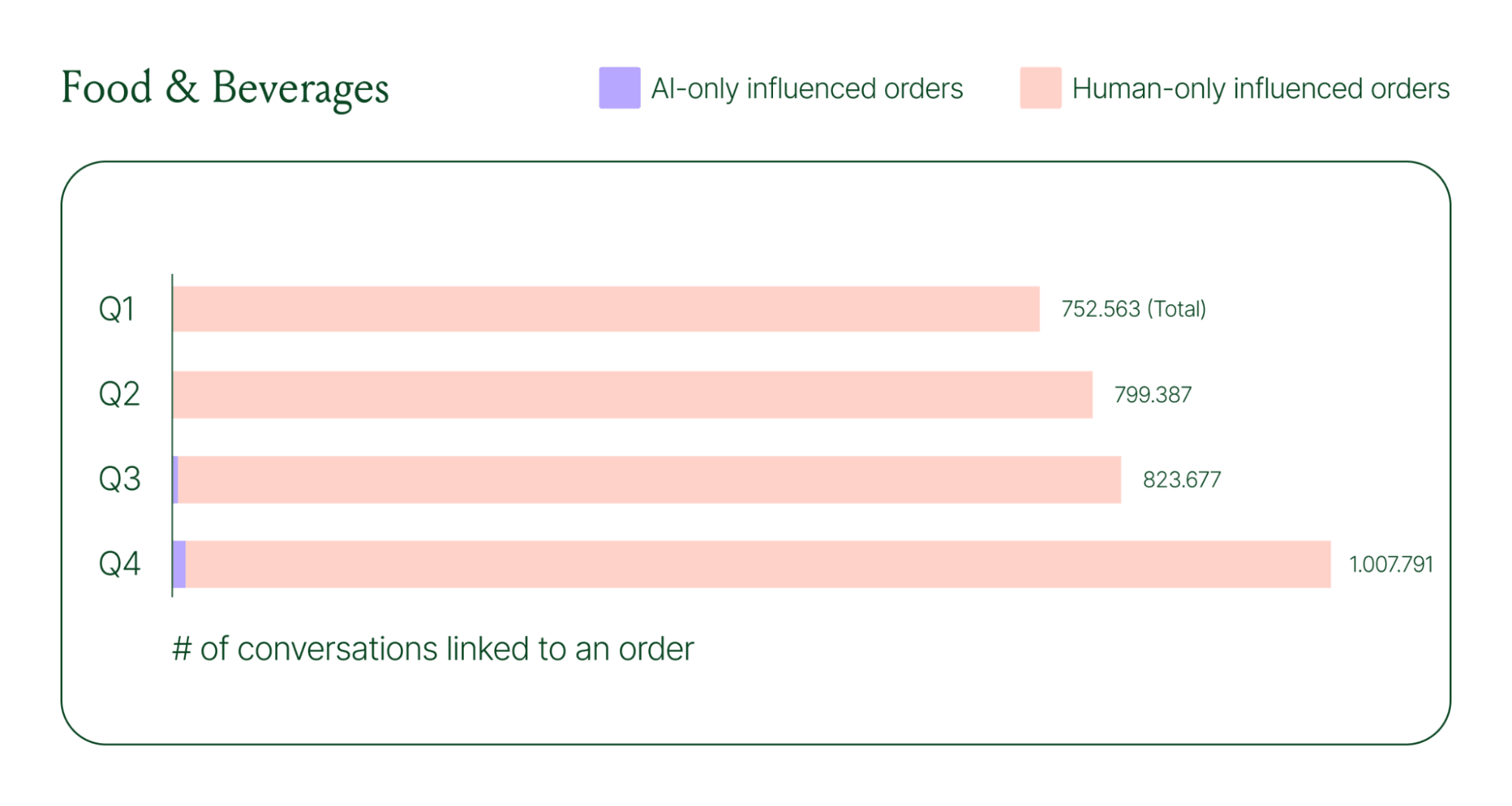
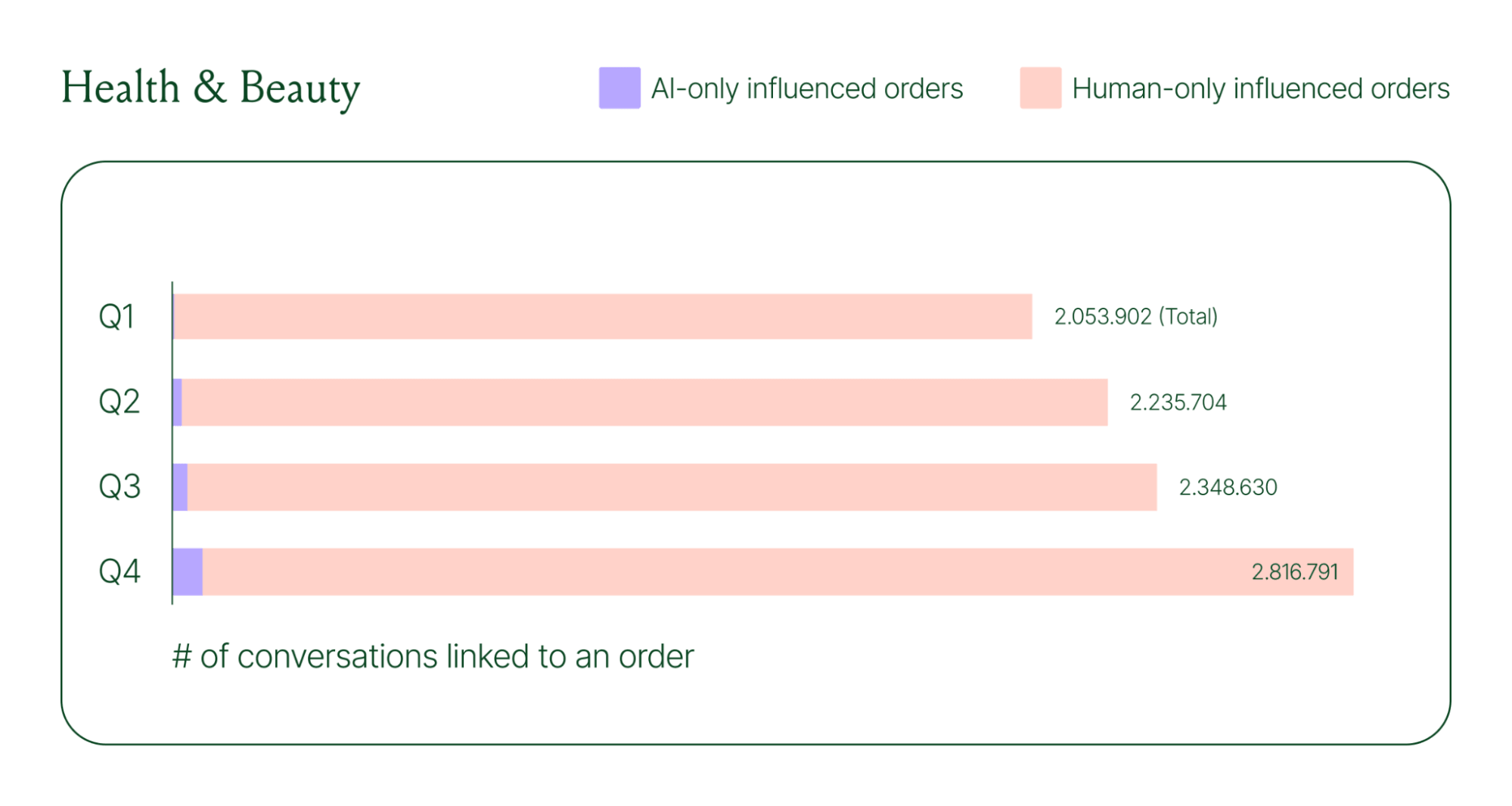
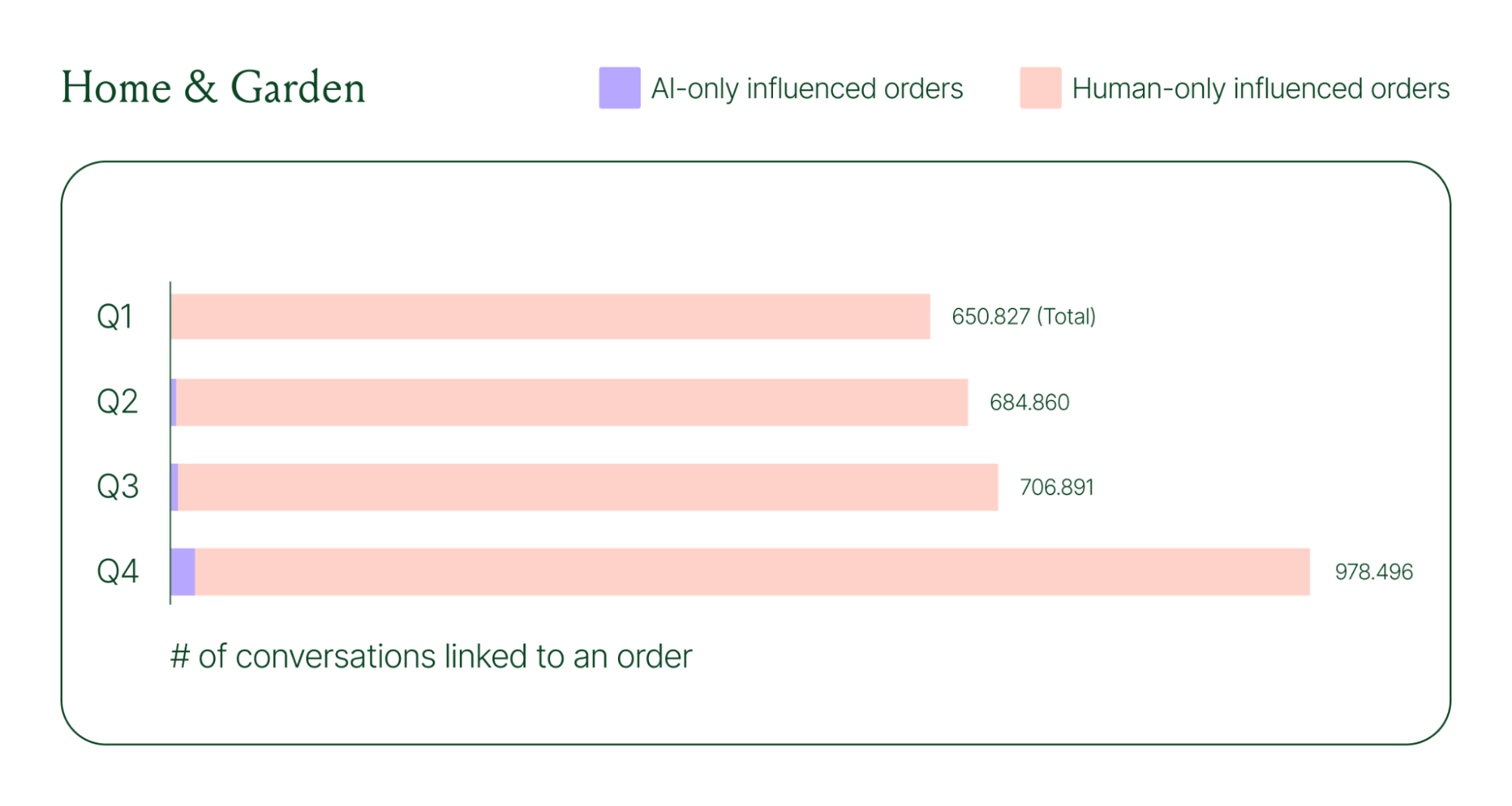
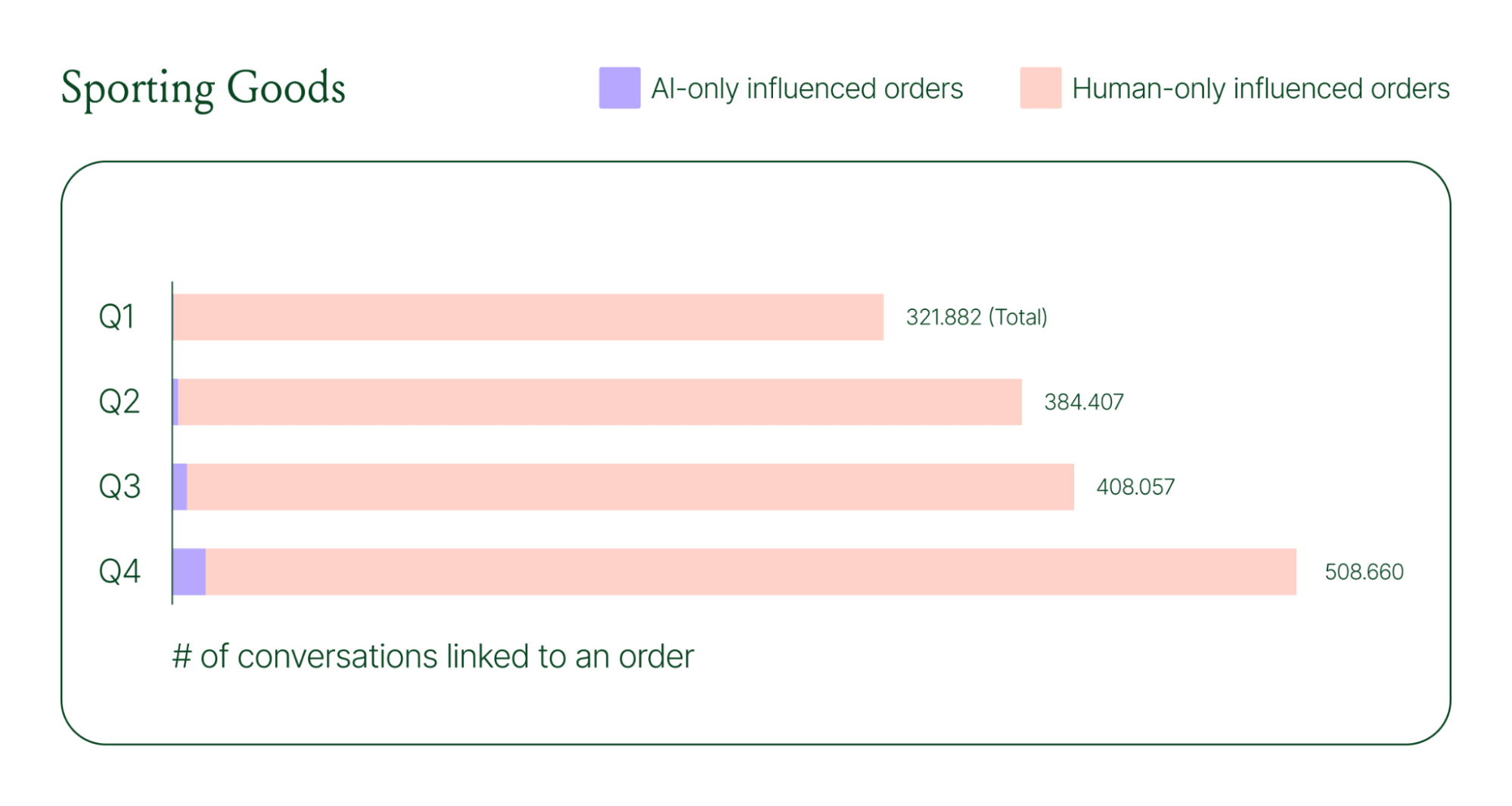
Across industries, ecommerce brands saw AI step into conversations, reduce shopper hesitation, and drive higher QoQ conversion rates.
Learn more about AI-powered revenue generation in the full 2026 Conversational Commerce Report.
Why brands are making this a strategic priority
84% of brands say the strategic importance of conversational commerce is higher than it was a year ago. 82% agree it will be mainstream in their sector within two years.
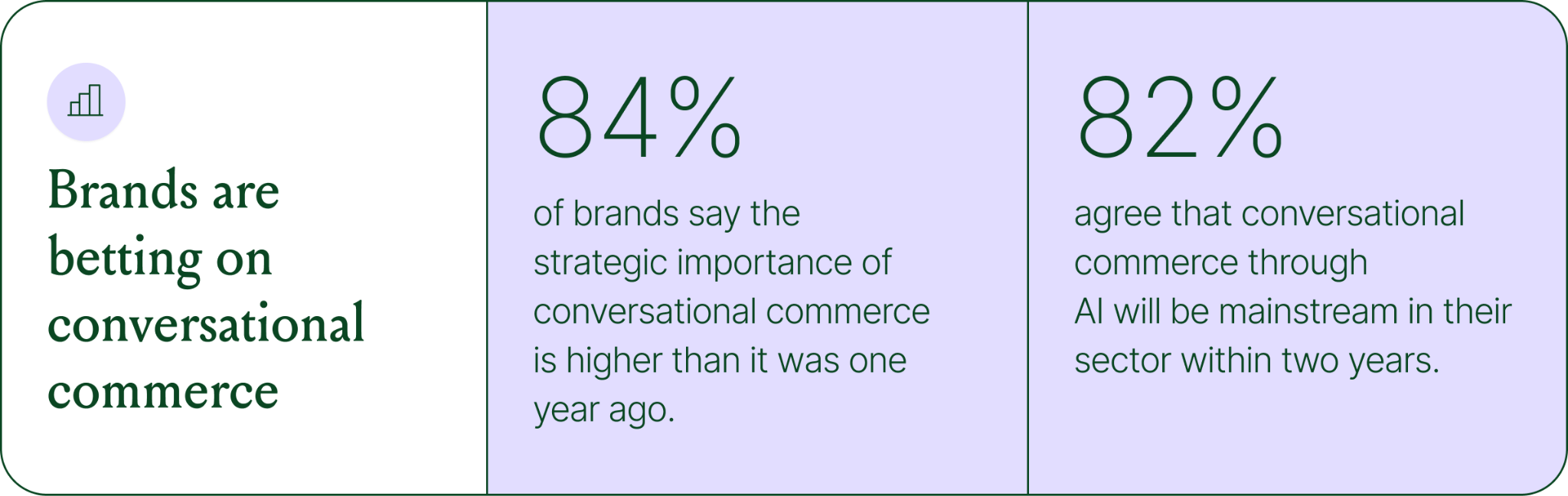
That shift is registering at the leadership level because of what conversational commerce does to the buying experience. Creating one-to-one touchpoints earlier in the journey drives higher AOV, shorter buying cycles, and stronger purchase rates. Shoppers who get real-time answers to their questions are more confident.
What this looks like in practice: TUSHY
TUSHY, known for eco-friendly bidets and bathroom essentials, is a useful example of what happens when you take conversational commerce seriously.
Bidets aren't an impulse purchase. Shoppers have real questions about fit, compatibility, and installation. Those questions used to go unanswered until the CX team could respond, often after the customer had abandoned the cart.
TUSHY used Gorgias's AI Agent and shopping assistant capabilities to automate pre-sales support. AI Agent engaged shoppers in real-time conversations, addressed their concerns directly, and built confidence at the moment of highest intent.
This resulted in a 190% increase in chat-based purchases, a 13x return on investment, and twice the purchase rate of human agents.
How to apply this to your strategy
You don't need to overhaul your entire operation to start seeing results. The most effective approach is to start where the impact is clearest and expand from there.
A few places to begin:
- Pre-sales chat. Identify your most common pre-purchase questions (sizing, compatibility, shipping timelines) and ensure your AI can answer them confidently and promptly.
- Product page engagement. Use proactive chat prompts triggered by page behavior to start conversations before shoppers leave.
- Post-purchase follow-up. Let AI pick up the conversation after checkout with order updates and proactive support, reducing inbound volume and building trust.
- Human escalation. Define clearly which situations require a human agent – complex issues, emotional exchanges, high-stakes decisions.
Want to see the full picture of where conversational commerce is headed in 2026? Read the full report to explore the data, trends, and strategies shaping the next era of ecommerce.
{{lead-magnet-1}}

AI Is Table Stakes for Ecommerce: What the Data Tells Us About 2026
TL;DR:
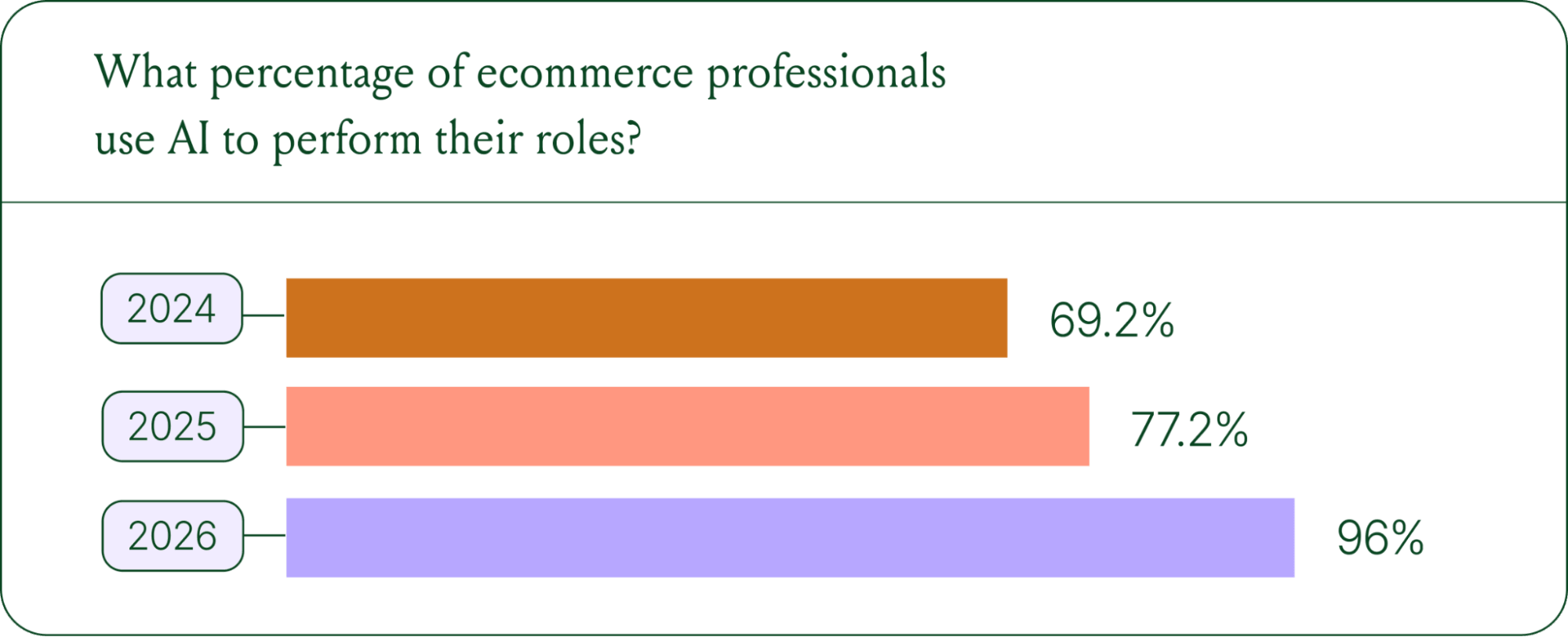
- AI adoption is rapidly accelerating. 96% of ecommerce professionals now use AI in their roles, up from 69% in 2024.
- AI has moved beyond support automation. Use cases have evolved into revenue generation, personalization, and logistics.
- Brands are tying AI success to profit-and-loss outcomes. 60% of brands consider AOV a top indicator of AI effectiveness.
A year ago, ecommerce brands were still debating whether AI was worth the investment. That debate is over. Today, nearly every ecommerce professional uses AI to do their job.
The shift isn't just about adoption. It's about what AI is used for and how brands measure its impact. Support automation was the entry point. Now, AI is embedded across the full operation, from product recommendations to inventory control to real-time shopping conversations.
In our 2026 State of Conversational Commerce Report, we break down trends on AI usage among 400 ecommerce decision-makers and 16,000+ ecommerce brands using Gorgias.
{{lead-magnet-1}}
AI adoption has reached a tipping point
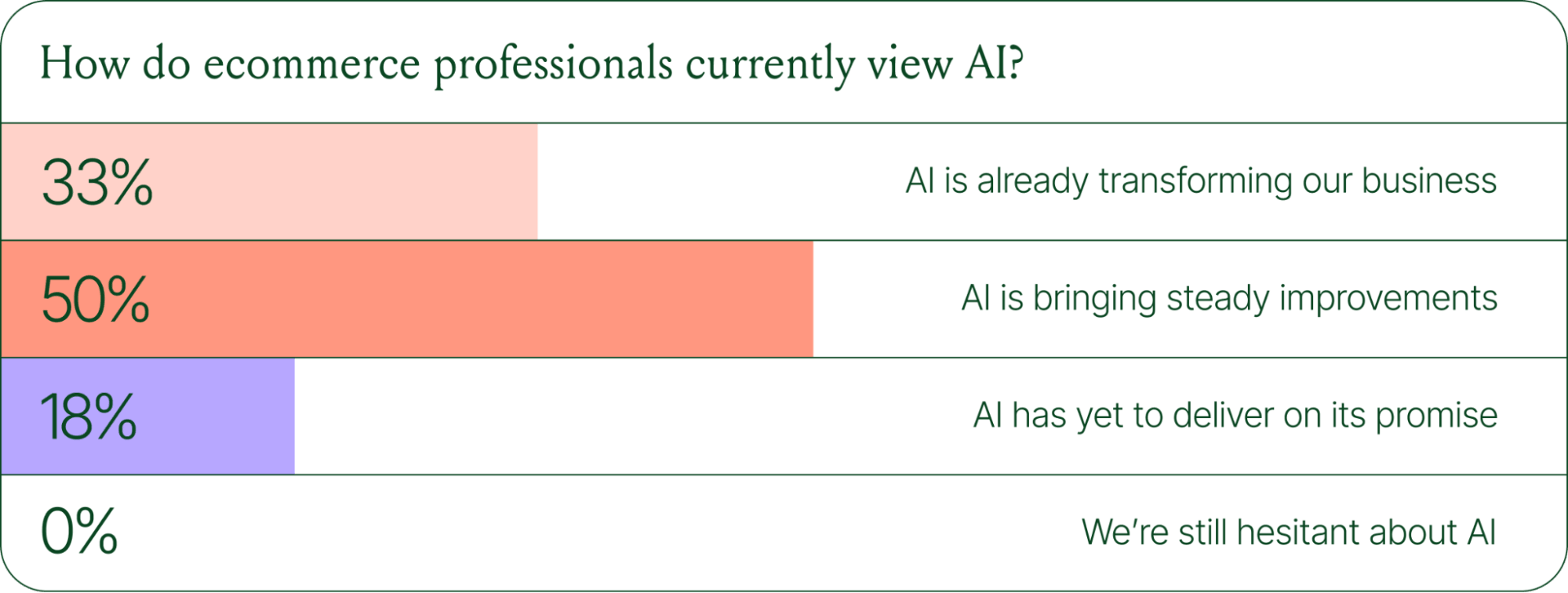
If we rewind 12 months ago, the industry was still split on AI. Some ecommerce professionals were excited, but most were still hesitant. In 2024, 69% of ecommerce professionals used AI in their roles. By 2025, that number reached 77%. In 2026, it hit 96%.
The confidence numbers back it up. 71% of brands say they are confident using AI for ecommerce, and 73% are satisfied with its business impact.
In early 2025, only 30% of ecommerce professionals rated their excitement for AI at 10/10. Today, zero percent of respondents describe themselves as hesitant about AI.
AI use cases now span the full ecommerce stack
Using AI in ecommerce is not new. In fact, it dates back to the 1980s with the invention of algorithms and expert systems. And if you’ve ever leveraged similar product recommendations or chatbots, you’ve already integrated AI into your ecommerce stack.
Modern AI is far more sophisticated.
With the rise of agentic commerce and conversational AI, brands began leveraging AI agents to automate the processing of repetitive support tickets. That’s still happening today, but the scope has expanded beyond the support queue.
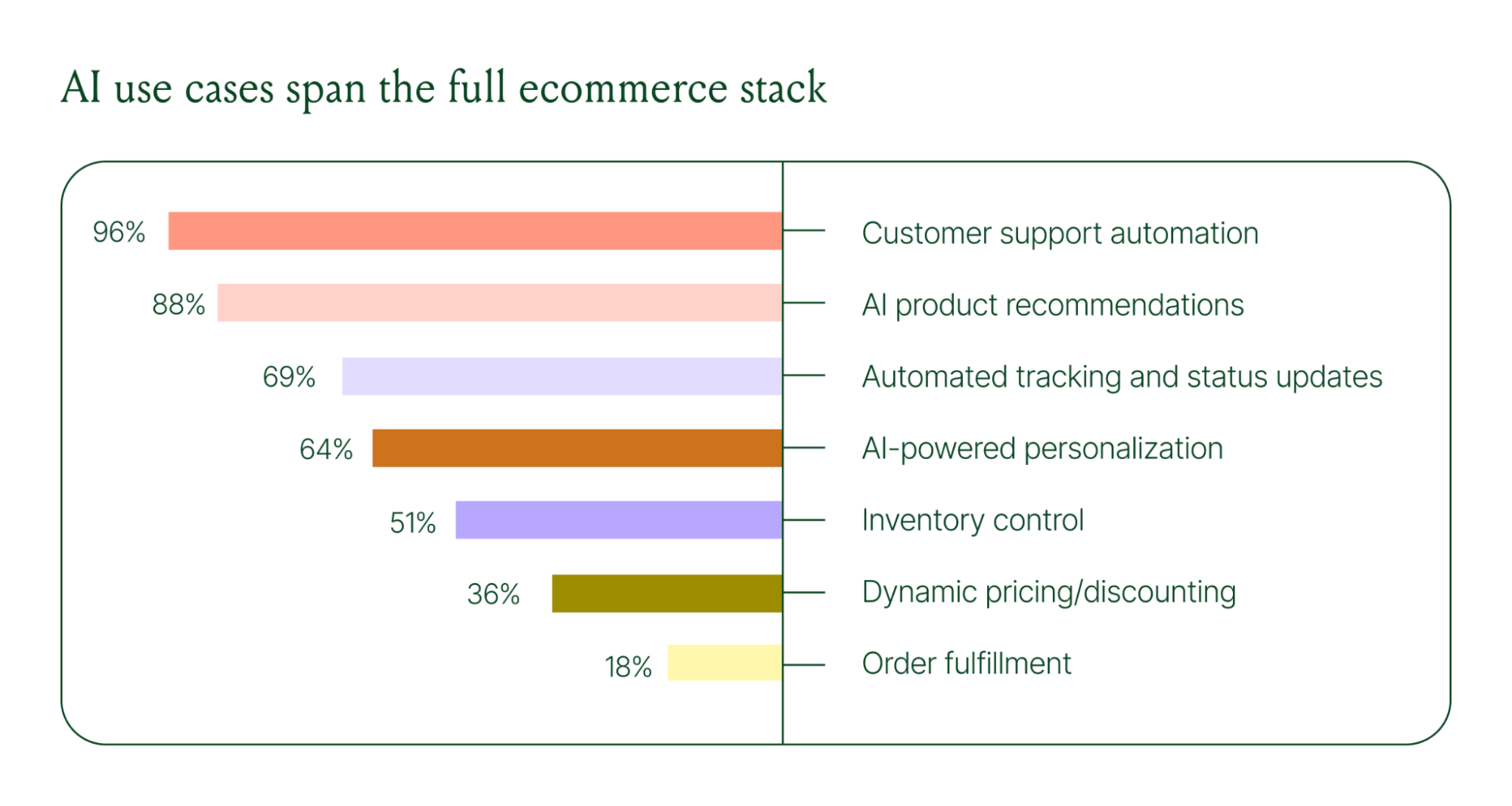
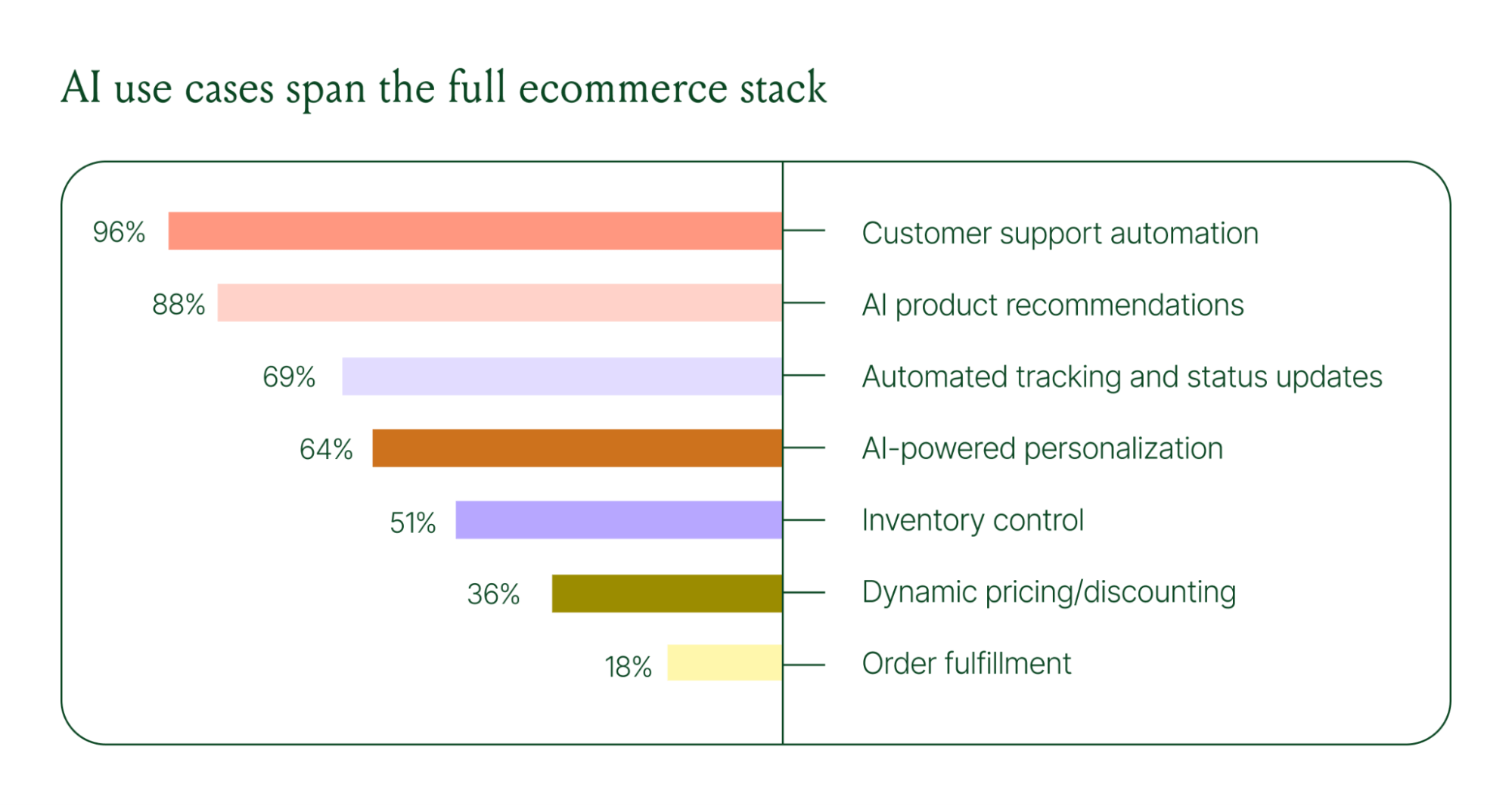
Ecommerce brands are deploying AI across every layer of their operation:
- Customer support automation: 96%
- Product recommendations: 88%
- Automated tracking and status updates: 69%
- Personalization: 64%
- Inventory control: 51%
- Dynamic pricing and discounting: 36%
- Order fulfillment: 18%
When brands were asked which channels contribute most to their AI success, conversational channels dominated. Social media messaging led at 78%, followed by SMS at 70%, and website live chat at 51%. Shoppers want fast, personal conversations, and AI is the best way to deliver that at scale.
Learn more about AI adoption, perception, and use case trends in the full 2026 Conversational Commerce Report.
How AI is changing CX success metrics
For decades, customer support success meant fast response times and high satisfaction scores. Those are still important indicators of success, but leading brands are adding revenue-focused metrics to their dashboards.
91% of brands still track CSAT as a measure of AI's impact. But 60% now include AOV as a top indicator, and higher-revenue brands earning $20M+ are focusing on metrics like total operating expenses, cost per resolution, incremental revenue, and one-touch ticket rate.
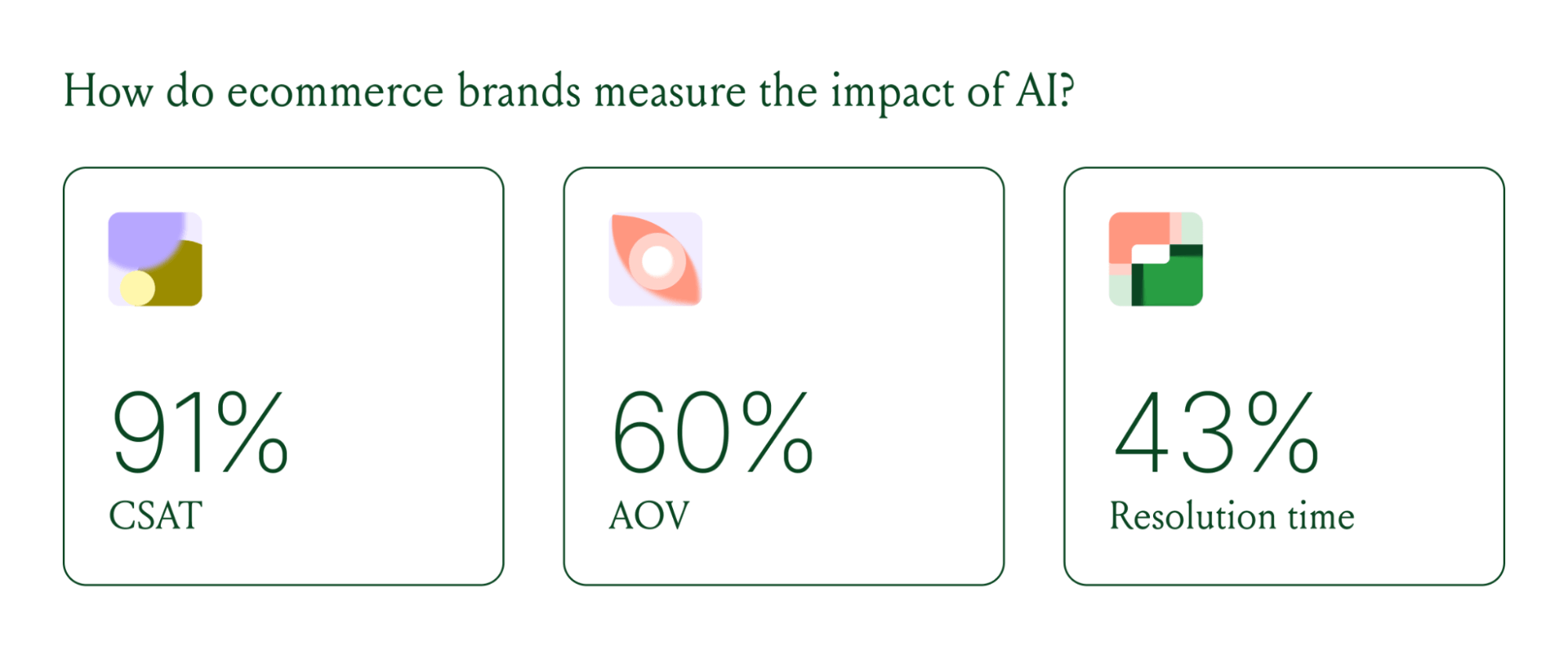
AI can now start a conversation, ease customer doubts, sell, upsell, and recover abandoned carts in a single conversation. When you’re only measuring CSAT, you’re ignoring the real ROI of conversational AI investment.
AI makes every conversational channel a storefront
Virtual shopping assistants now proactively engage shoppers, adapt to their needs in real time, and offer contextual product recommendations and upsells. When the moment calls for it, they can close the deal with a targeted discount.
Gorgias brands using AI Agent's shopping assistant capabilities nearly doubled their purchase rates and converted 20–50% better than those using AI Agent for support only.
Orthofeet, the largest provider of orthopedic footwear in the US, is a concrete example of this in practice. Using Gorgias, they achieved:
- 56% of support tickets automated in 2 months
- Email response times down from 24 hours to 35 seconds
- Double-digit revenue growth without adding headcount.
What this means for your AI strategy
The data tells a clear story: AI has evolved beyond a tool for handling tier 1 support tickets. It’s a core part of your revenue generation strategy.
57% of brands are already using AI for 26–50% of all customer interactions, and 37% expect that share to rise to 51–75% within the next two years. The brands building toward that range now are the ones who will have the operational advantage when it matters most.
The practical question isn't whether to invest in AI. It's where to focus first. Based on where brands are seeing the most impact, three priorities stand out:
- Start with high-volume, low-complexity tickets. WISMO (where is my order) inquiries, return policy questions, and order status updates are where AI delivers the fastest return. Automate these first.
- Expand into conversational channels. Social messaging and SMS are where AI is driving the most success right now.
- Connect AI performance to revenue metrics. If you're only measuring CSAT and response time, you're missing half the story. Add AOV, conversion rate, and incremental revenue to your reporting.
Want to go deeper on the full 2026 conversational commerce trends? Read the complete report for data across every major AI use case in ecommerce.
{{lead-magnet-1}}




Further reading

How to Calculate the Marginal Cost of Customer Service
And the Margin that Customer Service Impacts Your Net Profit.
In, The State of the Ecommerce Customer Service Industry Report for 2019, we found that a surprising 79% of respondents do not know the cost of a support ticket on the company.
This is quite scary, as this metric helps define the overall profitability of the product, and set reinvestment schedules for the growth of your company.
If costs overtake margin, you lose money with every sale.
While the Gorgias mission is to turn customer service from a cost center into a revenue generator, we do need to acknowledge the raw costs of customer support in order to bake it into our calculation of margin.
What metrics are we going to cover:
- Cost per support ticket.
- Cost per order.
- Cost per revenue.
Why should you track these metric?
- It helps baseline your opportunity for growth and profitability.
- You can make concerted efforts to lower your cost with customer service improvements.
- You can track indicators that something is going wrong with your business, and may require extra attention from the Head of Ecommerce or COO.
- You can hold your head of customer service accountable for staying within appropriate margins, and incentivize them accordingly.
Now, let’s get into it…
Step 1: Calculate your Cost Per Ticket
Here’s the data you need to collect:
Total cost of customer service. This includes technology, employees, managers, office space, equipment, travel… Everything. This should be easy to calculate if your accounting department is doing their job; they should be able to just hand you over a number. A monthly breakdown of the trailing 12 months is best.
Tickets per month. This can be found in your Gorgias dashboard under “Statistics.
Be sure to set the dates to match appropriately:

Now that we have these two numbers, we can get an understanding of our cost per support ticket.
Simply divide: In this example, we’ve got 1651 tickets in December. We spent ~$4500 on customer service. Therefore each ticket costs us $2.73.
Knowing your average cost per ticket helps you understand the time and value behind resolving customer inquiries. If this number goes up, then you’re inquiries are getting more complex - its either taking more time or more people to answer the same number of questions.
If you ever see this number spike, it’s likely due to a flaw in your product design. Immediately begin looking for commonalities among tickets, inspecting your inventory, and trying to get to the root of the problem before you make even more customers unhappy.
Step 2: Calculate Your Support Cost Per Order
Next up, you need to know your support cost per order, in order to bake customer support into your margin.
Here’s the data you need to collect:
- Orders per month.
To find this, simply log in to your Shopify dashboard, go to Orders, and add in a couple filters:

You can then “select all” and it will tell you the count of orders. For additional accuracy, you may want completed orders, not including refunds or other issues.
For our example month, we placed 2621 orders. That gives us a cost per order of $1.73
According to our Ecommerce Customer Service data, we estimate that small stores will see 88 support tickets per 100 orders, or roughly 1.1 support tickets for every $100 in revenue.
While large stores, with over $500k revenue/month, will see only 56 support tickets per month and .4 support tickets per every $100 in revenue.
How does your support cost per order compare with these benchmarks? Let us know in the comments below.
Calculate Your Cost Per Revenue
Sometimes it's helpful to calculate your cost per revenue as well, which is simply grabbing your net sales number from Shopify and dividing by tickets.
Data you need to collect:
Revenue.
Step 3: Consult with COO / Head of Ecommerce
You were previously calculating your margin without including the cost of support…
Even though support drives customer satisfaction, retention, and, in some cases, sales, it also has a clear impact on margin.
How does this new metric affect your COGS? Your margin?
If your average order value is $50, with a $13 margin, you now have only a $11.27 margin.
How does that affect your advertising objectives?
How does it affect your ability to invest into product research?
What can you do to improve your cost per order?
A lot. Mostly, this is called: ticket mitigation.
Here’s some of the more common opportunities:
- Updating your FAQ page.
- Improving your product detail pages.
- Video explainers.
- Onboarding videos.
- Educational retargeting campaigns,
- Stricter / more clear checkout processes.
- Improved notification emails to users.
- Faster shipping.
- Implementing new channels like SMS, on-site chat, or phone.
Final Thoughts
When you hire a new support agent, or manager, you will see your costs go up.
This is the nature of business: you’re investing in a new hire with the expectation that there will be more demand for them to fulfil.
You’re job, as an operations manager, head of Ecommerce, or COO, is to make sure those costs don’t get out of control while you look to scale your business.
Figure out what margins are acceptable to you and invest in growth cautiously. We’ve seen all too many companies fail because they oversupply and hit stretches of low demand.
That being said, if the business has healthy cashflow, and reasonable growth, I’d invest more in customer service before upping my ad budget.
It takes time to onboard new agents, and if you don’t have someone matching that demand, you’re creating unhappy customers, which is a surefire way to eat your margins even faster.

3 Ways to Reduce the Load On Your Customer Support Team
By Ross Beyeler, Founder and CEO of Growth Spark
Often, a support team answers the same questions over and over…
Or issues returns repeatedly for reasons that could be addressed internally…
Maybe the sizing isn’t well represented, the fulfillment house has mixed up SKUs, or your product images aren’t clear or detailed enough.
If you can lighten the load for your customer support team, you can save significant time and costs, while at the same time improving the buying experience for your customers.
The goals here are to:
- Reduce repeat inquiries
- Shorten first response times
- Speed up problem resolution time
- Lower overall customer care costs
The key is to address your customers questions and issues before they ask your support team. Here's how you do that:
A Better FAQ Page
91% of shoppers would gladly try to answer their own questions first using an online knowledge base or FAQ page before reaching out to a customer service team, according to a survey by Coleman Parkes for Amdocs.
This means that your FAQ page is a huge opportunity to answer your customers’ most common questions and issues so they don’t need to reach out to customer support.
FAQ information typically falls into one of two distinct buckets: product-specific and buying process.
Product Specific: Common questions about individual products may be better off addressed on the product pages rather than in a broad FAQ page. You may need to provide clearer or more comprehensive product descriptions, or consider more or better photography to clear up common product questions.
Buying Process: Questions about shipping, returns, policies, and other operational topics are best addressed in a single easy-to-find page like an FAQ.
When is the last time you cross-checked the content of your FAQ page with the data from your customer support team?
There are many customer support tools like Gorgias that will make it easy for you to track the reasons behind why users submit a ticket.
Once you begin tracking the topic, or tag, of your questions, you can easily identify the questions that top the list, and permanently add the responses to the FAQ.
Bonus points: Prioritize the FAQ page based on the frequency of each customer service inquiry so that the most relevant answers are closer to the top.
Your next step is to set up a monthly meeting with your head of customer service to review the feedback coming in from your customers and ask yourself:
- What are the most frequent topics of support inquiries?
- What issues take up the majority of your support team’s time and resources?
- What issues are emerging or could emerge do to seasonality or new initiatives within our company?
Remember, an FAQ page is:
- Easy to find
- If shoppers can’t find it quickly and easily, they won’t use it and all your work answering all of their questions will go to waste. If you have an answer on your FAQ page, yet people are still inquiring, they might be having trouble finding the page.
- Searchable
- Include a search bar so that shoppers can easily find the answers for their specific problem without having to read through everything else.
- Easy to read
- Use simple, conversational language. Technical slang gives most of us a headache, and leaves most people reaching for the closest live human to explain it in terms they understand.
For more on FAQ pages, check out this Shopify article.
Now that you have your FAQ page squared away, be sure to track visitors to the page and note any changes in volume, and look for changes in your support ticket volume around those related questions.
Remember: You should never answer a support ticket only by referencing your FAQ page. Always include the information they are asking for directly within your response. After that, let the customer know that there is an FAQ page for more information, to avoid future tickets.
See Where Your Customers Get Tripped Up
Have you watched actual customers explore your online store to see where they stumble?
Customer behavior tools like Hotjar make it easy to review how customers navigate your website. One way that customer behavior analysis tools can help you understand exactly how your customers are using your site is with heat maps.
 |
A heat map is a visual representation of the most popular (hot) and unpopular (cold) elements of a website page. They can give you an at-a-glance understanding of how people interact with individual website pages. Elements that get the most views and interaction are shown in red, so you can immediately spot what your users are clicking on. Those that most people tend to ignore appear in blue.
Once you know which parts of your website are most (and least) useful to shoppers, you can tweak those elements to make the on-site experience easier to use.
Customer behavior data can inform on-site improvements, such as:
- Identifying any “dead” pages so you can remove them
- Recognizing “deep” content that requires too many clicks for customers to reach, and making it more visible or accessible
- Ensuring that customers can easily see and access main links, buttons, and CTAs
- Making sure that important elements are getting the attention they deserve
- Checking whether any static elements are getting clicked too often, and adjusting them to clarify that they aren’t a linked object
It may require some A/B testing to ensure your changes deliver results.
Learn from Returns
According to a recent Shopify post, during the holiday season, Ecommerce returns surge to 30 percent (or as high as 50 percent for “expensive” products).
Return deliveries are estimated to exceed $550 billion by 2020 in the U.S. alone.
Many of those returns are probably associated with a customer support ticket - whether customers are asking questions about the product they received, or need help processing their return.
Anything you can do to reduce the number of returns - and the number of customer support requests associated with them - can mean a huge boost for your bottom line.
So, what causes returns?
Returns can often be traced back to a disconnect between customer expectations and the reality of the product once they receive it. It may be that:
- It doesn’t fit the way they expected
- It doesn’t look or feel like they thought it would
- Delivery came later than they expected (or not at all)
All of these problems (and more) can be prevented in advance with improvements to your website content.
Sizing Issues
While fit can be a difficult factor to get right online, including detailed dimensions is a big step in the right direction. Some apparel merchants are taking sizing one step further with interactive fit guides, like the one above Nudie Jeans, which uses an app integration called Virtusize:.
 |
Appearance Issues
Poor quality or not enough product images can make it difficult for customers to accurately understand what your product will look like when it arrives at their home.
You can easily reduce your return rate by making sure your product photography is clear and high-quality, and illustrates all of the primary parts of each product. More complicated or detailed products can also benefit from a video or 360-view.
Detailed product descriptions can also help address confusion about product appearance and feel. Sol de Janeiro does this with a multi-tab product content area that defaults to a brief product highlight, with additional tabs to provide more details.
 |
Fulfillment Issues
Are orders not being fulfilled to the right customers?
Are deliveries taking longer than they should?
Analyzing your fulfillment data and using that information to make adjustments to your website content - such as average delivery times - can help eliminate a source of customer support calls.
 |
For example, maybe you want to be able to deliver every order within two days, but your current fulfillment resources simply can’t make that happen consistently. Being up-front and clear about realistic delivery times (like The Black Dog does in their Shipping FAQ page, above) will help set customers’ expectations appropriately.
Bonus: To get setup on two day shipping, consider our partners at ShipBob.
Final Thoughts
Continue to study your on-site data using Google Analytics or Shopify’s native analytics and look for high exit % pages. These may be pages where prospects or customers are running into a dead end and being forced to turn to support.
You can also create a goal in Google Analytics that corresponds to contacting support, then reverse the user path to determine which pages lead to them submitting a ticket / hitting that “contact” or “support” button.
Chances are, there are a few areas of “low hanging fruit” that can make significant improvements to your customer support load once you find them and address the root concerns. And with those small fixes, you could see a big impact on your bottom line, and a better on-site experience for your customers.
Read more about customer support on our trusted partner’s site, Growth Spark:

Customer Loyalty: Bringing The Human Touch Back To Ecommerce
Ecommerce has become awash with digital bells and whistles. Technology has no doubt enhanced the shopper experience but the rapid rate of digital innovation has had a profound effect on customer expectations. By 2020, customers expect brands to automatically personalize experiences to address (not just predict) their current – and future – needs.
But, although customers expect more in terms of tech, they still crave the person-to-person connection. In fact, 75% of consumers want to see more human interaction, not less.
At LoyaltyLion we know that bringing back this human-touch depends on providing a good customer experience. Clearly, a worthwhile cause, as studies show that 86% of shoppers who received great customer care are more likely to repeat purchase. By going the extra mile to treat your shoppers as people – rather than numbers – you can secure a faithful, constant customer base.

Here are three insights that will help you bring the human touch back to your online store.
Use Data To Personalize Communications
Each customer is unique. They interact with your brand in different ways, all while having their own personal needs and desires. When a customer feels that you have taken the time to understand their unique requirements, they will trust and value your brand more.
Data and personalization go hand in hand. By using member information to learn how customers engage with your loyalty program, you can understand their feelings towards your brand and react accordingly. Being data-driven is the key to true e-commerce success.
One golden opportunity to personalize your communications this is through targeted emails. Use your Gorgias dashboard to identify past interactions and purchases, as well as a customer’s loyalty points balance. You can then use that member data to create bespoke rewards that you can send right to your customer’s inbox.
Maybe you’ve noticed that they keep eyeing a specific product range? If so, give them discounts on new products in that collection to tempt them to back to buy again. Or perhaps you’re aware that they’re just a couple of points away from their next reward. Give them a little nudge to return and receive their reward sooner. For example, LoyaltyLion user Dr. Axe alerts customers when they have rewards waiting to be claimed, and suggests a particular product to redeem that reward on.

Find Ways To Delight Customers
Shoppers love to feel that they’re your only priority and that you care about them on a personal level. They want to feel valued as individuals, not just another number in an extensive database.
Loyalty strategies should incorporate ways to surprise and delight customers. For example, making it easy to offer customers points on their birthday or taking a moment to personally congratulate them when they’ve made a certain number of purchases with you. Beauty Bakerie, for example, offers their customers 500 points on their birthday.

With Connectors for Shopify Flow, it’s easy to use LoyaltyLion and Gorgias to set up triggers that automatically create tickets on a customer’s birthday, reminding a representative to get in touch. It’s the thought that counts and going the extra mile will ensure your customers trust and remember you. Plus, you’ll feel good about it too!
Convert Negative Experiences Into Positive Ones
Customers get frustrated when they feel their complaints aren’t taken seriously. Dissatisfied customers will tell between nine and 15 people if they have a bad brand experience. Using Gorgias’ helpdesk and macros, you can help resolve complaints whilst maintaining a personal touch. For example, ethical online yarn store, Darn Good Yarn uses the helpdesk to analyse and automate how they solve common customer issues, using a whole database of the shopper’s history to address specific queries in a more informed way.
If you are reacting to customers have had a negative experience, your loyalty program can help you demonstrate you care. You might consider offering bonus points or benefits such as free delivery, or moving them up a loyalty tier so that they can unlock more exclusive rewards in the future. These tokens of appreciation can turn a bitter experience into a sweet deal.

Research shows that 94% of customers who have their issues solved painlessly said they would purchase from that company again. This shows that helping customers to solve their problems is key to securing their long-term loyalty. Treat your most valuable customers well by making their shopping experiences as easy as possible. In return, they’ll give you their loyalty.
It’s all about people-to-people
In a world where technology and data can give ecommerce stores a competitive edge, there’s a risk that we could lose touch with the human side of retailing. Human exchanges are still, and always will be, the primary driver of loyalty. So, use digital personalization to your advantage and treat your customers as individuals.

Small engineering team as a competitive advantage
It's been over 3 years since we've started working on the Gorgias helpdesk. The engineering team started with just me (Alex) and then gradually grew to a team of 5 people. We're a small team, but we've accomplished a lot during this period. Here are some stats from 0 code/customers/revenue in Oct 2015 to this:
- Handled over 16 million tickets.
- 2000 daily active sessions with an average length of ~4h each.
- 600 paying customers (companies).
- 17% MoM revenue growth.
Modest numbers to be sure, but we're very proud that people use our product in a big part of their workday and hopefully are becoming more productive while doing so. The whole idea behind our product is to scale customer support with as little resources as possible. Given this, perhaps it's only natural to build our product with a small team as well?

We've been suffering chronically from "not having enough people" - we still do. That forced us to adopt a certain engineering culture that I want to talk about in this post.
When we first started building Gorgias, having just a few people on the team allowed us to progress at a pace where we could collect real feedback from our customers with things that really mattered to them rather than building every feature they ask for. A lot of their asks seemed legitimate, but because we didn't have a lot of people it forced us to prioritize the critical, high impact things first.
Having a small team can act like a barrier that blocks you from building a bloated product.
I want to make more of a case for the above statement, but first I'd like to get a bit more into what we did during the 3 year period.
Once we've build an initial version of the app and got our first customers we quickly realized that building a "second Gmail" is super-hard:
- Communication protocols (email/facebook/etc..) are complicated - we knew that before we even started, but it's difficult to describe the amount of work that needs to get done to make them work correctly. The amount of corner cases and weird protocol quirks is just staggering. In fact I would even go ahead and say that if you're integrating with any kind of external systems (webhooks, REST apis, etc..) then you're going to have a very hard time making them work correctly.
- Having a highly-available and fast app is very hard when you don't have a team of full-time SREs. Scalability was not our big concern when we first started because we didn't have customers, but having an app that was always on was very important, remember the ~4h average session length? It meant that we had to make some architecture and infrastructure decisions that allowed for a high uptime.
- Customer support software space has a very high barrier for entry these days. You need to have certain features before people start to even consider you as a platform. The switching costs are high as well because now you have to train your people on a new app and changing people's routine is hard.
It takes a lot of effort to get to a point where you can compete with the likes of Gmail or Zendesk - both amazing products btw. This was definitely the case for us, for close to 2 years we had only a couple of customers and our product wasn't that good if we're being honest.
So what changed a year ago? To put it simply: our product didn't suck anymore. Or sucked less. It had that minimum set of features and stability that made it attractive enough to our main customer base (Shopify merchants) that were passionate about productivity in the customer support space. That, and the tenacity of our CEO Romain who was convincing everyone that they should use us.
So we started having our second wave of early adopters and all our hard work was finally starting to pay-off!
Now that we had more and bigger customers we were starting to have performance issues, our app was slow, suddenly we were starting to get bombarded by viral facebook posts events or promotional events via an email campaigns, we didn't have enough monitoring in place, our app was pretty inefficient, the main database was a frequent source of congestion. So we started fixing those issues while still receiving numerous feature requests.
Thankfully we didn't actually optimize our code that much before (no customers!) and there were a lot of low hanging fruits at first, but it still put a lot of stress on the team which was becoming tired and overworked and requested to hire more people to build those features and help with the performance issues.
We all agreed that it would be for the best to have more people on the team, but hiring is hard. Competent coders are not just randomly looking for the next gig. SF is also a very expensive city and for a startup that raised $1.5M and a 2 years of money burned we couldn't really compete with other players in town. We've started working with some great devs in Europe, we worked with a few talented interns as well and we tried to get by until we could have more customers and hopefully raise some more money to hire more people.
I could speak more about hiring in the Bay Area and there are a lot of things we did wrong and still have a lot of things to learn, but that's probably an even longer post than this one. But yeah, it's hard to find someone good, it's expensive, etc...
So what is the situation right now? Well, it's not much better. We've raise d a seed extension round from SaaStr with Jason Lemkin and hired a few people in the Growth team, but we still have a hard time hiring in SF or remote. In the meantime we have a small team and want to talk about that.
On the importance of saying NO
I think it's important to realize the advantages of having a smaller team and the single most important super-powers that you're forced to acquire is saying NO more often that you would with a bigger team. If you have a bigger team and say no to a feature, new platform, integration, etc.. it's harder to justify the decision. There are arguments like:
... we have enough devs! They are paid to make features, so what's the problem!?
... the data shows that 50% of our customers are saying that they want this or that feature, we must build it!
But do we absolutely need to build that feature? Are the customers going to be a lot less effective with your product otherwise? Is it going to be a big boost for them or just a nice improvement? Once a feature is there you have to maintain it, fix bugs, improve it, etc.. The thing with data driven decisions is that sometimes it can be biased towards some historical practice that might not have a place in your current world.
Now, I'm not saying that you shouldn't listen to your customers, you absolutely have to, but be sure you understand well what they want before taking action and understanding takes time. Having an artificial brake on your enthusiasm might be a good thing.
Engineers build things, the natural tendency is to accept any technical challenge because of ego, curiosity, fun, etc... It takes discipline to say no and stick by it. A small team is making it easier to do it.
Automation
When you have a small team you're forced to automate a lot more often some of your workflows. You don't have the luxury to do repetitive stuff so:
- You start writing more tests because you don't have people hired in QA and you don't want to repeat the same tests all the time.
- You add optional static typing, linting and other code quality tools because you don't have time to deal with random type errors or have debates about tabs vs spaces.
- You resolve repetitive bugs by doing some refactoring because you can't deal with the constant flow of tech support tickets.
- You make a lot of tasks retry-able so if a HTTP request to facebook failed you don't have to manually retry them.
- Cronjobs, cronjobs everywhere.
Building the right culture is a long process
People that work at Gorgias come from different backgrounds and sometimes it can be challenging to be on the same page. In some cases our work processes are similar to many other companies:
- Github for our code and issues.
- Code-reviews on Reviewable - it's awesome!
- Jenkins to build our docker images and upload them to google cloud.
- Kubernetes to run everything on GKE.
- Sentry to collect production errors.
- Datadog to monitor everything.
But there is so much more than just the above processes to engineering:
- The way we all come together and decide how certain things will be built or fixed.
- The way we talk about a certain API decisions and refactoring.
- The way we deal with an outage and a bad bug that affects our biggest customers.
These things need time to happen to be embedded in your engineering consciousness and if you're the first-time founder (like myself) you also need the time to understand how to operate in this environment.
Management overhead
Never managed a big team so I can't really speak about it's dynamics, but I would expect that because there are more people there is a lot more bandwidth you have to manage, a lot more people have to agree, a lot more politics have to be settled. I don't look forward to that to be honest, the more time I can get away with hiring as little as possible without a big sacrifice of our growth as a company the more I'll try to delay it.
I conclusion I would say that it's totally fine to have a small team, in fact, I'm considering it a competitive advantage that you should try to keep as long as you can.
The irony
I made a point in this post that having a small team is a competitive advantage, but I also think that we are ready to grow our team a bit. Yep, we're hiring!

Scale your Messenger marketing with Octane AI and Gorgias

Integrate your Smile.io account to Gorgias!
Loyalty programs are widely used amongst e-commerce merchants to grow and maintain market share by improving the number of repeat customers and attracting new ones. These programs come in different formats - from loyalty points to surprise gifts depending on the level of loyalty of each customer - and have proven efficient to help brands build a community of consumers based on the emotional attachment to their identity and values.
As a customer support helpdesk, Gorgias is focused on providing the best experience for both end-consumers and support agents. Consequently, giving access to the most accurate information about your customers’ loyalty status enables your support team to adapt their answers to customer requests.
Thus, it seemed only natural that we partner with Smile.io, a rewards platform that has helped over 20,000 merchants reward their most loyal customers for performing profitable actions.
With Smile, you can create and manage reward programs such as loyalty points, referrals and VIP programs, to build a fruitful relationship with your customers.
Because Gorgias is appreciated for its ease of use and automation tools, we have decided to build a strong integration with Smile: not only can your support team have easy access to all the necessary data about your customers, but they can also use Smile variables in canned responses (or “macros”) and automation rules.
- Display your customers’ Smile profiles next to tickets

- Use Smile variables (loyalty status, points balance, VIP program, referral url) in both your macros and your rules

By integrating your Smile account to Gorgias, you’ll be able to improve yet again not only your customer support but also your customers’ engagement to your brand. Our early adopters of the integration are already thrilled by it!
"We're loving the Smile integration so far! Having access to the variables in the automation features of Gorgias (macros and rules) is a game-changer, especially now that we're focusing on improving our loyalty program. It would be great if the integration went a little further in the future to enable editing loyalty points!"
Chris Storey, Founder and CEO at Dinkydoo
If you're already a Gorgias customer, you can connect Smile directly from your Gorgias account, in the Integrations section. If not, you can create an account here and get started in a few minutes.

Announcing the Okendo integration
Here at Gorgias, our aim is to provide the best customer support tools to our clients, whatever their specific needs. The more you grow, the more we work to develop our offer so that you can benefit from a tailor-made spectrum of integrations. As your business becomes more successful, you need to adapt your website to a fast-growing community of consumers, especially regarding the quality of your reviews and how they appear.
This is why today we are proud to announce our new partnership with Okendo, a customer-marketing platform perfectly suited for high-performance Shopify businesses.
Okendo helps Shopify’s fastest growing companies like oVertone, Paul Evans and Dormify build vibrant customer communities through product ratings & reviews, customer photos/videos and Q&A.
Along with this, Okendo gives you the tools to leverage customer generated content across other marketing channels such as Google Search, Google Shopping, Facebook and Instagram.
Since one of the key advantages of using Gorgias is to manage all your customer support in one dashboard, we decided to design a straight-to-the-point integration:
If a customer leaves low rating review such as < 3 stars and/or with negative sentiment, Okendo can automatically create a ticket in Gorgias. This way, your staff can quickly engage in a conversation with them to understand what went wrong, and address the issue immediately.

We believe this integration will take your customer support teams to the next level, as Okendo has already convinced some of our key clients.
"One of our biggest assets is our unique customer community, so being able to maintain it as active and engaged as possible is key for our business. And making sure that we address any negative experience efficiently and in no time is just as important: this is exactly what the Okendo integration within Gorgias has enabled us to do, by automatically creating a ticket for these cases with the review displayed right next to it."
Dan Appelstein, Founder & CEO at BeGummy
"Aside from being excellent at building shopper trust, reviews enable us to identify customers who, for whatever reason, have had a less than stellar experience. The Okendo + Gorgias integration enables us to flag these instances and automatically assign a Gorgias ticket to a member of our Client Services Team, so that we can follow up and do our best to assist them with whatever issues they're encountering. This integration, along with Okendo’s consistent availability and unwavering support, have made the integration between these two platforms seamless and successful!"
Jae Sutherland, Director of Client Service at oVertone
If you're already a Gorgias customer, we can introduce you to Okendo to implement the integration directly from your Okendo account. If not, you can create an account here and get started in a few minutes.

How Campus Protein built a multi-million dollar business
The supplement industry is not often the first thing that comes to mind when looking to start a new business. It’s crowded, the barriers to entry are low, the margins are thin, and there are some established and well-known brands with large budgets to outspend competitors.
And yet, Campus Protein, a provider of supplement to college students that started in a dorm room in 2010, has managed to carve itself a highly profitable niche and power its way to millions of dollars in revenue.
No, there’s no magic sauce or secret weapon that helped them do it. They have the same access to resources as everyone else. In fact, they have a smaller team than older brands in the space.
The only difference is they focused on one thing that others in the industry weren’t, the customer experience. This is the story of how they did that and dominated behemoths like GNC in colleges across the US.

Identifying The Problem
Before coming up with the idea, founder Russell Saks was just another sophomore at Indiana University. After joining a fraternity, his new friends convinced him to start hitting the gym.
As Russell started getting into fitness, he noticed that every month his friends would head to the local supplements store to purchase $200 to $300 worth of protein and workout drinks. These were the same people who always complained that they didn’t have beer money on the weekends. Yet here they were, spending hundreds of dollars on supplements without batting an eyelid.
In any industry as crowded as the supplement industry, there are always cheaper options. You can go online and buy your supplements at a much lower price than at the local store. However, the drawback is that you have to wait for it. And, as Russell found out, college students never planned ahead and always needed their next tub of protein powder instantly.
Ever the entrepreneur, Russell figured there was an opportunity here. If he could combine the affordability of online prices with the same-day delivery of the local store, he had a business. All he had to do was bulk order product from a low-cost site in advance, store it locally, and then redistribute it to students when they needed it.
As with any business, those initial days were rough. Yes, there was demand and Russell would often sell out each batch soon after they came in, but the margins were razor thin. To maintain cost-effectiveness, Russell sometimes had to take a loss on certain products.
On top of that, Russell found that his life was getting consumed by the fledgling business. To scale it up, he needed help. His friend and first business partner (now Chief Sales Officer), Mike Yewdell, was a fellow student at Indiana University with lots of connections. With his network, they quickly became the go-to source for supplements on campus.
Russell’s next stop was his high school friend (now business partner and CMO), Tarun Singh, who was studying in Boston University at the time. Tarun noticed the same problems at his school and quickly expanded Campus Protein to his school and then the entire Boston area.
The final piece fell into place when they entered into a business competition and won $100,000 to scale up. With the up-front money, they could negotiate deals with supplement makers to improve their margins, and expand to more college to increase sales.
Today, Campus Protein is in over 300 colleges across the US and shows no signs of slowing down. But none of that would have happened if Russell hadn’t been hyper-focused on a certain type of customer and their needs.

Customer Experience As A Growth Channel
One thing Russell learned early on was that college students had very specific needs. Thus, they craved a personalized experience. They needed help with what supplements to buy based on their goals and budget.
At the local supplement stores, Russell noticed that they couldn’t get any of that. Firstly, they sold to everyone so they didn’t have any expertise specific to the college student market. Secondly, they were trained to sell as much product as possible, so they’d often push supplements that weren’t right for the students.
Russell realized that Campus Protein needed to really understand the needs of a college student to own the market. That meant the company needed to hire students who were into fitness. And so the Campus Rep program was born.
A Campus Rep's main job is sales and marketing. They grow awareness for the brand and encourage help other students achieve their fitness goals.
By recruiting Reps in each college, Campus Protein could keep their core team lean while maintaining a large salesforce on the ground.
This has been the real key to their growth. These Reps are their ideal customers, and they hang out with other prospective customers. Thus, they provide a customer experience that’s far better than anything other brands can offer.
Imagine you’re a college student. Before Campus Protein came along, you had to figure out which products to buy, got pressured into buying unnecessary stuff, and ended up with very little money left over.
Today, you probably have a Campus Protein rep in your gym, wearing a branded tank. He’s giving out free tasters, providing you with workout tips and nutrition advice, listens to your goals, and hands you a card with a link where you can buy exactly what you need for much less. How’s that for customer experience?

Extending The Experience Online
Campus Protein may be marketing offline with their campus reps but all their sales come from their Shopify website. That’s the best way for them to scale.
Here’s how it works - they have warehouses across the country where they stock product. Because of their deep customer understanding, they know exactly what to stock and what not to stock. The campus reps then go around building awareness, and students head to the website to make their purchase. Because of the warehouse network, they get their products pretty quickly.
Because the actual sale is made online, the website becomes a crucial part of their strategy. If they don’t provide the same level of customer support and care their reps do, they’ll drop the ball and lose the sale. More importantly, they’ll lose trust. One bad experience could hurt their reputation across an entire college.
To replicate the one-on-one support of their reps, they used website chat. In the early days, they started with Zopim Chat. But as they grew, they found that it was too basic for their needs. They couldn’t tell if someone they were chatting with was an existing customer or a new one. They couldn’t tell if it was a new conversation or a continuation of one that happened in a different channel. It was a poor experience for the customer and the company.
Remember, they have a small core team, so they needed a customer support tool that could do the heavy lifting for them. That’s when they came across Gorgias and it allowed them to create an online experience that increased conversions and revenues.
For starters, Gorgias combines all their customer support channels (chat, email, phone, social media) into one unified view, and builds a profile of each customer. When a student chats with them, Campus Protein know if they are a previous customer, can see all past conversations and sales in their dashboard, and can provide relevant support.
Compare that to the typical support you get when you’re forced to repeat your previous conversations each time you chat with someone.

To speed things up, Gorgias also has macros and templated responses based on the question. For example, if a customer wants to know where their order is, Gorgias presents the support agent with a templated response that pulls in the customer’s order details from Shopify. With just a click, the support agent can answer the question in near real-time.
Automations like this also frees up time for support agents to provide more detailed answers to complicated questions, like when a student asks for nutrition advice. Again, they can provide the same level of caring support that reps do and this helps increase sales.
Another way they increase sales is by detecting if customers are spending a lot of time on a certain page and initiating a chat with them. For example, if someone is on the checkout for too long, Gorgias automatically pops a chat and ask them if they need help. This directly increases conversions.

Perhaps the most important way Campus Protein uses customer support to increase revenues is by converting feedback into website and product changes. For every question that comes in, they try to understand why it wasn’t obvious on the website, and make the appropriate change. This leads to fewer tickets of the same type and higher conversions.
Widening The Moat
At the end of the day, Campus Protein is just another retailer. In an industry like supplements, anyone can replicate their model, or existing brands like GNC can enter the market. So why hasn’t that happened yet?
Like Warren Buffett says, every business needs to have a moat, something that defends them against competition. In Campus Protein’s case, it’s their deep customer knowledge and the personal level of support they provide.
A college student is introduced to Campus Protein via the local rep. They’re nice, helpful, and remember the student’s name each time. When the student goes online, they have the same experience. Their previous conversations are remembered and even their most complicated questions are answered with care.
Now, you may not be able to create a rep army like Campus Protein for your eCommerce business, but you sure can create an online customer experience that sets you apart from others in your industry.
With Gorgias, whenever a customer creates a ticket on any channel, you have all their information like previous conversations and sales, right there. Instead of asking the customer if they’ve written in before or what their order numbers are, you can get straight to the important stuff. And with all the templates, macros, and automations available, you can do it in minutes.

When a customer has to decide between purchasing at a store where they forget about you after the sale, versus one where they treat you like a friend and remember you a year later, which do you think they’ll choose?
Give your customers a great experience and, like Campus Protein, you’ll have a business that keeps going up.
Curious about how Gorgias can optimize customer service? Click here to learn more.

Building delightful customer interactions starts in your inbox
