

72% of Gorgias Uses AI for Decisions: How We Did It
Four months ago, our analysts were dealing with a barrage of questions. "What's our ARR by segment?" "Build me a dashboard for this quarter's pipeline." Quick asks piled up behind complex deep dives. Stakeholders waited for answers that should have taken seconds, and analysts spent their time fielding requests instead of doing the strategic work that creates the most value.
Today, anyone at Gorgias can ask a question in plain language and get an accurate, contextualized response in seconds. Not from a colleague or dashboard, nor from a generic answer from the internet. But a response built on our business context. We call it Cortex, our flagship internal AI agent.
In two months, Cortex went from an idea to fielding thousands of questions every week, recommending actions across the business, and deprecating the need for manual dashboard creation. While most companies right now are treating AI as an initiative — at Gorgias, AI is already part of how we work. 72% of Gorgias employees use Cortex each week, and that number is only growing.
We didn’t achieve this by simply plugging a large language model into our stack. LLMs are a critical part of the equation, but they aren't the driving force — it’s everything else under the hood: the infrastructure, context, platform architecture, and the team that brings it all together.
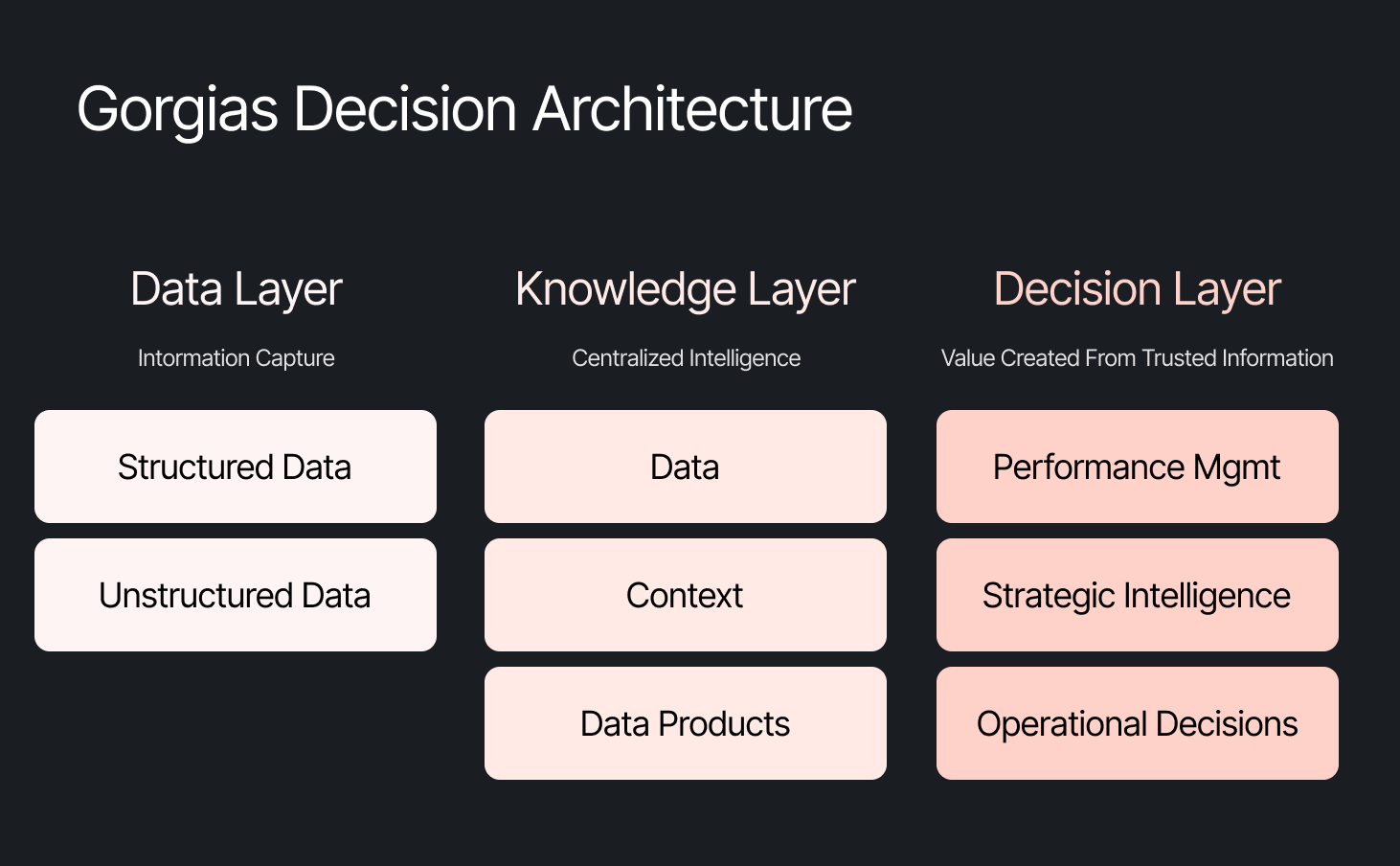
The framing problem most companies get wrong
The instinct across many companies today is to start with the model, pick a provider to solve a specific challenge, or invest heavily in getting the data right. All reasonable starting points, but most of them solve for one use case. Underneath that approach is a framing problem: seeing AI as an initiative — something you assign and measure. Seeing AI as another tool your company uses versus how your company operates.
We started somewhere different. Every company is built on four pillars: customers, people, product, and decisions. AI investments tend to place heavy emphasis on the first three. We started with the fourth. Our bet was that if we built everything around the need to make effective decisions first, asking what Gorgias needed to know to operate well, then our AI would become dramatically more powerful.
Cortex is that philosophy in practice
Cortex is our flagship internal AI agent, and the product where we established the tenets that now run through everything else we build: composable and modular infrastructure, governed context, and accessible from wherever decisions happen. Cortex lives in Slack, as well as across LLM vendors, in its own browser extension, and even on its own dedicated internal site.
Cortex doesn’t stop at answering questions. It can read and write to Notion, file Linear tasks, create HTML apps, automate signal delivery, and more. It operates across every layer of our stack, from dashboards to data pipelines, because we designed it as one integrated system. It is this connection that adds remarkable depth to what people can ask, and what they get in return.
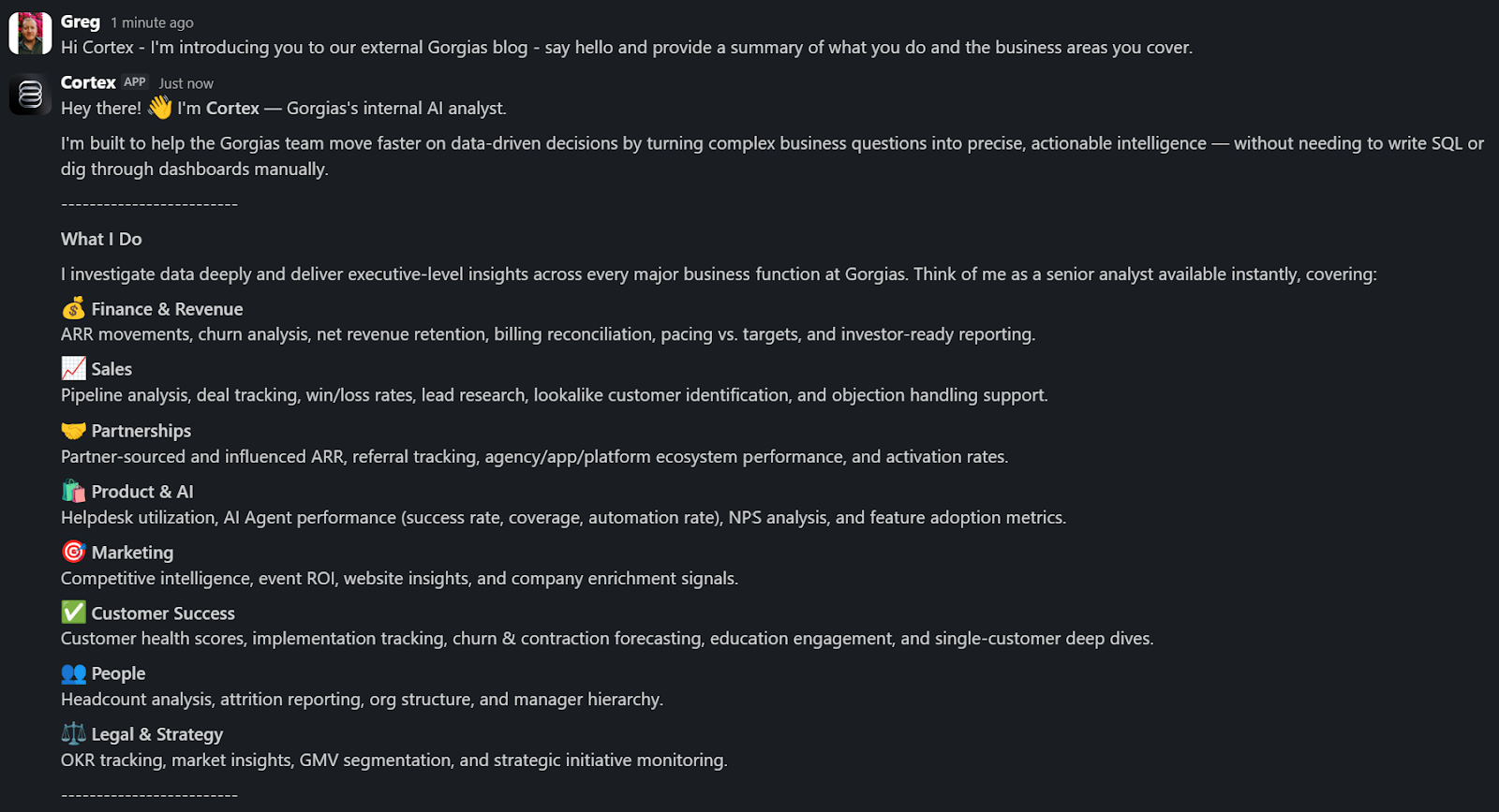
A Sales Lead is pitching and asks Cortex for the full picture of the merchant. In a customized PDF, Cortex lists coverage gaps, pre-sale intent signals, and product fit options. Everything the sales lead needs to walk in with confidence.
A Senior Product leader asks, "How are we performing against OKR #1, and what can my team do to help accelerate it?" Cortex returns a full ARR breakdown, projected end-of-month attainment, segment-level findings, and connects it all back to company-level strategies. A suite of recommendations customized to the leader, the performance, and the signals that bridge how they can support our goals. The kind of answer that used to take someone a week to put together.
These aren't simple lookup queries. They require deep business context spanning multiple areas. Cortex handles these because its Decision Engine gives it the information to reason against governed data, metric definitions, and business context, turning a generic answer into a credible one.
Overnight, teams have built Cortex into how they work. They’re spending less time searching and more time finding answers, not because they were told to, but because Cortex reduced the distance between question and decision.
Flexibility as the foundation
Cortex’s modular infrastructure allows us to experiment and add new capabilities freely. We’ve already built two more internal AI agents made for entirely different use cases, but using the same Decision Engine as Cortex.
GAIA, our internal experimentation AI Agent, helps our customers identify opportunities in their AI Agent Guidance design. It takes institutional knowledge across our teams and turns it into a scalable system that drives automation and value to our customers. Our CEO, Romain Lapeyre, has been its most vocal advocate since day one.
When we needed a platform for investor readiness and board preparation, we built Oracle. Our board decks and talk tracks are informed and built with the same AI, and our numbers are validated every step of the way.
We’re continuing to expand new AI agents internally, exploring how they can create value for customers and our own teams.
AI has transformed how data teams create value, and we’ve already shifted to account for it
When AI handles thousands of analytical questions each week, the highest-value work for a data team shifts permanently. Late 2025, we repositioned from a Data Analytics function into a Decision Intelligence function — a structural change in what we own and how we operate.
Today, our analysts focus on the most sensitive, complex, and forward-looking decisions and analyses. They partner more deeply with stakeholders by driving next steps from signals. They're even building entirely new capabilities that didn't exist in their role descriptions months ago. Things like AI skills for Cortex, context curation, and insight and recommendation delivery. The role of the analyst hasn't diminished. It's expanded to encompass the most meaningful work an analyst can do: driving outcomes and ensuring those decisions can achieve them.
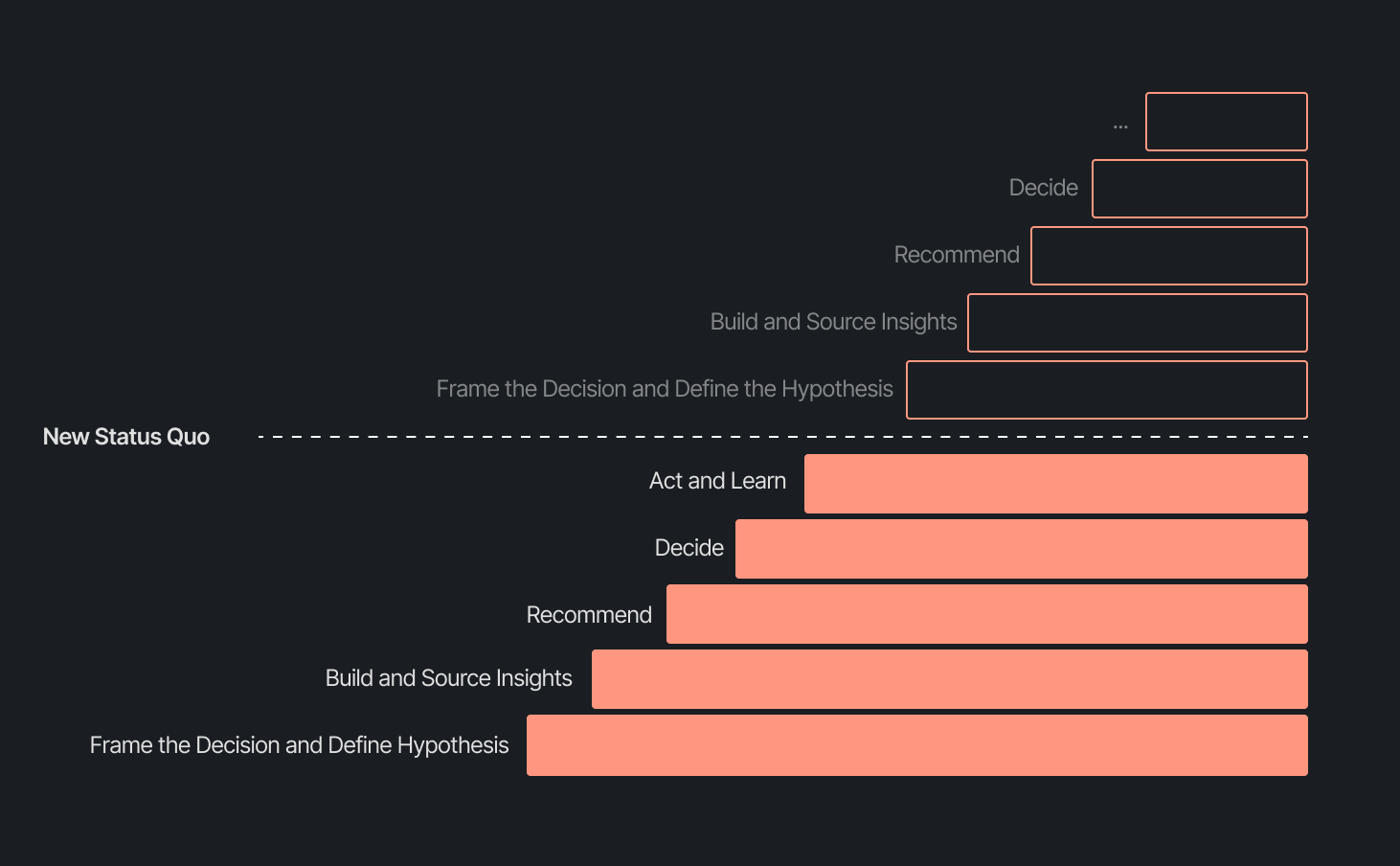
Our business support model has changed, too. Instead of embedding analysts and dedicated engineers within functional teams, we align capacity to the highest-impact company objectives and move fluidly across them. This model works even better because Decision Intelligence brings together both analytics and engineering teams under one roof.
Elliot Trabac leads our Data, Context and AI Engineering teams. The Decision Engine, Cortex, GAIA, and the platforms I've described exist because of the infrastructure his team innovated and built from the ground up. Noemie Happi Nono leads our Decision Strategy and Operations team, driving decision outcomes with stakeholders, advancing the development of Cortex skills and capabilities, and pushing into new areas of analysis every day.
Together, they're shaping what a modern data function looks like when AI becomes a standard building block for how a company operates.
What’s next for the Decision Intelligence team
The question of ROI is long gone. AI has opened the floodgates to more trusted and meaningful signals than ever. The natural next evolution is Proactive Intelligence, signals surfaced toward what you need to know, before you ask. And we're already building this because our architecture is designed to support it.
In the coming weeks, members of the Decision Intelligence team will go deeper into themes I've touched on here. Yochan Khoi, a Senior Analytics Engineer on our team, recently published a technical walkthrough of our context layer and will go further into building context strategies that scale. Others will cover infrastructure, analytical partnerships, evolving data assets into decision assets, and the cost and efficiency gains that make sustained AI investment viable.
AI hasn't changed the most important element of data and analytics functions — delivering outcomes — but it has raised the bar for what it looks like and how far we can take it. We’re just getting started.
TL;DR:
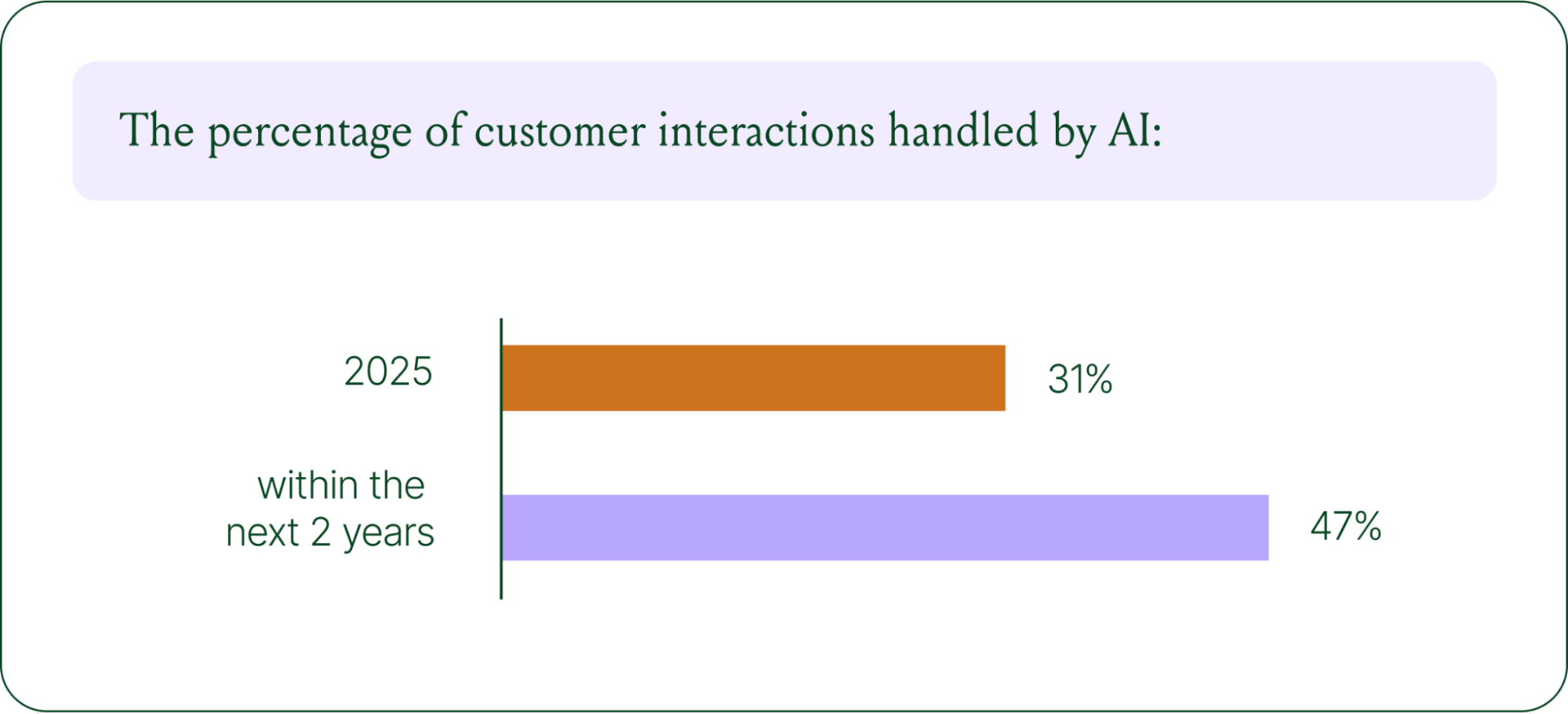
- AI is resolving tickets, not just replying. AI now handles 31% of customer interactions for ecommerce brands, and that number is expected to nearly double within two years.
- Every channel is becoming a storefront. Conversations are replacing the traditional browse-and-buy journey, with 79% of brands reporting sales from AI-driven interactions.
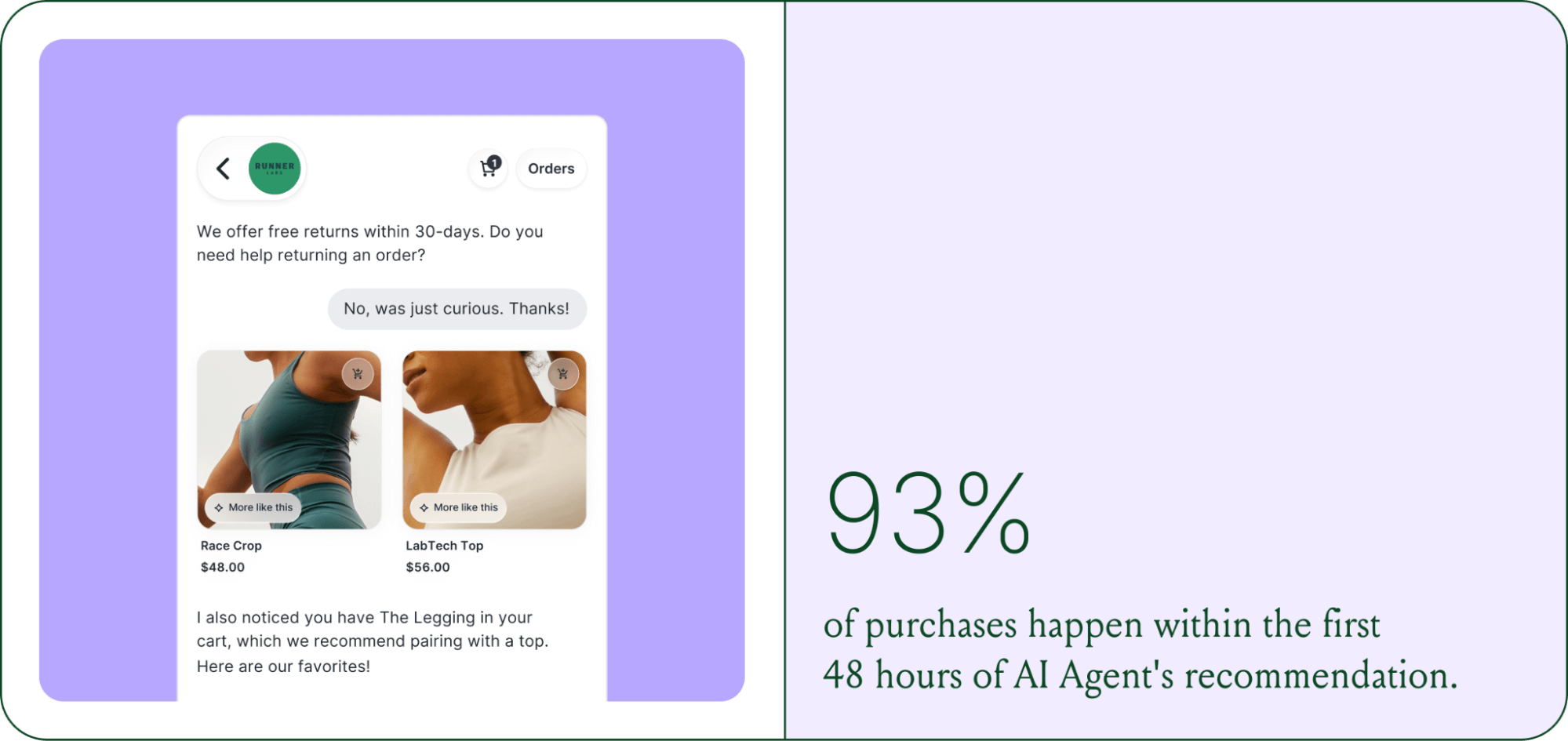
- AI is shortening the buying cycle. 93% of AI-influenced purchases happen within the first 48 hours of the conversation.
- CX teams are changing, not shrinking. Ecommerce brands are actively hiring for more technical roles to implement, coach, and maintain AI.
- The winning model is hybrid. AI handles volume and speed, while humans handle complexity and judgment.
The way shoppers buy online has shifted and customers are at the center.
They no longer want to scroll through product pages, dig through FAQs, or wait 24 hours for an email reply. They open a conversation, ask a specific question, and expect a useful answer in seconds. Brands that can’t deliver these experiences at scale are seeing customer hesitation turn into abandoned carts and lost revenue.
This shift has a name: conversational commerce. It's the practice of using real-time, two-way conversations as your primary sales channel, through chat, AI agents, messaging apps, and voice.
What started as an experiment for early adopters has become a key growth lever, with 84% of ecommerce brands treating conversational commerce as a strategic pillar this year vs. last year.
We surveyed 400 ecommerce decision-makers across North America, the U.K., and Europe to understand how conversational commerce and AI are reshaping the ecommerce landscape. These findings are complemented by aggregated and anonymized internal Gorgias platform data from 16,000+ ecommerce brands.
The State of Conversational Commerce in 2026 trends report breaks down all of the findings, including five key trends shaping the ecommerce landscape.
{{lead-magnet-1}}
Trend 1: AI is table stakes for ecommerce and it’s no longer just about efficiency
A few years ago, adding an AI chatbot to your site that could provide tracking links and Help Center article recommendations was a differentiator. Today, it's table stakes. McKinsey found that 71% of shoppers expect personalized experiences, and 76% get frustrated when they don't get them.
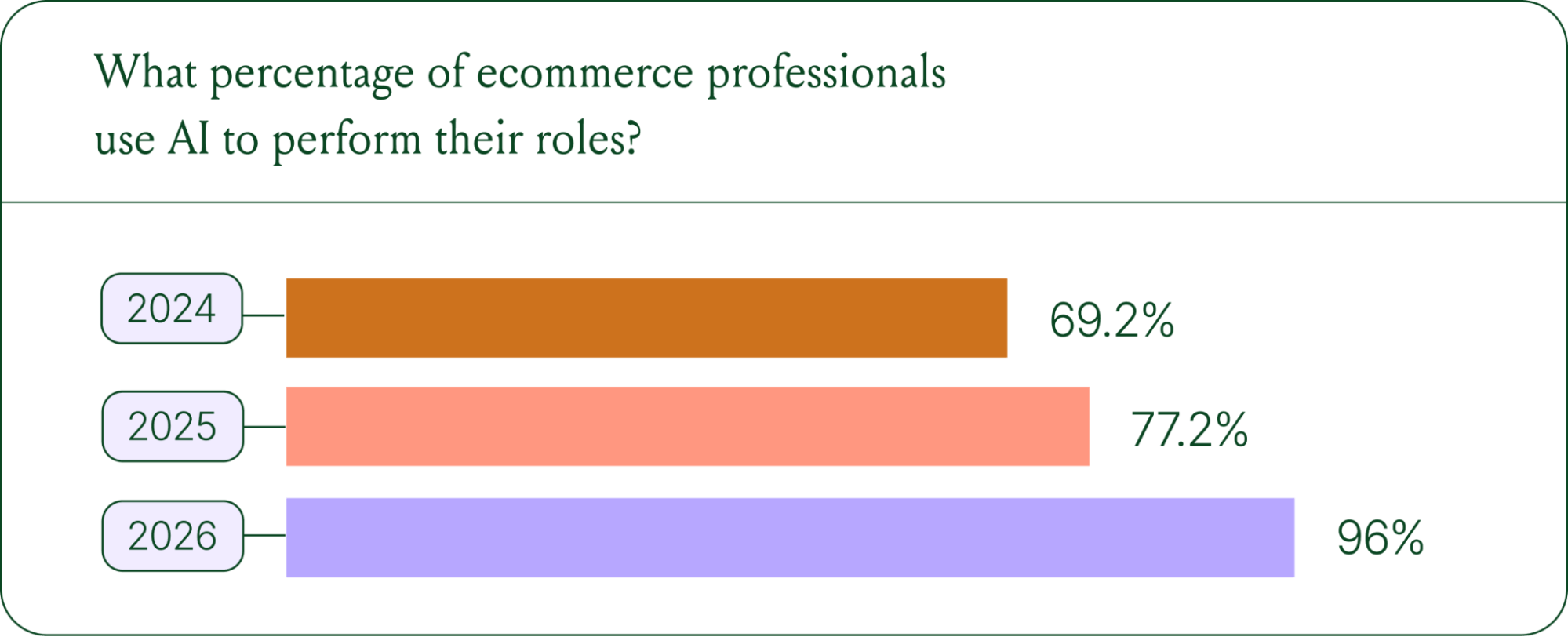
Right now, most ecommerce professionals use AI, with 93% having used it for at least 1 year. Enthusiasm is accelerating quickly, with only 30% of ecommerce professionals rating their excitement for AI at 10/10 in April 2025. Similarly, while AI adoption rose steadily year over year, it reached a clear peak in 2026.
The use cases driving this adoption are practical and high-volume:
- Order tracking and status updates
- Returns, exchanges, and refund requests
- Shipping FAQs and delivery estimates
These are the tickets that flood brands’ inboxes every day. AI agents resolve them instantly, without pulling teams away from conversations that actually require human judgment.
Explore AI adoption and use case data in more depth in the full report.
Trend 2: Conversations are the new path to checkout
The traditional ecommerce funnel, visit site, browse products, add to cart, check out, is losing ground. Shoppers now discover products on Instagram, ask questions via direct message, and complete purchases without ever visiting a website.
Conversational AI is actively increasing revenue, with 79% of brands reporting that AI-driven interactions have increased sales and conversion in their business.

The practical implication is that every channel is becoming a storefront. Creating personalized touchpoints with customers earlier in the journey, through proactive engagement, is impacting the bottom line.
Read the full report to explore how AI conversions have increased QoQ by industry.
Trend 3: AI is accelerating the purchase cycle
Pre-purchase hesitation is one of the biggest conversion killers in ecommerce. A shopper lands on your product page, has a question about sizing or compatibility, can't find the answer quickly, and leaves. That's a lost sale that had nothing to do with your product.
Conversational AI changes that dynamic. When a shopper can ask a question and get an accurate, personalized answer in real time, the friction disappears.
Brands using Gorgias saw this play out at scale in 2025. When AI Agent recommended a product, 80% of the resulting purchases happened the same day, and 13% happened the next day.
Brands are further accelerating the buying cycle through proactive engagement. On-site features such as suggested product questions, recommendations triggered by search results, and “Ask Anything” input bars drove 50% of conversation-driven purchases during BFCM 2025.
Explore how AI is collapsing the purchase cycle in Trend 3 of the report.
Trend 4: AI is making CX teams more technical
There's a persistent narrative that AI is making CX teams redundant. The data tells a different story. 62% of ecommerce brands are planning to grow their teams, not cut them. But the scope of those teams is changing.

New roles are emerging around AI configuration and quality assurance. Teams are investing in technical members to write AI Guidance instructions, develop tone-of-voice instructions, and continuously QA results.
CX teams are also bridging the gap between support goals and revenue goals, as the two functions increasingly overlap.
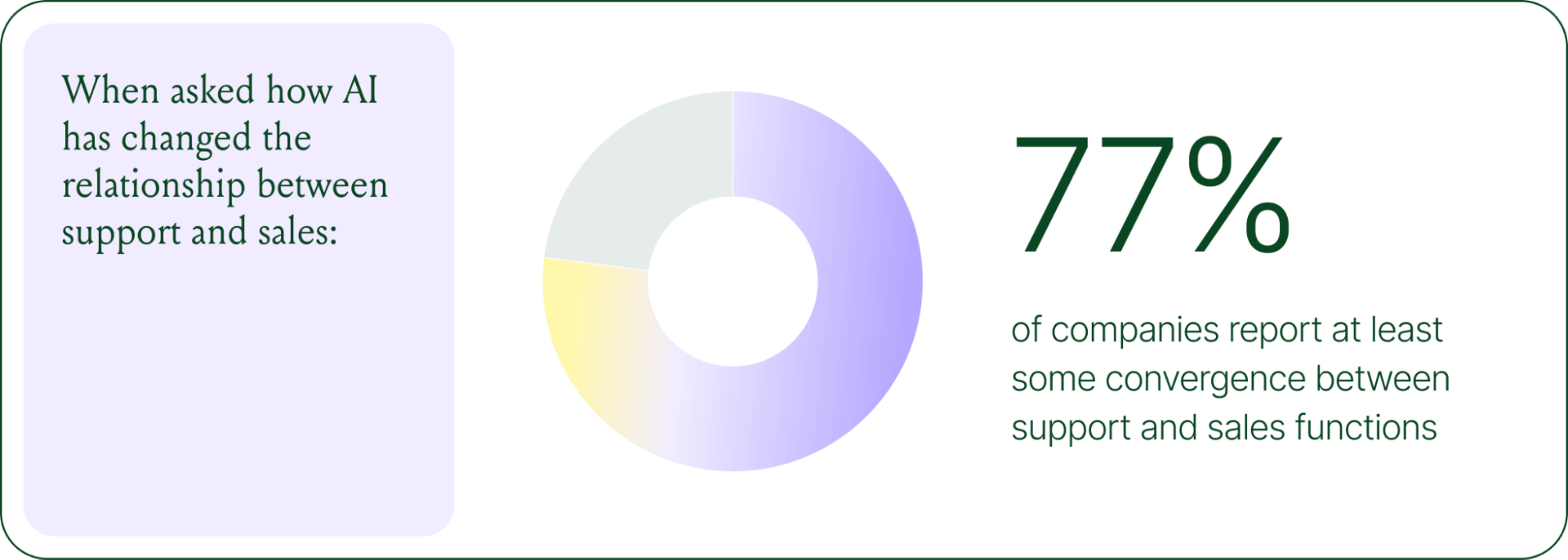
The result is CX teams that are more technical than they were before. Agents who once spent their days answering repetitive tickets are now spending that time on higher-value work: complex escalations, VIP customer relationships, and improving the AI systems and knowledge bases that handle the volume.
Learn more about the evolution of CX roles in Trend #4.
Trend 5: The future is hybrid: AI-first, humans when it counts
Despite increasing AI adoption, data shows that ecommerce brands shouldn’t strive for 100% automation. Winning brands are building systems in which AI handles repetitive tier-1 tickets, and humans handle complex, sensitive cases.

AI handles speed and scale. It resolves order-tracking requests at 2 a.m., processes return-eligibility checks in seconds, and answers the same shipping question for the thousandth time without compromising quality.
Human agents handle conversations that require context, empathy, or decisions that fall outside the standard playbook. There are several topics where shoppers still prefer human support.
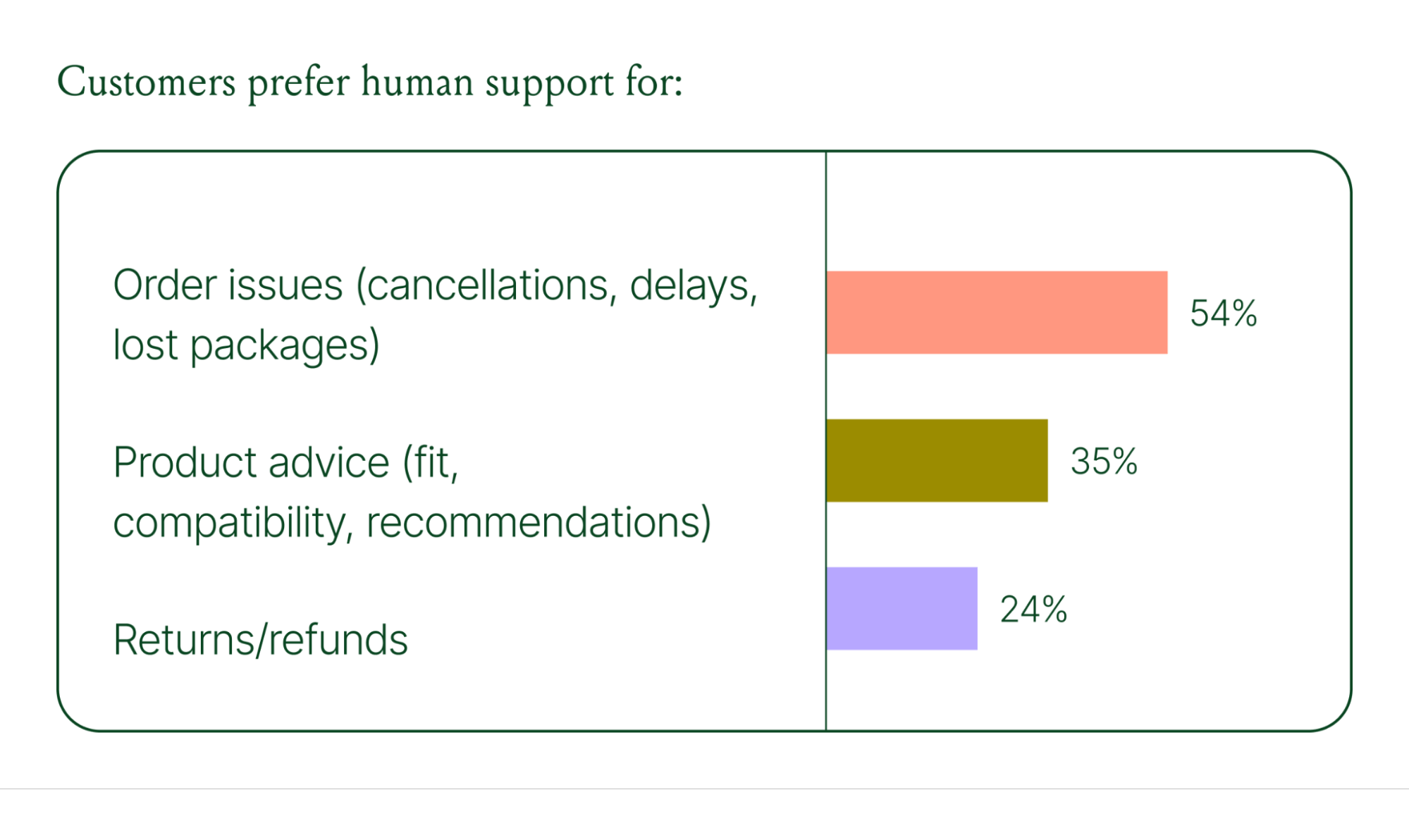
Successful hybrid systems require continuous iteration, meaning reviewing handover topics, Guidance, and reviewing AI tickets on a weekly basis.
Discover how leading brands are balancing human and AI systems in Trend #5.
Where conversational commerce is heading by 2030
The 2026 trends are about expansion and standardization. The 2030 predictions are about what comes next.
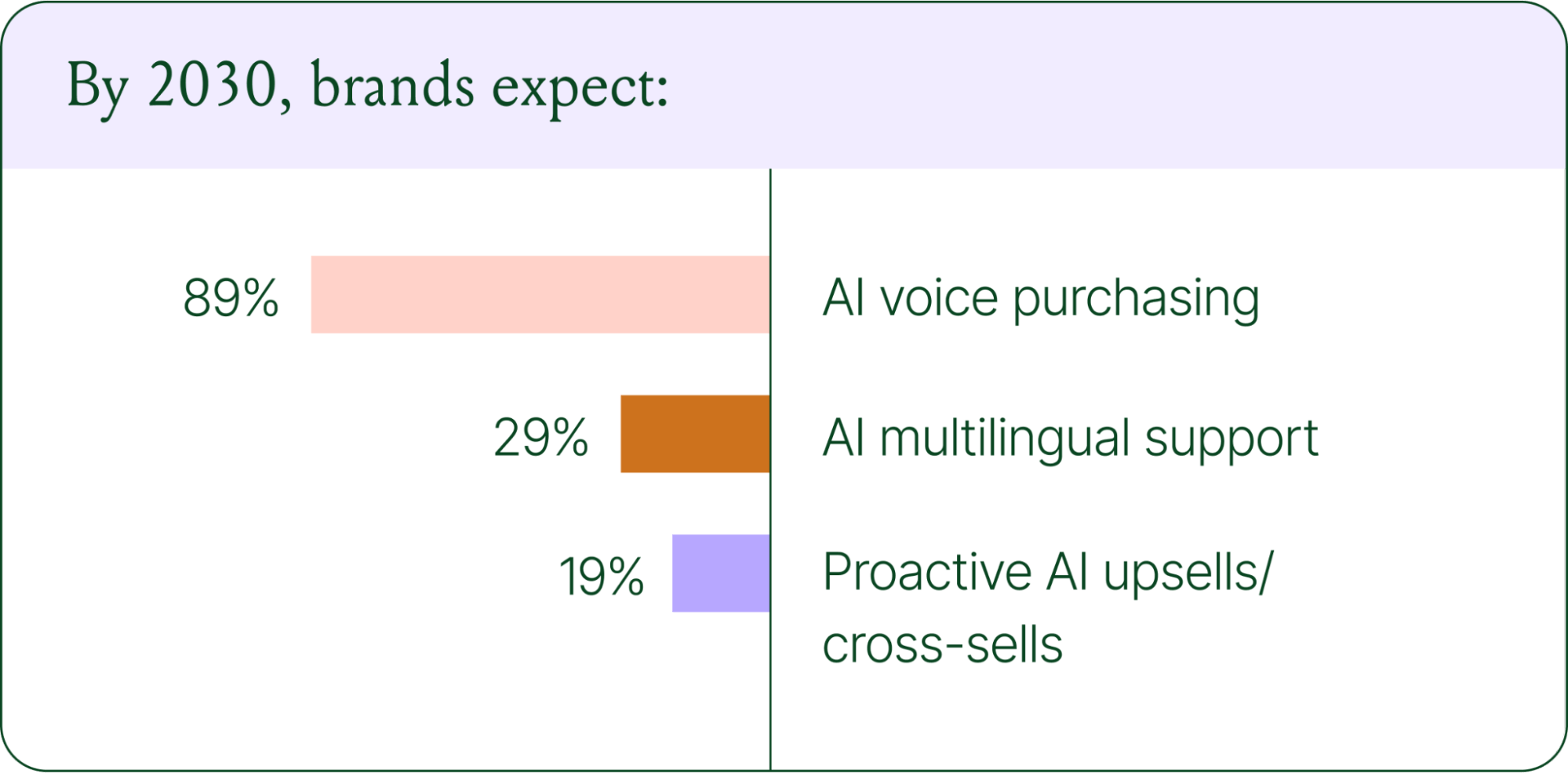
Voice-based purchasing is the biggest bet on the horizon. Only 7% of brands currently use voice assistants for commerce, but 89% expect it to be standard by 2030. The vision is a customer who can reorder a product, check their subscription status, or manage a return entirely over the phone.
Proactive AI is the other major shift. Rather than waiting for a customer to reach out, AI will anticipate needs based on browsing behavior, purchase history, and where someone is in their relationship with your brand. Think of it as the digital equivalent of a sales associate who remembers what you bought last time and knows what you're likely to need next.
Explore where ecommerce brands are allocating their AI budgets in the full report.
Start building your conversational commerce strategy today
The brands winning in 2026 are creating smart, scalable systems where AIhandles volume and humans handle nuance. They’re treating every conversational channel as an opportunity to serve and sell.
The data is clear: AI adoption is accelerating, customer expectations are rising, and the revenue impact of getting this right is measurable.
{{lead-magnet-1}}
Newsletter Signup
The best in CX and ecommerce, right to your inbox
Featured articles

Conversations Are Becoming a Revenue Channel: The Data Proves It
TL;DR:
- Customer journeys are collapsing to a single conversation. The traditional browse-and-buy journey is giving way to AI-guided shopping that moves from discovery to purchase in a single exchange.
- 79% of brands say AI-driven conversational commerce has increased their sales and purchase rates.
- AI-only influenced orders grew 63% in a single year, from 2.7 million in Q1 to 4.4 million in Q4.
- Brands treating conversation as a revenue channel. They’re not just a support function, generating higher AOV, shorter buying cycles, and stronger retention.
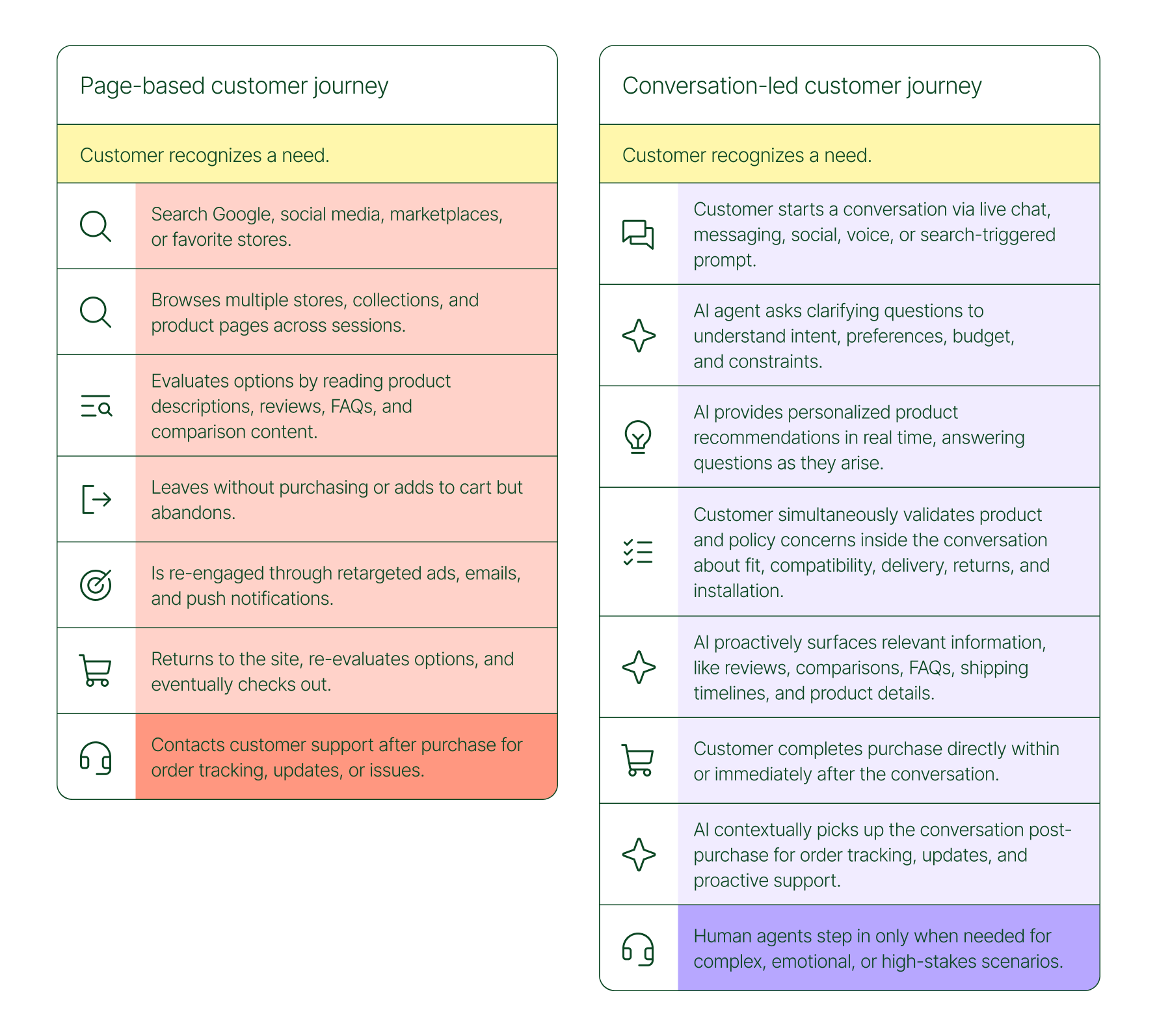
The page-based shopping experience dominated for decades. Customers would search, browse, compare, abandon, get retargeted, return, and eventually buy (sometimes).
That journey is no longer the only option.
Shoppers are turning to chat, messaging, and AI-powered tools to find what they need. Instead of clicking through product pages or reading static FAQs, they ask questions, have back-and-forth conversations, and get answers that move them closer to a purchase in real time. The path to checkout has changed, and the brands that recognize this are pulling ahead.
Read our 2026 State of Conversational Commerce Report to learn more about conversation commerce trends from 400 ecommerce decision-makers and 16,000+ ecommerce brands using Gorgias.
{{lead-magnet-1}}
The shopping journey has collapsed into a single thread
The traditional shopping journey was a solo experience. A shopper had a need, searched for options, browsed across sessions, and eventually made a decision — often days later, after being retargeted multiple times. Support only entered the picture after the purchase.
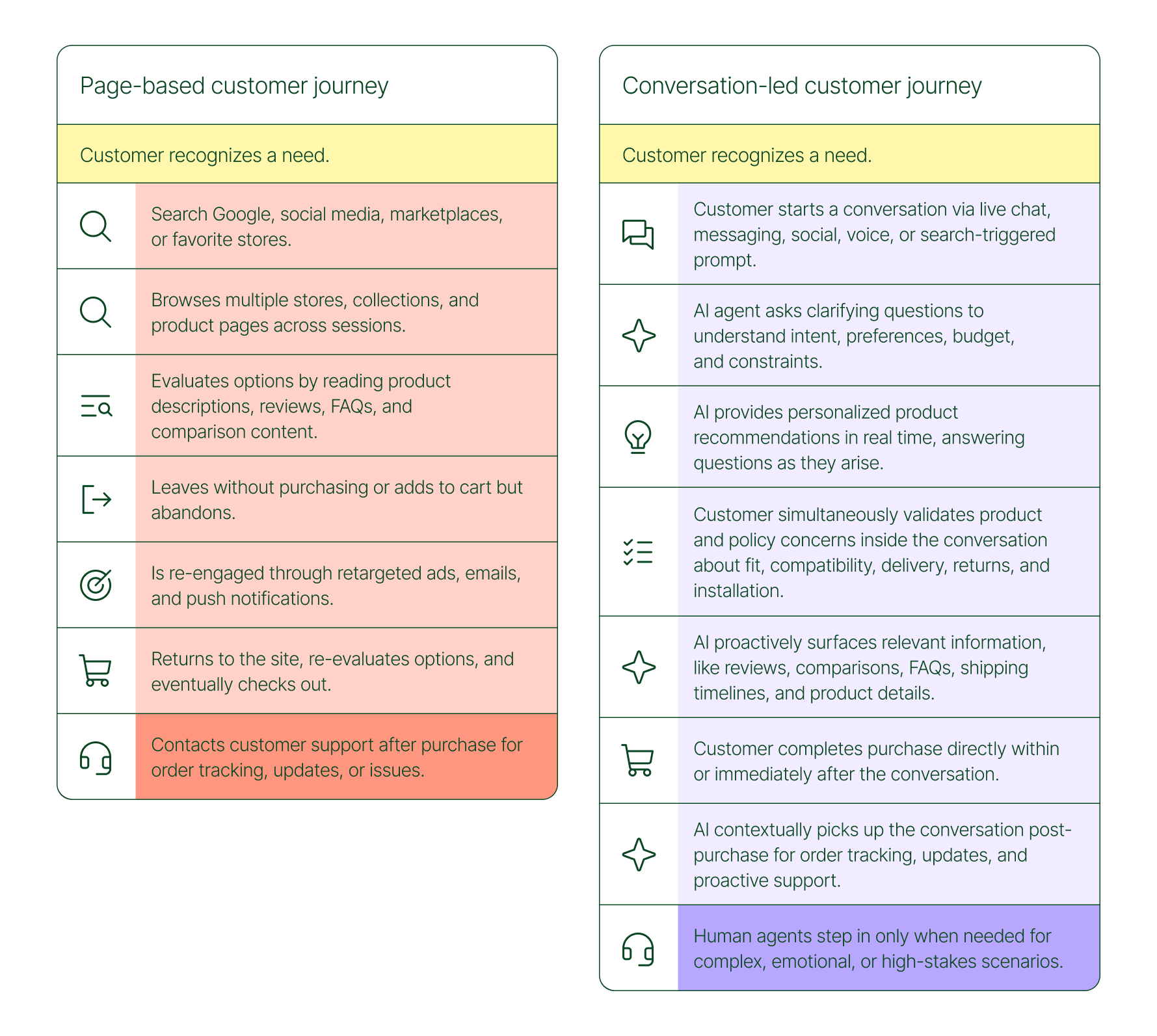
The conversation-led journey collapses that timeline:
- A shopper recognizes a need and starts a conversation via chat, messaging, or a search-triggered prompt
- An AI agent asks clarifying questions about preferences, budget, and constraints
- The AI provides personalized product recommendations in real time
- The shopper validates concerns about fit, compatibility, delivery, and returns, all inside the conversation
- The shopper completes the purchase directly within or immediately after that exchange
- The AI picks up the conversation post-purchase for order tracking and proactive support
- A human agent steps in only when the situation calls for it
What used to take days now takes minutes. Discovery, evaluation, and purchase happen in a single thread.
Conversation is a revenue strategy, not a support upgrade
79% of brands agree that AI-driven conversational commerce has increased sales and purchase rates in their business. When brands were asked to rank the highest-return areas:
- 38% cited improved customer support efficiency
- 23% pointed to higher customer retention and loyalty
- 20% saw improved purchase rates
Those numbers reflect something important: the value of conversation compounds. Faster support reduces friction. Better retention raises lifetime value. More confident shoppers buy more often and spend more per order.
The brands seeing the biggest returns aren't just using AI to deflect tickets. They're using it to create one-to-one shopping experiences at scale.
What the data shows about AI-influenced orders
Looking at AI-only influenced orders across key verticals like Apparel and Accessories, Food and Beverages, Health and Beauty, Home and Garden, and Sporting Goods, the growth across a single year was significant.
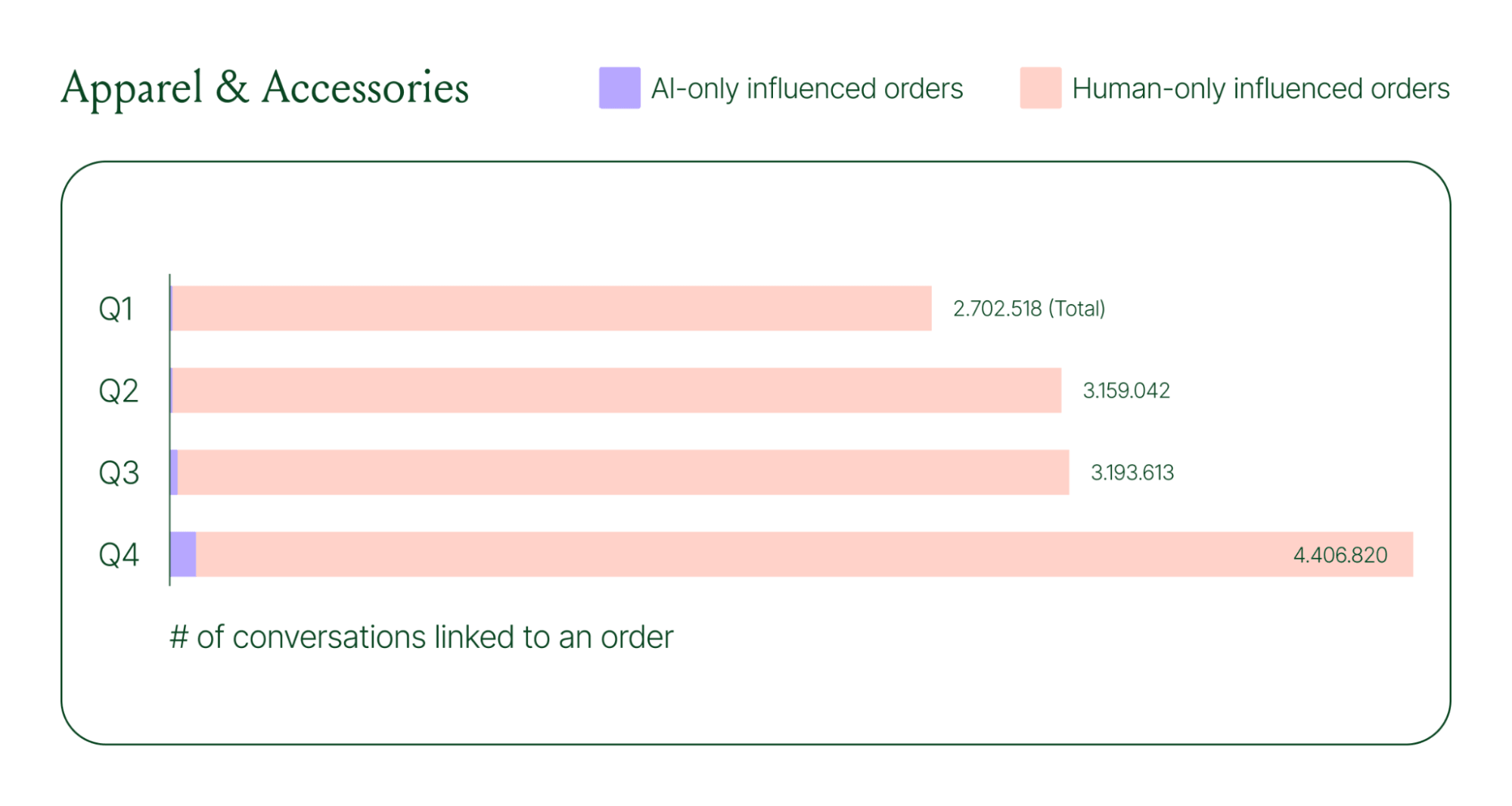
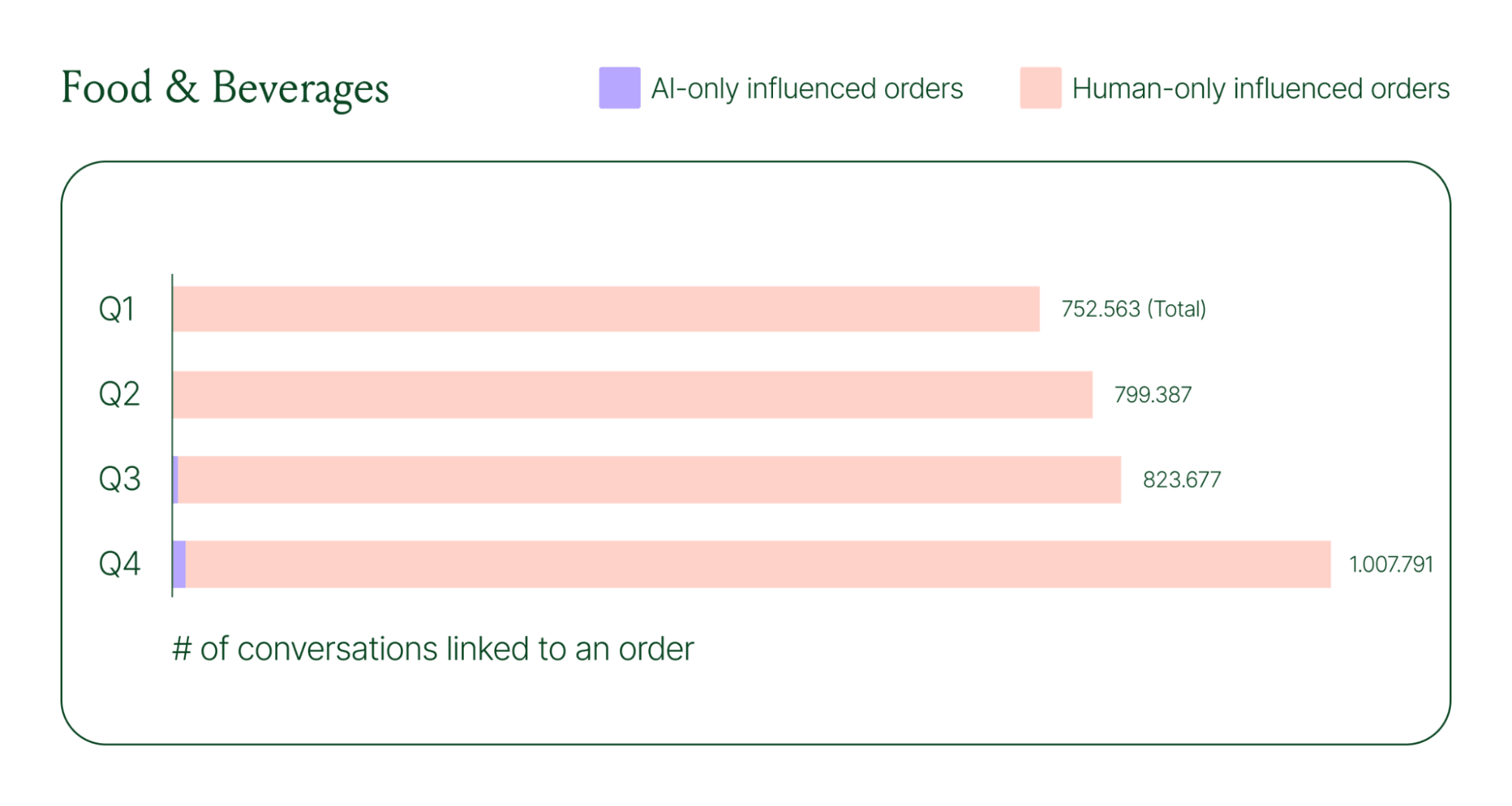
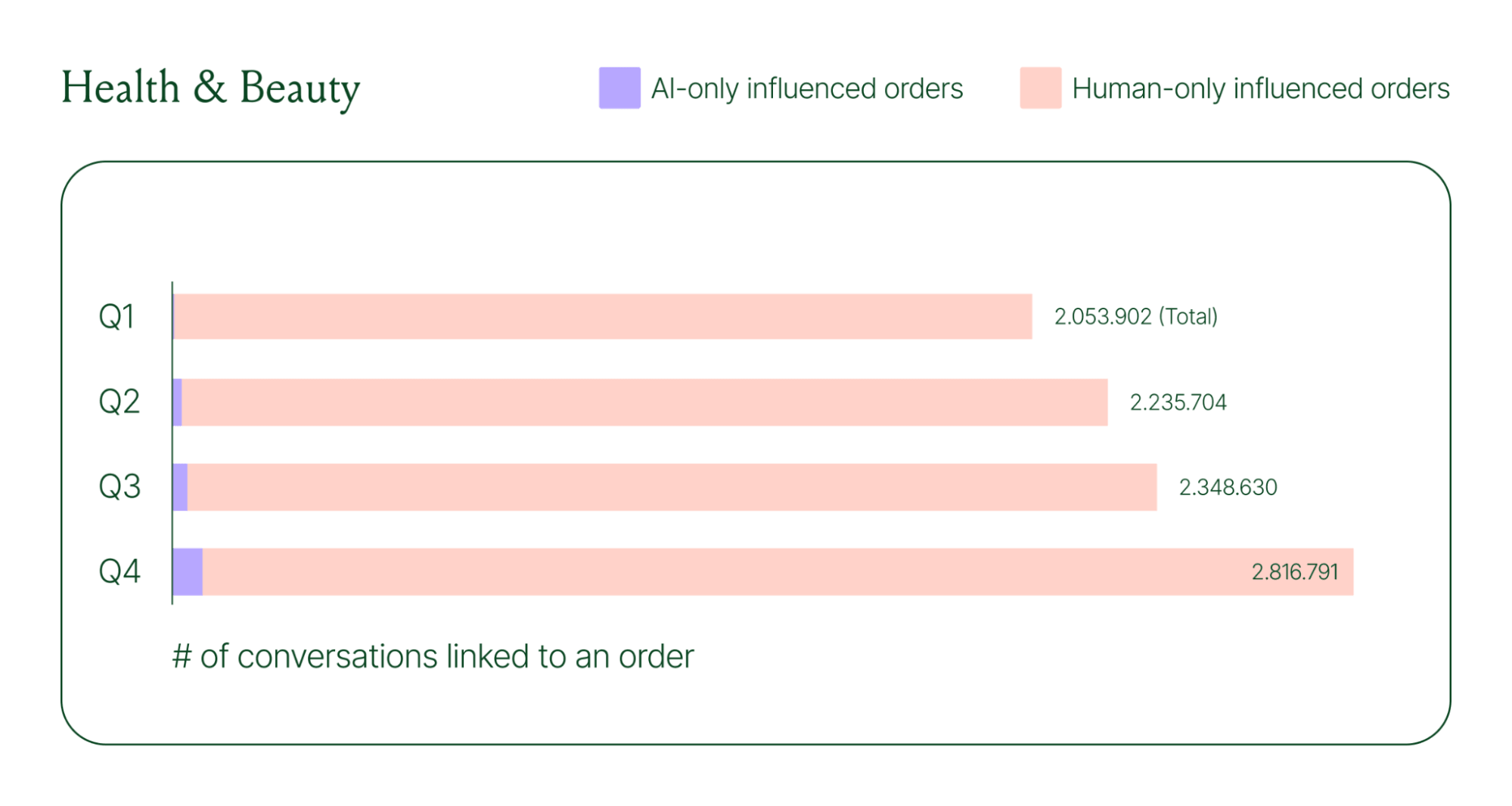
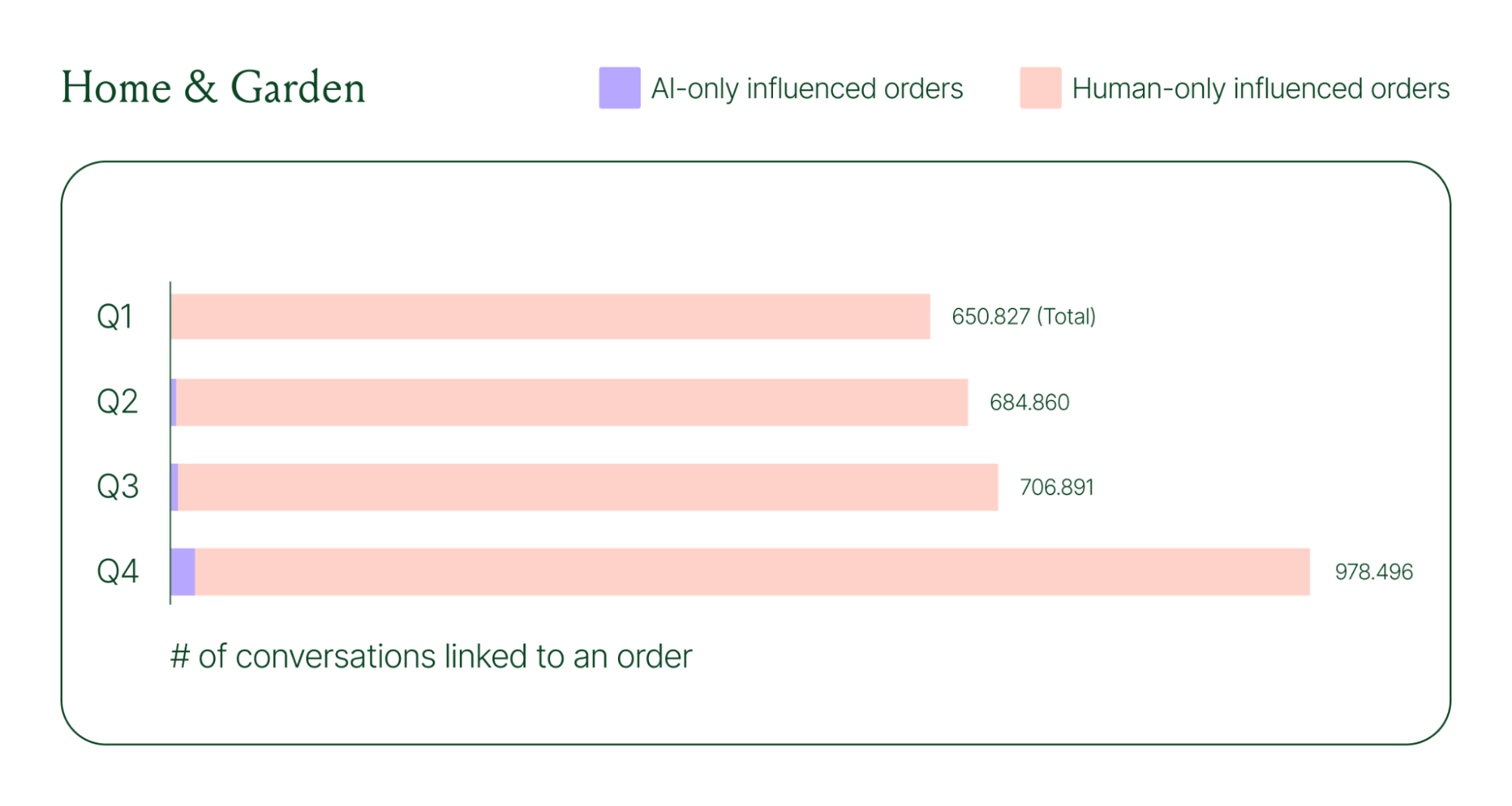
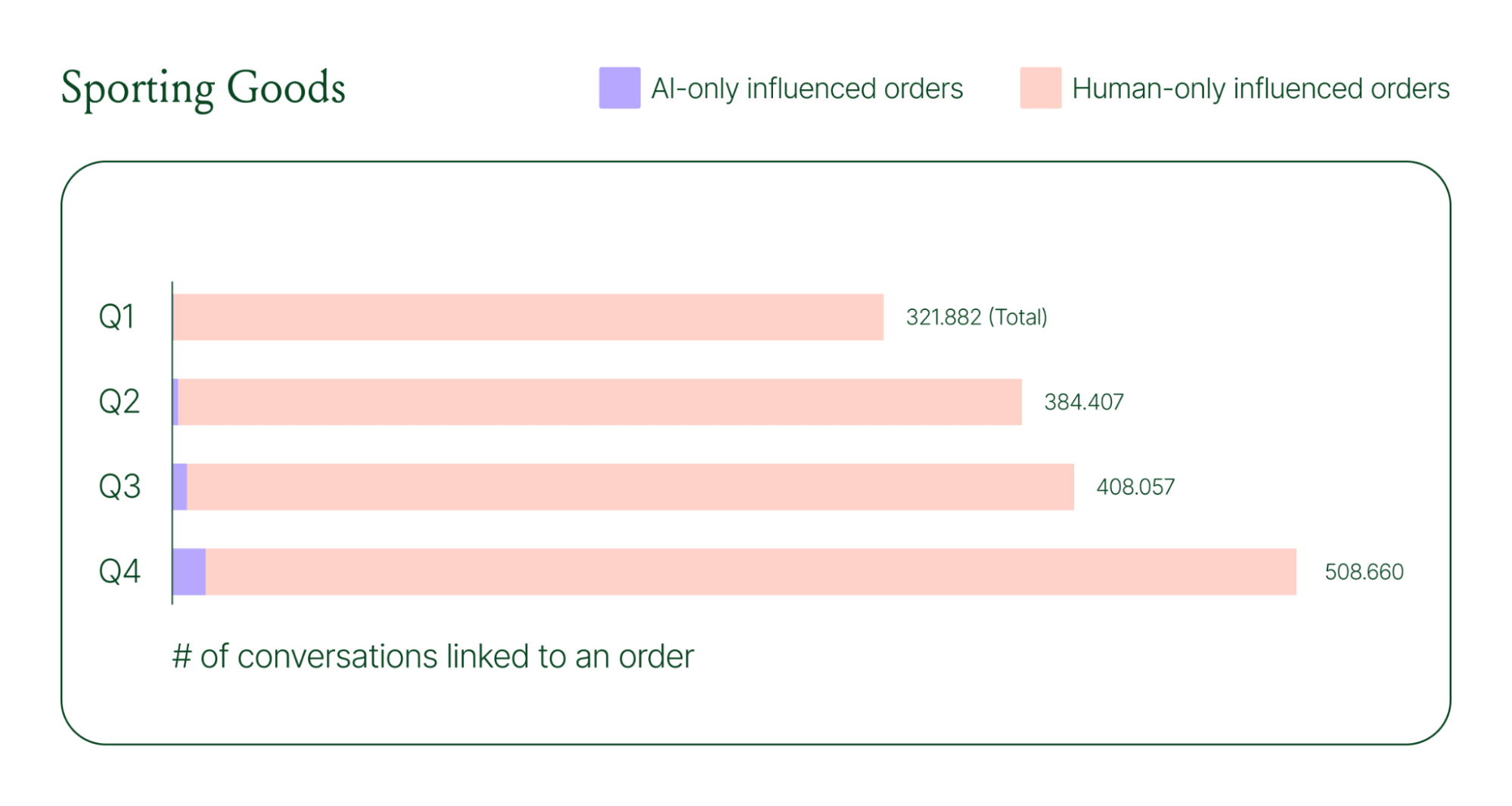
Across industries, ecommerce brands saw AI step into conversations, reduce shopper hesitation, and drive higher QoQ conversion rates.
Learn more about AI-powered revenue generation in the full 2026 Conversational Commerce Report.
Why brands are making this a strategic priority
84% of brands say the strategic importance of conversational commerce is higher than it was a year ago. 82% agree it will be mainstream in their sector within two years.
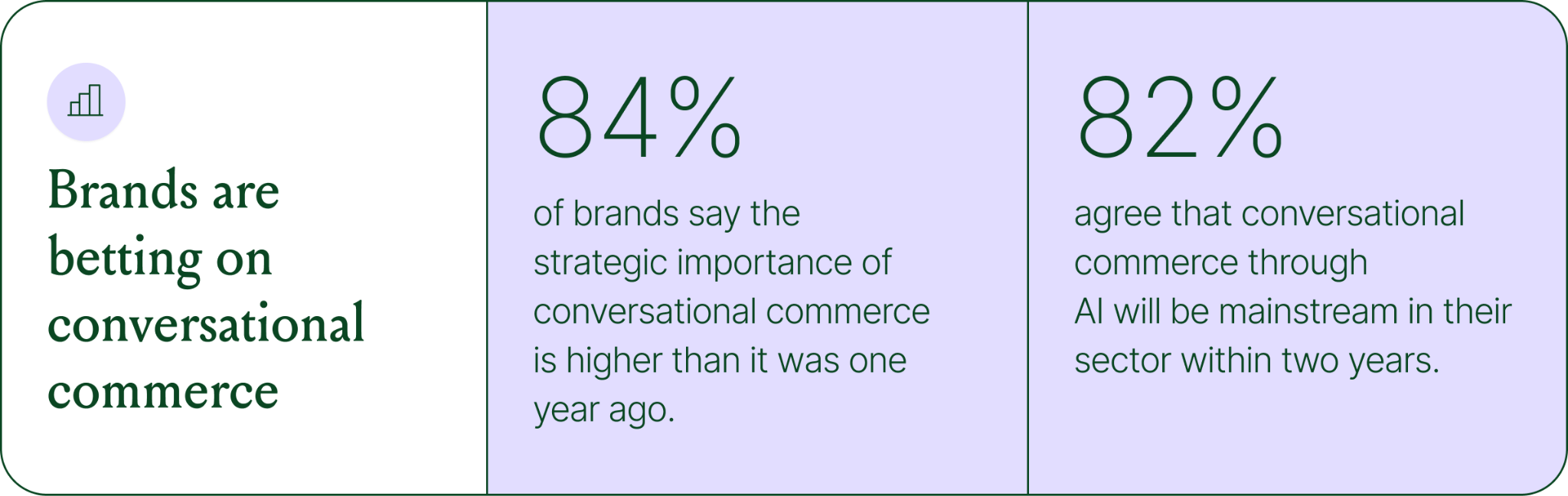
That shift is registering at the leadership level because of what conversational commerce does to the buying experience. Creating one-to-one touchpoints earlier in the journey drives higher AOV, shorter buying cycles, and stronger purchase rates. Shoppers who get real-time answers to their questions are more confident.
What this looks like in practice: TUSHY
TUSHY, known for eco-friendly bidets and bathroom essentials, is a useful example of what happens when you take conversational commerce seriously.
Bidets aren't an impulse purchase. Shoppers have real questions about fit, compatibility, and installation. Those questions used to go unanswered until the CX team could respond, often after the customer had abandoned the cart.
TUSHY used Gorgias's AI Agent and shopping assistant capabilities to automate pre-sales support. AI Agent engaged shoppers in real-time conversations, addressed their concerns directly, and built confidence at the moment of highest intent.
This resulted in a 190% increase in chat-based purchases, a 13x return on investment, and twice the purchase rate of human agents.
How to apply this to your strategy
You don't need to overhaul your entire operation to start seeing results. The most effective approach is to start where the impact is clearest and expand from there.
A few places to begin:
- Pre-sales chat. Identify your most common pre-purchase questions (sizing, compatibility, shipping timelines) and ensure your AI can answer them confidently and promptly.
- Product page engagement. Use proactive chat prompts triggered by page behavior to start conversations before shoppers leave.
- Post-purchase follow-up. Let AI pick up the conversation after checkout with order updates and proactive support, reducing inbound volume and building trust.
- Human escalation. Define clearly which situations require a human agent – complex issues, emotional exchanges, high-stakes decisions.
Want to see the full picture of where conversational commerce is headed in 2026? Read the full report to explore the data, trends, and strategies shaping the next era of ecommerce.
{{lead-magnet-1}}

AI Is Table Stakes for Ecommerce: What the Data Tells Us About 2026
TL;DR:
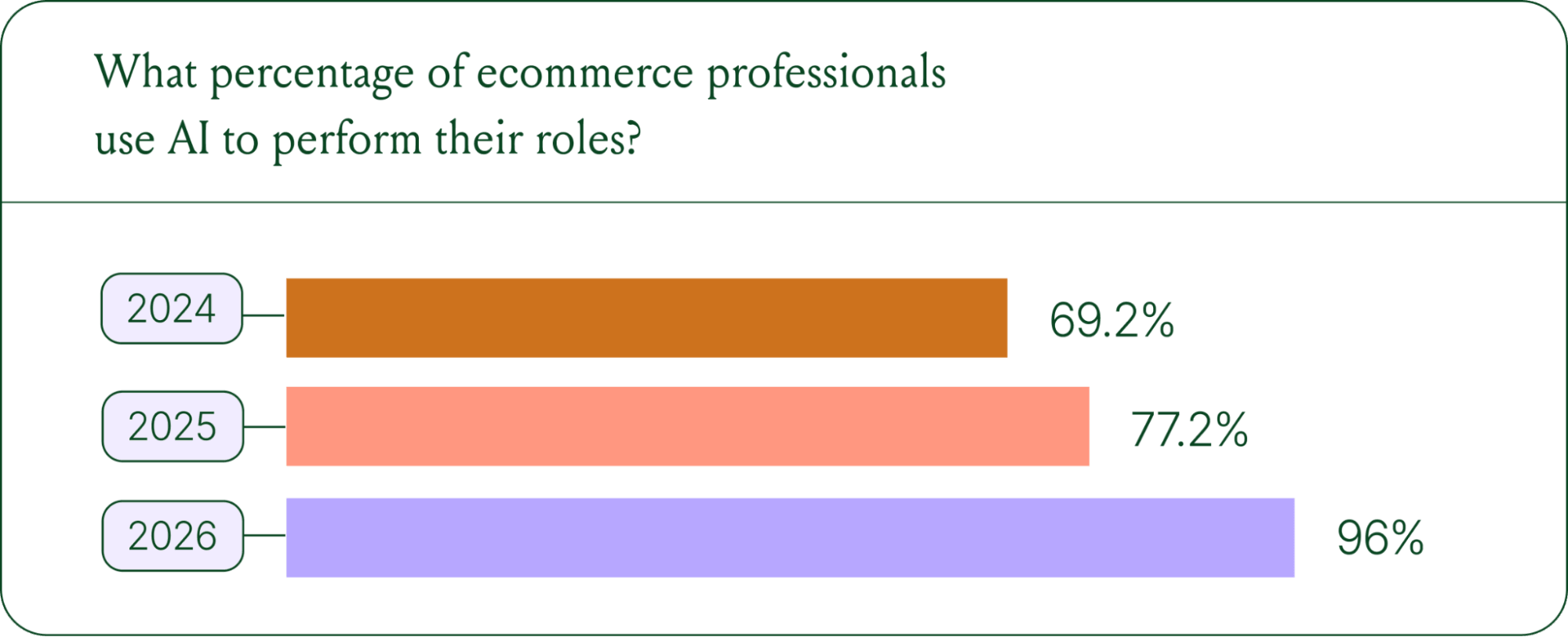
- AI adoption is rapidly accelerating. 96% of ecommerce professionals now use AI in their roles, up from 69% in 2024.
- AI has moved beyond support automation. Use cases have evolved into revenue generation, personalization, and logistics.
- Brands are tying AI success to profit-and-loss outcomes. 60% of brands consider AOV a top indicator of AI effectiveness.
A year ago, ecommerce brands were still debating whether AI was worth the investment. That debate is over. Today, nearly every ecommerce professional uses AI to do their job.
The shift isn't just about adoption. It's about what AI is used for and how brands measure its impact. Support automation was the entry point. Now, AI is embedded across the full operation, from product recommendations to inventory control to real-time shopping conversations.
In our 2026 State of Conversational Commerce Report, we break down trends on AI usage among 400 ecommerce decision-makers and 16,000+ ecommerce brands using Gorgias.
{{lead-magnet-1}}
AI adoption has reached a tipping point
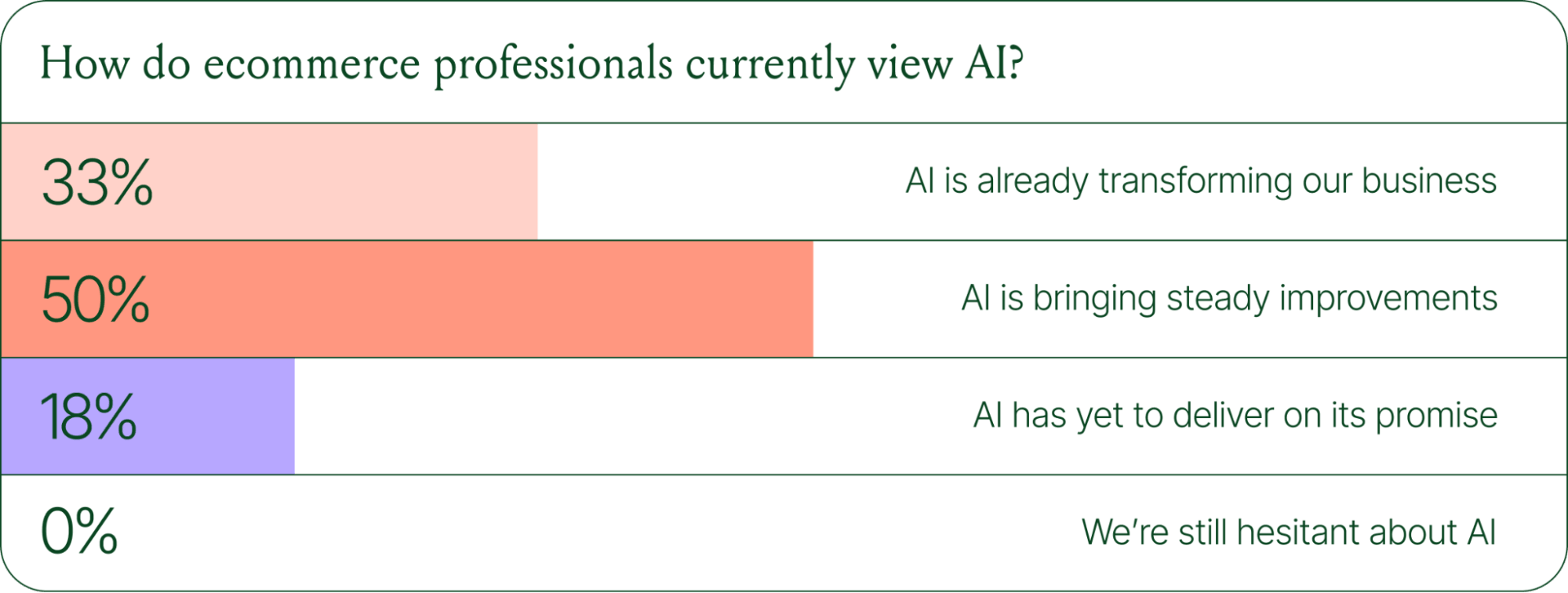
If we rewind 12 months ago, the industry was still split on AI. Some ecommerce professionals were excited, but most were still hesitant. In 2024, 69% of ecommerce professionals used AI in their roles. By 2025, that number reached 77%. In 2026, it hit 96%.
The confidence numbers back it up. 71% of brands say they are confident using AI for ecommerce, and 73% are satisfied with its business impact.
In early 2025, only 30% of ecommerce professionals rated their excitement for AI at 10/10. Today, zero percent of respondents describe themselves as hesitant about AI.
AI use cases now span the full ecommerce stack
Using AI in ecommerce is not new. In fact, it dates back to the 1980s with the invention of algorithms and expert systems. And if you’ve ever leveraged similar product recommendations or chatbots, you’ve already integrated AI into your ecommerce stack.
Modern AI is far more sophisticated.
With the rise of agentic commerce and conversational AI, brands began leveraging AI agents to automate the processing of repetitive support tickets. That’s still happening today, but the scope has expanded beyond the support queue.
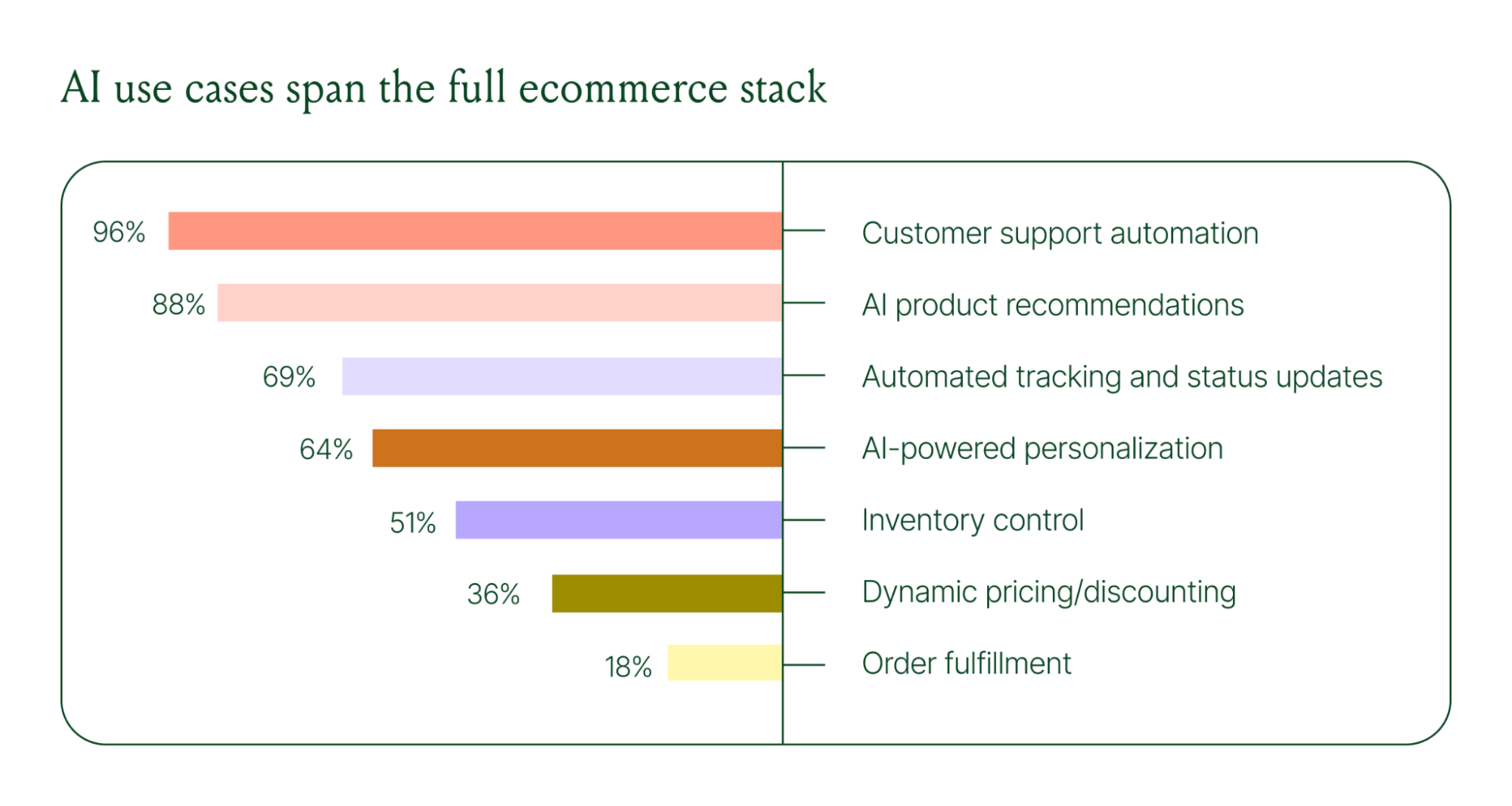
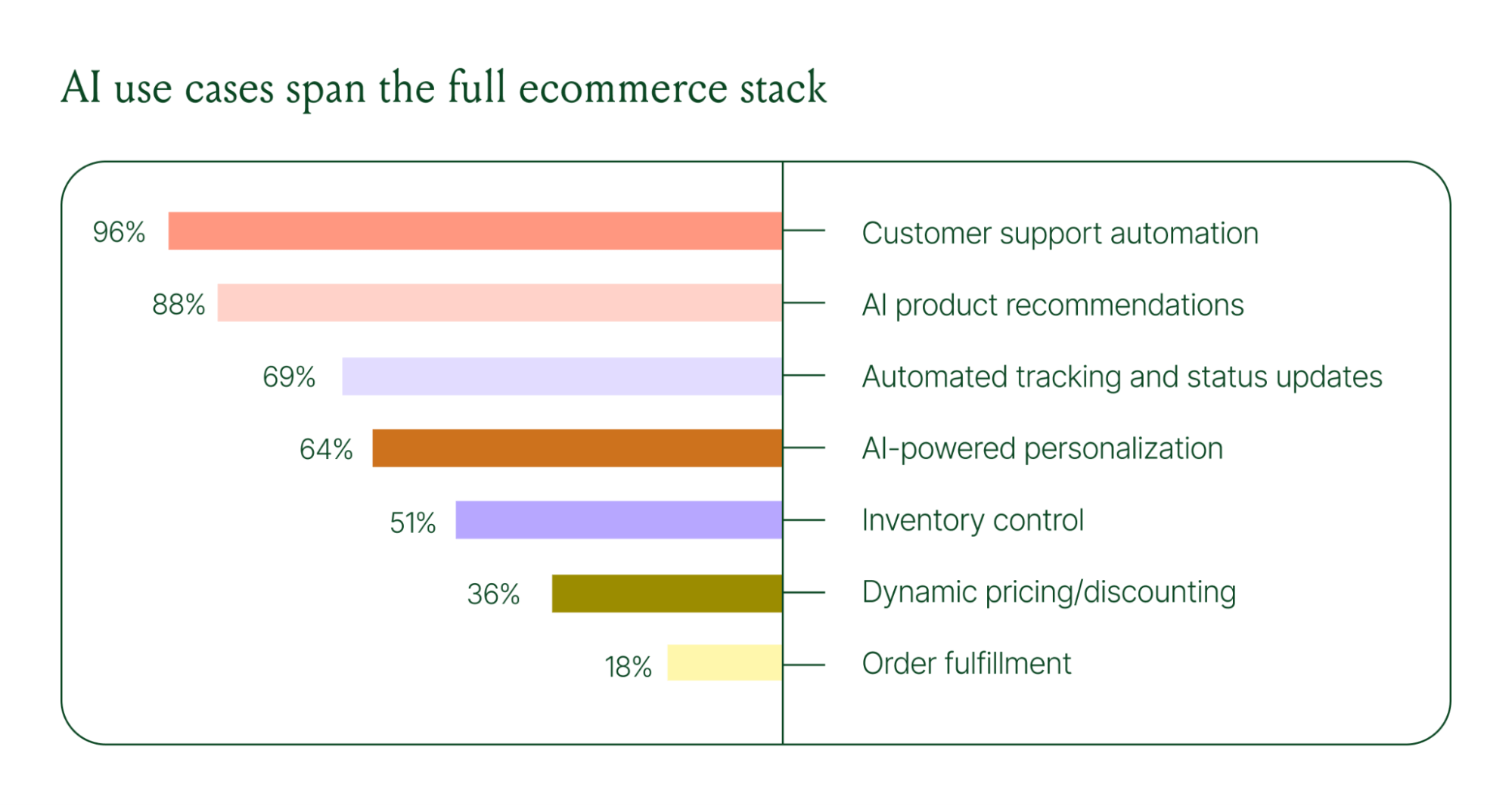
Ecommerce brands are deploying AI across every layer of their operation:
- Customer support automation: 96%
- Product recommendations: 88%
- Automated tracking and status updates: 69%
- Personalization: 64%
- Inventory control: 51%
- Dynamic pricing and discounting: 36%
- Order fulfillment: 18%
When brands were asked which channels contribute most to their AI success, conversational channels dominated. Social media messaging led at 78%, followed by SMS at 70%, and website live chat at 51%. Shoppers want fast, personal conversations, and AI is the best way to deliver that at scale.
Learn more about AI adoption, perception, and use case trends in the full 2026 Conversational Commerce Report.
How AI is changing CX success metrics
For decades, customer support success meant fast response times and high satisfaction scores. Those are still important indicators of success, but leading brands are adding revenue-focused metrics to their dashboards.
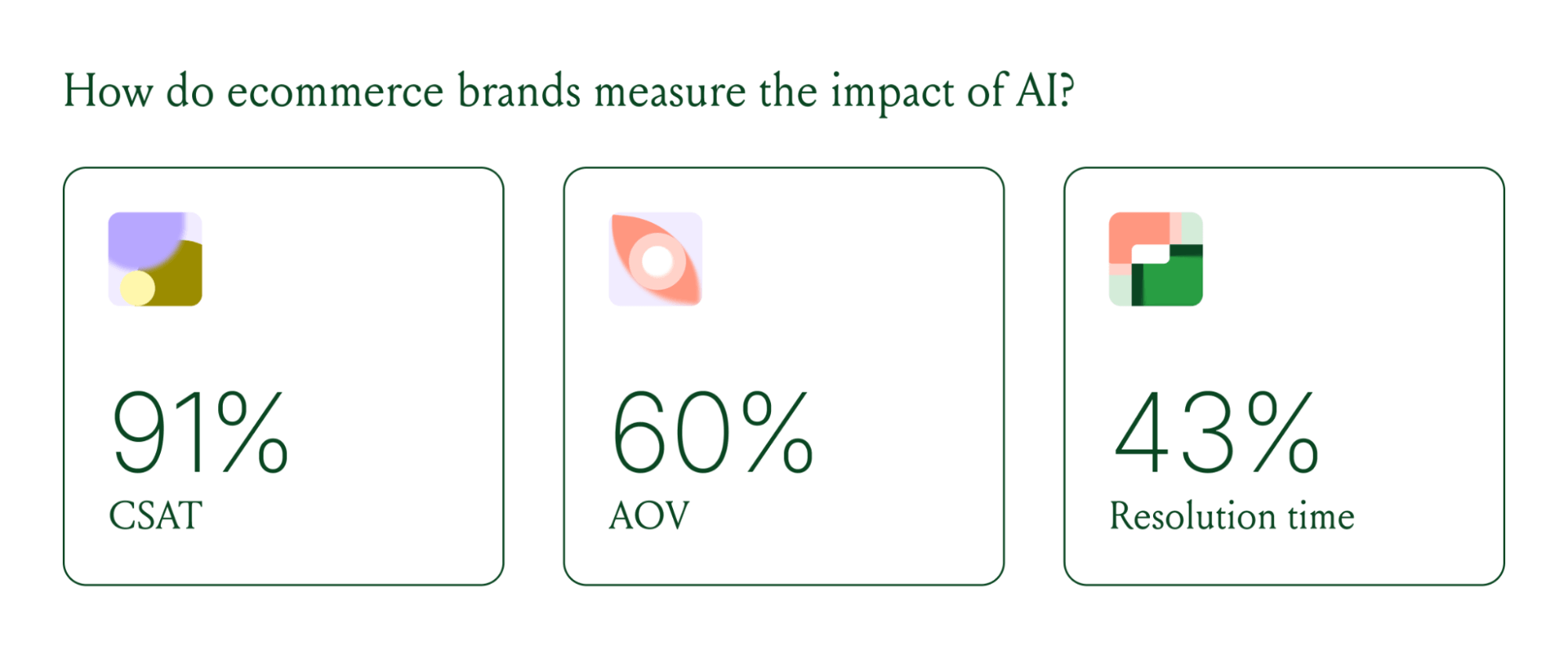
91% of brands still track CSAT as a measure of AI's impact. But 60% now include AOV as a top indicator, and higher-revenue brands earning $20M+ are focusing on metrics like total operating expenses, cost per resolution, incremental revenue, and one-touch ticket rate.
AI can now start a conversation, ease customer doubts, sell, upsell, and recover abandoned carts in a single conversation. When you’re only measuring CSAT, you’re ignoring the real ROI of conversational AI investment.
AI makes every conversational channel a storefront
Virtual shopping assistants now proactively engage shoppers, adapt to their needs in real time, and offer contextual product recommendations and upsells. When the moment calls for it, they can close the deal with a targeted discount.
Gorgias brands using AI Agent's shopping assistant capabilities nearly doubled their purchase rates and converted 20–50% better than those using AI Agent for support only.
Orthofeet, the largest provider of orthopedic footwear in the US, is a concrete example of this in practice. Using Gorgias, they achieved:
- 56% of support tickets automated in 2 months
- Email response times down from 24 hours to 35 seconds
- Double-digit revenue growth without adding headcount.
What this means for your AI strategy
The data tells a clear story: AI has evolved beyond a tool for handling tier 1 support tickets. It’s a core part of your revenue generation strategy.
57% of brands are already using AI for 26–50% of all customer interactions, and 37% expect that share to rise to 51–75% within the next two years. The brands building toward that range now are the ones who will have the operational advantage when it matters most.
The practical question isn't whether to invest in AI. It's where to focus first. Based on where brands are seeing the most impact, three priorities stand out:
- Start with high-volume, low-complexity tickets. WISMO (where is my order) inquiries, return policy questions, and order status updates are where AI delivers the fastest return. Automate these first.
- Expand into conversational channels. Social messaging and SMS are where AI is driving the most success right now.
- Connect AI performance to revenue metrics. If you're only measuring CSAT and response time, you're missing half the story. Add AOV, conversion rate, and incremental revenue to your reporting.
Want to go deeper on the full 2026 conversational commerce trends? Read the complete report for data across every major AI use case in ecommerce.
{{lead-magnet-1}}




Further reading

85+ Helpful Customer Service Statistics for 2023
Looking for some customer support statistics to develop your business strategy for 2023? You’re in the right place.
Understanding customer expectations and their impacts on your business is a great way to improve your company’s customer service. For example, it can help you:
- Make your request for more support resources more compelling and data-backed
- Inform your strategy, including deciding where to invest
- Benchmark your performance against similar companies
In this post, we’ve gathered tons of customer support statistics all in one place so you can understand the objective numbers behind the state of customer service as it stands now.
Customer service stats takeaways
Technology has driven the evolution of ecommerce in many ways, and the same trend rings true when it comes to customer service. Some of the biggest takeaways from this data include:
- Customer expectations are growing. 79% of businesses believe that customers are smarter and more informed now than in the past. They expect A+ service from every brand. Bad customer service experiences will even cause shoppers to look for alternative options.
- Seamless cross-channel journeys are challenging, but essential. 53% of consumers say customer support interactions feel “fragmented.” This is a critical challenge, as customers expect the same experience regardless of when and how they’re interacting with brands and service teams.
- Artificial intelligence (AI) is here. 64% of service professionals who use AI believe it allows them to personalize and improve the service they provide. AI technology is a cost-effective way for brands to keep up. And modern consumers are warming up to the idea, easing concerns about AI leading to bad experiences and issues with privacy, trust, and ethics.
Recommended reading: 8 Customer Service Trends for 2023
{{lead-magnet-1}}
The state of customer service in 2023
Excellent customer service is becoming both more challenging and a bigger competitive advantage than ever before. To deliver on that, brands have to overcome the challenge of high-effort, disconnected experiences.
- 88% of customers say the experience a brand provides is equally as important as the product or services it sells. This is up from 80% in 2020. Consider a good customer service experience one of the most important things you can sell. (Source: State of the Connect Customer report, Salesforce)
- 53% of consumers say customer support interactions feel “fragmented.” This is often due to hold times, handoffs to other customer service representatives, and ill-equipped customer service reps. (Source: State of the Connect Customer report, Salesforce)
- 13% of shoppers believe it takes minimal effort to get their issues resolved. (Source: State of the Connect Customer report, Salesforce)
- 29% of consumers feel like it takes “a lot” of effort to find solutions to their service issues. (Source: State of the Connect Customer report, Salesforce)
- Simplifying the customer journey while simultaneously reducing call volumes and costs is one of the top three customer service priorities for businesses in 2022. (Source: The State of Customer Care Survey 2022, McKinsey & Company)
 |
- 79% of businesses believe that customers are smarter and more informed now than in the past. (Source: HubSpot Annual State of Service in 2022)
 |
- 85% of businesses believe that customers are more likely to share both positive and negative experiences in 2022 than in the past. This could have a huge impact on your company’s word of mouth — a big concern if you’re offering poor customer service experiences. (Source: HubSpot Annual State of Service in 2022)
- 27% of customers who place an order reach out to support at some point in the buying journey, based on data from 12k ecommerce brands. (Source: Gorgias data)
- Brands receive an average of 882 monthly tickets, based on data from 12k ecommerce brands. (Source: Gorgias data)
- 61% of customer care leaders have experienced an increase in total calls in 2022. They cite “increased contacts per customer” and a growing customer base as the leading causes. (Source: The State of Customer Care Survey 2022, McKinsey & Company)
- Brands’ top four customer service priorities in 2022 are creating a great customer experience (45%), customer success (37%), customer retention (35%), and customer engagement(33%). (Source: HubSpot Annual State of Service in 2022)
- 88% of customer service leaders say customer expectations have soared to an “alltime high” in 2022. (Source: HubSpot Annual State of Service in 2022)
- 83% of customers expect to be able to resolve their complex issues with just a single customer support representative. (Source: The State of Customer Care Survey 2022, McKinsey & Company)
The top 10 reasons customers reach out to (ecommerce) support teams (based on a Gorgias survey of 12,000 ecommerce sites) are:
- Order status
- Returns
- Pre-sale product questions
- Shipping questions when deliveries aren’t received
- Order change
- Order cancellation
- Missing an item from an order
- Marketing
- Negative customer feedback
- Warranty questions
 |
Customer service benchmarks
Customer service is increasingly important, and average response times are decreasing. Benchmarks are helpful to keep in mind to ensure you’re competitive, but it’s equally important to set your own benchmarks and compete against yourself.
- Ecommerce businesses have an average Net Promoter Score (NPS) of 50. (Source: Retently)
- The customer satisfaction rating (CSAT) on Gorgias is 4.55. (Source: Gorgias data)
- Customer support agents handle an average of 1 ticket per hour. (Source Gorgias data)
- Brands have an average of 3 active agents at any given time. (Source: Gorgias data)
- The average resolution time is 18.1 hours. (Source: Gorgias data)
 |
- The average first response time is 11.4 hours. (Source: Gorgias data)
- The average first response time on Facebook is 10 hours. (Source: Gorgias data)
- The average first response time on email is 7 hours and 34 minutes. (Source: Gorgias data)
- The average first response time via contact form is 11 hours and 25 minutes. (Source: Gorgias data)
- The average first response time on live chat is 42 minutes. (Source: Gorgias data)
- The average first response time on SMS is 35 minutes hours. (Source: Gorgias data)
 |
- The recommended average resolution time is same-day for email. (Source: Gorgias)
- The recommended average resolution time for SMS tickets is 10 minutes. (Source: Gorgias). (Source: Gorgias)
- Live online chat support queries are typically resolved in under 10 minutes. (Source: Gorgias)
- Customer support interactions over the phone are best resolved in 1 call. (Source: Gorgias)
- Social media queries should ideally have a same-day resolution for comments and a 10-minute resolution for DMs. (Source: Gorgias)
 |
Want to get better at measuring your service? Check out our guide to customer service metrics.
The importance of great customer service (and danger of poor customer service)
Customer service impacts the bottom line, and customers are willing to share their experiences — good or bad. It also builds trust with shoppers, making them more eager to make a purchase and build a lasting relationship with your brand.
- 94% of customer respondents say the “treatment of customers” is the top influence on their purchase decisions. (Source: State of the Connect Customer report, Salesforce)
 |
- Improving the customer experience can increase sales revenues by 2%–7% and profitability by 1%–2%. (Source: Prediction: The future of Customer Experience, McKinsey & Company)
- Improvements to customer service also boost overall shareholder return by 7%–10%. (Source: Prediction: The future of Customer Experience, McKinsey & Company)
- 48% of customers will seek out competing brands for better customer service. (Source: State of the Connect Customer report, Salesforce)
 |
- 74% of customers say it’s more important now than before the pandemic for brands to communicate honestly and transparently. (Source: State of the Connect Customer report, Salesforce)
- 62% of customers feel an emotional connection to the brands they buy from most, which is amazing for customer loyalty. Impersonal interactions, including irrelevant offers or waiting on hold, damage those relationships. (Source: State of the Connect Customer report, Salesforce)
- Repeat customers account for only 21% of customers, but generate 44% of revenue and 46% of orders. (Source: Gorgias)
 |
- 94% of shoppers say they’re likely to make a repeat purchase after a positive customer service experience. (Source: State of the Connect Customer report, Salesforce)
- 82% of customers have recommended a company because they had a positive customer service experience. (Source: State of the Connect Customer report, Salesforce)
- 80% of consumers will even forgive brands after they made a mistake, so long as it’s followed up with good customer service. (Source: State of the Connect Customer report, Salesforce)
- 78% of consumers have made purchase decisions based on their customer service experiences. (Source: State of the Connect Customer report, Salesforce)
 |
- 68% of customers trust businesses are telling the truth in 2022, compared to 59% in 2020. (Source: State of the Connect Customer report, Salesforce)
 |
- 96% of customers say excellent customer service builds trust. (Source: State of the Connect Customer report, Salesforce)
- Repeat customers drive 300% more revenue than new customers. (Source: Gorgias)
 |
Customer service teams and employees
Challenges with employee retention have led to reduced quality in terms of service standards. Brands with strong customer service training and strong, loyal service teams stand to gain a competitive advantage.
- In 2021, nearly half of customer care managers faced increased employee attrition. (This was largely because up to 85% of the workforce shifted to working from home in 2020–2021). (Source: The State of Customer Care Survey 2022, McKinsey & Company)
- The top-cited reason for employees leaving is poaching by competitors—58%—followed by employee dissatisfaction (39%), lack of advancement opportunities (31%), and lack of work–life balance (30%). (Source: The State of Customer Care Survey 2022, McKinsey & Company)
 |
- 41% of service business leaders say it takes three to six months to train a new employee. 20% say it takes more than six months. (Source: The State of Customer Care Survey 2022, McKinsey & Company)
- “Retaining and developing the best people” was one of the top three customer service priorities for businesses in 2022. (Source: The State of Customer Care Survey 2022, McKinsey & Company)
- According to service leaders, the most effective ways to retain top customer service talent is through focusing on motivating and building trust with employees (34%), encouraging leaders to act on employee feedback (24%), offering new career opportunities (11%), and aligning their work to the overall company’s goals and values (11%). (Source: The State of Customer Care Survey 2022, McKinsey & Company)
 |
- According to 54% of customer service professionals, peer relationships are the best way to learn. 50% learn by attending conferences and 39% from formal mentors. (Source: HubSpot Annual State of Service in 2022)
- Service professionals actively learn new skills for their roles “a few times a month or more often” (32%), “about once a month” (30%), or “a few times a year” (28%). (Source: HubSpot Annual State of Service in 2022)
Personalization in customer service statistics
Customers continue to expect more relevant messaging and promotion from brands, including personalized customer support. And their hesitations around data privacy and related technologies are waning, making them more open to sharing information to receive improved customer service interactions.
- 73% of customers expect brands to understand their personal customer needs. (Source: State of the Connect Customer report, Salesforce)
- 62% of shoppers expect brands to anticipate their needs. (Source: State of the Connect Customer report, Salesforce)
- 56% of shoppers expect all offers to be personalized to them. (Source: State of the Connect Customer report, Salesforce)
- 56% of customers feel like brands just treat them as a number, not as a person to build a relationship with. (Source: State of the Connect Customer report, Salesforce)
 |
- 46% of consumers would share their style preferences if it meant they would receive personalized offers and rewards. (Source: State of the Connect Customer report, Salesforce)
- 61% of consumers feel comfortable with brands using their personal information transparently and beneficially. This is an increase from 52% in 2020. (Source: State of the Connect Customer report, Salesforce)
- Almost 80% of consumers say that when brands are transparent about how they use their data to provide personalized experiences, it makes them trust the brand more. (Source: State of the Connect Customer report, Salesforce)
 |
Customer service tools and platforms
Technology is key to delivering exceptional customer service experiences. The right tools, from helpdesks to live chat support apps, are essential to meeting today’s customer expectations.
- Only 12% of digital platforms are “highly integrated.” (Source: The State of Customer Care Survey 2022, McKinsey & Company)
- There are 94 help desk solutions currently available in the market. Gorgias has the top spot. (Source: Datanyze)
- Gorgias customers improve ticket resolution by 34% by adding phone support. (Source: Gorgias)
- 86% of live chat tickets end with a satisfied customer. (Source: Gorgias)
 |
- 77% of businesses use some form of digital means to provide customer service and assistance, yet only 10% of new digital platforms are fully taken advantage of by customers. (Source: The State of Customer Care Survey 2022, McKinsey & Company)
- 95% of customer service leaders believe a customer relationship management (CRM) platform can help boost productivity. (Source: HubSpot Annual State of Service in 2022)
- 36% of brands track NPS scores as a way to listen to customers. (Source: HubSpot Annual State of Service in 2022)
Multichannel customer service statistics
The number of communication channels customers can use to interact with brands (and vice a versa) is constantly increasing. This number is only going to grow, so brands need to understand not only how to leverage each customer service channel but also how to integrate all the touchpoints into a single synonymous customer experience.
Synergy across an omnichannel support experience is the new baseline for good service.
- 43% of shoppers prefer to use non-digital channels for customer service, preferring in-person or phone support. (Source: State of the Connect Customer report, Salesforce)
- 83% of shoppers say they have more brand loyalty when customer service is consistent across departments. (Source: State of the Connect Customer report, Salesforce)
- 86% of live chat tickets end with a satisfied customer—more specifically, a 4- or 5-star CSAT rating. (Source: Gorgias)
- Businesses plan to increase digital customer interactions by 1.5 times by 2024. (Source: The State of Customer Care Survey 2022, McKinsey & Company)
AI and automation in customer service
Artificial intelligence (AI) enables more self-service options, as well as automations. Effective use of support automation technology can boost efficiency and reduce resolution and response times.
- Nearly 80% of businesses have experienced an increase in customer adoption of self-service customer support channels, including chatbots. (Source: State of the Connect Customer report, Salesforce)
- Only 20% of online support interactions are completely self-serviced and unassisted. (Source: The State of Customer Care Survey 2022, McKinsey & Company)
- Nearly two-thirds of customer care leaders say that higher-quality self-service options have contributed significantly to reduced call volumes. (Source: The State of Customer Care Survey 2022, McKinsey & Company)
- 14% of Gorgias tickets are automated. (Source: Gorgias data)
- The top 5% of Gorgias Automate users automate 45% of all interactions (source: Gorgias).
 |
- 79% of customer service professionals believe AI is “somewhat to very important” to their jobs. (Source: HubSpot)
 |
- 64% of service professionals who use AI believe it allows them to personalize and improve the service they provide. (Source: HubSpot)
 |
- 65% of customer service tasks are automated. (Source: The State of Customer Care Survey 2022, McKinsey & Company)
- 57% of consumers trust companies to use AI ethically. (Source: The State of Customer Care Survey 2022, McKinsey & Company)
- 72% of shoppers have concerns about the ethics behind companies’ use of AI. (Source: The State of Customer Care Survey 2022, McKinsey & Company)
- 69% of customers are open to the use of AI if it can improve their experiences. (Source: The State of Customer Care Survey 2022, McKinsey & Company)
 |
- Only 20% of online support interactions are completely self-serviced and unassisted. (Source: The State of Customer Care Survey 2022, McKinsey & Company)
- Nearly two-thirds of customer care leaders say that higher-quality self-service options have contributed significantly to reduced call volumes. (Source: The State of Customer Care Survey 2022, McKinsey & Company)
 |
- 88% of consumers expect brands to have self-service support tools. (Source: Statista)
 |
- In 2022, 58% of customers have used chatbots for simple customer service. (Source: State of the Connect Customer report, Salesforce)
- In 2022, 65% of customers reported having used self-service account portals for service. (Source: State of the Connect Customer report, Salesforce)
 |
- 66% of Millennials prefer self-service for simple support cases, compared to 61% of Gen Zers, 59% of Gen Xers, and 49% of Baby Boomers. (Source: State of the Connect Customer report, Salesforce)
 |
The future of customer service
Anticipating future trends and advancements can help you stay ahead of the curve. Customer expectations will continue to rise, touchpoints will become increasingly complex, and AI will play a growing role in delivering top-notch service.
- 58% of service leaders believe call center volumes will continue to increase over the next 18 months. (Source: The State of Customer Care Survey 2022, McKinsey & Company)
- Digital channels will become increasingly important. Millennials and Gen Zers are the most digitally savvy. Each of these generations, for example, is 1.6x more likely than Baby Boomers to prefer digital channels. (Source: State of the Connect Customer report, Salesforce)
 |
- AI-powered self-service options are also going to grow. Nearly 80% of businesses have experienced an increase in customer adoption of self-service customer support channels, including chatbots. (Source: State of the Connect Customer report, Salesforce)
Are you ready to improve your customer service in 2023?
Now that you know the latest customer experience statistics in 2023, check out our list of customer service best practices to put this knowledge into action and become a more customer-centric company to attract and retain loyal customers.
{{lead-magnet-2}}

A Guide to Customer Service Roles & Responsibilities
In customer service, you can find a wide variety of job titles, each with a unique set of key responsibilities — everything from answering phones at a call center to setting up automations, developing strategies for customer retention, and much more.
If you’re looking for a job in customer service, you’re in the right spot. Customer support can be a great way to transition industries and work your way toward a satisfying and rewarding career. Below, you’ll learn about 7 types of customer service roles, including typical daily duties and qualifications.
If you’re hiring customer support team members, you can also adapt the job posting templates to help you find talented new employees. Plus, you’ll hear from a couple of top ecommerce brands about why it’s important to give everyone on your team some customer service responsibilities, regardless of their role.
Customer Service Agent (or Representative)
Customer Service Agents (or Customer Service Representatives) are the most junior role on a customer support team. Support Representatives are customer-facing employees on the frontline. They receive incoming support messages and calls, answer basic questions, and pass along complex or technical questions as needed.
Of course, even at this stage, Agents can play a major role in helping improve workflows, tagging and organizing incoming support requests, passing along customer feedback, and more.
If you’re a recent graduate or trying to pivot to a career in customer service, becoming an Agent is a great option.
Customer Service Representative job description template
We are seeking a dedicated and friendly Customer Service Agent to join our team. In this role, you will be the face of our company, assisting customers with their inquiries, resolving any issues, and ensuring a positive customer experience.
The ideal candidate will have excellent communication skills, problem-solving abilities, and a passion for delivering exceptional customer service.
Duties and responsibilities
- Provide prompt and efficient responses to customer questions via phone, email, social media, and chat
- Address and resolve customer complaints or concerns in a professional and timely manner
- Maintain a high level of company product knowledge to effectively answer customer queries
- Identify opportunities to upsell or cross-sell products and services to customers
- Collaborate with other team members and departments to ensure customer satisfaction
- Keep accurate records of customer interactions and transactions in the CRM system
- Follow company policies and procedures when handling customer requests and issues
- Continuously strive to improve customer service skills and knowledge through training programs
Qualifications and requirements
- Previous experience in customer service or a related field is preferred
- Excellent verbal and written communication skills, plus active listening skills
- Experience with a helpdesk, CRM software, and other customer service tools
- Ability to multitask and prioritize tasks effectively in a fast-paced environment
- Strong problem-solving and decision-making abilities
- A positive and empathetic attitude toward customers
- Availability to work flexible shifts, including evenings, weekends, and holidays
- High school diploma or equivalent work experience
- Additional certifications in customer service or related fields are a plus
Benefits
- Competitive salary ($40,000 – $55,000)
- Health, dental, and vision insurance
- 401(k) retirement plan
- Paid time off (15 days) plus holidays and sick days
- Ongoing training and development opportunities
How to apply
Interested candidates should submit their resume and cover letter to [email].
How Gorgias supports this role
Gorgias is chock-full of features and automations to help Customer Service Agents offer quick, helpful responses.
For instance, Gorgias centralizes messages from all communication channels (email support, live chat support, social media support, SMS support, WhatsApp support, and more) into one shared inbox so Agents don’t have to spend all day switching tabs. This helps your team offer omnichannel customer service.
 |
Also, when Agents are answering incoming support tickets, Gorgias displays customer information (including past conversations and orders) to give Agents all the context they need to answer the question. This also helps Agents offer personalized customer service.
 |
{{lead-magnet-1}}
Customer Service Specialist (or Level 2 Agent)
Customer Service Specialists have many of the same day-to-day responsibilities as Representatives. The main difference is that Specialists typically have more experience, know more customer service techniques, and can handle more complex, sensitive, and challenging interactions with customers.
In most teams, tickets get “escalated” to Level 2 Agents (or Specialists) if they’re beyond the skillset of an Agent. Often, Agents get promoted to Specialists once they understand the company’s policies, procedures, and products. It can be a great stepping stone to managing a team.
Customer Service Specialist job description template
We are seeking a Customer Service Specialist to join our team who will respond to customer inquiries by phone call, email, or chat. As a Specialist, you will be responsible for resolving mostly routine customer inquiries with some non-routine, more complex problems.
The ideal candidate will have excellent communication skills, problem-solving abilities, and a passion for delivering exceptional customer service — including to angry or escalated customers.
Duties and responsibilities
- Provide excellent customer service by responding to customer inquiries by phone, email, social media, SMS, or chat in a friendly and professional manner
- Analyze customer service needs and refer to other service or technical departments for follow up as needed
- Use customer relationship applications or databases to record activities and research product information
- Resolve mostly routine and some non-routine, more complex problems like processing orders and multitasking
- Document customer inquiries and monitor responses for quality assurance purposes
- Proactively engage with customers, identifying opportunities for improvements and suggesting potential solutions
- Stay up-to-date with industry trends and best practices in customer service
Qualifications and requirements
- 1-3 years of related experience preferred, or additional specialized training and/or certification
- Excellent verbal and written communication skills
- Ability to empathize with customers and remain calm and composed in difficult situations
- Strong problem-solving abilities with a focus on finding effective solutions for customers
- Familiarity with CRM systems and other relevant software tools
- Availability to work flexible hours, including evenings and weekends
- High school diploma or equivalent work experience
- Additional education or certification in customer service is a plus
Benefits
- Competitive salary ($45,000 – $60,000)
- Health, dental, and vision insurance
- 401(k) retirement plan
- Paid time off (15 days) plus holidays and sick days
- Ongoing training and development opportunities
How to Apply
To apply, please submit your resume and a cover letter detailing your relevant experience to [email].
How Gorgias supports this role
Gorgias makes escalating tickets to Level 2 agents extremely easy. You can even set Gorgias up to automatically assign angry customers to certain agents — this works because Gorgias scans the sentiment and intent of every incoming ticket, and can assign, tag, and even respond automatically based on what it finds.
Here’s a visualization to help explain how Gorgias can automatically detect the contents of a ticket, and assign or tag it however works best for your team.
 |
Customer Service Team Lead
The Customer Service Team Lead is directly responsible for managing a team of Agents. As a Team Lead, you’ll spend less (or no) time answering tickets, and more time hiring, onboarding, and training new support agents. ’
In some companies, the Customer Service Team Lead also acts as the Customer Service Manager (which we’ll cover below). But most companies separate the roles: The Team Lead manages the people, while the Manager manages the strategy and business impact.
Customer Service Team Lead job description template
We are seeking a customer service team lead to join our team. Reporting to the customer service team manager, the Customer Service Team Lead will be responsible for leading Customer Support Agents to provide the highest level of support and service to all internal and external customers.
The ideal candidate will have experience in team leadership, customer service, and problem-solving, with an understanding of industry best practices.
Duties and responsibilities
- Lead the customer service team to achieve key performance indicators (KPIs) and customer satisfaction goals
- Develop and implement departmental systems, policies, and procedures to maintain a high level of service
- Identify opportunities to enhance internal processes and promote best practices that lead to overall performance improvement and organizational efficiency
- Monitor and evaluate customer feedback to ensure that the team exceeds customer expectations
- Assist with the recruitment and selection of new team members
- Provide onboarding, coaching, and mentoring to new and existing team members
- Conduct regular performance evaluations and provide development plans that encourage employee engagement
- Plan team rotas to ensure adequate coverage at all times
- Administer the Time Management System (TMS), recording holiday and sickness absences
- Support the team in answering customer inquiries by phone, email, or chat
- Monitor and coordinate the post-sales support process, ensuring all orders are reconciled accurately and progressed through the system correctly
- Evaluate trends in customer inquiries and identify ways to improve customer satisfaction and retention
- Collaborate with other departments to handle customer complaints and issues
- Produce written reports when required to do so
Qualifications and requirements
- Proven experience as a customer service team lead or a relevant leadership role (3+ years)
- A minimum of a high school diploma or equivalent; additional education/training in customer service, leadership, or a related field preferred
- Excellent organizational and problem-solving skills, with a focus on finding effective solutions for customers
- Exceptional verbal and written communication abilities and a customer-centric mindset
- Strong interpersonal skills and experience working as part of a team
- Experience with a helpdesk, CRM software, and other customer service tools
Benefits
- Competitive salary ($55,000 – $70,000)
- Health, dental, and vision insurance
- 401(k) retirement plan
- Paid time off (15 days) plus holidays and sick days
- Ongoing training and development opportunities
How to apply
To apply, please submit your resume and a cover letter detailing your relevant experience to [email].
How Gorgias supports this role
Gorgias gives Team Leads a helpful overview of the team’s performance. Specifically, you can see each agent’s essential metrics — like CSAT, response times, resolution time, conversion rate, and more.
 |
You can use these metrics to evaluate each agent and inform the type of training and coaching each one needs. Speaking of training, Gorgias also offers Gorgias Academy, which features dozens of courses to help teach your agents how to upskill, including how to use the helpdesk.
 |
Customer Service Manager
Customer Service Managers are responsible for implementing the department’s tools and strategies. Unlike Team Leads, who are responsible for people management and coaching, Customer Service Managers are more responsible for setting up tools and automation, making sure the team is working toward business goals, and generating reports about the state of the department.
Customer Service Manager job description template
We are seeking a highly motivated and experienced Customer Service Manager to oversee our customer service operations and ensure the highest level of customer satisfaction. The Customer Service Manager will be responsible for leading a team of customer service representatives, implementing effective strategies, and continuously improving customer service processes.
The ideal candidate will have a strong background in customer service, excellent leadership skills, and a passion for delivering exceptional customer experiences.
Duties and responsibilities
- Lead and manage a team of Customer Service Representatives and Team Leads, providing guidance, training, and support
- Develop and implement customer service standards, policies, and procedures to ensure consistent and high-quality service delivery
- Handle escalated customer inquiries or complaints, resolving issues and ensuring customer satisfaction
- Monitor and analyze customer service metrics, identify areas for improvement, and implement strategies to enhance performance
- Collaborate with other departments to improve customer service processes and optimize customer interactions
- Identify training needs and provide ongoing coaching and development opportunities for the customer service team
- Stay up-to-date with industry trends and best practices in customer service management
- Conduct regular performance evaluations and provide feedback and recognition to team members
- Foster a positive and collaborative work environment, promoting teamwork and employee engagement
- Implement customer feedback mechanisms to gather insights and make data-driven decisions
Qualifications and requirements
- Proven experience in a customer service management role (5+ years)
- Strong leadership skills with the ability to motivate and inspire a team
- Excellent communication skills, both verbal and written
- Strong problem-solving and decision-making abilities
- Proficient in customer service software and CRM systems
- Experience in analyzing customer data and using it to drive improvements
- Excellent organizational and time management skills
- Ability to work well under pressure and meet deadlines
- Customer-centric mindset with a passion for delivering exceptional service
- Bachelor's degree in business administration, communications, or a related field (preferred), or equivalent work experience
Benefits
- Competitive salary ($65,000 – $80,000)
- Health, dental, and vision insurance
- 401(k) retirement plan
- Paid time off (15 days) plus holidays and sick days
- Ongoing training and development opportunities
How to apply
To apply, please submit your resume and a cover letter detailing your relevant experience to [email].
How Gorgias supports this role
Gorgias is full of automations that Customer Service Managers can set up to make their team more efficient and productive.
For instance, imagine you’re a Customer Service Manager looking for solutions to answer more tickets without hiring additional agents. You could set up Gorgias Automate to let customers answer FAQs, track orders, request returns, and more in the chat widget and Help Center.
 |
The Manager can also review the performance of these (and other) automations to understand the impact and find areas for improvement.
 |
Technical Support Engineer
Technical Support Engineers provide support to customers experiencing issues with software and other IT equipment. Most Technical Support Engineers are hired for Software-as-a-Service (SaaS) companies or universities, hospitals, and other large companies that need support for technical equipment and issues.
Note: Gorgias is 100% built for ecommerce. You can send images, videos, and other files to solve complex issues, but the tool isn’t built for software companies that need to offer very technical support. Check out our list of the best customer service software if you’re a non-ecommerce company.
Technical Support Engineer job description template
We are seeking a skilled and customer-oriented Technical Support Engineer to join our team. The Technical Support Engineer will be responsible for providing technical assistance and support to our customers, ensuring timely resolution of technical issues, and delivering exceptional customer service.
The ideal candidate will have a strong technical background, excellent problem-solving skills, and a passion for helping customers.
Duties and responsibilities
- Take ownership of customer issues reported and see problems through to resolution
- Research, diagnose, troubleshoot, and identify solutions to resolve system issues
- Follow standard procedures for proper escalation of unresolved issues to the appropriate internal teams
- Provide enterprise-level technical assistance to customers, including software and hardware support
- Resolve network issues and configure operating systems as needed
- Use remote desktop connections, email, and chat applications to provide immediate support and answer client queries
- Ask customers targeted questions to quickly understand the root cause of the problem
- Track computer system issues through to resolution, within agreed time limits
- Properly escalate unresolved issues to the appropriate internal teams for further investigation and resolution
- Provide prompt and accurate feedback to customers
- Refer to internal databases or external resources to provide accurate technical solutions
- Ensure all customer issues are properly logged and prioritized
- Manage and prioritize multiple open issues at a time
- Follow up with clients to ensure their IT systems are fully functional after troubleshooting
- Prepare accurate and timely reports
- Document technical knowledge by creating notes and manuals
- Maintain positive and professional relationships with clients
Qualifications and requirements
- Proven work experience as a Technical Support Engineer, Desktop Support Engineer, IT Help Desk Technician, or similar role
- Hands-on experience with Windows/Linux/Mac OS environments
- Good understanding of computer systems, mobile devices, and other tech products
- Ability to diagnose and troubleshoot basic technical issues
- Familiarity with remote desktop applications and helpdesk software
- Excellent problem-solving and communication skills
- Ability to provide step-by-step technical help, both written and verbal
- Bachelor's degree in Information Technology, Computer Science, or a relevant field, or equivalent work experience
- Additional certification in Microsoft, Linux, Cisco, or similar technologies is a plus
Benefits
- Competitive salary ($75,000 – $90,000)
- Health, dental, and vision insurance
- 401(k) retirement plan
- Paid time off (15 days) plus holidays and sick days
- Ongoing training and development opportunities
How to apply
To apply, please submit your resume and a cover letter detailing your relevant experience to [email].
Customer Success Manager
Customer Success Managers are responsible for maintaining client relationships. They don’t answer tickets at all — instead, they meet regularly with clients to understand their business goals, help implement solutions, and ensure the client remains happy and satisfied.
Most Customer Sucess Managers work for Software-as-a-Service (SaaS) companies, agencies, and other kinds of client-based companies. Because Gorgias is built for ecommerce support teams, it’s not recommended for Customer Success Managers.
Customer Success Manager job description template
Duties and responsibilities
- Establish clear client retention goals and develop strategies to achieve them
- Collaborate with sales and account management teams to onboard new customers and ensure a smooth transition
- Analyze customer data to gain insights and identify opportunities for improving customer experience and increasing revenue
- Conduct product demonstrations and train customers on how to effectively use our products or services
- Upsell additional services and products that align with customer needs and company offerings
- Act as the main point of contact for customer inquiries, concerns, and escalations, and ensure timely resolution
- Regularly engage with customers to check on their satisfaction, gather feedback, and identify areas for improvement
- Create and deliver customer success metrics and reports to internal stakeholders
- Collaborate with cross-functional teams to implement solutions that address customer needs and enhance their experience
- Assist in creating training courses and educational materials to help customers optimize their usage of our products or services
- Monitor customer health metrics and proactively intervene to prevent churn and increase customer loyalty
Qualifications and requirements
- Proven work experience as a Customer Success Manager or similar role
- Strong track record in managing and growing customer accounts
- Exceptional communication and relationship-building skills
- Technical aptitude with the ability to understand and explain complex products or services
- Experience in promoting and delivering value through exceptional customer experiences
- Ability to work independently and collaboratively in a dynamic, fast-paced environment
- Strong problem-solving and analytical skills
- Ability to build and maintain long-term relationships with clients
- Proficient in using CRM software and tools for tracking customer interactions and metrics
- Bachelor's degree in Business Administration, Marketing, or a related field, or equivalent work experience
Benefits
- Competitive salary ($85,000 – $100,000)
- Health, dental, and vision insurance
- 401(k) retirement plan
- Paid time off (15 days) plus holidays and sick days
- Ongoing training and development opportunities
How to apply
To apply, please submit your resume and a cover letter detailing your relevant experience to [email].
Director of Customer Service
The Director of Customer Service oversees the entire department and reports directly to executive leadership. They are responsible for managing the budget, reporting to executive management, and shaping the future of the department.
Director of Customer Service is the most senior role we’ll cover in this article. But depending on your business’s size and makeup, you could hire additional executive-level roles like Vice President of Customer Experience or Chief Customer Officer (CCO).
Director of Customer Service job description template
We are seeking a skilled and experienced Director of Customer Service to oversee our company's customer service policies, initiatives, and operations.
The ideal candidate will possess a deep understanding of customer needs and expectations, a passion for delivering exceptional customer experiences, and a proven track record of managing high-performing customer service teams.
Duties and responsibilities
- Direct and oversee all aspects of the company's customer service policies, initiatives, and operations
- Develop service level standards to improve response times, reduce customer complaints, and increase customer satisfaction
- Establish and implement best practices to improve service delivery quality, efficiency, and effectiveness
- Develop and institute systems to capture and analyze customer feedback, service metrics, and trends
- Manage resource allocation and budgeting to ensure the delivery of world-class customer service across all communication channels
- Align customer service activities with business objectives and support cross-functional initiatives
- Manage and coach customer service staff and enhance their skills delivery for excellent customer service
- Regularly report to top management and inform them of the progress on customer service KPIs and metrics
- Collaborate with other departments to identify areas for improving customer experience
- Maintain up-to-date knowledge of industry trends in customer service management, customer support software and industry software.
Qualifications and requirements
- 7+ years of progressive management experience in customer service, preferably at a leadership level
- Deep knowledge of best practices in customer service experience management
- Proficient in using and managing customer services systems
- Excellent communication, interpersonal, and conflict resolution skills
- Deep understanding of customer needs and expectations
- Excellent problem-solving skills
- Proven track record collaborating with other internal departments
- Bachelor’s degree in Business Administration, Customer Services Management, or related fields, or equivalent work experience
Benefits
- Competitive salary ($95,000 – $110,000)
- Health, dental, and vision insurance
- 401(k) retirement plan
- Paid time off (15 days) plus holidays and sick days
- Ongoing training and development opportunities
How to apply
To apply, please submit your resume and a cover letter detailing your relevant experience to [email].
How Gorgias supports this role
Gorgias features a suite of tools and dashboards that the Director can use to communicate the department’s performance to executive leadership. On top of Agent Performance, which we mentioned above, you can see a variety of other data.
For example, you can see an overview of your support performance, benchmarked against other support teams in your industry:
 |
You can also see data about your team’s contribution to revenue, to run and report on experiments like using chat campaigns or live chat to generate sales.
 |
Tip: Get your whole company involved in customer support
While you’re building a dedicated customer service team, consider requiring non-support team members to spend some time answering support tickets — either during onboarding or periodically as ongoing training. This helps non-support members:
- Understand your customers: Customer support speaks directly to customers, and it’s a great way to gain a first-hand understanding of their challenges, preferences, and more. Non-support team members can take these insights back to their own roles.
- Answer questions during busy seasons: If non-support team members understand customer support best practices and already know how to use your helpdesk, they can step in during Black Friday — Cyber Monday and other busy seasons.
- Learn the value of good customer support: Often, businesses take customer support for granted. They don’t understand the skill good customer service requires, and they don’t always understand the insights and feedback support conversations can provide.
If you use Gorgias, you’re in luck. While nearly every other helpdesk charges for additional seats, Gorgias gives you unlimited seats so everyone can make a profile and get involved with support at no extra cost.
Plus, Gorgias is easy for anyone — even non-support folks — to pick up and use. Here’s what a Marketing employee at Chomps, a Gorgias user, says:
“As a non-CX'r, Gorgias has made helping out the CX team so much easier. The platform is intuitive. And because our team has built out many Macros, I can easily answer common questions and concerns. Although I'm not on the platform every day, I can toggle between open and closed tickets if I need to reference an old situation and get up to speed quickly and efficiently.”
Read more about how Chomps uses Gorgias to share customer insights across the whole company.
Manage all your customer service roles inside Gorgias
Gorgias is a customer service platform built for teams of all sizes. And to accommodate all the different roles and responsibilities, Gorgias lets you select a role for each user, giving them (only) the permissions they need to do their jobs.
This helps keep everyone focused on their role’s scope, and ensure privacy and security — especially if you outsource customer service and want to limit access to sensitive information.
User Roles include:
- Observer agent: View customers and tickets and add internal notes.
- Lite agent: Modify (but not delete) customers and tickets and send messages.
- Basic agent: Modify (and delete) customers and tickets and send messages. Delete customers and tickets.
- Lead agent: Manage customers, tickets, and tags; send messages; and manage the Help Center.
- Admin: Manage everything.
 |
Want to learn about how Gorgias can help you make your customer service team more efficient and effective? Claim your demo today.
{{lead-magnet-2}}
<div fs-richtext-component="positive-negative" class="blog10_positive-negative-component"><div id="positive-div-1" class="blog10_positive-wrapper"><div class="text-style-bbmodern _48px">Positive</div><div class="blog10_positive-divider"></div><div class="blog10_positive-negative-richtext _0-space w-richtext"><p id="positive-p-1">“Trying”</p></div></div><div id="negative-div-2" class="blog10_positive-wrapper negative"><div class="text-style-bbmodern _48px">Negative</div><div class="blog10_positive-divider"></div><div class="blog10_positive-negative-richtext _0-space w-richtext"><p id="negative-p-1">“To be...”</p><p id="negative-p-2">“...better!”</p></div></div></div>
Should You Offer Live Chat Support? A Guide for CX Teams
TL;DR:
- Live chat is the fastest way to help shoppers. It gives customers real-time answers and prevents drop-off.
- You don’t need a 24/7 team to run live chat. Automate FAQs and set clear hours to keep it manageable.
- Live chat improves conversions and customer loyalty. Shoppers who chat are more likely to make a purchase and return to your store.
- Start by automating questions like order tracking and returns. These are easy to answer and make up most of your volume.
- Gorgias makes it easy to launch and scale live chat. You can integrate with your store and go live in under a day.
According to 2025 Gorgias data, chat inquiries are resolved in 24 minutes versus two days on email. It’s no wonder customers prefer live chat over any other support channel.
If you aren’t already offering live chat, it might feel like a big commitment. But when the end product is happier customers, it’s high time to catch up.
Thinking about offering live chat? Learn more about the benefits of live chat customer support, how it differs from chatbots, when and how to use it, and the best live chat tools to use based on your team’s needs.
What is live chat support?
Live chat support is a form of customer service that uses a chat widget to intake customer inquiries. Ecommerce websites, browser-based tools, and mobile apps typically offer live chat in combination with other customer service channels like email, phone, and social media.
Depending on the business, live chat support availability can vary. Some businesses choose to run live chat within their operating hours, while others extend 24/7 availability with the help of automation, conversational AI, or a dedicated off-hours team.
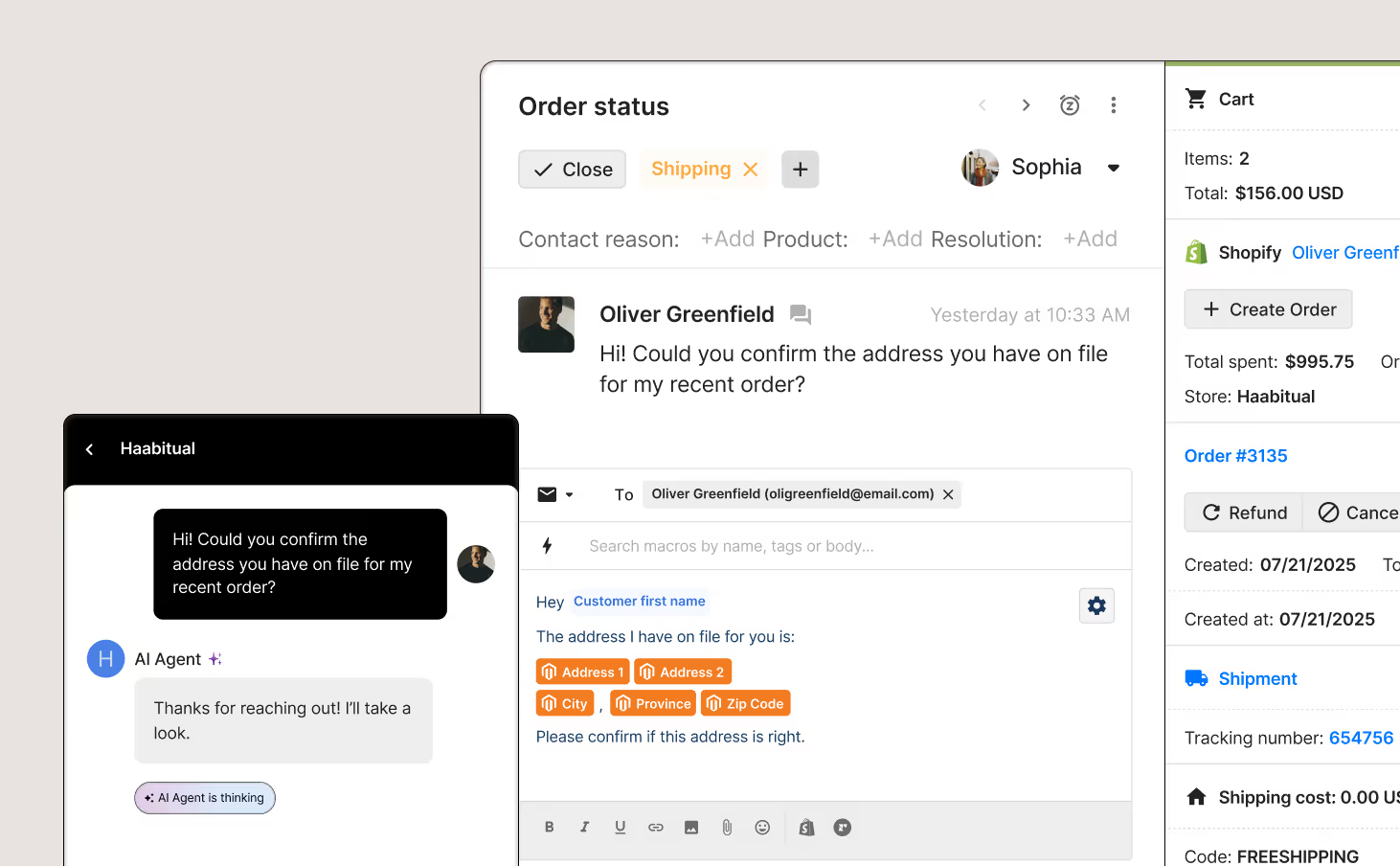
Related: Customer service messaging: Tips and templates for SMS + conversational channels
How does live chat support differ from a chatbot?
The main difference between live chat and chatbots is the option to speak to a live human agent.
With live chat support, customers always have the option of speaking to a live human agent. Meanwhile, chatbots can only provide customers with automated responses, whether preconfigured or generated by AI.
Why should you offer live chat support?
Live chat doesn’t just make support faster—it helps you close more sales.
Aside from quick answers, customers want confidence to buy. In fact, Hiver reports that 63% of consumers prefer live chat over phone and social media, mainly because they get instant answers while they’re still browsing.
Here are the benefits of implementing live chat for your business:
- Customer satisfaction: Customers get the clarity they need while shopping
- Higher conversions: Live chat removes friction at checkout by resolving doubts in real time
- Faster resolutions: Support teams close tickets faster by solving issues right away
- Revenue retention: Agents can recommend the right product, reducing the chance of returns later
Read more: A guide to resolution time: How to measure and lower it
When does live chat make the biggest impact?
Live chat shines in situations where timing directly impacts whether a customer buys your product or walks away. These conversations often happen before a purchase, like when a shopper is deciding between products, has concerns about shipping, or wants to confirm your return policy.
Use live chat in these moments:
How automation makes live chat support scalable
You don’t need a large support team to offer high-quality live chat support. Sure, live chat can feel risky if you’re a brand with a lean CX team or high ticket volume, but when you automate the right types of conversations, it becomes one of the most impactful support channels.
What to automate first
Start with high-frequency, low-complexity inquiries. These are repetitive questions that don’t require an agent to resolve:
- Order tracking (where is my order)
- Shipping, return, exchange, and cancellation policies
- Basic troubleshooting
- Product education, like sizing or fit guides
These types of tickets typically make up the bulk of your live chat volume. Automating them clears the way for agents to focus on conversations that require more specialized knowledge and nuance.

Automation features that help you scale
The best live chat isn’t only a messaging tool, it also comes with features that make the support agents using it more productive.
Here are the top automation features to improve live chat:
- Macros: One-click prewritten replies to common questions that agents can send manually or automatically.
- Customer and product variables: Dynamic details—like name, order number, and delivery date—pulled from your ecommerce platform and inserted into messages can easily make interactions more personalized.
- Flows: Interactive Q&A scenarios that automatically answer customer questions in the chat widget.
- Routing: Prioritize or assign tickets to agents based on topic, urgency, or language for maximum efficiency.
- Conversational AI: Leave live chat on 24/7 with tools like Gorgias AI Agent to answer repetitive questions and update orders—even when your team is offline.
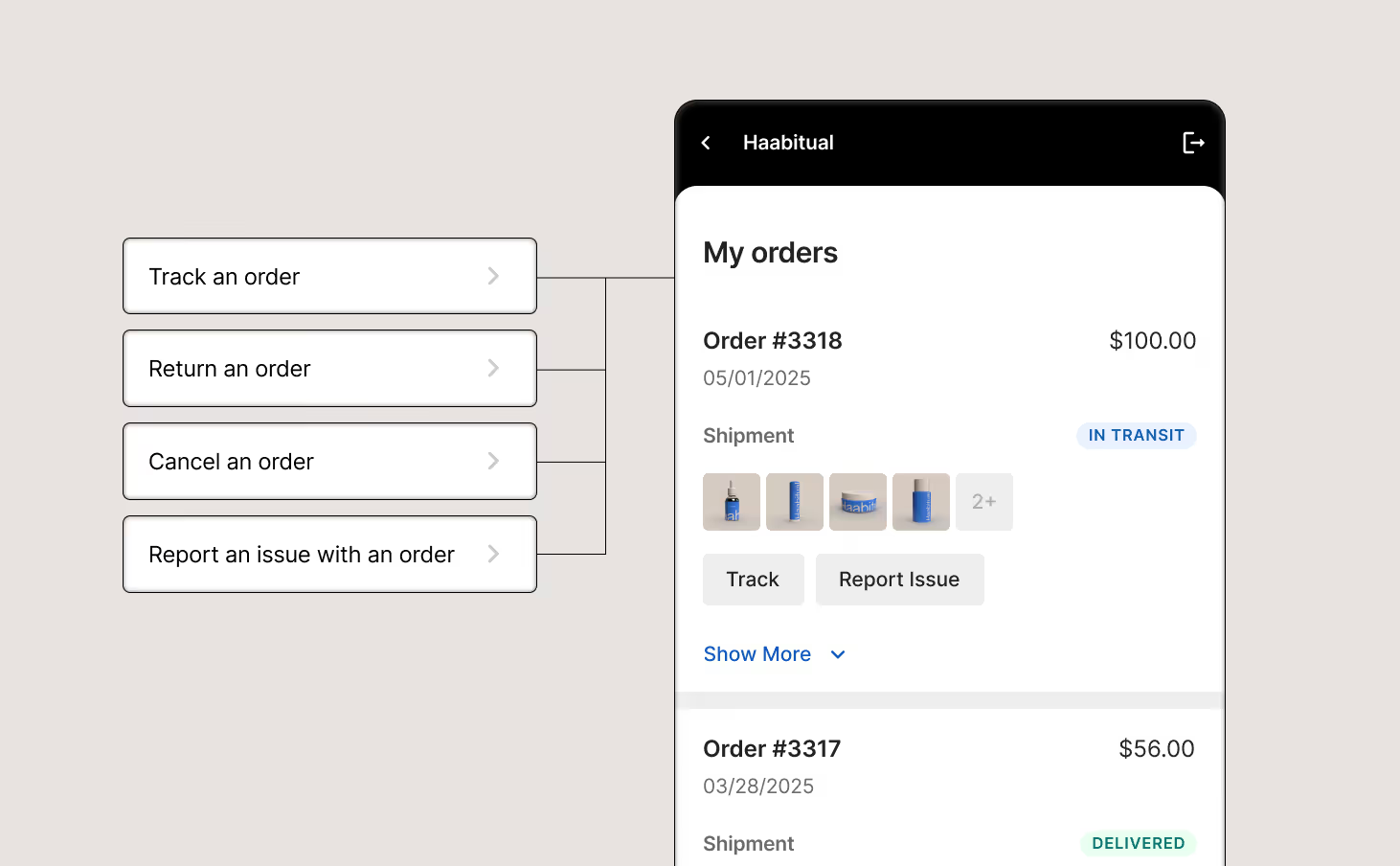
The dos and don’ts of replying to a live chat message
Good live chat messages are quick, helpful, and easy to follow. Poor live chat messages are slow, robotic, or long-winded.
Follow these guidelines to help keep your replies effective and consistent:
How to set up live chat without overwhelming your team
Adding live chat for the first time or want to make your current setup more manageable? Start with these five steps:
1. Set live chat hours
You don’t need to be online at all times to offer live chat. Start by choosing live chat hours that reflect your team’s availability and peak shopping hours.
Remember to display your availability on your website clearly to manage customer expectations.
2. Prioritize live chat tickets in your inbox
Customers who reach out to you via chat are active on your site and often close to purchasing.
Create rules in your helpdesk that flag live chat conversations as urgent, so they don’t get buried under slower channels like email. If you have a dedicated agent who handles chat, route all chat tickets to them for instant visibility.
3. Automate your first reply
Set up an auto-response that triggers immediately when someone starts a chat. Even a short message like “Hey! Thanks for your message, an agent will be right with you,” can reduce drop-off and give your team time to prep.
4. Edit your macros for live chat
Templates that work in email may be too wordy in chat. Shorten your macros, simplify the tone, and make sure each response fits cleanly into a chat window. Use dynamic variables to pull in details like order number or shipping status without slowing down your agents.
5. Capture customer emails when live chat is offline
Customers don't stop having problems when your team clocks out. When someone tries to chat outside business hours, collect their email so an agent can follow up once your support team is back online.

Best live chat tools for CX and support teams
If you’re evaluating live chat software, here are five solid options to start with. Each one fits different team sizes and priorities.
Deliver faster support without adding headcount
Gorgias helps ecommerce brands deliver fast support without cutting into your budget. Automate common questions with conversational AI, resolve tickets in seconds, support and sell, and give your team the context they need to handle complex conversations with one tool.
Want live chat that takes support to the next level? Book a demo.
{{lead-magnet-2}}

.avif)
Customer Service Glossary: Main Terms and Definitions To Know
The expansive terminology of customer service is ever-growing. Whether you’re venturing into the world as a new agent or you’re a seasoned support lead, our comprehensive customer service glossary will provide you with precise definitions and examples to elevate your understanding of customer service.
The glossary is divided into seven categories, starting with basic customer service concepts and ending with technical terms related to metrics and KPIs.
Start reading below and learn new and old customer service terms.
{{lead-magnet-1}}
The 100+ Most Important Customer Service Terms for Agents and Support Teams
Basic customer service concepts
1. Agent
An agent is a customer service representative who assists customers by addressing questions, inquiries, and fulfilling support requests.
Interested in being an agent? You can start learning with Gorgias Academy’s Agent Training collection and earn your certification.
2. Abandoned cart
An abandoned cart occurs when a customer adds items to their online shopping cart but leaves the website without completing the purchase. Some causes of abandoned carts are high prices, customers preferring competitor products, and complicated checkout pages.
📚 Related reading: How to reduce cart abandonment in 12 ways
3. Channels
A communication platform through which customers can contact customer service agents for assistance. Examples of channels include email, live chat, SMS, and phone. Offering multiple channels lets customers contact a business more easily.
4. Complaint
A complaint is when a customer expresses dissatisfaction with a product, service, or experience. Support teams should aim to have little to no complaints. However, if you do receive a complaint, make sure to take notes as they can provide powerful insights to how your business can improve your process or products.
5. Consumer behavior
Consumer behavior is the pattern of actions that customers take before, during, and after purchasing a product. Companies can get consumer behavior data by interacting with customers and receiving survey answers.
6. Conversational customer service
Conversational customer service focuses on providing customers a relatable, human experience through conversation. This is achieved through the use of friendly, casual language and minimal use of automated responses.
{{lead-magnet-2}}
7. Crisis management
Crisis management is about effectively managing customer service during times of crisis or emergencies. A customer service team will need proper crisis management during unexpected events like power outages, product recalls, or staff shortages.
8. Customer-centric
Customer-centric refers to an approach that centers and prioritizes the customer’s needs, desires, and behaviors. For example, a customer-centric brand will regularly ask customers for feedback on their processes and decisions.
9. Customer engagement
Customer engagement refers to how involved a customer is with your business. Higher customer engagement leads to more trust, and potentially, more sales. You can increase customer engagement with more customer interactions and eye-catching marketing campaigns.
10. Customer experience
Customer experience is the overall impression a customer has about your company at all stages of the customer journey. An excellent customer experience occurs when customers feel that a business’ service is personalized to their needs and preferences.
11. Customer feedback
Customer feedback is input from customers about their experiences and is used by businesses to improve their customer service processes and products. Some ways to collect customer feedback is by sending email surveys, implementing website pop-up surveys, and adding reviews to product pages.
12. Customer journey
The customer journey is the path a customer takes from initial brand awareness, purchasing consideration, first purchase, retention, and advocacy.

13. Customer needs
Customer needs are things a customer wants, needs, and desires. Customer service teams should pay attention to customer needs to empathize and have successful communications with customers.
14. Customer retention
Customer retention is the process of maintaining relationships with customers to keep them purchasing and engaged with a business. Customer retention is easier and less costly to maintain than engaging new customers.
15. Customer segmentation
Customer segmentation is the process of dividing customers into groups based on common characteristics to provide targeted support. For example, a clothing apparel company may divide customers by demographics in order to create suitable ad campaigns for each segment.
16. Customer service
Customer service is assistance and support provided to customers before, during, and after a purchase. Customer service is important for companies to invest in to grow their customers and instill trust in both potential and repeat customers.
17. Data privacy
Data privacy refers to protecting confidential customer data and information, such as full names, addresses, billing information, and phone numbers.
18. Feedback loop
Feedback loop is the cycle of collecting, reviewing, and applying customer feedback to improve products and customer services. The most important part of the loop is to apply customer feedback to demonstrate the importance of your customers’ opinions.
19. Influencer marketing
Influencer marketing is a type of marketing that involves working with social media influencers to advertise a business’ products on their social channels.

📚 Related reading: How Topicals increased sales by 78% through pre-sales customer conversations
20. Netiquette
Netiquette refers to the etiquette and guidelines for respectful communication online. For ecommerce stores, having proper netiquette includes writing messages with proper grammar and punctuation, refraining from sending too many promotional emails, and respecting customers’ privacy.
21. Personalized customer service
Personalized customer service is a type of customer service that focuses on customizing interactions and service based on a customer’s unique preferences. Creating individual experiences for customers allows them to feel understood on a personal level.
🧠 Learn more: Why you should implement a personalized customer strategy
22. Proactive support
Proactive support is a customer support approach that anticipates customer needs before they raise a concern. Proactive support does not have to involve agent support and can be accomplished passively through self-service options, such as a chat widget or help center.
23. Rapport
Rapport is the relationship businesses build with customers. Some characteristics that build good rapport are empathy, supportiveness, and honesty.
24. Reactive support
Reactive support refers to a customer support approach where assistance is provided in response to inquiries or issues as they arise, rather than proactively reaching out to customers.
25. Remote support
Remote support is a type of customer service where agents assist customers by using remote access tools, without needing to be physically present at the customer's location.
26. Resolution
Resolution is the successful solution to a customer’s request or inquiry.
27. Satisfaction
Satisfaction is the level of contentment a customer experiences after interacting with a business, its products or services. Customer satisfaction is important in order to build trust and gain customer loyalty.
28. Service recovery paradox
Service recovery paradox is the phenomenon where a customer is more loyal after experiencing and having their issue resolved than if they had not encountered the issue in the first place.
29. Social media management
Social media management is the process of monitoring and responding to customer inquiries and feedback on social media platforms. Today, most businesses participate in social media management by being present on various social media platforms.
30. Subject matter expert (SME)
Subject matter experts or SMEs are individuals who specialize in or are highly educated in particular topics. In customer service, support teams can benefit from having subject matter experts who specialize in different topics, to serve different types of customers.
31. Touchpoint
A touchpoint is a point of contact or interaction between a customer and a business. For example, the customer journey has multiple touchpoints like the pre-purchase intent, purchasing decision, and post-purchase stage.
32. Voice of the customer (VoC)
The voice of the customer or VoC is a summary of a customer’s opinions, preferences, and dislikes about a company’s product. The VoC is used to inform and improve a company’s practices, products, and services.
Customer service actions
1. Benchmarking
Benchmarking is the process of comparing a company's performance or practices against industry standards to identify areas for improvement.
2. Conflict resolution
Conflict resolution is the process of finding a solution to a disagreement or dispute. In customer service, conflict resolution is important in order to maintain customer satisfaction and decrease the chance of losing customers.
📚 Related reading: 17 ways to respond to an angry customer
3. Cross-selling
Cross-selling is the act of offering customers complementary products or services along with a product they are already considering.
4. Customer journey mapping
Customer journey mapping is a visual strategy that maps out a customer’s entire experience with a company. This strategy points out a customer’s needs and processes at every interaction with a company.
5. Digital transformation
Digital transformation is integrating digital technologies to a company’s customer service processes. For example, a brick-and-mortar store may undergo a digital transformation when they begin offering their products online orders.
6. Escalation
Escalation is the process of transferring a customer’s issue to a higher-level support agent who is more skilled at providing the proper solution. Escalation is necessary to address urgent tickets or high-priority customers. For example, a ticket from a loyal customer with a high lifetime value will likely need a higher-level agent.
7. Follow-up
A follow-up is communication meant for checking up on customers who have had a previous interaction with a company. Follow-ups are typically done when asking for customer feedback and reviews.
8. Service recovery
Service recovery is the process of regaining customer satisfaction after a negative experience. For example, service recovery is when a company provides a 50% off discount code due to delayed shipping.
9. Upselling
Upselling is the act of encouraging customers to purchase additional products or a higher-priced variant of a product, which can help increase your company’s revenue and average order value (AOV).
🧠 Learn more: How to upsell in 11 different ways
Customer service tools, types, and channels
1. Call center
A call center is a department that handles incoming and outgoing customer communications, often via telephone. Companies with large customer bases may outsource part of their customer service to a call center company.
2. Chatbot
A chatbot is an AI-powered, self-service feature that mimics human conversation. Chatbots can help agents from having to deal with repetitive inquiries or tickets.
🧠 Learn more: What’s the difference between a chatbot and live chat?
3. Contact center
A contact center is a hub that manages customer interactions through various channels like email, phone, chat, and social media. Bigger companies may outsource their customer service to a contact center to address a greater number of customers.
4. Customer loyalty
Customer loyalty refers to how devoted a customer is to a business. Loyal customers are valuable to businesses because they result in more sales, higher customer lifetime value, and the potential for more customers through word–of-mouth marketing.
5. Customer persona
A customer persona, also known as a buyer persona, is a fictional representation of a customer, based on demographics, behaviors, and preferences. A business may create multiple customer personas in order to create suitable messaging and marketing materials.
6. Customer portal
A customer portal is an online platform where customers can access their account information and support resources. Ecommerce stores benefit from customer portals by providing customers a self-service hub to manage orders and request returns or exchanges, without needing agent involvement.
7. Customer relationship management (CRM)
Customer relationship management, more commonly called CRM, or a CRM tool, refers to both software and strategies used to manage and analyze customer interactions and data.
8. Customer self-service portal
A customer self-service portal is a web-based platform that allows customers to find information and resolve issues on their own, without the help of an agent.
9. Helpdesk
A helpdesk is a hub for customer inquiries and technical support. Helpdesks manage customer data, orders, and inquiries in one platform. They can be operated by one person or a team of support agents.
🧠 Learn more: What is a helpdesk?
10. Interactive voice response (IVR)
Interactive voice response or IVR is an automated phone system that allows customers to get information from preset voice recordings.
11. Knowledge base
A knowledge base is a centralized database of information to help empower customers to learn about a product, service, or company on their own. Resources like instructional videos, FAQs, articles, and community posts can be found in a knowledge base.
12. Live chat
Live chat is a channel which connects customers with live agents. Live chat is a convenient option for ecommerce businesses with a high-traffic website.
13. Loyalty program
A loyalty program is a program designed to encourage customers to continue shopping with a brand through incentives like discounts, freebies, and exclusive access to products or services. An example of a loyalty program is a points-based reward program in which customers can redeem points in exchange for products.

📚 Related reading: How OLIPOP decreased their response time by 88% and resolution time by 91% with 25x ROI
14. Multi-channel support
Multi-channel support involves offering customer support through various channels like phone, email, and live chat.
15. Omnichannel support
Omnichannel support is the process of providing consistent customer support across multiple communication channels with the help of application add-ons. With Gorgias, support teams can integrate email, phone, SMS, live chat, and social media accounts to provide a seamless customer experience.
16. Self-service
Self-service options are customer support options that allow users to find answers or solutions independently, without contacting an agent. Self-service options include chat widgets, chatbots, and knowledge bases.

🧠 Learn more: Raise customer satisfaction with self-service options
17. Social listening
Social listening is the process of monitoring and analyzing social media platforms for mentions and comments about a company.
18. Survey
A survey is a set of questions that aims to collect customer feedback, opinions, and reviews about a company, product, or experience. In customer service, surveys are important to gauge overall customer satisfaction with a product.
19. Ticketing system
A ticketing system is a customer service software tool that manages customer support inquiries and improves agent workflow. Gorgias is a helpdesk with a ticketing system, which allows agents to handle customer inquiries by creating and resolving tickets.
📚 Related reading: Best practices for effective ticket management
20. Virtual assistant (VA)
Virtual assistants, also referred to as VAs, are individuals who work remotely and are contracted to assist a business with administrative and technical support. Companies may choose to hire a virtual assistant to increase efficiency, improve data organization, while reducing hiring costs.
21. Voice
Voice refers to a support channel that uses telephone or voice messages to communicate. Having a voice channel can be a great way to reach customers who prefer to get support over the phone.
22. Widget
A widget is an interactive element on a website that provides an answer to customer inquiries. Widgets are a form of self-service customer service and can include chatbots and interactive quizzes.

Customer service operations and ticket management
1. Canned response
A canned response is a pre-written message that is used to reply to common inquiries and questions. Using canned responses is one way to increase first response times (FRT) and prevent your support team from doing repetitive work.
2. Coaching
Coaching is the process of providing guidance, training, and feedback to customer service agents to develop their ability to engage with customers and deliver exceptional customer service.
3. Service-level agreement (SLA)
A service-level agreement or SLA is a contractually agreed-upon level of service, specifying response times and processes for customer support.
4. Macros
Macros are pre-made responses that can include important customer information pulled from ecommerce platforms like Shopify or BigCommerce. On Gorgias, Macros are advanced canned responses.
5. Backlog
Backlog refers to customer inquiries or tickets that need attention and have yet to be acknowledged and resolved.
6. Business hours
Business hours refer to the designated working hours during which a company operates and provides customer service.
7. Closed tickets
Closed tickets represent customer inquiries that have been resolved or addressed to the customer's satisfaction.
8. Collision detection
Collision detection is a feature in Gorgias that prevents multiple agents from simultaneously working on the same customer ticket to avoid duplicate or conflicting responses.
9. Conversion rate
Conversion rate refers to the ratio between customers who interact or visit a website and customers who purchase a product or subscribe to a service. Conversion rate measures how effective a sales or marketing strategy is. In other words, it is the difference between window shoppers and first-time customers.
10. Customer intent
Customer intent refers to the underlying reason behind a customer's inquiry. Understanding every customer’s intent can give support teams insight into customer behavior and can highlight the strengths and weaknesses of a product.
11. Customer sentiment
Customer sentiment is the underlying connotation and overall mood of a support ticket or inquiry. Understanding customer sentiment is helpful to engage with customers in pleasant ways. Failing to match a customer’s sentiment may result in losing them as a customer due to a bad customer experience.

📚 Related reading: 15 customer phrases to use and 5 to avoid
12. Customer ticket lifecycle
The customer ticket lifecycle represents the different stages a customer support ticket goes through, from its creation to resolution.
13. Integration
Integration is the process of connecting different applications to a helpdesk, enabling them to share data and increase the efficiency of customer service operations.
14. Intent detection
Intent detection is a customer experience automation feature in Gorgias that automatically identifies a ticket's intent based on its messaging.
15. Onboarding
Onboarding is the process of guiding and assisting new customers to get acquainted with a product or service.

16. One-touch ticket
One-touch tickets are inquiries that can be resolved in a single interaction without requiring further follow-up.
17. Open tickets
An open ticket is a ticket that has not yet been answered or resolved by a customer service agent.
18. Outsourcing
Outsourcing is the practice of delegating specific tasks to third-party companies. For businesses, this can mean outsourcing some customer service tasks to a call center company.
19. Reassign
Reassigning a ticket means handing over the ownership of a ticket to another agent of the support team. Reassigning tickets is beneficial for balancing the workload or pairing a customer with an agent with more specialized knowledge.
20. Rules
Rules are customizable automations that trigger actions based on pre-set conditions. In Gorgias, Rules offload tedious work by automatically closing, tagging, or assigning tickets to particular agents.
21. Script
A script is a predefined response used by agents during frequent, predictable interactions. Customer service scripts are helpful for answering frequently asked questions, alleviating angry customers, or upselling new products.
22. Shared ownership
Shared ownership is when multiple team members collaborate and take collective responsibility for resolving a customer inquiry or ticket.
23. Ticket routing
Ticket routing is the automated process of transferring support tickets to the most appropriate customer service agent or team based on pre-set Rules.
24. Ticket status
Ticket status refers to the current state of a support ticket, indicating whether it is open, in progress, on hold, or closed.
25. Ticket views
Ticket views in Gorgias are customizable filters that help organize support tickets by certain criteria. For example, one ticket view can display only high-priority tickets, so agents can resolve urgent issues faster.
26. Unassigned ticket
An unassigned ticket is a customer inquiry that has not been assigned to a specific customer service agent for handling.
27. Variables
Variables refer to the elements or properties of a customer support ticket that can store different values or data. Some examples of ticket variables are customer intent, ticket status, and tags.
Gorgias also has a Ticket Fields feature that enables tickets to have custom variables. This allows support teams to label tickets according to their needs.
Customer service soft skills
1. Soft skills
Soft skills are non-technical skills, such as empathy and resourcefulness, that enable effective customer interactions.
2. Active listening
Active listening involves understanding, responding, and remembering what a customer is saying during a conversation.
3. Empathy
Empathy is the ability to understand and share the feelings of customers. Being empathetic is crucial to providing thoughtful customer service that puts the customer first.
4. Proactive
Being proactive means taking initiative by anticipating potential customer issues, and acting in advance to prevent them from occurring.
5. Resourceful
Being resourceful means having the creativity and inventiveness to find solutions to customer problems. A resourceful agent consults all possible resources, including fellow teammates and team leads, to satisfy customers.
6. Social intelligence
Social intelligence is the capacity to navigate social situations and appropriately participate in interpersonal dynamics based on emotional awareness and empathy.
Metrics and KPIs
1. Key performance indicator (KPI)
Key performance indicators, known as KPIs, are used to evaluate the effectiveness of customer service efforts. KPIs help customer service teams to set goals, establish standards, and maintain excellent service.
2. Average first response time
Average first response time is the average time it takes for your customer service team to send the first response to a customer after receiving a request.
3. Average handle time
Average handle time is the average time it takes for your customer service team to handle a case from start to finish.
4. Average hold time
Average hold time is the average time a customer spends on hold before connecting with a support agent.
5. Average response time
Average response time, also known as average reply time, is the average time it takes for your customer service team to get back to a customer throughout an entire customer ticket lifecycle.
6. Call abandonment rate
Call abandonment rate is the percentage of callers who hang up before speaking to a customer service representative.
7. Call monitoring
Call monitoring refers to listening in on calls to ensure company policies are being followed and agents are providing high-quality assistance. Monitoring calls can help teams collectively find better resolutions and can also prepare them for similar interactions in the future.
8. Call volume
Call volume is the total number of incoming customer calls received by a support team.
9. Churn rate
Churn rate is the percentage of customers who stop doing business with a company over a specific period, such as over a month or year. Churn rate suggests customer dissatisfaction with a company’s product, service, or policies.
10. Customer effort score (CES)
Customer effort score or CES is a metric that assesses how much effort a customer has to put in to resolve their issue. CES is measured by sending customers a one-question survey asking how much effort was required of them to resolve their issue. Answers range from no effort to very high effort. A successful customer service operation will require little to no effort.
11. Customer lifetime value (CLV)
Customer lifetime value (CLV) is the projected revenue a customer is expected to generate throughout their relationship with a company. Some ways to increase CLV involve improving customer touchpoints, upselling, reaching out to neutral and unsatisfied customers, and creating a loyalty program.
12. Customer satisfaction score (CSAT)
Customer satisfaction or CSAT measures general customer satisfaction and happiness with your products or service. CSAT can be measured by collecting customer feedback from surveys and reviews.
🧠 Learn more: 9 ways to improve your CSAT score and response rate
13. Customer support metrics
Customer support metrics are measurements used to evaluate the effectiveness and quality of customer service interactions. Customer service teams can use metrics such as first response time, customer satisfaction scores, churn rate, and other indicators to assess the overall support experience.
14. First call resolution (FCR)
First call resolution (FCR), also known as first contact resolution, is a call center metric that measures the rate of resolving a customer inquiry within the first call. An excellent FCR rate indicates that a support team is well-trained to be able to solve issues quickly.
15. First response time (FRT)
First response time (FRT), sometimes called first reply time, is how quickly a customer inquiry is acknowledged. Customers expect their questions to be answered as quickly as possible, and FRT is a good measure of how responsive customer service teams are.
16. Net promoter score (NPS)
Net promoter score (NPS) measures customer loyalty and the likelihood of a customer recommending a company’s products or services to others. A high net promoter score can indicate high customer retention and loyalty. A low net promoter score can be a sign that your product or service is decreasing in quality.
17. Service level expectation (SLE)
A service level expectation (SLE) is an agreed-upon standard for the response or resolution time that a customer anticipates from a customer service team. It serves as a performance metric to ensure timely handling of customer inquiries.
18. Service level goal (SLG)
A service level goal (SLG) is the desired or targeted service level for responding to customer inquiries within a specific timeframe.
Service level objective (SLO)
Service level objectives (SLOs) are targets or thresholds for performance metrics like response times or resolution times. SLOs are used to track a team’s performance and ensure high-quality customer service. For example, a support team may be required to respond to emails in no longer than 24 hours.
19. Retention rate
Customer retention rate is the percentage of existing customers that continue buying from your brand over a given period of time. It directly reflects a brand's ability to retain existing customers, which is more cost-effective than acquiring new customers.
20. Resolution time
Resolution time is the average time a customer spends interacting with a business’s customer support, helpdesk, or customer service team before their issue is solved. Agents should aim to have a low resolution time to secure higher customer satisfaction.
21. Ticket volume
TIcket volume refers to the total number of tickets a customer service team receives in a specified amount of time, such as a day, week, or month. A high ticket volume may indicate unclear company policies or an uninformative website.
22. Turnaround time
Turnaround time is how long it takes for support teams to resolve a customer issue. Websites that offer support can display the turnaround time for each support channel to make customers aware of the approximate time they can receive an answer.
Level up your customer service with Gorgias
Gorgias offers a powerful solution to kickstart and streamline your customer service team. With the ability to automate repetitive tasks and integrate with popular ecommerce platforms like Shopify and Adobe Commerce, your agents can focus on providing personalized support to customers.
Additionally, Gorgias's real-time insights and advanced reporting tools allow you to track agent performance and identify revenue opportunities to keep your customers coming back.
If you’re ready to level up with Gorgias, the first step is to start agent training with Gorgias Academy. If you can’t wait, go ahead and book a demo.

16 Essential Customer Service Skills to Manage Any Situation
Customer service professionals (and the customer service skills they possess) are at the frontline of creating great brand experiences.
All too often, customer service workers aren’t valued as truly skilled or strategic members of the business. It’s a shame (and a missed opportunity), given how big a role customer service agents play in the success of a business.
According to 2022 McKinsey research, three out of five customer service leaders view attracting, training, and retaining skilled customer service workers as a top business priority.
My name is Deja Jefferson, and I’m the CX and Consumer Insights Manager at Topicals. We’ve upskilled our customer experience associates with both soft and hard skills to give our customers complete support and unwavering confidence when making a purchase.
Here are 16 of the most important hard and soft skills for customer support that we train for at Topicals, and that you should build your support team to possess.
Top customer service soft skills to manage any situation
Customer service soft skills are the non-technical, interpersonal traits agents use while supporting shoppers. Ultimately, soft skills help to problem solve through good communication and clear thinking.
These aren’t technical skills, nor are they easily quantifiable, but they are vitally important to improve customer communications.
1) Positive language
Your support agents need to have a firm understanding of how their tone of voice and word choice affect customer satisfaction.
Using positive language is a valuable customer service technique that steers conversations toward positive emotions, which generate positive outcomes for customers and your business.
Examples of positive language used in customer service
Here are some examples of how your team can use positive language in customer service situations.
- “Absolutely! We will definitely get this sorted out for you.“
- “Good idea! I will do everything I can to make it right.”
- “Oh, that certainly sounds like something I can help you with.”
- “I’m confident it will work out and we’ll get your product to you as soon as possible.”
- “Thanks! I hope you have a fantastic day. Please reach out again if I can assist you with anything else.”
For further clarification, here are a few examples of what these same interactions might look like using negative language instead:
- “Oh no! I’ll see if I can fix your problem.”
- “That sounds awful; I wish that didn’t happen.”
- “Ah, I’m not sure if I can fix it, but I’ll try.”
- “Don’t be upset; this is why I’m here.”
- “There you go. Let me know if anything else goes wrong.”

|
Tips to use positive language in your customer service communications
You can get a sense of a person’s positive language skills early on, even during an interview when hiring for customer service roles.
If your support agents need help using positive language for any scenario, write customer service scripts or Macros that incorporate positive language. This helps all your agents stay positive, whether they're brand-new employees or established team members.
“I ensure that customer service provided by Topicals not only exhibits empathy when issues arise but should be seamlessly integrated throughout the entire transaction process. Our priority is to ensure that our customers feel fully supported at every step.”
—Deja Jefferson, CX and Consumer Insights Manager at Topicals
2) Showing empathy
It's a key customer service skill to show empathy for a shopper, especially when a difficult situation comes up.
When customers share their challenges and frustrations, it's essential for them to feel assured that their concerns are being understood by empathetic listeners. In the realm of targeted skincare for specific skin conditions, we must consider the vulnerability of consumers as they seek out new skincare solutions. Let's be honest — they've received recommendations from friends, witnessed numerous skin influencers endorse their preferred "featured" products for various skin types, and might be following advice from various dermatologists, (if they're lucky). I ensure that customer service provided by Topicals not only exhibits empathy when issues arise but should be seamlessly integrated throughout the entire transaction process. Our priority is to ensure that our customers feel fully supported at every step.
Examples of empathy in customer service
Take a look at this hypothetical customer issue with an angry customer:
- Hypothetical issue: “When my order arrived, it was three days late and broken. This was supposed to be a birthday gift for my daughter, and now I’m not going to have this in time to give it to her on that day. I’m angry, and I demand a refund.”
- Empathetic Response: “Wow. That does sound frustrating, and it’s not the experience you were hoping for when you chose to shop with us. I totally see why you’re angry. Let me find out what I can do for you.”
Tips to foster empathy among your customer service team
Empathy is hard to teach. At Topicals, I train my team to get inside the customer’s mind.
Our customers are real people facing challenging (and highly personal) skin issues, from Hyperpigmentation, Atrophic/Acne Scarring, Keratosis Pilaris, and so much more.
Sure, some customers lose their patience when they feel defeated — that’s unavoidable. But most of them are feeling frustrated and hopeless. And my team has an opportunity to give them hope that we can work together to help fix the customer’s issue.
{{lead-magnet-1}}
3) Active listening skills
Whether in a physical retail setting or digital, active listening is a key step to adapting to nuanced questions or navigating tense situations with customers.
Active listening is listening with the intent to obtain information and understand it, rather than simply listening with the intent to reply.
Examples of active listening in customer service
Active listening requires the agent to acknowledge that they understand our customers during a conversation, and provide feedback or ask follow-up questions when appropriate.
First, let’s look at a hypothetical customer issue:
- “Hey, I ordered the Post-Acne Kit several weeks ago and still haven’t received my package. I haven’t gotten an email with tracking updates. Can you tell me whether or not my order was shipped?”
Here’s what a generic, canned response looks like:
- “Thank you for contacting us. Did you receive a confirmation email with your order number?”
But when you use active listening skills, the reply becomes more like this:
- "Hi there, we apologize for the delay in your order. Rest assured, we're actively resolving the issue with our shipping partners to determine its status. If it's considered lost, we'll promptly send a replacement. It may take 24-48 hrs for us to hear back but we will provide and update to you tomorrow. We appreciate your patience and apologize for any inconvenience.”
The second example response showcases that the support agent has heard the problem and is actively looking for a solution.
Tips to incorporate active listening in your customer service strategy
Use active listening alongside a helpdesk like Gorgias, which helps your customer service representatives “remember” past interactions. It’s like active listening but at scale.
Gorgias displays customer information like past conversations and orders, current orders, and data from your other apps (like loyalty points or product review scores).
Your agents can use this information to avoid asking for information the customer already gave, and automatically pull it into their responses with variables like [Last Order #] or [Shipping Address].

|
Related reading: Our full guide on personalized customer service
4) Time management
Time management is the ability to get the most important things done, with a limited number of hours in a day.
As a customer service skill, it's make-or-break: The better an agent's time management, the quicker their first response time and the more tickets they can resolve.
Customer service response times tremendously impact your store’s bottom line. If a response to a query takes too long, customer satisfaction plummets.
Examples of time management in customer service
In a customer support environment, managing time effectively allows an agent to handle a larger volume of tickets (without breaking their back).
Effective time management is a team sport. You need to make sure:
- Your automations (like Rules) are saving your team from repetitive tasks
- Your team is using resources (like Macros) to avoid typing messages from scratch
- Your team is prioritizing customer service requests to handle the most important tickets first
Tips to improve time management with your customer service team
Your agents have better things to do than copy/paste order statuses all day. We use Gorgias’s Automate at Topicals to handle repetitive questions (like “Where is my order?” or “Where do you ship?”) so that my team can spend their time on issues that need human attention.
Plus, Automate helps customers, even when my team isn’t online.
5) Patience and awareness of tense situations
Support services is an industry that is stressful by nature, largely because most shoppers’ problems are a little tense.
Your agents need to understand when a situation is tense and what to do to defuse the emotional heat:
- Recognize the situation as emotionally tense
- Detach from taking anything said personally
- Maintain control over internal negative emotions
- Employ empathetic responses to the customer
Examples of patience and awareness of tense situations in customer service

|
We know we can’t make everyone happy, but we can always make sure people feel heard. In this example, a shopper shared on Instagram that the product we were featuring didn’t work for them.
Instagram comments are public-facing and we always want to be sure we address feedback from disappointed customers in this kind of arena.
So, we apologized and recognized what the commentator said. Then, we suggested carrying the conversation to a private DM so we could find a solution.
Tips to boost patience and handle awareness of tense situations
In addition, support agents need to care for themselves, drink plenty of water, and get enough rest.
"People underestimate the emotional and mental resilience that working in CX requires. It’s hard not to take things personally sometimes."
—Grace Choi, Customer Experience Team Lead at TUSHY
When an agent takes time for self-care, they are prepared to be resilient to the job's stresses and approach customer problems with understanding. It’ll improve both a customer's patience with your rep as well as their ultimate satisfaction.
6) Reflecting
Reflecting is the act of repeating a concern to the person speaking — and it’s a crucial customer service skill your agents must master.
It will make your shoppers feel heard, which is the foundation of a great experience.
Reflecting accomplishes three things:
- Enables the speaker to hear their own thoughts spoken back to them so that they can focus on what they have to say and what they feel.
- Displays empathy to the speaker, letting them know that you are trying to understand the concern at hand.
- Encourages the speaker to continue expressing themselves.
Example of reflecting in customer service
Let’s see what reflecting looks like in action in a customer support context.
- Hypothetical issue: “I’ve been having trouble getting my Scar Primer to work properly. I’ve written in three times for help with the same problem, and it keeps happening. Does this product even work?”
- Reflective response: “Hi, I’m happy to help. Sounds like the Scar Primer is giving you trouble. Are you not seeing results, or is it causing a breakout? I’ve got some solutions to try for either.”
Tips to improve reflection in your customer service strategy
Sometimes, the most challenging part of solving a problem is understanding what the problem actually is.

|
Here are a couple of clarifying phrases to keep in your back pocket.
- “It sounds like ..., is this correct?”
- “Did I miss anything?”
- “Is there anything else you want to make sure I understand?”
7) Maintaining brand voice
A strong brand voice is crucial for any brand, but keeping the brand tone consistent in customer comms is a challenge — especially for technical tickets.
Example of maintaining brand voice in customer service
Skilled customer service reps know that maintaining brand voice in customer communications goes a long way toward improving customer experiences.
Personalized Macros help brands plug in automated responses for commonly asked questions. You can build pre-made responses that are infused with your brand voice, so you can maintain fast and effective response times without sacrificing your core messaging.
At Topicals, we use Macros to help maintain brand voice while handling a high volume of customer service tickets. We’ve built a library of templated responses based on our audience persona of skincare-obsessed Gen Z-ers and millennials.

|
As a result, 69% of tickets at Topicals are now dealt with using automations.
Tips to encourage customer service reps to maintain brand voice
In addition to Macros, consider following up with customers using SMS messaging.
At Topicals, we tested out SMS so customer service reps could follow up with customers. The less formal format made it easy to keep up with our brand persona of Gen-Z and millennials who prefer quick messaging over emails or phone support.
We were blown away by the positive response. Customers were willing to open up about their experiences and were happy to chat about how much they loved our products.
Important hard skills for any customer service rep
Beyond the soft skills we’ve discussed above, there are hard skills every customer service representative needs to master.
Customer service techniques or hard skills are defined as the hands-on, technical requirements of the job. This entails understanding the company's products and the tools and technology that your customer service team uses.
8) Product knowledge
The most obvious customer service skill your agents (and your virtual assistants) must possess is the ability to answer questions and communicate information about the products you sell.
An essential part of customer service training is making sure your agents really understand the product, so they can answer in-depth questions and questions about how to use the product:
- “Can I use Faded with my retinol at night?”
- “How long will it take for me to see results?”
- “Will this work on my melasma?
If hiring, you may occasionally come across an applicant who has existing knowledge of your products, which is a bonus. Still, you should maintain a knowledge base that gives your support team (and your customers, if you chose to make your knowledge base public) easy access to the information they need.
Product knowledge includes product ingredients, uses, compatibility, troubleshooting, and more. Your training should also include process and policy information, like shipping times, packaging, returns and exchanges, and other common questions in ecommerce.
Tips to expand your product knowledge
- Create a comprehensive knowledge base or FAQ page so support agents can easily access the product information they need.
- Have your product development team brief support agents on new products and product updates.
- Identify frequently asked product questions and ensure that your agents have canned responses to these questions.
↗️ Check out our Director of Support’s guide to customer service training for more guidance.
9) Language and grammar
Your support staff doesn’t need to illustrate beautiful images with their wordplay — actually, that risks confusing the customer. However, they do need a sharp understanding of the language they’re using and know how to use proper grammar and spelling.
Test your prospective agents on the following:
- Spelling
- Punctuation
- Word use
Tips for improving your language and grammar
If your agents are having trouble with spelling or grammar, consider giving them access to tools they can incorporate into their day-to-day work.
A few great language and grammar tools to consider include:
- Gorgias, which includes spell check
- Grammarly
- ProWritingAid
- Hemingway App
10) Typing speed
Typing speed may not sound like the most crucial skill on this list, but when you break it down faster typing speed = faster response times.
90% of customers rate an immediate response as "important" or "very important" when they have a support request. So, the faster you can move through tickets, the more satisfied your customers are likely to be.
Tips to optimize typing speed
Take a typing speed test to know exactly how your typing ability stacks up.
Generally speaking, here’s a ranking of words per minute (WPM):
- Below average: 20 WPM or less
- Average: Between 20 - 40 WPM
- Above average: 40 - 60 WPM

|
If you’re a professional typist, you’re likely typing at a whopping 60 - 90 WPM (or more!)
11) Email
A bulk of communication with your customers will take place via email.
Make sure your support staff has excellent email communication skills in place and that they understand how to leverage your email platform’s features.
One great way to make email customer support more streamlined and convenient for your team is to utilize a single platform for all of your customer support channels.
With Gorgias, agents can respond to emails, SMS messages, and social media messages from a single, easy-to-use dashboard rather than having to master each channel individually.
Tips for better emails
- Include the recipient’s name in the body of the email, and use a professional signature at the end of the message.
- Speed up your email response time with automated responses to common customer questions.
- Create an efficient system for responding to email inquiries so that nothing slips through the cracks.
- Limit back-and-forth responses and reduce your resolution times by requesting all necessary information in your initial email to the customer.
↗️ Check out our email templates for a way to scale quality email customer service.
12) Indirect channels (like social media)
Considering 59% of the world's population uses some form of social media, it makes sense to arm your support staff to field questions and concerns that come through your social media comments.
Build a clear protocol to handle public tickets. Will you move the conversation to another communication platform or handle it where it starts? Your support agent should know what you expect as well as how to use the social media platforms you promote your brand on.
If you don’t have a helpdesk, you’re missing out on opportunities to provide great experiences and turn more casual browsers into loyal buyers:
“Gorgias has so much integration between Shopify, Instagram, and Facebook. The Facebook ad comment has been very interesting. People have been converting right there, thanks to simple social interaction.” —Cody Szymanski, Customer Experience Manager, Shinesty
↗️ Learn more about how Shinesty earns more sales and answers questions faster with Gorgias.
Tips for social media customer service teams
- Move public negative customer interactions to a private channel (like DMs) so that they don't damage your brand image.
- Don’t worry about being on every social media channel, only use the ones where your customers are the most active.
- Monitor social conversations that are relevant to your brand with social listening tools.
↗️ Read our complete guide on social media and customer service for more tips.
13) Omnichannel customer service
Most customer relationships span multiple channels. As your brand grows, make sure your customer service agents are comfortable switching from one channel to the next.
If you don’t have a helpdesk, this will require a bit of tab-shuffling throughout the day to respond to comments and messages from all these different platforms.
That said, a helpdesk will save your agents hours every week by unifying your omnichannel approach to one platform, where agents can see every past interaction — be it an hour-long phone call or a 5-star review — and respond to customers without leaving the platform.

|
Tips for omnichannel customer support
Offering customer support via multiple channels such as live chat, email, call centers, and social media provides customers with more touchpoints for contacting your company.
A helpdesk that can unify customer support interactions across channels in one view is helpful for agents because it reduces the amount of app swapping they have to do. It also gives every customer's entire interaction history with your brand across all channels.
Here are a few effective tips to optimize your omnichannel support approach:
- Use a centralized customer support dashboard so support reps can access messages from multiple channels in a single location.
- Offer mobile-friendly customer support options.
- Create a system for efficiently transferring customer interactions between support channels.
↗️ Check out our complete guide to omnichannel customer service for more tips.
Ecommerce-specific customer service skills
The skills we’ve covered so far can apply to agents that work to manage customer issues for in-person or online experiences.
For those agents who solely work in ecommerce, there are four more valuable skills to help improve customer satisfaction with your brand.
14) Live chat
Nearly 80% of customers told PwC that a speedy, helpful answer is the most important aspect of good customer service. So, brands are turning to messaging-based customer support channels (like live chat support, WhatsApp, and SMS texting) to meet these customer expectations.
If your support team isn’t trained on these fast-moving channels, your customers miss out on opportunities for sales.
Answering live chat is more involved than you may think: Agents must incorporate previous customer context, pull up the right information, and be proactive to think about a forward resolution (like being able to answer customer follow-up questions) — all at a fast pace, and potentially handling other interactions at the same time.
Example to incorporate live chat in your customer service communications
Here’s what answering a live chat in Gorgias looks like:

|
In addition to the technical skill required to maneuver these channels within your helpdesk, your staff should refine their skillset to drive sales with live chat. Live chat can boost your conversion rate by 12%, and it’s made a huge difference in raising our purchase rate and lowering our return rate here at Topicals:
https://gorgias.wistia.com/medias/yok5z1e4uo
Tips for enhancing live chat skills
- Use templated Macros to help your live chat agents address customer questions more efficiently.
- Use automated responses to filter out repetitive questions for your agents.
- Ensure clear communication by prioritizing proper spelling and grammar.
Check out our detailed guide to live chat support for more tips and tricks.
15) Decision making
When talking directly with customers you need to be able to solve their issues quickly — and that involves fast decision-making.
It’s the responsibility of the customer service rep to take care of the customer by providing the best possible solution to their problem right away.
Example of decision-making in customer service
Sometimes what the customer wants isn’t beneficial to your business’s bottom line. If that happens, your agents need to be able to weigh this one issue with the customers’ entire lifetime value.
Let’s look at a hypothetical example.
- “Hey, I ordered the Faded serum in the mail. When it was delivered, the box was damaged. The serum works just fine, but considering the way it was delivered, I’d like my money back.
While the delivery person didn't take great care to keep the packaging intact, the customer was clear that the serum works as advertised. It might not be realistic for your brand’s bottom line to offer a replacement in this case.
Instead of giving the customer something that could hurt your bottom line, a strong customer service agent might make a quick decision:
- “Wow, I’m so sorry to hear the package was damaged — our packaging is really cute and we’re proud of the design work. Luckily, it sounds like our Faded serum is living up to its expectations, which we are so happy to hear. We are happy to offer you 30% off your next order with this special discount code.”
Sometimes, bending your rules to keep a customer happy (even if it’s not the most cost-effective) can pay you back with repeat purchases, positive reviews, recommendations, and more.
Tips to empower your customer service team to make informed decisions
In your customer service policies and training, be extremely clear about what kinds of situations are black-and-white, where the agent must follow company policy.
But also be very clear where there's some gray area, where the agent can deviate from the stated policy to delight a customer or make sure an interaction ends positively.
Make sure your customer service reps know what they are allowed to do on their own, and when they need a manager's review.
16) Pre-sales support
In a physical retail setting, employees can welcome customers, ask if they need any help, and give customers the information (and encouragement) they need to make a purchase.
Pre-sale support means you are able to communicate with a shopper during their browsing experience — helping the shopper make a confident purchasing decision before they click “checkout.”
It's tricky to pull this off in an ecommerce setting, but it can have a huge impact on the ROI of your support team. That’s why it's important to think critically about how your brand offers pre-sale support and give agents the skills to pull it off.
Examples of pre-sales support in ecommerce customer service
Empower your customer service reps to speak with shoppers during their browsing experience.
At Topicals, we offer a lot of education about our products, so we can arm agents with the knowledge they need to talk about Topicals with customers.
Here are a few examples of common pre-sale questions your agents might see:
- Product questions: How does this product work?
- Inventory questions: When will this product be back in stock?
- Shipping questions: Do you ship to my location?
- Technical questions: How do I use this product?
- Sourcing or ethical questions: Do you use sustainably sourced materials?
- Pricing questions: When will this item go on sale?
Tips to establish pre-sale support in your customer service communications
For brands that use Gorgias, chat campaigns let you proactively reach out to customers based on their browsing behavior.

|
This way, you can ask if the customer has questions, remind them of a timely promotion or free shipping offer, point them to a product recommendation quiz, or even offer a discount to nudge them toward a purchase.
Level up your customer service skills with training
When you’re looking for a new agent, it’s a great idea to hire for the skills in this list right out the gate. Then, continue to offer training opportunities for your customer service reps to master their craft.
Training for the skills listed in this article has a great impact on your company’s reputation and revenue.
- If you’re trying to level up your agents, take a look at our Support Leader's Guide to Better Customer Service Training.
- If you’re trying to level up your own skills, we’ve compiled a list of excellent resources to gain customer service certifications.
Once you’re ready to put those skills to use, sign up for Gorgias to turn your customer support team into a revenue-generating machine.
{{lead-magnet-2}}

The 19 Best Customer Service Certifications to Earn at All Levels
90% of customers agree that customer service plays an important role in deciding whether they do business with a company, according to a Microsoft survey. Research from Salesforce, meanwhile, shows that 78% of customers will forgive companies for mistakes — if they receive excellent customer service.
Insights like these highlight the immense role that customer service plays within a business — they resolve issues quickly, drive purchases with pre-sales conversations, and create a wonderful customer experience.
But how do customer service professionals go about acquiring these skills? While there are a number of approaches to training, customer service courses and certification programs are great options to consider.
Whether you're a junior support agent trying to land a promotion or a team lead looking for the best certifications for your crew, this guide is for your. On top of suggesting many courses and certifications, we’ll also cover best practices when vetting and choosing certifications.
{{lead-magnet-1}}
The 19 best customer service certifications by category
Customer service certification courses can be broken down into seven main types:
- Basic customer service agent certification: The most broad-ranging type of certification courses, these courses focus on the fundamentals and provide training on the hard and soft skills that reps need to navigate various customer interactions.
- Customer service leadership certification: Meant for customer service managers, directors, and other team leaders, these courses are designed to improve strategic and managerial skills.
- Helpdesk certification: These courses are intended to provide reps with training on how to utilize helpdesk software effectively.
- Call center certification: These courses teach reps the fundamentals of phone-based customer support and the skills required for real-time conversations with customers.
- Customer service business management certification: These courses provide support leaders with the business knowledge to align customer service initiatives with the business's overall goals, such as budgeting and data management.
- Customer experience certification: These courses are designed to help reps form a better understanding of customer needs across the entire customer experience and provide top-notch support across all their customer touchpoints.
- Client service certification: These courses are geared towards any customer-facing employee (not just customer service reps) and are designed to teach the skills necessary for positive customer interactions.
While there are in-person customer service programs available locally, we’ll spend th. Most of the courses are self-paced, meaning you can make progress between shifts rather than waiting for an instructor. Of course, if you prefer on-site instructions, you can look into local options.
Now that we've got the definitions down, we’ll explore each one in more detail and recommend some of the top customer service certifications available in each category.
1) Getting certified as a customer service agent
Basic customer service agent certification courses are the most common type of courses for support reps to attend and are designed to provide a basic yet thorough understanding of the various skills required for excellent customer service. This includes hard skills — such as learning how to use various support tools or software, data entry and analysis, and customer management — as well as soft skills like communication skills, customer service phrases, problem-solving, and collaboration.
This is a great place to start if you don’t have any frontline customer service experience, you want to demonstrate your skill set for an employer, or you’re a newer rep looking for a structured learning experience.

Explore the available courses for this certification below.
HDI Customer Service Representative (HDI-CSR)
Agents who attend the HDI Customer Service Representative training focuses on best practices for customer support, like conflict resolution, communication, and call-handling.
Service Strategies Customer Service Representative Training
The Customer Service Representative Training by Service Strategies provides agents with an introduction to the customer support principles that will help them provide great service and experiences to customers. This course is best for people who have been recently hired as new support agents or students looking to earn a support certification.
Motlow State Customer Service Certificate
The Customer Service Certificate from Motlow State is great for students looking to learn about support roles in different industries like retail or healthcare.
Alison Customer Service Skills
Agents who take the Customer Service Skills course from Alison will learn foundational customer service skills, like how to handle complaints, manage their stress level, and create better customer experiences.
2) Getting certified as a customer service leader or manager
Most of the time, customer service managers benefit from support certification courses by using those courses to train their team and boost performance. However, there are also courses designed specifically for managers and leaders themselves.
Topics commonly covered in these courses include things such as communication skills from a leader’s perspective, how to motivate and inspire others, how to delegate and direct, and other key skills that a manager needs to hone.
By improving your own skills and knowledge as a support manager, you can improve your team's performance from the top down. You can also use these courses to acquire the skills and certifications you need to advance your own career.

Explore the available courses for this certification below.
Gorgias Academy Lead Agent Training
Agents who complete the Lead Agent Training through Gorgias Academy will learn how to expand their skills within the Gorgias platform.
Service Strategies Advanced Service Leadership Training Course
Service Leadership Training Course by Service Strategies teaches agents how to become a customer service leader in a four day intensive. Attendees will learn things like how to set a strategy for a customer service team and how to lead a successful CS team.
Get a head start on leveling up your team: Read the 20 customer service best practices every customer service leader should know.
3) Getting certified for a specific helpdesk
According to HubSpot, over 85% of customer service teams that utilize helpdesk software say that it makes them more productive. Before we tell you why helpdesk software is so beneficial that it's worth taking an entire course on it, we should first define what a helpdesk actually is.
A helpdesk is a platform that allows customer service teams to manage and respond to customers, whether through incoming messages or support tickets, all in a single, user-friendly dashboard.
At a time when more and more companies are offering omnichannel support — enabling customers to contact them via phone, live chat support, social media, email, and so on — it’s more beneficial than ever to organize and prioritize the flow of requests with helpdesk software.
For example, Gorgias’ helpdesk helped BrüMate earn over $9 million in revenue exclusively from the support team.
There may be a bit of a learning curve depending on the helpdesk and how it integrates with your team’s other business tools. By attending a helpdesk certification course, support reps are able to learn the ins and outs of this valuable software so that they can leverage it to its maximum potential.

Explore the available courses for this certification below.
Gorgias Academy Admin Training
The Admin training course via Gorgias Academy helps agents boost their knowledge of the Gorgias platform and become a power user in 30 minutes.
Gorgias Academy Basic Agent Training
Agents who take the Gorgias Academy Basic Agent Training course will learn how to answer support tickets on the Gorgias platform for Shopify stores and get an introduction to automation. The course takes about 40 minutes to complete.
{{lead-magnet-2}}
4) Getting certified to enhance call center skills
A call center is an organizational structure for customer support that’s widely used. In a call center, your team takes calls from customers who have questions or concerns and works to address those issues over the phone. In fact, it’s where many customer service representatives begin their careers. Working at a call center requires great communication skills, technical abilities, and customer service skills.
These certification courses will help you learn how to improve your customer competency, get through more calls, and help your customers get a better experience with your brand while making you a better customer service specialist.

Explore the available courses for this certification below.
EdApp Call Center Customer Service
The Call Center Customer Service training course through EdApp focuses on foundational call center skills that agents need like call prep, call etiquette, and holds & transfers.
The Call Center School Navigating a Customer Call
In the Call Center School's collection of call center trainings, agents can select between different courses like basics, how to manage remote teams, or learn about workforce management and its challenges.
Bonfire Training Customer Service Essentials
Bonfire training has many different trainings for support team members to choose from, but those looking for specific call center trainings might benefit from the Customer Service Essentials course, which helps agents learn how to deliver a top-notch customer experience consistently.
5) Get certified in customer service business management
Customer service business management courses are typically for managers and teach fundamentals like budgeting, data analysis, and strategic decision-making. courses.) By sharpening these skills and gaining that deeper context, managers can guide their team toward broader business goals more effectively, including revenue generation.
Note: This type of course isn’t focused on goals like clearing tickets, helping customers, advancing leadership careers, or upskilling teams. That’s the aim of a customer service leadership certification.

Explore the available courses for this certification below.
Durham Tech Business Administration Management Certificate
The Business Administration Certificate from Durham Tech offers training on business organizations and processes.
CSU Global Undergraduate Certificate in Business Administration
People looking for a more in-depth certification can take an Undergraduate Course in Business Administration from CSU. The course takes about six months and is made up of six three-credit courses.
6) Get certified to provide better customer experiences
When reps have a deep understanding of the customer journey and the needs, desires, and pain points of the customers they’re serving, the quality of their service and outcomes is bound to go up. A customer experience certification teaches reps how to go beyond simple ticket handling to improving customer experience across all touchpoints — not just when they reach out with a problem or question.
This type of course usually provides training on building and supporting a positive in-product experience, creating a full-fledged help center, designing a smooth and informative buying process, and delivering a thorough customer onboarding program. With that in mind, it can be helpful for support team members at all experience levels.

Explore the available courses for this certification below.
Udemy Customer Experience Certification Workshop
If you're in search of a CCXP certification, this course on Customer Experience from Udemy will teach you how to get it, as well as the relationship between customer experience and loyalty, and how to map the customer journey.
LinkedIn Customer Experience Leadership
Taught by expert Brad Cleveland, LinkedIn's Customer Experience Leadership course teaches you how to create positive, impactful customer experiences and how to maintain them.
Business Training Works Customer Service Refresher Training
The Customer Service Refresher Training course from Business Training helps agents get excited and learn more about delivering a good customer experience consistently.
7) Get certified in client services
A client service certification course covers the fundamentals of customer care and how to use customer support skills in everyday roles and tasks. Client service certification courses aren’t just for customer service reps. They can be taken by anyone who wants to improve their ability to communicate with customers.
Sales reps, customer support reps, customer success reps, product team members, and other customer-facing employees who want to learn the soft skills required to effectively interact with customers (and, when appropriate, upsell them) can benefit from it.

Explore the available courses for this certification below.
Customer Service Institute of America (CSIA) Certified Customer Experience Professional
CSIA's Certified Customer Experience Professional course is a comprehensive training for those looking to excel in client services.
CCPC Global Certified Client Service Specialist (CCSS) Program
CCPC's Certified Client Service Specialist program is an informative training that teaches agents how to excel in providing exceptional customer service.
CCPC Global Certified Client Service Professional (CCSP) Program
Similar to the above program, CCPC's Global Certified Client Service Professional Program helps agents learn foundational skills to excel in their careers.
The benefits of earning customer service certifications

Assuming that you choose a high-quality online course (something we can definitely help with), earning professional certifications as a customer service rep can boost your career and performance.
These training programs offer substantial benefits to customer service managers as well, enabling them to lead and support their team on a higher level and unlock customer service excellence.
Here are some of the top benefits of customer service certification courses for both reps and team managers:
Opens up career advancement opportunities
Simply put, a certified customer service rep is often going to be more attractive to employers than someone who’s not certified. They’re likely better equipped to navigate customer expectations, pick up service industry tools, handle difficult customers, and improve customer relations with certifications.
Earning certification from an accredited program can help a rep distinguish themselves in the eyes of their employer, making it easier to secure new positions and promotions. Similarly, customer service managers can improve their career prospects by completing programs geared toward leadership and skill development.
Helps hiring managers choose the right hire
Hiring customer service reps can be a difficult process since it can be challenging to gauge and verify a rep's skills and knowledge from a job interview alone. Customer service certifications make it easier for managers to make the right hire by serving as proof of the knowledge and training that a candidate has earned.
Adds to your company’s support training
Providing the training and instruction reps need to ensure customer satisfaction is a time-consuming part of a customer service manager's job. The good news is that online customer support training programs can deliver high-quality lessons, practice, insights, and tests — without requiring direct involvement from a manager.
This frees up time in a support manager's schedule and allows them to focus on improving their own skills, exploring new service strategies (like proactive customer service and customer self-service), and initiatives for boosting team performance.
Improves individual and team performance
Speaking of boosting team performance, let's wrap up with the most obvious benefit of customer service certifications: improving support skills. From communication skills to problem-solving, the top customer service courses teach reps a wide range of skills that they can use to execute their daily tasks better.
Of course, improving the performance of your customer service team can drive serious results, from improving conversion rate with new customers to promoting greater customer loyalty and retention. When it comes to the business-boosting benefits of great customer support, the possibilities are endless.

Where customer service certifications fall short
All of the high-quality customer service certifications that we've covered so far can offer a lot of value to customer service reps and team leaders. However, these online certifications are not the end all, be all solution. Here are some things to keep in mind when you’re weighing courses/certifications as a learning tool:
Online certifications aren’t a replacement for training
Regardless of the certifications that a support leader or rep has earned, thorough onboarding, continuous education, and ongoing training is still a must-have.
Training courses are wonderful for their convenience and relative affordability, but they can't quite match tailored, one-on-one training. If you’re a support manager, it’s still your job to give each rep the hands-on coaching they need to perform at their highest possible level. And if you’re a customer service rep, it's your job to ask for or take advantage of skill development opportunities.
Team members will still need tailored training for their specific role. For example, product knowledge is one piece of customer service training that no online course can provide. Even helpdesk certification courses will be limited in value unless they cover the specific helpdesk your team uses.
Online support certifications require extra investment from team members
Online certification programs in particular can require a large degree of self-motivation. Support managers counting on these programs to upskill their team may find that some team members struggle to stay engaged. Similarly, job candidates or agents looking to advance their careers need to plan for the time investment and have tactics to stay accountable and get the course done.
Some certifications are better than others
There isn’t one single organization vetting and accrediting every customer service certification program, and some aren’t reviewed by anyone but the course creator(s). When every course isn’t held to the same standard or worth your time or money, you’ll want to do some due diligence before hitting “Sign up.” We’ll give you some tips in the section below.
None of this is meant to discourage you from online customer service certification programs. Used well, these programs can offer valuable skill- and confidence-building, which in turns leads to better customer service. However, understanding the pitfalls is the first step to using these programs properly and within the scope of what they’re built to do.
How to make sure your certification is worth your time
To improve the odds that the certification you or your reps receive is comprehensive, accurate, and will actually hold weight with future employers, here are a few tips to keep in mind:
1) Look for accredited programs
Some online customer service certification programs have earned accreditations from recognized bodies like higher education institutions or professional associations.
As an example, the Customer Service Institute of America (CSIA) is an arm of the International Council of Customer Service Organizations (ICCSO), which promotes excellent CS practices through standards, awards, and development programs. The institution and the program itself must meet a rigorous set of standards, which helps you rest assured it’s a quality training opportunity.
Once certified through one of their programs, you can include their logo on your LinkedIn or resume to make your application (or request for a promotion) stand out:

2) Check out reviews from students and graduates
If a customer service certification program is well-known and respectable enough to be worth considering then you should have no problem finding online reviews from reps who have already completed the program. These reviews serve as an unbiased source of feedback that you can use to gauge a program's quality and value.
For example, the Customer Experience Certification Workshop on Udemy includes ratings and reviews, the number of students who have taken it, and even companies who have offered the course to their employees before.

4.1 is a pretty solid score, especially considering the course has over 2,000 reviews.
3) Research the organization or individual offering the program
The reputation of a certification program is deeply tied to the reputation of whoever is offering it. A potential employer is going to value a certification much more if they recognize and respect the individual, school, company, or organization that offers it, even if they are not familiar with the program itself. With this in mind, research the “who” behind the certification course.
Even if they’re not accredited by a major certification body, they may be an organization that’s known for excellent customer service or a thought leader in the industry.
More ways to level up your skills or your team now
Whether you’re an agent looking to develop your skills and boost your career prospects or a manager looking for ways to train your team, online customer service certification programs can offer plenty of value. As long as these programs are used within their proper role and chosen carefully, they can be a convenient way to learn a range of customer service skills.
Gorgias users can check out the Gorgias Academy for high-quality courses and certifications that help you become a certified helpdesk expert and practice beginner and advanced skills along the way.
For more ways to learn and upskill today, explore these 20 practical customer support tips.

37 Shopify Statistics for 2023: Facts & Figures For Merchants
Shopify is the most popular ecommerce platform in the US, with one-third of the national market share according to Oberlo. With access to data from millions of stores of all sizes, Shopify has unique, data-driven insights into the state of ecommerce.
We compiled 37 of the most relevant and interesting Shopify statistics for merchants using the platform — many of which will be interesting to merchants who host their online stores on other platforms like Wix, WooCommerce, or Squarespace. You'll gain some practical info about what’s going on in ecommerce, which can give you some valuable insights for your own ecommerce business.
{{lead-magnet-1}}
Statistics about Shopify store traffic and performance
It's always useful to know where your ecommerce store's traffic is coming from. Knowing effective strategies for boosting your store's traffic is even more useful. With that in mind, here are a few statistics on Shopify store traffic that can help you figure out how to drive more visitors to your own store.
79% of Shopify traffic comes from mobile devices
Year over year, mobile searches continue to make up a larger percentage of all online searches. This is true for online shopping as well, with 79% of all Shopify traffic now coming from mobile devices. This is one of the most vital ecommerce statistics to pay attention to as you design your online store; if you don't optimize your store for mobile devices, you will likely drive away many potential customers. As a result, ensuring that your website looks great and functions well when viewed from a mobile device is vital.
Want to increase traffic to your Shopify store? Check out our Shopify SEO guide for growing ecommerce merchants.
Repeat customers generate 300% more revenue than first-time shoppers
We studied data from over 10,000 merchants who use Gorgias and found that customers who place more than one order end up generating 300% more revenue. While these repeat shoppers only make up 21% of most brands’ total customer base, they make up 44% of overall revenue.

Happy customers are the best fuel for growth. They leave reviews, generate referrals, place large orders, and provide monthly recurring revenue at a much lower cost than first-time shoppers.
Email boasts the highest conversion rate for Shopify stores with a rate of around 4.29%
According to data from BuiltWith, email marketing remains the most effective way to generate ecommerce sales. Marketing emails from Shopify sellers convert at a rate of about 4.29% — higher than SMS marketing, social media marketing, and pay-per-click advertising. While email may seem like outdated technology, it's one that the vast majority of your customers still use daily. As a result, email campaigns remain the most effective marketing tool that online businesses have at their disposal.
Related reading: Learn more email marketing automation tips that drive sales (without driving your customers crazy).
70% of shopping carts get abandoned before checkout
According to Baymard Institute, 70% of shopping carts never turn into orders. The rate jumps up to nearly 86% on mobile devices, too. The most common reason for abandoned purchases is unexpectedly high pricing for shipping and other fees, and many of the other top reasons include speed bumps in the checkout process:

If you’re trying to reduce your cart abandonment rate, take advantage of Shopify POS’s simplicity and eliminate any unnecessary steps. Also, do everything possible to offer free or reduced shipping, and advertise it across your website.
Related reading: Learn how to reduce and recover abandoned carts on your Shopify store.
The top-performing brands on Shopify have revenues of over $10 billion
Many brands use Shopify to generate massive amounts of online sales — so much so that Shopify has processed billions of dollars in sales in the past few years alone. Recent research shows that the total annual revenue for all Shopify stores in 2021 was a little over $4.6 billion. If you add this 2021 gross merchandise volume (GMV) to all of the annual revenue totals since 2015, you get a little over $10 billion, so it's pretty apparent that Shopify has come to dominate the global commerce market.
Proactive live chat boosts average order value by 10-15%
Shopify stores that proactively reach out to customers to answer questions, provide support and discounts, and share recommendations motivate shoppers to place larger orders. According to Shopify data, average order value (AOV) rises 10-15% after a live chat conversation. And according to Gorgias data from over 10,000 merchants, proactive live chats can lift a brand’s overall revenue by 13%.
Proactive chats give shoppers the opportunity to ask questions, confirm shipping dates, and double-check sizes, all of which help reduce cart abandonment. And talking to a human agent before making a purchase enriches the experience customers have while shopping — much like an in-store shopping associate.

“Customer service shouldn't just be reactive, putting out fires. We want to be proactive. And that’s what Gorgias helps you do. You go talk to customers, make sure they're having a great experience. You don't use it just to solve problems, but to create new relationships and create sales.”
— Caela Castillo, Director of Customer Experience, Jaxxon
Top online stores lead in customer experience (CX) 80% of the time
Great customer experience is one of the most impactful elements of a successful ecommerce brand. Customer experience is the entire process a customer undergoes, from first discovering your brand to purchasing and receiving your product.
If your customer experience leaves customers satisfied and eager to do business with your brand again, your company's growth rate is bound to improve. In fact, companies that prioritize the customer experience outperform those that don't 80% of the time, according to Shopify.
Looking to boost your revenue? (Who isn’t?) Check out our CX-Driven Growth Playbook, which shares 18 tactics to improve CX and lift revenue, from data of over 10,000 merchants who use Gorgias.
The cost of acquiring a customer is 60% higher than 5 years ago
One well-known rule of business is that acquiring new customers is always more expensive than marketing to your existing customer base. Unfortunately, this rule is now more true than ever thanks to the rising customer acquisition costs. Today, the cost of acquiring a new customer is roughly 60% higher than it was five years ago.
With customer acquisition costs continuing to rise, retaining the customers you acquire and maximizing your average customer lifetime value is key to maximizing growth without dumping your entire budget into marketing spend.

Paid advertising for Shopify stores may be 15%-20% less effective
For a long time, pay-per-click advertising was the cornerstone of digital marketing. But it didn't take long for consumers to become so saturated with online ads that they mostly ignored them. Today, paid advertising for Shopify stores is not nearly as effective as it used to be. Shopify cites research that shows that paid advertising is now 15%-20% less effective for most online sellers than it was at the height of its performance.
Using Shopify Inbox for support and sales? See why Gorgias is the top Shopify Inbox alternative.
Customers are twice as likely to purchase an item that offers a 3D image
One of the few drawbacks of the global ecommerce market is that buying products online doesn't allow customers to see the product for themselves before purchasing it. Using 3D images, augmented reality, and virtual reality are just a few effective ways to bring your products to life and give your customers a better idea of what they are getting for their money.
According to Shopify, 3D images alone make customers twice as likely to purchase a product. “Costs of [photoshoots] add up,” said Ryan Walker, co-founder of HORNE furniture. That’s part of the reason HORNE uses AR to show off products such as the Serge Mouille lamp.

Most Shopify stores see 20% more tickets during Black Friday and Cyber Monday
According to historical data from over 10,000 merchants who use Gorgias, most brands experience a 20% bump in customer support requests during the holiday season. Usually, the biggest increase is standard-fare questions, such as shipping questions, return requests, and “Where is my order?”
This is an especially daunting challenge for brands without a helpdesk because they don’t have the tools to:
- Manage self-service resources
- Automatically provide helpful answers to questions
- Prioritize customer service requests
And while those teams are racing to answer piles of repetitive tickets, they can’t quickly answer urgent pre-sales questions and end up losing sales. If this sounds like you, take a look at how Gorgias integrates with Shopify to help ecommerce brands provide better customer service and drive revenue.
Check out our ultimate guide to Black Friday Cyber Monday (BFCM) to learn strategies to deal with that spike, maintain a great customer experience, and retain customers in the first quarter of the following year (and beyond).
📚 Related reading: Black Friday/Cyber Monday trends and statistics
Statistics about Shopify stores
As the biggest ecommerce platform, Shopify stores boast some pretty impressive numbers — no matter what you sell. Here are a few Shopify stats that shed light on what you can expect from hosting your store on Shopify.com.
Total sales on Shopify are an estimated $543 billion
Since the platform launched in 2006, the total number of Shopify sales has climbed to an estimated $543 billion. While this is just a percentage of all ecommerce sales, it's a sizable percentage nonetheless. Today, Shopify's market covers customers worldwide, and Shopify stores generate billions of dollars in sales each year.
There are over 4 million ecommerce stores built by Shopify
One key indicator of Shopify's growth is the number of Shopify stores created since the platform's launch. Today, there are over 4 million ecommerce stores built by Shopify, spanning countless countries, languages, and industries.
Over 2 million merchants use a Shopify platform
In 2022, over 2 million merchants used Shopify to create and host their online stores. Given that there are about twice that many live websites built using Shopify, this means that each merchant creates an average of two unique Shopify websites.
In the spring of 2022, the average Shopify customer’s revenue per shopper was $90
A July 2022 survey of 2,608 Shopify stores finds that the average total revenue a Shopify merchant earns per shopper is $90. This means that as a Shopify merchant, you can expect about $90 in Shopify revenue for each customer you acquire — if your store falls in the median range. The top 10% of Shopify stores, meanwhile, generate an average revenue of $343 per customer.
There are more than 100 website themes available to Shopify users
Shopify themes are a big part of what makes the platform appealing and are one of the most important of Shopify's merchant solutions. When you create your Shopify store, you will have over 100 different unique website themes to choose from that allow you to customize the look and layout of your site.
This wide range of themes makes it easy to create a website that perfectly matches your company's branding and helps set your brand apart from the competition.
Ready to refresh your Shopify store? See our picks for the best 32 themes based on our analysis of over 13,000.
The average cost of a shipping container is now over $10,000 — four times higher than a year ago
The rising costs of shipping services these days is one of the most concerning ecommerce statistics. Simply purchasing a single shipping container now costs an average of $10,000, and this doesn't even factor in additional transportation expenses such as carrier rates and demurrage/detention fees. The rising cost of shipping services highlights the importance of cost-effective supply chain management, which Shopify strives to help its users achieve.
On the topic of shipping, 66% of ecommerce customers expect it to be free. Check out our helpful guide to find out how your ecommerce business can continue to offer free shipping — despite rising shipping costs.

Trying to improve your shipping and fulfillment? Read our review of Shopify Fulfillment Network to see whether it could be the right solution for you.
Statistics about the Shopify company
Shopify has come a long way since being founded in 2006. Today, Shopify and Shopify Plus are used by merchants all over the world, who sell products on their own sites as well as Facebook, Instagram, eBay, Amazon, and more.
Here are six Shopify statistics and trends that show just how far the platform has come in the past two-and-a-half decades.
Shopify has over 8,000 apps in its app store
Utilizing third-party apps and integrations is one of the best ways to optimize your Shopify store. Thankfully, Shopify offers plenty of these third-party apps to choose from. With over 8,000 apps available on the Shopify app store, you shouldn't have any trouble finding the solutions you need for marketing, sales, customer support, order fulfillment, and beyond.

If you’re a Shopify store owner looking for new apps to improve your ecommerce website, check out our lists on:
- The best customer service apps on Shopify
- The best social media apps on Shopify
- The best live chat apps on Shopify
- The best overall Shopify apps
Shopify has over 10,000 employees
When Shopify first launched, the company only had five employees. Today, over 10,000 people work for Shopify. These employees fill many roles: designers that develop new Shopify themes, engineers that keep the platform's software updated, marketing professionals who help market the Shopify platform to ecommerce sellers, etc.
Shopify has over 780 experts in its network
Along with offering thousands of third-party apps in the Shopify app store, Shopify also provides its merchants access to a network of over 780 third-party agencies and freelancers known as "Shopify experts." These Shopify experts help with marketing and sales, store design and setup, content writing, branding, and a range of other services. Best of all, each freelancer (and agency) in the Shopify expert network is handpicked by Shopify to guarantee quality services.
Shopify's valuation is around $50 billion — a nearly $49 billion increase from its IPO
In August 2022, Shopify reached a valuation of $50.07 billion, marking almost a $49 billion increase over Shopify's $1.27 billion valuation when the company went public on the New York Stock Exchange in 2015. This highlights how large a share of the global commerce market Shopify has claimed over the past seven years. While Shopify is the most popular platform in the US, it ranks fourth globally with 10% of the global market share, according to Statista — higher than Amazon! If you combine Shopify and Shopify Plus, the total market share is around 12%.
Shopify’s stock has seen a sharp decrease (76%) in 2022 compared to last year, likely due to the economic slowdown. However, experts want to remind merchants that Shopify’s growth is still steady — this drop is largely a come-down from unprecedented growth in previous years, a result of the massive spike in online shopping caused by the pandemic.

Are you shopping for a new ecommerce platform? Check out our posts comparing Shopify with Magento, BigCommerce, and Shopify Plus.
Some key brands that use the Shopify platform include GymShark, Heinz, Lord & Taylor, and Crate & Barrel
When most people think of Shopify, a small ecommerce business is probably the first thing that comes to mind. While it's true that Shopify strives to make its platform an ideal solution for companies of all sizes, many massive brands use Shopify Plus. Along with GymShark, Heinz, Lord & Taylor, and Crate & Barrel, a few other notable brands that use Shopify websites include Pepsi, Tesla, Nestle, and Staples.
Looking to keep up with top ecommerce brands? Check out our review of Shopify Plus, which powers most of the largest merchants on the platform.
Shopify recently launched LinkPop, a customizable link-in-bio tool
Shopify is constantly working to develop new tools for its merchants, and LinkPop is one of the platform's latest offerings. With LinkPop, Shopify merchants can easily add shoppable links to their social media bios and turn their social media profiles into additional online shopping avenues.

Statistics about global ecommerce
After being founded in Canada, Shopify has expanded into a global ecommerce platform. Today, sellers all over the globe use Shopify and the brand has become a pillar of modern ecommerce.
Shopify has expanded to exist in 175 countries
Since 2006, Shopify has expanded to offer its platform to sellers in over 175 different countries, including Canada, Australia, New Zealand, the United Kingdom, and China. No matter where you are located in the world, you'll be able to build a professional ecommerce store using Shopify.
Shopify is available in 20 different languages
Shopify offers sellers the ability to create websites in over 20 different languages. This lets sellers select their preferred language so that all of the instructional content on the admin side of their store is in their native tongue. It also means that if you're a Shopify store owner, you can create multiple versions of your website to target customers in various locations.
You can even use third-party tools like Langify to detect a visitor's native language and automatically translate your website's content into that language when they load it on their browser.
Global ecommerce sales are expected to hit $7 trillion by 2025
The final ecommerce statistic that we want to look at highlights just how much opportunity there is for ecommerce sellers in the coming years. Shopify cites projections that the global ecommerce market will hit $5.5 trillion in 2022, and further projections estimate that global ecommerce sales will reach a total of $7 trillion by 2025. If both figures turn out to be accurate, online retail will account for a little under a quarter of all retail sales in 2025.
Accelerate your customer support by 20%+ and see a sales boost by 5%+ with Gorgias
Keeping up with Shopify trends and statistics can be a useful way to inform your ecommerce strategy. Of course, seeing positive data come from your own company is even more rewarding.
Gorgias is a customer service platform purpose-built to integrate with customer support platforms like Shopify. With Gorgias, online sellers can automate around 20% of their customer support and see an average sales boost of more than 5%. Our integration with Shopify allows agents to edit Shopify orders, see a customer’s entire Shopify order history (and more), and automatically pull up-to-date Shopify data (like order status and estimated arrival date) — all without leaving the helpdesk. Learn more about how our Shopify integration contributes to a customer service program that moves fast and drives sales.
{{lead-magnet-2}}
Building delightful customer interactions starts in your inbox
