Join us for Moments That Matter: Meet the Modern Helpdesk
September 10 at 12PM EST.
Save your seat


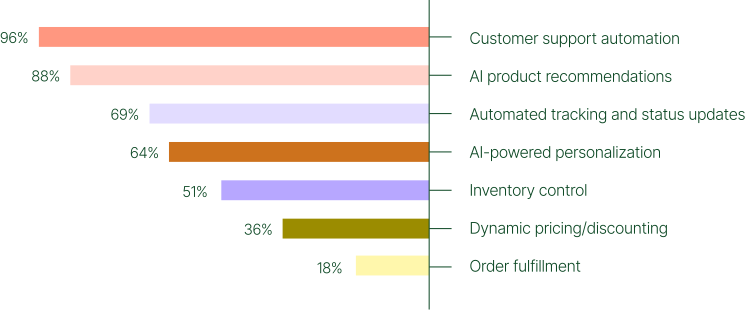
AI adoption is now widespread across ecommerce. The question isn’t if you’re using AI, but rather how, where, and how much. Ecommerce brands are leveraging AI for support automation, product recommendations, revenue generation, personalization, logistics, and more.
AI is already handling a significant share of customer interactions. 57% of brands are using AI for 26-50% of all customer interactions. 37% expect it to rise to 51-75% within the next two years


If we rewind one year ago, AI perceptions, excitement, and adoption varied significantly across brands. Research from our April 2025 study reveals that only 30% of ecommerce professionals rated their excitement for AI at 10/10. Similarly, while AI adoption rose steadily year over year, it reached a clear peak in 2026.
This increased adoption is closely tied to confidence in AI’s performance, accuracy, and overall business impact. Very few brands express hesitation, indicating a broad acceptance of AI as a necessary part of the ecommerce tech stack.
AI extends far beyond customer support efficiency. What started with automation loops and autoresponders has expanded into operational workflows and customer-facing shopping assistance.
Brands are seeing the most substantial impact from conversational channels. When asked which channels are contributing most to their AI success, 78% of respondents said social media messaging, 70% said SMS, and 51% said website live chat.
The AI renaissance means customers are interacting with brands in a completely new way. If you’re measuring success the same way you have for the past decade, you may be falling behind. So what are the winning brands actually looking at?
Nearly all companies still use customer satisfaction as a measure of AI’s impact, but three out of five mention average order value (AOV) as a top indicator. Higher-revenue companies earning $20M+ emphasize metrics such as total operating expenses, cost per resolution, incremental revenue, and one-touch ticket rate.


While brands still prioritize customer satisfaction and fast response times, incremental revenue and larger basket sizes are equally important for long-term business growth.
Virtual shopping assistants proactively engage shoppers, adapt to each shopper’s needs, provide contextual product recommendations and upsells, and close the deal with discounts when it matters. In 2025, Gorgias brands using AI Agent’s shopping assistant capabilities nearly doubled their conversion rates and converted 20%-50% better than those using AI Agent for support only.
In 2026, customers won’t settle for a fragmented experience. Shopper behavior signals indicate a clear preference for a single conversational experience that spans product discovery through order tracking.