Join us for Moments That Matter: Meet the Modern Helpdesk
September 10 at 12PM EST.
Save your seat


Four months ago, our analysts were dealing with a barrage of questions. "What's our ARR by segment?" "Build me a dashboard for this quarter's pipeline." Quick asks piled up behind complex deep dives. Stakeholders waited for answers that should have taken seconds, and analysts spent their time fielding requests instead of doing the strategic work that creates the most value.
Today, anyone at Gorgias can ask a question in plain language and get an accurate, contextualized response in seconds. Not from a colleague or dashboard, nor from a generic answer from the internet. But a response built on our business context. We call it Cortex, our flagship internal AI agent.
In two months, Cortex went from an idea to fielding thousands of questions every week, recommending actions across the business, and deprecating the need for manual dashboard creation. While most companies right now are treating AI as an initiative — at Gorgias, AI is already part of how we work. 72% of Gorgias employees use Cortex each week, and that number is only growing.
We didn’t achieve this by simply plugging a large language model into our stack. LLMs are a critical part of the equation, but they aren't the driving force — it’s everything else under the hood: the infrastructure, context, platform architecture, and the team that brings it all together.
The instinct across many companies today is to start with the model, pick a provider to solve a specific challenge, or invest heavily in getting the data right. All reasonable starting points, but most of them solve for one use case. Underneath that approach is a framing problem: seeing AI as an initiative — something you assign and measure. Seeing AI as another tool your company uses versus how your company operates.
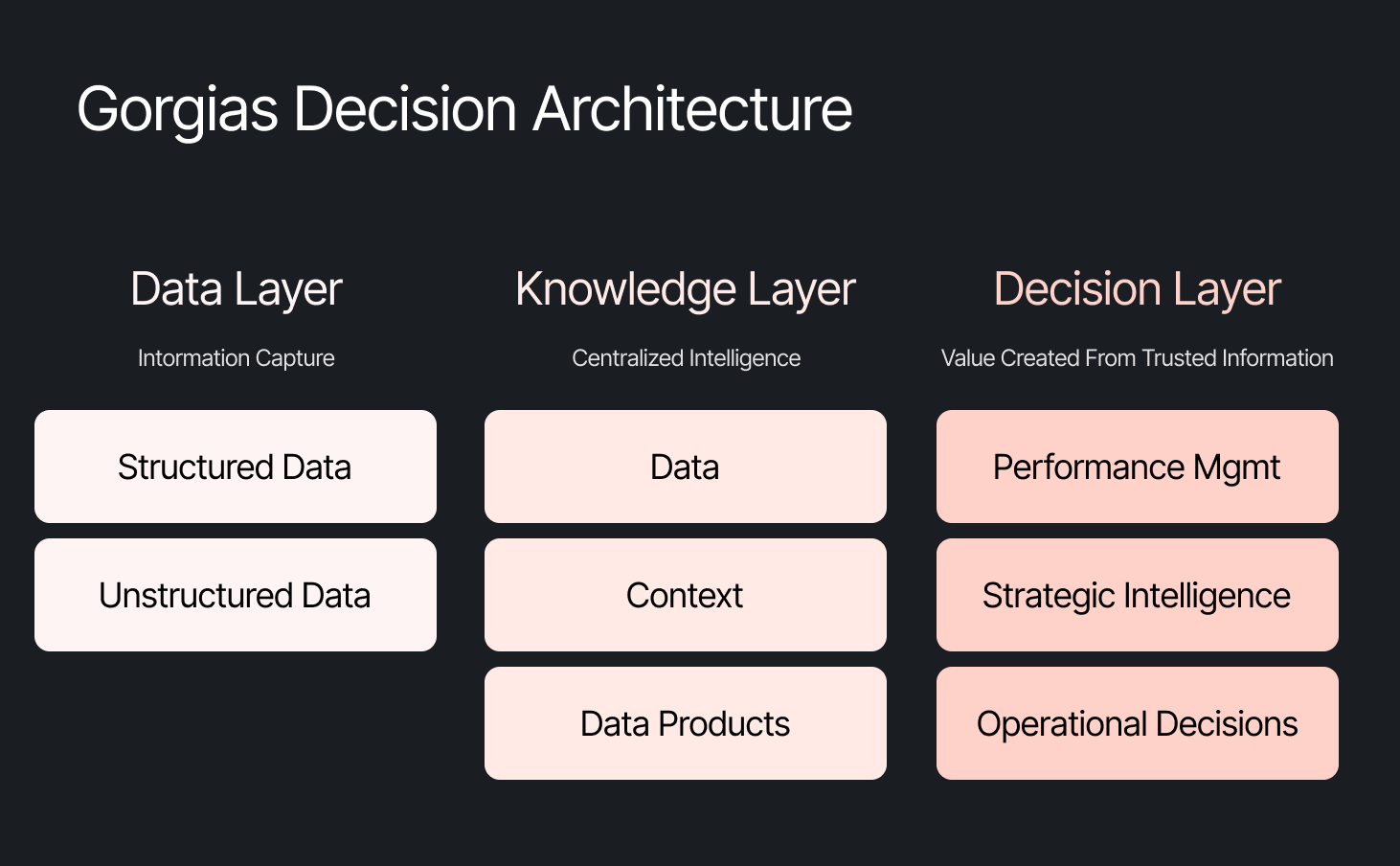
We started somewhere different. Every company is built on four pillars: customers, people, product, and decisions. AI investments tend to place heavy emphasis on the first three. We started with the fourth. Our bet was that if we built everything around the need to make effective decisions first, asking what Gorgias needed to know to operate well, then our AI would become dramatically more powerful.
Cortex is our flagship internal AI agent, and the product where we established the tenets that now run through everything else we build: composable and modular infrastructure, governed context, and accessible from wherever decisions happen. Cortex lives in Slack, as well as across LLM vendors, in its own browser extension, and even on its own dedicated internal site.
Cortex doesn’t stop at answering questions. It can read and write to Notion, file Linear tasks, create HTML apps, automate signal delivery, and more. It operates across every layer of our stack, from dashboards to data pipelines, because we designed it as one integrated system. It is this connection that adds remarkable depth to what people can ask, and what they get in return.
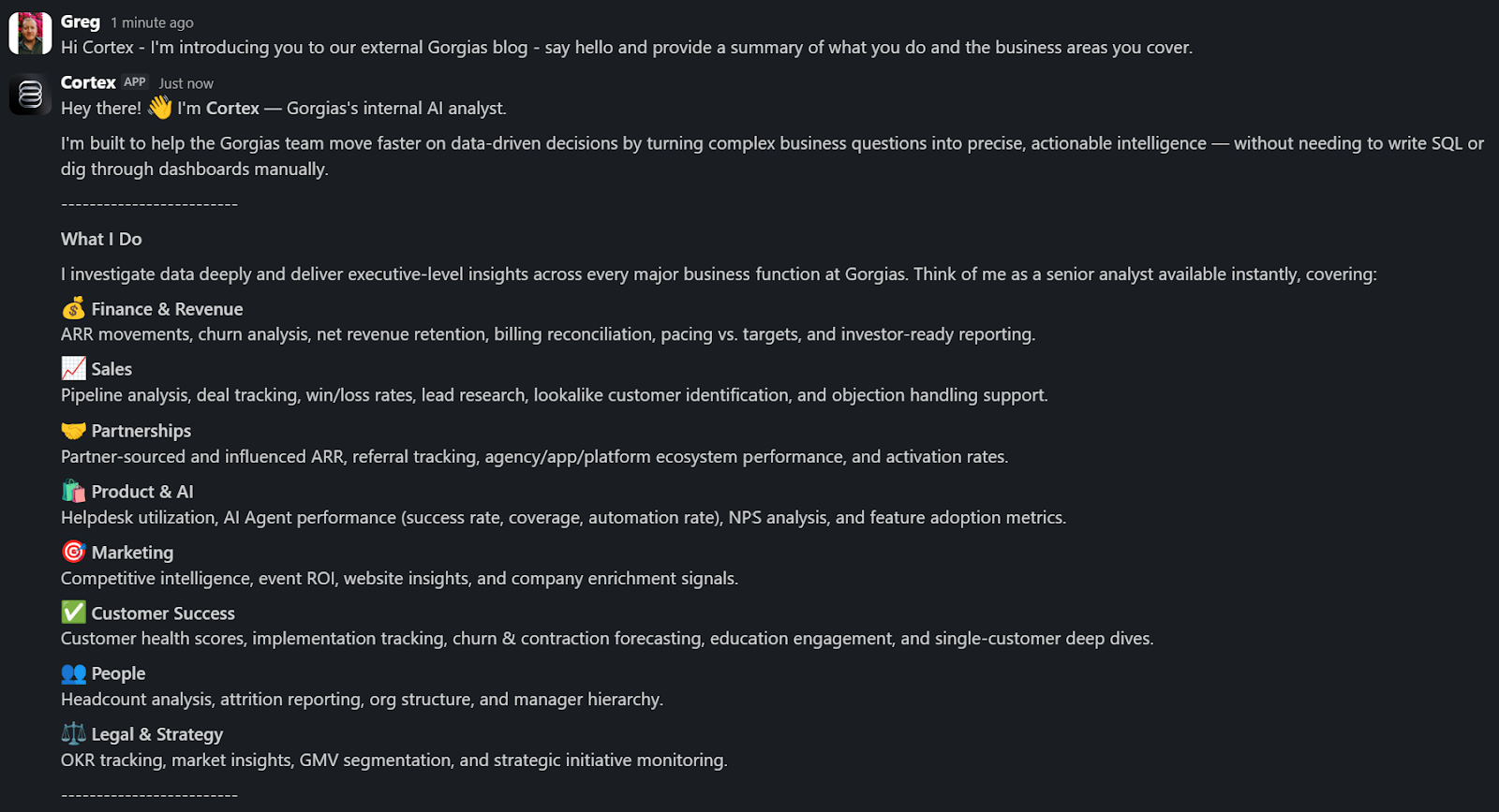
A Sales Lead is pitching and asks Cortex for the full picture of the merchant. In a customized PDF, Cortex lists coverage gaps, pre-sale intent signals, and product fit options. Everything the sales lead needs to walk in with confidence.
A Senior Product leader asks, "How are we performing against OKR #1, and what can my team do to help accelerate it?" Cortex returns a full ARR breakdown, projected end-of-month attainment, segment-level findings, and connects it all back to company-level strategies. A suite of recommendations customized to the leader, the performance, and the signals that bridge how they can support our goals. The kind of answer that used to take someone a week to put together.
These aren't simple lookup queries. They require deep business context spanning multiple areas. Cortex handles these because its Decision Engine gives it the information to reason against governed data, metric definitions, and business context, turning a generic answer into a credible one.
Overnight, teams have built Cortex into how they work. They’re spending less time searching and more time finding answers, not because they were told to, but because Cortex reduced the distance between question and decision.
Cortex’s modular infrastructure allows us to experiment and add new capabilities freely. We’ve already built two more internal AI agents made for entirely different use cases, but using the same Decision Engine as Cortex.
GAIA, our internal experimentation AI Agent, helps our customers identify opportunities in their AI Agent Guidance design. It takes institutional knowledge across our teams and turns it into a scalable system that drives automation and value to our customers. Our CEO, Romain Lapeyre, has been its most vocal advocate since day one.
When we needed a platform for investor readiness and board preparation, we built Oracle. Our board decks and talk tracks are informed and built with the same AI, and our numbers are validated every step of the way.
We’re continuing to expand new AI agents internally, exploring how they can create value for customers and our own teams.
When AI handles thousands of analytical questions each week, the highest-value work for a data team shifts permanently. Late 2025, we repositioned from a Data Analytics function into a Decision Intelligence function — a structural change in what we own and how we operate.
Today, our analysts focus on the most sensitive, complex, and forward-looking decisions and analyses. They partner more deeply with stakeholders by driving next steps from signals. They're even building entirely new capabilities that didn't exist in their role descriptions months ago. Things like AI skills for Cortex, context curation, and insight and recommendation delivery. The role of the analyst hasn't diminished. It's expanded to encompass the most meaningful work an analyst can do: driving outcomes and ensuring those decisions can achieve them.
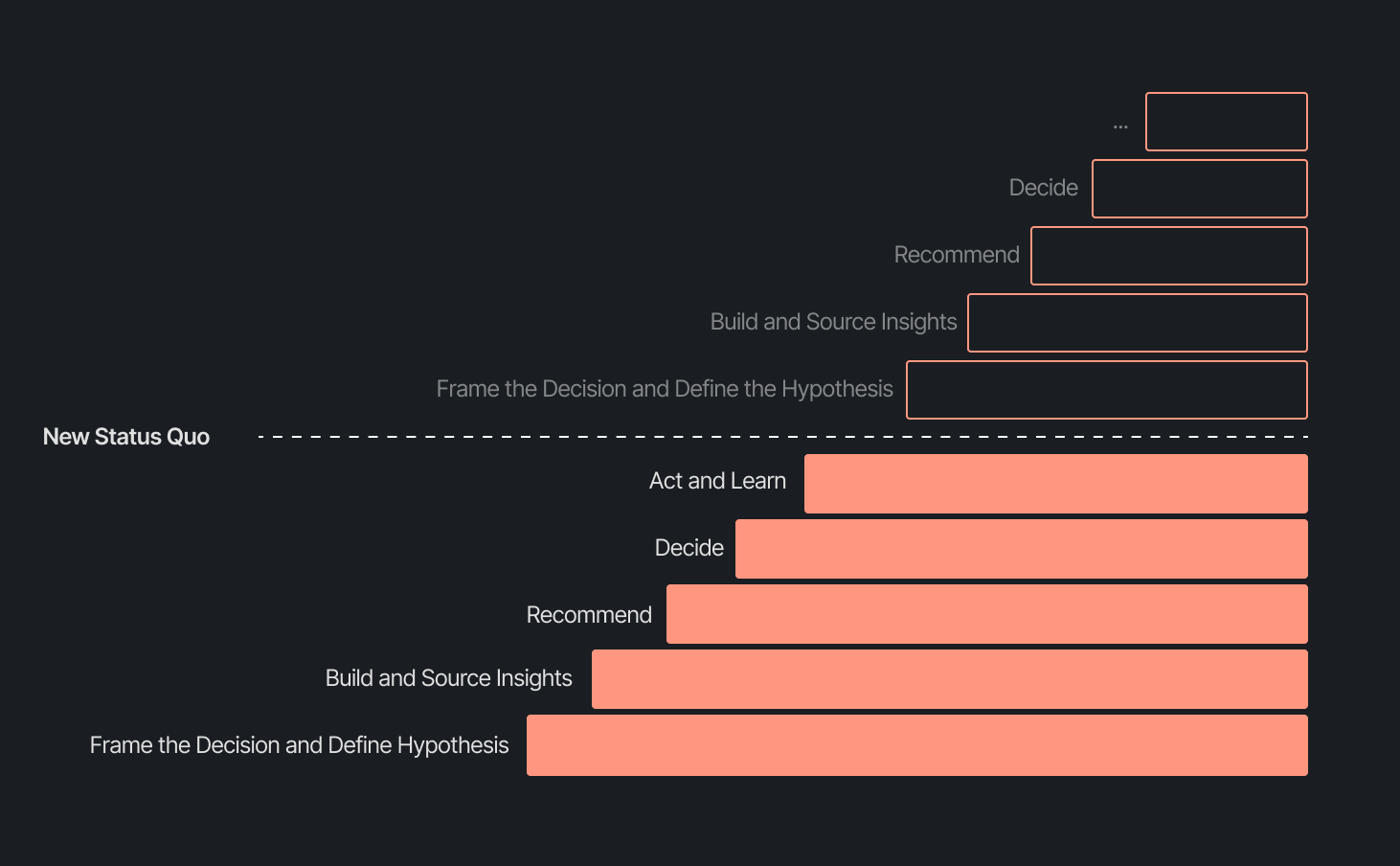
Our business support model has changed, too. Instead of embedding analysts and dedicated engineers within functional teams, we align capacity to the highest-impact company objectives and move fluidly across them. This model works even better because Decision Intelligence brings together both analytics and engineering teams under one roof.
Elliot Trabac leads our Data, Context and AI Engineering teams. The Decision Engine, Cortex, GAIA, and the platforms I've described exist because of the infrastructure his team innovated and built from the ground up. Noemie Happi Nono leads our Decision Strategy and Operations team, driving decision outcomes with stakeholders, advancing the development of Cortex skills and capabilities, and pushing into new areas of analysis every day.
Together, they're shaping what a modern data function looks like when AI becomes a standard building block for how a company operates.
The question of ROI is long gone. AI has opened the floodgates to more trusted and meaningful signals than ever. The natural next evolution is Proactive Intelligence, signals surfaced toward what you need to know, before you ask. And we're already building this because our architecture is designed to support it.
In the coming weeks, members of the Decision Intelligence team will go deeper into themes I've touched on here. Yochan Khoi, a Senior Analytics Engineer on our team, recently published a technical walkthrough of our context layer and will go further into building context strategies that scale. Others will cover infrastructure, analytical partnerships, evolving data assets into decision assets, and the cost and efficiency gains that make sustained AI investment viable.
AI hasn't changed the most important element of data and analytics functions — delivering outcomes — but it has raised the bar for what it looks like and how far we can take it. We’re just getting started.
TL;DR:
The way shoppers buy online has shifted and customers are at the center.
They no longer want to scroll through product pages, dig through FAQs, or wait 24 hours for an email reply. They open a conversation, ask a specific question, and expect a useful answer in seconds. Brands that can’t deliver these experiences at scale are seeing customer hesitation turn into abandoned carts and lost revenue.
This shift has a name: conversational commerce. It's the practice of using real-time, two-way conversations as your primary sales channel, through chat, AI agents, messaging apps, and voice.
What started as an experiment for early adopters has become a key growth lever, with 84% of ecommerce brands treating conversational commerce as a strategic pillar this year vs. last year.
We surveyed 400 ecommerce decision-makers across North America, the U.K., and Europe to understand how conversational commerce and AI are reshaping the ecommerce landscape. These findings are complemented by aggregated and anonymized internal Gorgias platform data from 16,000+ ecommerce brands.
The State of Conversational Commerce in 2026 trends report breaks down all of the findings, including five key trends shaping the ecommerce landscape.
{{lead-magnet-1}}
A few years ago, adding an AI chatbot to your site that could provide tracking links and Help Center article recommendations was a differentiator. Today, it's table stakes. McKinsey found that 71% of shoppers expect personalized experiences, and 76% get frustrated when they don't get them.
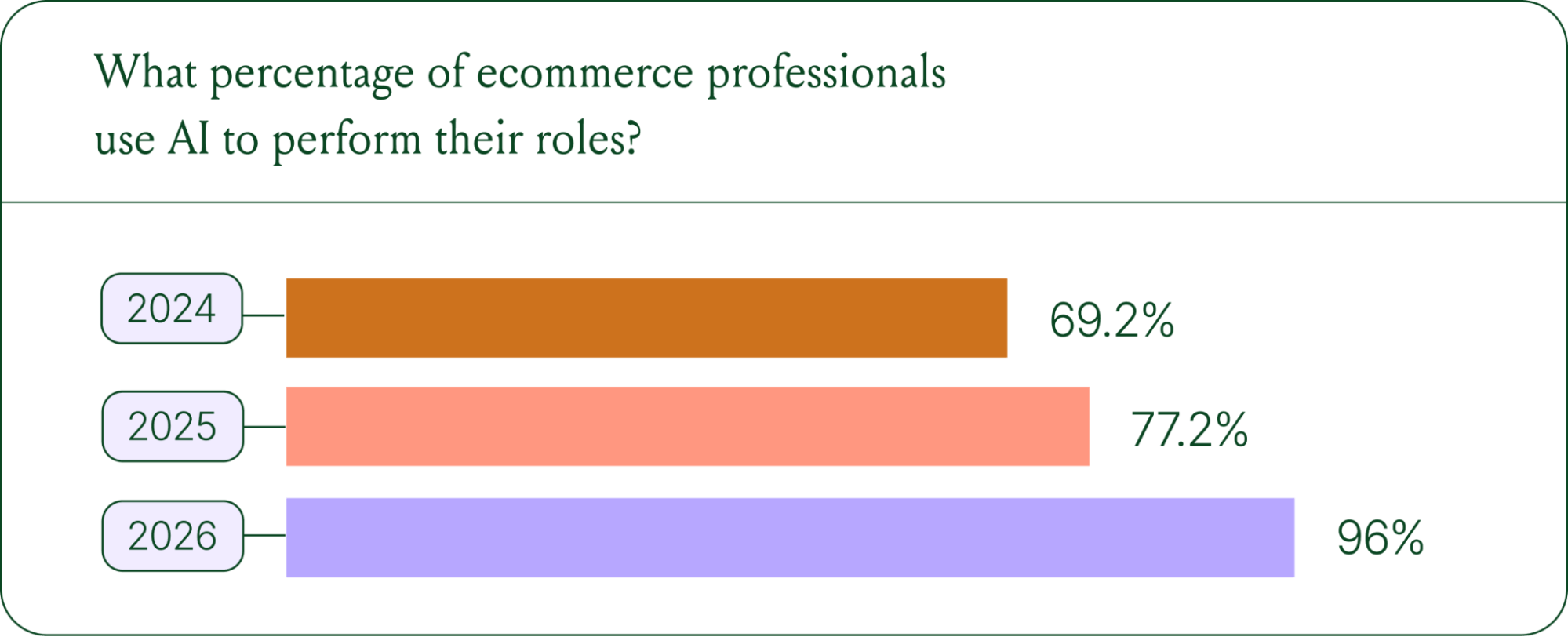
Right now, most ecommerce professionals use AI, with 93% having used it for at least 1 year. Enthusiasm is accelerating quickly, with only 30% of ecommerce professionals rating their excitement for AI at 10/10 in April 2025. Similarly, while AI adoption rose steadily year over year, it reached a clear peak in 2026.
The use cases driving this adoption are practical and high-volume:
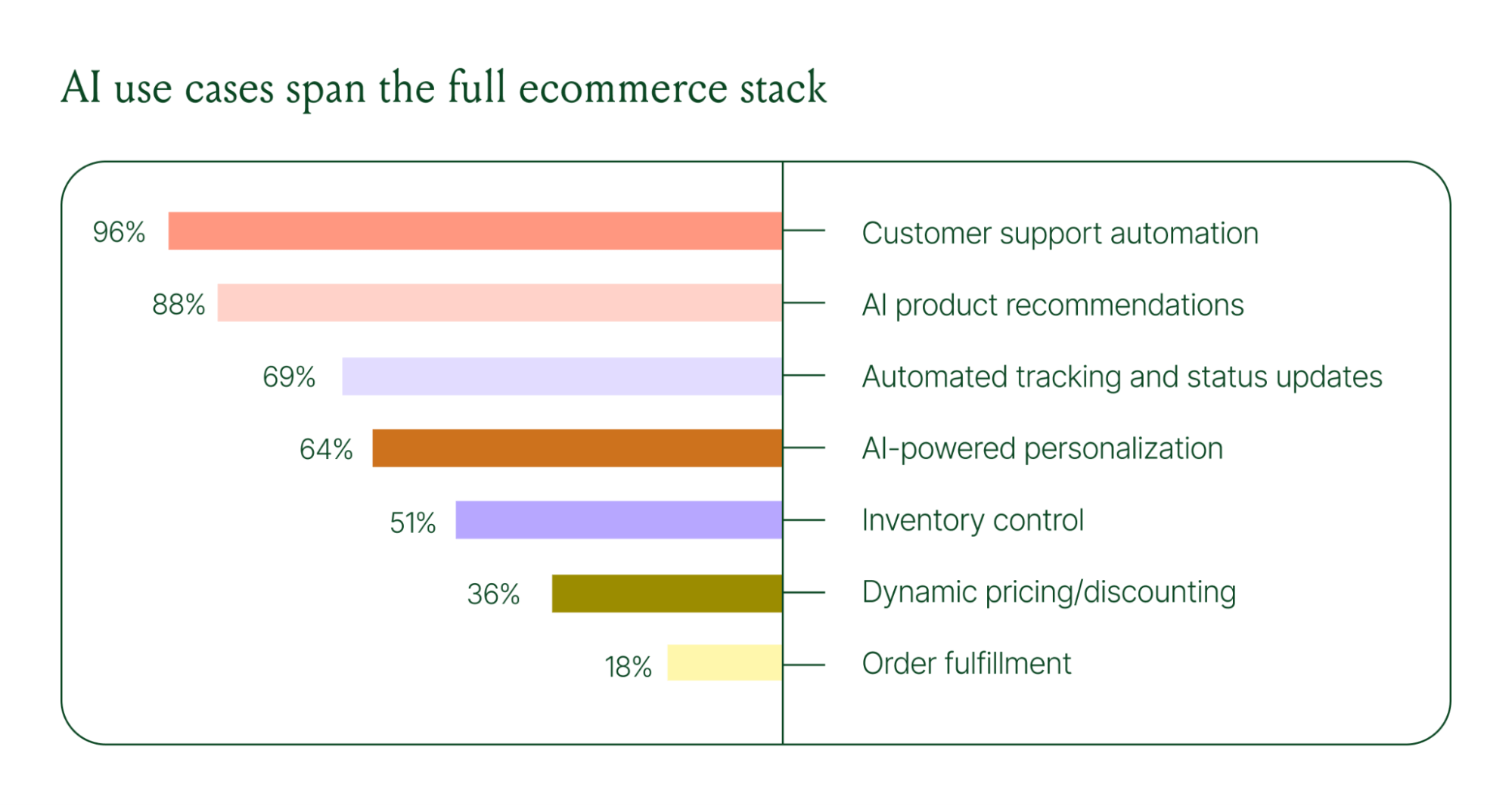
These are the tickets that flood brands’ inboxes every day. AI agents resolve them instantly, without pulling teams away from conversations that actually require human judgment.
Explore AI adoption and use case data in more depth in the full report.
The traditional ecommerce funnel, visit site, browse products, add to cart, check out, is losing ground. Shoppers now discover products on Instagram, ask questions via direct message, and complete purchases without ever visiting a website.
Conversational AI is actively increasing revenue, with 79% of brands reporting that AI-driven interactions have increased sales and conversion in their business.

The practical implication is that every channel is becoming a storefront. Creating personalized touchpoints with customers earlier in the journey, through proactive engagement, is impacting the bottom line.
Read the full report to explore how AI conversions have increased QoQ by industry.
Pre-purchase hesitation is one of the biggest conversion killers in ecommerce. A shopper lands on your product page, has a question about sizing or compatibility, can't find the answer quickly, and leaves. That's a lost sale that had nothing to do with your product.
Conversational AI changes that dynamic. When a shopper can ask a question and get an accurate, personalized answer in real time, the friction disappears.
Brands using Gorgias saw this play out at scale in 2025. When AI Agent recommended a product, 80% of the resulting purchases happened the same day, and 13% happened the next day.
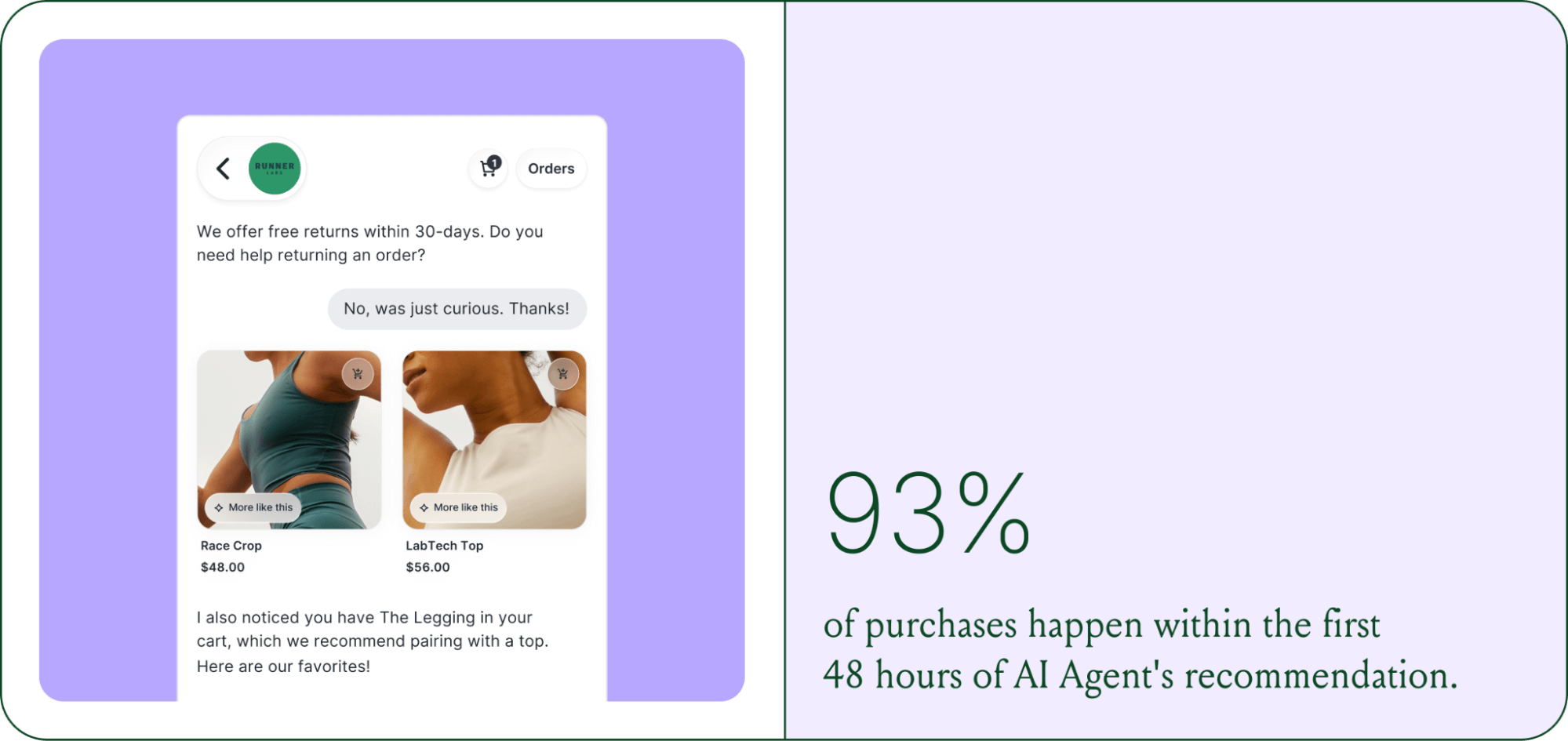
Brands are further accelerating the buying cycle through proactive engagement. On-site features such as suggested product questions, recommendations triggered by search results, and “Ask Anything” input bars drove 50% of conversation-driven purchases during BFCM 2025.
Explore how AI is collapsing the purchase cycle in Trend 3 of the report.
There's a persistent narrative that AI is making CX teams redundant. The data tells a different story. 62% of ecommerce brands are planning to grow their teams, not cut them. But the scope of those teams is changing.

New roles are emerging around AI configuration and quality assurance. Teams are investing in technical members to write AI Guidance instructions, develop tone-of-voice instructions, and continuously QA results.
CX teams are also bridging the gap between support goals and revenue goals, as the two functions increasingly overlap.
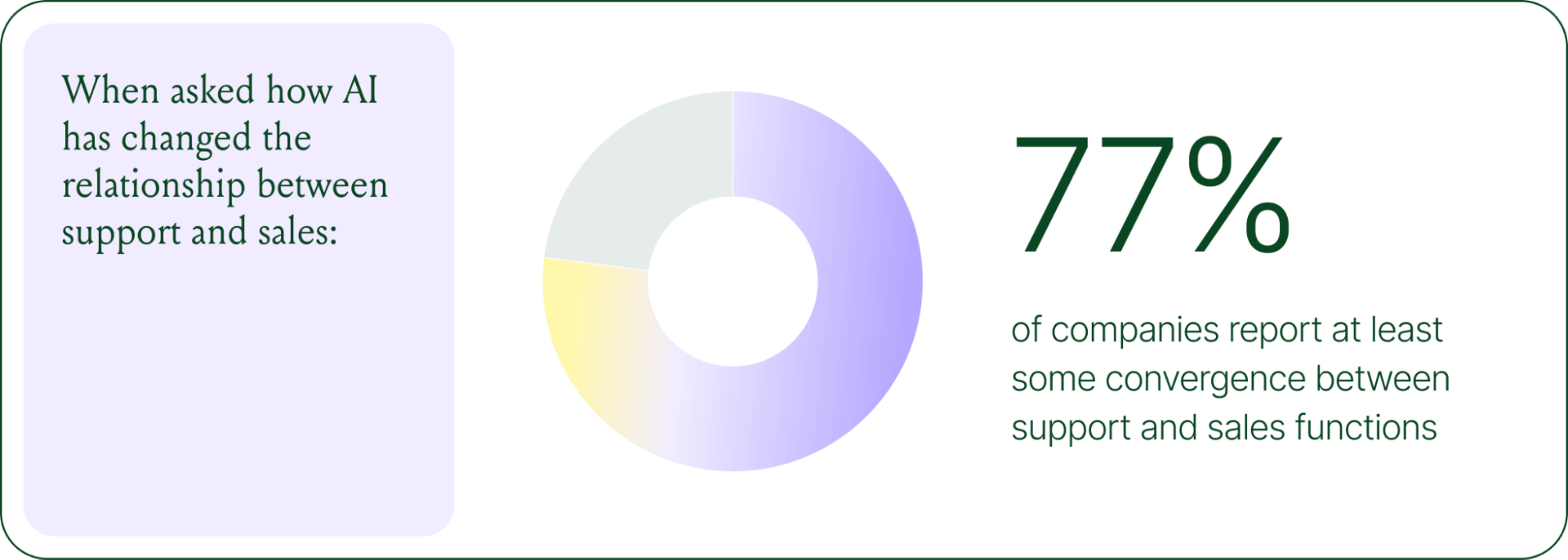
The result is CX teams that are more technical than they were before. Agents who once spent their days answering repetitive tickets are now spending that time on higher-value work: complex escalations, VIP customer relationships, and improving the AI systems and knowledge bases that handle the volume.
Learn more about the evolution of CX roles in Trend #4.
Despite increasing AI adoption, data shows that ecommerce brands shouldn’t strive for 100% automation. Winning brands are building systems in which AI handles repetitive tier-1 tickets, and humans handle complex, sensitive cases.

AI handles speed and scale. It resolves order-tracking requests at 2 a.m., processes return-eligibility checks in seconds, and answers the same shipping question for the thousandth time without compromising quality.
Human agents handle conversations that require context, empathy, or decisions that fall outside the standard playbook. There are several topics where shoppers still prefer human support.
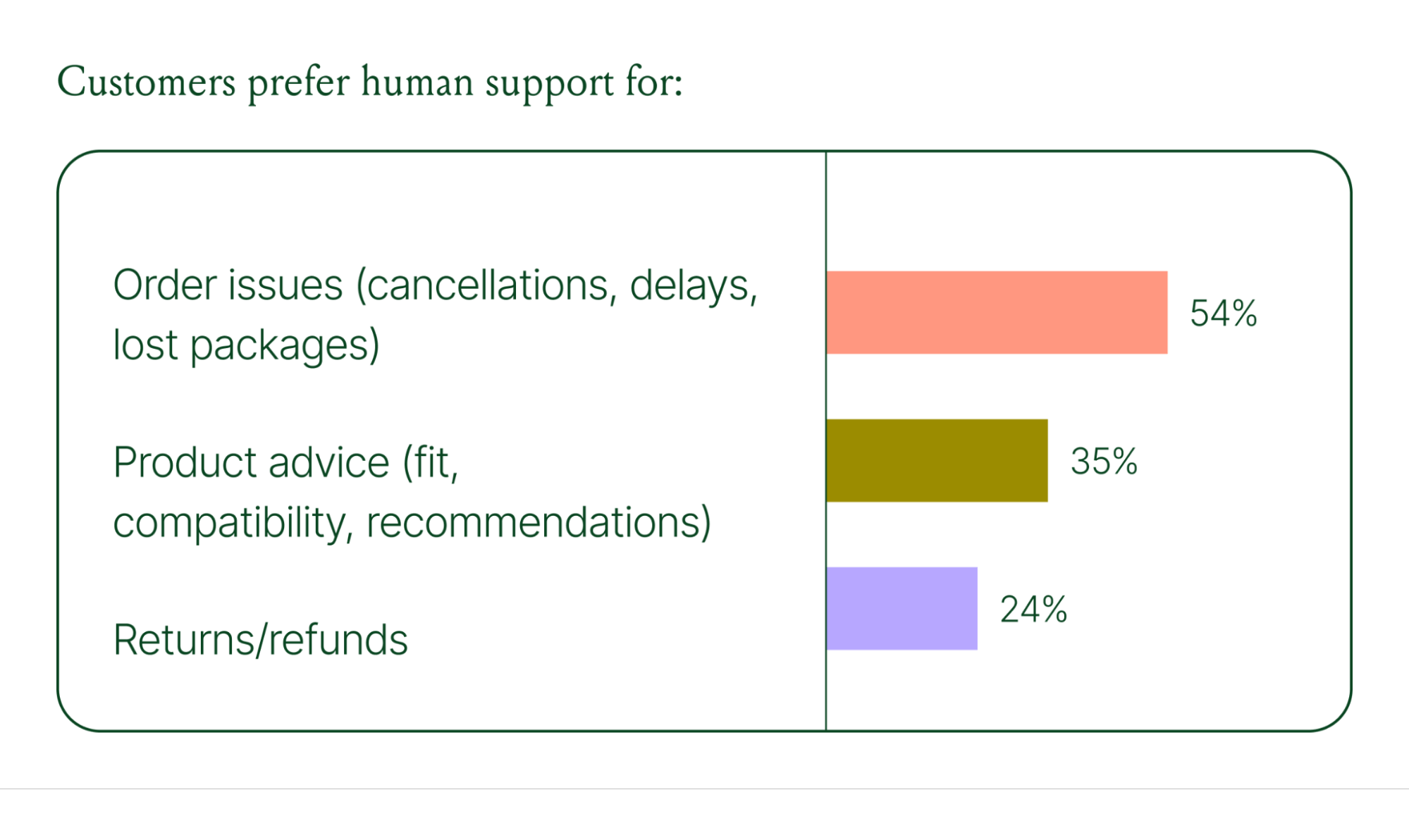
Successful hybrid systems require continuous iteration, meaning reviewing handover topics, Guidance, and reviewing AI tickets on a weekly basis.
Discover how leading brands are balancing human and AI systems in Trend #5.
The 2026 trends are about expansion and standardization. The 2030 predictions are about what comes next.
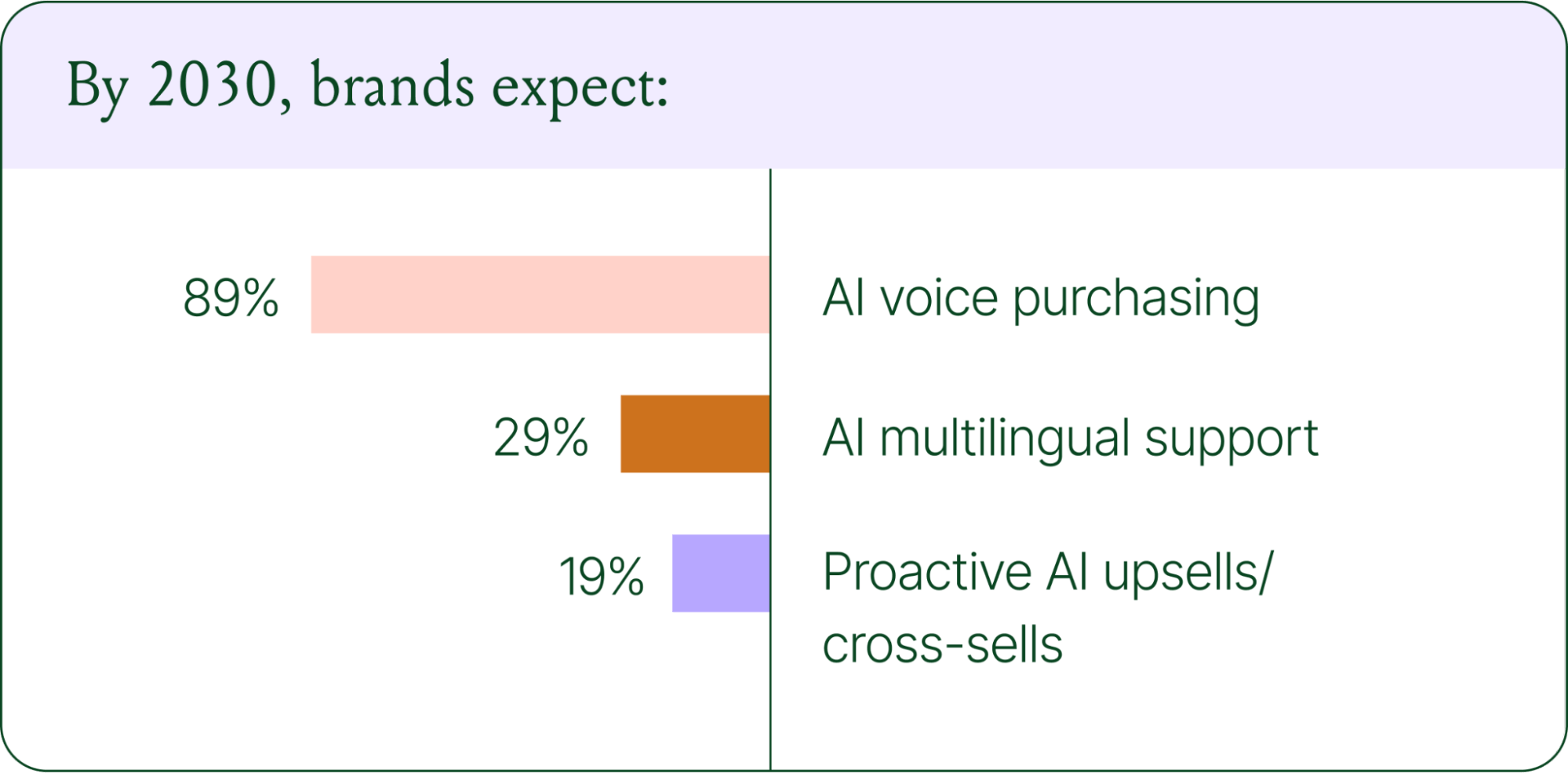
Voice-based purchasing is the biggest bet on the horizon. Only 7% of brands currently use voice assistants for commerce, but 89% expect it to be standard by 2030. The vision is a customer who can reorder a product, check their subscription status, or manage a return entirely over the phone.
Proactive AI is the other major shift. Rather than waiting for a customer to reach out, AI will anticipate needs based on browsing behavior, purchase history, and where someone is in their relationship with your brand. Think of it as the digital equivalent of a sales associate who remembers what you bought last time and knows what you're likely to need next.
Explore where ecommerce brands are allocating their AI budgets in the full report.
The brands winning in 2026 are creating smart, scalable systems where AIhandles volume and humans handle nuance. They’re treating every conversational channel as an opportunity to serve and sell.
The data is clear: AI adoption is accelerating, customer expectations are rising, and the revenue impact of getting this right is measurable.
{{lead-magnet-1}}
The best in CX and ecommerce, right to your inbox

TL;DR:
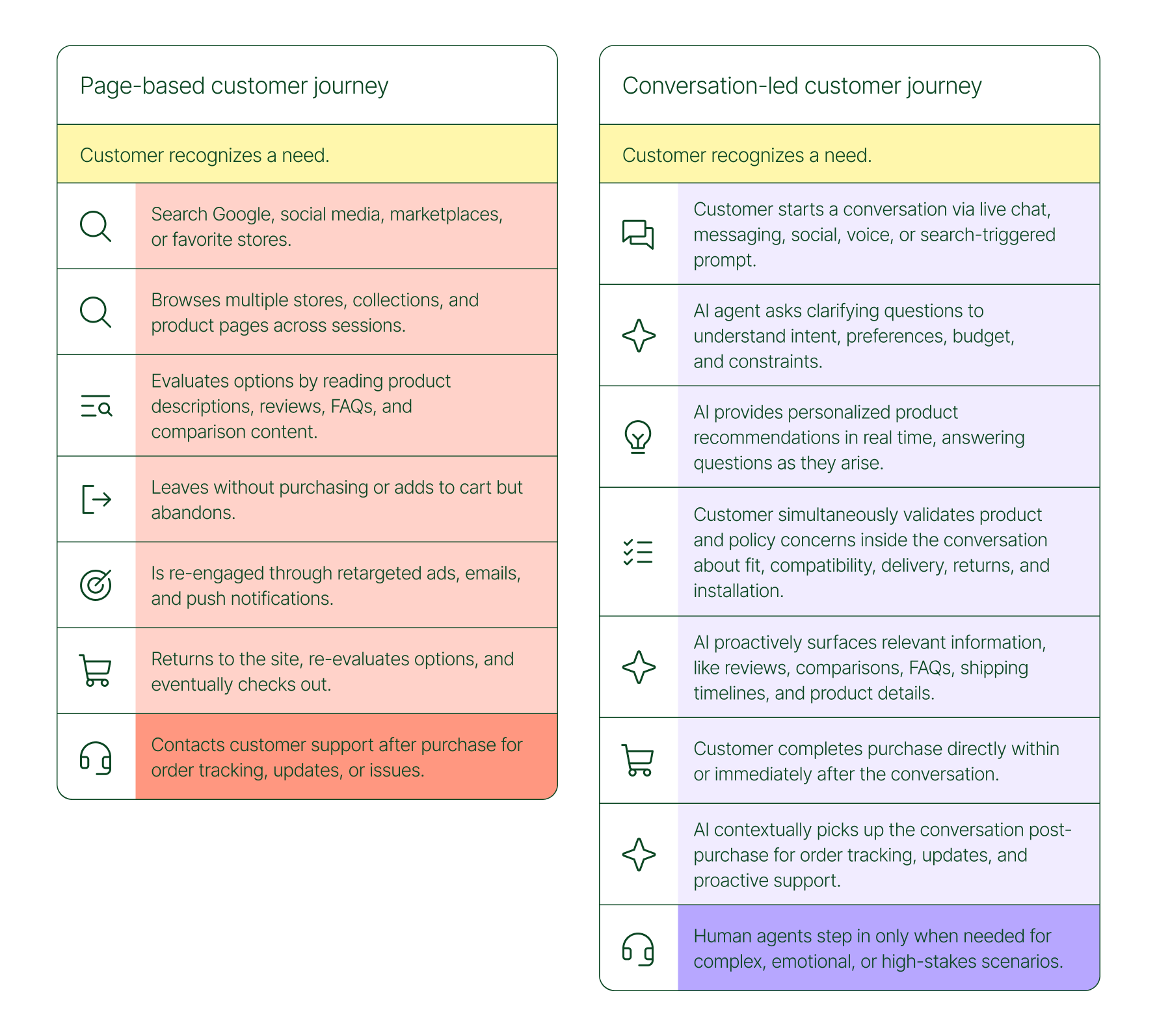
The page-based shopping experience dominated for decades. Customers would search, browse, compare, abandon, get retargeted, return, and eventually buy (sometimes).
That journey is no longer the only option.
Shoppers are turning to chat, messaging, and AI-powered tools to find what they need. Instead of clicking through product pages or reading static FAQs, they ask questions, have back-and-forth conversations, and get answers that move them closer to a purchase in real time. The path to checkout has changed, and the brands that recognize this are pulling ahead.
Read our 2026 State of Conversational Commerce Report to learn more about conversation commerce trends from 400 ecommerce decision-makers and 16,000+ ecommerce brands using Gorgias.
{{lead-magnet-1}}
The traditional shopping journey was a solo experience. A shopper had a need, searched for options, browsed across sessions, and eventually made a decision — often days later, after being retargeted multiple times. Support only entered the picture after the purchase.
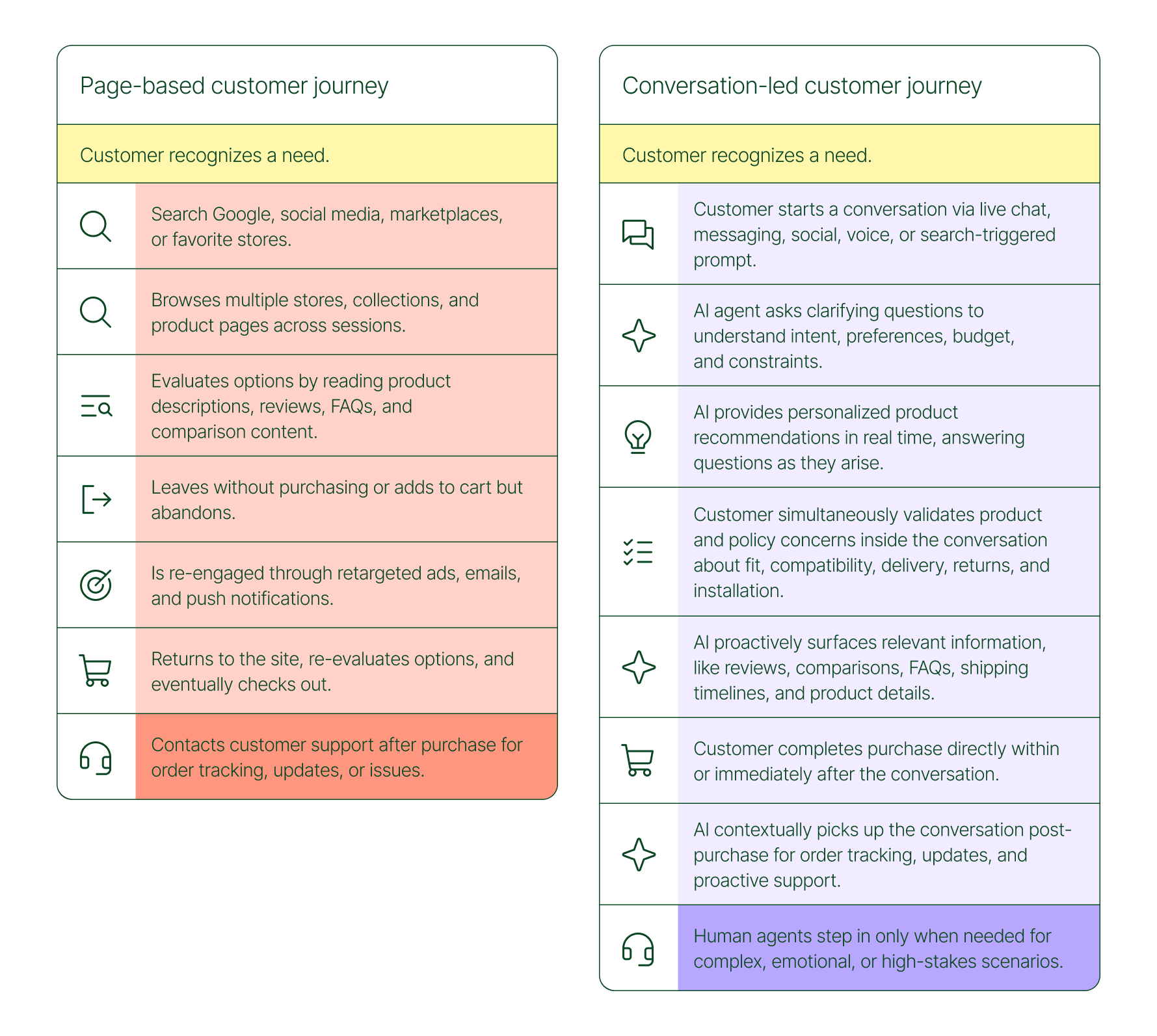
The conversation-led journey collapses that timeline:
What used to take days now takes minutes. Discovery, evaluation, and purchase happen in a single thread.
79% of brands agree that AI-driven conversational commerce has increased sales and purchase rates in their business. When brands were asked to rank the highest-return areas:
Those numbers reflect something important: the value of conversation compounds. Faster support reduces friction. Better retention raises lifetime value. More confident shoppers buy more often and spend more per order.
The brands seeing the biggest returns aren't just using AI to deflect tickets. They're using it to create one-to-one shopping experiences at scale.
Looking at AI-only influenced orders across key verticals like Apparel and Accessories, Food and Beverages, Health and Beauty, Home and Garden, and Sporting Goods, the growth across a single year was significant.
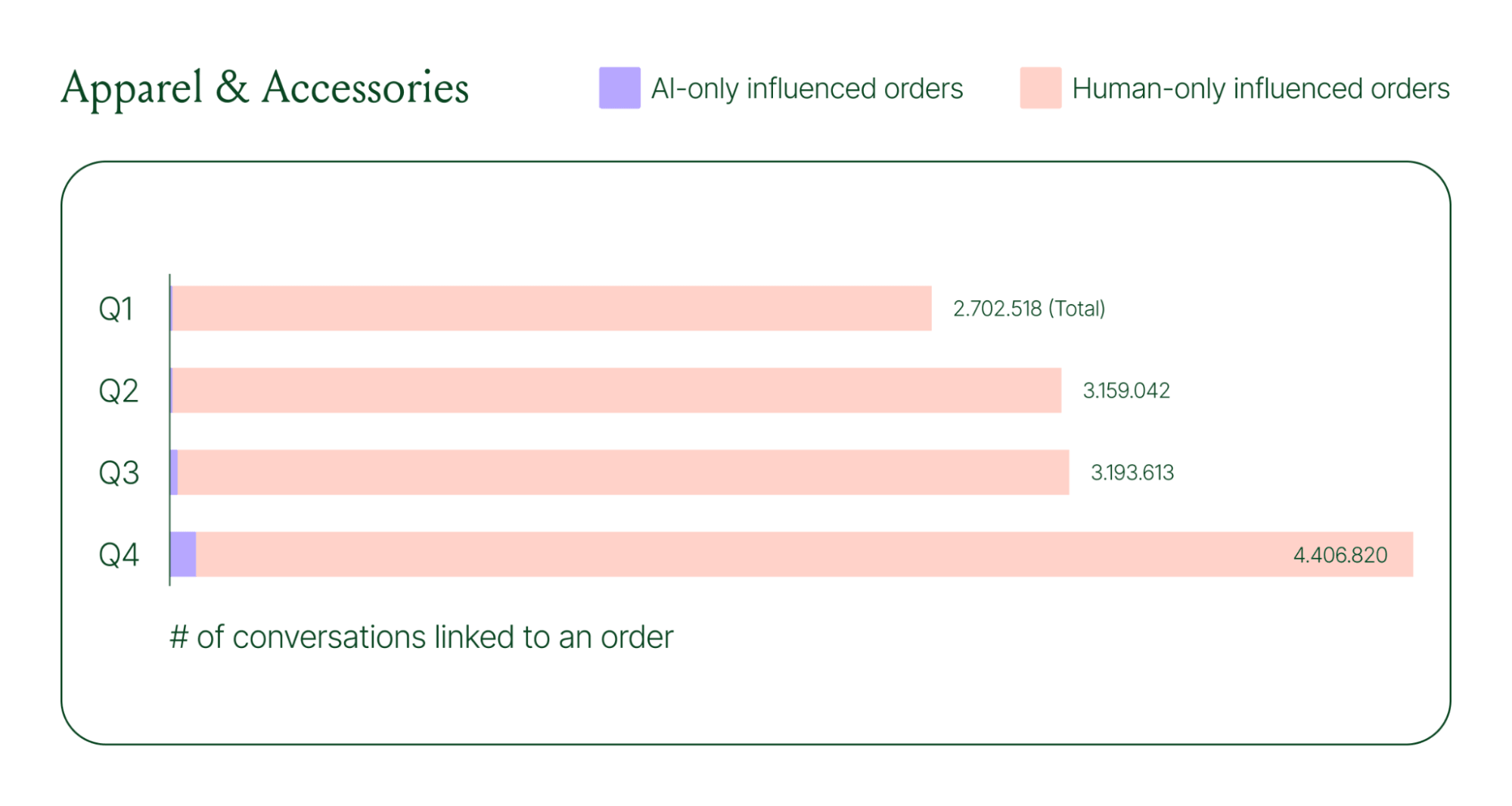
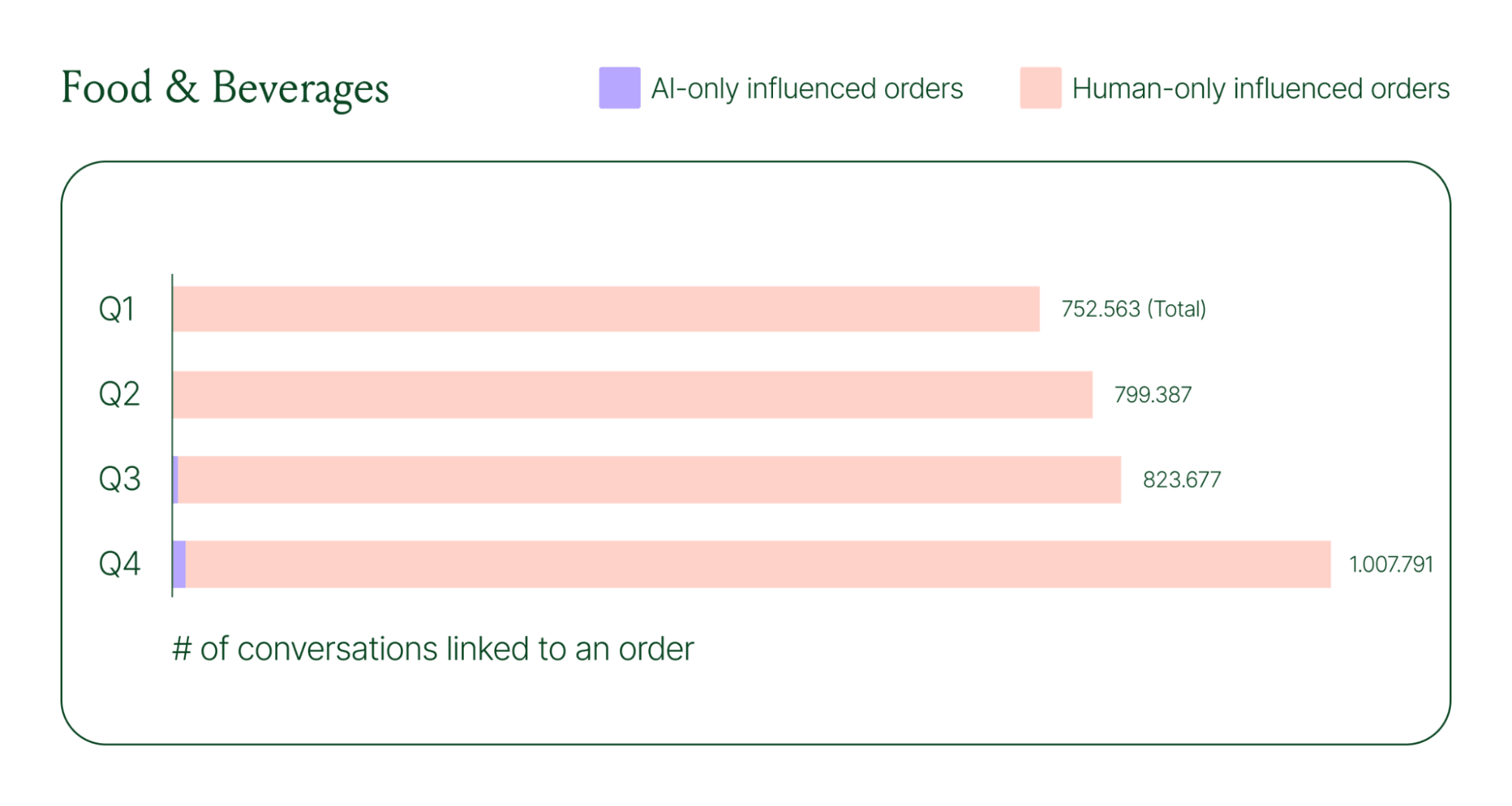
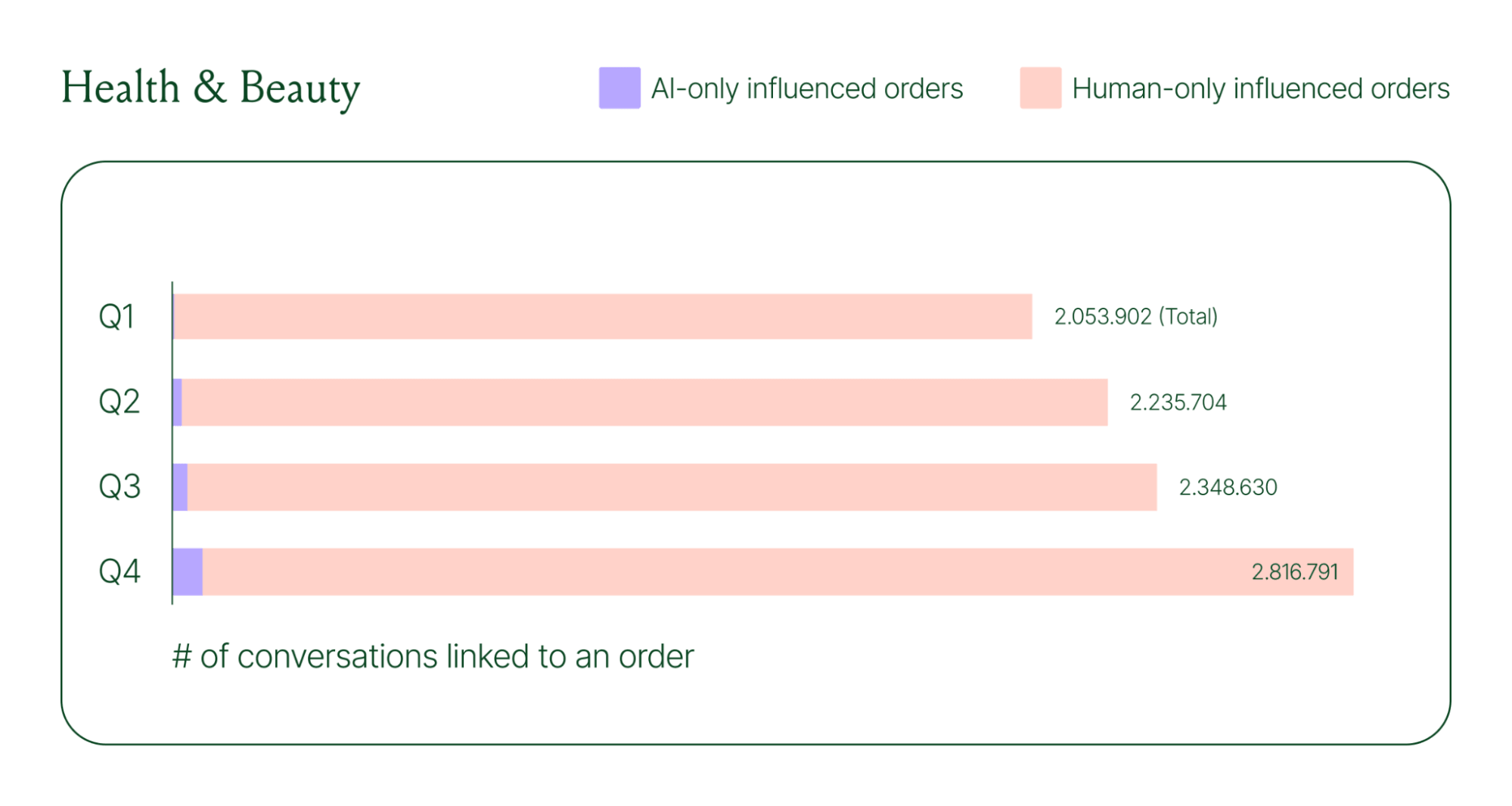
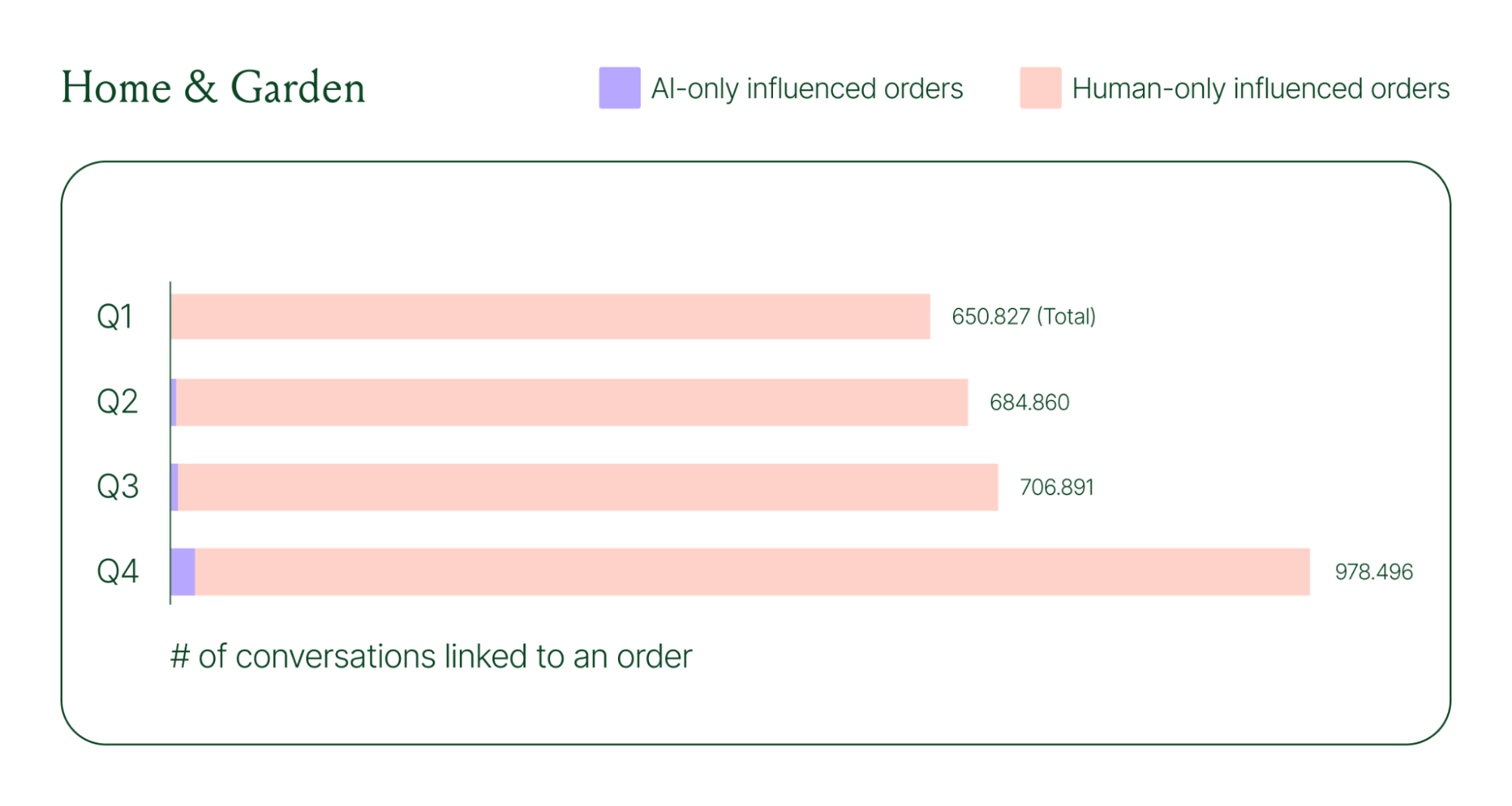
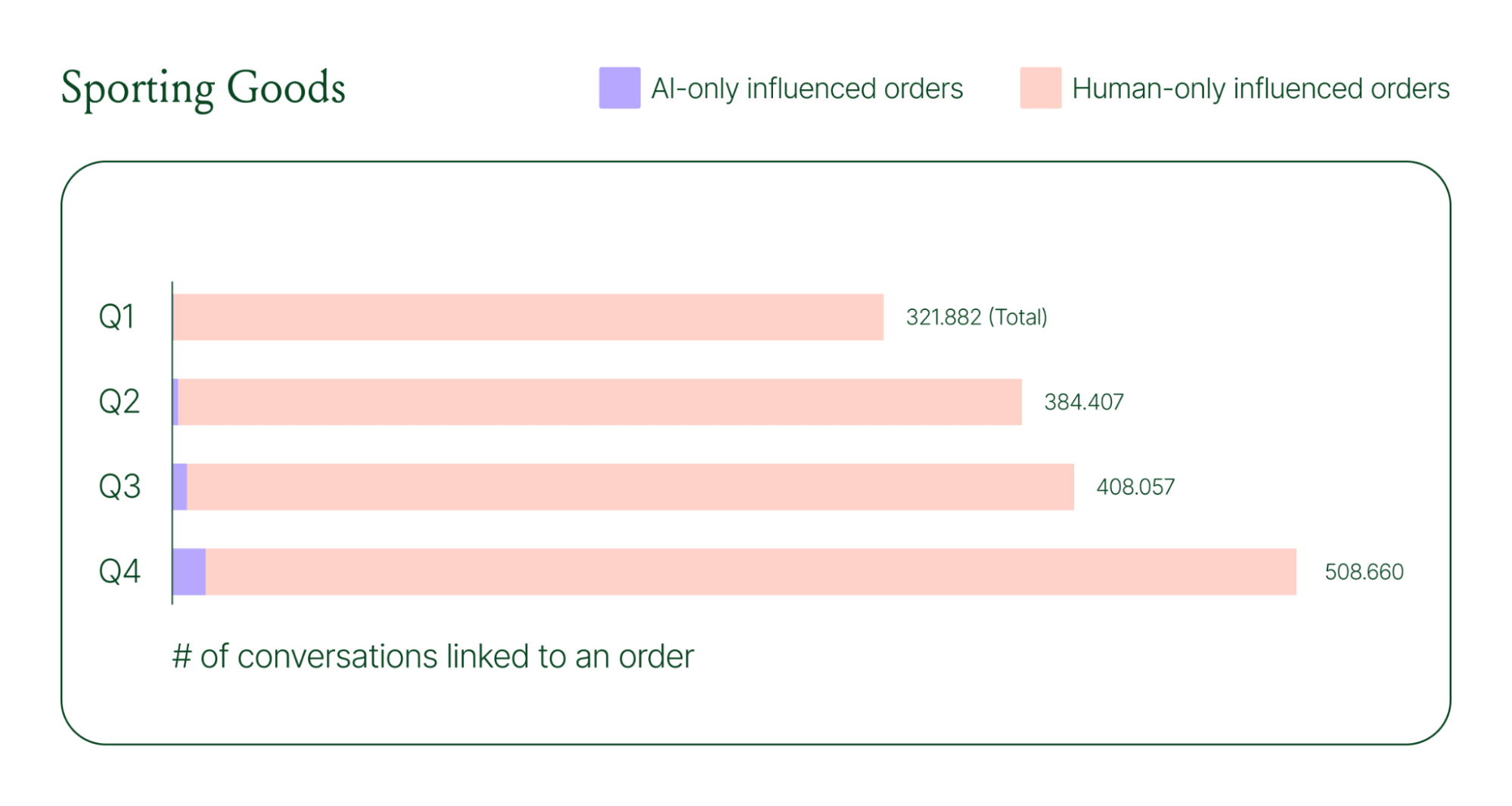
Across industries, ecommerce brands saw AI step into conversations, reduce shopper hesitation, and drive higher QoQ conversion rates.
Learn more about AI-powered revenue generation in the full 2026 Conversational Commerce Report.
84% of brands say the strategic importance of conversational commerce is higher than it was a year ago. 82% agree it will be mainstream in their sector within two years.
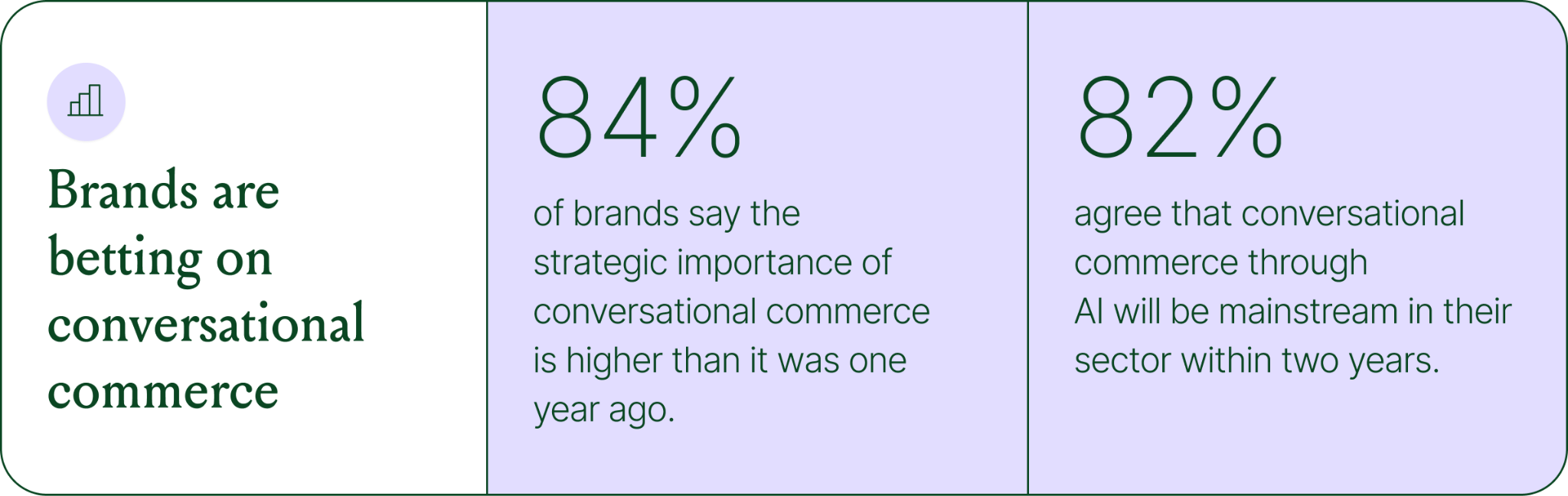
That shift is registering at the leadership level because of what conversational commerce does to the buying experience. Creating one-to-one touchpoints earlier in the journey drives higher AOV, shorter buying cycles, and stronger purchase rates. Shoppers who get real-time answers to their questions are more confident.
TUSHY, known for eco-friendly bidets and bathroom essentials, is a useful example of what happens when you take conversational commerce seriously.
Bidets aren't an impulse purchase. Shoppers have real questions about fit, compatibility, and installation. Those questions used to go unanswered until the CX team could respond, often after the customer had abandoned the cart.
TUSHY used Gorgias's AI Agent and shopping assistant capabilities to automate pre-sales support. AI Agent engaged shoppers in real-time conversations, addressed their concerns directly, and built confidence at the moment of highest intent.
This resulted in a 190% increase in chat-based purchases, a 13x return on investment, and twice the purchase rate of human agents.
You don't need to overhaul your entire operation to start seeing results. The most effective approach is to start where the impact is clearest and expand from there.
A few places to begin:
Want to see the full picture of where conversational commerce is headed in 2026? Read the full report to explore the data, trends, and strategies shaping the next era of ecommerce.
{{lead-magnet-1}}
TL;DR:
A year ago, ecommerce brands were still debating whether AI was worth the investment. That debate is over. Today, nearly every ecommerce professional uses AI to do their job.
The shift isn't just about adoption. It's about what AI is used for and how brands measure its impact. Support automation was the entry point. Now, AI is embedded across the full operation, from product recommendations to inventory control to real-time shopping conversations.
In our 2026 State of Conversational Commerce Report, we break down trends on AI usage among 400 ecommerce decision-makers and 16,000+ ecommerce brands using Gorgias.
{{lead-magnet-1}}
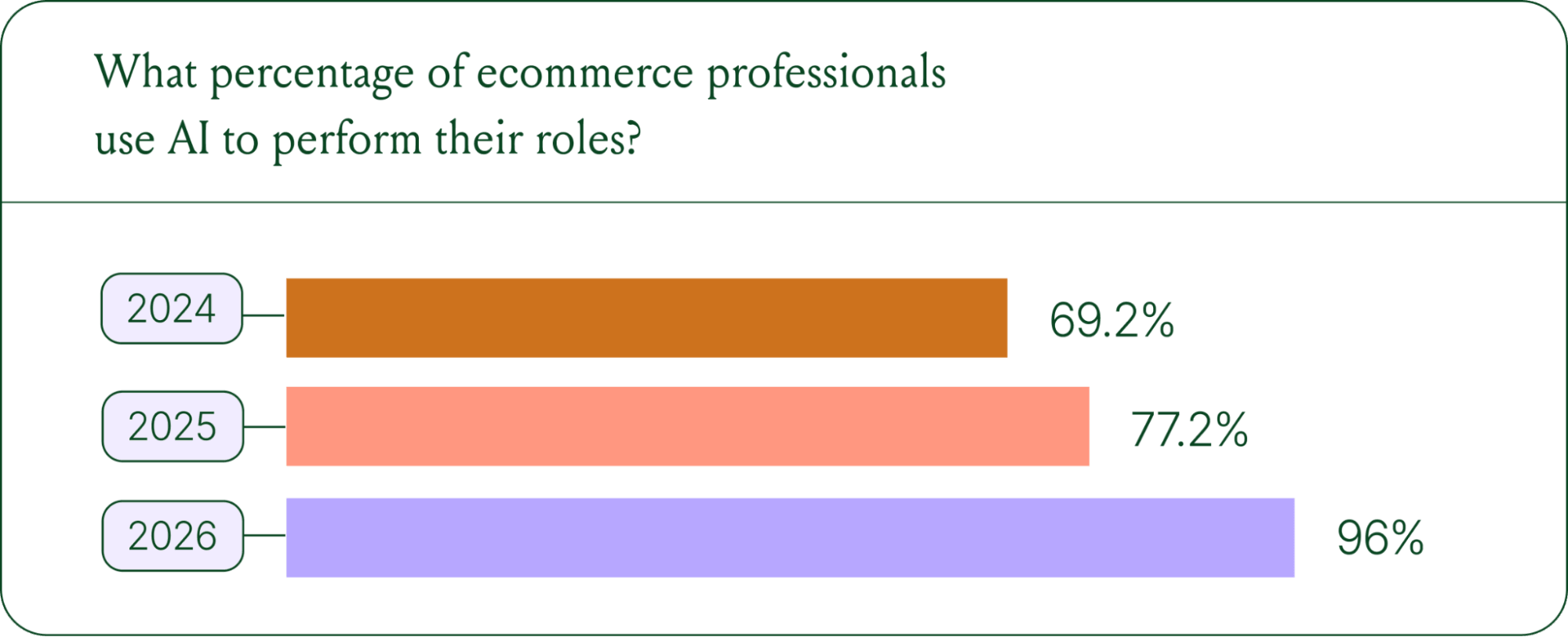
If we rewind 12 months ago, the industry was still split on AI. Some ecommerce professionals were excited, but most were still hesitant. In 2024, 69% of ecommerce professionals used AI in their roles. By 2025, that number reached 77%. In 2026, it hit 96%.
The confidence numbers back it up. 71% of brands say they are confident using AI for ecommerce, and 73% are satisfied with its business impact.
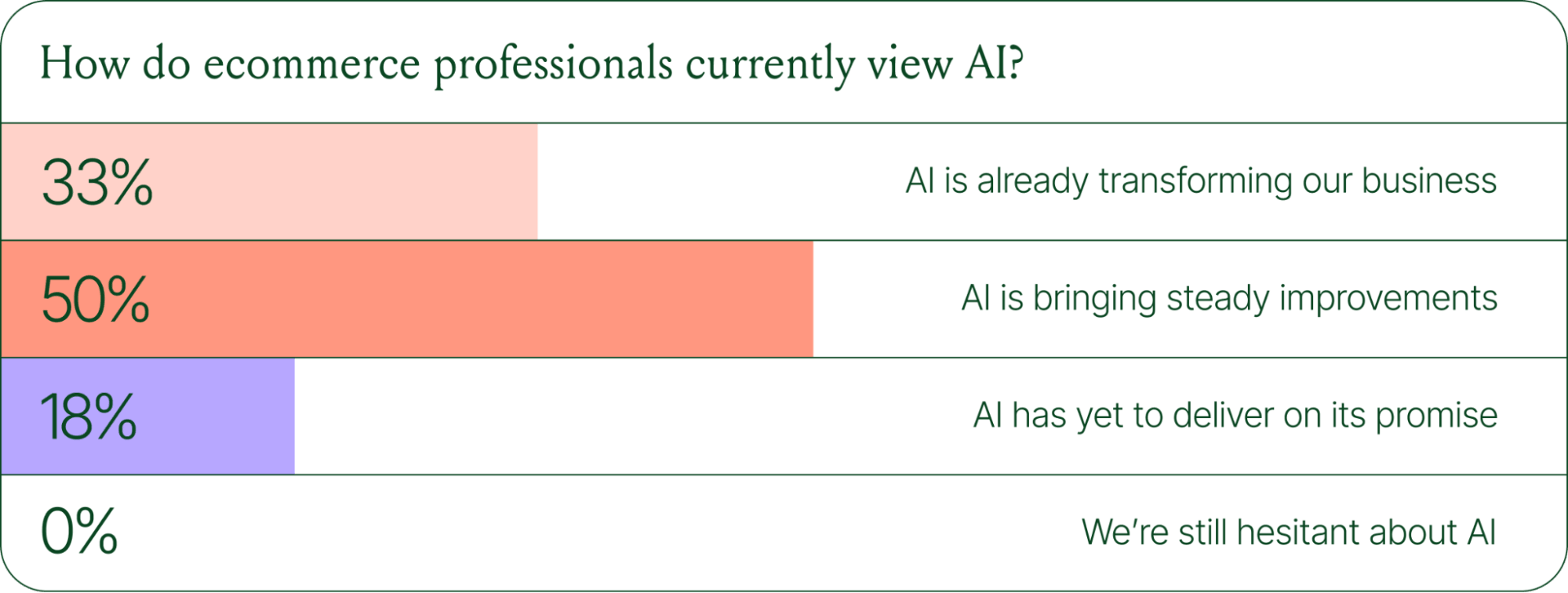
In early 2025, only 30% of ecommerce professionals rated their excitement for AI at 10/10. Today, zero percent of respondents describe themselves as hesitant about AI.
Using AI in ecommerce is not new. In fact, it dates back to the 1980s with the invention of algorithms and expert systems. And if you’ve ever leveraged similar product recommendations or chatbots, you’ve already integrated AI into your ecommerce stack.
Modern AI is far more sophisticated.
With the rise of agentic commerce and conversational AI, brands began leveraging AI agents to automate the processing of repetitive support tickets. That’s still happening today, but the scope has expanded beyond the support queue.
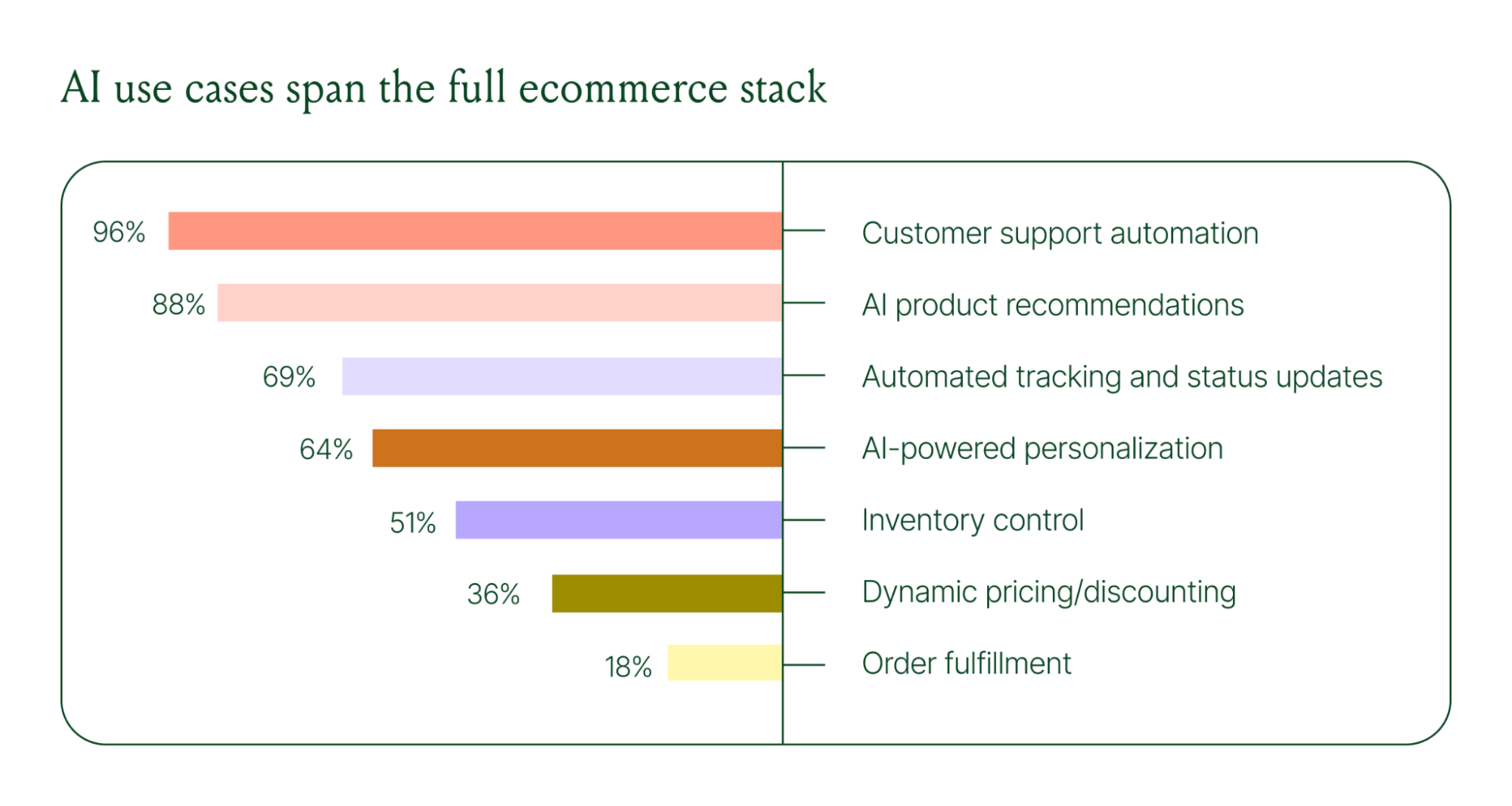
Ecommerce brands are deploying AI across every layer of their operation:
When brands were asked which channels contribute most to their AI success, conversational channels dominated. Social media messaging led at 78%, followed by SMS at 70%, and website live chat at 51%. Shoppers want fast, personal conversations, and AI is the best way to deliver that at scale.
Learn more about AI adoption, perception, and use case trends in the full 2026 Conversational Commerce Report.
For decades, customer support success meant fast response times and high satisfaction scores. Those are still important indicators of success, but leading brands are adding revenue-focused metrics to their dashboards.
91% of brands still track CSAT as a measure of AI's impact. But 60% now include AOV as a top indicator, and higher-revenue brands earning $20M+ are focusing on metrics like total operating expenses, cost per resolution, incremental revenue, and one-touch ticket rate.
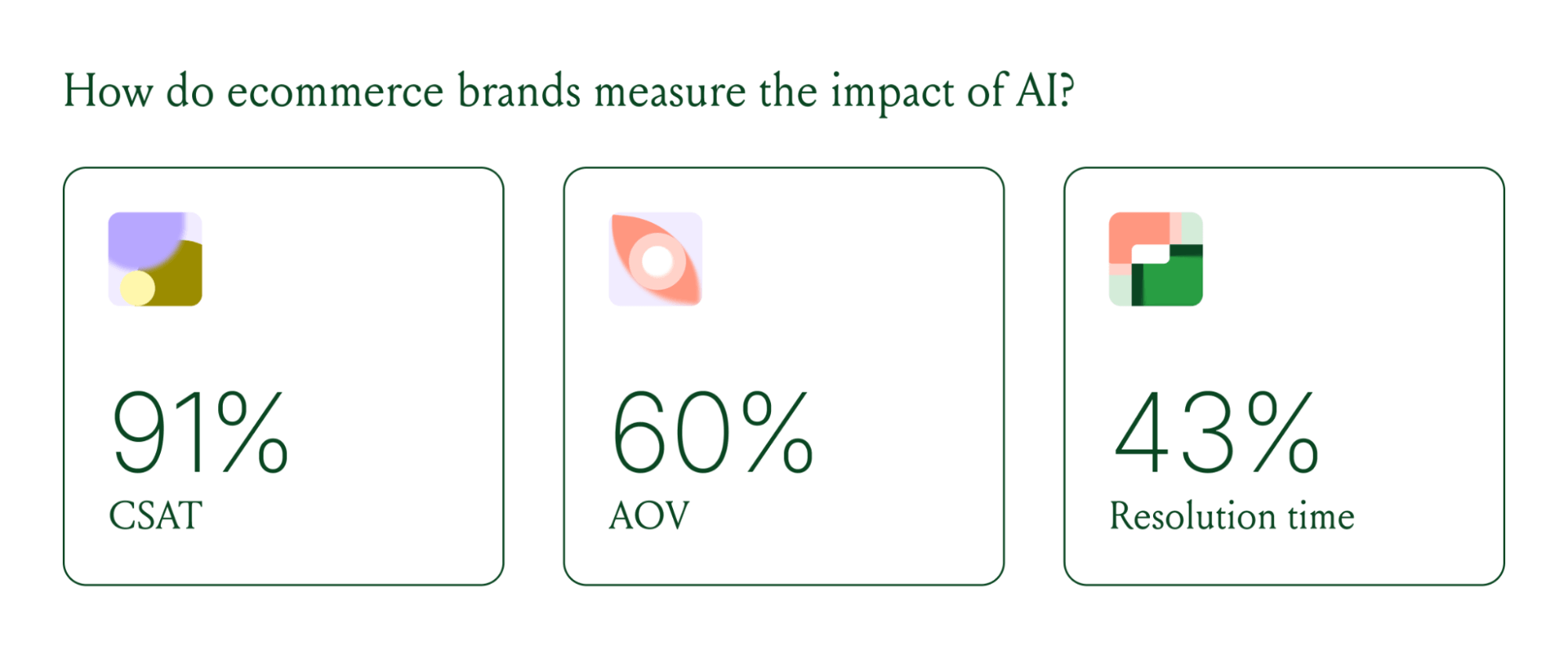
AI can now start a conversation, ease customer doubts, sell, upsell, and recover abandoned carts in a single conversation. When you’re only measuring CSAT, you’re ignoring the real ROI of conversational AI investment.
Virtual shopping assistants now proactively engage shoppers, adapt to their needs in real time, and offer contextual product recommendations and upsells. When the moment calls for it, they can close the deal with a targeted discount.
Gorgias brands using AI Agent's shopping assistant capabilities nearly doubled their purchase rates and converted 20–50% better than those using AI Agent for support only.
Orthofeet, the largest provider of orthopedic footwear in the US, is a concrete example of this in practice. Using Gorgias, they achieved:
The data tells a clear story: AI has evolved beyond a tool for handling tier 1 support tickets. It’s a core part of your revenue generation strategy.
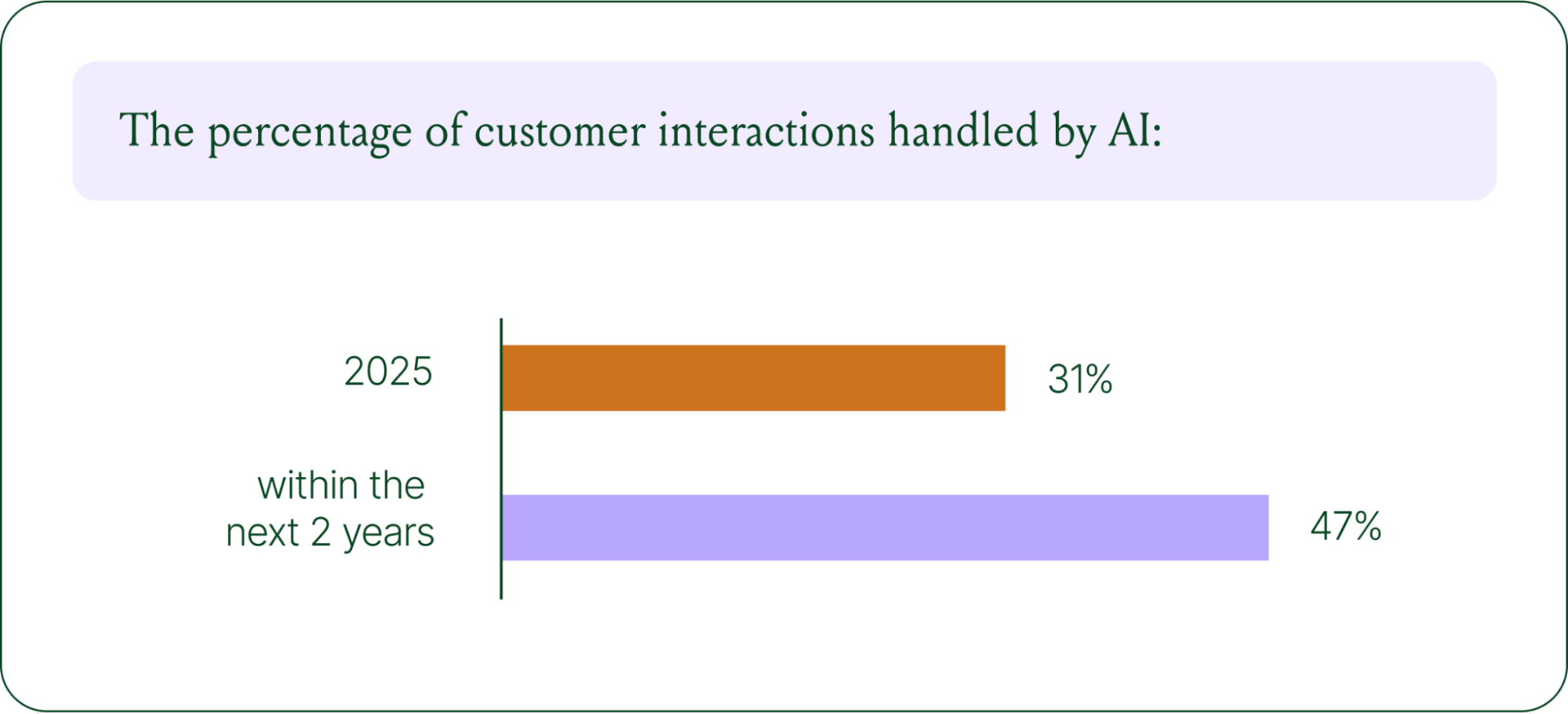
57% of brands are already using AI for 26–50% of all customer interactions, and 37% expect that share to rise to 51–75% within the next two years. The brands building toward that range now are the ones who will have the operational advantage when it matters most.
The practical question isn't whether to invest in AI. It's where to focus first. Based on where brands are seeing the most impact, three priorities stand out:
Want to go deeper on the full 2026 conversational commerce trends? Read the complete report for data across every major AI use case in ecommerce.
{{lead-magnet-1}}


You asked Google “how to sell on Instagram for free” and found yourself on this page? Good for you! You’re about to learn 9 ways to make a lot of money on this social platform without spending a dime.
Selling on Instagram has been red-hot since it introduced several ecommerce features like Instagram Live Shopping and Instagram Guides.
Whatever you’re selling, you can make use of Instagram to increase sales for your ecommerce business.
Excited to learn? Let’s waste no time.
{{lead-magnet-1}}
First things first, you should create an Instagram business profile and optimize it as much as possible. It matters a lot.
Why? Because more and more customers are turning to Instagram instead of Google to search for brands, sales, product reviews, and recommendations.
These numbers don’t lie.
Another reason is an Instagram business profile offers a bunch of extra features and tools you can use to grow your business, compared with a normal profile. For example, Instagram Shopping, Instagram Ads, Instagram Guides, Instagram Reels Shopping, and Instagram Insights.

Tips for creating an Instagram business profile that sells:
Take a look at Skirt Society’s Instagram business profile:

What Skirt Society does well:
See? Skirt Society’s Instagram bio is all about their customers or what customers will get when shopping with the brand.
{{lead-magnet-2}}
Instagram Shopping allows you to create an Instagram shoppable feed and a digital, shareable product catalog right on Instagram.
With Instagram Shopping, people can learn more about your products and purchase your products directly from the app (with Instagram Checkout) or click through to complete the order on your ecommerce store.

Instagram Shopping’s key features:
Here is an excellent example from @camillerosenaturals. Their Instagram profile is filled with many posts with a shopping bag icon tagged in the top right corner. Tap on the product tagged, and you can see additional product details like this:

To set up Instagram Shopping, ensure your business checks a few boxes for eligibility:
Instagram Stories allows you to connect with your followers on a more personal, casual level. It brings you a huge opportunity to build trust and increase engagement in a short time.
Mention’s 2020 Instagram Engagement report reveals many interesting statistics about Instagram Stories. Here are some of them:
That’s awesome, right?
Here are some Instagram Stories’ sales and conversion features you should keep in mind:
Shopping stickers: Use them to tag physical products in your stores. There are four types of stickers, including a shopping bag icon, a sticker with a product name in rainbow or grey, and translucent text.

What makes this feature so great is that no matter how many followers you have, you can drive traffic to your website through your stories.
Swipe up: Once you reach over 10k followers, you can add a “swipe up” to your Instagram Stores — another big opportunity to promote products, blog posts, and sign-up pages.
For example, @covergirl includes the View Product button at the bottom of their story. Viewers can simply tap on the button to access the link.

Note that you must have an Instagram business profile and over 10k followers to access this feature.
According to Morning Consult’s The State of Consumer Trust 2020 report, 69% of consumers say it’s very important brands deliver consistently on what they promise when considering trust. Nielsen’s research also shows that consumers trust personal recommendations above paid ads.
How can brands gain customer trust? One of the best practices is working with Instagram influencers.
Instagram influencers are a reliable source for product reviews, recommendations, opinions, and more. They share content in an authentic way, helping them gain a high level of trust from their followers.

By partnering with Instagram influencers, brands can take advantage of their influence on their audiences to promote products, encourage purchases, and gain a loyal following.
Another great thing about Instagram is that you don’t need to work with mega influencers like Selena Gomez and pay them thousands of dollars for a sponsored post.
Today, ecommerce merchants and small business owners have many choices to establish a partnership with an influencer.
If you have a tight budget, you can find nano-influencers (having 1k-10k followers) or micro-influencers (10k-100k followers) and offer them free products in exchange for sharing branded content on their profiles.

According to Mention, an enthusiastic micro-influencer with a smaller, but keen and dedicated following, provides better value for money.
Also, micro-influencers are experts of their niche and more personally invested in their online presence. They spend a lot of time creating high-quality content, reading comments, and addressing their followers’ inquiries personally.
Want to give your followers a bit of fun while still making a lot of sales? Enter Instagram giveaways.
With a giveaway, you can invite your followers to join a competition in which they have to do a couple of things to have a chance to win a prize.
For example, you can ask them to share a video of themselves using your product, use your branded hashtag, or tag a friend in your post. The rules should be as simple as possible so your followers can follow them without taking much effort.
Here is a great example from Pacifica Beauty (@pacificabeauty):

Some tips for creating a successful Instagram contest:
One of the most common ways brands leverage exclusivity in their Instagram marketing strategy is by giving their followers exclusive access to deals… just for being part of their Instagram community.
Sattwa Skincare (@sattwaskincare) knows how to start off on the right foot. From their post, they state clearly what they’re offering and frame the offer around exclusivity.

What’s more, Sattwa Skincare limits the offer “until Sunday evening,” giving followers a little push to take action before the deal ends. This is an excellent example of creating a sense of urgency with an exclusive deal.
Gaining audiences’ attention is one thing; getting them to stay longer (and forever) with you is another.
When you show people you’re truly interested in them and want to create a meaningful relationship with them, they’ll show their caring back to you.

Follow these tips to build great connections with fans on Instagram:
Related: Learn how to use social media for customer service. Or, if you're just interested in Instagram, check out our in-depth guide on Instagram for customer service.
IGTV is both a standalone video-sharing app and an extension of the existing feature on Instagram. IGTV supports vertical and horizontal videos with a 10-minute length for most Instagram accounts and up to one hour for larger accounts.
Done right, IGTV can bring a great opportunity to build engagement, collaborate with influencers, drive sales, and many other things.

Here are some ideas for your IGTV videos:
Instagram Reels allows you to create interactive videos, add effects, and stitch the video together right within the app. It’s a new way to make fun and engaging video content on Instagram.
With Instagram Reels, you can record and edit together 15 to 30-second video clips set to music and share them to your Stories, Instagram feed, and the Reels tab on your profile.
Brands use Reels to share stories, user-generated content (UGC), new product teasers, and tutorials. They even collaborate with influencers to promote products, announce sales, and more. As an online store, you should start creating Reels right away to reach more potential customers.

Many merchants think they have to make huge investments on Instagram to get a significant level of return. But that’s not true. You can start selling on Instagram for free with these 9 tips:
In case you’re looking for a help desk tool to manage Instagram customer requests, give Gorgias' social media features a try. Sign up for an account to get a full-featured 7-day free trial. You’ll be amazed at what Gorgias can do for your customer service experience.

With so many choices and so little time, it can seem an impossible task to gain the attention (and wallets) of your target audience, especially if you’re just starting out! It of course doesn’t help that there are thousands of guides out there teeming with ecommerce tips telling you the one thing you’re doing wrong or the best way to grow 300% year-over-year...all before you’ve even made a sale.
At Gorgias, we prefer to cut through all that noise and get straight to the point. After all, we can’t consider our job well done until your store starts making bank. But before we take a second look at your store, consider this: websites are not dissimilar to shops in a mall (remember those?) where the first impression is everything.
For example, Apple’s simple, structured aesthetic seems to encourage a sense of order and management. It stands out from the dying electronic stores of yesteryear that piled their wares in the front window and whose own employees struggled to tell you what was in stock on any given day.
The key takeaway for you is that before doing anything consider applying a holistic approach to your online store. Ask a fresh pair of eyes to take a look and give you their initial impression if it’s clear from the start what you’re selling and how to learn more. Once you’ve done this brief exercise you’re ready to dig deeper. So let’s get on to our list of common ecommerce mistakes that might be preventing your first sale.
Okay so maybe your website looks pretty but did you spend too much time focusing on the aesthetic and too little time ensuring you had all the basics in place before launching?
Your design needs to be clear, clean and simple, in other words make sure you’re focusing on the sale first and foremost. You’ll also want all the usual elements to be easily findable, that means including clear and well-defined Return Policy, Terms of Service and About Us pages in your website’s footer.
Make sure your site navigation is as easy to use as possible. Since research shows that most visitors only read about 20% of the text on any given page, your customers need to be able to find their way around your store easily and quickly. Achieve this by making sure your menu is clear, concise and easier to locate.
Finally, don’t forget to verify your domain with Google (as well as other major search engines) by submitting your sitemap to them and always include any security badges your site uses. Considering almost 50% of Americans have been victims of credit card fraud in the last five years, letting your users know you’re trustworthy is fundamental to securing a sale.

No two product pages are created equal and chances are yours could be working way harder. Start with the quickest fix: your copy. As your customers aren’t able to see and feel your products in-store, you need to describe them in a way that gives them the confidence to buy. Here’s a few characteristics to apply to your writing:
Balance detail with skimmable content and avoid long paragraphs that could cause a user’s eyes to look away. And where photos are concerned, the more the better. Multiple photos at different angles are proven to convert better than one single image.

As mentioned earlier on, trust is essential when it comes to getting customers to hand over the sensitive data required to make a purchase. If they’ve never heard of you before, it might be harder to convince them you’re a trustworthy seller.
Of course it’d be easy to tell you to just incorporate product reviews on your product pages (which you definitely should do) but if you haven’t yet made a sale then that’s not a possibility for you yet. Instead, embrace the fact that we’re living in the age of the influencer and reach out to a few relevant figures in your target market. Offer to send them your products to test out in exchange for a testimonial you can put online. Some may even agree to post about your product.

If you target micro-influencers (people with 1000 to under 1 million followers) you can avoid running expensive search ads but still enjoy traffic from your target market and possibly sales as you’ll be benefiting from their pre-established trust. Keep in mind some influencers will charge a rate on top of the “free product” you’ve sent, but these fees are always negotiable and in some cases can be avoided if your product is of enough interest to the influence.
Finally, don’t forget to just ask for reviews in the first place. Make it part of the process with automated emails that remind customers to leave a review after they’ve made a purchase. You can also make posts calling for feedback and reviews on your social accounts as well.
Maybe you’ve built the best website imaginable, with emotive product photos, great emails and dazzling social accounts to boot, but have you considered how relevant your traffic is? You might already be getting all the traffic in the world but if you haven’t defined and appealed to the right target audience, the significance of a large traffic volume quickly becomes a vanity metric.

Getting the right people to your website is the result of a few factors. First, it’ll be easier if you’re a fan of what you’re selling. Why? Because if you’re your own target audience you already understand the lifestyle, behaviour and unique selling points that get people to buy products like yours. Use this research to create customer profiles (built on demographics like location, pages visited, etc) that then inform the style of content you create.
Are athletic people more interested in your product? Do you have a lot of site visitors from a particular state or province? You can use this information to personalise some marketing materials like emails. These practices apply across social media and your main site - you can do this kind of research and targeting everywhere.
Finally, make sure you’re using relevant keywords on your site. Do you h2s and h3s and meta descriptions use phrasing and specific wording that aligns with what you’re selling and who you’re selling to? Understanding what your customers are searching for will help you answer those needs and get the low-funnel traffic that converts.
Payment gateway technology is what store owners use to accept credit and debit cards from shoppers. The term refers to both physical, card-reading devices found in stores and the digital payment processor apps that exist on ecommerce websites. Now that you’re caught up on the lingo, let’s explain why choosing the right payment gateway is essential to making sales.
There are frankly hundreds of different payment platforms you can choose from and picking the right one can be difficult. But as we describe in detail here, there are three specific factors to consider before surrendering yourself over to one specific gateway. They are:
For example, PayPal requires users to leave your website in order to complete the payment process. If you want, you can pay a $30 fee to make sure the payment is processed without requiring shoppers to go to the external site but why do that when there’s providers out there like Shopify who have on-site processing built in to the experience?
Maybe your customers are the kind of people who would prefer to pay in a digital currency. Not all payment providers will support this. Not all payment providers even support the use of gift cards. Consider a provider that can grow with your business because one day you might want to have these options even if you don’t right now!
Nobody likes data hacks. If your provider runs a less-than-secure operation that means your customers’ data is vulnerable and if they suffer a breach it might make even the loyalist fan think twice before shopping with you again.
There’s offering options and there’s drowning people in so many choices you inadvertently cause the dreaded “abandoned cart” outcome. Pay attention to which payment gateways your customers are primarily using and stick to a small number (certainly not 5) of the most relevant ones.
Once these factors are considered you’ll want to know which options are out there. We talk in depth about different providers in the article linked above but check out these names and weigh which one makes sense for the size and priorities of your business: Amazon Pay, Square, Apple Pay, Stripe, Google Pay, and WooCommerce Payment.
Whether your online store is a one person show or a small team that includes a trusty support agent, you might be missing out on sales simply due to a lack of customer service. That doesn’t mean you don’t have the skills required to provide superb support, instead the problem is likely that you aren’t making tech work for you.
For example, let’s say you have your online store but you also have an Instagram channel, a Facebook page and a Twitter account. You might be getting emailed about questions and concerns via your website while also getting bombarded with DMs and comments across your socials. Despite your best efforts, if you’re checking everything manually across apps and websites - you’re going to miss something.
But that’s okay! You’re only human. And lucky for us humans, we’ve got some pretty incredible tech on our side to streamline manual (yet important) tasks.
With Gorgias, you can view your customer’s order history easily from the BigCommerce backend, personalise the experience by integrating data relevant to the customer, automate answers to common questions to save time and more. The sky’s the limit and even a one-person team will be able to deliver the support of 10 with the help of a few simple integrations.
You can see which e-commerce platforms we support on our website and check out the support channels we can give you a hand with by visiting our integrations page.
Now listen, we left this one for last because nobody likes to hear but maybe, just maybe you haven’t given your store enough time to reap the benefits of all your hard work. The story of the best e-commerce stores are rarely the ones that describe themselves as an “overnight success.”
Be patient and if you’re applying the tips we’ve mentioned above you’ll start to see things like relevant traffic and conversions pick up on your site before you know it.
And if you ever need more advice or a helpful tool, we’ve got you covered! Good luck!

But before going into details, let’s learn why you should add a chat button to your online store.
If you’re running an ecommerce business, you know how difficult it is to turn every visitor into a customer and then a repeat one. With a live chat, you can deliver personal touches that help make your job much easier.
Here are the benefits of adding a live chat to your online store:
Sounds great, right?
You might be excited to have one! So, let’s move on to discover the best live chat app for your Shopify store.
{{lead-magnet-1}}
Gorgias gives you a powerful live chat widget that you can add to your Shopify store or other ecommerce stores like Magento and BigCommerce. It’s one of the best Shopify live chat apps, with over 400 reviews on the Shopify App Store.
Gorgias live chat features:
About pricing, Gorgias offers you a 7-day free trial with full access to premium features. Its pricing plans are reasonable and affordable than Zendesk Chat, Tidio Chat, and other live chat software.
Bonus: Gorgias is also an ecommerce ticketing system! It offers omnichannel communication, i.e., email, live chat, phone, SMS messaging, and social media.
Use Shopify Inbox? Learn why Gorgias is the #1 Shopify Inbox alternative.
To follow along in this tutorial, you’ll need a Gorgias chat account. If you haven’t had it, click here to sign up for an account and enjoy a 14-day free trial with full access to all advanced features.
After that, take these steps to install Gorgias on your Shopify store:
Step 1: Log in to your Gorgias helpdesk.
Then, from the right sidebar, click Connect Shopify to enter the Shopify integration page.
 |
Step 2: In the Shopify integration page, click the Add Shopify button at the top-right corner.
 |
Here’s what you’ll see:
 |
Type your store name in the Store name box. Then, click Add integration, and your Shopify store will be integrated into Gorgias in a second:
 |
Done! You’ve just integrated your Shopify store with Gorgias successfully. Move on to learn how to create your first Gorgias live chat.
Do as follows:
Step 1: Click the Connect live chat option on the right menu of the Tickets view.
 |
You’ll be directed to the Chat integration page as below.
 |
Step 2: Click Add chat to open the New chat integration page.
 |
On this page, you can add a chat title, edit introduction text during and outside business hours, change colors and language of the chat window.
When you’re done with customization, click Add new chat.
 |
At this point, you already have a real-time chat box. Now you need to add it to your Shopify store.
To add a live chat to your Shopify store, just switch the button on the right side of your Shopify store name from OFF to ON.
 |
Then, go to your Shopify store to see how Gorgias live chat appears:
 |
To further customize your live chat widget, check out these tutorials:
Note: If your store isn’t on Shopify, you can copy the JavaScript code and paste it on your website above the </body> tag. No plugin required.
Create a Gorgias account right now and follow this guide to add a live chat to your Shopify store. Your customers are waiting to talk with you.
In case you have any questions, don’t hesitate to contact our fantastic customer support team. We’re more than happy to help you.
{{lead-magnet-2}}

This week, Gorgias and Simplr announced a partnership to help provide ecommerce brands with a customer service stack that is built to turn contact centers into revenue drivers via 24/7 rapid-response digital customer engagement.
And, with consumers operating on a “NOW” schedule, we’re pretty excited about how this partnership will enable ecommerce brands to engage more customers in valuable CX moments.
If you put on your consumer hat for a minute, think back to even two or three years ago- a time when we had to wait just a little bit longer for a meal delivery, for the arrival of an online order, or for a customer service email response. Today, everyone’s tolerance for waiting is lower than ever, thanks to the sky-high standards set by world-class companies like Amazon, Netflix, and Spotify. These are the brands that are setting the tone for every other experience your customer is having. Your business is not only competing with others in your industry, you’re competing with the best brands in the world.
Elevated customer expectations in our instant gratification culture have created a new kind of consumer that CX professionals haven’t been forced to deal with before.
We call this consumer the NOW customer.
For ecommerce brands in particular, the NOW customer, who is always “on” and expects immediacy in every experience they have, both online and offline, is looking for exceptional CX from the brands they shop and engage with -- they won’t (and shouldn’t have to?) settle for anything less.
In the new Simplr Consumer Online Shopping and Customer Service Study, published in December 2020, Simplr found that NOW-centric, exceptional customer service is a must (unless you like losing customers):
NOW customers are quicker than ever to leave you and shop with someone else if they aren’t getting the service they expect. So how does the NOW Customer define “exceptional” service?
From the same study, we found that:
All this boils down to providing fast, always-on service, on the customer’s terms, over any channel they want, 24/7. That’s all. Oh, and if you can’t deliver this type of experience, your customers and would-be fans will leave, and your brand ends up missing out on revenue. No big deal.
Tongue-in-cheek-ness aside, providing this type of experience has historically been extremely hard, and few brands have actually been able to crack the NOW customer code.
The fact of the matter is, the traditional contact center model is not able to scale and flex to meet these new expectations. The fixed and rigid nature forces you to make compromises and tradeoffs that are ultimately trade-downs for your customers- resulting in limited hours and channels, deflection, and slow response times- all because the model you’re using today is so fixed and rigid, along with the costs that go with it.
Now, brands don’t have to be held back by a contact center model that can’t scale. CX professionals can access a new model and approach the rise of the NOW customer as an opportunity to set themselves apart from the rest of the pack. By taking a “NOW” approach to CX and providing a level of service that boosts your reputation with buyers, you’ll be in a position to take advantage of every revenue opportunity in the moment.

To provide the NOW customer with the service they expect and deserve, and to capitalize on every revenue opportunity, brands should break free from their traditional contact center model and embrace a newer model that was designed to deliver for the NOW customer. This model needs to scale easily, enable you to always be ready and responsive for customers, and engage them whenever and wherever they want.
The NOW customer can’t be ignored. And the brands that will rise in the NOW era will be the ones that have this realization and make the necessary adjustments, well, now.
Find out more about how the Simplr + Gorgias partnership can help you rise to meet the NOW customer and capture revenue opportunities in every moment.

Standing out and building a community of loyal fans is hard, and it’s even harder after the surge online shopping had in 2020. The mammoth amount of competition out there is constantly fighting for even the tiniest slice of ecommerce action.
To gain a competitive edge, brands must put their customers first.
In fact, companies voted customer experience as the most exciting opportunity for businesses over the next year, and it makes sense. Why? It’s because the customer experience drives sales. Research shows that brands with a customer experience mindset drive revenue 4-8% higher than the rest.
When your customers have a bad experience, it can wreak havoc on a brand and dramatically affect the bottom line. The problem is, it can be tricky to improve, especially if you don’t know where to start or what your customers actually want. This is where those customer reviews come into play
Not only do they help bolster customer support best practices, but these powerful assets give you a deep understanding of your customers — something that DTC brands are leveraging to the max. Customer-centric brands like Born Primitive, Beardbrand, Bombas, Tuff Wraps, and WAG are nailing customer experience by tapping into reviews and using them to leverage the buyer journey.
Read on to learn how reviews and UGC are helping brands create a 5-star customer experience.
A clothing brand isn’t going to know how a jacket sits on every single body type, and they’re certainly not going to include this information in their product descriptions. Unfortunately, this can be a sticking point, especially since online shoppers aren’t able to try on products before they buy.
This unsurprisingly leads to more returns (while in-store returns are around 8%, online returns hover around 25%).
There’s a solution though, by strategically using reviews and UGC, brands can provide online shoppers with in-depth insights to help customers get exactly what they’re looking for. This is particularly essential for brands that use reviews with additional product and customer attributes, like shopper size and product color or type.

Born Primitive does exactly this, sharing customer attributes and photos alongside reviews to help buyers get an idea about how items might look on them.
Your products are the crux of your business.
Fail to get your products right, and you’ll struggle to grow a flourishing business. This is one of the most important customer support tips for Shopify merchants — know thy customer and give them what they want.
Brands can fuel product development and internal procedures with customer feedback to continue to optimize the customer experience, all you need to do is listen.
Using real-life feedback from buyers to improve how they view and buy products, as well as the products themselves, ties into the customer-centric vision that successful DTC brands share. It also shows your customers that you’re an honest, and transparent brand working to give them the best product and best experience.
Take LSKD, for example. They’re using customer reviews to improve their products and to better align with customer wants and needs. The brand uses Okendo to capture reviews, respond to them, and gather crucial customer feedback.

In fact, the brand’s popular Rep Tights have been molded over the years by customer feedback to ensure they take on the attributes buyers are looking for. Through reviews, customers are able to share their thoughts on specific product points to fuel development.
Involving customers in this part of the process creates a community around a brand, and ensures you’re giving customers what they want.
And think about it: if a brand is giving customers everything you need, why would they go elsewhere?
Support and customer experience go hand-in-hand. If customer support is good, the customer experience tends to be good too.
Creating a good customer support experience is all about streamlining responses and separating those easy-to-answer questions from more complex ones. Brands can use reviews to automate commonly asked questions and personalize support based on the type of review a customer has given.
On a more basic level, reviews help retailers identify customers who might be experiencing problems with their order. This, in turn, allows brands to address and resolve issues by responding to customer reviews, turning the experience from bad to good in a matter of minutes. Which can end up saving a company from hitting a bit of a rough patch, or issue with further customer responses.

Tuff Wraps regularly replies to less-than-stellar reviews with extra information and an email address that customers can use to get in touch with support. This can help customers feel seen and heard and completely turn around what was initially a poor experience. Combining reviews and customer support in this two-pronged approach aligns with the common best practices for customer support on Shopify.
If you’re experiencing this issue with customers leaving negative reviews, we’ve got something that might help. With Gorgias’ integration with Okendo, you’re able to diagnose these problems and handle them seamlessly from a single dashboard. By leveraging this integration, merchants gain full visibility on customer reviews and their support history.
As many of us know, reviews are key to creating a positive customer experience, especially when they form such a crucial part of the buying journey. Shoppers actively seek out peer reviews before they buy to get a better understanding of a product.
This is where Okendo can come in again, since it encourages customers to leave reviews complete with visuals and helpful attribute information. You can then use the reviews that come rolling in to glean valuable insights into the customer experience and identify ways to improve your products and the overall experience for your buyers.
Signup to Gorgias and leverage reviews to create a 5-star customer experience.

The Covid-19 pandemic has dramatically accelerated the move from offline to online in retail. This got us busier than ever supporting our merchants, new and old, to ensure we help them work towards providing exceptional customer service.
The latest example of this is Black Friday and Cyber Monday, where Shopify saw an uptick of 75% GMV when compared to last year.
As a result of this huge ecommerce spike, 2020 has been a massive year for Gorgias.
At the beginning of the year, we had just 30 people on our team and now, we’re sitting at over 100 incredible people working each and every day to help serve 5,000+ merchants.

The reason our team grew so much this year is to support the growth of our merchants.
Throughout the year, order volume has massively increased and therefore, lots of customers have been contacting businesses through customer service. We went from having 2 million support requests a month on Gorgias to 6 million during the holiday season.

So today, we’re announcing a $25m series B lead by Rajeev Dham at Sapphire Ventures, with participation of Jason Lemkin (SaaStr), François Meteyer (Alven) and other historic investors.
We want to accelerate our progress towards our mission to transform support from painful to exceptional for merchants.
We asked our merchants and learned that they have the following needs: first they want their support to be fast and high quality, then they want to optimize their cost, and once they’ve done that, they are willing to shift the way they think about support to make it a profit center.

In 2021, we want to focus on the top questions our merchants are getting, which account for 60% of the support volume. By empowering support agents to respond faster to these frequent questions, we’re aiming at reducing first response time for our merchants and at increasing the quality of their support. This will free up agents time so that they can focus more on the more complex questions their customers are asking.

You can learn more about our next quarter roadmap here.
Looking further ahead into the future, our goal is to change the role of support from responding to customers’ issues to helping the business grow.
2021 is going to be a new chapter for us. With this round, we’re going to double our team to 200 people across all our hubs, in San Francisco, Belgrade, Paris, Charlotte, Toronto and Sydney.
If you’d like to join the adventure and help us improve the daily lives of 3 million support agents in the US (and more worldwide), we’re hiring aggressively in all these locations.
I want to thank our amazing team for helping build a company that has an impact on 60 million customers yearly, and the 5000 merchants who’ve decided to use our product every day.
The adventure continues, we’re more excited than ever!
Alex & Romain
.avif)
TL;DR:
An ecommerce business plan is your roadmap to build and scale a profitable online store. It outlines your target market, strategy, and financial projections to give you clarity as you grow.
A well-crafted plan keeps you focused on acquiring customers and driving revenue. Unlike traditional retail, ecommerce plans prioritize digital marketing, logistics, and technology infrastructure — the pillars of online commerce. According to research from Wiley, startups with a business plan grow 30% faster. A Harvard Business Review study also found they are 16% more likely to succeed.
This guide walks through every component of an ecommerce business plan. We provide actionable insights and expert tips to help you create a plan that works.
{{lead-magnet-1}}
An ecommerce business plan is a strategic document that outlines your online store's objectives, target market, competitive positioning, operational approach, and financial projections. It serves as both a roadmap for growth and a tool for securing funding from investors or lenders. This document translates your business idea into a concrete strategy. It identifies potential challenges and shows stakeholders where your business is headed.
Unlike traditional retail business plans, ecommerce plans prioritize digital customer acquisition, logistics partnerships, and technology infrastructure. Your plan should address how you'll drive traffic to your store, fulfill orders efficiently, and leverage data to optimize the customer experience. The business world can be harsh — about 45% of businesses fail in the first five years. A comprehensive ecommerce business plan helps you avoid becoming part of that statistic.
Every ecommerce business benefits from a plan — whether you're launching a new store, seeking venture capital, or scaling an existing operation. Create your initial plan before launch, then revisit it quarterly to adjust for market changes, new product lines, or shifts in customer behavior. Here's who needs an ecommerce business plan:
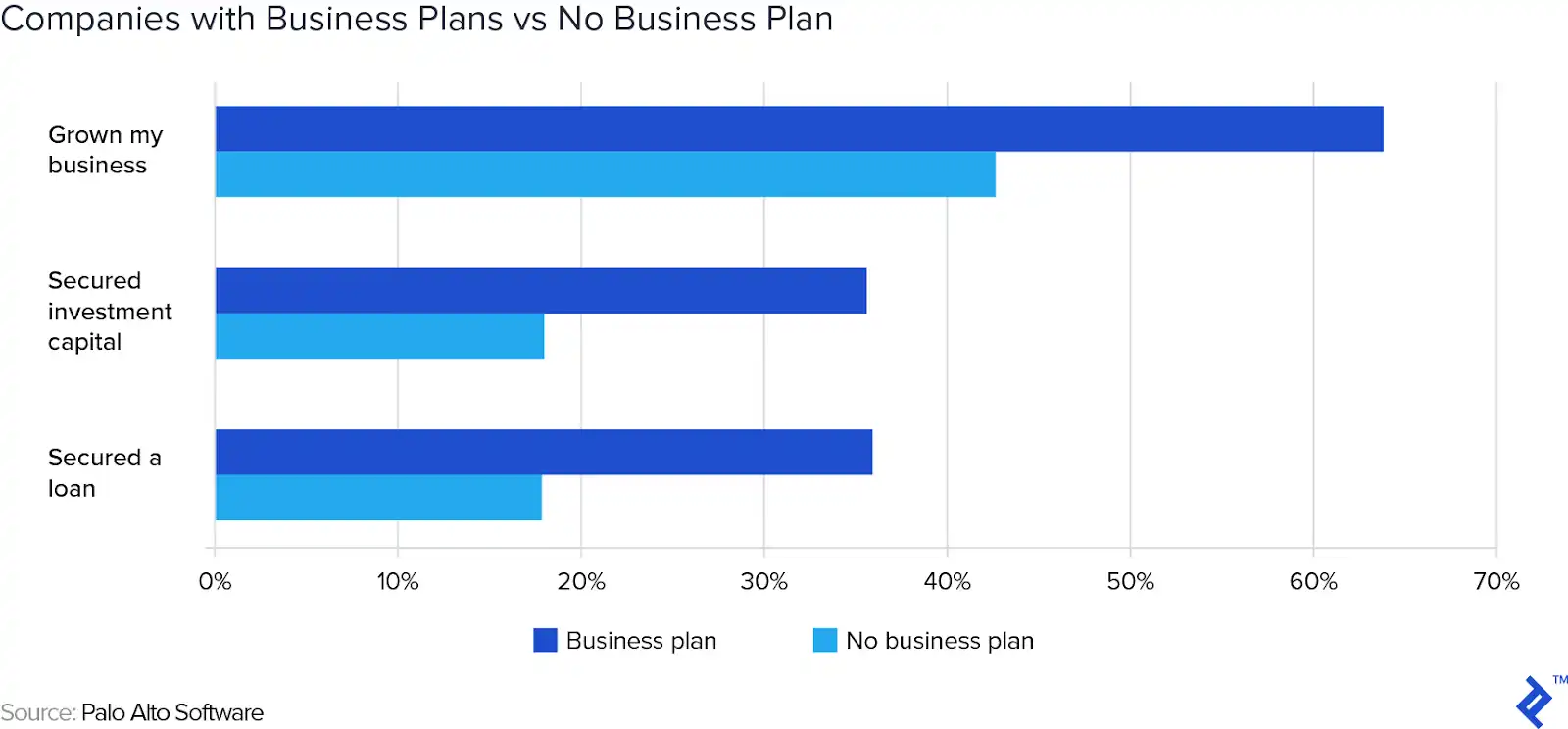
A comprehensive ecommerce business plan includes seven essential sections. Each component serves a specific purpose — from defining your market to projecting your finances. Together, they create a complete picture of your business strategy, operational approach, and growth projections. Below, we break down what goes into each section so you can craft a plan that's both thorough and actionable.
The executive summary is a one-page overview of your entire business plan. It highlights your business concept, target market, competitive advantage, financial needs, and projected outcomes. Think of it as your elevator pitch in written form — concise, compelling, and complete. Even though it appears first, you should write it last. This allows you to distill the most important points after completing all other sections.
Your executive summary should answer these questions: What problem does your store solve? Who are your customers? What makes you different from competitors? How much funding do you need, and what will you use it for? This section needs to grab your reader's attention and convince them it's worth their time to read the entire document. Keep it under 300 words and focus on the most compelling aspects of your business model and unit economics.
Use clear, confident language that reflects your brand voice. Avoid jargon and focus on demonstrating what makes your business unique.
Your company overview describes the fundamentals of your business: your name, legal structure, mission, and team. This section gives readers context on who you are and how you're organized to execute your plan. It typically appears second and provides vital details about your ecommerce business, including the size of your company, your location, and what you want to achieve.
Specify your legal structure — LLC, S-corp, sole proprietorship, or partnership — and explain why you chose it. Include your business name, domain, physical address (if applicable), and founding date. If you have a unique founder-market fit story that demonstrates your expertise in the space, share it here. This helps build credibility and shows you understand the market you're entering.
Your mission statement explains why your business exists. In a few sentences, it should describe what you strive to accomplish.
Introduce key team members, highlighting relevant experience and roles. Make sure you paint a picture of your team that showcases their professionalism and finest skills. If you're a solo founder, explain how you'll handle operations and growth as you scale. Consider outlining these team roles:
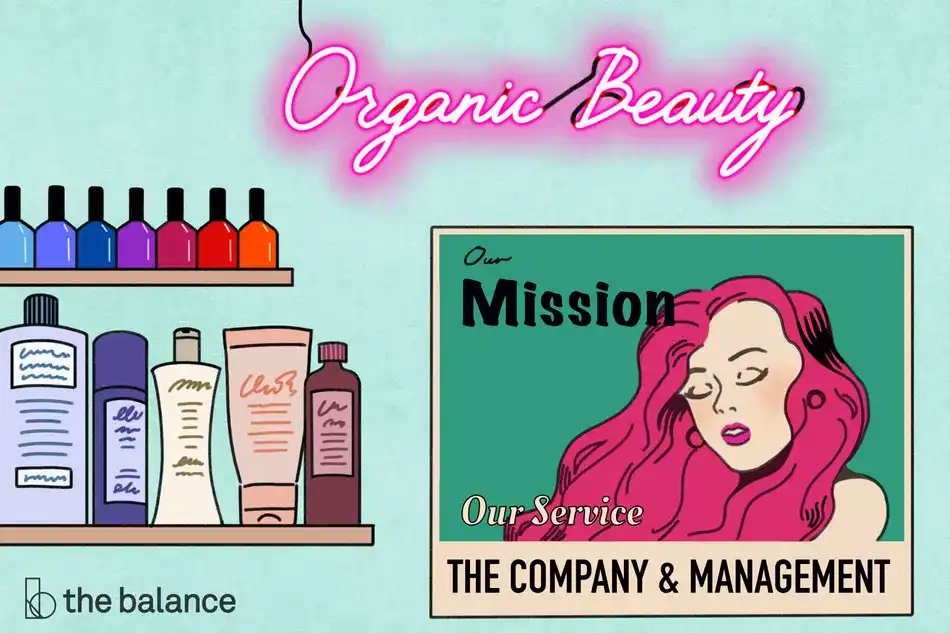
Market analysis is where you prove there's demand for your products. This section should demonstrate both your expertise and provide a thorough analysis of your current market. If you plan on tapping into a new market, you should also analyze it. Start by defining your target market — the specific group of customers most likely to buy from you. You must understand your target market. Never assume that everyone will want to buy your products. Create detailed buyer personas that include demographics, psychographics, pain points, and shopping behaviors.
Calculate your total addressable market (TAM), serviceable addressable market (SAM), and serviceable obtainable market (SOM). TAM represents the entire market for your product category. SAM narrows it to the segment you can realistically serve based on your business model and resources. SOM is the portion you can capture in the near term, considering competition and market dynamics. The industry market size is often a huge factor for investors that will read your business plan. You should also note if the market is declining or growing.
Identify your direct and indirect competitors. You want to know who is thriving in your niche, and why. Analyze their strengths, weaknesses, pricing, and customer reviews. This could be everything from their weaknesses to their web traffic, to their product and pricing strategy. Use a strengths, weaknesses, opportunities, and threats (SWOT) analysis to map your position relative to the competition. The more you know about your competition, the better you will be able to position yourself to stand out.
Highlight relevant trends that support your business case — shifts in consumer behavior, emerging technologies, or regulatory changes. Show investors you understand the market dynamics that will influence your success. This demonstrates your command of the competitive landscape and validates your business opportunity.
Describe what you sell, including SKU count, product categories, and any proprietary features. Explain your unique selling proposition—what makes your products different or better than alternatives. Describe all of your products, explaining their key benefits and features. They need to address a need that customers have or opportunities in the market. Show how your products differ from competitors. Highlight why customers will choose your product over other options. If you plan to expand your product line, outline your roadmap for the weeks, months, and years to come.
Detail your pricing strategy: cost-plus (markup on COGS), value-based (pricing tied to customer perceived value), or competitive (matching or undercutting competitors). A monetization strategy is a detailed plan about how to generate revenue for your products. Justify your pricing with data on production costs, competitor pricing benchmarks, and customer willingness to pay. Consider these pricing factors:
If you have patents, trademarks, or proprietary technology, mention them here. Intellectual property can be a significant competitive moat. Even without formal IP, explain how your branding, customer experience, or supply chain creates defensibility. This helps investors understand what makes your business sustainable in the long term.
Your marketing plan outlines how you'll attract and convert customers. This segment of your business expansion plan is where you share your comprehensive marketing plan, identifying how you plan to promote your products, attract leads, and retain customers. Start with brand positioning—how you want customers to perceive your store relative to competitors. Define your brand voice, key messaging, and value proposition. Your marketing strategy will determine your growth.
List your primary acquisition channels: organic search (SEO), paid ads (Google, Meta), social media, email marketing, influencer partnerships, or affiliate programs. For each channel, estimate customer acquisition cost (CAC) and expected conversion rates. Here are the primary channels to consider:
Calculate your customer lifetime value (LTV)—the total revenue you expect from a customer over their relationship with your brand. Your CAC should be significantly lower than LTV (ideally a 3:1 ratio or better). Map the customer's path from awareness to purchase. Identify key conversion points and drop-off risks.
Explain how you'll retain customers through lifecycle marketing: welcome campaigns, post-purchase follow-ups, loyalty programs, and win-back campaigns. To retain customers, consider rewarding them through a loyalty program. Retention is often more profitable than acquisition, so plan for it from the start.
Gymshark example: This go-to-market (GTM) strategy turned Gymshark into a category leader in athletic apparel, demonstrating the power of a well-executed marketing plan.

Operations and logistics cover how you'll source, store, and ship products. This section accounts for the day-to-day operations of your ecommerce store. Describe your supply chain: Will you manufacture in-house, work with wholesalers, or dropship? Identify key suppliers, lead times, and minimum order quantities (MOQ). Production is a very important component of success, so be very detailed.
Choose your fulfillment model: in-house (you handle storage and shipping), third-party logistics (3PL), or dropshipping. Each has trade-offs in cost, control, and scalability. Define your service level agreements (SLAs) for shipping speed and accuracy. Consider whether you will sell your products to international customers, how long it will take to package and ship them, and whether a third party shipment company will be necessary.
List the technology you'll use to manage operations: ecommerce platform (Shopify, BigCommerce), warehouse management system (WMS), inventory tracking tools, and shipping integrations. Explain how you'll monitor inventory turns and avoid stockouts or overstock. Here, you should include how much inventory you have at any given time and plan for how you will store, handle, and track product lines. Key operational metrics to track include:
Transformer Table example: Transformer Table scaled globally by partnering with reliable 3PL providers and optimizing their shipping strategy. Their business plan included detailed logistics planning, allowing them to fulfill orders efficiently across multiple countries while maintaining high customer satisfaction. This operational excellence became a key competitive advantage.
Your financial plan proves that your ecommerce store can be successful. Start with your revenue model: How do you make money? Detail your pricing, sales volume projections, and expected growth rate. Create a three-to-five-year P&L (profit and loss) statement showing projected revenue, COGS, operating expenses, and net income. You will have the opportunity to demonstrate profitability by translating all the components of your business into numbers.
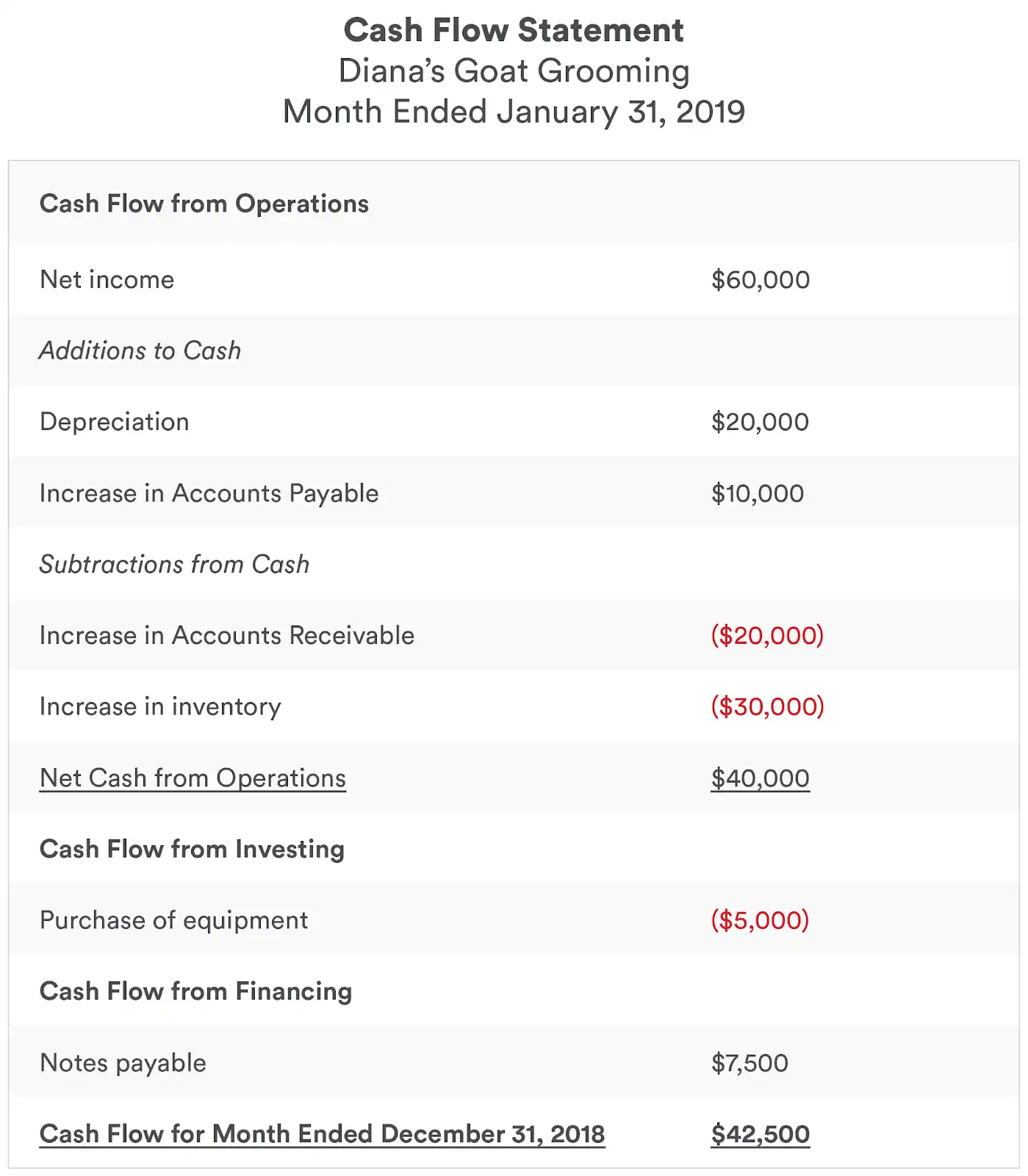
List your startup costs: inventory, platform fees, marketing, legal fees, and initial payroll. Undoubtedly, equipment will be required for your business to operate — list out what you have on hand, what you will need before you launch, and what you might need as your business grows. Build a cash flow forecast showing monthly inflows and outflows for your first year. Cash flow statements show the cash that comes in and goes out each month. Identify your break-even point — the moment when revenue covers all expenses.
Startup Costs: Inventory, Platform fees, Legal & licensing, Initial marketing
Operating Costs: Marketing, Payroll, Shipping, Platform fees
Calculate your unit economics: gross margin per product, CAC, LTV, and CAC:LTV ratio. These metrics show whether your business model is sustainable. If you're seeking funding from investors, specify how much you need, what you'll use it for, and when you expect to reach profitability.
Runway is how long you can operate before running out of cash. Build in contingency plans for slower-than-expected growth or unexpected expenses. Forecasting cash flow is very important, even if it is an imprecise practice. It allows you to prepare for a variety of different circumstances, such as a quiet season, and demonstrate how you will adapt your ecommerce business strategy accordingly. Investors want to see that you've thought through downside scenarios.
Your ecommerce platform is the foundation of your online store. Popular options include Shopify (easy setup, extensive app ecosystem), BigCommerce (scalability and built-in features), and WooCommerce (flexibility for WordPress users). Choose based on your technical skills, budget, and growth plans. The platform you select will influence everything from your site's performance to your ability to integrate essential tools.
Beyond your platform, you'll need a payment gateway (Stripe, PayPal), CRM for customer service (Gorgias), email service provider (Klaviyo, Mailchimp), and analytics tools (Google Analytics, Shopify Analytics). Each tool should integrate seamlessly with your platform to create a unified tech stack. Your business plan should list the software, hardware, and machinery critical to the success of your operations. Here are the must-have tools:
Customer service is revenue-critical for ecommerce. A helpdesk like Gorgias centralizes support across email, chat, social media, and voice — integrating with Shopify to provide agents full customer context. AI Agent can automate repetitive inquiries, freeing your team to focus on high-value interactions. Gorgias integrates with Shopify and over 100 ecommerce tools. This helps you streamline customer service and drive revenue with personalized support. Planning for customer support infrastructure from the start ensures you can scale efficiently while maintaining customer satisfaction.
We've created a structured approach to help you build your ecommerce business plan efficiently. A template includes all seven core sections with prompts and guidance to help you cover every essential component. Starting with a clear framework ensures you don't miss critical elements and helps you organize your thoughts systematically.
You now have the resources and tools to write a comprehensive business plan.
Traditional business plans are comprehensive (20-30 pages) and ideal for seeking funding. Lean business plans are shorter (1-2 pages) and focus on key metrics — perfect for internal planning or quick iterations. Choose the format that matches your immediate goals:
Traditional business plan:
Lean business plan:
A strong business plan is built on solid research. Before writing, gather data on your market, competitors, and customers. Use tools like Google Trends, SEMrush, and industry reports to validate your assumptions. The more evidence you provide, the more credible your plan. This research phase is critical — it's the foundation that supports every claim you'll make about your business opportunity.
Avoid jargon and buzzwords. Write in plain language that anyone — investors, partners, or team members — can understand. Use short sentences and paragraphs to improve readability. Bold key terms like SMART goals (Specific, Measurable, Achievable, Relevant, Time-bound) and use bullet lists to break up dense information. Your goal is to communicate clearly, not to impress with complex terminology.
Your business plan isn't static. Revisit it quarterly to adjust for market changes, new product launches, or shifts in customer behavior. Treat it as a living document that evolves with your business. Your business plan helps you attract investors. It also helps you overcome common obstacles that ecommerce businesses face. By planning ahead, you increase your chances of success and help to ensure that your business will enjoy a continued fruitful future.
Customer service is a critical component of your ecommerce business plan — it directly impacts retention, revenue, and brand reputation. Planning for customer support infrastructure early ensures you can scale efficiently while maintaining high satisfaction. When you map out your operations and technology stack, include how you'll handle customer inquiries, resolve issues, and turn support interactions into revenue opportunities.
Gorgias is built specifically for ecommerce businesses, integrating seamlessly with Shopify, Magento, BigCommerce, and 100+ other tools in your tech stack. Our AI Agent automates up to 60% of repetitive customer inquiries — like order tracking, returns, and product questions — freeing your team to focus on complex issues and personalized service. With full customer context at your agents' fingertips, you can deliver the kind of support that drives loyalty and repeat purchases.
Your business plan should account for customer service as a growth driver, not just a cost center. Gorgias helps you:
See how Gorgias can support your ecommerce growth — book a demo today.
{{lead-magnet-2}}

By doing quality assurance on the support side, you’re able to see what’s working, what triggers customers and how to train your team to improve. It’s also a great tool for your team’s personal development as a support agent.
Since it’s time consuming though, everyone wants to find a way to streamline.
The good news?
Klaus can do it, and there’s officially an integration that you can use with your Gorgias account to streamline it. Klaus is a quality review tool that helps you create a perfect customer experience for buyers and potential buyers
So, how does this help with the issues you may be facing with customer support quality assurance?
Let’s dive in.
As we just talked about earlier, customer assurance can be a time sucker. You may be manually looking at transcripts and organizing everything yourself, but there’s no need to do it this way. You know at Gorgias how much we love saving you time, so here’s how to reduce that with our new Klaus integration.
By pulling conversations automatically from your helpdesk, you can get instant review samples with erases the manually part of copy and pasting transcripts. Using Klaus, there’s also manual filtering options to help you quickly, and seamlessly, find specific cases or keywords you’re looking for.
For example, say you were curious about those tickets that took several responses to solve, or ones that received negative ratings from customers, you can easily pull those up in an instant
Notifications are also automatic when it comes to using Slack or email. By setting up these notifications, you’re able to ensure that none of your support agents misses a piece of their feedback. Thus saving you time, and constant reminders, to ensure that they receive these reviews.
You all know how we love having all our data and information in one place, and Klaus is the same as Gorgias. Their dashboard which allows you to track you team’s performance over time, see the aspects of their communication they may be struggling with and looking into their quality scores (which will get into), really makes things easy.
This full overview makes things efficient for you to see the overall health of your customer support team for your ecommerce business.
On top of that, reporting efficiencies are really easy. Reporting, no matter the department, tends to take up a lot of time. With Klaus, you can have all your efforts easily viewable in the dashboard.
No matter the size of your ecommerce business or support team, you’re always going to want to know how each of your members are doing. Using customizable scorecards with Klaus you can create these to add in a rating criteria for a number of different situations (an unlimited about by the way!).
This is helpful when it comes to working with multiple teams or support channels since it allows you to efficiently track quality in as much detail as you need based on what you’d set the customizable scorecards for.
Klaus also lets you choose between different rating scales. For example, a binary thumbs up/down suit some people, while others would rather use the 3 or 5 point scoring system -- you choose what you prefer!
At Gorgias, we’re continuing to work on partnerships that will make your life easier, and Klaus is one of those that will make the difference in a critical part of your strategy. Haven’t tried Gorgias out yet? Give it a try for 7-days free and see how it can make your life more efficient and simple when it comes to your ecommerce store and customer support.
Your online store, mixed with the e-commerce helpdesk Gorgias, and topped with the quality review tool Klaus - that’s how you cook purr-fect customer experiences for your buyers.
You don’t even have to write this recipe down because we’re excited to announce that we’ve just released the native Gorgias and Klaus integration! You can now pull your customer conversations from Gorgias seamlessly into Klaus for internal support QA and provide consistent feedback to your agents.
There’s a number of reasons why Gorgias can be the best solution for your online store. And there’s a lot of sense in using it together with Klaus if you want to provide your customers with top-notch customer care.
Let’s look into the magic that you can unleash with the Gorgias and Klaus integration.
If you’re running an online store then you probably already know that e-commerce customer service is not just about helping your users. It’s about converting customers, increasing sales, and growing your business.
To reap the benefits of having a revenue-driving e-commerce support team, set your team up for success with the right tools. A regular helpdesk may be enough to give timely answers to your online visitors’ questions, but it might not reveal the full potential of each of your customer interactions.
That’s why dedicated ‘e-commerce helpdesks’ are a thing now, and why Gorgias has become so successful in this category. Here’s what sets Gorgias apart from other more generic helpdesk solutions:
Gorgias also delivers information about the customers’ previous orders and other nifty functionalities that help you turn your customer service team into a sales department - and, as a matter of fact, a very successful one.
But how can you make sure that your customer service agents actually nail every sales opportunity hiding in your support interactions? That’s where Klaus comes in.
 |
Klaus is a conversation review and support QA tool dedicated to helping your agents make the most out of every support interaction. It’s a platform for having a systematic insight into your customer conversations, providing consistent feedback to your agents, and gaining control over support performance.
You can’t improve your support quality if you don’t measure it. And Internal Quality Score - the metric of conversation reviews - does just that. It makes the quality of your customer service quantifiable and allows you to track and compare your team’s performance over time.
While some smaller teams prefer to manage their internal quality reviews in spreadsheets, companies like Automattic, Wistia, PandaDoc, and Geckoboard, have trusted the manual work behind support QA to Klaus. Here’s why:
Klaus is a very dynamic and customizable tool and that’s why it works well with all customer service teams. If you want to boost your online store sales results through your support team, make sure you create the respective rating categories, measure your agents’ performance in them, and give regular feedback on how to score higher.
We’re firm believers of support-driven growth and we’ve written more about building customer loyalty through customer service here. Go forth and prosper!
Your e-commerce customer service is running on Gorgias and now you want to start improving your customer service quality and drive more sales with Klaus? Can be done easily.
 |
Connecting your Gorgias account with Klaus is easy as one-two-three with our native integration seamlessly connecting these software solutions. To set up the connection:
There you go, you’ve built yourself a scalable way of assessing your support team’s performance and providing individual feedback to your agents with no unnecessary hassle.
The Gorgias and Klaus integration can give your customer service such an advantage that it almost sounds unfair. Poor competitors of yours!
Getting control over your support interactions and turning them into your sales reps is an art that not everyone can master. Working with the right tools is a quick shortcut to success.
We’re excited to welcome Gorgias into our extended family connected through our native integrations. Which other integrations would you like to see on our list? Share your thoughts in our online CX community The Quality Tribe.