

72% of Gorgias Uses AI for Decisions: How We Did It
Four months ago, our analysts were dealing with a barrage of questions. "What's our ARR by segment?" "Build me a dashboard for this quarter's pipeline." Quick asks piled up behind complex deep dives. Stakeholders waited for answers that should have taken seconds, and analysts spent their time fielding requests instead of doing the strategic work that creates the most value.
Today, anyone at Gorgias can ask a question in plain language and get an accurate, contextualized response in seconds. Not from a colleague or dashboard, nor from a generic answer from the internet. But a response built on our business context. We call it Cortex, our flagship internal AI agent.
In two months, Cortex went from an idea to fielding thousands of questions every week, recommending actions across the business, and deprecating the need for manual dashboard creation. While most companies right now are treating AI as an initiative — at Gorgias, AI is already part of how we work. 72% of Gorgias employees use Cortex each week, and that number is only growing.
We didn’t achieve this by simply plugging a large language model into our stack. LLMs are a critical part of the equation, but they aren't the driving force — it’s everything else under the hood: the infrastructure, context, platform architecture, and the team that brings it all together.
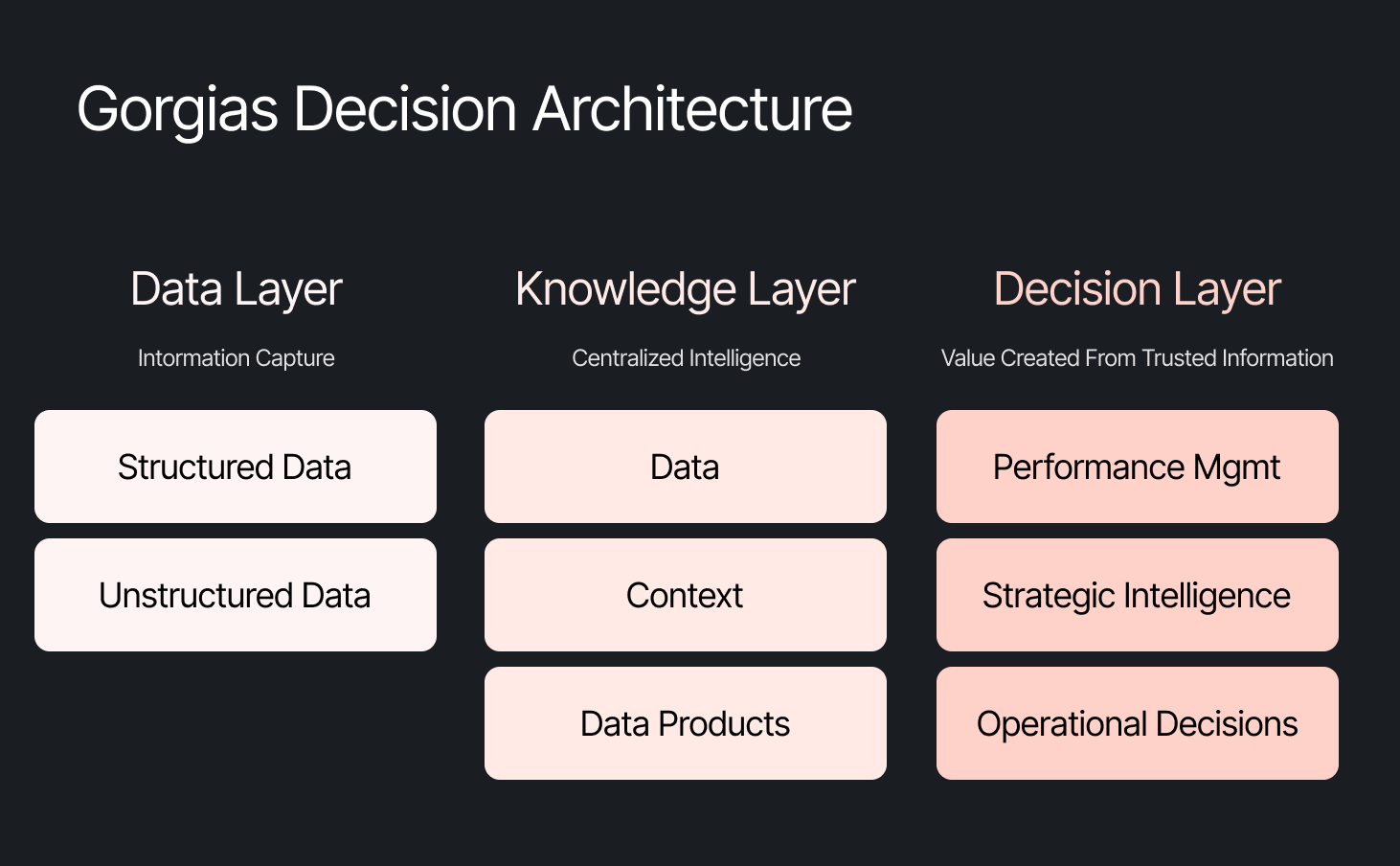
The framing problem most companies get wrong
The instinct across many companies today is to start with the model, pick a provider to solve a specific challenge, or invest heavily in getting the data right. All reasonable starting points, but most of them solve for one use case. Underneath that approach is a framing problem: seeing AI as an initiative — something you assign and measure. Seeing AI as another tool your company uses versus how your company operates.
We started somewhere different. Every company is built on four pillars: customers, people, product, and decisions. AI investments tend to place heavy emphasis on the first three. We started with the fourth. Our bet was that if we built everything around the need to make effective decisions first, asking what Gorgias needed to know to operate well, then our AI would become dramatically more powerful.
Cortex is that philosophy in practice
Cortex is our flagship internal AI agent, and the product where we established the tenets that now run through everything else we build: composable and modular infrastructure, governed context, and accessible from wherever decisions happen. Cortex lives in Slack, as well as across LLM vendors, in its own browser extension, and even on its own dedicated internal site.
Cortex doesn’t stop at answering questions. It can read and write to Notion, file Linear tasks, create HTML apps, automate signal delivery, and more. It operates across every layer of our stack, from dashboards to data pipelines, because we designed it as one integrated system. It is this connection that adds remarkable depth to what people can ask, and what they get in return.
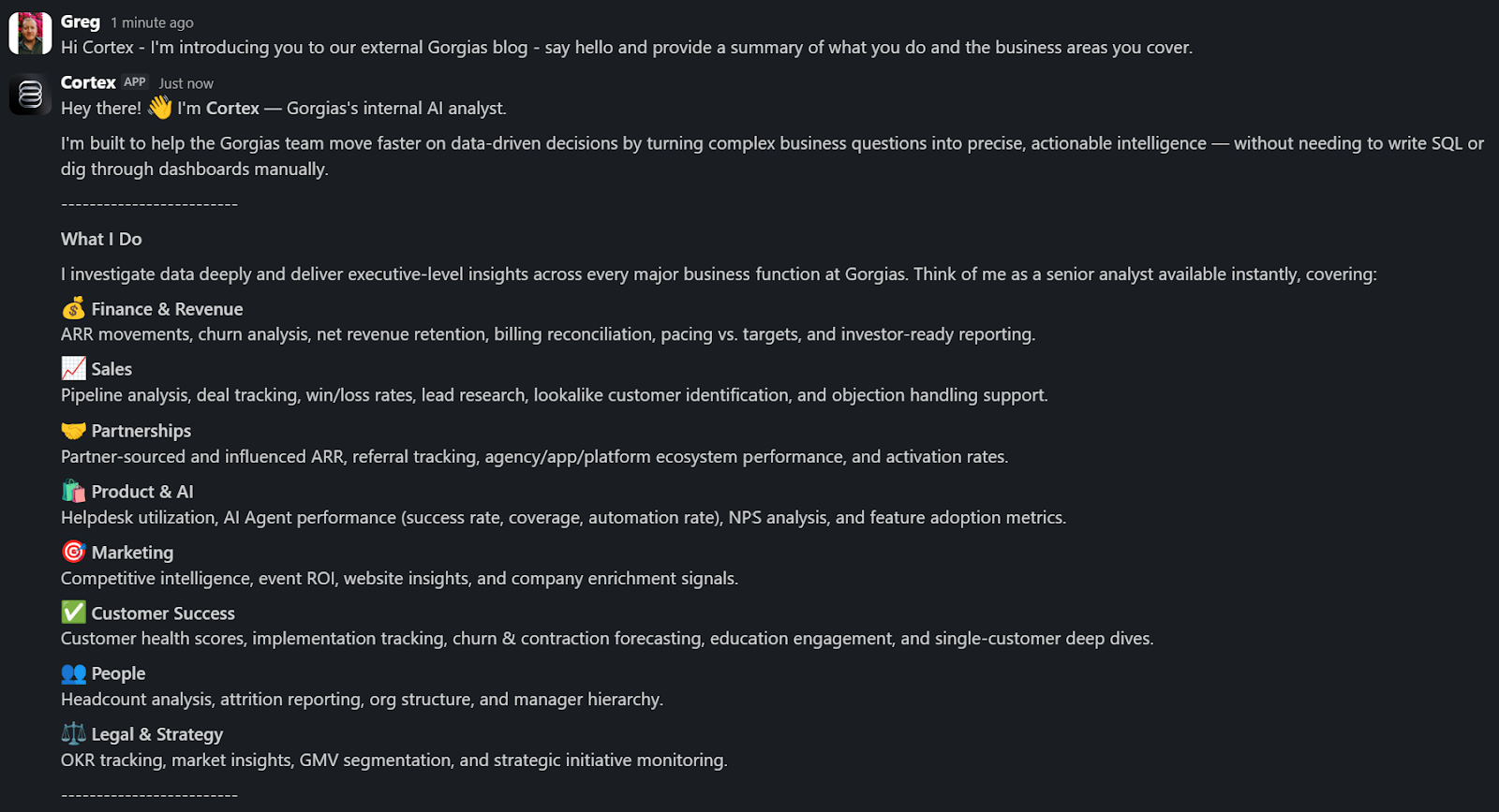
A Sales Lead is pitching and asks Cortex for the full picture of the merchant. In a customized PDF, Cortex lists coverage gaps, pre-sale intent signals, and product fit options. Everything the sales lead needs to walk in with confidence.
A Senior Product leader asks, "How are we performing against OKR #1, and what can my team do to help accelerate it?" Cortex returns a full ARR breakdown, projected end-of-month attainment, segment-level findings, and connects it all back to company-level strategies. A suite of recommendations customized to the leader, the performance, and the signals that bridge how they can support our goals. The kind of answer that used to take someone a week to put together.
These aren't simple lookup queries. They require deep business context spanning multiple areas. Cortex handles these because its Decision Engine gives it the information to reason against governed data, metric definitions, and business context, turning a generic answer into a credible one.
Overnight, teams have built Cortex into how they work. They’re spending less time searching and more time finding answers, not because they were told to, but because Cortex reduced the distance between question and decision.
Flexibility as the foundation
Cortex’s modular infrastructure allows us to experiment and add new capabilities freely. We’ve already built two more internal AI agents made for entirely different use cases, but using the same Decision Engine as Cortex.
GAIA, our internal experimentation AI Agent, helps our customers identify opportunities in their AI Agent Guidance design. It takes institutional knowledge across our teams and turns it into a scalable system that drives automation and value to our customers. Our CEO, Romain Lapeyre, has been its most vocal advocate since day one.
When we needed a platform for investor readiness and board preparation, we built Oracle. Our board decks and talk tracks are informed and built with the same AI, and our numbers are validated every step of the way.
We’re continuing to expand new AI agents internally, exploring how they can create value for customers and our own teams.
AI has transformed how data teams create value, and we’ve already shifted to account for it
When AI handles thousands of analytical questions each week, the highest-value work for a data team shifts permanently. Late 2025, we repositioned from a Data Analytics function into a Decision Intelligence function — a structural change in what we own and how we operate.
Today, our analysts focus on the most sensitive, complex, and forward-looking decisions and analyses. They partner more deeply with stakeholders by driving next steps from signals. They're even building entirely new capabilities that didn't exist in their role descriptions months ago. Things like AI skills for Cortex, context curation, and insight and recommendation delivery. The role of the analyst hasn't diminished. It's expanded to encompass the most meaningful work an analyst can do: driving outcomes and ensuring those decisions can achieve them.
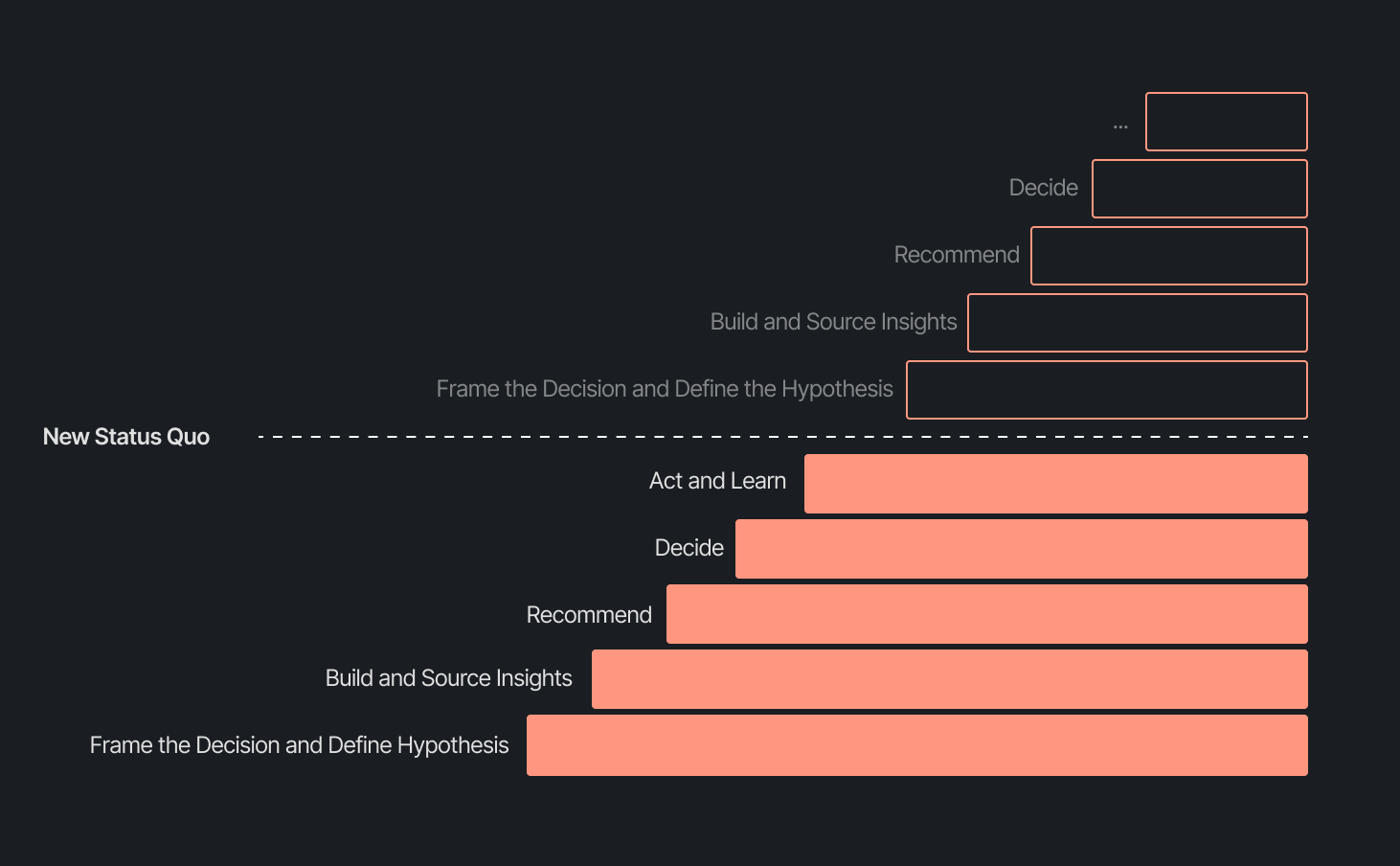
Our business support model has changed, too. Instead of embedding analysts and dedicated engineers within functional teams, we align capacity to the highest-impact company objectives and move fluidly across them. This model works even better because Decision Intelligence brings together both analytics and engineering teams under one roof.
Elliot Trabac leads our Data, Context and AI Engineering teams. The Decision Engine, Cortex, GAIA, and the platforms I've described exist because of the infrastructure his team innovated and built from the ground up. Noemie Happi Nono leads our Decision Strategy and Operations team, driving decision outcomes with stakeholders, advancing the development of Cortex skills and capabilities, and pushing into new areas of analysis every day.
Together, they're shaping what a modern data function looks like when AI becomes a standard building block for how a company operates.
What’s next for the Decision Intelligence team
The question of ROI is long gone. AI has opened the floodgates to more trusted and meaningful signals than ever. The natural next evolution is Proactive Intelligence, signals surfaced toward what you need to know, before you ask. And we're already building this because our architecture is designed to support it.
In the coming weeks, members of the Decision Intelligence team will go deeper into themes I've touched on here. Yochan Khoi, a Senior Analytics Engineer on our team, recently published a technical walkthrough of our context layer and will go further into building context strategies that scale. Others will cover infrastructure, analytical partnerships, evolving data assets into decision assets, and the cost and efficiency gains that make sustained AI investment viable.
AI hasn't changed the most important element of data and analytics functions — delivering outcomes — but it has raised the bar for what it looks like and how far we can take it. We’re just getting started.
TL;DR:
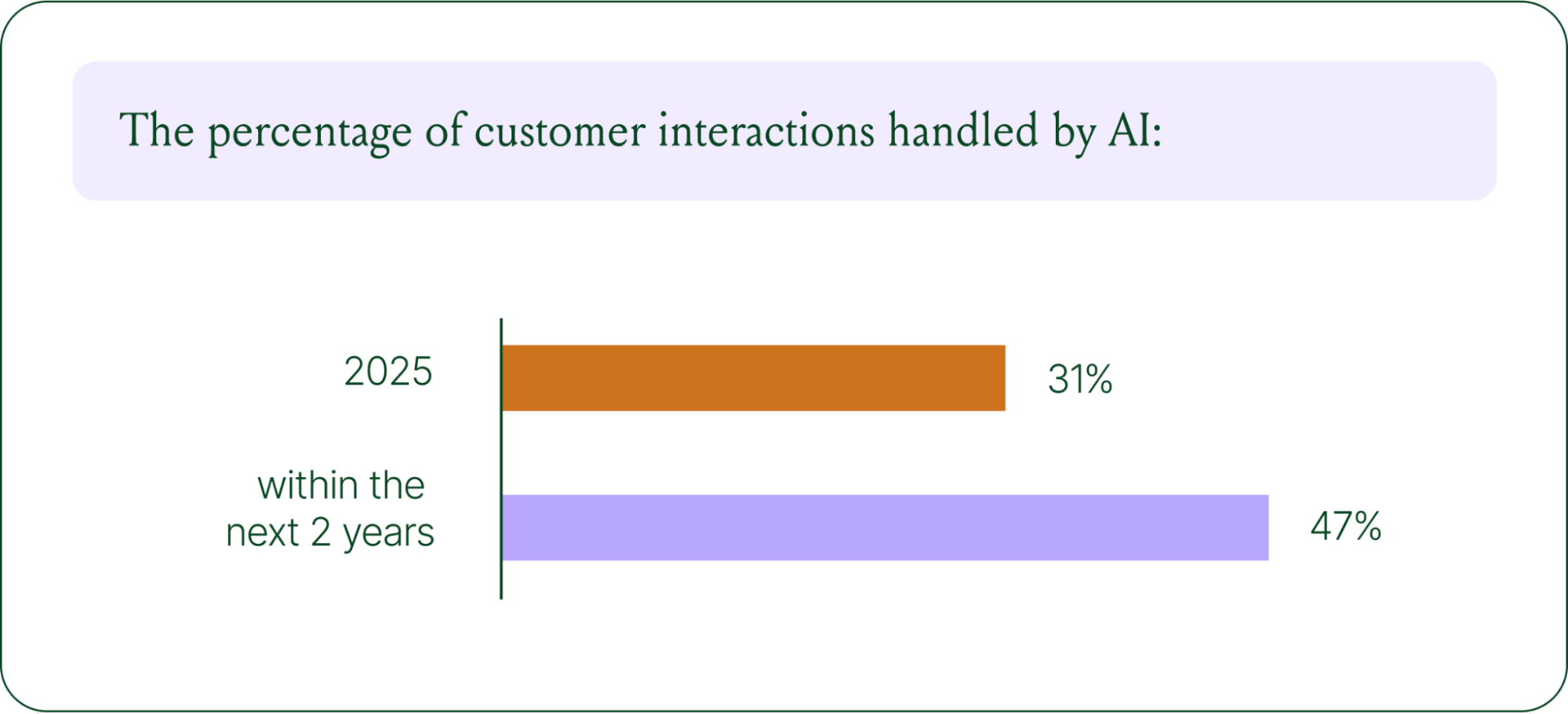
- AI is resolving tickets, not just replying. AI now handles 31% of customer interactions for ecommerce brands, and that number is expected to nearly double within two years.
- Every channel is becoming a storefront. Conversations are replacing the traditional browse-and-buy journey, with 79% of brands reporting sales from AI-driven interactions.
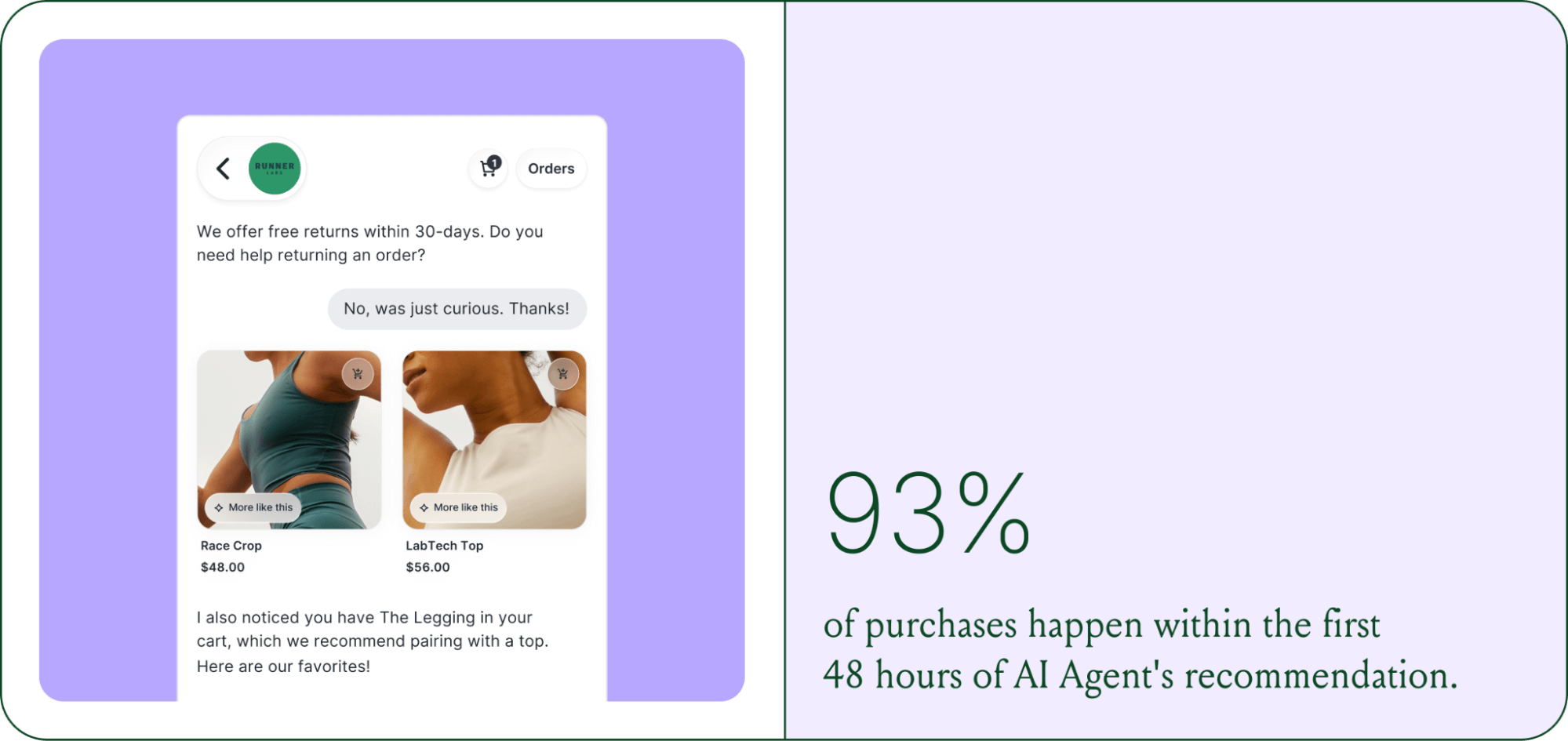
- AI is shortening the buying cycle. 93% of AI-influenced purchases happen within the first 48 hours of the conversation.
- CX teams are changing, not shrinking. Ecommerce brands are actively hiring for more technical roles to implement, coach, and maintain AI.
- The winning model is hybrid. AI handles volume and speed, while humans handle complexity and judgment.
The way shoppers buy online has shifted and customers are at the center.
They no longer want to scroll through product pages, dig through FAQs, or wait 24 hours for an email reply. They open a conversation, ask a specific question, and expect a useful answer in seconds. Brands that can’t deliver these experiences at scale are seeing customer hesitation turn into abandoned carts and lost revenue.
This shift has a name: conversational commerce. It's the practice of using real-time, two-way conversations as your primary sales channel, through chat, AI agents, messaging apps, and voice.
What started as an experiment for early adopters has become a key growth lever, with 84% of ecommerce brands treating conversational commerce as a strategic pillar this year vs. last year.
We surveyed 400 ecommerce decision-makers across North America, the U.K., and Europe to understand how conversational commerce and AI are reshaping the ecommerce landscape. These findings are complemented by aggregated and anonymized internal Gorgias platform data from 16,000+ ecommerce brands.
The State of Conversational Commerce in 2026 trends report breaks down all of the findings, including five key trends shaping the ecommerce landscape.
{{lead-magnet-1}}
Trend 1: AI is table stakes for ecommerce and it’s no longer just about efficiency
A few years ago, adding an AI chatbot to your site that could provide tracking links and Help Center article recommendations was a differentiator. Today, it's table stakes. McKinsey found that 71% of shoppers expect personalized experiences, and 76% get frustrated when they don't get them.
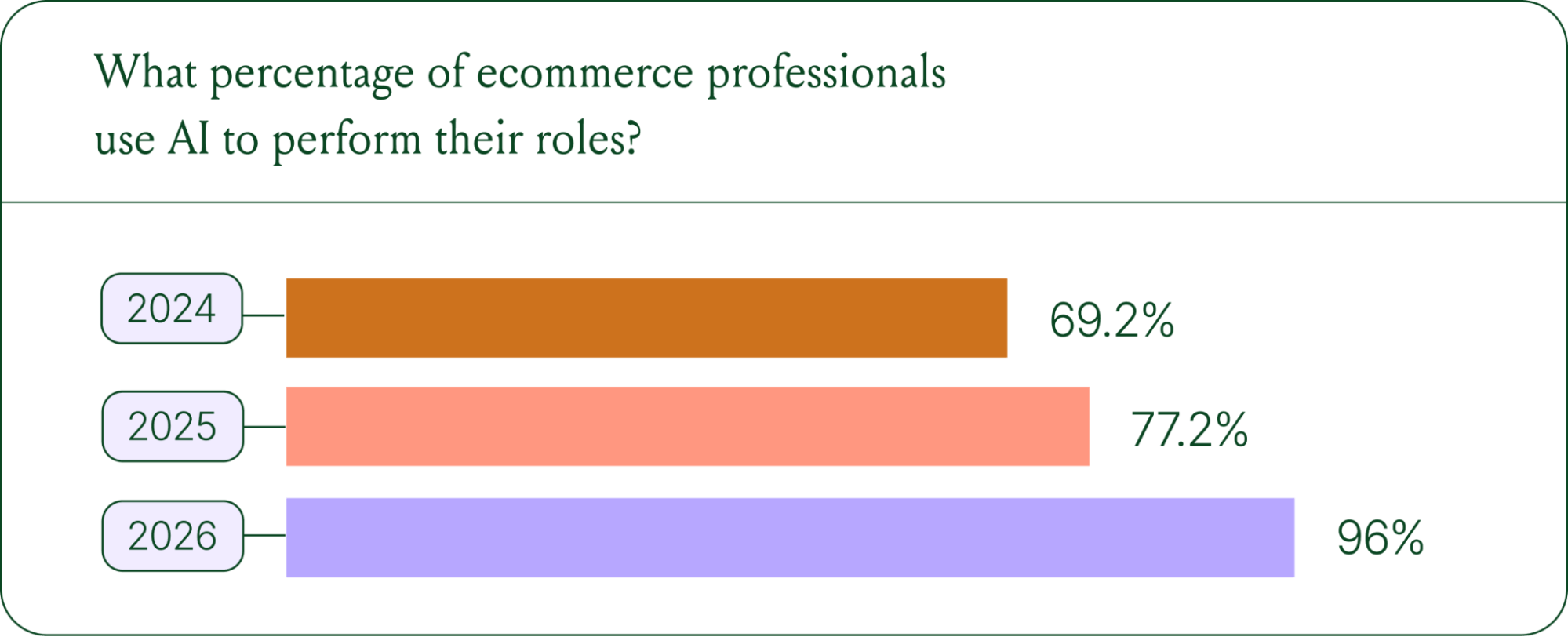
Right now, most ecommerce professionals use AI, with 93% having used it for at least 1 year. Enthusiasm is accelerating quickly, with only 30% of ecommerce professionals rating their excitement for AI at 10/10 in April 2025. Similarly, while AI adoption rose steadily year over year, it reached a clear peak in 2026.
The use cases driving this adoption are practical and high-volume:
- Order tracking and status updates
- Returns, exchanges, and refund requests
- Shipping FAQs and delivery estimates
These are the tickets that flood brands’ inboxes every day. AI agents resolve them instantly, without pulling teams away from conversations that actually require human judgment.
Explore AI adoption and use case data in more depth in the full report.
Trend 2: Conversations are the new path to checkout
The traditional ecommerce funnel, visit site, browse products, add to cart, check out, is losing ground. Shoppers now discover products on Instagram, ask questions via direct message, and complete purchases without ever visiting a website.
Conversational AI is actively increasing revenue, with 79% of brands reporting that AI-driven interactions have increased sales and conversion in their business.

The practical implication is that every channel is becoming a storefront. Creating personalized touchpoints with customers earlier in the journey, through proactive engagement, is impacting the bottom line.
Read the full report to explore how AI conversions have increased QoQ by industry.
Trend 3: AI is accelerating the purchase cycle
Pre-purchase hesitation is one of the biggest conversion killers in ecommerce. A shopper lands on your product page, has a question about sizing or compatibility, can't find the answer quickly, and leaves. That's a lost sale that had nothing to do with your product.
Conversational AI changes that dynamic. When a shopper can ask a question and get an accurate, personalized answer in real time, the friction disappears.
Brands using Gorgias saw this play out at scale in 2025. When AI Agent recommended a product, 80% of the resulting purchases happened the same day, and 13% happened the next day.
Brands are further accelerating the buying cycle through proactive engagement. On-site features such as suggested product questions, recommendations triggered by search results, and “Ask Anything” input bars drove 50% of conversation-driven purchases during BFCM 2025.
Explore how AI is collapsing the purchase cycle in Trend 3 of the report.
Trend 4: AI is making CX teams more technical
There's a persistent narrative that AI is making CX teams redundant. The data tells a different story. 62% of ecommerce brands are planning to grow their teams, not cut them. But the scope of those teams is changing.

New roles are emerging around AI configuration and quality assurance. Teams are investing in technical members to write AI Guidance instructions, develop tone-of-voice instructions, and continuously QA results.
CX teams are also bridging the gap between support goals and revenue goals, as the two functions increasingly overlap.
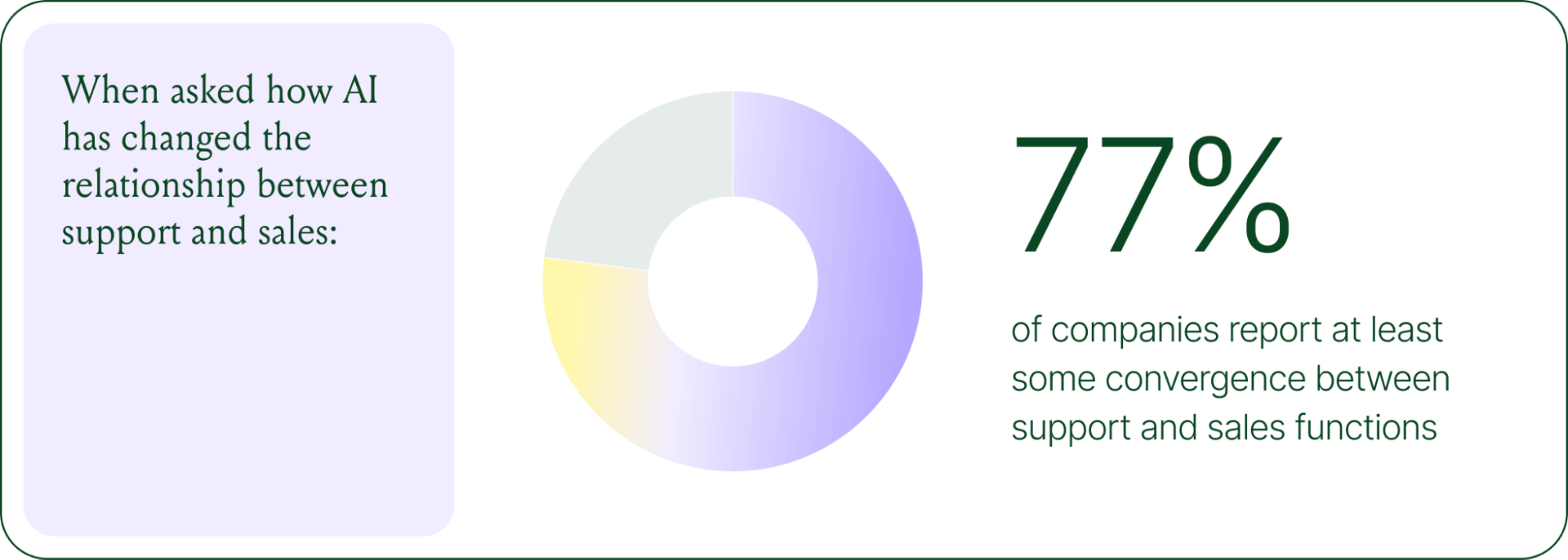
The result is CX teams that are more technical than they were before. Agents who once spent their days answering repetitive tickets are now spending that time on higher-value work: complex escalations, VIP customer relationships, and improving the AI systems and knowledge bases that handle the volume.
Learn more about the evolution of CX roles in Trend #4.
Trend 5: The future is hybrid: AI-first, humans when it counts
Despite increasing AI adoption, data shows that ecommerce brands shouldn’t strive for 100% automation. Winning brands are building systems in which AI handles repetitive tier-1 tickets, and humans handle complex, sensitive cases.

AI handles speed and scale. It resolves order-tracking requests at 2 a.m., processes return-eligibility checks in seconds, and answers the same shipping question for the thousandth time without compromising quality.
Human agents handle conversations that require context, empathy, or decisions that fall outside the standard playbook. There are several topics where shoppers still prefer human support.
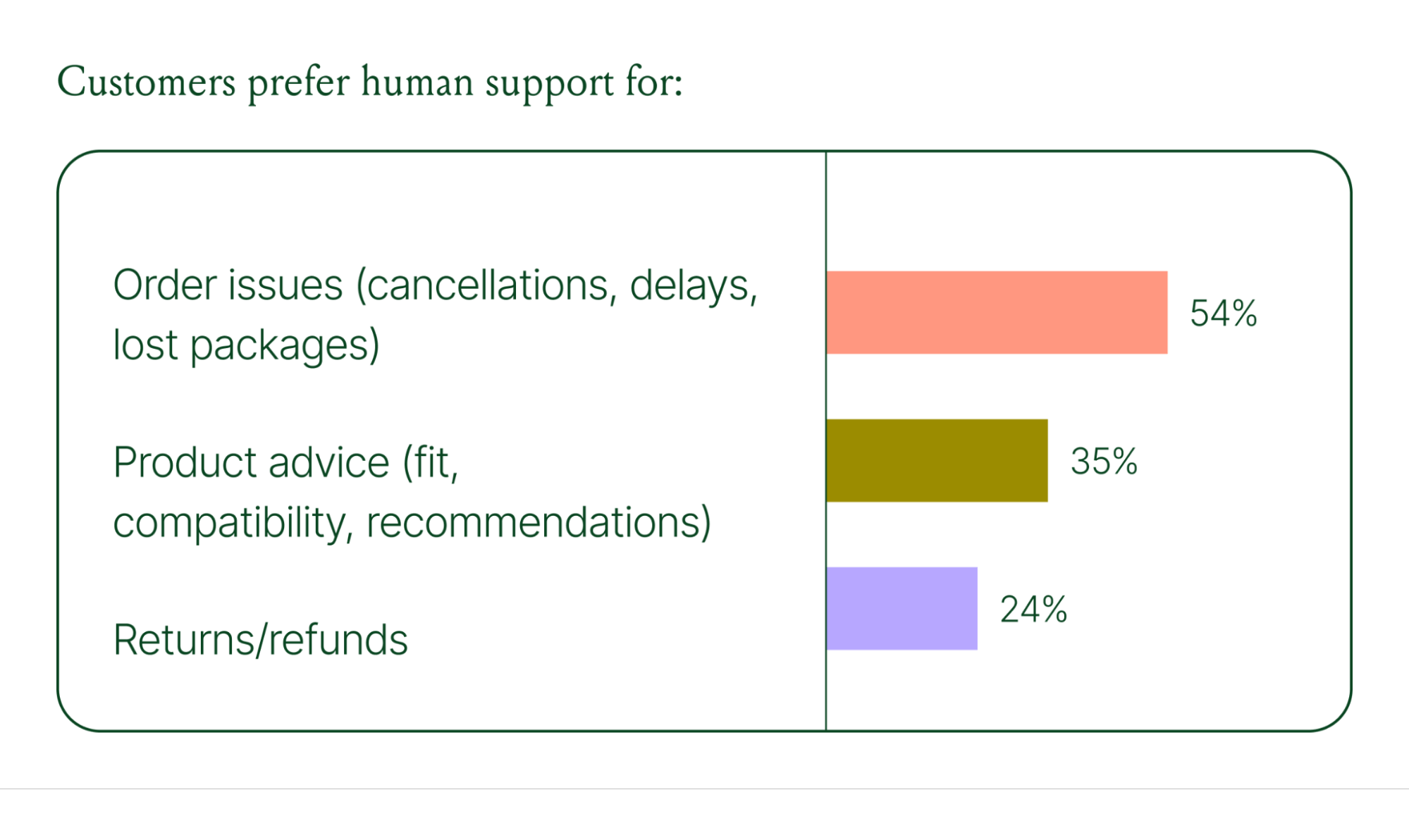
Successful hybrid systems require continuous iteration, meaning reviewing handover topics, Guidance, and reviewing AI tickets on a weekly basis.
Discover how leading brands are balancing human and AI systems in Trend #5.
Where conversational commerce is heading by 2030
The 2026 trends are about expansion and standardization. The 2030 predictions are about what comes next.
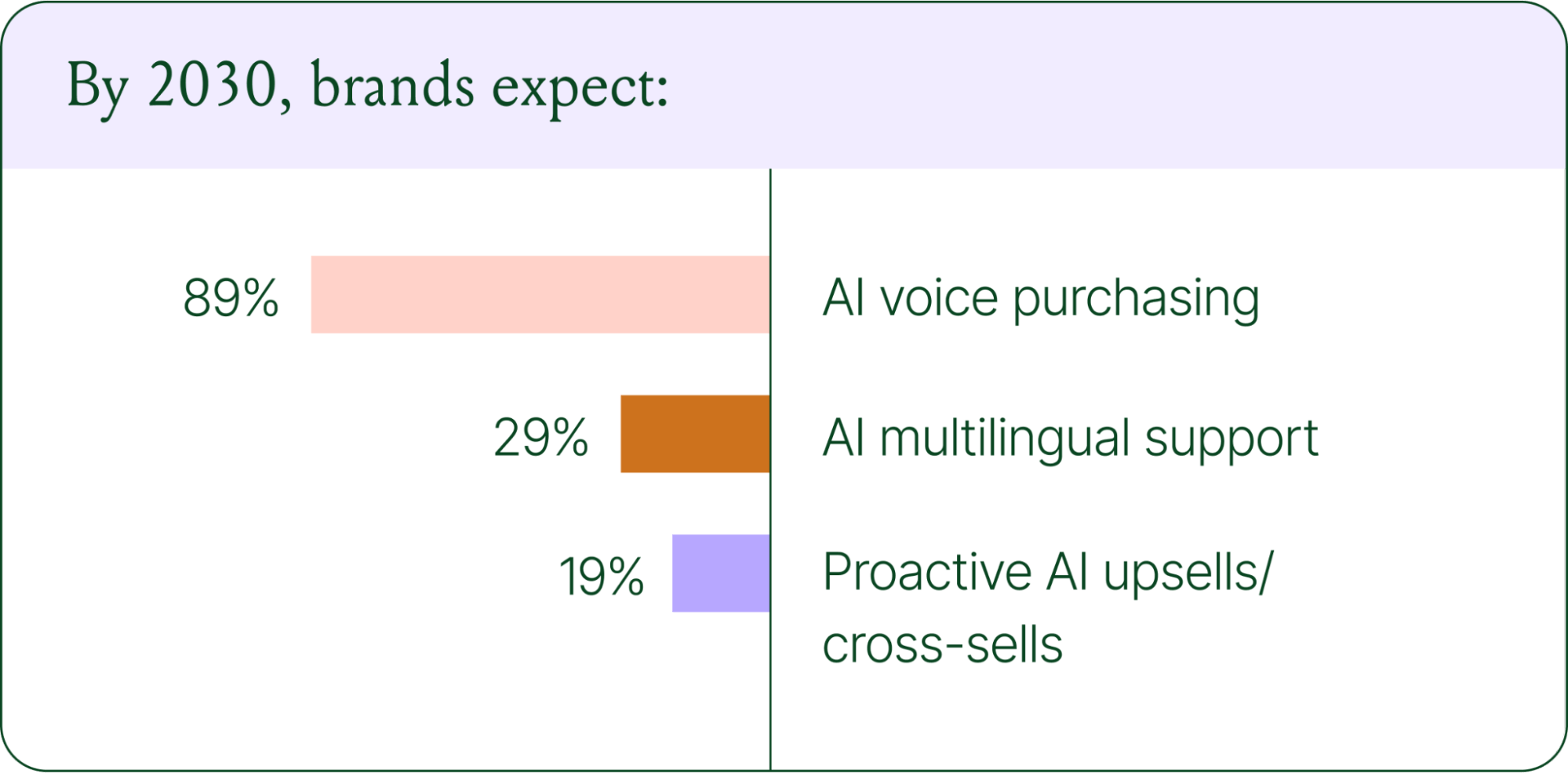
Voice-based purchasing is the biggest bet on the horizon. Only 7% of brands currently use voice assistants for commerce, but 89% expect it to be standard by 2030. The vision is a customer who can reorder a product, check their subscription status, or manage a return entirely over the phone.
Proactive AI is the other major shift. Rather than waiting for a customer to reach out, AI will anticipate needs based on browsing behavior, purchase history, and where someone is in their relationship with your brand. Think of it as the digital equivalent of a sales associate who remembers what you bought last time and knows what you're likely to need next.
Explore where ecommerce brands are allocating their AI budgets in the full report.
Start building your conversational commerce strategy today
The brands winning in 2026 are creating smart, scalable systems where AIhandles volume and humans handle nuance. They’re treating every conversational channel as an opportunity to serve and sell.
The data is clear: AI adoption is accelerating, customer expectations are rising, and the revenue impact of getting this right is measurable.
{{lead-magnet-1}}
Newsletter Signup
The best in CX and ecommerce, right to your inbox
Featured articles

Conversations Are Becoming a Revenue Channel: The Data Proves It
TL;DR:
- Customer journeys are collapsing to a single conversation. The traditional browse-and-buy journey is giving way to AI-guided shopping that moves from discovery to purchase in a single exchange.
- 79% of brands say AI-driven conversational commerce has increased their sales and purchase rates.
- AI-only influenced orders grew 63% in a single year, from 2.7 million in Q1 to 4.4 million in Q4.
- Brands treating conversation as a revenue channel. They’re not just a support function, generating higher AOV, shorter buying cycles, and stronger retention.
The page-based shopping experience dominated for decades. Customers would search, browse, compare, abandon, get retargeted, return, and eventually buy (sometimes).
That journey is no longer the only option.
Shoppers are turning to chat, messaging, and AI-powered tools to find what they need. Instead of clicking through product pages or reading static FAQs, they ask questions, have back-and-forth conversations, and get answers that move them closer to a purchase in real time. The path to checkout has changed, and the brands that recognize this are pulling ahead.
Read our 2026 State of Conversational Commerce Report to learn more about conversation commerce trends from 400 ecommerce decision-makers and 16,000+ ecommerce brands using Gorgias.
{{lead-magnet-1}}
The shopping journey has collapsed into a single thread
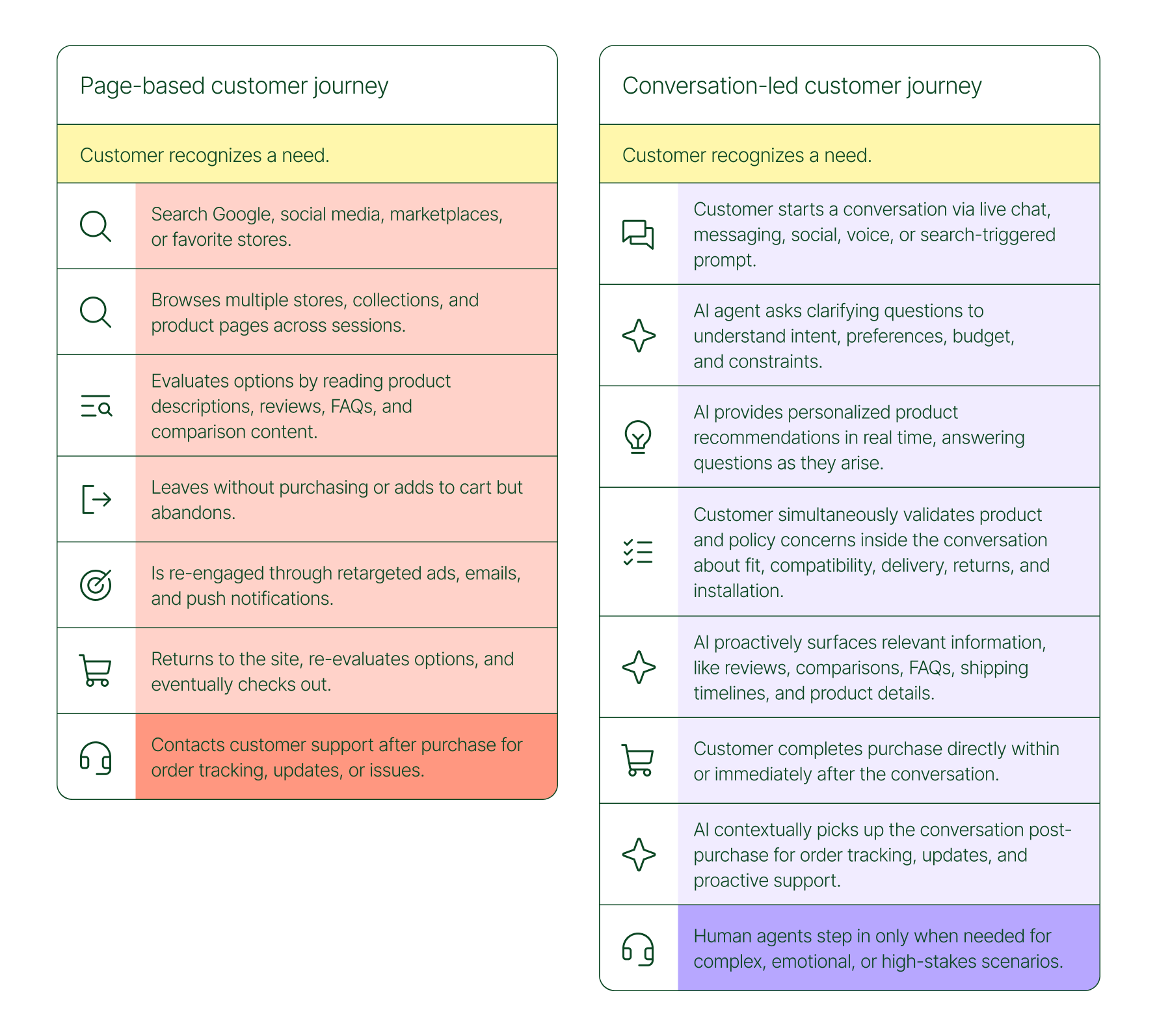
The traditional shopping journey was a solo experience. A shopper had a need, searched for options, browsed across sessions, and eventually made a decision — often days later, after being retargeted multiple times. Support only entered the picture after the purchase.
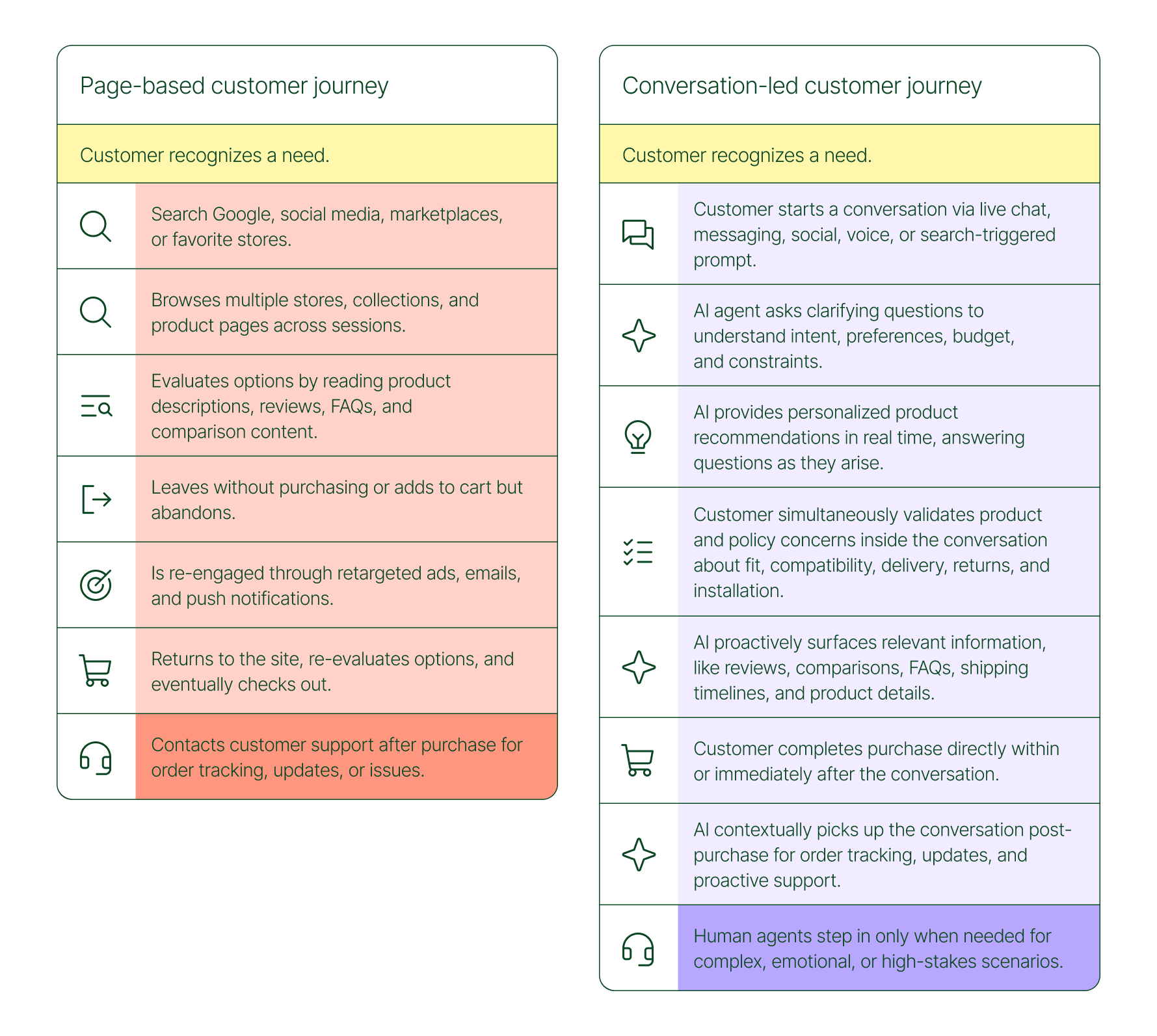
The conversation-led journey collapses that timeline:
- A shopper recognizes a need and starts a conversation via chat, messaging, or a search-triggered prompt
- An AI agent asks clarifying questions about preferences, budget, and constraints
- The AI provides personalized product recommendations in real time
- The shopper validates concerns about fit, compatibility, delivery, and returns, all inside the conversation
- The shopper completes the purchase directly within or immediately after that exchange
- The AI picks up the conversation post-purchase for order tracking and proactive support
- A human agent steps in only when the situation calls for it
What used to take days now takes minutes. Discovery, evaluation, and purchase happen in a single thread.
Conversation is a revenue strategy, not a support upgrade
79% of brands agree that AI-driven conversational commerce has increased sales and purchase rates in their business. When brands were asked to rank the highest-return areas:
- 38% cited improved customer support efficiency
- 23% pointed to higher customer retention and loyalty
- 20% saw improved purchase rates
Those numbers reflect something important: the value of conversation compounds. Faster support reduces friction. Better retention raises lifetime value. More confident shoppers buy more often and spend more per order.
The brands seeing the biggest returns aren't just using AI to deflect tickets. They're using it to create one-to-one shopping experiences at scale.
What the data shows about AI-influenced orders
Looking at AI-only influenced orders across key verticals like Apparel and Accessories, Food and Beverages, Health and Beauty, Home and Garden, and Sporting Goods, the growth across a single year was significant.
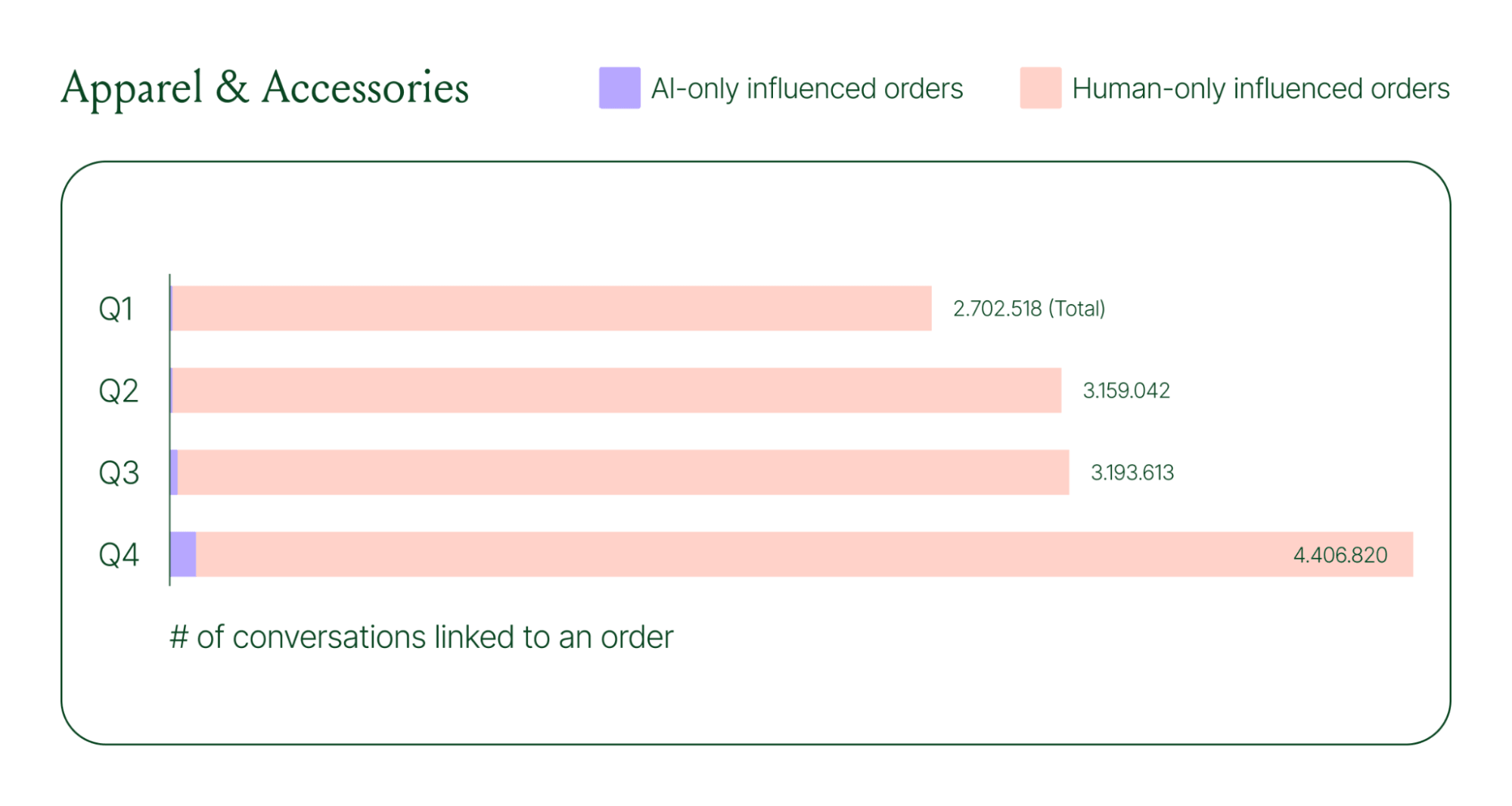
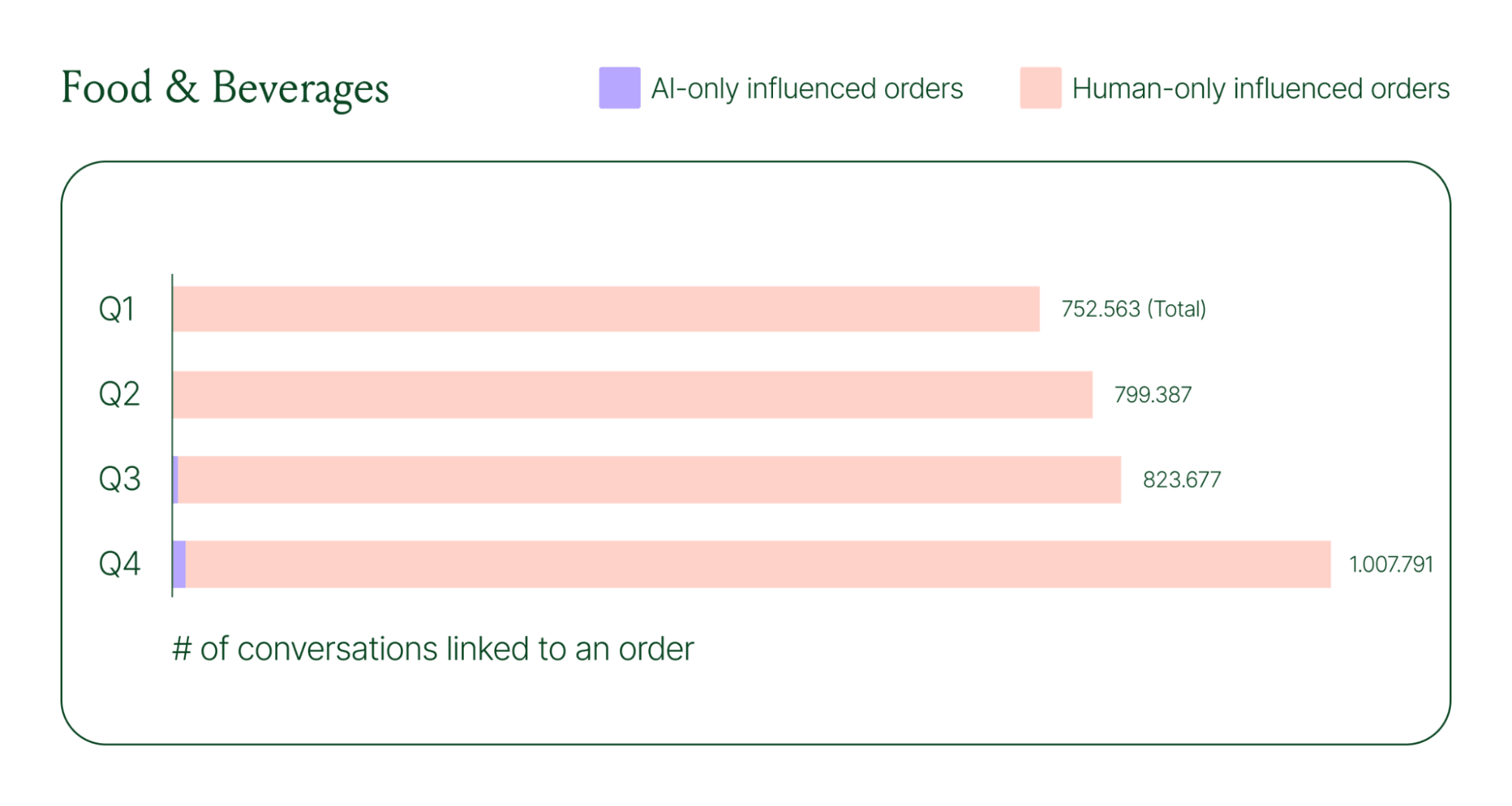
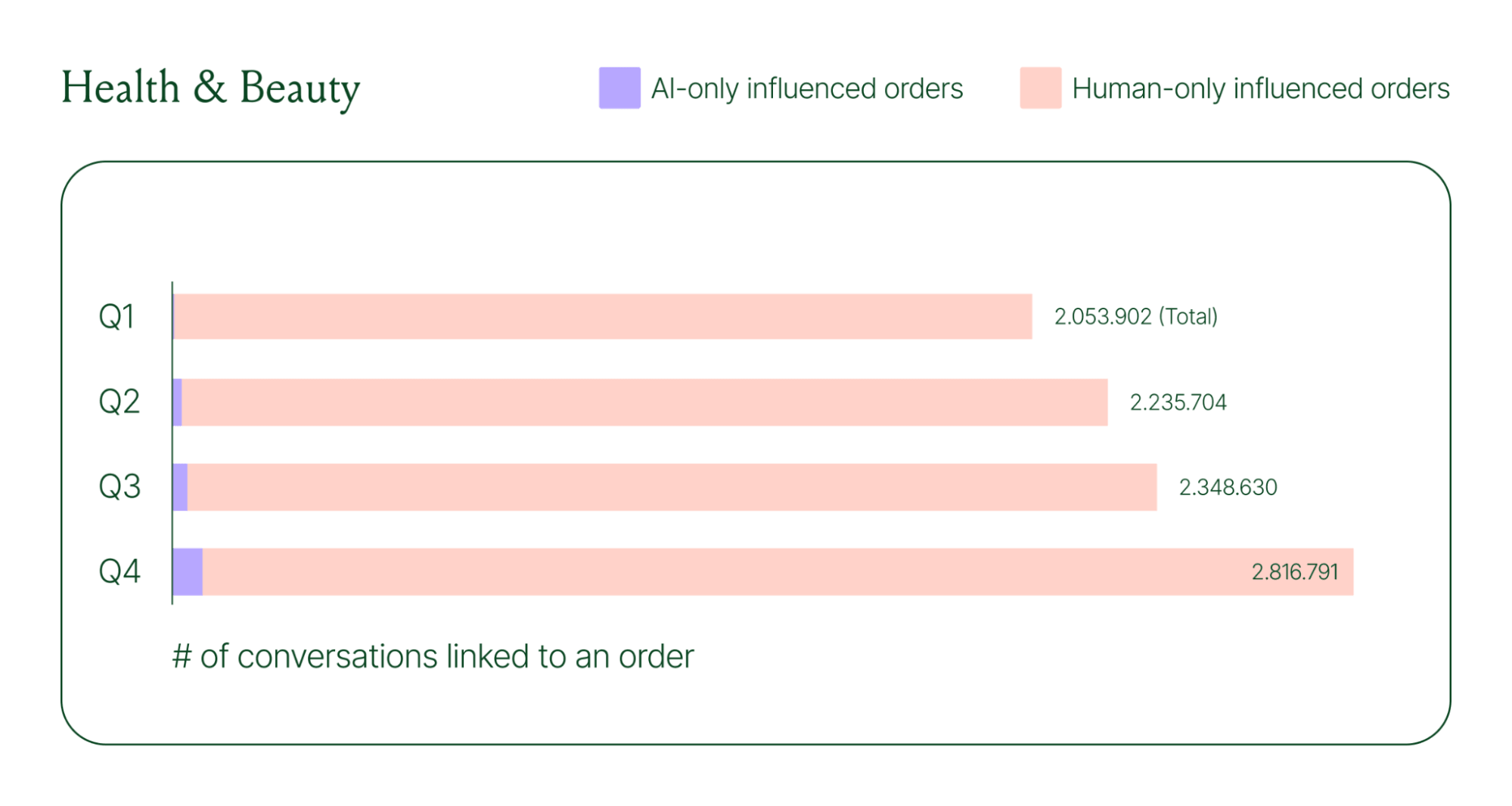
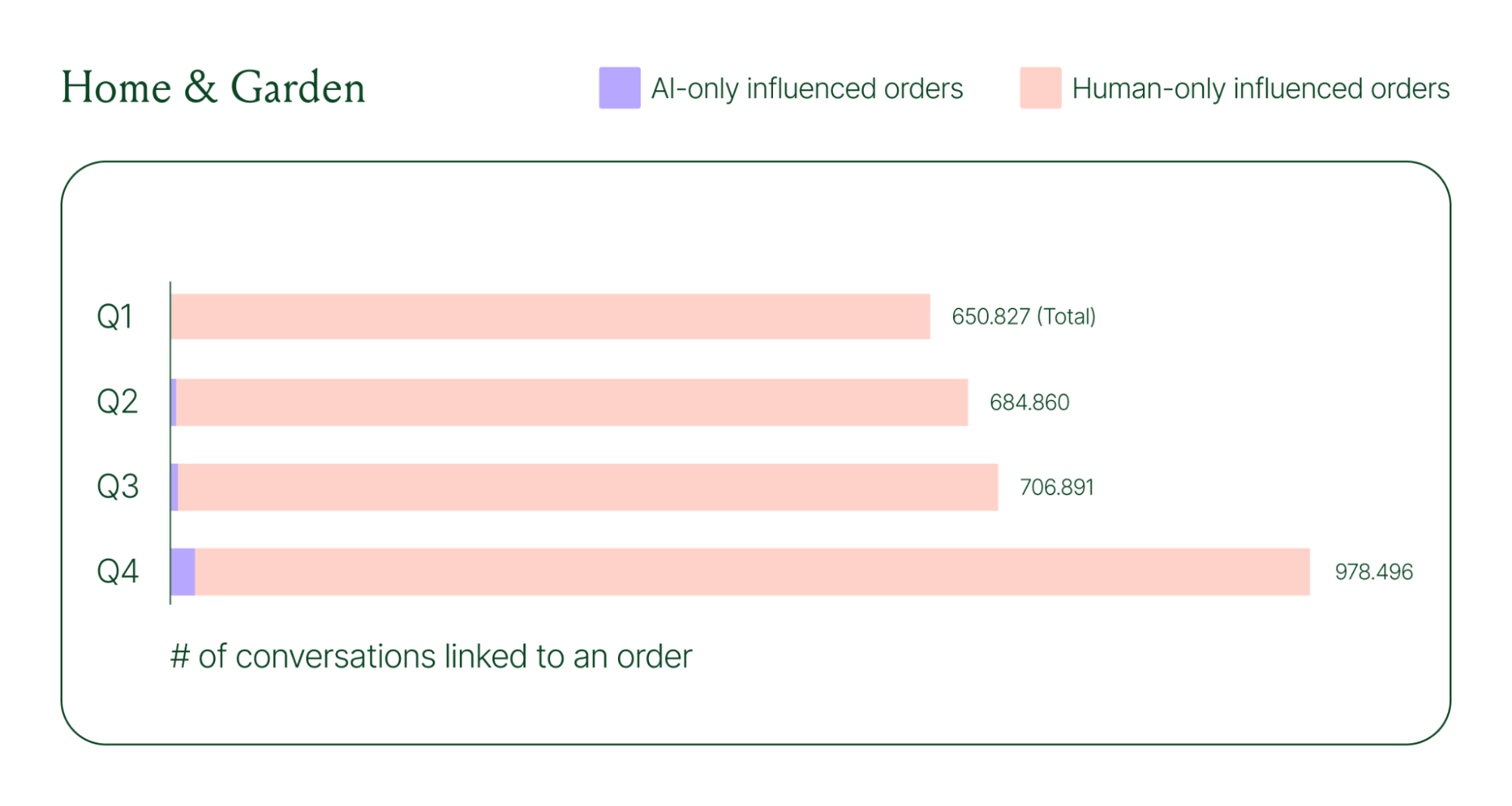
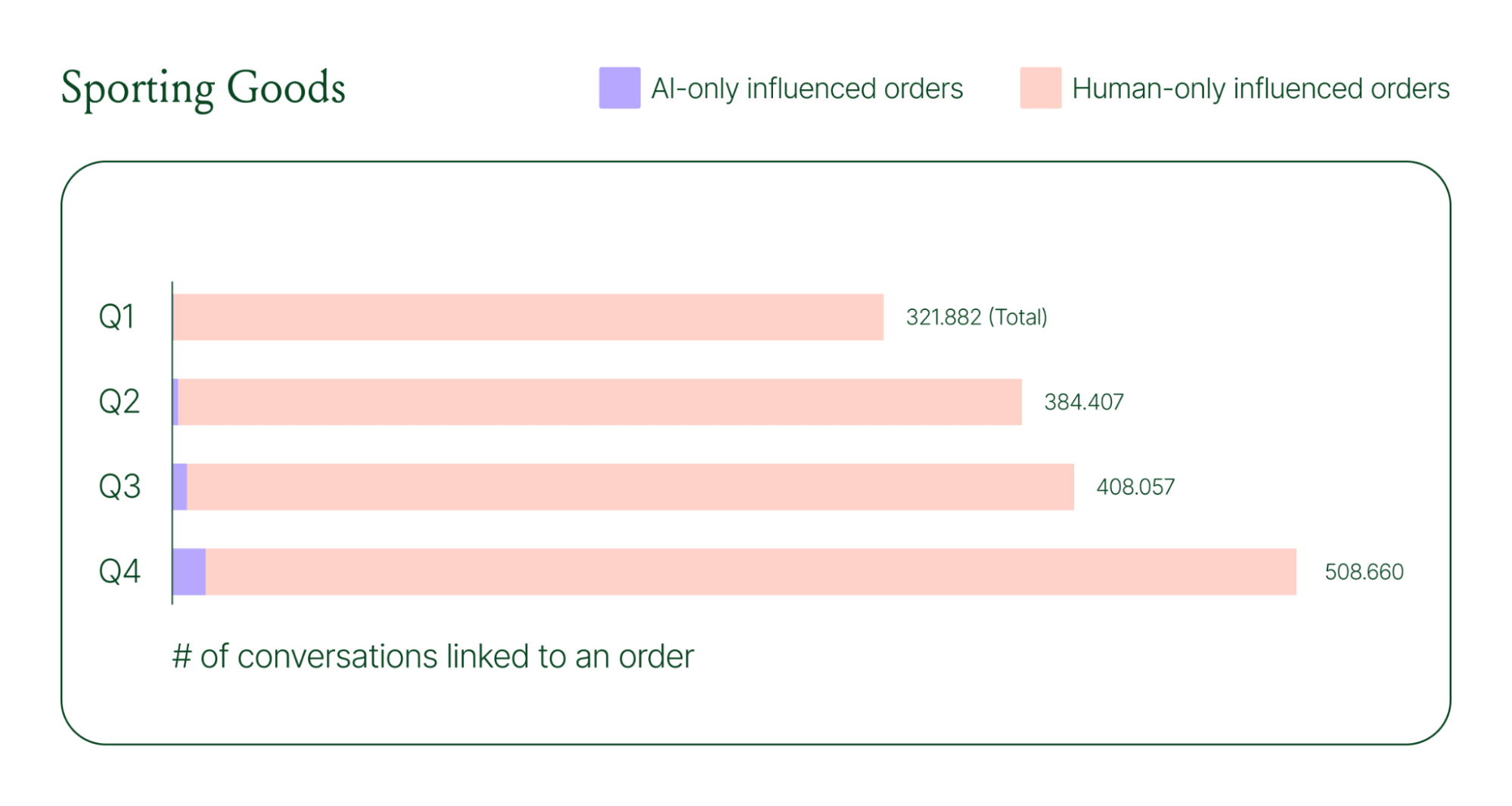
Across industries, ecommerce brands saw AI step into conversations, reduce shopper hesitation, and drive higher QoQ conversion rates.
Learn more about AI-powered revenue generation in the full 2026 Conversational Commerce Report.
Why brands are making this a strategic priority
84% of brands say the strategic importance of conversational commerce is higher than it was a year ago. 82% agree it will be mainstream in their sector within two years.
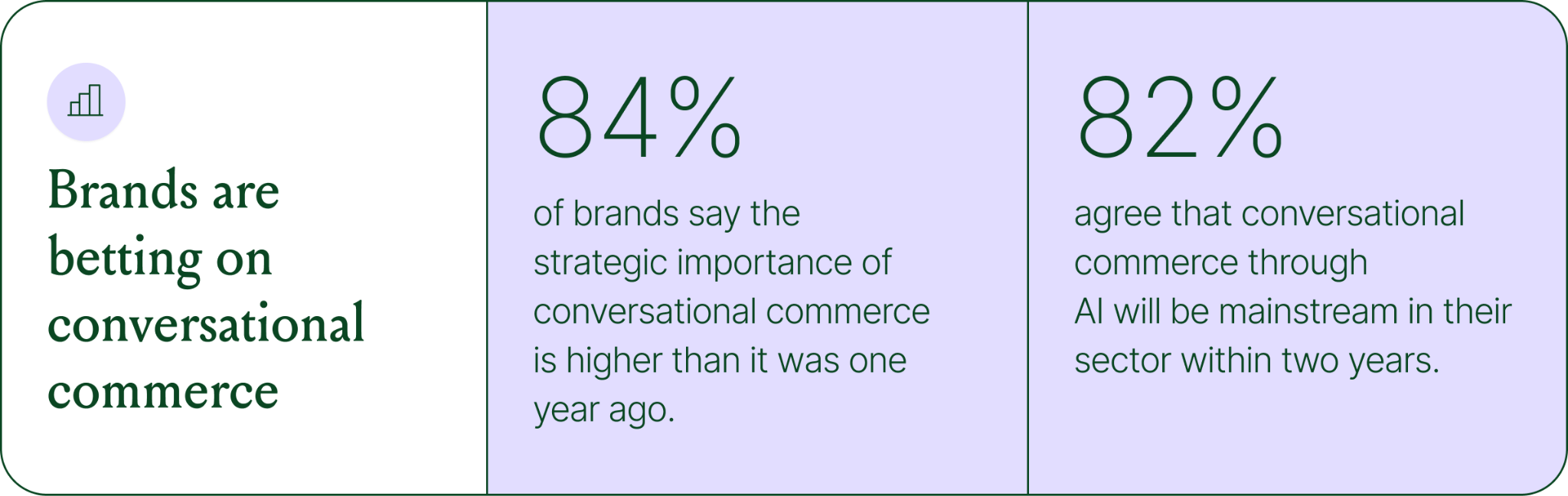
That shift is registering at the leadership level because of what conversational commerce does to the buying experience. Creating one-to-one touchpoints earlier in the journey drives higher AOV, shorter buying cycles, and stronger purchase rates. Shoppers who get real-time answers to their questions are more confident.
What this looks like in practice: TUSHY
TUSHY, known for eco-friendly bidets and bathroom essentials, is a useful example of what happens when you take conversational commerce seriously.
Bidets aren't an impulse purchase. Shoppers have real questions about fit, compatibility, and installation. Those questions used to go unanswered until the CX team could respond, often after the customer had abandoned the cart.
TUSHY used Gorgias's AI Agent and shopping assistant capabilities to automate pre-sales support. AI Agent engaged shoppers in real-time conversations, addressed their concerns directly, and built confidence at the moment of highest intent.
This resulted in a 190% increase in chat-based purchases, a 13x return on investment, and twice the purchase rate of human agents.
How to apply this to your strategy
You don't need to overhaul your entire operation to start seeing results. The most effective approach is to start where the impact is clearest and expand from there.
A few places to begin:
- Pre-sales chat. Identify your most common pre-purchase questions (sizing, compatibility, shipping timelines) and ensure your AI can answer them confidently and promptly.
- Product page engagement. Use proactive chat prompts triggered by page behavior to start conversations before shoppers leave.
- Post-purchase follow-up. Let AI pick up the conversation after checkout with order updates and proactive support, reducing inbound volume and building trust.
- Human escalation. Define clearly which situations require a human agent – complex issues, emotional exchanges, high-stakes decisions.
Want to see the full picture of where conversational commerce is headed in 2026? Read the full report to explore the data, trends, and strategies shaping the next era of ecommerce.
{{lead-magnet-1}}
AI Is Table Stakes for Ecommerce: What the Data Tells Us About 2026
TL;DR:
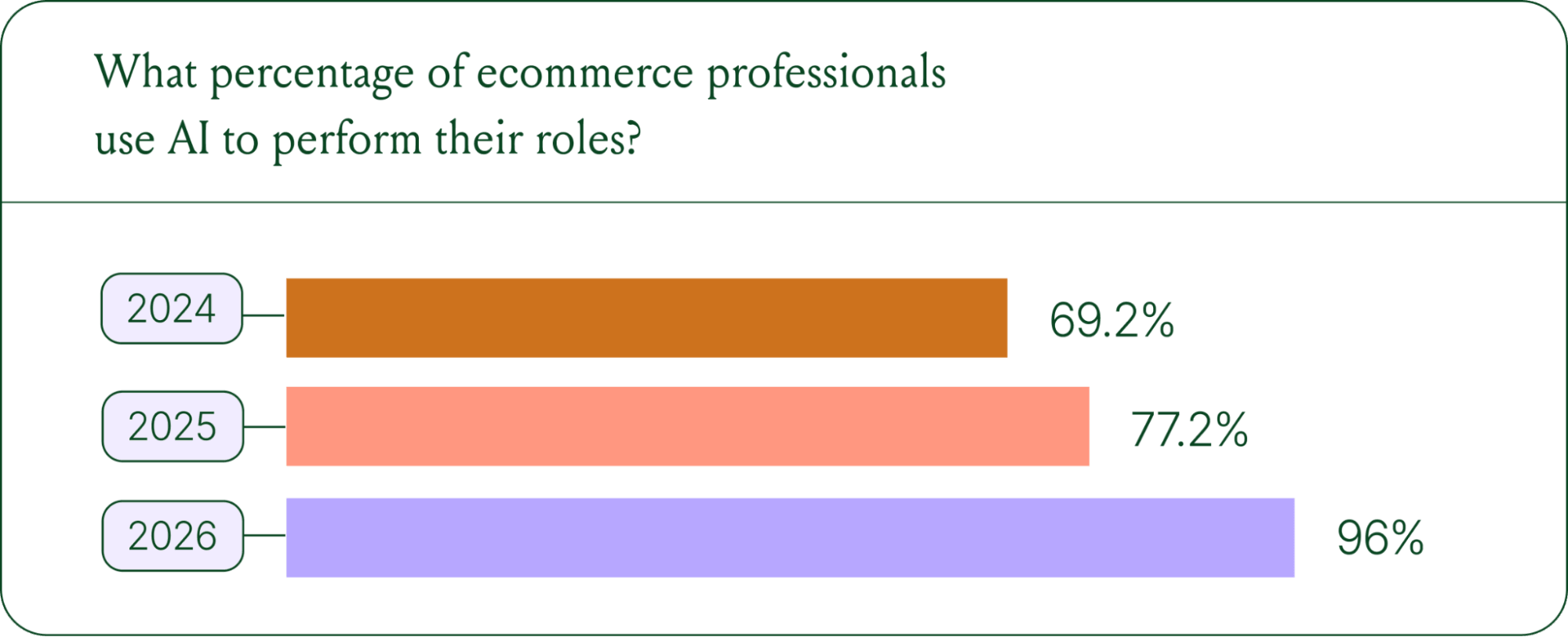
- AI adoption is rapidly accelerating. 96% of ecommerce professionals now use AI in their roles, up from 69% in 2024.
- AI has moved beyond support automation. Use cases have evolved into revenue generation, personalization, and logistics.
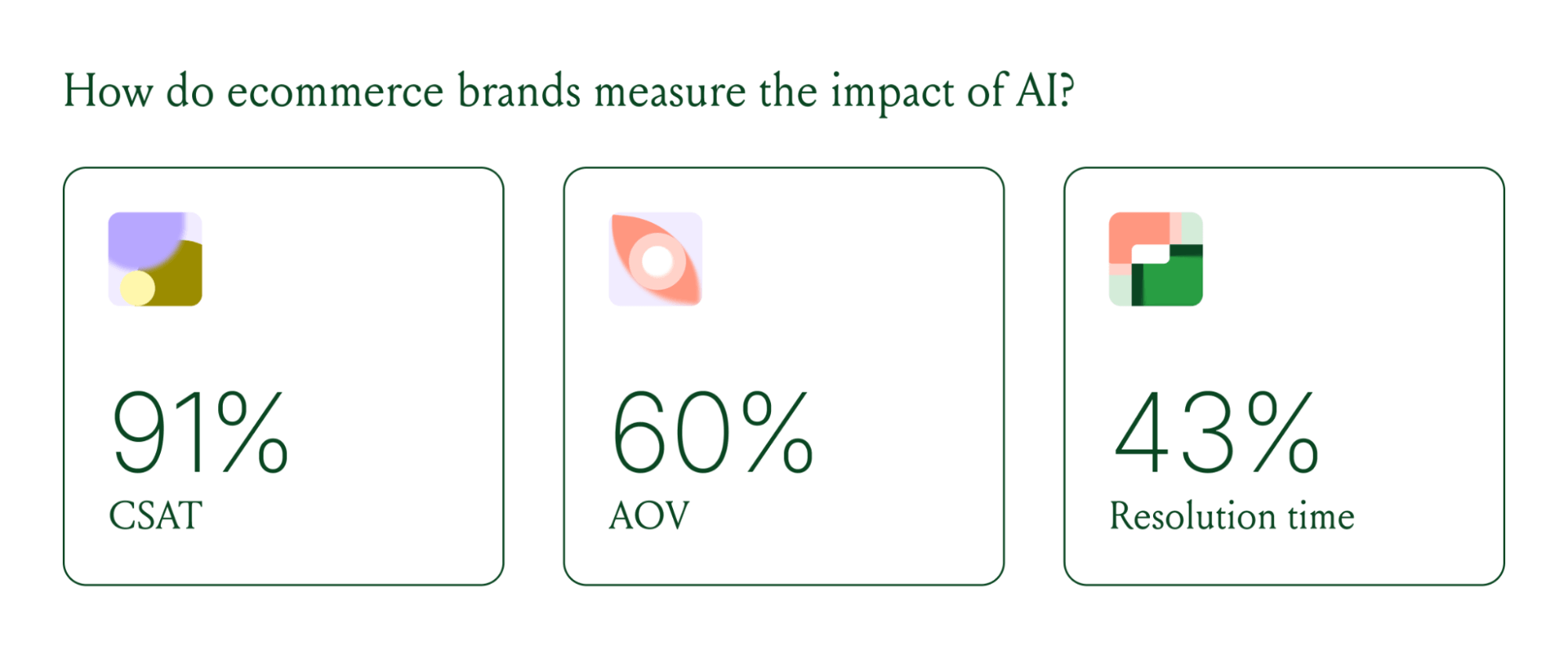
- Brands are tying AI success to profit-and-loss outcomes. 60% of brands consider AOV a top indicator of AI effectiveness.
A year ago, ecommerce brands were still debating whether AI was worth the investment. That debate is over. Today, nearly every ecommerce professional uses AI to do their job.
The shift isn't just about adoption. It's about what AI is used for and how brands measure its impact. Support automation was the entry point. Now, AI is embedded across the full operation, from product recommendations to inventory control to real-time shopping conversations.
In our 2026 State of Conversational Commerce Report, we break down trends on AI usage among 400 ecommerce decision-makers and 16,000+ ecommerce brands using Gorgias.
{{lead-magnet-1}}
AI adoption has reached a tipping point
If we rewind 12 months ago, the industry was still split on AI. Some ecommerce professionals were excited, but most were still hesitant. In 2024, 69% of ecommerce professionals used AI in their roles. By 2025, that number reached 77%. In 2026, it hit 96%.
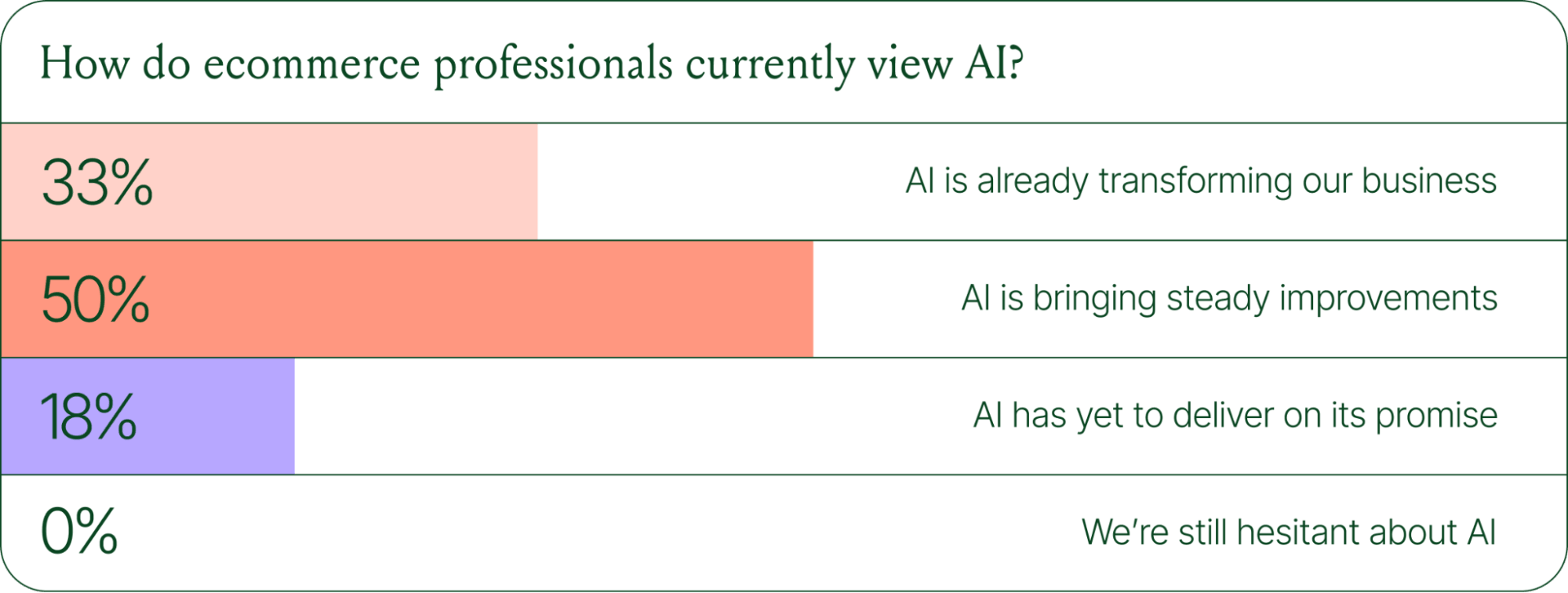
The confidence numbers back it up. 71% of brands say they are confident using AI for ecommerce, and 73% are satisfied with its business impact.
In early 2025, only 30% of ecommerce professionals rated their excitement for AI at 10/10. Today, zero percent of respondents describe themselves as hesitant about AI.
AI use cases now span the full ecommerce stack
Using AI in ecommerce is not new. In fact, it dates back to the 1980s with the invention of algorithms and expert systems. And if you’ve ever leveraged similar product recommendations or chatbots, you’ve already integrated AI into your ecommerce stack.
Modern AI is far more sophisticated.
With the rise of agentic commerce and conversational AI, brands began leveraging AI agents to automate the processing of repetitive support tickets. That’s still happening today, but the scope has expanded beyond the support queue.
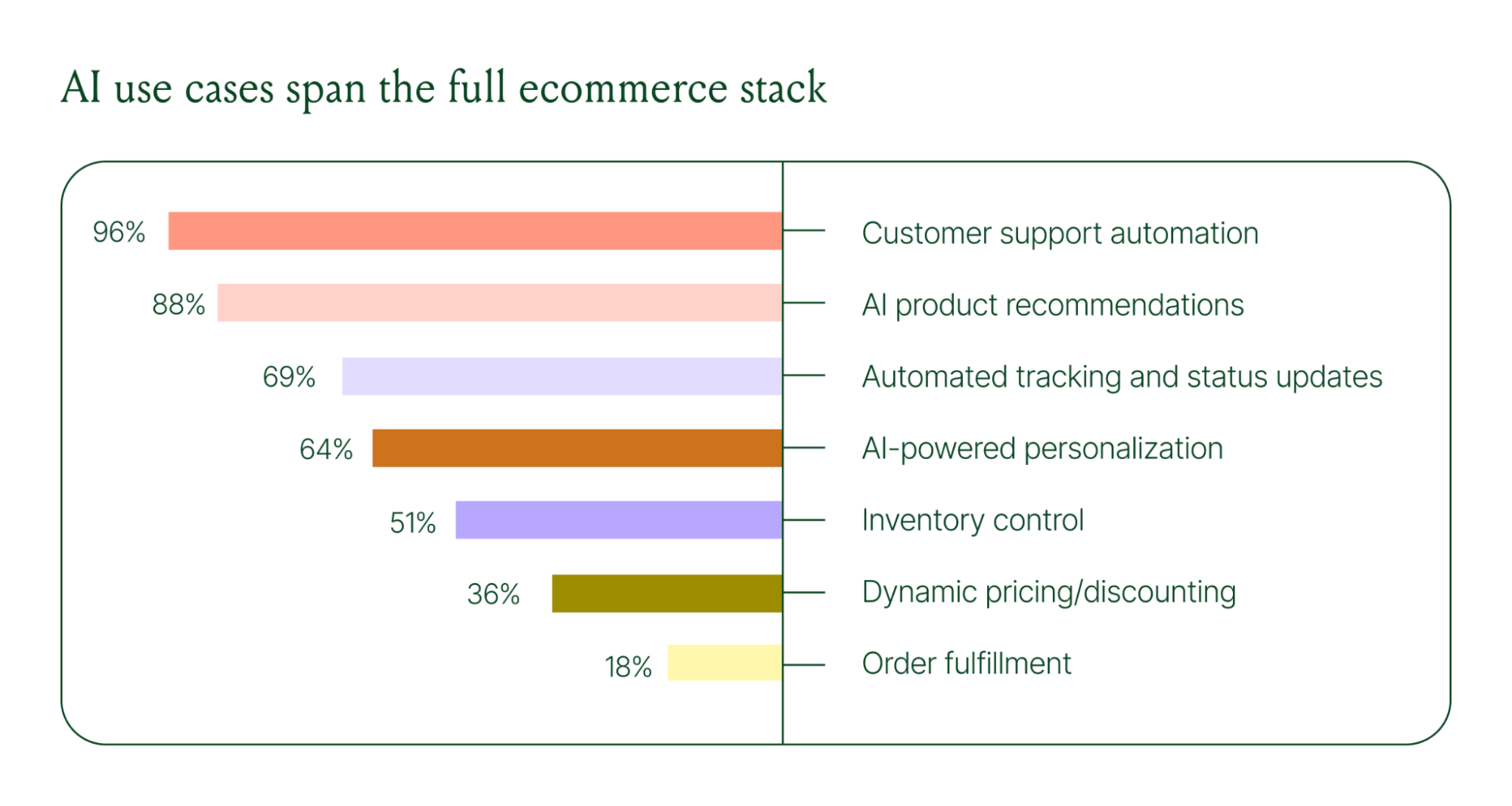
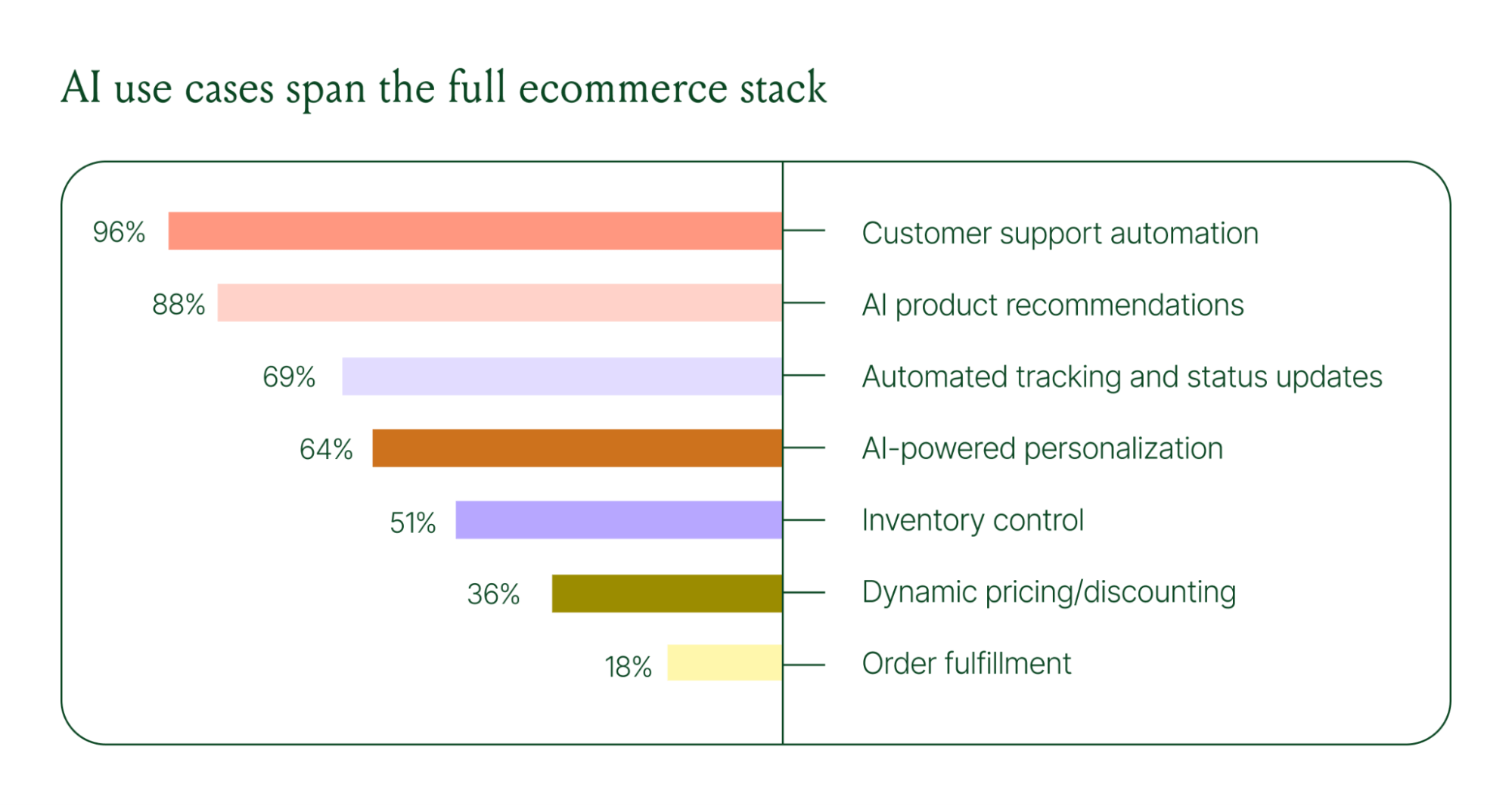
Ecommerce brands are deploying AI across every layer of their operation:
- Customer support automation: 96%
- Product recommendations: 88%
- Automated tracking and status updates: 69%
- Personalization: 64%
- Inventory control: 51%
- Dynamic pricing and discounting: 36%
- Order fulfillment: 18%
When brands were asked which channels contribute most to their AI success, conversational channels dominated. Social media messaging led at 78%, followed by SMS at 70%, and website live chat at 51%. Shoppers want fast, personal conversations, and AI is the best way to deliver that at scale.
Learn more about AI adoption, perception, and use case trends in the full 2026 Conversational Commerce Report.
How AI is changing CX success metrics
For decades, customer support success meant fast response times and high satisfaction scores. Those are still important indicators of success, but leading brands are adding revenue-focused metrics to their dashboards.
91% of brands still track CSAT as a measure of AI's impact. But 60% now include AOV as a top indicator, and higher-revenue brands earning $20M+ are focusing on metrics like total operating expenses, cost per resolution, incremental revenue, and one-touch ticket rate.
AI can now start a conversation, ease customer doubts, sell, upsell, and recover abandoned carts in a single conversation. When you’re only measuring CSAT, you’re ignoring the real ROI of conversational AI investment.
AI makes every conversational channel a storefront
Virtual shopping assistants now proactively engage shoppers, adapt to their needs in real time, and offer contextual product recommendations and upsells. When the moment calls for it, they can close the deal with a targeted discount.
Gorgias brands using AI Agent's shopping assistant capabilities nearly doubled their purchase rates and converted 20–50% better than those using AI Agent for support only.
Orthofeet, the largest provider of orthopedic footwear in the US, is a concrete example of this in practice. Using Gorgias, they achieved:
- 56% of support tickets automated in 2 months
- Email response times down from 24 hours to 35 seconds
- Double-digit revenue growth without adding headcount.
What this means for your AI strategy
The data tells a clear story: AI has evolved beyond a tool for handling tier 1 support tickets. It’s a core part of your revenue generation strategy.
57% of brands are already using AI for 26–50% of all customer interactions, and 37% expect that share to rise to 51–75% within the next two years. The brands building toward that range now are the ones who will have the operational advantage when it matters most.
The practical question isn't whether to invest in AI. It's where to focus first. Based on where brands are seeing the most impact, three priorities stand out:
- Start with high-volume, low-complexity tickets. WISMO (where is my order) inquiries, return policy questions, and order status updates are where AI delivers the fastest return. Automate these first.
- Expand into conversational channels. Social messaging and SMS are where AI is driving the most success right now.
- Connect AI performance to revenue metrics. If you're only measuring CSAT and response time, you're missing half the story. Add AOV, conversion rate, and incremental revenue to your reporting.
Want to go deeper on the full 2026 conversational commerce trends? Read the complete report for data across every major AI use case in ecommerce.
{{lead-magnet-1}}




Further reading

How to Use CX Data to Improve Marketing, Messaging & Conversions
TL;DR:
- Your support inbox is full of marketing gold. CX insights can sharpen messaging and inspire high-impact campaigns.
- Ticket data unlocks smarter segmentation. Use support interactions to build more relevant, behavior-based audiences.
- Chat campaigns work better with CX insights. Tackle objections in real time and lift conversions with proactive messages.
- Use objection data to reduce drop-offs. Identify common blockers and address them in product pages, ads, and chat prompts.
- Help Center stats guide better content. Turn top-searched questions into FAQs, landing pages, and ad copy.
Today’s best marketing starts with your customers.
According to Forrester’s 2024 research, “Customer-obsessed organizations reported 41% faster revenue growth, 49% faster profit growth, and 51% better customer retention than those at non-customer-obsessed organizations.”
Support teams interact with hundreds or thousands of customers every week, collecting valuable insights in the process. This voice of the customer (VOC) data is a goldmine for marketers, but it too often stays siloed among CX teams.
Ahead, we’ll break down how ecommerce brands can tap into CX insights to drive better marketing.
5 ways to use CX data to improve marketing
CX can play a crucial role in driving growth, but many brands aren’t leveraging it for marketing insights yet.
When connected to marketing, CX becomes a proactive engine that fuels better segmentation, sharper messaging, smarter campaigns, and more personalized content.
Support functions collect objections, complaints, compliments, and pre-purchase questions. When you capture and apply those insights, your marketing can target the precise roadblocks—and key sales differentiators—customers care about.
Here’s how to turn CX insights into a high-impact marketing strategy, with real examples from brands using Gorgias.
- Leverage ticket insights to improve messaging
- Segment customers based on support interactions
- Launch more targeted chat campaigns
- Reduce drop-offs and abandoned carts
- Monitor Help Center and Dashboard stats to craft smarter content
1) Leverage ticket insights to improve messaging
When you want to sharpen your brand messaging, there’s no better place to look than your support inbox. Your support inbox is a rich resource full of information specific to your brand and your customers.
Tools like Gorgias Ticket Insights help surface recurring themes, top questions, and friction points across all conversations. By analyzing these patterns, marketers can identify the exact words customers use to describe problems, questions, or product feedback and then reflect that language across ads, landing pages, and emails.
How to implement
Spikes in tickets around specific topics (sizing, shipping timelines, and materials, for example) are insights marketers can use to update and improve corresponding content.
This can increase confidence and conversion on key pages.
By incorporating the same terminology and phrasing customers use in support conversations, brands can also increase resonance across ads, emails, and social media. Messaging that mirrors the customer’s language builds trust and helps audiences feel understood.
Ask your CX team 💬 What product issues or themes have emerged this quarter?

For example, cordless heating cushion brand Stoov® used Ticket Fields in Gorgias to understand and resolve a ticket spike. By figuring out that some customers were dissatisfied with the battery life of its core product offering, the team was able to add an optional upsell. For €20, shoppers now have the option to purchase a larger battery.
The results were meaningful: the brand saw 50% of customers opt for this battery, resulting in a 10% increase in average order value (AOV). And while the team saw a significant increase in revenue, they saw no increase in support ticket volume.
2) Segment customers based on support interactions
Most marketers rely on transactional data—like past purchases or time since last order—to build audience segments. But support data reveals a whole new layer of context: behavior, concerns, sentiment, and urgency.
Tools like Gorgias’s Ticket Insights and Ticket Fields allow CX teams to customize different properties attached to tickets. Agents can fill these out to capture data more accurately.
Here’s how these types of tools work: tickets come with a mandatory field for return reasons, product feedback, contact reason, etc. Before the agent closes the ticket, they use a dropdown menu to fill out the ticket field.
How to implement
Studying support interactions helps answer key questions around why customers are getting in touch. This data can provide marketing teams with a way to build smarter segments for campaigns or personalized journeys.
For example, if one product is getting a large amount of inquiries, marketing teams could segment customers interested in those products and launch pre-sales education campaigns.
Fashion brand Psycho Bunny switched from Zendesk to Gorgias to improve access to reporting tools that surfaced customer patterns and support trends.
“By cross-referencing our Gorgias data with insights around basket size, product performance, and store performance, we can inform broader business decisions. For example, we can see if a certain store location generated more tickets or how many incoming queries are about a certain product,” says Jean-Aymeri de Magistris, VP IT, Data & Analytics, and PMO at Psycho Bunny.
By integrating insights like these with marketing workflows, teams can build more relevant segments that improve retention and engagement.
Ask your CX team 💬 Which customer segments are most likely to churn or repurchase?
3) Launch more targeted chat campaigns
Chat campaigns are proactive messages that trigger based on real-time behavior and context. You can use CX trends to design campaigns that directly address common objections, answer FAQs, or deliver tailored offers.
How to implement
Start by reviewing your most common pre-purchase questions with your CX team. Then, create chat prompts that address those concerns exactly where they arise. For example, a sizing guide prompt on product pages or a shipping FAQ in the cart.
Make sure your message feels helpful and not overly salesy. Conversational AI assistants like AI Agent can also tailor responses in real-time, helping customers get what they need without leaving the page.

Pepper, a size-inclusive bra brand, put this into practice by combining their AI Agent (named Penelope) with targeted chat campaigns to guide shoppers through one of their most common friction points: sizing. Thanks to insights from their support team, Pepper created messaging that helped customers find the right fit instantly. The result was an 18% uplift in average order value.
“With AI Agent, we’re not just putting information in our customers’ hands; we’re putting bras in their hands. With Penelope on board, we’re turning customer support from a cost center to a revenue generator,” says Gabrielle McWhirter, CX Operations Lead at Pepper.
Ask your CX team 💬 How are customers reacting to recent promotions or launches?
4) Reduce drop-offs and abandoned carts
When shoppers hesitate at checkout, it’s often because they don’t have the information they need.
Tapping into support conversations allows CX teams to identify common objections. They can then share those insights with marketing to refine product messaging, improve product pages, ads, and marketing campaigns.
How to implement
Use customer service data to identify the top three objections customers have before converting. These might be concerns about sizing, compatibility, delivery time, or product setup. Then, pair that knowledge with a proactive AI sales tool like Shopping Assistant to offer timely answers that move shoppers closer to purchase.
For example, TUSHY, a modern bidet company, found that many prospective customers were hesitant because they weren’t sure how difficult the installation would be. By using a real-time shopping assistant to address these concerns directly on-site, TUSHY was able to guide shoppers past uncertainty.

Ask your CX team 💬 What are the top three reasons customers contact us before they buy?
5) Monitor Help Center and Dashboard stats to craft smarter content
If you want to know what content your customers actually need, your Help Center holds the answers. Real customer questions are found right in Help Center search queries and article analytics.
By tracking which articles are most viewed, most searched, and most frequently updated, marketers can spot common knowledge gaps and fill them with high-value content.
How to implement
Start by reviewing your Help Center Statistics to see which articles are performing well, which ones are underutilized, and what terms customers are searching for.
If an article about “returns policy” is getting a spike in views, that’s your cue to simplify the policy or preempt questions with a dedicated email campaign. Marketing teams could also use this insight to build FAQ-rich landing pages, preempt questions in email flows, or even turn top-performing help content into organic blog posts or performance ad copy.
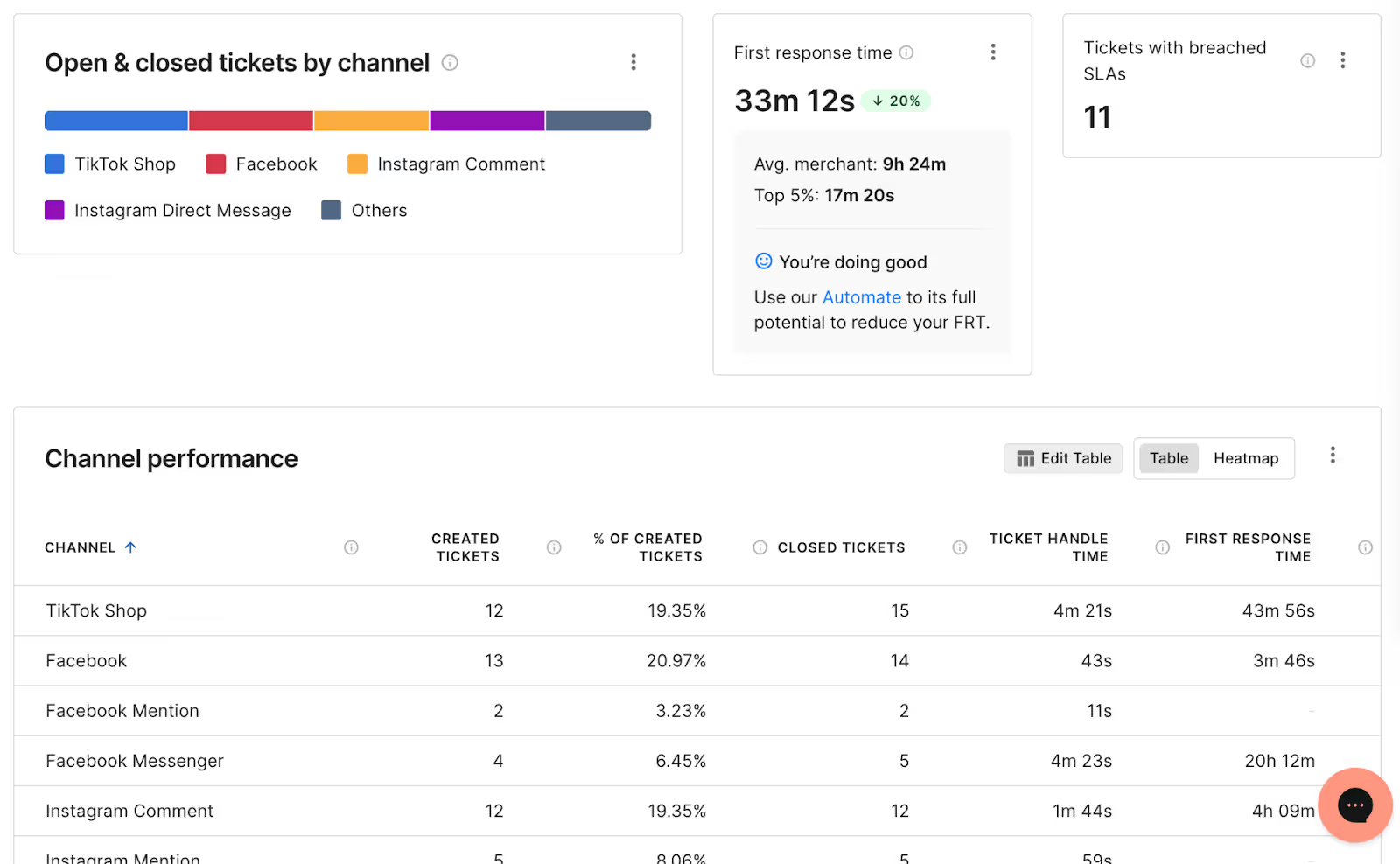
You can also use Gorgias's Dashboard to spot emerging trends across all your channels. This custom reporting feature lets you choose from various charts that reveal high-level patterns—like the most common contact reasons or sudden spikes in ticket volume—giving marketers early insight into shifting customer sentiment and trending topics across social platforms.
Ask your CX team 💬 Which articles in our Help Center are most searched right now?
Find alignment between CX and marketing teams
When support and marketing teams collaborate, you unlock a cycle of continuous improvement. CX teams surface the insights, marketing turns them into strategy, and both sides drive measurable results.
Here’s how to make it work:
- Set up recurring syncs between CX and marketing teams to review insights from customer service reports.
- Involve support in campaign planning to consider what customer objections might come up.
- Encourage CX to tag tickets based on themes or behavior that marketing can act on.
Unlock revenue by listening to your customers
We need to reframe CX as a proactive function that drives revenue.
Support teams already have the answers marketers are searching for. You just need the tools to tap into them. Gorgias makes that easy, with flexible reporting features, powerful AI, automated tagging, and integrations that bridge the gap between CX and marketing.
Want to connect your support data to better marketing?
Explore Gorgias’s analytics tools or book a demo to speak to a product expert about how to integrate your support strategy with marketing.
{{lead-magnet-1}}

Stop Resolving These 7 Tickets Manually (Use AI Agent Actions Instead)
TL;DR:
- Actions are tasks automatically performed by AI Agent for customers. From address changes and subscription pauses to order cancellations, Actions can fulfill requests for your customers, even when your human agents are offline.
- Actions connect directly to your ecommerce apps. Currently, Actions have native integrations with Shopify, ShipMonk, ShipHero, ShipStation, Stay AI, Recharge, Loop, Subscriptions by Loop, Skio, Seal Subscriptions, and Wonderment.
- Use pre-built Actions or build your own. There are 12 Action templates available, or you can build Actions using custom HTTP requests.
- Watch out for setup snags. Conflicting Guidance, multiple matching Actions, older orders, or broken logic can block an Action from executing.
Automated responses don’t actually resolve anything. In reality, they increase customer wait time.
What a customer really wants is immediate resolution, whether they’re looking to cancel an order, change a shipping address, or pause a subscription.
So, how do you go beyond automated text responses? AI Agent Actions.
Below, we’ll go over the 7 most common customer service requests you can resolve with AI Agent Actions, so your team gets time back to strengthen customer relationships, increase revenue, and improve your CX strategy.
{{lead-magnet-1}}
What are AI Agent Actions?
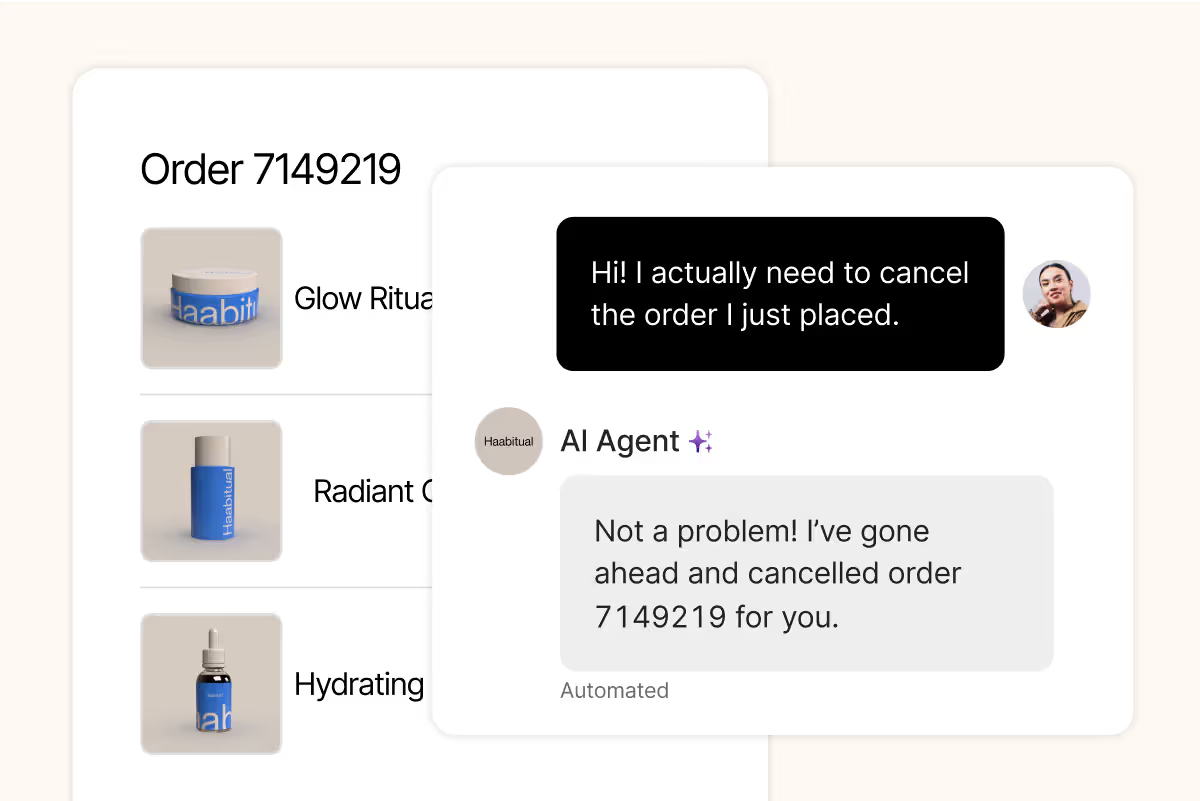
AI Agent Actions are tasks AI Agent can complete for your customers, such as canceling an order or updating a shipping address.
Instead of handing it off to a human agent, AI Agent resolves the ticket by connecting to your ecommerce apps and performing the action on its own.
You get maximum control over when and how Actions are executed. Before performing the Action, AI Agent asks customers for confirmation, respecting your processes and maintaining a high level of customer service. Once an Action has been taken, you can even share feedback with your AI Agent to reinforce its behavior or finetune it further.

Pro Tip: Unlike Guidance, which tells AI Agent how to respond in a conversation, Actions determine what happens. It’s the difference between saying “I’ll refund your order” and doing it.
Related: How AI Agent works & gathers data
Top 7 customer requests you should be automating with AI Agent Actions
Ready to resolve requests in seconds? Activate these pre-built Actions in Gorgias to keep your team efficient and your customers happy.

1. Customer wants to update their shipping address
Action to use: Update shipping address
Supported apps: Shopify, ShipMonk, ShipHero, ShipStation
Incorrect shipping addresses lead to costly re-shipments, delays, and even refunds. Catch errors early to keep customers satisfied and excited about their order.

Why do you need this Action?
The reality is your agents aren’t available 24/7. Unless you hire a team to cover night and weekend shifts (which is unlikely), requests will be missed. AI Agent fills in that gap, handling time-sensitive issues when your team is off the clock. Missing them isn’t just about poor customer experience—it can also lead to extra costs, like reshipping orders.
2. Customer wants to cancel an order
Action to use: Cancel order
Supported apps: Shopify, ShipMonk, ShipHero, ShipStation
Perhaps a customer ordered the wrong item, chose the wrong size, used the wrong card, or simply changed their mind. Allow them to quickly cancel their order and receive a refund in one go.

“Actions responds to tickets within about 30 seconds and is available 24/7. Regardless of when a customer places their order, the likelihood of quickly catching and canceling the order has increased by 70% since we started using Actions. It’s an exceptional result."
—Jon Clare, VP of Customer Service at Trove Brands
3. Customer wants to replace/remove an item in their order
Actions to use:
- Replace item, or
- Remove item
Supported app: Shopify
It happens—shoppers order the wrong size or color and want to change their order immediately. Regardless of the reason, make their new decision easy to implement. Quick, accessible order updates prevent returns, lost revenue, and, most importantly, customer disappointment.
Here’s what the replace order item setup looks like in Gorgias:

Pro Tip: If you have unique workflows, you can create advanced, multi-step Actions and connect to your tools beyond our default integrations. This option requires some tech know-how (like custom HTTP requests), so feel free to bring in your developers for assistance.
4. Customer wants to skip or pause a shipment
Actions to use:
- Skip next subscription shipment, or
- Pause subscription
Supported apps: Stay AI, Recharge, Subscriptions by Loop, Skio, Seal Subscriptions
Subscriptions shouldn’t be all or nothing. Let customers skip a shipment or pause their subscription, so they can come back when they’re ready. Giving them full control lets them manage their subscription on their own terms, reducing churn rate in the process.
Here’s how AI Agent handles a skip shipment request:

5. Customer lost or damaged their order in transit
Action to use: Reship order for free
Supported apps: Shopify, ShipMonk
No customer expects a lost or damaged order. Let customers know that you have their backs by reshipping a new order free of charge. Fast resolutions during unexpected events demonstrate your commitment to customer satisfaction.
“An instant response builds confidence. We live in a world with short attention spans, so customers appreciate how quickly we can respond to their inquiries. Customers aren’t worrying unnecessarily for longer than they have to for an address change or order cancellation.”
—Mia Chapa, Sr. Director of Customer Experience at Glamnetic
6. Customer wants to know their return shipping status
Action to use: Send return shipping status
Supported app: Loop
Customers want to know that their return package is on its way to you, so they can redeem their refund. Easily send them a shipment tracking link to give them that peace of mind.
7. Customer wants to know about order status
Action to use: Get order info
Supported apps: Shopify, ShipHero, ShipMonk, ShipStation, ShipBob, Wonderment
Based on Gorgias data, order status ranks among customers' top 10 questions for support teams. Reassure your customers with quick updates on their orders, including product details, shipping progress, expected delivery date, and other helpful information.
What to know before turning on Actions
Here are a few helpful setup tips to make sure Actions run without a hitch:
- Guidance can override Actions. If conflicting Guidance exists, it may prevent an Action from triggering, even when all conditions are met. Review your Guidance to avoid overlaps, or write your logic into the Action description instead.
- Any Action that changes data requires shopper confirmation. Actions like canceling orders, updating addresses, or canceling subscriptions mean AI Agent will always ask the shopper to confirm before making a change.
- Currently, only one Action can run per ticket. If multiple Actions qualify, none will run, and the ticket will be handed off. Use conditions carefully to ensure only one Action matches per use case.
- AI Agent can only access the shopper’s last 10 orders. If the customer references an older order, the Action won’t trigger and the ticket will be handed over for manual handling.
AI Agent Actions speak louder than words
If you want…
- Fewer repetitive tickets
- Faster customer support
- Happier customers who get what they need instantly
- More time for your team to strategize
- Lower costs and higher efficiency
AI Agent Actions can get you there.
You’ve now seen how Actions can resolve tickets in a snap—no unnecessary handoffs, canned responses, or long response times.
Book a demo to see AI Agent Actions work in real time and start automating what you shouldn’t be doing manually anymore.
{{lead-magnet-2}}

How to Write Guidance with the “When, If, Then” Framework
TL;DR:
- AI Agent is only as good as the instructions you give it. Clear Guidance enables it to perform like your best support teammate.
- The “When, If, Then” framework makes writing Guidance easy and repeatable. Start with the scenario (when), define the conditions (if), and list specific actions (then) to create structured Guidance.
- Use Guidance to handle frequently asked questions, like returns, cancellations, or discount code inquiries, so your team can focus on more complex issues.
- If your Guidance isn’t working, formatting or logic gaps might be to blame. Check for missing conditions, unsupported tasks, or confusing formatting.
AI Agent is built to deliver fast, accurate support at scale, but like any teammate, it performs best when given clear and specific instructions.
That’s where Guidance comes in. Writing structured prompts that tell your AI Agent exactly what to do in a given scenario helps reduce escalations, speed up resolutions, and create a more consistent customer experience.
One simple, repeatable way to do that is with the “When, If, Then” framework.
In this post, we’ll show you how it works, using examples from our Gorgias Academy course, Improve AI Agent with Better Guidance.
You’ll learn how to write Guidance that results in:
- Fewer escalations
- Faster resolutions
- Smarter, more consistent AI behavior
Let’s break it down.
{{lead-magnet-1}}
What is Guidance?
Guidance is how you tell your AI Agent what to do. It’s a set of instructions that outlines how your AI Agent should respond in specific situations.
When Guidance is available, your AI Agent follows it first, even before checking your Help Center or website content.
That means if your Guidance is missing, unclear, or incomplete, your AI Agent might escalate the ticket, or worse, give a confusing or unhelpful response. Here’s an example:
Let’s say a customer wants to return an item. A human agent would send them a link to the return portal and explain the steps. But without that instruction in Guidance, your AI Agent might skip straight to escalation, turning a simple request into unnecessary work for your team.
That’s why clear, step-by-step Guidance is key to help your AI Agent respond the way your best support agent would.
Learn more: Create Guidance to give AI Agent custom instructions
Introducing the “When, If, Then” framework
Sometimes it’s hard to know where to start when writing Guidance. The “When, If, Then” framework gives you a simple, repeatable structure to follow, so there’s no need to guess.
Taking this approach mirrors how AI Agent processes information behind the scenes. When you write clear Guidance, your AI Agent can follow it step by step, just like a support teammate would.
Let’s walk through the three parts of the framework.
WHEN: Set the scenario
Start by identifying the situation your Guidance applies to. This is the trigger or scenario. Use it as the title of your Guidance so it’s easy to find later.
Example:
- WHEN a shopper asks to return an order
- WHEN a customer wants to cancel their subscription
Keep it simple and action-oriented. You’re setting the stage for what comes next.

IF: Add conditions
Once you’ve defined the scenario, add any conditions that determine what should happen. “If” statements help your AI Agent understand what to do based on specific details, like timing, order history, or customer tags.
Example:
- IF the order was placed less than or equal to 15 days ago
- IF the customer has a VIP tag in Shopify
Use as many “if” conditions as needed to guide different outcomes. Just make sure you cover all the possibilities so your AI Agent doesn’t get stuck.
THEN: Define the actions
This is where you tell your AI Agent exactly what to do. Be specific and use bullet points or numbered steps to keep things clear.
Example:
- Tell the shopper they’re eligible for a return
- Send them a link to the return portal
- Let them know they’ll receive a prepaid label once the form is submitted
The more clearly you outline the steps, the more consistently your AI Agent will perform.
The framework keeps your Guidance simple, structured, and easy to understand—for both your team and your AI Agent. When your AI Agent knows exactly what to do, it can deliver fast, accurate, and helpful responses that keep customers happy.
Put it all together
Say a shopper messages your store asking to return an item and you want AI Agent to send them to your return portal.
Here’s how this looks in a complete piece of Guidance:
WHEN a shopper asks to return an order:
IF the order was placed less than or equal to 15 days ago,
THEN
- Tell the shopper they’re eligible for a return
- Send them a link to the return portal
- Let them know they’ll receive a prepaid label via email once they submit the form
9 support scenarios made better with Guidance
These nine scenarios come up constantly in ecommerce support, and they’re perfect candidates for automation. They follow predictable patterns and are quick to resolve when your AI Agent knows what to do.
Use the examples below to jumpstart your setup. Each one is written using the When, If, Then framework and can be copied directly into Gorgias.
1. Where’s my order? (WISMO)
WHEN a customer asks about their order status:
IF tracking information is available,
THEN
- Provide the tracking number and link to the carrier's tracking page.
- Inform the customer of the expected delivery date.
IF tracking information is unavailable,
THEN
- Inform the customer that the order is being prepared for shipment.
- Provide an estimated shipping date.
2. What size should I order?
WHEN a customer inquires about product sizing for [item name]:
IF the customer asks what size to get, or mentions they’re unsure about sizing,
THEN
- Share the sizing chart or guide.
- Offer recommendations based on common fit feedback.
3. Can I change my shipping address?
WHEN a customer requests to change their shipping address:
IF the order has not been fulfilled,
THEN
- Confirm the new address with the customer.
- Update the shipping address in Shopify (or your chosen platform).
IF the order has already been fulfilled,
THEN
- Inform the customer that the address cannot be changed.
- Provide options for order interception or return.
4. Can I cancel my order?
WHEN a customer asks to cancel their order:
IF the order has not been fulfilled,
THEN
- Confirm that we can cancel their order.
- Tell them they’ll receive their refund in 5-10 business days.
IF the order has already been fulfilled,
THEN
- Inform the customer that the order cannot be cancelled.
- Help to initiate a return once the item is delivered.
5. How do I return an item?
WHEN a customer asks about returning an item:
IF the return is within the allowed return window of [x] days after the order was received,
THEN
- Provide the return instructions and link to the return portal.
- Inform the customer about the refund process.
IF the return window has expired,
THEN
- Inform the customer that the return period has ended.
- Offer alternative solutions if available.
6. Do you have any discount codes?
WHEN a customer inquires about discounts or promo codes:
IF there is an active promotion for [item name],
THEN
- Share the current discount code and its terms.
IF there are no active promotions for [item name],
THEN
- Inform the customer that there are no current promotions.
- Suggest subscribing to the newsletter or following social media for future promos.
7. I want to pause my subscription.
WHEN a customer requests to pause their subscription:
IF the customer has an active subscription,
THEN
- Provide instructions on how to pause the subscription through their account.
- Confirm the pause and inform them of the next billing date.
8. When will this item be back in stock?
WHEN a customer asks about product restocking:
IF a restock date is available,
THEN
- Inform the customer of the expected restock date.
IF the restock date is unknown,
THEN
- Offer to notify the customer when the product is back in stock.
- Suggest similar products.
9. Do you ship internationally?
WHEN a customer inquires about international shipping:
IF international shipping is available,
THEN
- Confirm that international shipping is offered.
- Provide estimated delivery times and any additional fees.
IF international shipping is not available,
THEN
- Inform the customer that shipping is limited to specific regions.
Pro Tip: Test out your Guidance by going to AI Agent > Test, and iterate as you go.
Troubleshooting: Why Guidance might not trigger
If your AI Agent isn’t following your Guidance, or it’s escalating tickets you thought it could handle, run through this quick checklist to spot the issue:
- Has a descriptive, easy-to-understand name: Name your Guidance based on the scenario (e.g. When a shopper asks about returns).
- Clear IF and THEN conditions: Make sure your Guidance spells out what to do when a condition is met.
- Covers all variations (no gaps in logic): Don’t leave your AI Agent hanging. Include fallback instructions for all scenarios.
- No wall-of-text formatting: Break things up with line breaks, headers, and spacing to help AI Agent scan quickly.
- Clearly written steps with bullets or numbers: Use lists to make actions easy to follow, like you would for a teammate.
- Doesn’t include unsupported tasks: Avoid unsupported instructions like “send macro,” “assign to agent,” or “delay the response.”
Bonus: Let AI do the heavy lifting
Don’t have time to write Guidance from scratch? The good news is AI can help with that, too.
AI-generated Guidance is available for all AI Agent subscribers. This feature analyzes your historical ticket data and uses it to generate ready-to-use, customizable prompts for your AI Agent.
Here’s what it does:
- Analyzes past tickets to identify common support scenarios
- Generates step-by-step Guidance based on what’s worked before

Ready to level up your Guidance?
Clear, structured Guidance is the key to unlocking better performance from your AI Agent. With just one well-written “When, If, Then” prompt, you can reduce escalations, speed up resolutions, and give your shoppers a smoother experience.
Not sure where to start? Try writing Guidance for one common question today—like returns, order status, or promo codes. Or, if you want to go deeper, check out our free Gorgias Academy course.

When Should You Migrate Helpdesks? 5 Signs to Watch Out For
TL;DR:
- Your helpdesk shouldn't hold you back. If your team is buried in tickets or bouncing between tools, your platform might be the problem—not your process.
- Rising ticket volumes, slower response times, and clunky integrations are signs you’ve outgrown your platform. Don’t wait for these issues to impact revenue or retention.
- You’re not alone—fast-growing brands hit these roadblocks too. Dr. Bronner’s, Psycho Bunny, and Audien Hearing all switched platforms to support bigger growth with less friction.
- Helpdesk migration doesn’t have to be scary. With the right migration support, you can move quickly, avoid downtime, and give your team a tool they actually want to use.
As ticket volume grows, even the best CX teams start running into roadblocks: limited integrations, repetitive manual work, clunky interfaces, and slower response times. You patch things together. You make it work... until you can’t.
Many growing ecommerce brands find themselves trapped in a system that demands constant workarounds just to function.
If your current customer service platform feels more like a burden than a backbone, you’re not alone—and you’re not stuck.
In this post, we’ll walk through:
- The key signs it’s time to switch platforms
- What to prioritize when choosing your next one
- How brands like Pepper made a smooth move to Gorgias
The 5 warning signs you’ve outgrown your helpdesk
There’s a tipping point most brands hit as they scale. The signs are subtle at first—maybe your agents are taking longer to respond, or the volume of customer support tickets quietly outpaces your team. Then it starts affecting revenue, customer satisfaction, and retention. Big yikes.
Left unchecked, small inefficiencies can snowball into bigger operational challenges.
Catch these warning signs before they start costing you growth:
1. Rising ticket volume and slower resolution times
Support teams that are always playing catch-up rarely have time to focus on higher-value work. If your inbox is constantly overflowing or first response times are creeping up, it’s likely a sign your tools aren’t scaling with your business.
That’s exactly what happened with apparel brand Psycho Bunny.
“As we grew and expanded, we needed a tool that was better suited for Shopify, easier to manage, and offered better support to help us get the most out of the tool,” said Jean-Aymeri de Magistris, VP IT, Data & Analytics, and PMO at Psycho Bunny.
2. Agents constantly toggling between tabs and tools
If your agents are spending more time gathering context than solving problems, you’re losing time (and likely, patience) on both sides of the conversation. Fragmented tools can seriously undercut productivity.
Dr. Bronner’s experienced this firsthand, juggling Salesforce, spreadsheets, and disconnected systems.
“When I joined, we were logging calls and emails in Excel. It wasn’t scalable,” recalled Emily McEnany, Senior CX Manager at Dr. Bronner’s.
3. Clunky or missing integrations with your ecommerce stack
Some platforms require technical support even for small changes, such as custom workflows, new automations, or basic integrations. That may work at the start, but it becomes a bottleneck as your brand grows.
Disconnected systems strip away context, increasing the risk of mistakes. Whether it’s pulling up an order status or managing a return, agents need tools that work together, not against each other.
4. You’re stuck answering the same questions over and over
Every support team deals with repetitive inquiries. But without automation or self-service options, those tickets eat into your team’s time and keep you from focusing on higher-impact conversations.
Nude Project struggled to keep up with their ticket volume due to Zendesk’s lack of intuitive automation features. During Black Friday, the team received a record-high number of tickets—more than double their average volume.
“Connecting with customers through a screen is not always easy. With the high volume of messages, we need a tool that simplifies operational tasks while enabling effective communication and organization,” said Raquel J. Méndez, CX Manager at Nude Project.
5. Onboarding takes too long
Your platform should be easy for new hires to learn and for your team to evolve with. If ramping up agents takes weeks (or months), the platform might be getting in the way more than it’s helping.
Arcade Belts went through this process, trying one system, then switching back to one that better matched their needs.
“It just took a demo or two to realize what was actually going to support our team the way we needed,” their Ecommerce Coordinator, Grant, shared.
If any of these challenges sound familiar, you’re not alone.
The important part is recognizing when you’ve outgrown your current setup—and knowing that there are options out there to help you move faster.
What to look for when switching CX platforms
Switching platforms isn’t just about solving today’s problems. It’s about creating space for your team to be efficient, serve customers better, and turn support from a cost center into a real growth engine.
Need to migrate to a new platform? Look for the following:
1. A system that keeps up with rising ticket volumes
As your brand grows, support volume naturally increases.
Find a stable infrastructure that can handle that growth, has zero platform lag, and a robust engineering team that continuously makes the tool better for your needs.
To Psycho Bunny, Zendesk was a “legacy tool”—so they switched to Gorgias.
In just a few weeks, they migrated all historical conversations, tags, and Macros to Gorgias. Jean-Aymeri, their VP IT, credits Gorgias’s helpful onboarding specialists for making it effortless to integrate their apps and onboard their team onto a brand new tool.
Related: The engineering work that keeps Gorgias running smoothly
2. Automation for repetitive tasks (that maintains the human touch)
From “where’s my order” questions to return policies, prioritize AI tools that can automate repetitive inquiries.
Dr. Bronner’s implemented AI Agent to handle rising volumes of FAQs, allowing their team to focus on complex requests that require a human touch.
In just two months, they saw:
- 45% of all customer service tickets automated
- $100,000 saved per year by switching from Salesforce to Gorgias
- 4 days per month in team time savings
- 11% higher customer satisfaction score
By systematizing the simple stuff, they freed up bandwidth to focus on what matters most—building relationships and solving more nuanced problems.

3. Built-in features that turn support into sales
More brands are rethinking how support contributes to revenue. Look for a tool that combines support and sales. The most effective ones use AI to initiate upselling conversations, so your team can generate new revenue without needing to scale headcount at the same rate.
For jewelry brand Caitlyn Minimalist, which normally saw 30,000 tickets per month, AI Agent was the perfect fit. On top of answering FAQs, AI Agent also helped recommend products based on customer needs.
These conversations often begin as simple inquiries (“What should I get for my friend’s birthday?” or “What product suits me?”) and end in a purchase—handled entirely by AI. In fact, AI Agent’s conversion rates were 150% higher than the team average, proving that automation can support and sell.
4. A more efficient workflow—without relying on developers
The last thing scaling brands should have to worry about is relying on developers for basic changes. That includes being able to create macros and automations in-house and access key customer data without toggling across tools.
The platform should fit into your existing ecommerce stack—not fight against it.
That’s where Audien Hearing found themselves before switching to Gorgias.
“I’ve seen companies lose a lot of money because it’s not efficient,” said Zoe Kahn, former VP of CX. “You try to save money early on, but then you look at your helpdesk a year later and think, ‘Oh no, what’s happening?’”
Since switching from Richpanel, Audien Hearing’s CX team has been able to run CX on their own terms—without the bottlenecks.
They now resolve 9,000 tickets per month through self-service alone (including a customer knowledge base), cut first response times by 88%, and reduced return rates by 5%. With more time for one-on-one conversations, CSAT jumped from 80 to 86.
What migration actually looks like
“But migration sounds hard.”
We get it. Moving your entire CX operation can feel intimidating. But with the right partner (and the right platform), it doesn’t have to be.
Here’s how Gorgias makes switching smooth and stress-free:
- A dedicated onboarding team: Our team is with you every step of the way—from initial setup to post-launch optimization.
- A platform built for ecommerce workflows: Gorgias is designed to work the way ecommerce brands do, not the other way around.
- Fast setup and agent training: Most brands are up and running in days, not weeks. And because the interface is intuitive, teams can get comfortable quickly without heavy, time-consuming training.
- Full data migration support: Whether you’re moving from Gladly, Zendesk, or another platform, we’ll help you bring your history, macros, and workflows over smoothly.
Most Gorgias customers are fully live within just a few days—ready to serve customers faster, smarter, and with less manual lift.
How Pepper made a smooth switch to Gorgias
When fast-growing intimates brand Pepper outgrew their old CX platform, they knew they needed a system that could scale with them—without sacrificing speed or quality.
“Gladly didn’t offer any automation or inbox organization features. Our queue got really messy. We got 400 tickets a day during Black Friday, and we didn’t clear that backlog until the following Spring. We knew we couldn’t do that again,” explained Gabrielle McWhirter, CX Operations Lead at Pepper.
With Gorgias, Pepper was able to:
- Fully migrate their workflows and history
- Train their team quickly on the new platform
- Launch their AI Agent ("Penelope") to automate more than 50% of support tickets

And the results spoke for themselves:
- 16.5x ROI on AI-driven sales interactions
- 90%+ decrease in first response and resolution times
- 18% uplift in average order value
See how Pepper made the switch happen (and why they’re never looking back):
Is it time to make the switch?
If you’re seeing the warning signs, here’s a quick gut check:
- You’re drowning in tickets and toggling between tabs
- You can’t track or tie support to revenue
- You need better integration with your tech stack
- You’re not using automation, or it’s not actually saving time
- Your team dreads logging into your current tool
The right platform won’t just help your team work better. It’ll help you drive more revenue, boost customer retention, and actually make customers want to talk to you.
See what switching to Gorgias could do for your brand. Book a demo today.
{{lead-magnet-1}}

11 Ways CX Teams Can Turn Customer Touchpoints Into Revenue
TL;DR:
- Your CX team drives revenue: Build trust, remove friction, and influence buying decisions across the customer journey
- Optimize existing processes: Automate tasks, address concerns proactively, and create efficient handoffs
- Spot risk early: Use tagging and sentiment detection to re-engage customers before they churn
- Protect VIPs: Prioritize loyal customers, create moments of delight, turn supporters into advocates
Rising tariffs. Shipping delays. Unpredictable price hikes. For ecommerce, it's an understatement to say the pressure is rising. If you're on the CX team, you're already facing the fire head-on — all the customer frustration, confusion, and hesitation.
CX teams are on the frontlines of support and sales. You're shaping customer trust, buying decisions, and brand loyalty.
From pre-sales conversations to loyalty programs, it’s time to rethink the customer journey, so you can turn every interaction into an opportunity to grow your revenue.
{{lead-magnet-1}}
Reframe CX’s role across the customer journey
Customer service isn’t just about reacting to problems. It can be a proactive and strategic function that helps you stabilize and even grow your revenue.
Think about it this way: you have the power to turn everyday customer moments into wins.
At every stage of the customer journey, you can turn:
- Purchase hesitation -> confidence to buy (pre-sales)
- Concern → relief (post-purchase)
- Disinterest -> re-engagement (loyalty)
- Returning customers → brand advocates (advocacy)
This isn’t about being pushy for sales. It's about anticipating needs and putting systems in place that protect customer relationships and revenue.
As you update your CX workflow, keep these two questions in mind:
- How can I positively influence revenue?
- How can I reduce the risk of losing it?
1. Resolve pre-sales hesitation with education
Most pre-sales hesitation is rooted in uncertainty: What’s the return policy? How much is shipping? Will this fit? Will it arrive in time?
Reduce customer effort and build confidence with automation as your CX team’s first line of defense. Anything else more complicated, your agents can take care of.
Automate repetitive questions
Start by setting up automated answers for the questions your team responds to every day, especially the ones that delay conversions:
- Where is my order?
- Do you ship internationally?
- How much is shipping?
- Do you accept returns?
- Are your prices affected by tariffs?
There are a few ways to automate these questions in Gorgias:
- Flows: Automated conversations designed to resolve common inquiries without agent intervention
- AI Agent: Conversational AI that answers customer questions in chat and email, trained on your internal documents and brand voice
- Help Center: A self-serve, customer-facing knowledge base of help articles, FAQs, guides, and product resources
Read more: How to optimize your help center for AI Agent
Proactively guide shoppers
Be the compass for the wandering window shoppers and browsers. They might not know exactly what to get, but with the right nudge, you can guide them toward the right product and a fuller cart.
Try these chat prompts:
- Don’t know what size to get? Check out our sizing guide to get your perfect fit!
- Need help choosing the right carry-on? Here’s a quick comparison of our top sellers.
- We offer free shipping for orders over $60!
- What’s your skin type — dry, oily, or combination?
Offer discounts based on shopper intent
Sometimes, a discount is all a customer needs to take their order to checkout. Instead of storewide promo codes, use AI to offer tailored discounts to shoppers who show strong intent to buy. This can help reduce abandoned carts and leave customers with a great impression of your brand.
Here are some of the best times to offer a discount:
- A first-time shopper is hesitant because of the price
- A shopper adds an item to their cart, then asks about shipping or return policies
- A shopper asks if they should wait for a sale
Recommend products in real time
If shoppers can’t quickly find what they’re looking for, they’ll leave. Real-time product recommendations help resolve indecision and increase average order value.
Examples of when real-time suggestions drive conversions:
- A shopper asks for jeans in medium — AI suggests bestsellers in their size
- A returning customer mentions loving a nude-colored top — AI recommends similar or matching items
- A product is out of stock — AI suggests alternatives based on color or style

Hand off high-intent shoppers to live agents
High-intent questions are usually specific and goal-oriented — things like:
- What size should I get?
- How soon can this ship?
- Is this item still in stock?
When customers ask questions that directly impact their ability to purchase, it’s a strong buying signal. If they don’t get a fast response, they’ll probably abandon their cart.
So, how do you encourage shoppers to keep shopping?
Activate chat on your website and equip it with automated features, such as Flows, and/or conversational AI, like AI Agent.
No matter what setup you choose, always have a protocol ready to hand off to a human agent when needed.
In Gorgias, you can set up Rules or use AI Agent handover rules to automatically route conversations based on specific keywords, topics, or customer behavior.

2. Alleviate post-purchase concerns
After buying, customers may want to change their order or just need reassurance that everything is on its way.
If customers feel ignored during this critical window, you risk losing their business.
The easy fix? Eliminate friction, reassure customers, and make it easy for them to stay excited about their purchase.
Automate order status updates
Customers expect full visibility into their orders. Give them full access to this information, and you'll receive fewer WISMO requests.
Integrate your helpdesk with your 3PL or shipping provider to automatically send real-time updates on order status. If customers have an account portal, give them a tracking link.
Pro Tip: If delays are expected, automate messages to let customers know ahead of time. Being proactive keeps customers informed and reduces the need for reactive support.
Turn negative experiences into retention moments
When something goes wrong, like a delay, a lost package, or unexpected fees, it's how you respond that matters most.
Empower your CX team to act quickly. For example:
- Offer store credit, loyalty points, or free shipping perks to impacted customers
- Prioritize VIP or first-time buyers for fast-tracked resolutions
- Escalate critical post-purchase issues to senior agents
You can also use sentiment detection to flag frustrated customers early. Gorgias has built-in customer sentiment detection that automatically identifies tones like urgent, negative, positive, or even threatening language. You can create Rules that tag these conversations and route them to the right agent for faster handling.
Read more: Customer sentiments
3. Re-engage at-risk customers and reduce churn
Just because a customer is at risk doesn’t mean you’ve lost them. Identifying and re-engaging at-risk customers is one of the highest-impact things you can do to protect revenue.
Spot risk early
Pay attention to repeat patterns that signal dissatisfaction. Common early indicators include:
- Multiple shipping complaints
- Frequent refund or return requests
- Negative or urgent sentiment in support tickets
- Long periods of customer inactivity after purchase
Use sentiment detection and Ticket Fields (ticket properties) to tag these signals automatically. With this data identified, you’ll start to spot patterns that can help you address issues, giving customers a reason to stay.

Build recovery flows
Once you’ve identified your at-risk customers, use win-back strategies, like:
- Offering discount codes, loyalty perks, or free returns
- Sending personalized emails or messages acknowledging the issue and offering solutions
- Prioritizing conversations for your most experienced agents or account managers
When handled thoughtfully, a churn-risk customer can become one of your strongest advocates because you showed up when it mattered most.
4. Build loyalty by surprising your best customers
Don’t forget, there are already customers who love you! These loyal customers don’t just come back to buy again — they bring friends, amplify your brand, and give your business stability when you need it most.
Identify and prioritize VIPs
Use customer data to identify customers who purchase frequently, spend more, or have referred others. Tag them as VIPs in your helpdesk so that their requests are prioritized.
For example, in Gorgias, you can use Customer Fields (customer labels and properties) to group your customers under:
- VIP
- Repeat purchaser
- High lifetime value
- Promoter
When you know who your top customers are, you can offer more personalized service and make sure every interaction strengthens their connection to your brand.
Create brand advocates through small gestures
You don’t need to offer huge discounts to let customers know you appreciate them. Small, thoughtful gestures often make the biggest impact:
- Send handwritten thank-you notes with their orders
- Offer a free gift, upgrade, or loyalty perk after a milestone purchase
- Include a referral code they can share with friends
- Feature loyal customers on your social media channels (with their permission)
If you’re using macros and automations, you can even trigger some of these surprise-and-delight actions automatically, making it easier to scale while keeping the personal touch.
Make revenue your outcome at any time
We know how overwhelming uncertain times can be. It’s easy to think you need to reinvent your entire strategy just to keep up.
But the truth is, you already have what you need. You have a team that knows your customers. You have conversations happening every day that can protect, nurture, and even grow your business.
By grounding yourself in what’s already working and creating proactive systems, you can turn uncertainty into strong and steady growth.
{{lead-magnet-2}}

Store Policies by Industry, Explained: What to Include for Every Vertical
TL;DR:
- Clear policies reduce tickets. When customers can’t find return windows or shipping timelines, they turn to your support team — often unnecessarily.
- Each vertical has different CX needs. A fashion shopper wants fit info. An electronics buyer needs setup help. Tailor your policies to match.
- Proactive placement matters. Don’t bury policies in the footer — surface them in product pages, chat, emails, and account portals where customers actually look.
- Policy + AI = self-service support. Gorgias’s AI Agent can guide shoppers to answers instantly, reducing WISMO and freeing up your team for high-value work.
For many ecommerce teams, store policies are an afterthought, tucked away in the footer or buried deep in the FAQ. But they shouldn’t be.
Great customer experience (CX) starts before a customer reaches out. And with 55% of shoppers preferring self-service support, your store policies are often their first stop for answers.
In this guide, we break down the must-have policies for five key ecommerce verticals, based on real Gorgias ticket data. From shipping delays to subscription changes, you’ll learn how to prevent tickets before they happen.
{{lead-magnet-1}}
Why store policies are a CX power move
If you’re constantly fielding questions about returns, shipping times, or order changes, it’s a policy opportunity.
Well-crafted store policies are one of your CX team's most effective tools for setting expectations, building trust, and preventing support issues before they happen. When done right, they turn common friction points into effortless experiences.
Common blind spots that lead to tickets
When policies are vague or hard to find, customers turn to your inbox, driving up ticket volume and slowing down your support team.
Here are the most common blind spots we see:
- Unclear or missing return windows lead to questions like, “Can I still return this?”
- No defined process for exchanges or edits confuses customers who need to fix an order.
- Subscription rules hidden in fine print frustrate loyal customers trying to pause, skip, or cancel.
- Shipping timelines that shift without explanation cause “Where’s my order?” messages that could’ve been avoided.
When policies aren’t clear or easy to find, customers turn to your inbox. And that means more tickets, wait times, and pressure on your team.
Proactive policies = fewer tickets, happier customers
Based on real data from Gorgias, these are the top 10 tickets customers send across channels like chat, contact forms, and email:
- Order damaged
- No reply tickets
- Shipping policy
- Shipping change
- Order change
- Product question
- Return status
- Thank you tickets
- Discount request
- Shipping status
What do most of these have in common? You can address them with clear, accessible policies.
15 store policies you need, organized by industry
Customer expectations aren’t one-size-fits-all, and your store policies shouldn’t be either.
What shoppers expect from a fashion brand is very different from what they need from a wellness company or electronics provider.
We’ve broken down the top policy must-haves by vertical, using real-world examples from Gorgias customers and ticket data.
Use these examples as your plug-and-play guide to write better policies, reduce ticket volume, and create smoother support experiences — no matter what you sell.
Apparel and fashion
When it comes to fashion, uncertainty drives tickets. “Will this fit?” “Can I return it?” “Where’s my order?” The most successful fashion brands like Princess Polly cut down on support volume by making these answers easy to find before customers ever reach out.
Key policies to prioritize
- Returns and exchanges: Be clear on timeframes, conditions, and the process. Bonus points for adding visuals or quick links to return portals.
- Size guide and fit: To minimize confusion, include details on model sizing, garment measurements, and fit notes.
- Order changes: Let customers know how to update their order before it ships.
- Shipping timelines: Set expectations around processing and delivery windows (especially during peak seasons).


Where to share store policies
- Link return and shipping policies on product detail pages (PDPs).
- Trigger chat campaigns with the sizing guide when shoppers linger on product pages.
- Add return instructions in post-purchase emails to cut “How do I return this?” tickets.
Consumer goods
Consumer goods customers often want to know two things right away: “What’s it made of?” and “When will it get here?” These questions can quickly pile up in your inbox if your policies aren’t front and center.
Trove Brands, home to household favorites like BlenderBottle and Owala, solves this by proactively answering product and shipping questions across their site and emails.
Key policies to prioritize
- Shipping: Share estimated delivery times, carrier information, and instructions on how customers can track their orders.
- Product specs and materials: List dimensions, materials, care instructions, and safety notes to avoid product-related confusion.
- Damage/defect resolution: Set clear expectations around what qualifies as a defect and how customers can report it.
- Warranty or guarantee: Outline what’s covered, for how long, and how to claim it, especially important for durable goods.

At the end of each product page, BlenderBottle shares a support menu where shoppers can find information on order status and replacement parts.

Where to share store policies
- Embed product-related FAQs directly on PDPs to answer questions where they arise.
- Use conversational AI assistants like AI Agent to automatically resolve tickets related to product questions and damaged orders.
- Add warranty and damage policy links in order confirmation and shipping emails to keep customers informed.
Read more: What's the secret to reducing WISMO requests?
Consumer electronics
In electronics, clarity is everything. Customers want to know how to use the product, what to do if it doesn’t work, and how to get a replacement — without jumping through hoops.
Over-the-counter hearing aid company Audien Hearing nails this by creating crystal-clear support content around setup, shipping, and returns, so customers can troubleshoot confidently and independently.
Key policies to prioritize
- Warranty/repairs: Explain what’s covered, how to file a claim, and turnaround times for repairs or replacements.
- Returns and exchanges: Clearly state the return window, list of eligible items, processing time, and whether you accept refunds, in-store credit, or exchanges.
- Shipping and delivery expectations: Share average delivery timelines and what to expect once a product ships.
- Troubleshooting steps: Provide self-service guides for common issues like connectivity, battery life, or setup confusion.
Audien Hearing has clear visual policies that make it simple for shoppers to find the info they need quickly.

Where to share store policies
- In chat, set up an automated flow that answers questions like “How do I set this up?” or “Can I return this?”
- Let customers track their return or exchange process, especially when high-value items are involved.
- Create step-by-step guides, accompanied by video or images, in your Help Center for setup and basic troubleshooting.
- Include warranty and return information in the product packaging, so customers have it readily available in case something goes wrong.
Health and wellness
In the health and wellness space, trust and transparency are everything. Customers want to feel confident that the products they’re using are safe and that the support will be just as thoughtful as the product itself.
Brands like period underwear brand Saalt do this exceptionally well, pairing clear product education with empathetic policies that guide customers through everything from first use to subscription changes.
Key policies to prioritize
- Product safety and use: Provide detailed instructions, safety disclaimers, and FAQs for first-time users, especially for intimate or ingestible products.
- Returns (especially for hygiene items): Be upfront about what can and can’t be returned, and include compassionate language to build trust.
- Order change or cancellation: Make it easy to update or cancel orders, especially for items that ship quickly or automatically.
- Subscription FAQs: Clearly explain how to skip, pause, or cancel a subscription, and what benefits subscribers get.
Saalt lets customers phrase questions themselves or choose from a dropdown menu.


Where to share store policies
- Prioritize clarity on your contact form by using dropdowns or checkboxes to organize customer inquiries by topic.
- Let AI Agent handle recurring product questions like “How do I use this?” or “Is this safe?” to free up your team.
- Include shipping and return info in SMS flows so customers can get answers on-the-go, without needing to email.
Food and beverage
Food and beverage customers tend to be both curious and cautious. They want to know what they’re putting in their bodies — and what to do if something goes wrong with the order.
Brands like Everyday Dose get ahead of these concerns by making their policies clear, accessible, and customer-first.
Key policies to prioritize
- Ingredient and allergen disclaimers: Transparency is everything. List ingredients, possible allergens, and sourcing details to build trust.
- Subscription changes: Give customers full control to pause, skip, or cancel deliveries with minimal friction.
- Damaged orders: Outline what customers should do if a product arrives broken or spoiled, and how fast they can expect a replacement.
- Shipping and delivery FAQs: Cover delivery timeframes, how orders are packed, and what to do if a shipment is delayed.
Everyday Dose lists frequently asked questions and makes it simple for customers to find important allergen and ingredient information.

Given that Everyday Dose is a mushroom supplement brand, many shoppers will likely have questions around allergens and exact ingredients. On each of their product pages, there is a clear “Read the Label” button.


Everyday Dose also has a chat which encourages customers to click through to the correct support link or to track their order.

Where to share store policies
- Enable self-service order management on chat to give customers real-time updates on shipping status and subscription changes.
- Feature policy links prominently in your customer account portal — especially for managing subscriptions.
- Include your damage/return policy in post-purchase and thank-you emails, so customers know exactly what to do if something’s wrong.
Pro Tip: Use a conversational AI platform to handle common questions at scale. For example, Gorgias’s AI Agent can instantly respond to FAQs like “How much is shipping?” or “When will my order arrive?” — all in your brand’s voice. And when a request needs a human touch, it routes the ticket to the right agent automatically.
Best practices for writing and distributing store policies
Even the most well-written policy won’t reduce tickets if it’s buried three clicks deep in your footer. To truly support your customers (and lighten your team’s workload), your policies need to show up in the right places, at the right moments.
Here’s how to get them in front of customers when they need them most:
Surface policies across key customer touchpoints
- Product detail pages: Link to size guides, shipping timelines, or ingredient lists directly on PDPs.
- Chat: Use a combination of automated flows and conversational AI to proactively suggest relevant policies based on the customer’s question or page.
- Help center: Turn your most common ticket topics into easy-to-scan articles with clear titles and headers.
- Email flows: Include return and warranty info in post-purchase emails, shipping updates, and thank-you messages.
- Account portals: Make it easy for customers to manage subscriptions, view order policies, and find FAQs in their account dashboard.
- SMS or mobile support: Include quick policy reminders in transactional texts, like shipping delays or renewal reminders.
3 core elements of a strong store policy
- Clear: Use plain language, short sentences, and bullet points. Avoid legal jargon.
- Accessible: Link them prominently in your footer, header, Help Center homepage, chat, and product pages.
- Actionable: Tell customers exactly what to do — where to click, who to contact, and what to expect.
Well-placed policies turn support into a self-service experience. They empower your customers to get what they need without ever opening a ticket — and that’s a win for everyone.
Turn store policies into your first line of support
Clear, proactive policies do more than answer questions. They prevent tickets, build trust, and make your support team’s job easier. By tailoring your policies to your industry and placing them where customers actually need them, you turn potential friction points into smooth experiences.
Want to take it a step further? Book a demo to see Gorgias’s AI Agent handle common inquiries like shipping, returns, and product questions, across chat, email, and contact forms.
{{lead-magnet-2}}

How CX Leaders are Navigating Tariffs with Transparency
If you're an ecommerce leader right now, you’re likely facing a new wave of uncertainty. Rising tariffs, disrupted imports, and sudden cost increases are putting pressure on your margins, and your customer relationships.
At Gorgias, we are working with thousands of brands that are grappling with tough calls: adjust prices, shift sourcing, or absorb costs to protect loyalty. And while the supply chain is where these issues start, the customer experience is where they play out.
Whether you’re a growing DTC or an enterprise brand, your customers deserve transparency. We know the pressure you're under, and we're here to help you navigate it. To help you not only manage the conversation, but lead it with clarity, empathy, and speed.
Ecommerce brands are in an impossible position right now, following the 24 hours news cycle, and waiting to see how tariffs will cut into profits and impact their business.
For customers? It can create confusion, frustration, and a flurry of angry tickets if brands aren’t proactive and transparent. But here's the truth: how your team talks about tariffs is just as important as what they say.
These moments of friction, and how you communicate these changes to your customers can be opportunities to build trust, reduce churn, and even demonstrate the real revenue power of your team. In a moment when clarity and trust are everything, the role of CX leaders is more important than ever.
When tariffs hit, CX takes the call
Tariffs may seem like a back-end issue, but in reality, they shape front-end experiences—from product pricing and availability to fulfillment speed and satisfaction.
For ecommerce brands, especially those sourcing from China or shipping globally, these trade shifts hit close to home. Products get more expensive, shipping slows down, and some SKUs disappear altogether.
And CX teams are often the first to hear about it. The question isn’t if you should communicate tariff implications, but how.
What customers actually want to know
Here’s the good news: customers don’t expect you to control global trade policy. But they do expect honesty.
What matters most right now is:
- Transparency: Be clear about what’s changing and why.
- Timing: Tell them before they find out at checkout.
- Empathy: Acknowledge that increased prices or delays are frustrating and explain what you're doing to help.
And even more specifically, your customers are likely looking for answers to three simple questions:
- Did the price increase? Why?
- Why can’t I find this product anymore?
- Is my order going to be delayed?
In times of change, trust becomes foundational. If you're not upfront about what’s happening and how it affects them, customers will fill in the blank, or worse, turn to competitors.
How to talk tariffs without losing trust
Be clear, not complicated
Tariffs are complex, but your messaging shouldn’t be. Strip out the policy jargon and explain the changes in human terms. Let customers know what’s changing, why it’s happening, and what steps you’re taking to protect their experience.
Instead of: “Due to regulatory changes impacting import duties…”
Say: “Because of new tariffs, some of our prices have gone up. Here’s why, and what we’re doing to keep costs down.”
Say the same thing everywhere
From your Help Center to your agents to your email updates, your message should be consistent. Mismatched explanations create confusion and erode trust. Align your team on the key talking points and update scripts and automations across all customer touchpoints.
Speaking of your Help Center, now might be a great time to create an article specifically about tariffs and how you’re approaching them. The article can serve as a source of truth for your customers and your AI agents on the front lines answering questions.
Lead with empathy
Customers don’t just want the facts, they want to know you care. Acknowledge the frustration, and offer reassurance. Small gestures like a personalized note or a shipping perk can show you’re on their side.
Be specific and honest
Generic messages fall flat. Give customers details that they can rely on: Are the changes permanent? Are you absorbing part of the cost? Is a specific product impacted? When you’re upfront about the situation, and how you’re responding to it, you build credibility.
Decide how AI Agents should help
Times of uncertainty are times to cut costs, but it may also mean increased ticket volume. AI agents can help on the frontlines. But be sure to build your handovers to escalate to your team in the right moments to build trust.
Start with transparency: Beis sets the bar
Luggage brand, Beis, recently sent an email to customers that is a great example in customer-first communication. Rather than quietly raising prices or burying fees in checkout, they called it what it was: tariffs.

They explained the change clearly, why it was happening, and what customers could expect. And most importantly, they acknowledged the frustration. No spin, or vague language, just a clear message from a brand that respects its customers enough to be honest with them.
This kind of proactive messaging does more than prevent a flood of support tickets. It creates alignment between the brand and the customer. Beis didn’t make the rules but they’re navigating them with their customers, not in spite of them.
Make it a CX conversation, not just a policy page
Too often, tariff policies get relegated to the FAQ page or terms and conditions. Customers typically only land there after they’re already confused or upset.
Instead, CX should treat tariffs as a key part of the customer journey and be equipped to speak about them empathetically and clearly.
1. Proactive chat leads to fewer surprises
Add a proactive message to your chat widget that addresses tariff-related questions before they even come up. A short note like, “You may notice some pricing changes – here’s why,” with a link to your FAQ or a specific article, helps to deflect confusion and prevents cart abandonment.
2. Update your FAQ with key information
Surface timely information right where customers are most likely to look. Use your chat or search function to include a clear callout.
“Looking for information on recent pricing or shipping updates? Here’s what changed.”
This type of visibility empowers self-service, and reduces ticket volume.
3. Equip your agents with scripts that are genuine
Don’t leave your support team guessing. Create internal scripts with clear language on what to say (and what to avoid) when talking tariffs. Script empathy, not just compliance: Empower agents with language that acknowledges the inconvenience while reinforcing the brand's values.
Say:
- We’ve made some pricing updates due to new tariffs, and we’re doing everything we can to minimize the impact.
- We know this change may be frustrating. Here’s how we’re helping our customers through it.
Avoid:
- Overly technical or vague terms like “regulatory adjustments” or “economic climate shifts.”
- Any messaging that deflects responsibility or blames external factors without explanation.
4. Build smart macros for Tariff FAQs
If you’re using automation, make sure your AI Agent and autoresponders can explain tariff policies accurately and compassionately. Use macros to ensure fast, consistent replies, without sacrificing tone. Some key macro themes to create:
- Why did prices increase?
- Are tariffs permanent?
- Is my order delayed because of tariffs?
- Why is this product no longer available?
Each macro should strike a balance of clarity, empathy, and brand voice, offering both the what and the why.
You can’t control tariffs. But you can control trust.
Tariffs might be out of your control. But how you talk about them? That’s entirely in your hands.
This is your moment as a CX leader, not just to react but to lead. To turn friction into transparency, tension into trust, and confusion into connection. Because when policies change overnight and customer confidence is on the line, the brands that communicate with honesty, consistency, and care don’t just survive. They strengthen loyalty.
Your customers don’t expect perfection. They expect clarity. They expect empathy. And they expect you to show up.
At Gorgias, we’re here to make sure you can. With tools to automate answers, personalize conversations, and empower your team to deliver the kind of CX that builds long-term brand equity, even when times get tough.

Stop Chargebacks Before They Start: The Power of Fast Customer Support
TL;DR:
- Most chargebacks occur due to poor merchant communication rather than fraud. Customers choose this path when they feel ignored or frustrated.
- 80% of customers report never being contacted by merchants after filing a chargeback. 23% file immediately after an issue and 38% file within 1-3 days if unresolved.
- The most common chargeback reason is "product not received" (35%). 79% of all chargebacks are actually "friendly fraud" filed for invalid claims.
- Prevention requires fast customer support and automated chargeback management. Combining Gorgias for AI-powered support with Chargeflow for automated dispute management provides a comprehensive solution with faster resolutions and higher win rates.
Chargebacks are more than a thorn in a merchant’s side — they’re a growing financial and operational threat. According to Ethoca, chargebacks are projected to more than double, from $7.2 billion in 2019 to $15.3 billion by 2026 in the U.S. alone. And while fraud plays a role, the primary reason customers file chargebacks is simpler: they feel ignored.

At Chargeflow, we recently published a comprehensive report analyzing why customers dispute chargebacks. The findings were eye-opening. While it’s true that fraud is a real concern, most chargebacks happen for a different reason: a lack of communication between merchants and customers.
Top stats from Chargeflow’s report:
- 23% of customers file a chargeback immediately after an issue.
- 38% file a chargeback within 1-3 days if unresolved.
- 80% report never being contacted by the merchant.
- 52% are likely to dispute if the response is too slow.
When customers feel ignored or frustrated, they often turn to their bank for a solution instead of reaching out to the merchant first. Understanding these behaviors is key to preventing disputes before they escalate and cause chaos.
So, what actually drives customers to dispute charges? Here’s what the data says.
Why customers file chargebacks
While chargebacks are often the cost of doing business, the truth is that many disputes are preventable — but only if merchants understand the root causes. We identified five key drivers behind chargebacks.
1. Customers take immediate action
According to our research, most customers file a dispute right away after encountering an issue, leaving no opportunity to resolve the problem. Another 38% file within one to three days if they don’t receive a timely response.
Why? Customers assume the fastest way to get their money back is by filing a chargeback, especially if they receive no response from the merchant.
2. Lack of communication leads to disputes
We found that 80% of customers never receive a follow-up after filing a chargeback. Additionally, 64% of customers state immediate communication is crucial, yet many businesses fail to reach out.
- 90% of customers tried to reach out to the merchant first.
- If they don’t receive a response, they quickly file a dispute.
Why? Customers expect businesses to be proactive. When they don’t hear back quickly, they assume the merchant won’t help, making a chargeback seem like the best option.
3. Chargebacks are too easy for customers
98% of customers report a neutral to highly satisfactory experience when filing chargebacks, and only 12% are denied.

Why? Many customers believe chargebacks are faster and easier than dealing with merchants directly, especially if return policies are unclear.
4. Transaction issues drive chargebacks
The most common reason for filing a chargeback is “product not received” (35% of the cases). Other common reasons included:
- Fraudulent transaction claims - 16%
- Product significantly not as described - 15%
- Unauthorized transaction - 15%
Why? When customers don’t receive clear shipping updates or experience delivery delays, they assume their order won’t arrive and file a chargeback rather than waiting.
5. Friendly fraud is a major problem
Friendly fraud occurs when a cardholder makes a legitimate purchase but later disputes the charge as fraudulent or unauthorized, leading their card issuer to reverse the payment.
Our research found that:
- 21% of customers admitted to not fully understanding the chargeback process.
- Another 20% aren’t even aware of what a chargeback is.
- 97% of consumers believe they’ve never filed a chargeback incorrectly, while only 3% admit they have.

According to our State of Chargebacks report, 79% of chargebacks are actually friendly fraud, meaning they were filed for invalid reasons.
Why? Many customers mistakenly believe that a chargeback is just another way to request a refund, rather than a process intended for fraud or merchant failure.
📌 The takeaway: Most chargebacks aren’t actual fraud, but rather a result of customer confusion, impatience, or poor communication from merchants.
The solution: how to stop chargebacks before they happen
Merchants who want to stop chargebacks before they happen need a two-part strategy:
- Fast, customer-focused support to resolve issues before customers dispute charges.
- Automated chargeback management to detect and fight disputes efficiently, so merchants don’t lose revenue to invalid claims.
Chargebacks result from slow response times, poor communication, and unresolved issues, not fraud. Adopting AI-driven customer support and chargeback automation allows businesses to significantly reduce disputes and retain more revenue.
How AI-powered support & chargeback automation work together
Instant responses prevent frustration-driven chargebacks
Many chargebacks happen because customers don’t receive a fast enough response. In fact, 52% say they will dispute a charge if the response time is too slow. AI-powered chatbots provide real-time support, resolving issues before they escalate.
Proactive communication reduces uncertainty
Customers expect updates regarding orders and refunds, but often don’t receive them. 80% of customers report never hearing from a merchant after filing a chargeback.
Automated order updates, refund confirmations, and proactive notifications keep customers informed, reducing unnecessary disputes.
24/7 availability ensures no issues go unanswered
Customers expect round-the-clock support, but most businesses can’t provide live assistance. AI-powered ticketing and automation ensure every customer receives help, regardless of the time zone or urgency.
The result? Fewer chargebacks, faster resolutions, and increased customer satisfaction.
Actionable strategies for improving response times
Prioritize long-term clients
It’s impossible to please every customer. On average, chargebacks take 50 days to resolve successfully. Focus your energy on retaining high-value, long-term customers.
Prioritize high-risk inquiries
Lost inquiries take on average 15 days to resolve, and lost chargebacks take 38 days. Prioritize cases based on impact.
Build efficient escalation systems
Advanced automated ticketing systems can route inquiries and prioritize urgent cases.
Use pre-approved resolution templates
Ensure customer service teams have quick-response templates to speed their resolutions.
Work closely with shipping carriers
“Product not received” was the most cited reason for delivery-related chargebacks. Work closely with carriers and third-party suppliers to improve fulfillment and reduce disputes.
Leverage chargeback management tools
Use automated tools for real-time analytics, enhanced communication, and proactive alerts, which will reduce response times.
Gorgias & Chargeflow: A fully automated chargeback prevention system
Successfully tackling chargebacks requires both proactive customer support and automated dispute management. That’s why Gorgias and Chargeflow work so well together to give merchants a comprehensive defense against disputes.
Post-purchase automation isn’t just about reducing customer support workload or quick replies. It's about finding the most effective ways to increase customer loyalty and prevent disputes.
Learn more about how AI-driven automation enhances post-purchase experiences here.
How Gorgias prevents chargebacks with conversational AI
- Automated real-time responses engage customers before they decide to dispute charges.
- Proactive customer communication ensures customers receive updates on their orders, refunds, and transactions.
- 24/7 availability ensures customers receive the support they need without increasing overhead.
How Chargeflow automates chargeback prevention & recovery
- Pre-dispute alerts notify merchants before a chargeback is finalized and provide proactive intervention.
- AI-powered chargeback responses to automate evidence collection and improve win rates.
- Smart analytics to help merchants understand why disputes happen and how they can prevent them.
Final thoughts: Stop chargebacks before they start
As you know, chargebacks are costly, frustrating, but most importantly, preventable. Our research shows that most chargebacks don’t stem from fraud, but from poor communication, slow response times, and customer uncertainty.
By prioritizing fast, AI-driven customer support and automated chargeback management, merchants can resolve issues before they escalate, improve customer experience, and protect their revenue.
With Gorgias handling proactive customer support and Chargeflow managing chargeback disputes, merchants get a powerful, end-to-end prevention system that ensures fewer chargebacks, higher dispute win rates, and, at the end of the day, happier customers.
Don’t let chargebacks drain your revenue. Take control today with faster, smarter automation.
Download Chargeflow’s full Psychology of Chargebacks Report to dive deeper into the data and start preventing disputes before they happen.
Building delightful customer interactions starts in your inbox
