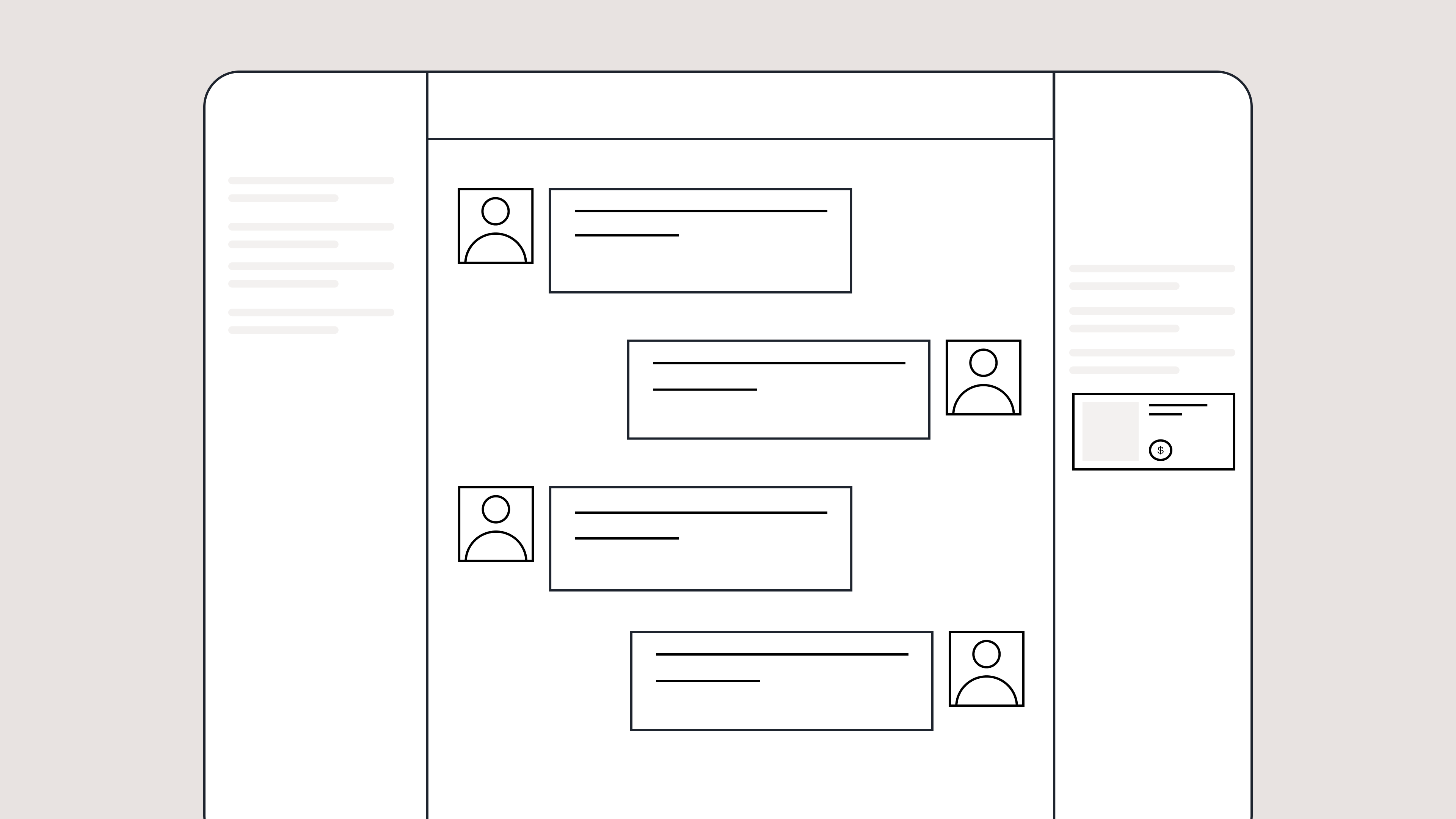
Four months ago, our analysts were dealing with a barrage of questions. "What's our ARR by segment?" "Build me a dashboard for this quarter's pipeline." Quick asks piled up behind complex deep dives. Stakeholders waited for answers that should have taken seconds, and analysts spent their time fielding requests instead of doing the strategic work that creates the most value.
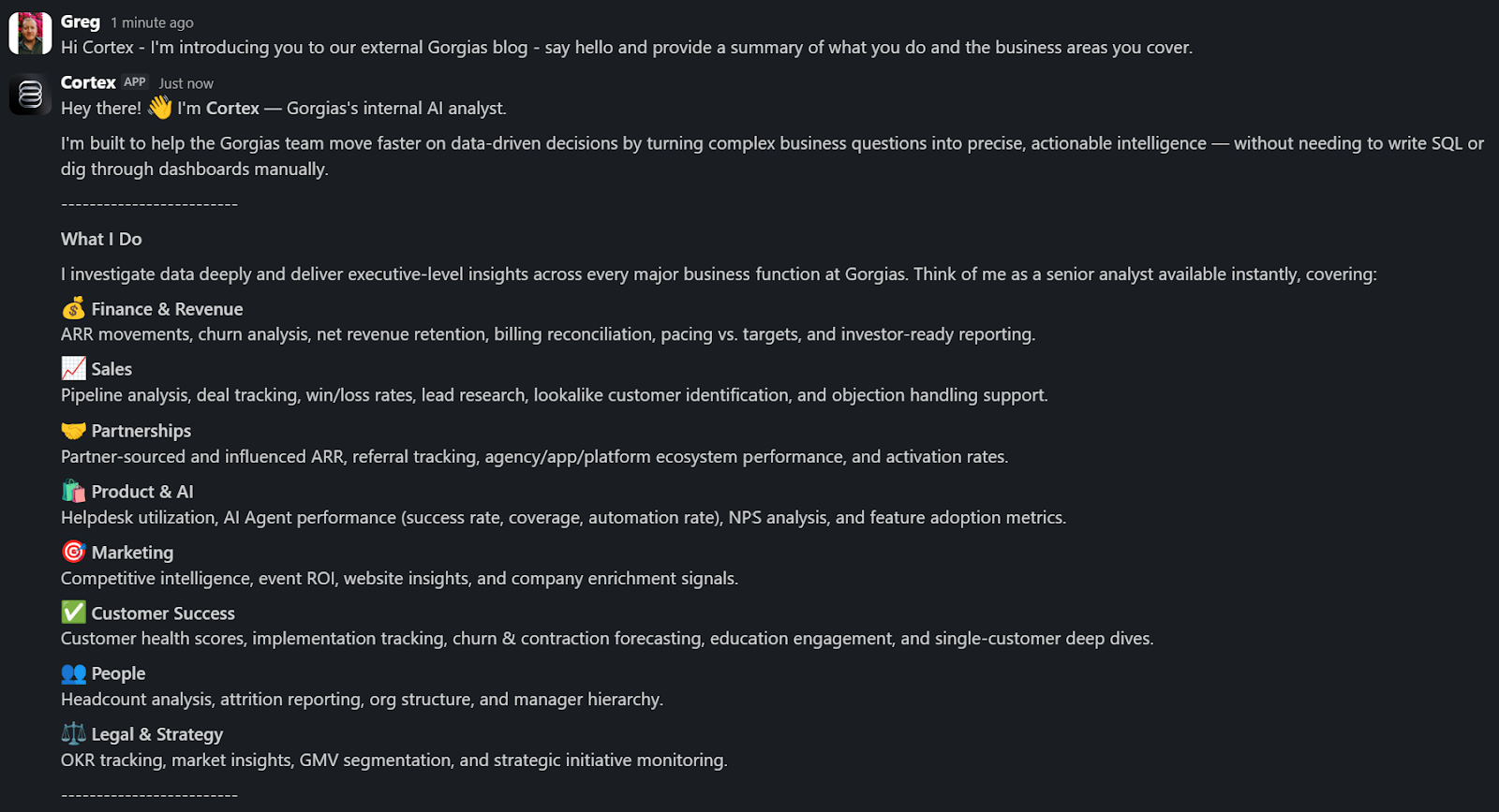
Today, anyone at Gorgias can ask a question in plain language and get an accurate, contextualized response in seconds. Not from a colleague or dashboard, nor from a generic answer from the internet. But a response built on our business context. We call it Cortex, our flagship internal AI agent.
In two months, Cortex went from an idea to fielding thousands of questions every week, recommending actions across the business, and deprecating the need for manual dashboard creation. While most companies right now are treating AI as an initiative — at Gorgias, AI is already part of how we work. 72% of Gorgias employees use Cortex each week, and that number is only growing.
We didn’t achieve this by simply plugging a large language model into our stack. LLMs are a critical part of the equation, but they aren't the driving force — it’s everything else under the hood: the infrastructure, context, platform architecture, and the team that brings it all together.
The framing problem most companies get wrong
The instinct across many companies today is to start with the model, pick a provider to solve a specific challenge, or invest heavily in getting the data right. All reasonable starting points, but most of them solve for one use case. Underneath that approach is a framing problem: seeing AI as an initiative — something you assign and measure. Seeing AI as another tool your company uses versus how your company operates.
We started somewhere different. Every company is built on four pillars: customers, people, product, and decisions. AI investments tend to place heavy emphasis on the first three. We started with the fourth. Our bet was that if we built everything around the need to make effective decisions first, asking what Gorgias needed to know to operate well, then our AI would become dramatically more powerful.
Cortex is that philosophy in practice
Cortex is our flagship internal AI agent, and the product where we established the tenets that now run through everything else we build: composable and modular infrastructure, governed context, and accessible from wherever decisions happen. Cortex lives in Slack, as well as across LLM vendors, in its own browser extension, and even on its own dedicated internal site.
Cortex doesn’t stop at answering questions. It can read and write to Notion, file Linear tasks, create HTML apps, automate signal delivery, and more. It operates across every layer of our stack, from dashboards to data pipelines, because we designed it as one integrated system. It is this connection that adds remarkable depth to what people can ask, and what they get in return.
A Sales Lead is pitching and asks Cortex for the full picture of the merchant. In a customized PDF, Cortex lists coverage gaps, pre-sale intent signals, and product fit options. Everything the sales lead needs to walk in with confidence.
A Senior Product leader asks, "How are we performing against OKR #1, and what can my team do to help accelerate it?" Cortex returns a full ARR breakdown, projected end-of-month attainment, segment-level findings, and connects it all back to company-level strategies. A suite of recommendations customized to the leader, the performance, and the signals that bridge how they can support our goals. The kind of answer that used to take someone a week to put together.
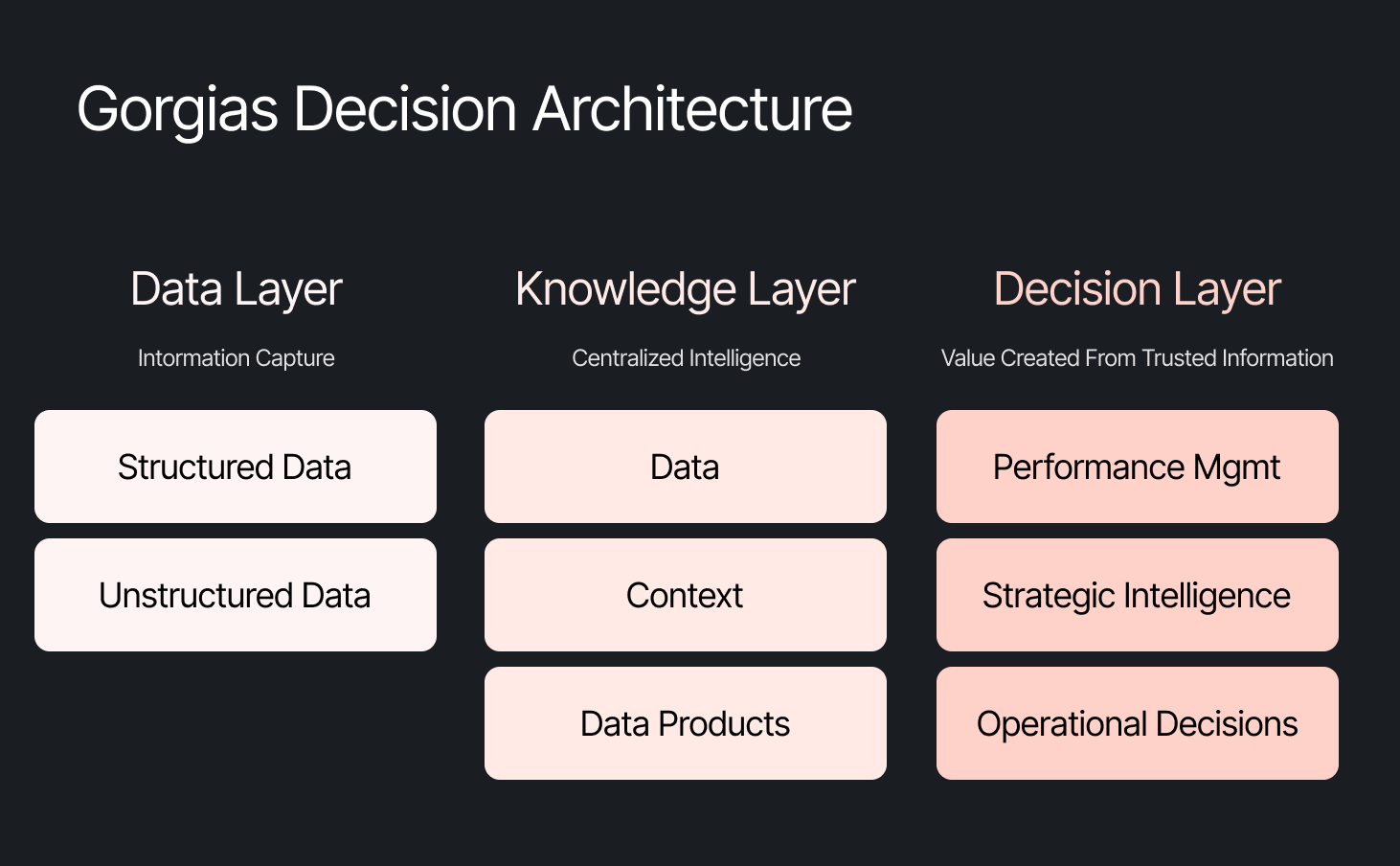
These aren't simple lookup queries. They require deep business context spanning multiple areas. Cortex handles these because its Decision Engine gives it the information to reason against governed data, metric definitions, and business context, turning a generic answer into a credible one.
Overnight, teams have built Cortex into how they work. They’re spending less time searching and more time finding answers, not because they were told to, but because Cortex reduced the distance between question and decision.
Flexibility as the foundation
Cortex’s modular infrastructure allows us to experiment and add new capabilities freely. We’ve already built two more internal AI agents made for entirely different use cases, but using the same Decision Engine as Cortex.
GAIA, our internal experimentation AI Agent, helps our customers identify opportunities in their AI Agent Guidance design. It takes institutional knowledge across our teams and turns it into a scalable system that drives automation and value to our customers. Our CEO, Romain Lapeyre, has been its most vocal advocate since day one.
When we needed a platform for investor readiness and board preparation, we built Oracle. Our board decks and talk tracks are informed and built with the same AI, and our numbers are validated every step of the way.
We’re continuing to expand new AI agents internally, exploring how they can create value for customers and our own teams.
AI has transformed how data teams create value, and we’ve already shifted to account for it
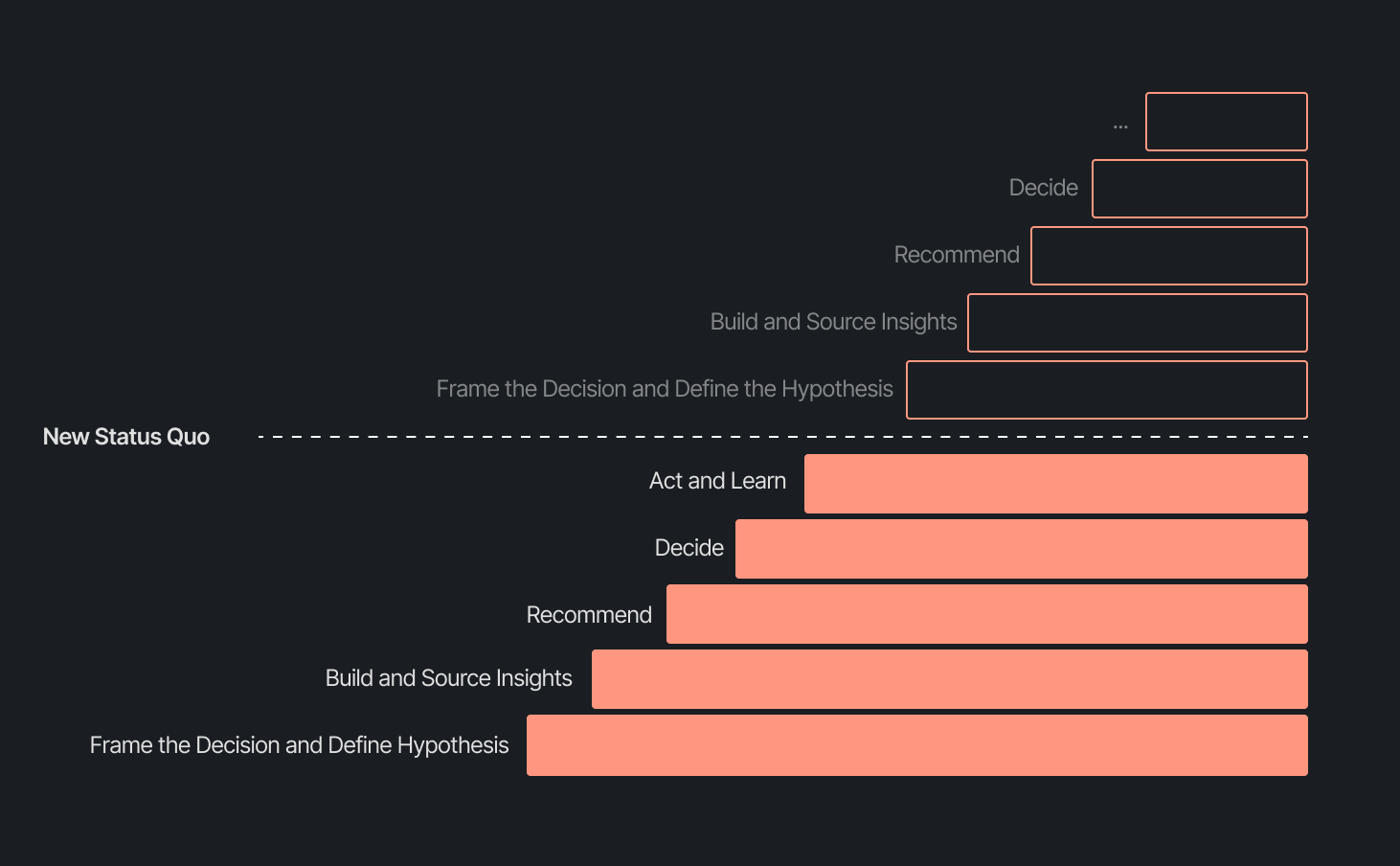
When AI handles thousands of analytical questions each week, the highest-value work for a data team shifts permanently. Late 2025, we repositioned from a Data Analytics function into a Decision Intelligence function — a structural change in what we own and how we operate.
Today, our analysts focus on the most sensitive, complex, and forward-looking decisions and analyses. They partner more deeply with stakeholders by driving next steps from signals. They're even building entirely new capabilities that didn't exist in their role descriptions months ago. Things like AI skills for Cortex, context curation, and insight and recommendation delivery. The role of the analyst hasn't diminished. It's expanded to encompass the most meaningful work an analyst can do: driving outcomes and ensuring those decisions can achieve them.
The Decision Intelligence operating model focuses the team on outcomes.
Our business support model has changed, too. Instead of embedding analysts and dedicated engineers within functional teams, we align capacity to the highest-impact company objectives and move fluidly across them. This model works even better because Decision Intelligence brings together both analytics and engineering teams under one roof.
Elliot Trabac leads our Data, Context and AI Engineering teams. The Decision Engine, Cortex, GAIA, and the platforms I've described exist because of the infrastructure his team innovated and built from the ground up. Noemie Happi Nono leads our Decision Strategy and Operations team, driving decision outcomes with stakeholders, advancing the development of Cortex skills and capabilities, and pushing into new areas of analysis every day.
Together, they're shaping what a modern data function looks like when AI becomes a standard building block for how a company operates.
What’s next for the Decision Intelligence team
The question of ROI is long gone. AI has opened the floodgates to more trusted and meaningful signals than ever. The natural next evolution is Proactive Intelligence, signals surfaced toward what you need to know, before you ask. And we're already building this because our architecture is designed to support it.
In the coming weeks, members of the Decision Intelligence team will go deeper into themes I've touched on here. Yochan Khoi, a Senior Analytics Engineer on our team, recently published a technical walkthrough of our context layer and will go further into building context strategies that scale. Others will cover infrastructure, analytical partnerships, evolving data assets into decision assets, and the cost and efficiency gains that make sustained AI investment viable.
AI hasn't changed the most important element of data and analytics functions — delivering outcomes — but it has raised the bar for what it looks like and how far we can take it. We’re just getting started.
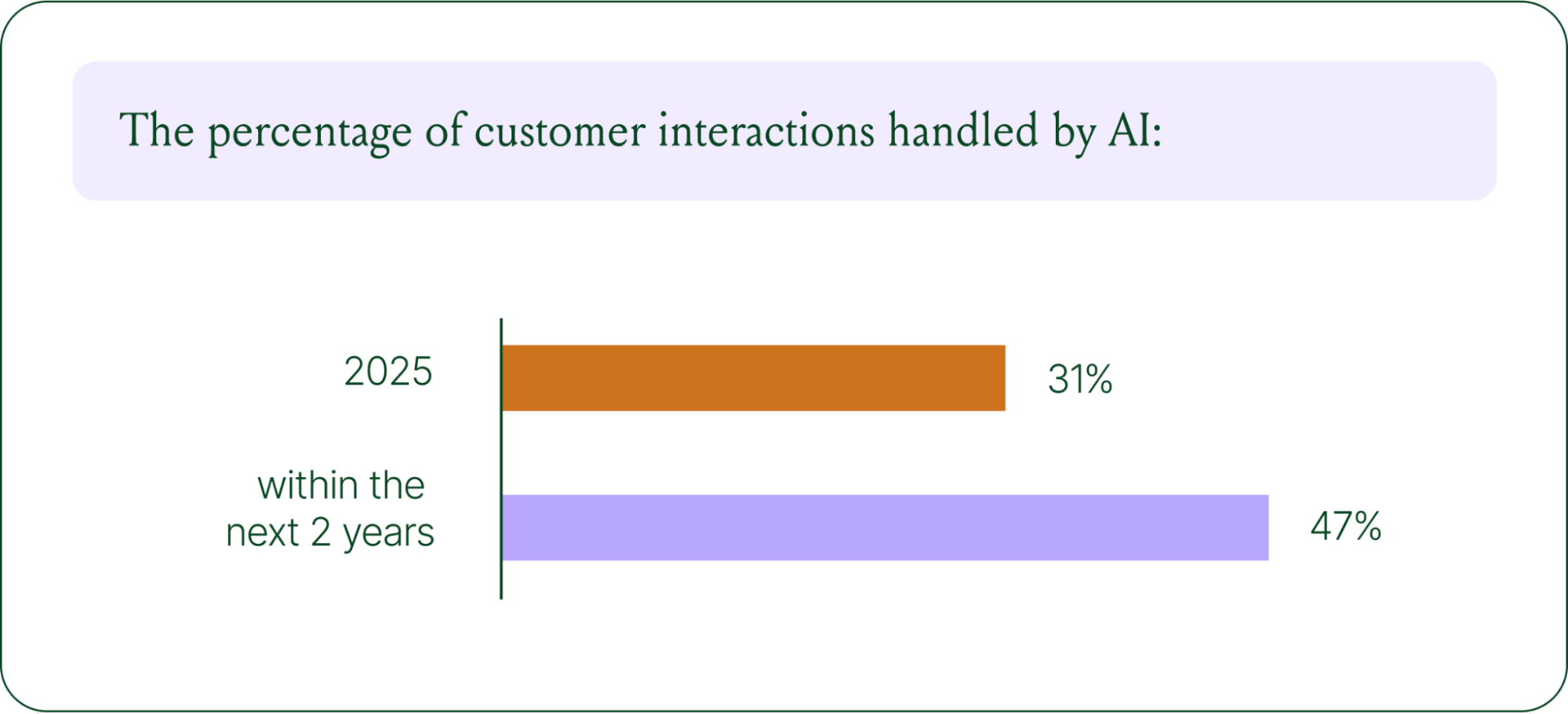
AI is resolving tickets, not just replying. AI now handles 31% of customer interactions for ecommerce brands, and that number is expected to nearly double within two years.
Every channel is becoming a storefront. Conversations are replacing the traditional browse-and-buy journey, with 79% of brands reporting sales from AI-driven interactions.
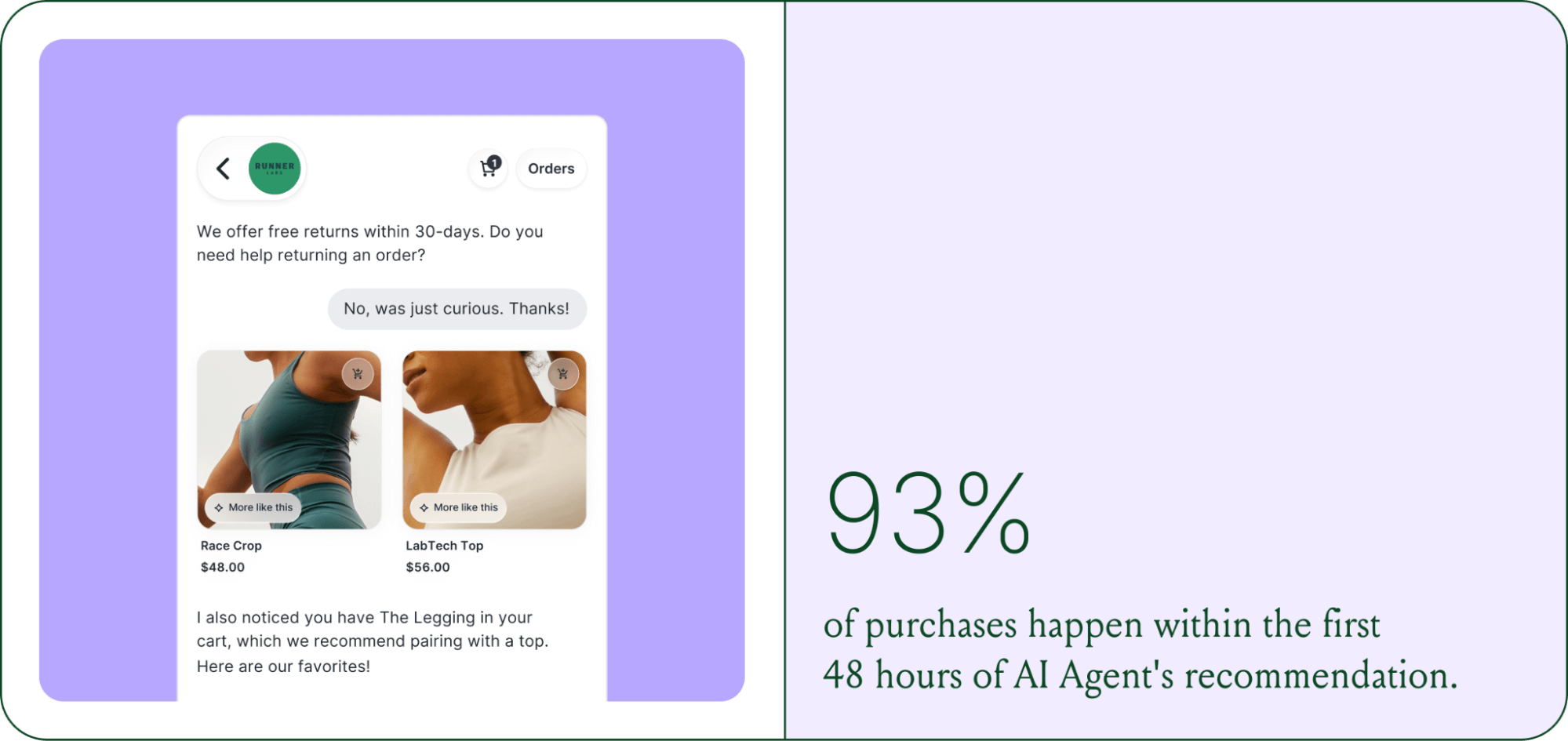
AI is shortening the buying cycle. 93% of AI-influenced purchases happen within the first 48 hours of the conversation.
CX teams are changing, not shrinking. Ecommerce brands are actively hiring for more technical roles to implement, coach, and maintain AI.
The winning model is hybrid. AI handles volume and speed, while humans handle complexity and judgment.
The way shoppers buy online has shifted and customers are at the center.
They no longer want to scroll through product pages, dig through FAQs, or wait 24 hours for an email reply. They open a conversation, ask a specific question, and expect a useful answer in seconds. Brands that can’t deliver these experiences at scale are seeing customer hesitation turn into abandoned carts and lost revenue.
This shift has a name: conversational commerce. It's the practice of using real-time, two-way conversations as your primary sales channel, through chat, AI agents, messaging apps, and voice.
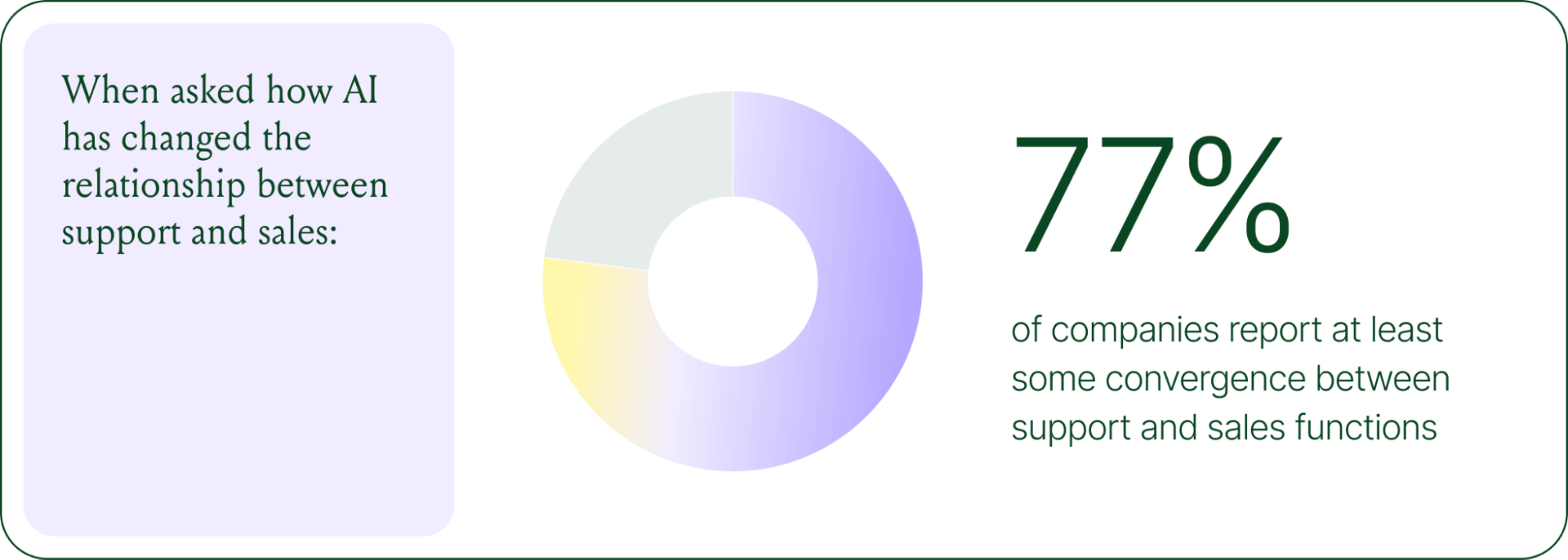
What started as an experiment for early adopters has become a key growth lever, with 84% of ecommerce brands treating conversational commerce as a strategic pillar this year vs. last year.
We surveyed 400 ecommerce decision-makers across North America, the U.K., and Europe to understand how conversational commerce and AI are reshaping the ecommerce landscape. These findings are complemented by aggregated and anonymized internal Gorgias platform data from 16,000+ ecommerce brands.
Trend 1: AI is table stakes for ecommerce and it’s no longer just about efficiency
A few years ago, adding an AI chatbot to your site that could provide tracking links and Help Center article recommendations was a differentiator. Today, it's table stakes. McKinsey found that 71% of shoppers expect personalized experiences, and 76% get frustrated when they don't get them.
Right now, most ecommerce professionals use AI, with 93% having used it for at least 1 year. Enthusiasm is accelerating quickly, with only 30% of ecommerce professionals rating their excitement for AI at 10/10 in April 2025. Similarly, while AI adoption rose steadily year over year, it reached a clear peak in 2026.
The use cases driving this adoption are practical and high-volume:
Order tracking and status updates
Returns, exchanges, and refund requests
Shipping FAQs and delivery estimates
These are the tickets that flood brands’ inboxes every day. AI agents resolve them instantly, without pulling teams away from conversations that actually require human judgment.
Trend 2: Conversations are the new path to checkout
The traditional ecommerce funnel, visit site, browse products, add to cart, check out, is losing ground. Shoppers now discover products on Instagram, ask questions via direct message, and complete purchases without ever visiting a website.
Conversational AI is actively increasing revenue, with 79% of brands reporting that AI-driven interactions have increased sales and conversion in their business.
The practical implication is that every channel is becoming a storefront. Creating personalized touchpoints with customers earlier in the journey, through proactive engagement, is impacting the bottom line.
Pre-purchase hesitation is one of the biggest conversion killers in ecommerce. A shopper lands on your product page, has a question about sizing or compatibility, can't find the answer quickly, and leaves. That's a lost sale that had nothing to do with your product.
Conversational AI changes that dynamic. When a shopper can ask a question and get an accurate, personalized answer in real time, the friction disappears.
Brands using Gorgias saw this play out at scale in 2025. When AI Agent recommended a product, 80% of the resulting purchases happened the same day, and 13% happened the next day.
Brands are further accelerating the buying cycle through proactive engagement. On-site features such as suggested product questions, recommendations triggered by search results, and “Ask Anything” input bars drove 50% of conversation-driven purchases during BFCM 2025.
There's a persistent narrative that AI is making CX teams redundant. The data tells a different story. 62% of ecommerce brands are planning to grow their teams, not cut them. But the scope of those teams is changing.
New roles are emerging around AI configuration and quality assurance. Teams are investing in technical members to write AI Guidance instructions, develop tone-of-voice instructions, and continuously QA results.
CX teams are also bridging the gap between support goals and revenue goals, as the two functions increasingly overlap.
The result is CX teams that are more technical than they were before. Agents who once spent their days answering repetitive tickets are now spending that time on higher-value work: complex escalations, VIP customer relationships, and improving the AI systems and knowledge bases that handle the volume.
Trend 5: The future is hybrid: AI-first, humans when it counts
Despite increasing AI adoption, data shows that ecommerce brands shouldn’t strive for 100% automation. Winning brands are building systems in which AI handles repetitive tier-1 tickets, and humans handle complex, sensitive cases.
AI handles speed and scale. It resolves order-tracking requests at 2 a.m., processes return-eligibility checks in seconds, and answers the same shipping question for the thousandth time without compromising quality.
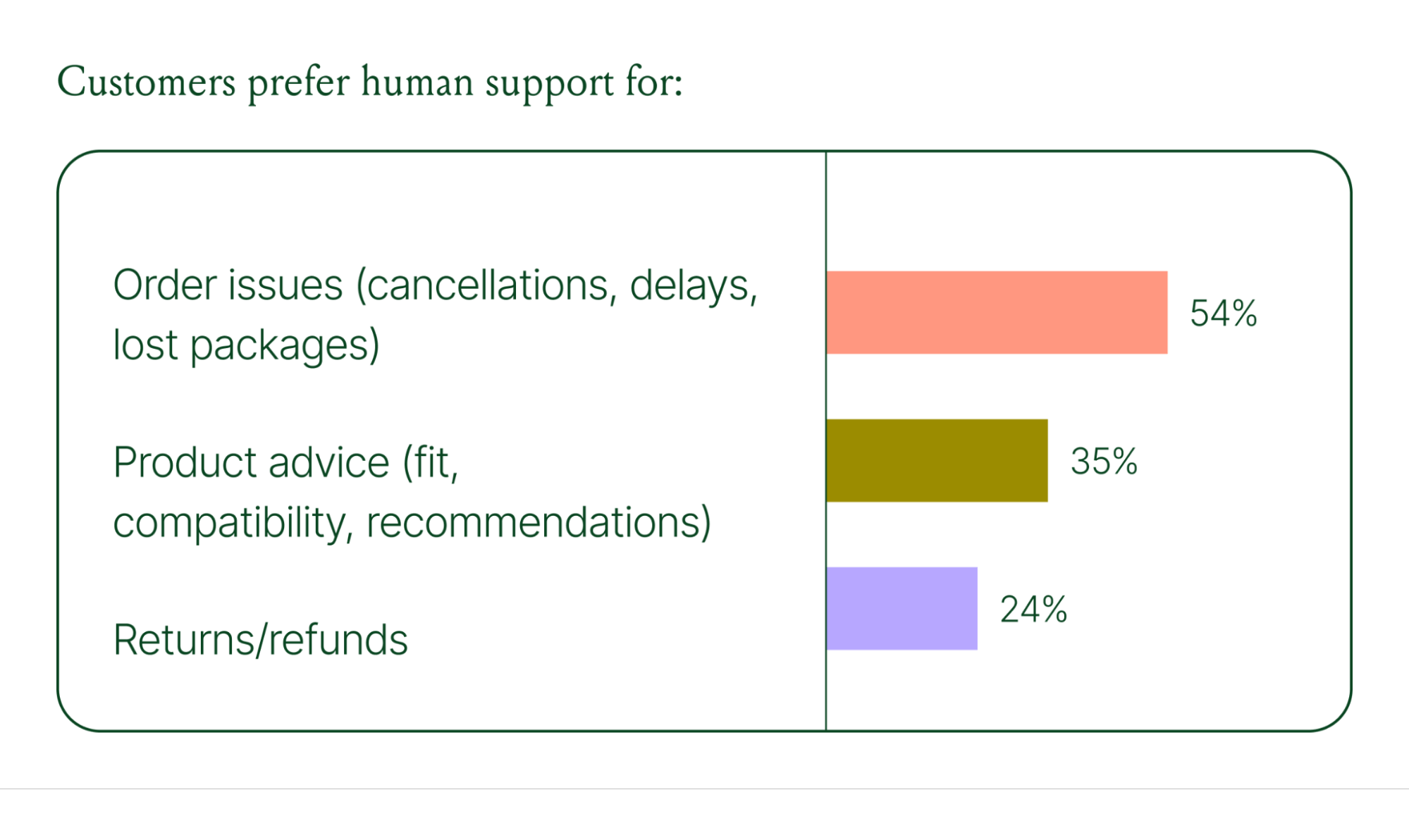
Human agents handle conversations that require context, empathy, or decisions that fall outside the standard playbook. There are several topics where shoppers still prefer human support.
Successful hybrid systems require continuous iteration, meaning reviewing handover topics, Guidance, and reviewing AI tickets on a weekly basis.
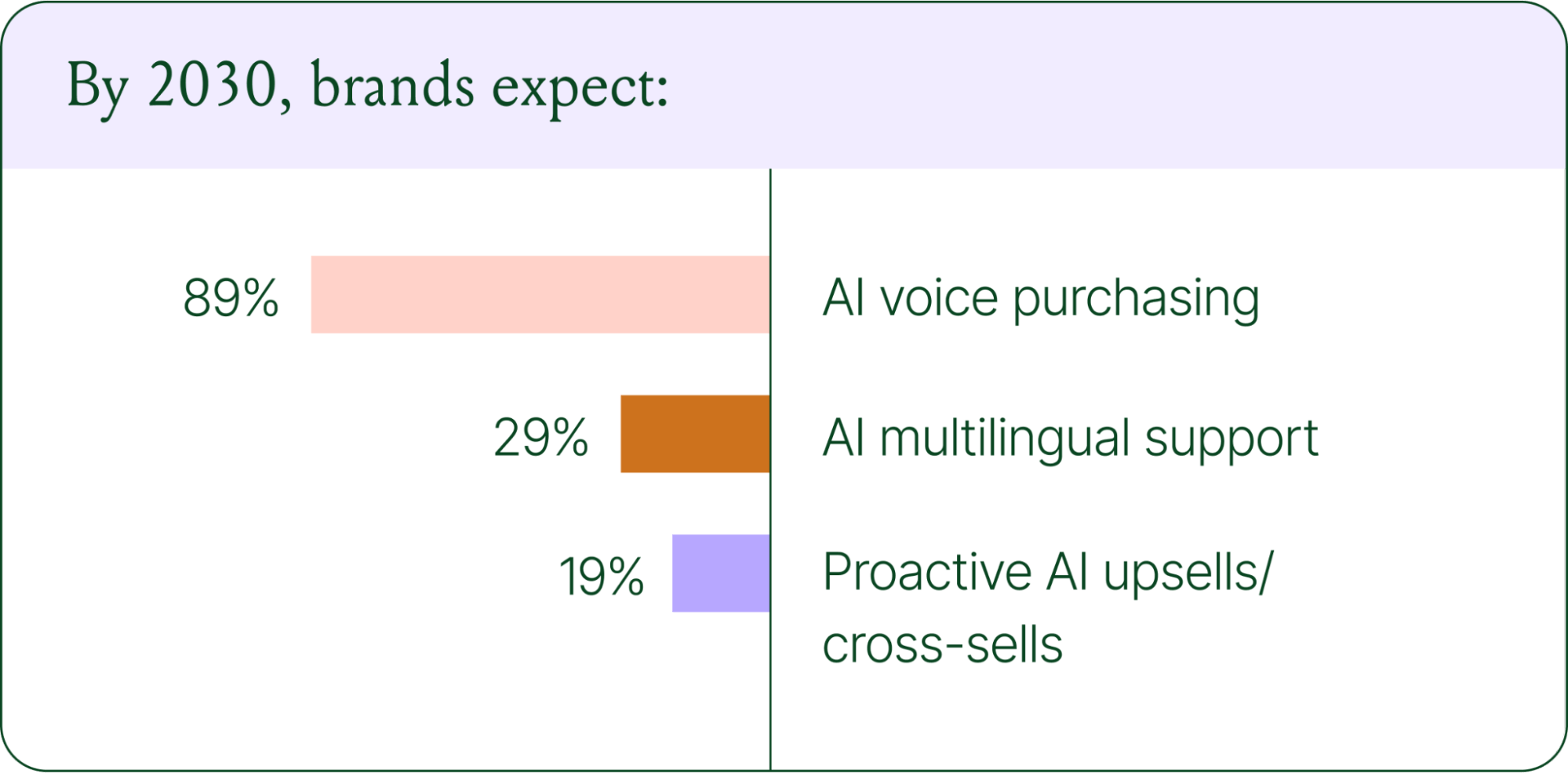
The 2026 trends are about expansion and standardization. The 2030 predictions are about what comes next.
Voice-based purchasing is the biggest bet on the horizon. Only 7% of brands currently use voice assistants for commerce, but 89% expect it to be standard by 2030. The vision is a customer who can reorder a product, check their subscription status, or manage a return entirely over the phone.
Proactive AI is the other major shift. Rather than waiting for a customer to reach out, AI will anticipate needs based on browsing behavior, purchase history, and where someone is in their relationship with your brand. Think of it as the digital equivalent of a sales associate who remembers what you bought last time and knows what you're likely to need next.
Start building your conversational commerce strategy today
The brands winning in 2026 are creating smart, scalable systems where AIhandles volume and humans handle nuance. They’re treating every conversational channel as an opportunity to serve and sell.
The data is clear: AI adoption is accelerating, customer expectations are rising, and the revenue impact of getting this right is measurable.
{{lead-magnet-1}}
Newsletter Signup
The best in CX and ecommerce, right to your inbox
Registered! Get excited, some awesome content is on the way! 📨
Oops! Something went wrong while submitting the form.
Brands using AI-driven conversational commerce are seeing measurable gains in purchase rates, retention, and AOV. The data from 16,000+ ecommerce brands shows why conversation has become the new path to checkout.
By Gabrielle Policella
0 min read . By Gabrielle Policella
TL;DR:
Customer journeys are collapsing to a single conversation. The traditional browse-and-buy journey is giving way to AI-guided shopping that moves from discovery to purchase in a single exchange.
79% of brands say AI-driven conversational commerce has increased their sales and purchase rates.
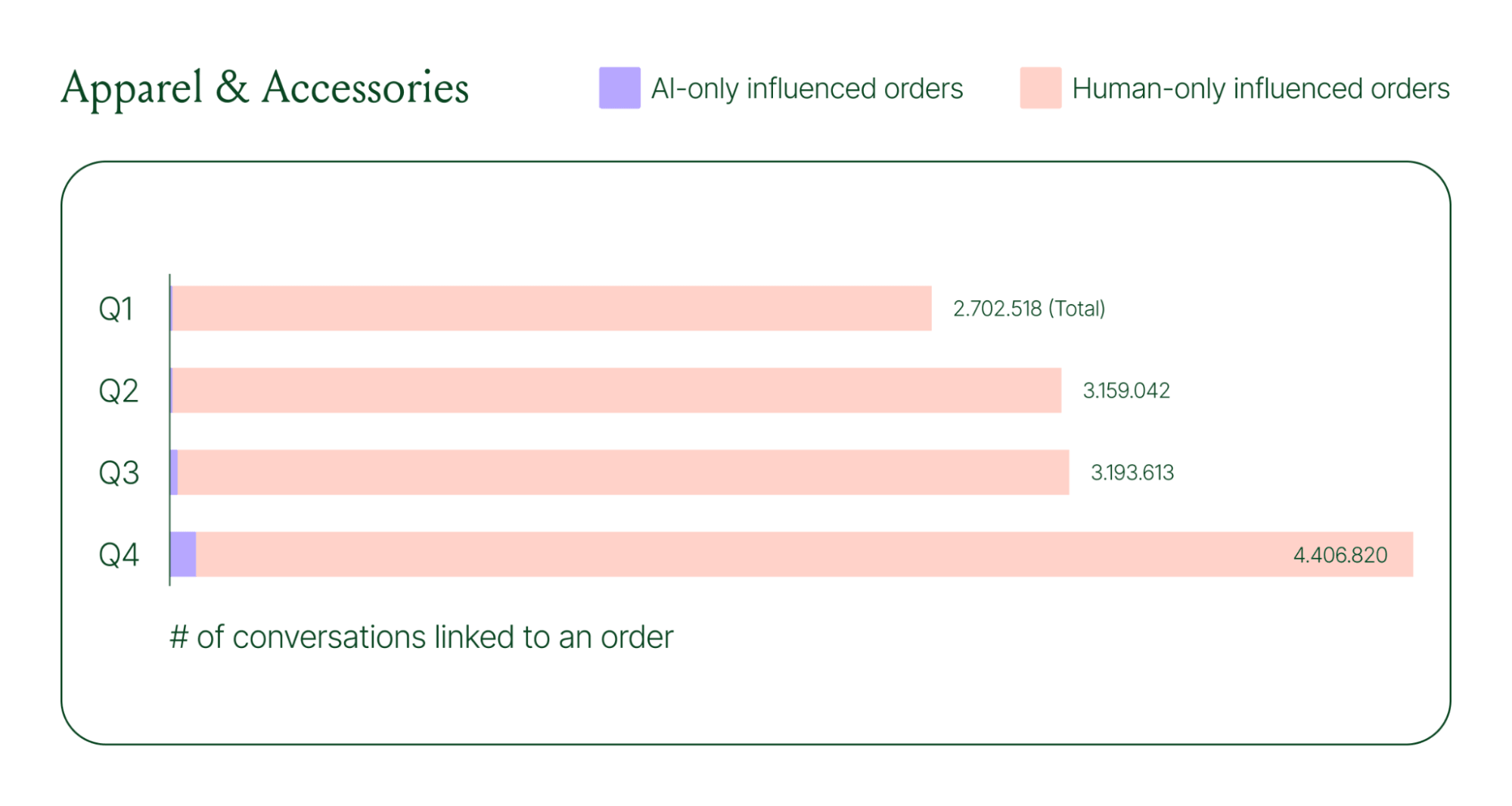
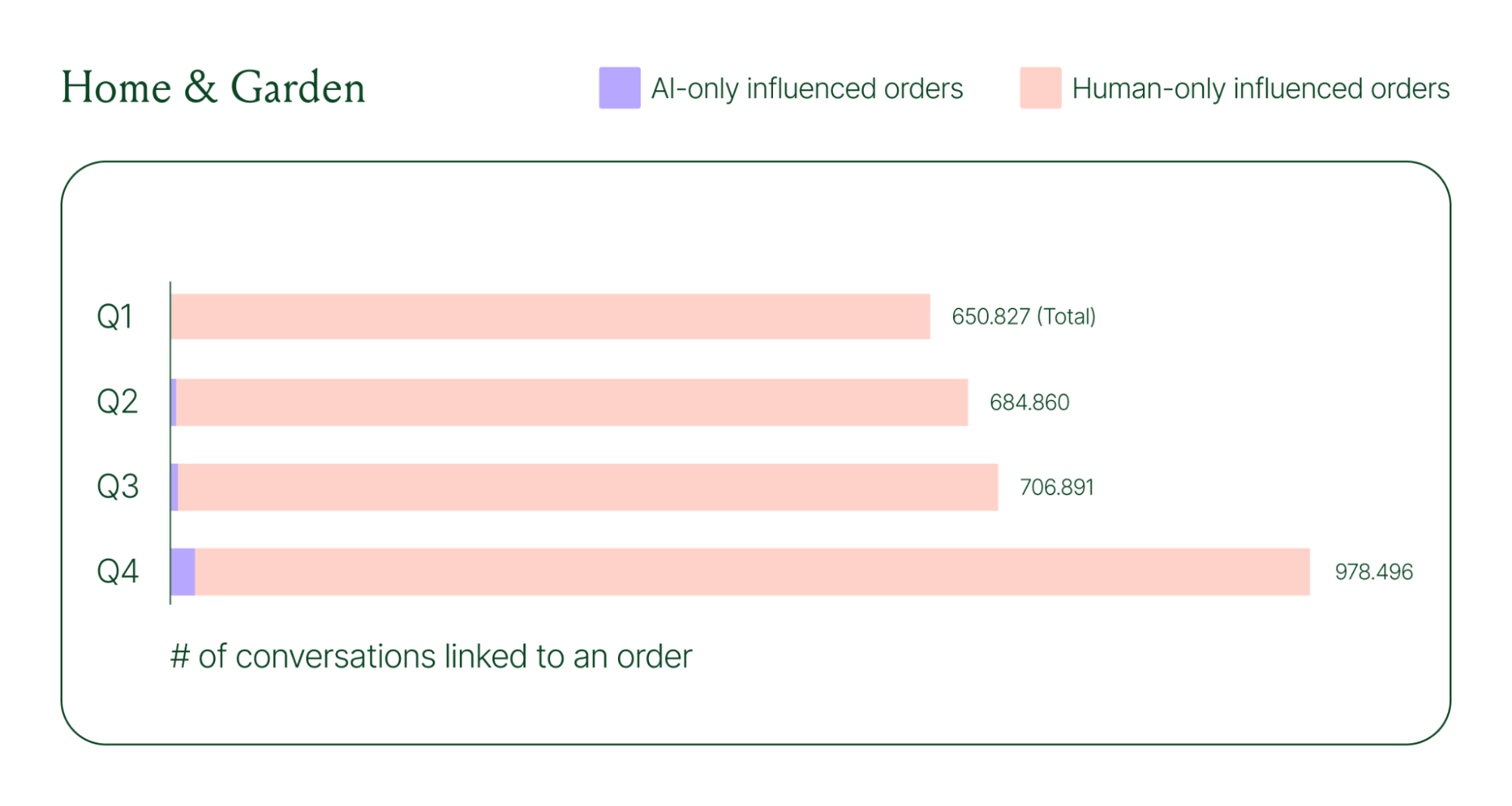
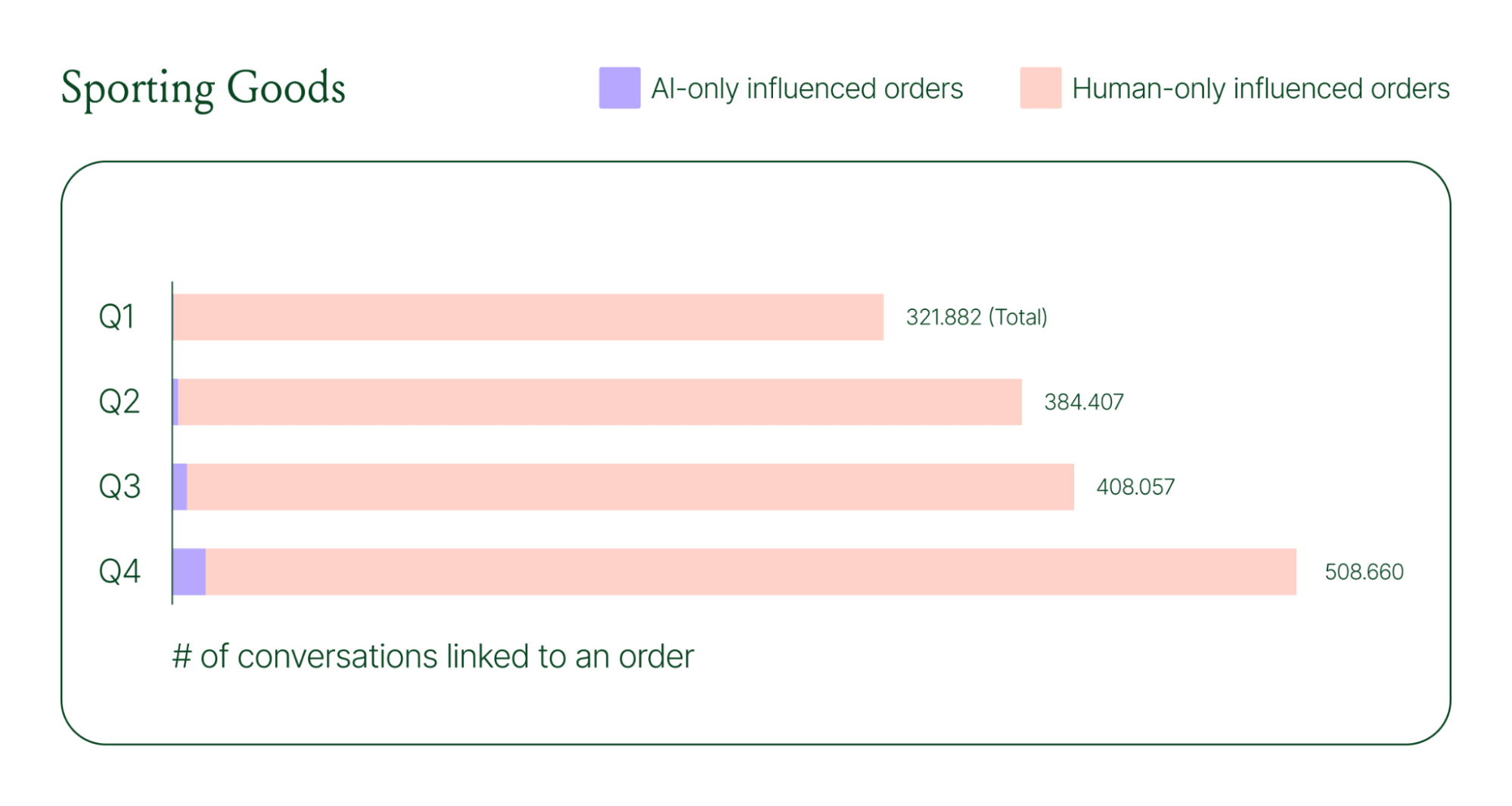
AI-only influenced orders grew 63% in a single year, from 2.7 million in Q1 to 4.4 million in Q4.
Brands treating conversation as a revenue channel. They’re not just a support function, generating higher AOV, shorter buying cycles, and stronger retention.
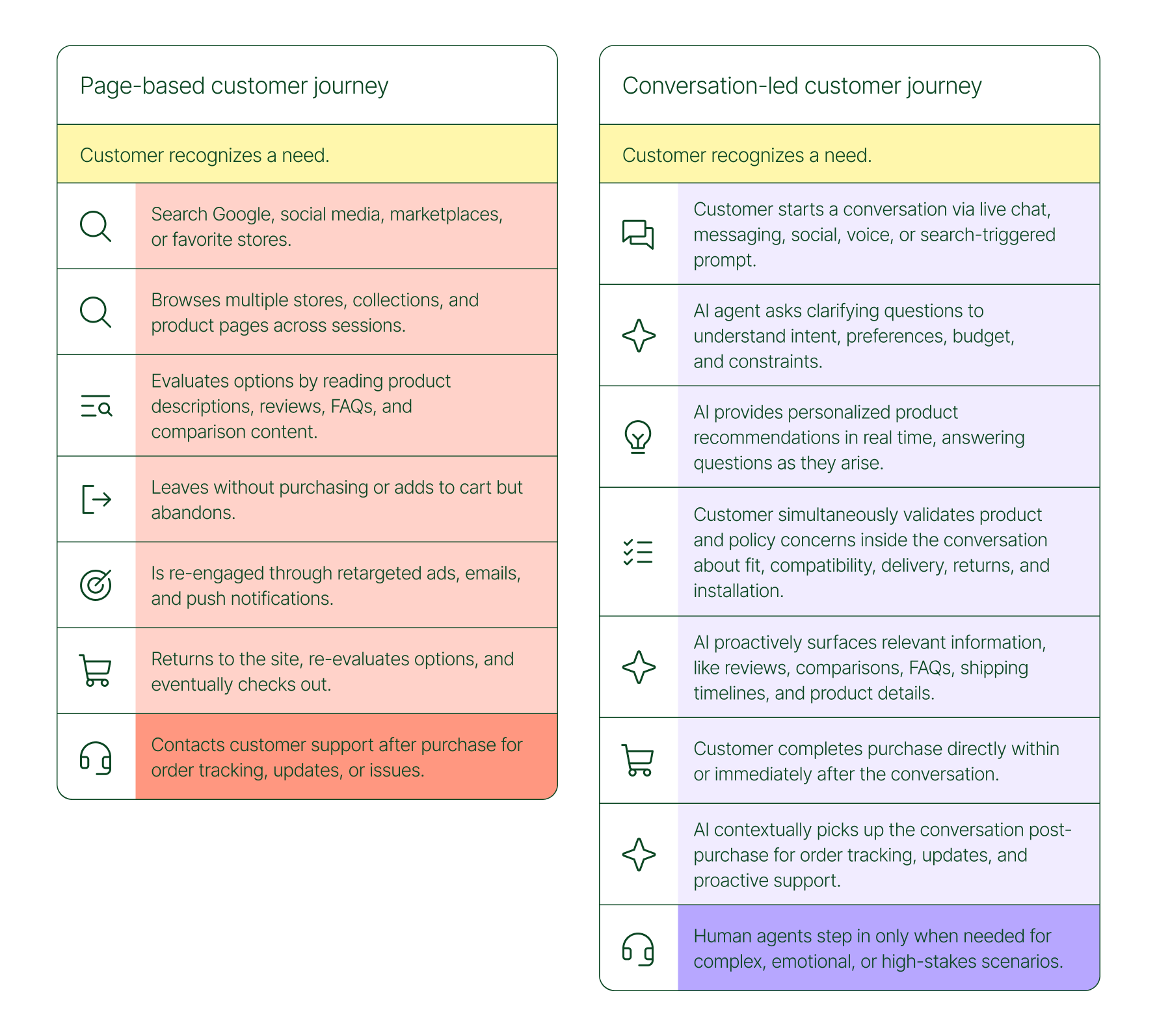
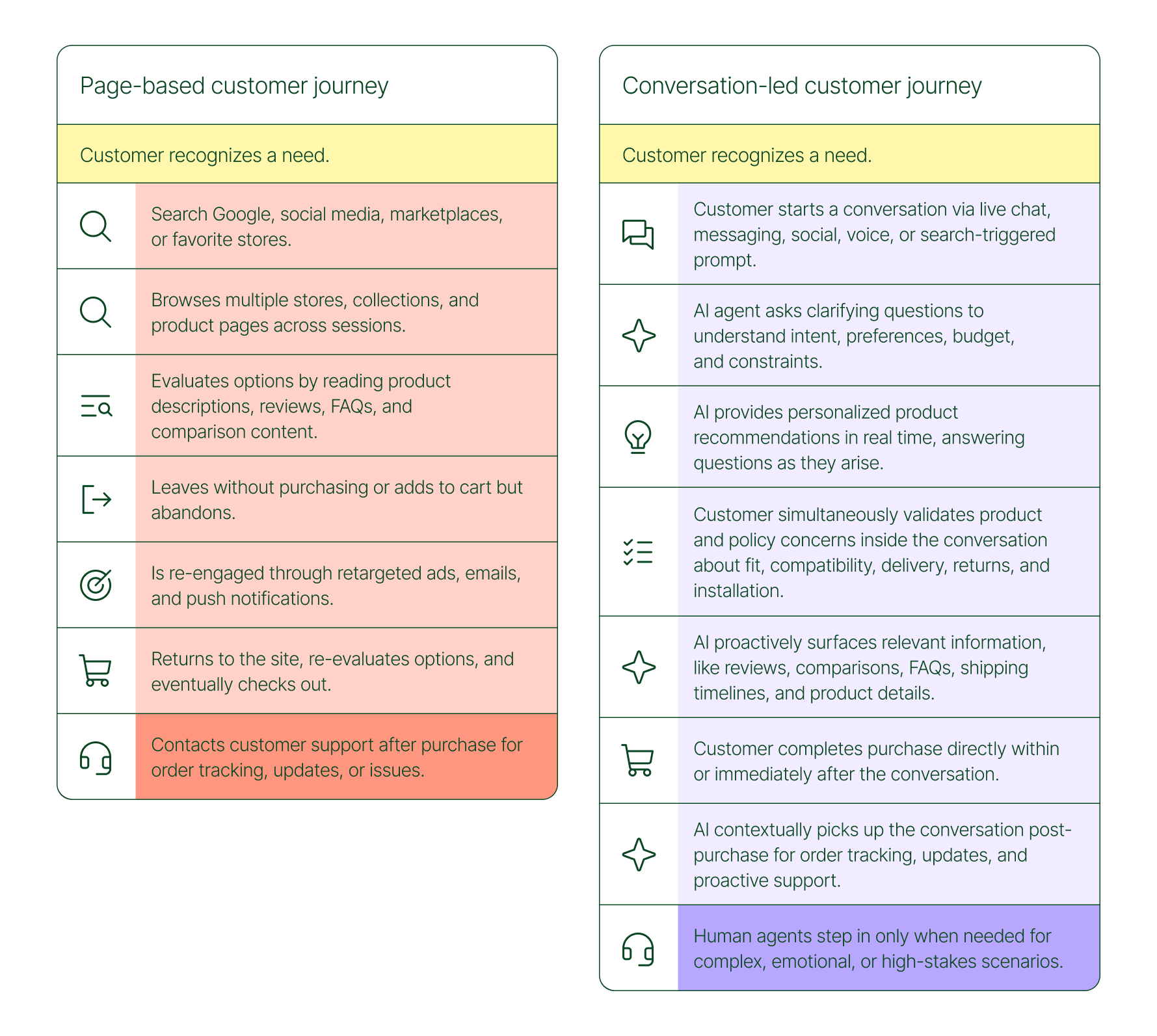
The page-based shopping experience dominated for decades. Customers would search, browse, compare, abandon, get retargeted, return, and eventually buy (sometimes).
That journey is no longer the only option.
Shoppers are turning to chat, messaging, and AI-powered tools to find what they need. Instead of clicking through product pages or reading static FAQs, they ask questions, have back-and-forth conversations, and get answers that move them closer to a purchase in real time. The path to checkout has changed, and the brands that recognize this are pulling ahead.
Read our 2026 State of Conversational Commerce Report to learn more about conversation commerce trends from 400 ecommerce decision-makers and 16,000+ ecommerce brands using Gorgias.
{{lead-magnet-1}}
The shopping journey has collapsed into a single thread
The traditional shopping journey was a solo experience. A shopper had a need, searched for options, browsed across sessions, and eventually made a decision — often days later, after being retargeted multiple times. Support only entered the picture after the purchase.
The conversation-led journey collapses that timeline:
A shopper recognizes a need and starts a conversation via chat, messaging, or a search-triggered prompt
An AI agent asks clarifying questions about preferences, budget, and constraints
The AI provides personalized product recommendations in real time
The shopper validates concerns about fit, compatibility, delivery, and returns, all inside the conversation
The shopper completes the purchase directly within or immediately after that exchange
The AI picks up the conversation post-purchase for order tracking and proactive support
A human agent steps in only when the situation calls for it
What used to take days now takes minutes. Discovery, evaluation, and purchase happen in a single thread.
Conversation is a revenue strategy, not a support upgrade
79% of brands agree that AI-driven conversational commerce has increased sales and purchase rates in their business. When brands were asked to rank the highest-return areas:
38% cited improved customer support efficiency
23% pointed to higher customer retention and loyalty
20% saw improved purchase rates
Those numbers reflect something important: the value of conversation compounds. Faster support reduces friction. Better retention raises lifetime value. More confident shoppers buy more often and spend more per order.
The brands seeing the biggest returns aren't just using AI to deflect tickets. They're using it to create one-to-one shopping experiences at scale.
What the data shows about AI-influenced orders
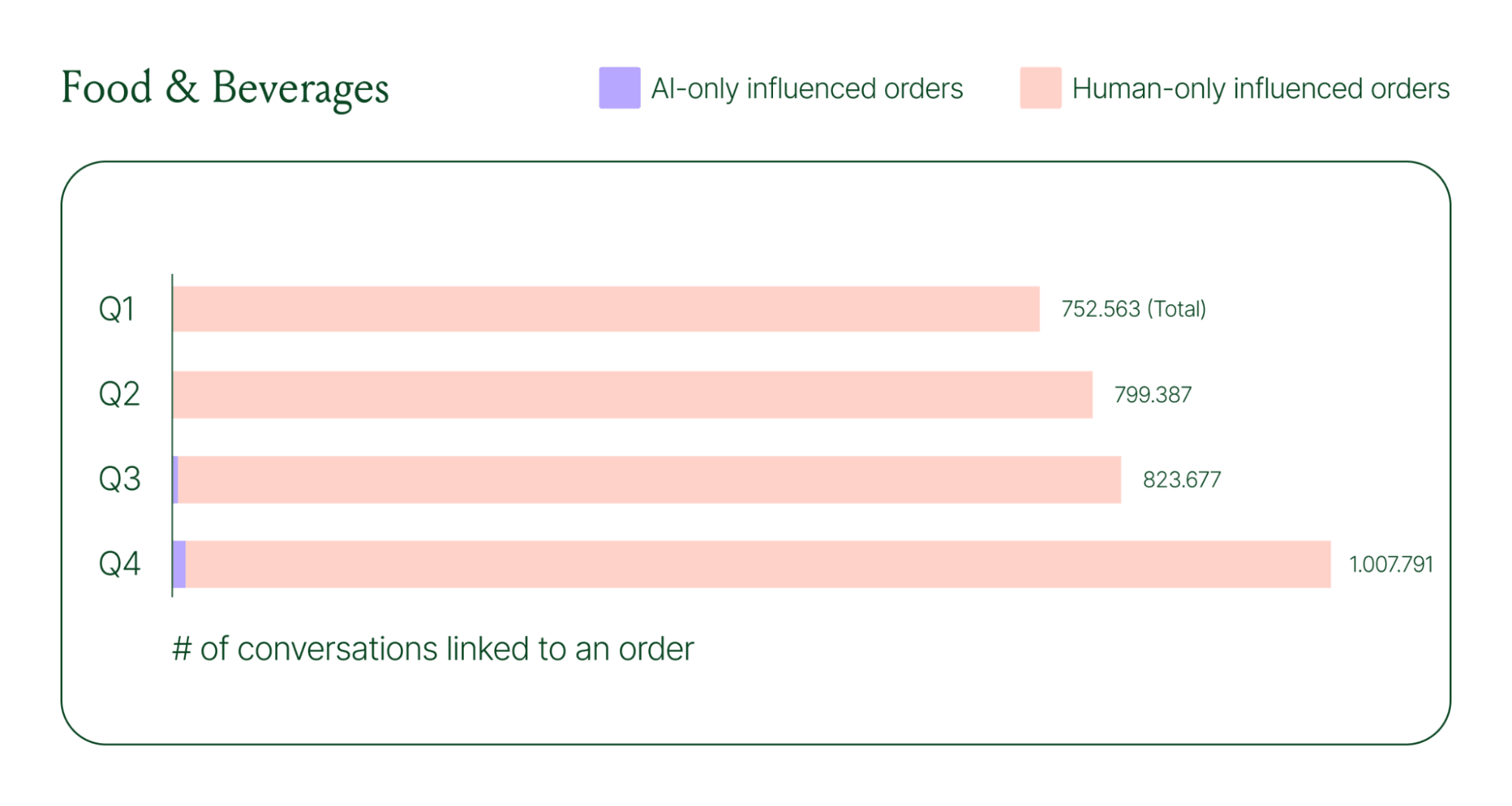
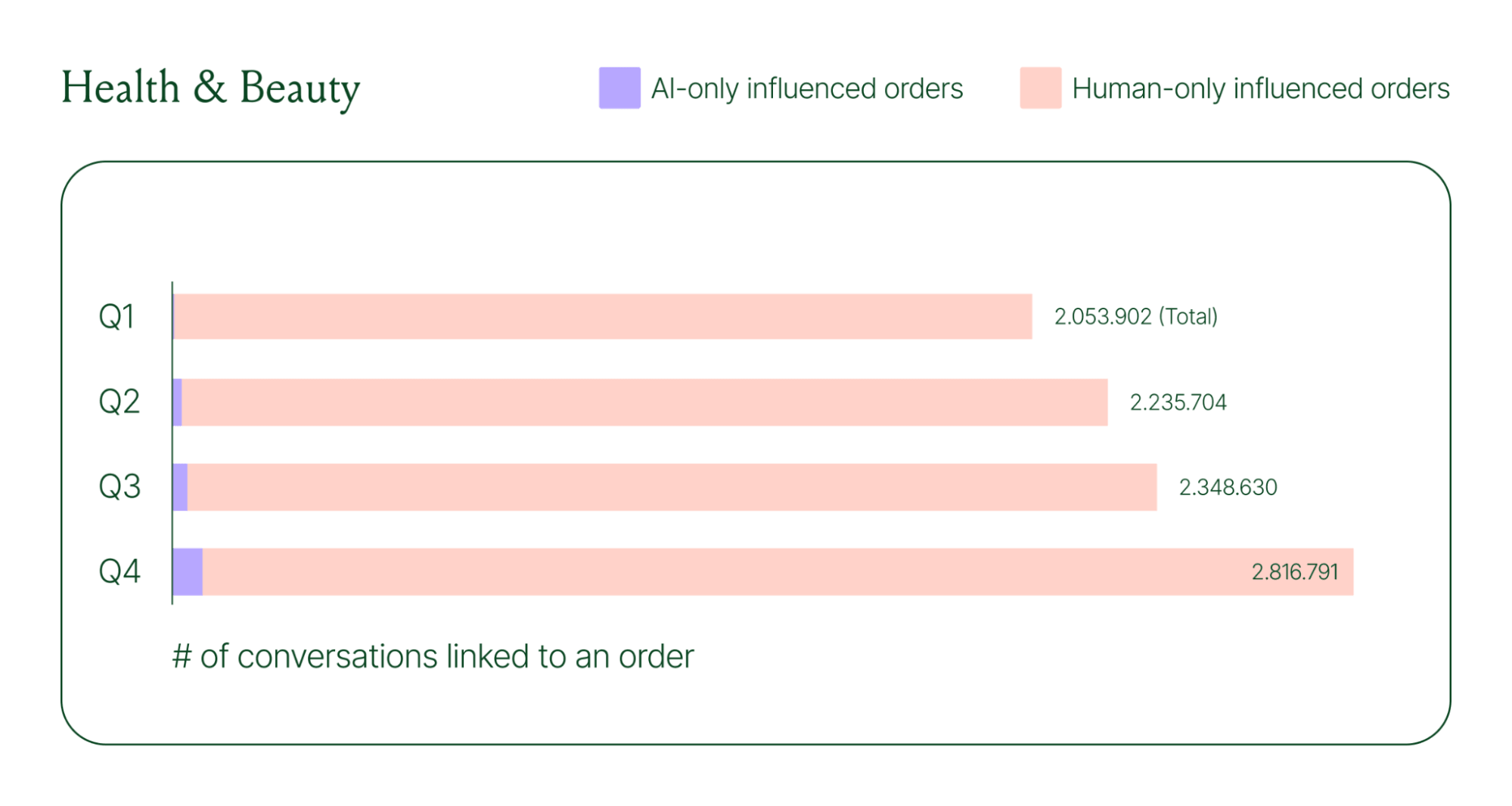
Looking at AI-only influenced orders across key verticals like Apparel and Accessories, Food and Beverages, Health and Beauty, Home and Garden, and Sporting Goods, the growth across a single year was significant.
Across industries, ecommerce brands saw AI step into conversations, reduce shopper hesitation, and drive higher QoQ conversion rates.
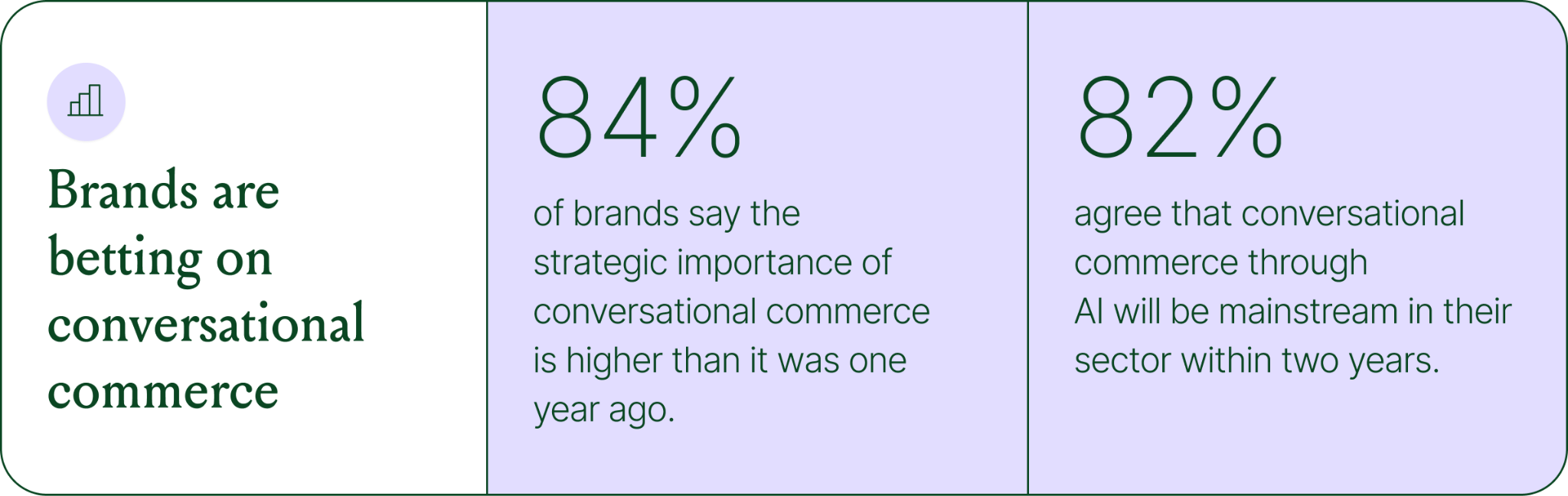
84% of brands say the strategic importance of conversational commerce is higher than it was a year ago. 82% agree it will be mainstream in their sector within two years.
That shift is registering at the leadership level because of what conversational commerce does to the buying experience. Creating one-to-one touchpoints earlier in the journey drives higher AOV, shorter buying cycles, and stronger purchase rates. Shoppers who get real-time answers to their questions are more confident.
What this looks like in practice: TUSHY
TUSHY, known for eco-friendly bidets and bathroom essentials, is a useful example of what happens when you take conversational commerce seriously.
Bidets aren't an impulse purchase. Shoppers have real questions about fit, compatibility, and installation. Those questions used to go unanswered until the CX team could respond, often after the customer had abandoned the cart.
TUSHY used Gorgias's AI Agent and shopping assistant capabilities to automate pre-sales support. AI Agent engaged shoppers in real-time conversations, addressed their concerns directly, and built confidence at the moment of highest intent.
This resulted in a 190% increase in chat-based purchases, a 13x return on investment, and twice the purchase rate of human agents.
How to apply this to your strategy
You don't need to overhaul your entire operation to start seeing results. The most effective approach is to start where the impact is clearest and expand from there.
A few places to begin:
Pre-sales chat. Identify your most common pre-purchase questions (sizing, compatibility, shipping timelines) and ensure your AI can answer them confidently and promptly.
Product page engagement. Use proactive chat prompts triggered by page behavior to start conversations before shoppers leave.
Post-purchase follow-up. Let AI pick up the conversation after checkout with order updates and proactive support, reducing inbound volume and building trust.
Human escalation. Define clearly which situations require a human agent – complex issues, emotional exchanges, high-stakes decisions.
Want to see the full picture of where conversational commerce is headed in 2026? Read the full report to explore the data, trends, and strategies shaping the next era of ecommerce.
AI adoption in ecommerce has reached 96% in 2026, with use cases spanning support automation, personalization at scale, product discovery, and end-to-end operations.
By Gabrielle Policella
0 min read . By Gabrielle Policella
TL;DR:
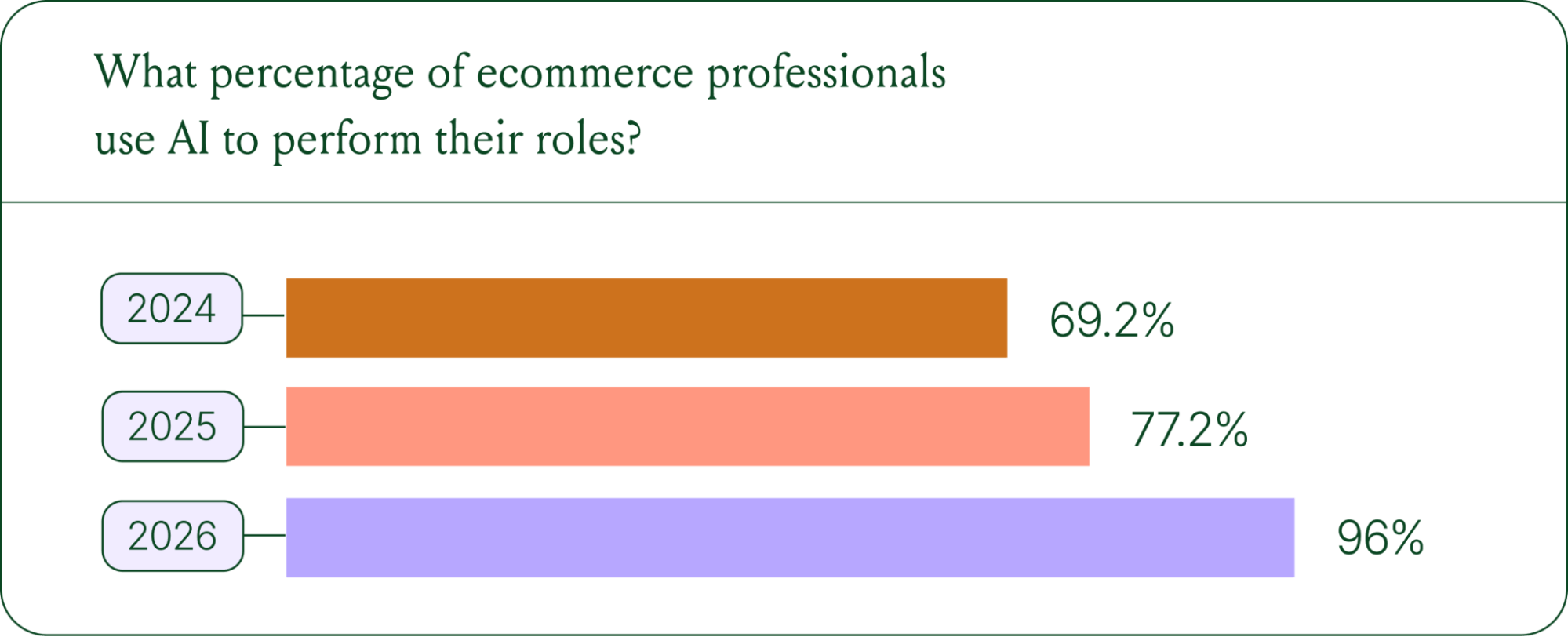
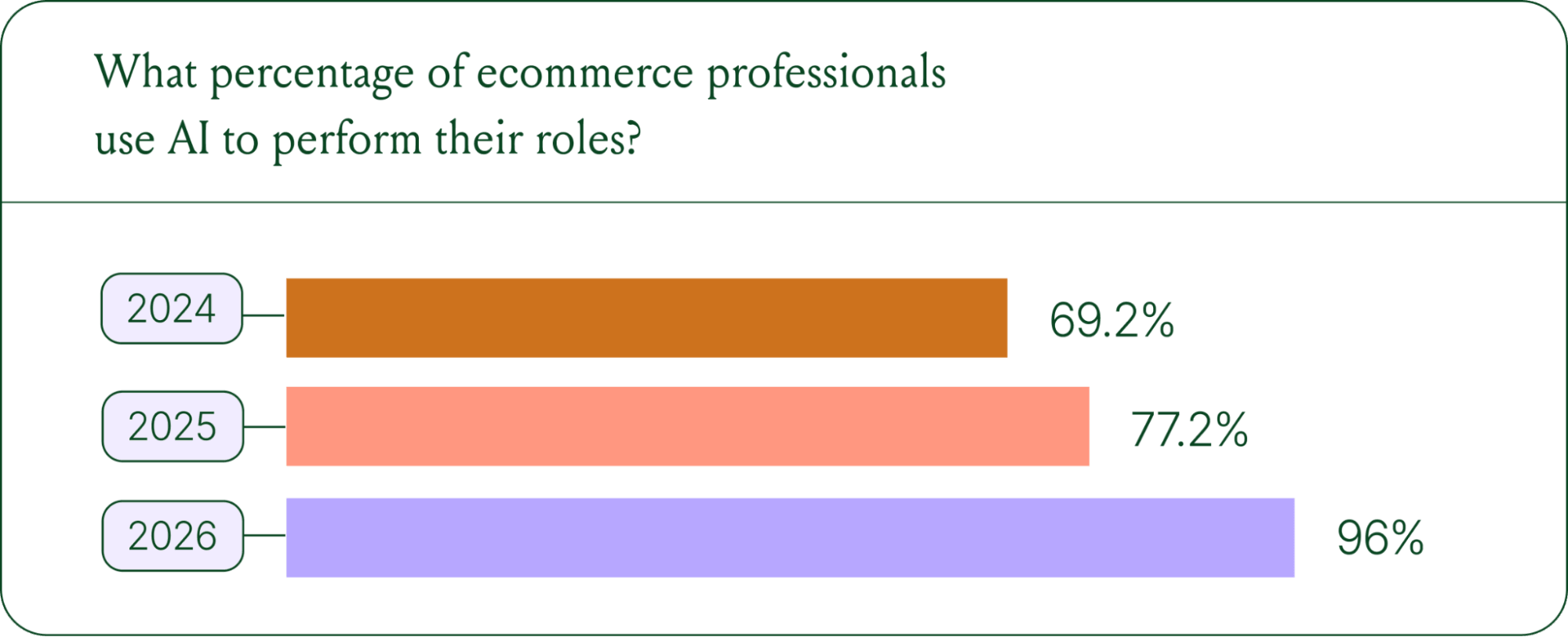
AI adoption is rapidly accelerating. 96% of ecommerce professionals now use AI in their roles, up from 69% in 2024.
AI has moved beyond support automation. Use cases have evolved into revenue generation, personalization, and logistics.
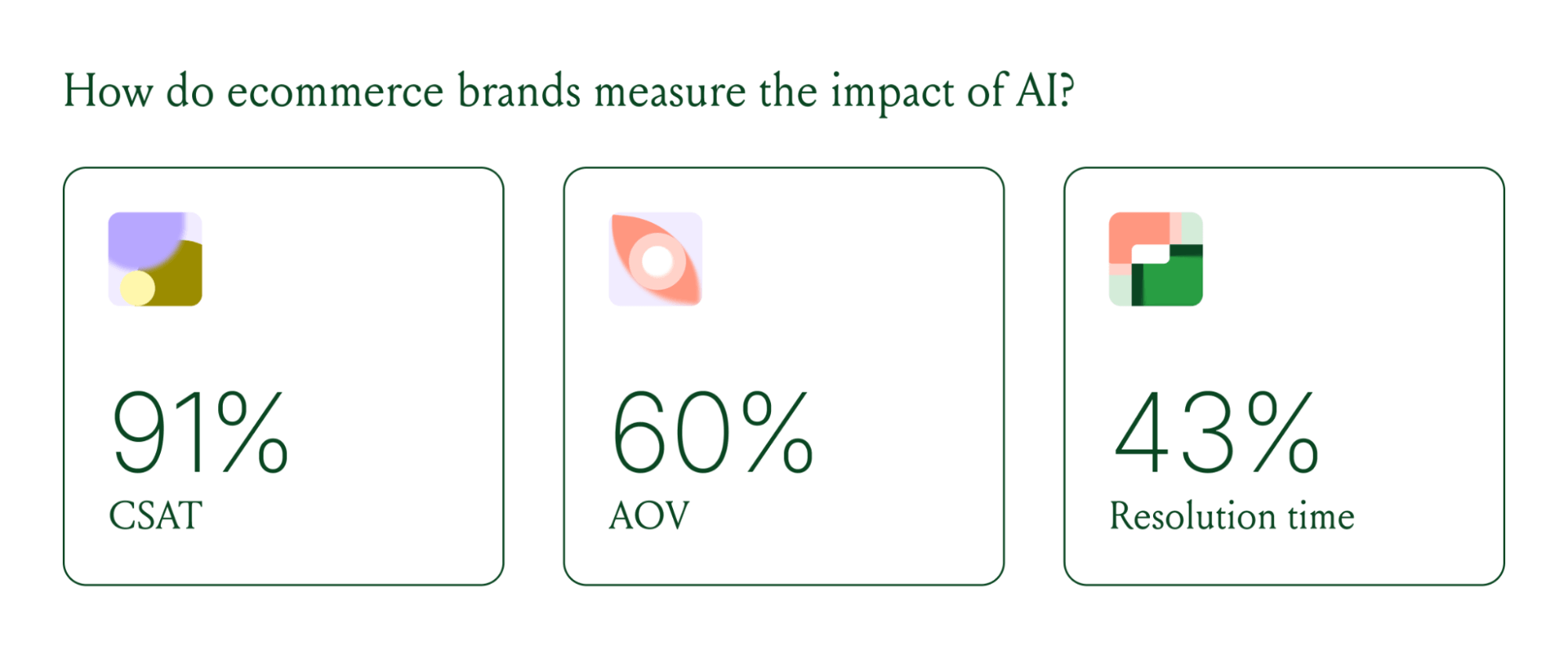
Brands are tying AI success to profit-and-loss outcomes. 60% of brands consider AOV a top indicator of AI effectiveness.
A year ago, ecommerce brands were still debating whether AI was worth the investment. That debate is over. Today, nearly every ecommerce professional uses AI to do their job.
The shift isn't just about adoption. It's about what AI is used for and how brands measure its impact. Support automation was the entry point. Now, AI is embedded across the full operation, from product recommendations to inventory control to real-time shopping conversations.
If we rewind 12 months ago, the industry was still split on AI. Some ecommerce professionals were excited, but most were still hesitant. In 2024, 69% of ecommerce professionals used AI in their roles. By 2025, that number reached 77%. In 2026, it hit 96%.
The confidence numbers back it up. 71% of brands say they are confident using AI for ecommerce, and 73% are satisfied with its business impact.
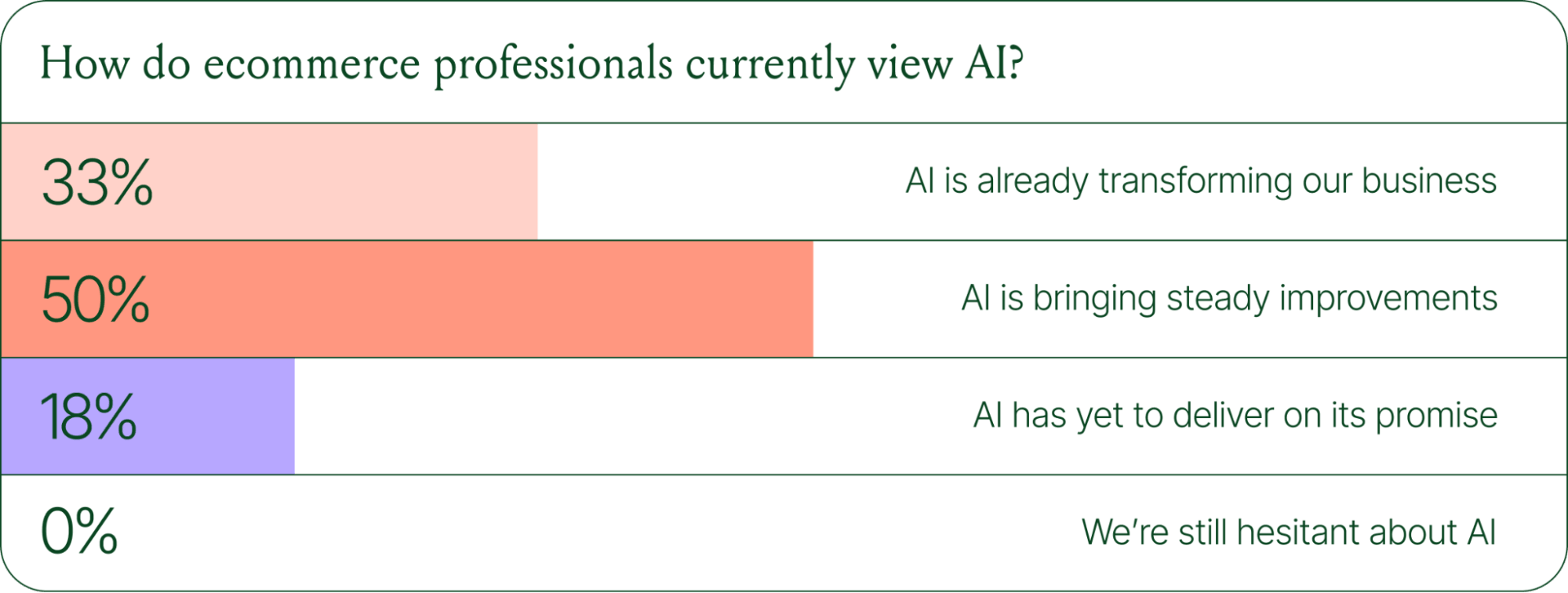
In early 2025, only 30% of ecommerce professionals rated their excitement for AI at 10/10. Today, zero percent of respondents describe themselves as hesitant about AI.
AI use cases now span the full ecommerce stack
Using AI in ecommerce is not new. In fact, it dates back to the 1980s with the invention of algorithms and expert systems. And if you’ve ever leveraged similar product recommendations or chatbots, you’ve already integrated AI into your ecommerce stack.
Modern AI is far more sophisticated.
With the rise of agentic commerce and conversational AI, brands began leveraging AI agents to automate the processing of repetitive support tickets. That’s still happening today, but the scope has expanded beyond the support queue.
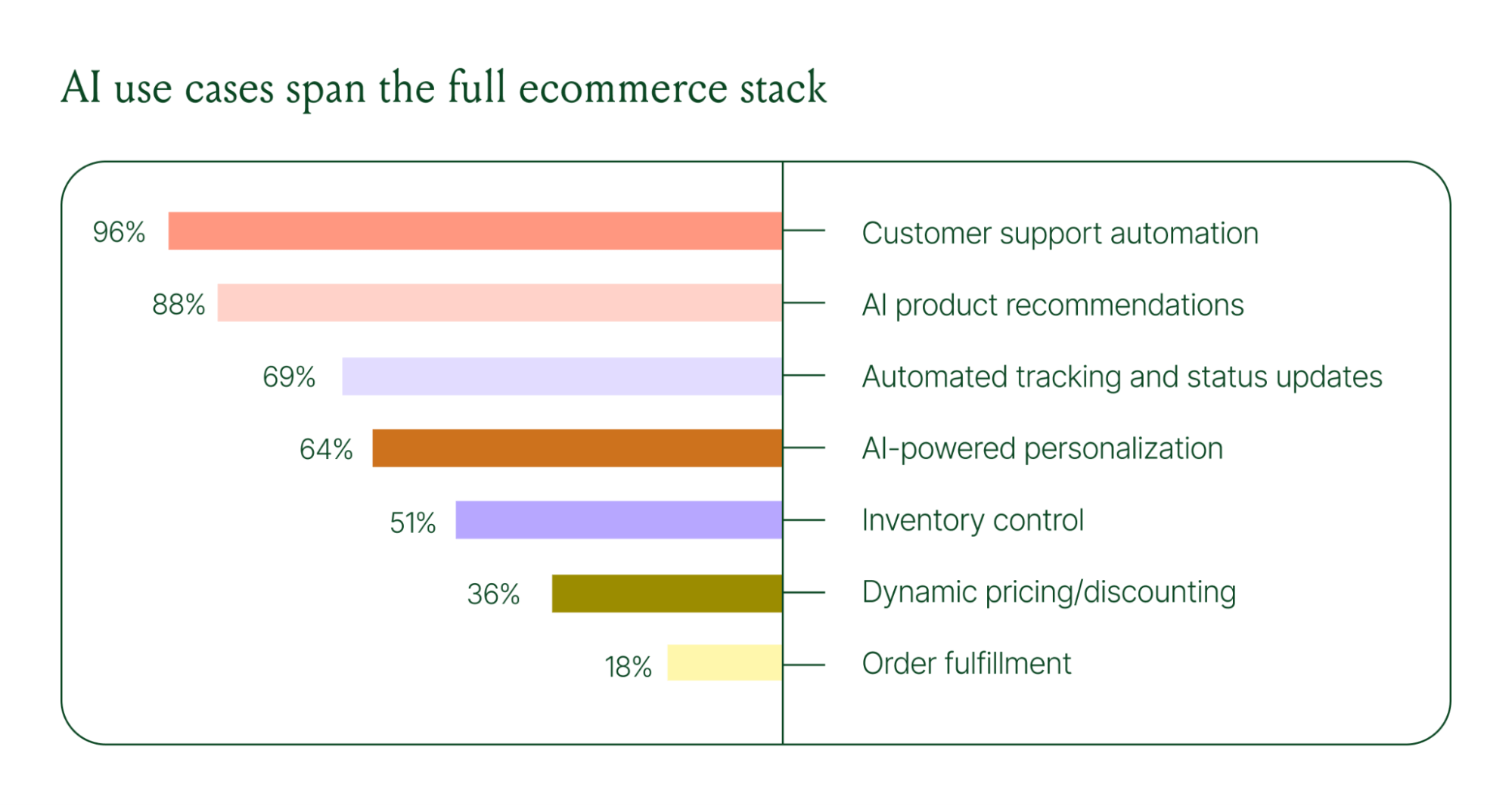
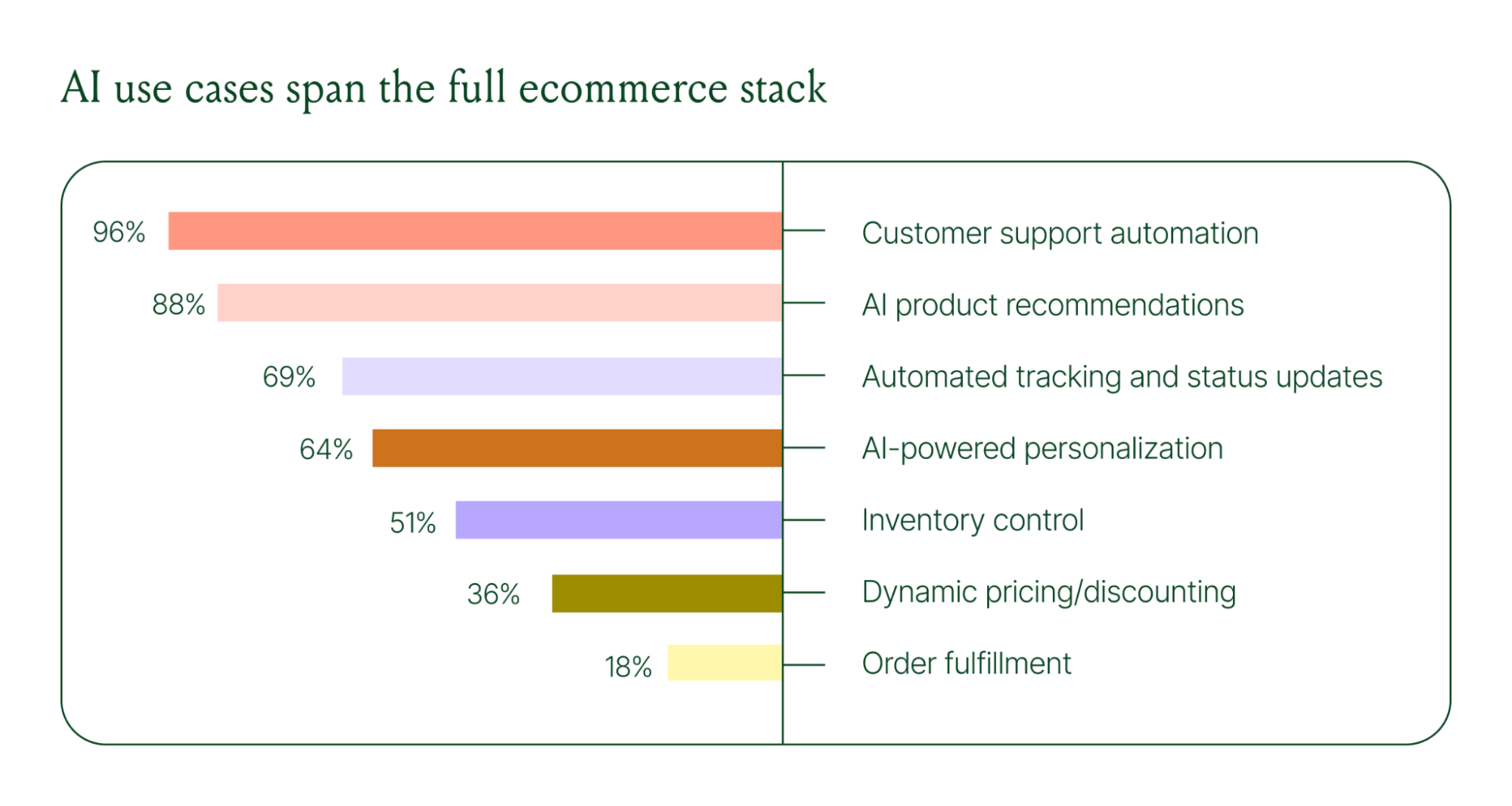
Ecommerce brands are deploying AI across every layer of their operation:
Customer support automation: 96%
Product recommendations: 88%
Automated tracking and status updates: 69%
Personalization: 64%
Inventory control: 51%
Dynamic pricing and discounting: 36%
Order fulfillment: 18%
When brands were asked which channels contribute most to their AI success, conversational channels dominated. Social media messaging led at 78%, followed by SMS at 70%, and website live chat at 51%. Shoppers want fast, personal conversations, and AI is the best way to deliver that at scale.
For decades, customer support success meant fast response times and high satisfaction scores. Those are still important indicators of success, but leading brands are adding revenue-focused metrics to their dashboards.
91% of brands still track CSAT as a measure of AI's impact. But 60% now include AOV as a top indicator, and higher-revenue brands earning $20M+ are focusing on metrics like total operating expenses, cost per resolution, incremental revenue, and one-touch ticket rate.
AI can now start a conversation, ease customer doubts, sell, upsell, and recover abandoned carts in a single conversation. When you’re only measuring CSAT, you’re ignoring the real ROI of conversational AI investment.
AI makes every conversational channel a storefront
Virtual shopping assistants now proactively engage shoppers, adapt to their needs in real time, and offer contextual product recommendations and upsells. When the moment calls for it, they can close the deal with a targeted discount.
Gorgias brands using AI Agent's shopping assistant capabilities nearly doubled their purchase rates and converted 20–50% better than those using AI Agent for support only.
Orthofeet, the largest provider of orthopedic footwear in the US, is a concrete example of this in practice. Using Gorgias, they achieved:
56% of support tickets automated in 2 months
Email response times down from 24 hours to 35 seconds
Double-digit revenue growth without adding headcount.
What this means for your AI strategy
The data tells a clear story: AI has evolved beyond a tool for handling tier 1 support tickets. It’s a core part of your revenue generation strategy.
57% of brands are already using AI for 26–50% of all customer interactions, and 37% expect that share to rise to 51–75% within the next two years. The brands building toward that range now are the ones who will have the operational advantage when it matters most.
The practical question isn't whether to invest in AI. It's where to focus first. Based on where brands are seeing the most impact, three priorities stand out:
Start with high-volume, low-complexity tickets. WISMO (where is my order) inquiries, return policy questions, and order status updates are where AI delivers the fastest return. Automate these first.
Expand into conversational channels. Social messaging and SMS are where AI is driving the most success right now.
Connect AI performance to revenue metrics. If you're only measuring CSAT and response time, you're missing half the story. Add AOV, conversion rate, and incremental revenue to your reporting.
Want to go deeper on the full 2026 conversational commerce trends? Read the complete report for data across every major AI use case in ecommerce.
Implement quickly and optimize continuously. Cornbread's rollout was three phases: audit knowledge base, launch, then refine. Stacy conducts biweekly audits and provides daily AI feedback to ensure responses are accurate and on-brand.
Simplify your knowledge base language. Before BFCM, Stacy rephrased all guidance documentation to be concise and straightforward so Shopping Assistant could deliver information quickly without confusion.
Use proactive suggested questions. Most of Cornbread's Shopping Assistant engagement comes from Suggested Product Questions that anticipate customer needs before they even ask.
Treat AI as another team member. Make sure the tone and language AI uses match what human agents would say to maintain consistent customer relationships.
Free up agents for high-value work. With AI handling straightforward inquiries, Cornbread's CX team expanded into social media support, launched a retail pop-up shop, and has more time for relationship-building phone calls.
Customer education has become a critical factor in converting browsers into buyers. For wellness brands like Cornbread Hemp, where customers need to understand ingredients, dosages, and benefits before making a purchase, education has a direct impact on sales. The challenge is scaling personalized education when support teams are stretched thin, especially during peak sales periods.
Katherine Goodman, Senior Director of Customer Experience, and Stacy Williams, Senior Customer Experience Manager, explain how implementing Gorgias's AI Shopping Assistant transformed their customer education strategy into a conversion powerhouse.
In our second AI in CX episode, we dive into how Cornbread achieved a 30% conversion rate during BFCM, saving their CX team over four days of manual work.
Top learnings from Cornbread's conversational commerce strategy
1. Customer education drives conversions in wellness
Before diving into tactics, understanding why education matters in the wellness space helps contextualize this approach.
Katherine, Senior Director of Customer Experience at Cornbread Hemp, explains:
"Wellness is a very saturated market right now. Getting to the nitty-gritty and getting to the bottom of what our product actually does for people, making sure they're educated on the differences between products to feel comfortable with what they're putting in their body."
The most common pre-purchase questions Cornbread receives center around three areas: ingredients, dosages, and specific benefits. Customers want to know which product will help with their particular symptoms. They need reassurance that they're making the right choice.
What makes this challenging: These questions require nuanced, personalized responses that consider the customer's specific needs and concerns. Traditionally, this meant every customer had to speak with a human agent, creating a bottleneck that slowed conversions and overwhelmed support teams during peak periods.
2. Shopping Assistant provides education that never sleeps
Stacy, Senior Customer Experience Manager at Cornbread, identified the game-changing impact of Shopping Assistant:
"It's had a major impact, especially during non-operating hours. Shopping Assistant is able to answer questions when our CX agents aren't available, so it continues the customer order process."
A customer lands on your site at 11 PM, has questions about dosage or ingredients, and instead of abandoning their cart or waiting until morning for a response, they get immediate, accurate answers that move them toward purchase.
The real impact happens in how the tool anticipates customer needs. Cornbread uses suggested product questions that pop up as customers browse product pages. Stacy notes:
"Most of our Shopping Assistant engagement comes from those suggested product features. It almost anticipates what the customer is asking or needing to know."
Actionable takeaway: Don't wait for customers to ask questions. Surface the most common concerns proactively. When you anticipate hesitation and address it immediately, you remove friction from the buying journey.
3. Implementation follows a clear three-phase approach
One of the biggest myths about AI is that implementation is complicated. Stacy explains how Cornbread’s rollout was a straightforward three-step process: audit your knowledge base, flip the switch, then optimize.
"It was literally the flip of a switch and just making sure that our data and information in Gorgias was up to date and accurate."
Here's Cornbread’s three-phase approach:
Preparation. Before launching, Cornbread conducted a comprehensive audit of their knowledge base to ensure accuracy and completeness. This groundwork is critical because your AI is only as good as the information it has access to.
Launch and training. After going live, the team met weekly with their Gorgias representative for three to four weeks. They analyzed engagements, reviewed tickets, and provided extensive AI feedback to teach Shopping Assistant which responses were appropriate and how to pull from the knowledge base effectively.
Ongoing optimization. Now, Stacy conducts audits biweekly and continuously updates the knowledge base with new products, promotions, and internal changes. She also provides daily AI feedback, ensuring responses stay accurate and on-brand.
Actionable takeaway: Block out time for that initial knowledge base audit. Then commit to regular check-ins because your business evolves, and your AI should evolve with it.
Here's something most brands miss: the way you write your knowledge base articles directly impacts conversion rates.
Before BFCM, Stacy reviewed all of Cornbread's Guidance and rephrased the language to make it easier for AI Agent to understand.
"The language in the Guidance had to be simple, concise, very straightforward so that Shopping Assistant could deliver that information without being confused or getting too complicated," Stacy explains. When your AI can quickly parse and deliver information, customers get faster, more accurate answers. And faster answers mean more conversions.
"We treat AI as another team member. Making sure that the tone and the language that AI used were very similar to the tone and the language that our human agents use was crucial in creating and maintaining a customer relationship."
As a result, customers often don't realize they're talking to AI. Some even leave reviews saying they loved chatting with "Ally" (Cornbread's AI agent name), not realizing Ally isn't human.
Actionable takeaway: Review your knowledge base with fresh eyes. Can you simplify without losing meaning? Does it sound like your brand? Would a customer be satisfied with this interaction? If not, time for a rewrite.
5. Black Friday results proved the strategy works under pressure
The real test of any CX strategy is how it performs under pressure. For Cornbread, Black Friday Cyber Monday 2025 proved that their conversational commerce strategy wasn't just working, it was thriving.
Over the peak season, Cornbread saw:
Shopping Assistant conversion rate jumped from a 20% baseline to 30% during BFCM
First response time dropped from over two minutes in 2024 to just 21 seconds in 2025
Attributed revenue grew by 75%
Tickets doubled, but AI handled 400% more tickets compared to the previous year
CSAT scores stayed exactly in line with the previous year, despite the massive volume increase
Katherine breaks down what made the difference:
"Shopping Assistant popping up, answering those questions with the correct promo information helps customers get from point A to point B before the deal ends."
During high-stakes sales events, customers are in a hurry. They're comparing options, checking out competitors, and making quick decisions. If you can't answer their questions immediately, they're gone. Shopping Assistant kept customers engaged and moving toward purchase, even when human agents were swamped.
Actionable takeaway: Peak periods require a fail-safe CX strategy. The brands that win are the ones that prepare their AI tools in advance.
6. Strategic work replaces reactive tasks
One of the most transformative impacts of conversational commerce goes beyond conversion rates. What your team can do with their newfound bandwidth matters just as much.
With AI handling straightforward inquiries, Cornbread's CX team has evolved into a strategic problem-solving team. They've expanded into social media support, provided real-time service during a retail pop-up, and have time for the high-value interactions that actually build customer relationships.
Katherine describes phone calls as their highest value touchpoint, where agents can build genuine relationships with customers. “We have an older demographic, especially with CBD. We received a lot of customer calls requesting orders and asking questions. And sometimes we end up just yapping,” Katherine shares. “I was yapping with a customer last week, and we'd been on the call for about 15 minutes. This really helps build those long-term relationships that keep customers coming back."
That's the kind of experience that builds loyalty, and becomes possible only when your team isn't stuck answering repetitive tickets.
Stacy adds that agents now focus on "higher-level tickets or customer issues that they need to resolve. AI handles straightforward things, and our agents now really are more engaged in more complicated, higher-level resolutions."
Actionable takeaway: Stop thinking about AI only as a cost-cutting tool and start seeing it as an impact multiplier. The goal is to free your team to work on conversations that actually move the needle on customer lifetime value.
7. Continuous optimization for January and beyond
Cornbread isn't resting on their BFCM success. They're already optimizing for January, traditionally the biggest month for wellness brands as customers commit to New Year's resolutions.
Their focus areas include optimizing their product quiz to provide better data to both AI and human agents, educating customers on realistic expectations with CBD use, and using Shopping Assistant to spotlight new products launching in Q1.
Build your conversational commerce strategy now
The brands winning at conversational commerce aren't the ones with the biggest budgets or the largest teams. They're the ones who understand that customer education drives conversions, and they've built systems to deliver that education at scale.
Cornbread Hemp's success comes down to three core principles: investing time upfront to train AI properly, maintaining consistent optimization, and treating AI as a team member that deserves the same attention to tone and quality as human agents.
As Katherine puts it:
"The more time that you put into training and optimizing AI, the less time you're going to have to babysit it later. Then, it's actually going to give your customers that really amazing experience."
Last September, Gorgias hosted CX-All Star: Episode 1, a webinar presented by a superstar panel of customer experience leaders in the DTC industry. From the health and wellness space to the tech sphere, experts Eli Weiss, Amanda Kwasniewicz, Deja Jefferson, and Ren Fuller-Wasserman gathered years of experience and wasted no time sharing their top strategies, tips, and a-ha moments with fellow attendees.
One hour wasn't long enough to reveal all their expert tricks, but it was definitely enough to help fellow CXers rethink their strategy. If you weren't able to attend the event, these were the top four lessons we learned from CX All-Star: Episode 1.
1) Make CX the core of your business if it isn't already
Amanda Kwasniewicz, the VP of Customer Experience at Love Wellness, emphasizes how CX should be the core of any business. "[CX] has a finger on the pulse of everything we do, whether we're just on the receiving end or whether we're executing it."
To emphasize CX's far-reaching impact, Amanda introduced a company-wide policy where every new employee spends six weeks working directly with support tickets and customers. This immersive approach to CX was so successful that non-CX team members, from marketing to finance, were able to help the CX team during a hectic inbox day when Love Wellness migrated platforms.
"I think CX is often viewed as a call center, a revenue driver—and we're missing the core part that it's a feedback machine. It's like a feedback treasure trove. So, if you can think about it as all three of those things, that's what it is. It really is about the experience." —Amanda Kwasniewicz, VP of Customer Experience at Love Wellness
2) The best CX hires are empathetic and eager to learn
"Brands are either notoriously anti-having a big CX team, or they're very straightforward. Either one of those extremes is dangerous," says Eli Weiss, VP of Retention Advocacy at Yotpo. The balance lies in building a team of passionate learners willing to grow.
Our experts agree that product knowledge can be taught through training, but soft skills like empathy, creativity, and passion are intrinsic. Eli notes that asking questions like "Why CX?" helps determine if a candidate will stick around. Amanda notes these team members often become superstar hires for other departments because of the breadth of their knowledge and skills.
“[LinkedIn] is how I've gotten a lot of people early on. I just looked at brands that crush it and said, 'Stay exactly where you are. I just need 2 hours.' Those 2 hours will usually give you what you as a founder can do in six, because somebody that's doing it all day is probably really good at figuring out how to put a move on it.” —Eli Weiss, VP of Retention Advocacy at Yotpo
3) Acknowledge different learning styles in your onboarding process
"If people can understand and learn the product they're selling and they can educate the customer, I think that's really valuable," says Deja Jefferson, Manager of Customer Insights at skincare brand Topicals. That's why she takes a diverse approach to product knowledge onboarding.
At Topicals, new hires don't only have to pore over lengthy documents to learn about skincare products. They get their hands dirty by speaking to experts in the product team, reading cheat sheets, and talking to customers about personal skin concerns. This multifaceted strategy is inclusive to all types of learners and leads to agents becoming true experts.
"People who are passionate about what they're doing and about helping customers [will] figure out the rest." —Deja Jefferson, Customer Insights Manager at Topicals
4) When necessary, break the script to create mensch moments
Ren Fuller-Wasserman, Head of Customer Experience at bidet brand TUSHY, empowers her team to go above standard protocols to create memorable or, as her team calls it, mensch (Yiddish for a person of integrity) moments. These are exceptional CX moments that can't be found in the onboarding manual, things like sending handwritten notes, personalized texts, and replacing items without question.
However, as with all things, it's also valuable to understand that mistakes happen. Ren likens the trial-and-error nature of customer experience to building a plane as it's being flown — it won't be perfect. She notes that protocols are important guidelines, but it's also worthwhile to allow your team to be mensch and decide, where do I need to follow the protocols here?
"There are incredible opportunities to make moments that matter, but only if your team has the agency to do so." —Ren Fuller-Wasserman, Head of Customer Experience at TUSHY
Imagine leaving your angriest customers to spar with an automated script in your website’s chat window. Now picture your support team reading “Where is my order?” for the hundredth time and glancing at the clock, only to find six hours left in the workday.
Who do you think is more frustrated?
Luckily, you won’t have to answer that, because these are completely avoidable problems. Once you learn the important distinctions between chatbot software and live chat software, you’ll understand how to use them both more effectively and lower blood pressures across the board.
Chatbots rely completely on automation and artificial intelligence (AI) while live chat software connects customers with human agents via a real-time chatbox. A third option, self-service chat, is an appealing alternative.
To determine which solution(s) is best for your business, let’s compare chatbots and live chat software and go through the top use cases for each.
What is live chat software?
Live chat support connects customers with human support agents who can answer their questions and assist them with any issues. When a customer opens the chat box on a live chat support solution, they are connected with a real person from the company's customer support department.
Support agents then use live chat messaging to address customer inquiries and walk customers through the solution to their problem.
Interested in getting live chat software? Check out one of these lists for tailored recommendations:
Live agents have the knowledge base to answer complex queries and customer issues
73% of customers state that live chat is the most satisfactory form of customer communication with a company
Enables multitasking for support agents so they can assist multiple customers at the same time
The personalized touch of a real human can go a long way toward improving your customer satisfaction
Support agents can find opportunities to convert visitors or turn support interactions into additional sales
Cons:
Not available after-hours when your customer team is off the clock
More expensive to employ agents to respond to chats
Responses will be slowed down by high volume which impacts resolution times
Much of your agents’ time will be spent answering the same simple questions over and over
{{lead-magnet-1}}
What is the difference between chatbots vs. live chat?
Unlike live chat software, chatbot software doesn’t connect customers with human agents. Instead, chatbot software connects customers with a chatbot that utilizes AI and machine learning to provide natural language answers to common questions.
Automation assists customers with less complex issues and provides quick answers. Chatbot technology enables companies to reduce their average response time, and frees up support agents to focus on more complex queries.
Pros and cons of chat bots
Pros:
The ability to answer questions 24/7 without paying for agents to work around the clock. According to a survey by Drift, 64% of customers say that 24/7 service is the best feature of chatbots.
Chatbots offer instant responses to common questions like pricing inquiries, improving customer experience with quick resolutions to common issues
Chatbot solutions are a highly cost-effective option, as they allow companies to resolve more customer issues without having to hire new customer support reps
By answering commonly asked questions and resolving simple issues, chatbot solutions can free up support agents to focus on more complex questions
Cons:
Chatbots can’t handle complex inquiries requiring human intervention
Automated responses are a colder, less human form of communication, which can impact customer satisfaction
No opportunity for agents to elevate an inquiry into an exemplary customer experience, such as offering personalized live chat offers
Customers will become frustrated if the chatbot can’t properly answer their questions or solve an issue
{{lead-magnet-2}}
Live chat vs. chatbots: Evaluating their strengths to help you choose the right one (or both)
When comparing chatbots with live chat solutions, it's important to recognize that each category offers its own unique advantages. Many companies choose to employ both live chat and chatbot apps on their ecommerce websites.
With that in mind, let's explore the strengths of each solution.
Response times and customer expectations
One of the biggest advantages of chatbot solutions is the fact that they allow for immediate responses to customer inquiries. Live chat solutions can also help companies reduce their wait times, though not to the same degree.
Chatbot advantage: Answers are immediate
According to data from HubSpot, 90% of customers rate an "immediate" response as important or very important when contacting customer service, with 60% of customers defining "immediate" as 10 minutes or less.
With a chatbot app, offering immediate response times to customer queries is a much more attainable goal. Best of all, these immediate response times are a 24/7 offering for customers, whereas live chat agents may not always be on the clock.
Live chat advantage: Solve complex issues
The problem with relying solely on chatbots to reduce customer wait times is the fact that even the best and most intelligent chatbots are often unable to resolve complex issues. Chatbots are excellent at pulling information from internal databases to answer common questions, such as providing the status of a customer's order or editing it.
But for uncommon questions or complex issues, a chatbot alone may not be sufficient. Because they can only handle one thing at a time, it can take forever before you get all of your questions resolved.
Solution: Use both chatbots and live chat
Many companies use chatbots alongside live chat support. This allows businesses to offer both immediate responses, as well as more in-depth support for complex issues.
For example, a customer may first be connected with a chatbot that provides instant responses to their query and assists with gathering initial information. If the chatbot determines the customer's question or issue is too complex to resolve, the customer is then connected to a support agent via live chat.
This combination is an ideal solution for many companies, allowing them to quickly resolve common issues without the need for a live chat agent. At the same time, customers have the option to speak with a real person in cases where assistance from a chatbot alone isn’t sufficient.
Human touch and personalization needs
While chatbot apps can help reduce customer service wait times and the number of customer service reps needed, many customers prefer speaking with a person.
Live chat advantage: The human touch
A CGS study found that 86% of customers would rather interact with a human agent than a chatbot. Further, 71% of customers say that they would be less likely to purchase from a brand that did not have real customer service representatives available.
Chatbot advantage: AI learning
Chatbots have come a long way toward replicating natural language and determining customer intent for better customer engagement. Today, the best chatbot applications can come quite close to sounding like actual human beings.
Chatbots leverage AI and machine learning to deliver personalized responses, as opposed to only “canned” responses, and can better serve your customers.
Solution: Use both chatbots and live chat
Even the most advanced chatbots still fall short of a live representative when it comes to delivering a personalized, human touch. They’re also lacking when it comes to handling more complex questions or customer issues.
Once again, a combination of automation and live chat support is typically the best approach.
Consistency and accuracy
Chatbots and live chat applications have unique advantages when it comes to delivering consistent and accurate responses to customer queries.
Chatbot advantage: Consistency
Chatbots are excellent at delivering consistent, on-brand messaging. They can be programmed to systematically follow templates or scripts to provide a consistent customer service experience.
When working with human customer support agents, this high degree of consistency can be a little more difficult to achieve.
Live chat advantage: Accuracy
While live chat support may not offer the same consistency as chatbots, human support agents do tend to be more accurate when determining the intent of the customer they are assisting.
For example, a simple spelling error can sometimes confuse chatbots, whereas a human customer support agent would be much more likely to look past the error and correctly figure out what the customer needs.
A human agent is also much more likely than a chatbot to accurately interpret questions that are worded strangely.
Solution: Use both chatbots and live chat
For companies that are choosing between chatbots and live chat support, it’s a question of whether they’d like to prioritize consistency or accuracy. This is yet another reason why a combination of chatbots and live chat support is often the best solution.
More chat features to provide self-service support without the bots
Many of the issues your website visitors have with bad chatbots involve their mimicry of support from real people. It’s easy to tell when you’re chatting with a robot, but it’s not always made clear to you by the chat widget.
But there’s a third chat option that you should consider in addition to live chat and chatbot software.
Self-service chat options make it clear to your customers that they are receiving automated help. By presenting menus instead of imitating a human conversation, self-service customer support empowers customers to find the answers they need on their own.
It’s a win-win, because the customers get the answers they need in real time, at any hour. And your team can focus on support tickets that are more important to the business.
Here are a few ways self-service chat options can work.
Self-service order management
Up to 30% of incoming customer service tickets are shipping status requests. With self-service order management in the chat widget, customers are empowered to make these queries on their own — providing fast answers and reducing your support tickets.
Quick service with chat automation provides quick, responsive customer service, which means better customer experience and a positive impact on revenue.
Barcelona-based shoe brand ALOHAS added self-service order management flows with Gorgias after experiencing a high chat volume. This allowed customers to find information on their own without a human needing to respond.
Here’s how a “track order” request looks in action:
ALOHAS
Quick answer flows
When using a chat widget, you’ll notice the same questions come up again and again. You can satisfy those FAQs by adding quick answer flows into the chat widget.
These automations can be set up in the widget for questions like:
What is your shipping policy?
Are there any discounts available?
Do you have any new products?
What materials do you use?
These automations can be customized for whatever FAQs are most relevant to your ecommerce store.
Here’s how it looks, for example, when an ALOHAS customer wants to find out more about the brand’s shipping policy.
Luxury jewelry brand Jaxxon has used these self-service quick responses with great success. The customer service team found themselves overwhelmed with customer questions and unable to respond as quickly as desired.
Jaxxon upgraded their live chat widget with Gorgias Automate with Quick Responses for customers. The result, combined with using Gorgias’ helpdesk, reduced live chat volume by 17% and lifted the on-site conversion rate by 6%.
Jaxxon
Autoresponders
Even when a customer chooses to type out a question, automation can be used to provide quick, customized service through the chat widget.
Rules is triggered when a relevant message is found (such as some asking about where their order us) is responds to the customer.
Macros is where you create the templated response sent to the customer. The Macro can be set up to pull in a customer’s unique information like order number, their name, and their tracking code.
The best part is this can not only be used for chat, but for responses to tickets coming in through other communication channels like email, social media, and SMS.
Keep customer service running 24/7
With Gorgias, you can make sure your chat widget isn’t missing a single ticket, even if your customer support team is offline.
First, you can set up your business hours to correspond with when you have live chat available. This will show up on your site’s chat widget by either showing the current status as online or offline.
From there, you can create automated responses for whether you’re offline or online. During business hours, this message can tell customers you’ve received their request and give a time by which they can expect a response.
After business hours, the responder can tell customers that although you’re offline, they can expect a response during the next day’s business hours via email.
Absolute Collagen
You can also use a contact form which turns a chat into an emailed ticket. This is great to use after-hours and to make sure chat requests don’t get lost overnight.
Combine automation and human interaction for the strongest customer experience
The use of automation within customer service is multifaceted. As we discussed earlier, a human touch is critical for many customers, and speaking with an automated chatbot can be a turn-off. However, automation certainly has its place in the customer service process.
On the customer’s side, starting with self-service chat helps them receive quicker customer support at scale — a more satisfying experience. On your team’s side, automation allows for sorting, segmenting, and prioritizing tickets.
When self-service chat can’t solve an issue, someone from your support team can easily step into the conversation. You can use Macros — scripts that automatically bring in the customer’s information — to scale the human touch on your support team.
So in reality, it’s not automation vs human support. These are two complementary tools that work better together. And the result is a stronger and faster customer experience for your website visitors, which can increase your conversion rate by as much as 12%.
Still not convinced? In 2021, brands using the Gorgias chat widget generated an average of $38,702 from conversations involving chat. We have a whole post on live chat statistics that can help illustrate the impact our chat widget can have on your business.
Gorgias brings intuitive live chat to your ecommerce business, alongside your other channels
If you’re an ecommerce business looking for an all-in-one customer support solution that includes live chat support and AI-powered chatbots, Gorgias is your one-stop shop.
Our algorithms are trained on hundreds of millions of ecommerce tickets, so you can be sure your customers are getting the right responses every time.
Plus, you can manage both live chat and chatbot conversations in the same dashboard that you use for all your other channels, including phone, email and major social media platforms. Bring in chat from other channels, including Facebook Messenger. We’ll even be supporting Whatsapp in early 2023.
First contact resolution rate is the percentage of support tickets resolved in one interaction
How to calculate FCR: # of tickets resolved on first contact / total # of tickets * 100
FCR doesn’t distinguish between successful and unsuccessful resolutions, nor does it tell you the reasons for a low or high rate
You can increase FCR by automating responses, offering self-service resources, and automatic ticket triage
You know what customers love? When their problems are solved on the first try.
Being able to resolve issues right away is a clear sign that your support team is on the right track to provide great customer experiences.
To maintain that level of excellence and efficiency, you’ll need to understand first contact resolution (FCR)rate.
In this article, we’ll deep dive into first contact resolution rate. You’ll learn how to calculate and monitor FCR, how to increase your FCR for better customer experiences, and look at what other metrics to monitor alongside FCR.
{{lead-magnet-1}}
What is first contact resolution?
First contact resolution rate is a metric that measures the percentage of customer support tickets that your agents resolve on the first interaction.
Generally, this measurement is used in call centers, but it’s also considered one of the most essential customer support metrics in ecommerce.
Like a lot of customer support metrics, FCR also goes by a few names, like:
First call resolution rate
First interaction rate
Single reply resolution rate
Whichever name you prefer, the goal of the measurement is the same: understand how efficient your team is at resolving customer issues.
The impact of first contact resolution on a support program
Time-consuming interactions erode trust over time and drive customers to shop with the competition.
According to The Effortless Experience, 96% of shoppers with a high-effort experience feel disloyal to brands afterward.
By aiming to solve customer issues from the very first interaction, you can combat the escalation of poor customer experiences and use positive interactions to improve loyalty and satisfaction, gain repeat customers, and boost revenue to meet your bottom line.
A guide to calculating first contact resolution
Let’s walk through the formula to figure out your FCR and look at an example. Then, we’ll unpack some challenges behind the FCR metric to make it as useful for your support agents as possible.
FCR formula
The formula to calculate first contact resolution rate is:
(Number of support tickets resolved on first contact / total number of resolved support tickets) x 100 = FCR rate %
The goal is to have an FCR percentage that’s as close to 100% as possible. A higher FCR indicates how successful you are at solving tickets at the first interaction without follow-up questions from customers.
Example FCR calculation
Here’s what calculating FCR looks like using real numbers:
(15,000 tickets solved on first contact / 20,000 total resolved tickets) x 100 = 75% FCR
That means, on average, your team can solve 75% of support tickets on the first try.
The challenges of measuring FCR
First contact resolution is a fantastic starting point to improve your support team’s resolution time. But, like most customer support metrics, FCR has some limitations.
FCR doesn’t provide you the reason for a high or low rate
Simply knowing your first contact resolution rate doesn’t give you the whole story.
A low FCR means you aren’t solving most problems on the first try but it doesn’t explain the root causes.
You’ll need to track other metrics that look into customer interactions more qualitatively, like customer satisfaction (CSAT).
FCR doesn’t distinguish ticket quality
Second, a high FCR isn’t an automatic indicator of a successful support strategy. The challenge lies in accurately categorizing tickets resolved in one interaction. This process can be complicated by instances where automated responses may be quick but unhelpful.
{{lead-magnet-2}}
4 tactics to increase first contact resolution rate
Here are four tactics you can use now to improve FCR performance and your customer experiences.
1. Provide support agents with customer service scripts
Your agents are your front line, and it’s important they’re armed with customer service scripts to resolve common issues efficiently. Scripts are pre-written responses that agents can use to avoid typing the same answers over and over again.
At Gorgias, we call scripts Macros. Gorgias allows you to personalize each Macro with customer information pulled from your integrated ecommerce platforms like Shopify and WooCommerce.
Deja Jefferson, CX and Consumer Insights Manager at skincare brand Topicals uses Macros “to help maintain brand voice while handling a high volume of customer service tickets.” As a result of this automation tactic, her team influenced 72% more revenue.
💡 Pro Tip: Exceptional customer experience depends on a robust customer service training program. Keep agent knowledge fresh with a knowledge base or Help Center of scripts. This way, agents can continuously upskill or grab information whenever they need it.
2. Automate responses to frequently asked questions
At Gorgias, we’ve found that automation increases both FCR and sales.
An automation tool like Gorgias Automate can help resolve up to 30% of incoming tickets. With features like Quick Responses and Article Recommendations, customers can get answers to their questions without waiting to speak to an agent.
Gorgias Article Recommendations is an AI-powered tool that helps customers choose the right products on their own.
For example, luxury shoe and garment care retailer Kirby Allison used Gorgias Automate to deflect 30% of incoming tickets and boosted revenue from support by 46%.
3. Offer self-service options to resolve simple customer inquiries
Chances are, a bulk of your tickets can be answered by customers themselves. In fact, 88% of U.S. customers expect a customer self-service portal according to a 2022 Statista survey.
On Gorgias, we solve this issue by giving merchants the ability to create a Help Center.
A Help Center is an article database that includes information commonly sought by shoppers, like product information, policies (like shipping, returns, or order cancellations), and billing and payment information.
Below, Loop Earplugs makes the customer experience seamless by linking to their FAQs in the top navigation bar of their website.
Keeping FAQs prominent makes it easy for shoppers to quickly find policies and other information about their brand and products.
4. Categorize tickets automatically and route them to the most suitable agent
Resolving your low-priority tickets quickly is a surefire way to improve your FCR. It would be a full-time job if you had to manually prioritize and categorize your tickets.
With a helpdesk like Gorgias, you can automatically categorize incoming tickets into low-, medium-, and high-priority based on customizable parameters called Rules. Better yet, Gorgias can take care of routing high-priority tickets to your most experienced agents to maintain customer retention.
For example, snack brand Chomps created a Rule that tagged customer tickets with an “Urgent” tag if their message included phrases like “cancel order,” “wrong,” or “update my address.”
Auto-tagging helps Chomps become more efficient with resolutions. It also allows their agents to update incorrect customer orders before they are fulfilled and shipped from their warehouse.
How FCR works with other important customer success metrics
To give deeper context to your customers’ shopping experiences, it’s important to use FCR alongside other customer success metrics and KPIs.
Let’s look at how FCR works with key customer support metrics, like Customer Contact Rate, Average Response Time, Average Resolution Time, and Unresolved Ticket Rate.
Customer contact rate
Customer contact rate (CCR) looks at the percentage of customers who ask for help over a given time. It's an important metric that gives you a snapshot of your company's overall health.
Calculating CCR in combination with FCR will help you see how many people need support versus how effective your team is at deflecting lower-priority tickets.
Average response time
Average response time (AVT) or average reply time measures how long your support team takes to respond to a customer message.
90% of shoppers agree that an immediate response is important when they have a support request, so it’s crucial that you have as low an AVT as possible.
The longer your response time, the longer it’ll take to get to a resolution. That’s why it’s useful to calculate AVT with FCR together. It’ll help show you the time it takes for an agent to respond, getting you even closer to a lightning-fast solution.
Average resolution time
Average resolution time (ART) is similar to FCR in that it looks at your support team’s ability to resolve customer issues.
The difference with ART is that the metric looks at your team’s average ability to resolve issues, not just the first time.
A benefit of calculating ART is that you can understand how efficiently your team resolves higher-priority issues, like complicated returns, customer retention rates, or problems with loyal shoppers.
Unresolved ticket rate
Unresolved ticket rate (UTR) lets you track and measure abandoned conversations and tickets that could not be solved.
It’s critical to calculate UTR because unresolved tickets are a key indicator of unhappy customers — and unhappy customers can negatively impact your bottom line.
Calculating UTR can help you find gaps in your support strategy by locating tickets where a resolution is difficult and working to build a resolution for similar problems in the future.
Measure, track, and improve first contact resolution with Gorgias
If you’re stuck manually calculating first contact resolution, you’ll never have time to improve your strategy.
That’s where Gorgias comes in. Gorgias Helpdesk automatically tracks and measures data like FCR so that you can focus on optimizing your strategy to provide a more positive customer experience.
On average, 15% of interactions were resolved with automation
Experts predict that 2024 will focus on strategic planning, optimized AI use, more real-time communication, and amplifying the voice of CX within companies
This year, we witnessed customer service teams from 16,140 brands support over 77 million shoppers and millions of tickets with Gorgias.
As we turn to a new chapter, we want to spotlight how six of the top-performing industries delivered customer service in 2023.
From food to fashion, we’ll see how quickly agents answered questions, then discover what customers were asking, and learn from experts about what customer experience trends to expect in the new year.
{{lead-magnet-1}}
Support teams resolved tickets in 2.5 business days
Step into the ecommerce world, where you’ll find a vibrant population of merchants, each with their own niche and groups of loyal customers. Together, they generated $1.45 billion in revenue in 2023.
Of course, this would not have been possible without the grit of customer service teams and their dedication to customer satisfaction.
Support teams across 20 industries answered customer inquiries within one business day and solved them in two and a half, resulting in very satisfied shoppers. Impressively, 15% of interactions were fully automated and resolved on average.
Here are the average industry support stats:
First response time: 7.6 hours
Resolution time: 18.6 hours
CSAT score: 4.5/5
From food to fashion: a cross-industry glance at support statistics
The most popular ecommerce industries — Apparel and Fashion, Health, Wellness, and Fitness, Cosmetics, Food and Beverage, Consumer Goods, and Luxury Goods and Jewelry — were the top performers.
Using exclusive Gorgias data, we’ll look at how support teams from these industries handled tickets. Then, we’ll gain expert insight into the ecommerce experience in 2023, and how experts predict it will change in the coming year.
Apparel and Fashion strutted with a 4.5/5 CSAT score
Our first stop is the bustling market of Apparel and Fashion. We’re all familiar with how tricky online clothes shopping can be. Most likely due to issues with sizing and style, support teams mainly dealt with inquiries about:
Shipping status
Returns
Refunds
Yet, despite receiving the highest number of customer tickets among the six industries, Apparel and Fashion brands kept customers happy. They responded within one business day and resolved issues within two, with 15% of interactions being resolved with automation.
Here are their stats compared to the overall industry average:
First response time: 8 hours (+0.4 hours)
Resolution time: 17 hours (-1.6 hours)
CSAT score: 4.5/5
According to Loop, over 50% of their merchants now charge for certain returns, including fees for exchanges and returns for store credit. This change aligns with consumer preferences, as their report shows 70% of shoppers are willing to pay for premium, convenient experiences, a trend already embraced by half of these customers.
Cancellations and returns were Health, Wellness, and Fitness’ biggest hurdles
The next stop on our tour is the thriving Health, Wellness, and Fitness industry.
Unfortunately, brands in this sector had a challenging year keeping up with unpleasant tickets about:
Shipping status
Subscription cancellations
Refunds
Perhaps support teams could have automated more than 15% of interactions to handle these repetitive tickets better. But despite their slower-than-average first response time, customers were still pleased with the support experience:
First response time: 9 hours (+1.4 hours)
Resolution time: 18.3 hours (-0.3 hours)
CSAT score: 4.5/5
Expert Insights: Amanda Kwasniewicz, the VP of Customer Experience at women’s wellness brand Love Wellness, highlights that personalized customer service has been a key trend of 2023. She’s observed that customers now expect to receive personal recommendations during their shopping journeys.
Cosmetics enhanced support with 18% automation
Now, take a peek at the fast-growing Cosmetics industry, and you’ll see how eager customers were to check out the hype around both small businesses and celebrity brands.
Given the boom of influencer marketing for these highly personal products, customers often inquired about:
Shipping status
Feedback
Damaged orders
To solve these tickets, support teams automated 18% of interactions and attained faster times than average:
First response time: 7 hours (-0.6 hours)
Resolution time: 15.8 hours (-2.8 hours)
CSAT score: 4.5/5
Food and Beverage served it fresh with a 5-hour first response time
Getting hungry? This year, the growing appetite for Food and Beverage in the ecommerce world was unmistakable. Beef jerky or freshly squeezed fruit juice, customers savored their snacks. But it also didn’t stop them from being tough critics.
The main issues raised to Food and Beverage support teams revolved around:
Shipping status
Feedback
Damaged products
Luckily, they cut down their first response time by automating 15% of interactions — nearly three hours faster than average:
First response time: 5 hours (-2.6 hours)
Resolution time: 17.2 hours (-1.4 hours)
CSAT score: 4.5/5
Expert insights: Zoe Kahn, former Manager of CX & Retention at Chomps and now Owner of Inevitable Agency, saw inventory issues as a major challenge of 2023. The complexity of inventory logistics is difficult for consumers to understand, leading to higher outreach from customers wondering when items would be back in stock. "Quieting those concerns is really difficult," Zoe notes. However, after witnessing inventory issues over the last few years, Zoe realized that "it's inevitable that inventory problems will happen because of how challenging the logistics of selling a product are."
Consumer Goods has CSAT down pat with a 4.6/5
There’s a lot to explore in the all-encompassing Consumer Goods industry. You’ll find brands that sell everything from sustainable water bottles and furniture to everything else in between, like dog toys and mystery subscription boxes.
While Consumer Goods brands only automated 14% of interactions, their resolution time was two hours faster than the industry average, resulting in the happiest customers among the six industries:
First response time: 8 hours (+0.4 hours)
Resolution time: 16.4 hours (-2.2 hours)
CSAT score: 4.6/5 (+0.6)
The top tickets Consumer Goods brands received were about:
Shipping status
Damaged orders
Customer feedback
Expert Insights: Ren Fuller-Wasserman, the Director of Experience at TUSHY, notes that the impact of the macroeconomic climate was among the top challenges faced in 2023. “As there's talk of recession and inflation, people are really looking for products that provide added value,” she says.
Our partner Okendo, a growth marketing platform that has worked with well-known brands like SKIMS and Rhode, notes that tech stack consolidation has been the top priority in 2023. They saw that merchants who used a multifaceted product with app integrations resulted in a 15x return on investment.
Luxury Goods and Jewelry polished interactions with 28% automation
Our final stop is at the small gem of an industry, Luxury Goods and Jewelry. Making sure their pricey wares arrived to customers safely was the top priority. That’s why the top questions support teams received were in regard to:
Shipping status
Discount requests
Damaged orders
Out of all the industries, Luxury Goods and Jewelry brands automated the most interactions at 28%, which certainly helped to shorten response and resolution times:
First response time: 6 hours (-1.6 hours)
Resolution time: 17.1 hours (-1.5 hours)
CSAT score: 4.4/5 (-0.1)
Expert Insights: Caela Castillo, Director of CX at Jaxxon, advises preparing early for BFCM but being flexible to change. She notes, “Sometimes you need a different perspective,” acknowledging that agents are valuable resources to gain customer insights, especially when it comes to planning new customer service strategies.
How to prepare for ecommerce in 2024 (according to experts)
It’s been a fruitful year of expediting the traditionally slow support process. However, with greater strides made in AI technology, ecommerce has only scratched the surface of providing accelerated service.
We interviewed ecommerce experts who saw the rise and fall of trends in 2023 and are ready to use their learnings to make the new year better.
Here are the top four actions ecommerce companies should take in 2024.
1) Identify business goals to adapt to new tech
We’re constantly fed an endless stream of new technology, which can be a distraction to business goals. That’s why the CTO of ecommerce agency Novatize, Pierre-Olivier Brassard, highly recommends planning a robust strategy first. Clear business goals will help teams pick the best tools — not the other way around.
2) Maximize the use of AI to streamline support
Customer service management platform TalentPop saw AI as the top CX trend of 2023. They foresee late adopters using AI next year, while early adopters will focus on optimization. To get ahead of the game, TalentPop recommends that support teams research all AI options since CX will only become more saturated with AI tools.
Brandon Amoroso, Founder & President at Electriq and Co-founder at SCALIS observed similar trends. In 2023, many CX teams implemented more self-service options for customers. Going into 2024, Brandon notes that a “continual integration of AI into the entire customer experience” is likely.
3) Offer real-time communication options
As social shopping gains traction, marketing platform Yotpo predicts customers are going to look for more real-time communication with brands. In fact, HubSpot reports a 45% year-over-year surge in using social media DMs for customer service. Therefore, using tools that enable interactions through DMs or text, like Yotpo SMS, will be a crucial strategy in the upcoming year.
4) Amplify the voice of the customer
Amanda Kwasniewicz, VP of Customer Experience at Love Wellness, advises CX leaders to ensure their contributions are recognized. Kwasniewicz notes that support teams often know the business better than any other department. "Beat the CX drum loudly. If you're not in the room, find a way in the room," she stresses.
Helpdesk automation uses both AI and automation to handle recurring tasks and reduce manual work done by agents
Using an automated helpdesk results in better customer satisfaction, decreased ticket volume, and higher revenue
Ensure your automated helpdesk has features like chat, one-click answers, an order management portal, and article recommendations
The top helpdesk automation solution is Gorgias, an automated helpdesk made for ecommerce merchants at all levels
Customer service helpdesks are essential for managing customer conversations, but support teams are looking to increase efficiency beyond being organized. Answering customer questions is the easy part for agents — the main challenge lies in making manual tasks like typing up responses faster. This is where helpdesk automation comes in.
The top helpdesks have automation features that solve issues without agents needing to sift through complex documents or advanced settings. Helpdesks shouldn’t only streamline the customer experience, they should also simplify the process of delivering that service.
This guide will explore the benefits of helpdesk automation, pinpoint the must-have features of a helpdesk, and highlight the leading automated helpdesks. By the end, you’ll be ready to put helpdesk automation into action and trim out the extra tasks from your workflow.
{{lead-magnet-1}}
What is an automated helpdesk?
An automated helpdesk is a customer service tool that uses automation and AI to synthesize customer messages from various channels. The goal of automated helpdesks is to handle repetitive tasks, like categorizing and routing support tickets, so agents have fewer manual tasks to do.
The Gorgias Helpdesk is an example of an automated helpdesk made especially for ecommerce merchants. Notable features include:
Rules. Processes, such as ticket tagging or rerouting, are automatically activated when certain conditions are met.
Macros. Pre-written response templates that can be reused for recurring customer interactions like WISMO requests.
Inbox. Omnichannel communication is prioritized with email, SMS, voice, and social media messages in one inbox.
Quick Responses. Automated one-click Q&A interactions on Chat.
Flows. Interactive Chat conversations powered by automation.
Why more companies are adopting helpdesk automation
Helpdesks are brilliant tools by themselves but truly shine once combined with customer service automation. The time saved from automation leads to a significant drop in resolution times, and a boost in CSAT scores and revenue. Let’s take a closer look.
Resolve customer issues instantly
If you run an online store, you’re familiar with replying to the same messages about your shipping policy, returns, and products day in and day out. The beauty of helpdesk automation is how it handles frequently asked questions with self-service resources, like a knowledge base, that are available 24/7 and allow customers to get instant answers outside of business hours.
Give your agents bandwidth to focus on trickier tickets
When you remove copy-pasting answers from your customer service responsibility list, support agents get time back to engage with high-value shoppers who are either loyal customers or at risk of churning. With more time to focus on complex tickets, response times will be faster, and customers happier.
Drive more revenue by turning questions into sales
Automation is a proven way to drive more revenue, not just a quick fix to smooth out the wrinkles in your support workflow. Working with 30 brands, Gorgias found that brands that automated 30% of their customer support tended to generate around 8.7% of their companies' revenue.
6 key automation features your helpdesk needs
Automation is common in many helpdesk software, but the key is to focus on how the automation features can speed up support tasks.
Below are six essential automation features a helpdesk should have.
1) Chat
What is it? A website chat window for customers to get automated or real-time answers. The chat window’s visibility can differ on each webpage.
The manual task it replaces: Exiting the brand website and using a different channel (like email or social media) just to contact a brand’s support.
Why is it important? If the process of getting help is too complicated, customers are forced to switch to competitors with simpler solutions. But when you provide a clear way to receive support, customers get faster responses, are better informed, and more inclined to make a purchase.
The best part about Chat is it gives shoppers the option to either receive a quick, automated answer or chat with an agent if they prefer real-time assistance.
Success story with Gorgias:RevAir implemented Chat and increased response times by 93% and revenue to $76k per quarter.
2) Quick Responses
What is it? One-click question-and-answer scenarios that occur in Chat. Quick Responses are not powered by a chatbot and use pre-set answers to reply to users.
The manual task it replaces: Responding to frequently asked questions (FAQs)
Why is it important? Quick Responses is your solution to 24/7 support when agents aren’t available. Giving customers a low-stakes method of asking questions lets them experience a more pleasant and low-pressure shopping journey.
Success story with Gorgias: ALOHAS nearly tripled growth by automating 83% of support with Chat and Quick Responses.
3) Order Management
What is it? An in-chat order portal that lets customers track, cancel, and return their orders without contacting a support rep.
The manual tasks it replaces: Resolving where is my order? tickets, order return and cancellation requests
Why is it important? Customers who ask order-related questions typically have one of two goals: to track the status or change the status of their order. Basically, order management tickets aren’t unique and can be easily handled by automation. When you provide answers to your customers’ top priority (their purchase), you deflect a ticket from entering your inbox while improving customer satisfaction.
Success story with Gorgias:Topicals implemented Chat to reduce returns and ended up deflecting 69% of tickets from manual agent intervention.
What is it? Promotional messages in Chat that activate when visitors interact with your website.
The manual tasks it replaces: Spending money and time finding new customers, promoting storewide discounts and sales, upselling and cross-selling
Why is it important? Finding new customers is more expensive than retaining the ones you already have. Chat Campaigns acts as a virtual salesperson, making sure sales, promotions, and products are getting the attention they need. Even when agents are offline, Chat Campaigns work overtime to capture every visitor, effectively reducing cart abandonment, website bounce rate, and lost sales.
Success story with Gorgias:Glamnetic’s exit intent Chat Campaigns increased sales by 49%.
5) Autoresponders
What is it? AI processes that declutter your email inbox of spam and easily answered inquiries
The manual tasks it replaces: Deleting spam emails, answering WISMO tickets, sending tracking links, and processing refund requests
Why is it important? Autoresponders handle routine inquiries such as order status or refund requests. This improves customer service response times and frees you up to focus on more complex issues that require a human touch. You can also gain insights into the effectiveness of your automation strategies with Autoresponders, allowing you to monitor what customers need more or less of.
Success story with Gorgias:Stoov leveraged insights from ticket information and increased CSAT to 4.9 with 10% cost savings.
6) Article Recommendations
What is it? An AI-powered recommendation tool that resolves questions with relevant Help Center articles
The manual task it replaces: Responding to product-specific inquiries
Why is it important? Answering product questions can get long, especially if agents are manually typing the same explanations and instructions over and over again. By offloading this repetitive and laborious task to AI, customers receive consistent and detailed answers, while agents focus on resolving one-of-a-kind tickets.
Article Recommendations combines the knowledge power of AI and your own Help Center to give customers accurate and personalized solutions. This allows curious shoppers to receive complete information about your brand and products since articles can include images, videos, and links.
Success story with Gorgias:TUSHY gained 25% in revenue from leveraging pre-sales education including the use of Article Recommendations.
{{lead-magnet-2}}
The top 6 automated helpdesk options
Within the diverse range of available options, there are five standout helpdesk platforms renowned for their remarkable features: Gorgias, Zendesk, Kustomer, Freshdesk, Help Scout, and Shopify Inbox. Let’s take a closer look at what each helpdesk offers.
1) Gorgias
Price: Starts at $50/month; billed per ticket
Best features: The only ecommerce-focused helpdesk, powerful and easy-to-use automation features
As more businesses rely on ecommerce platforms to offer their products, Gorgias stands out as the best helpdesk for merchants at all levels. Gorgias offers seamless integration with major ecommerce platforms like Shopify, BigCommerce, WooCommerce, and Magento and centralizes customer data and conversations within the platform.
Combining it with the AI-powered Gorgias Automate makes it a top contender for customer support teams seeking to streamline the customer experience and maximize the power of automated workflows. Gorgias Automate checks off all the boxes with foundational features like Quick Responses, Order Management, Chat Campaigns, Autoresponders, and Article Recommendations.
2) Zendesk
Price: Starts at $49/month; billed per user
Best features: Designed for enterprise companies, advanced reporting capabilities
Zendesk is favored by enterprise-level businesses for its excellent multi-channel support and strong reporting features like real-time data views and customizable dashboards.
However, while its specialty is raising customer satisfaction, users report dissatisfaction with Zendesk’s very own customer service due to unresponsiveness and difficulties with subscription changes. Despite these drawbacks, Zendesk's configurability makes it a valuable tool for larger businesses aiming to optimize their customer service operations.
3) Kustomer
Price: Starts at $89/month; billed per agent
Best features: Interface is easy to navigate, ability to add internal notes to tickets
Kustomer shines in organizing data and managing customer interactions. Though it may not fully meet the needs of ecommerce-based businesses, its strengths in streamlining support processes stand out. Users have noted some drawbacks such as a complicated search engine and limited mobile functionality. However, if a straightforward ticketing system is what you need, Kustomer may be the right fit.
4) Freshdesk
Price: Starts free for up to 10 agents; billed per agent
Best features: Includes a free plan, innovative collaboration features for convenient ticket assignment
If you're a SaaS business, Freshdesk is a great pick, excelling in basic ticket management. Its ability to integrate seamlessly with non-ecommerce applications like Salesforce and Jira makes it valuable for tech companies. Large ecommerce stores, on the other hand, might find Freshdesk's features somewhat limited.
Freshdesk's solid ticket management system, coupled with its user-friendly interface, makes it a top choice for SaaS businesses.
5) Help Scout
Price: Starts at $20/month; billed per user
Best features: Intuitive user interface, extensive knowledge base and documentation features
Help Scout excels in managing inbound customer emails with its feature-rich toolset. Recent enhancements like help docs and video embedding have improved its functionality. However, workflow automation still needs improvement and can lead to unintended mass email responses.
The limitation of features like real-time chat on higher-tier plans and subpar support experiences are its weaknesses, but its streamlined email support and knowledge management make Help Scout a strong option for teams that rely on email support.
6) Shopify Inbox
Price: Free for Shopify users
Best features: Native Shopify helpdesk solution for Shopify merchants, user-friendly interface
Shopify Inbox is favored by Shopify store owners for its excellent customer communication and user-friendly interface. Users appreciate its ability to centralize conversations and enhance customer engagement, which is great for brand-new merchants.
However, some find the initial learning curve challenging, with concerns over limited reporting features and inconsistent message notifications. Nevertheless, its cost-effectiveness and efficient customer engagement tools make Shopify Inbox a great pick for customers who don’t want to leave the Shopify environment.
Gorgias is the ultimate automated helpdesk for ecommerce
Gorgias stands out as the only helpdesk designed explicitly for ecommerce businesses. Boasting an incredible 4.3/5 stars on Shopify, it offers unparalleled integration with major ecommerce platforms like Shopify, BigCommerce, and WooCommerce. Its suite of features is powered by advanced AI, streamlining ticket and order management, support workflows, and customer communication.
For ecommerce businesses looking to elevate their customer support experience, look no further than Gorgias. To see how Gorgias can transform your customer service, book a demo today.
Key customer service techniques for agents include understanding customer issues, using positive language, thoroughly understanding products, adapting to different communication styles, and setting clear expectations.
Key techniques for support leaders include providing agents with enriched customer data, building a library of templates, specializing agents in specific channels or issues, and training the entire organization to be customer-first.
Gorgias offers features such as automated responses, self-service options, live chat for pre-sales support, and integrations with other tools to enhance customer service.
Amid the barrage of social media ads, email campaigns, and influencer endorsements that consumers navigate weekly, PWC highlights that 73% of people see customer experience as a pivotal factor in their buying decisions.
The techniques today’s customer service teams use are the foundation for those excellent experiences.
Below, learn five key customer service techniques for agents and four for CS leaders.
{{lead-magnet-1}}
9 customer service techniques for agents, leads, and managers
Here are five essential techniques for agents to provide great customer service.
Effective techniques for agents to enhance customer service
To deliver good customer service, agents should first aim to understand customers’ issues at the beginning of each interaction. Then, they can leverage other tactics like reframing statements and setting clear expectations.
1) Get an understanding of the issue before you start the interaction
Every customer service encounter is unique and should be approached with a fresh perspective. Here’s how to make sure you understand the customer’s issue before diving into problem-solving mode:
Active listening: Context is key. Start every conversation by allowing the customer to feel heard by giving them the space to fully express their concerns before making any recommendations.
Review previous interactions: Skim past customer interactions to gain context. Tools like Gorgias streamline this process by integrating data across multiple channels, offering a comprehensive customer history at a glance.
Ask clarifying questions: Politely ask for more details if the customer’s problem isn’t immediately clear.
Avoid assumptions: Never assume you know the issue before the customer fully explains it, even if it seems familiar.
Empathy: Demonstrate understanding and concern for the customer’s issue to empathize with them.
2) Maintain a positive and uplifting tone in your communication
The words we choose in customer service can significantly impact the tone of an interaction.
Psychology professor Albert Mehrabian conducted insightful research on communication and found a fascinating breakdown: only 7% of a message's meaning is derived from the actual words spoken, while a much larger portion, 38%, is understood through tone. Meanwhile, body language proves to be the most influential factor, accounting for 55% of how the message is interpreted.
Since all customer conversations for ecommerce brands happen via chat, email, or on the phone (not face-to-face), agents can’t rely on body language. This means tone of voice becomes even more important for agents to get right.
How can you maintain positive language?
1️⃣ First, avoid negative words: “can't,” “won't,” or “don't” can often be reframed in a positive manner. Swap them for phrases like "I understand," "I'm here to help," and "Let's see what we can do," which are much more reassuring to customers.
2️⃣ Second, aim to be solution-oriented. Focus on potential solutions or next steps rather than dwelling on the problem.
3) Develop a comprehensive knowledge of the products or services
What happens when a recent customer sends an email asking about how to fix a broken part from the product they purchased from you, and your agents don’t know enough about it to help?
Or, if your skincare line recently underwent a formula change that your agents get asked about, but they aren’t sure what was changed and how it alters the performance of your products?
Knowledge of the products you’re selling is critical for accurately informing customers and managing their expectations.
💡 Our recommendation: Encourage a culture of sharing by creating feedback loops across the entire organization. The product team should communicate product details and capabilities, marketing teams should share information about customer behavior, and support teams should share the pain points they hear from customers.
Plus, when one agent learns something new about a product, such as an undocumented use case or a common customer complaint, sharing this insight with fellow agents can enrich everyone with deeper product knowledge.
4) Adapt your communication style to suit different customers
Every customer comes with a unique set of expectations and comfort levels, making flexibility in your communication skills a key skill for customer service agents.
Whether you’re talking on the phone or messaging the customer on Instagram, you can match a customer’s preferred style byrecognizing customer profiles.
Pay attention to cues that suggest how each customer prefers to interact. Some customers are straight to the point, desiring quick, factual information with minimal fuss.
Others might appreciate a more personable and reassuring approach, especially if they're dealing with a stressful issue.
Take it from Deja Jefferson, CX and Consumer Insights Manager at Topicals: “I ensure that customer service provided by Topicals not only exhibits empathy when issues arise but should be seamlessly integrated throughout the entire transaction process. Our priority is to ensure that our customers feel fully supported at every step.”
If you use Gorgias Helpdesk to manage your customer support channels, you’ll easily be able to see historical conversations with customers to give you an idea of their preferred communication style. You can also leverage sentiment detection, a Gorgias feature that automatically detects the tone of voice the customer is using. Using sentiment detection, you can also prioritize support tickets based on customers' urgent needs.
5) Establish clear expectations with customers
Managing customer expectations is a delicate balance. You don’t want to overpromise services, but you also don’t want customers to feel like you aren’t able to help them.
The balance? Be optimistic about solving their issues, but equally crucial not to promise more than can be delivered. Here's how to set realistic expectations:
Be transparent: When a resolution might take some time, communicate this to the customer, providing a realistic timeline. It's better for a customer to be pleasantly surprised by an early resolution than frustrated by a late one.
Keep commitments achievable: Assure the customer that what you know can be delivered within the set constraints.
Follow up: If you've provided a timeframe, check back in with the customer within this period. If there’s a delay, communicate it promptly—customers will appreciate the update even if it's not the news they were hoping for.
Acknowledge limitations: If a request falls outside the scope of what the company can provide or if there are factors beyond your control, it’s better to be upfront about it. Honesty goes a long way in maintaining a respectful and professional relationship with customers.
The truth is, you won't always have the answers customers want to hear. But being clear and honest with them can help them grasp why things are the way they are.
{{lead-magnet-2}}
Techniques for leads and managers
Effective leadership in customer service hinges on empowering agents with the right tools and strategies to excel in their roles.
Considering that 78% of customers will switch to a competitor after multiple bad customer service experiences, it’s important for your team to be well-equipped for success.
Let’s talk about how to do that.
1) Provide agents with enriched customer data
For customer service teams to excel, they require more than just basic customer information. Leads and managers can empower their teams by providing enriched customer data, leading to more personalized and efficient service.
A helpdesk software will make this easy — if it offers a range of integrations. This is an essential feature to look for because you want your helpdesk to mesh with your existing tech stack. Here’s why: agents need access to data beyond a customer’s name. Integrations are the only way a helpdesk can pull in this additional context.
We’re talking about past orders, historical conversations, engagement info, and conversion metrics into comprehensive customer profiles. This will help agents get a holistic view of the customer, paving the way for tailored interactions.
Bonus tip: Beyond your helpdesk, share any feedback you hear from customers with the rest of the team. Integrating your helpdesk with a tool like Slack can make this easy, and it’s one way the Love Wellness team actions quickly on the advice from customers:
“We have a channel in Slack dedicated to customer feedback. Dropping in feedback is part of the team’s daily and weekly responsibilities, which helps them get really familiar with all of the content.
“It also allows our team to dissect them and collaborate on how we can improve. You could also schedule recurring feedback share sessions with the Product or Website teams, or even invite them directly into Gorgias (at no extra cost) and create a dedicated view for product feedback, website feedback, and so on.”
—Amanda Kwasniewicz, VP of CX at Love Wellness
2) Create a library of templates to streamline agent responses
Templates are a big help for customer support teams, especially those who are strapped for time (which, let’s be honest, that’s 99% of them).
Two types to build include:
Standard responses for common queries: Develop and include a set of pre-written answers tailored to frequently asked questions and routine issues. This ensures quick, consistent, and accurate responses to customer queries.
Scenario-specific templates: Different situations call for different responses. Having templates specifically designed for complaints, product inquiries, returns, and other common scenarios can guide agents to handle each situation with the appropriate tone and information.
Gorgias offers dynamic, reusable answers, so your agents can build a template of canned responses for all your FAQs. These are easily accessible for agents to swiftly locate and use when replying to customers.
If you want some tips on how to craft these templated responses, check out this article with tips for responding to frustrated customers for a good start.
3) Specialize agents in specific channels or issues
Just as every customer is unique, so too is every communication channel. Providing specialized training for agents in their chosen channels — be it phone, email, social media, or live chat — ensures they are not just familiar but highly skilled in navigating the nuances of these platforms.
But you can take this one step further by encouraging agents to become connoisseurs of specific product lines or types of issues. This deep dive into a particular area enables them to provide not just answers but insights, elevating the customer experience from good to great.
However, remember that specialization doesn’t mean working in silos. It's still crucial for specialized agents to also have a broad understanding across all areas.
💡 Tip: With Gorgias, you can auto-assign tickets to an agent based on issue or channel. This way, you’re routing tickets to agents who can best help every customer.
4) Promote a customer-first mindset across the entire organization
A tip that we love from Amanda Kwasniewicz at Love Wellness is the idea that to truly excel in customer service, a customer-first mentality needs to be woven into the very fabric of your organization.
This goes beyond the customer service department and includes everyone, from the C-suite to the front lines.
She suggests organizing workshops that paint the picture of the crucial role a customer-centric approach plays in every department. These sessions should highlight how each team member's contributions echo in the symphony of customer satisfaction.
“At Love Wellness, we believe that every single team member plays a vital role in creating a haven of care and understanding. That’s why we created an immersive customer experience training program that involves each and every one of us, including the president of the company and even our office manager!” she said.
Additional resources to support customer service teams
For those who are eager to dive deeper into the world of customer service and sharpen their skills even further, Gorgias offers a treasure trove of resources.
Whether you’re starting from scratch or looking to refine your expertise, these materials are designed to enhance your understanding and execution of top-tier customer service:
Customer Service Terms: A comprehensive glossary to get you fluent in the language of customer service.
Customer Service Phrases: This collection of key phrases can help guide your communication towards more positive and impactful interactions.
Customer Service Skills:An outline of the essential skills every customer service professional should master, for any situation.
Customer Service Tips: A series of actionable tips that can be implemented to improve your customer service delivery immediately.
Customer Service Email Templates: Save time and maintain consistency with a variety of templates that cover common customer service scenarios.
Each of these resources is designed to instruct and inspire your customer service team to exceed expectations and create memorable customer experiences.
Enhance agent support with Gorgias
Exceptional customer service isn't just about the right words; the helpdesk tool you use is equally important to enhance efficiency and deliver exceptional service.
Gorgias is tailored to provide such support with innovative features that streamline your customer service processes. Let’s review a few in detail:
Automate responses with reusable Macros
Macros are pre-scripted customer service templates that accelerate response times by using automation to tackle those repetitive but essential customer inquiries that come in droves. Think of them as pre-made customer service scripts.
Often called ‘empty-calorie tickets,’ queries like “Where is my order?” don't require personalized responses and can be time-consuming if handled manually. Automating responses to these repetitive questions frees your agents to focus on more complex issues.
Here are some other times when Macros help:
Welcome emails: A friendly and informative welcome message can set a positive tone for the customer relationship.
Order status updates: For updates on transactions, shipping, and delivery, a Macro can provide customers with the information they need promptly.
Refund confirmations: When processing refunds, a clear and courteous Macro can assure customers that their request has been handled.
Customer loyalty messages: Keep your loyal customers engaged with updates and rewards information through efficient Macro communication.
Enable customers to find answers themselves
A staggering 88% of customers prefer to find answers independently, according to Statista. This tells us that the modern customer values autonomy, which is why self-service options are key.
Self-service options are resources for customers to get the answers they need without contacting an agent. These include FAQ pages, help centers, chat widgets, and interactive quizzes.
Here’s how each self-service option can benefit you:
FAQ page: Centralizes customers’ most commonly asked questions on one page to prevent your inbox from being filled with the same questions.
Help center: Larger in scope than an FAQ page or contact center, a Help Center is a database of detailed resources like articles and how-to videos to help customers learn more about your brand and product.
Chat: Chat can turn into a self-service option with the implementation of Quick Responses, or preset conversations that can answer customers without a live agent.
Interactive quiz: A fun self-service addition to online stores that carry highly specialized products, like skincare, health supplements, and apparel.
Here’s a great example from BrüMate, which uses a product finder quiz in its customer knowledge base:
Use live chat for pre-sales support
Live chat has become an indispensable tool for connecting with customers in real-time. Some inquiries present a great opportunity to sell a specific product, which Olipop shows here:
Live chat impact on sales and customer satisfaction is notable: 86% of live chat engagements end with a satisfied customer, and adding live chat to your website has been linked to a 12% improvement in conversions.
Gorgias live chat is designed to integrate seamlessly with the leading platforms for ecommerce customer support. It allows you to manage live chat tickets alongside those from email, phone, and social media, providing a unified interface to serve your online customers more effectively.
Chat campaigns can trigger when certain conditions are met (like visiting/dwelling on a certain page or being a repeat shopper). You can hit these targeted shoppers with personalized product recommendations or provide a unique discount code.
To sum it up: You're not only addressing customer needs in real-time with live chat but also creating opportunities to influence purchasing decisions positively.
Integrates your helpdesk with the rest of your tech stack
This extensive range means that Gorgias can likely connect with whatever tools you use to manage your ecommerce business, creating a streamlined workflow for your customer service agents.
The real win with these integrations? They let your agents get super personal with support.
When an agent pulls up a ticket, they’re able to see everything they need to know— past buys, loyalty points, you name it. This means they can give spot-on help that feels really tailored to each customer, cutting down on all that back-and-forth and making the whole experience smoother.
“Having quick access to previous order info in the helpdesk is super convenient and helps us turn our support agents into sales people.”
—Ian Anderson, Operations Manager @ mnml
Boost revenue through improved customer satisfaction
When it comes to turning satisfied customers into sales, Gorgias users are living proof of the potential.
Take Kirby Allison, for instance, who saw a 23% uptick in conversions after automating 30% of their customer support tickets. Or consider TUSHY, influencing a whopping 25% of their sales through Gorgias Convert.
These success stories highlight a clear message: customer service strategy isn’t just about problem-solving but about creating opportunities.
Ready to see the difference a proactive customer-first approach can make for your bottom line? Give Gorgias a try.
Consumers are increasingly multi-screen and multi-channel. From desktop to mobile to tablet, they interact with businesses through Instagram DMs, Facebook Messenger, emails, support chat, and even phone calls.
Though omnichannel customer service lays a valuable foundation, communicating effectively as a brand involves weaving marketing, sales, and customer service into a cohesive omnichannel communication strategy.
An omnichannel communication approach makes it easier to talk to customers in a personal way, helping drive sales and keep customers loyal.
This article explores how centralizing communications offers your team — from marketing and sales reps to support staff — the tools and insights they need for a consistent customer experience.
By doing so, you don’t just react to customer needs; you anticipate them, opening avenues for proactive engagements that positively impact both relationships and revenue.
Omnichannel communication: an overview
Omnichannel communication is a customer-centric approach that integrates different methods of communication and business channels into a unified, seamless experience for prospective and existing customers.
Omnichannel communication goes beyond just offering multiple avenues for customer interaction; it creates a seamless and integrated experience across all touchpoints.
How omnichannel works
Omnichannel communication focuses on three key facets—data unification, fluidity of customer interactions, and data-driven insights. By focusing on these key tenets, omnichannel communication moves beyond being a buzzword to a strategic approach that places the customer at the center of your business operations. This strategy allows retailers to deliver an experience that is consistent, contextually relevant, and highly personalized.
Data unification
Centralizing customer data from various digital channels like email, social media, and in-store interactions enables a more consistent and personalized experience. Also, it serves as the foundation for customer profiles. These profiles are critical for delivering targeted offers, rewards, and personalized service to shoppers.
Fluidity of customer interactions
Customers don’t experience channels; they experience your brand. They want to transition effortlessly between online chats, phone calls, and physical visits and have a conversation pick up right where it left off. This seamlessness is particularly beneficial for ecommerce retailers, who can use these channels to provide real-time updates such as stock availability or order status, enhancing customer satisfaction and reducing friction.
Data-driven insights
Turn data into actionable insights. By analyzing integrated data across platforms, you can discern valuable patterns in customer behavior and preferences, allowing you to continuously refine your marketing strategies and improve the overall shopping experience.
Omnichannel communication moves beyond being a buzzword to a strategic approach that places the customer at the center of your business operations.
Omnichannel communication in action
While the concept sounds promising, how does it manifest for a single brand?
Graza excels at omnichannel communication, offering its customers a seamless and enriched experience across various touchpoints.
Using Gorgias Live Chat, they provide real-time customer support, resolving queries when customer service reps are online. As an alternative, their customer service email channel serves as both a satisfaction tool and a means for personalized marketing, sending targeted offers.
On social media platforms — like Facebook, Twitter, and Instagram — they respond to customer inquiries and engage the community with educational content about their single-origin olive oils.
Graza captures customer emails through Gorgias Chat's offline hours feature.
Graza's Instagram profile
This multi-layered approach ensures that every interaction is not just a transaction but an opportunity to deepen the relationship. The outcome is higher customer satisfaction and increased brand loyalty, leading to repeat purchases and a more robust bottom line.
Omnichannel communication vs. multichannel communication
We’re in a platform renaissance: retailers now have many ways to connect with customers.
However, not all channel strategies are created equal. Understanding the differences between omnichannel and multichannel approaches is critical to developing a communication plan that meets customer expectations.
Data integration sets omnichannel apart
Both omnichannel and multichannel strategies use multiple channels for customer engagement. Omnichannel takes it a step further by integrating data across these platforms. This provides cohesive and personalized customer experiences, rather than fragmented interactions that are often the result of multichannel approaches.
Customer continuity is a hallmark of omnichannel
An omnichannel strategy focuses on offering a seamless customer experience across all touchpoints, whereas multichannel often treats each channel as an isolated silo. This can result in a disjointed and less satisfying journey for customers who hop from one channel to another, asking the same question to different customer service reps.
Instant communication and real-time interaction
Omnichannel doesn’t just collect data; it leverages real-time analytics. This level of insight can drive data-driven decision-making, which is generally absent in multichannel strategies. This makes multichannel less effective for optimizing customer engagement and marketing efforts.
More tech setup for better communication
To make an omnichannel strategy work, you need strong tech systems that bring together data and tasks from different channels. While this may cost more at first compared to simpler multichannel setups, the benefit is happier customers and smoother day-to-day running of your business.
{{lead-magnet-1}}
Different channels to focus on
In the retail landscape, multiple channels connect your brand and your customers. To harness the full power of an omnichannel strategy, you need to focus on integrating different types of customer service and specific channels that offer different advantages for customer engagement.
Selecting the right mix of channels allows you to meet your customers where they are and offer them a consistent and seamless brand experience. Keep in mind that different communication channels have different customer expectations. According to data collected by Gorgias from over 12,000 ecommerce brands, here are the average response times for different communication channels:
Email
Below average: 1 day
Average:12 - 24 hours
Above average: Under 4 hours
Stellar: Under 1 hour
Social media
Below average: 1 day
Average:12 - 24 hours
Above average: Under 4 hours
Stellar: Under 15 minutes
SMS
Below average: 1 hour
Average: 10 minutes
Above average: Under 5 minutes
Stellar: Under 1 minute
Live chat
Below average: 1 hour
Average: 10 minutes
Above average: Under 5 minutes
Stellar: Under 1 minute
With that in mind, here are some channels to consider including in your own omnichannel communications strategy:
Email
Email remains a powerful tool for businesses to speak to customers, allowing for targeted marketing campaigns tailored to specific customer segments. Personalized follow-up emails are also critical for nurturing long-term customer relationships and encouraging repeat purchases.
SMS
SMS is an increasingly effective channel for businesses, offering real-time customer engagement. Targeted SMS campaigns can reach specific customer groups with timely offers and updates, while personalized follow-up messages help sustain long-term relationships and promote repeat business.
Social media
Platforms like Facebook and Instagram facilitate immediate customer engagement and provide a wealth of data on customer preferences and behavior. This data can be integrated into your larger omnichannel strategy to refine marketing campaigns and product offerings.
Live chat
Live chat offers real-time, on-site customer support, which can drastically improve conversion rates. Resolving customer queries and concerns in real time removes barriers to purchase and enhances customer satisfaction.
Mobile app
A dedicated mobile app can be a hub for personalized promotions and a streamlined shopping experience. A well-designed app can significantly boost customer engagement, build loyalty, and even integrate with your in-store experiences.
In-store experience
Physical stores are not just about sales; they offer tactile and immediate experiences that are challenging to replicate online. They also provide opportunities for cross-promotion with online channels, making a thoughtful in-store experience a vital part of a cohesive omnichannel strategy.
Phone support
Even in the digital age, phone support retains its value. According to a report, 43% of consumers favor non-digital customer service methods, such as in-person consultations or phone calls. Many customers prefer the immediacy and personal touch of voice support, especially for resolving complex queries or deciding about high-ticket items.
The impact that an omnichannel strategy can have on your company
Implementing an omnichannel strategy has far-reaching implications for your business, affecting everything from customer engagement to your bottom line. Here, we delve into how this integrated approach can drive revenue, increase customer loyalty, and offer other pivotal advantages for your ecommerce business.
Boost brand awareness and reach
A solid omnichannel strategy amplifies brand awareness by offering unified messaging across all customer touchpoints, whether social media, email, or in-store interactions.
This consistency strengthens brand recognition and facilitates customer engagement as they know what to expect from your brand. This multi-pronged strategy, leveraging both digital and traditional channels, ensures you’re where your customers are.
Parade, an undergarment brand committed to comfort and inclusivity, maintains a solid social media presence that includes customer support on platforms like Instagram and Facebook. Using Gorgias tools, Parade offers customers a seamless omnichannel communication experience.
Parade integrates their Facebook messages to Gorgias for a smooth omnichannel experience.
Drive more revenue
Omnichannel communication isn’t just about convenience — it’s a revenue multiplier. Customers who feel understood and valued across all touchpoints are more likely to become repeat buyers. This is achieved by harnessing data for personalization and ensuring consistent, real-time communication. Here’s how:
Personalized offers. Tailoring offers to individual customer behavior increases both engagement and spending.
Seamless interaction. Providing consistent and timely responses across channels boosts customer trust and satisfaction, further fueling revenue growth.
Earning customer loyalty is about creating brand advocates through consistently exceeding expectations. Exceeding expectations across all channels fosters a sense of reliability and trust in your brand. Here’s how:
Brand credibility. By delivering a consistent and high-quality experience across all touchpoints, your brand becomes a trusted name that customers gravitate back to.
Immediate support. Real-time support minimizes customer wait times and leads to higher satisfaction and positive reviews.
Enhanced loyalty programs. Managing loyalty programs with unified data allows tailored rewards based on individual customer behavior, increasing lifetime value.
Bychari boosts brand trust through omnichannel communication
BYCHARI is a luxury jewelry brand established in 2012, known for its unique and modern handmade pieces designed for women who desire luxury while appreciating simplicity. The brand excels in omnichannel communication, offering a variety of customer touchpoints, including a contact form, live chat powered by Gorgias, calls, and emails.
To empower customers 24/7, especially when live support is unavailable, BYCHARI also provides self-service options like comprehensive FAQs, and uses Gorgias Flows to automate tasks such as order tracking and management.
BYCHARI’s contact page includes a contact form and Gorgias Chat.
Optimize marketing efficiency
Centralized data and analytics make your marketing campaigns smarter and more efficient. When you understand your customers’ behaviors and preference across channels, your targeting becomes dynamic and your messaging more personalized. Here’s how:
Clearer ROI tracking. Aggregating data from multiple channels into one dashboard sharpens your view of ROI, enabling quicker strategy adjustments.
Channel-specific insights. Detailed analytics help pinpoint which channels are driving customer conversion and engagement more effectively.
Efficient personalization. Using cross-channel data, both customer service and marketing teams can tailor their interactions, saving time while boosting customer engagement.
Enhance customer data analysis
A holistic view of customer data from multiple touchpoints uncovers insights that can drive quick, informed decisions. This rich data not only refines marketing efforts but also helps product teams tailor their offerings. Here’s how:
Actionable insights. Integrated analytics convert behavioral patterns into actionable tactics for sales and marketing adjustments.
Improved customer segmentation. Comprehensive data allows for more precise customer categorization, enabling highly targeted campaigns.
Maximized impact. This granular level of data enhances the effectiveness of each customer interaction, contributing to long-term business success.
How to create an omnichannel communication strategy
An omnichannel communication strategy can transform customer engagement and drive meaningful business results. This section will guide you through the essential steps for crafting a practical omnichannel approach that aligns with your retail goals.
1) Measure engagement across channels
Understanding your customer’s journey begins with measuring engagement across multiple channels. Use analytics tools to capture key metrics such as click-through rates and time spent on various pages, providing a quantitative foundation for your omnichannel communication strategy. By comparing these performance metrics, you gain insights into which channels are most effective in capturing and holding customer attention.
While these analytics can offer a comprehensive view of customer activity on marketing platforms, don’t overlook support channels. Platforms like Gorgias can measure engagement metrics within customer support, supplementing your overall data collection. Gorgias Support Performance serves as a control center for tracking key metrics such as ticket volume and agent activity, offering actionable insights to improve customer experience and measure engagement across various platforms.
Combining this support data with your broader analytics will provide a fuller understanding of customer engagement, equipping you to refine your omnichannel strategy.
2) Focus on brand voice and values in employee training
Employee training ensures that your omnichannel communication strategy reflects your brand’s voice and values. Developing a robust employee training program can instill these crucial elements in all customer-facing personnel, setting the stage for consistent brand representation. Real-life scenarios can serve as effective teaching tools, guiding employees on maintaining branding consistency during interactions, whether via email, social media, or SMS.
Given that companies evolve, your training materials must keep pace with any shifts in brand messaging or objectives. Regular updates to these resources can help your support team adapt to changes and continue to offer an aligned and cohesive customer experience across all touch points.
Don’t miss our article on customer service training, which provides 15 valuable activities your team can try to improve customer interactions.
3) Centralize customer data
When creating an effective omnichannel communication strategy, the importance of centralizing customer data can’t be overstated. A CRM system aggregating customer information from various touch points into one database is invaluable. It brings together disparate data and provides an integrated view of customer interactions, helping your team make data-driven decisions.
To realize the full potential of this centralized approach, ensure your CRM seamlessly integrates with all communication channels your company uses, enabling real-time data updates. Data from customer support platforms like Gorgias can then be merged with the information in your CRM, enhancing the quality and depth of the customer profiles that drive your omnichannel strategy.
4) Foster interdepartmental collaboration
Effective omnichannel communication necessitates collaboration that extends beyond the confines of individual departments. One approach is to conduct regular cross-departmental meetings where teams can share and discuss customer data insights. This guarantees everyone is on the same page about customer behaviors and needs, contributing to a holistic customer engagement strategy.
All departments should be aligned to respond more cohesively to customer needs. Amanda Kwasniewicz, the VP of Customer Experience at Love Wellness, ensures that her team collaborates broadly by having an internal communication channel for discussing customer concerns.
“We have a channel in Slack dedicated to customer feedback,” she says. “Dropping in feedback is part of the team’s daily and weekly responsibilities, which helps them get familiar with the content. It also allows our team to dissect them and collaborate on how we can improve.”
Establish a feedback loop, particularly with customer service, to continually share frequently encountered customer issues and trends. This feedback can catalyze improving products, services, and customer communication strategies.
5) Deliver personalized messages on customers’ channels of choice
Elevate your omnichannel strategy by tailoring your communications to the specific channels your customers prefer. Leveraging your centralized customer data, identify which channels—email, social media, or in-app notifications—are most effective for reaching your audience. Then, craft personalized messages that are not generic but informed by customer behavior and past interactions.
Continuously monitor how well personalized customer service resonates with your customers by tracking engagement metrics such as click-through and open rates. Equally important is collecting and analyzing customer feedback to understand the qualitative impact of your efforts. Based on these insights, make necessary adjustments to your messaging strategy, ensuring it remains aligned with customer preferences and behavior.
6) Harness automation to interact with customers 24/7
According to a report from Statista, 88% of consumers anticipate that brands will offer self-service support options. Automation is vital for maintaining a 24/7 connection with your customers. Implement chatbots on your website and social media channels to answer frequently asked questions immediately, enhancing user experience and satisfaction through proactive customer service.
Employ customer experience automation tools like Gorgias Automate to configure automated Flows for common customer queries. Fable, a brand dedicated to elevating dining experiences with premium dinnerware, utilizes Automate to provide round-the-clock customer service. Their automated flows are designed to swiftly answer common customer queries, such as active discounts and return procedures, ensuring customers can always find the information they need.
Fable uses Gorgias Quick Responses in their chat widget to provide automatic answers to the most common customer questions.
Create an omnichannel customer experience with Gorgias
Despite the benefits of a unified approach to customer communication, a 2022 report found that only 12% of digital platforms are “highly integrated.” Gorgias can be your key partner in achieving an omnichannel communication strategy, offering core helpdesk capabilities designed to seamlessly integrate customer interactions across multiple channels. Gorgias ensures that you meet and exceed customer expectations while driving revenue.
Data enrichment for agents communicating with customers
Gorgias equips agents with enriched customer profiles, pooling data from different channels — including social media, voice, and SMS — to provide context during interactions. This feature allows for quicker, more accurate support, as agents don’t have to switch between each communication platform to gather customer history.
A centralized hub to manage customer interactions
Gorgias is a one-stop hub, consolidating communications from email, chat, social media, and more, enabling easier management and response. The centralized system facilitates proactive support, which can directly impact sales by addressing customer concerns before they abandon their shopping carts.
Tools to customize branding in different channels
Gorgias allows you to maintain consistent branding by customizing the look and feel of your customer support channels. This ensures that no matter the channel, customers always have a uniform omnichannel experience that reinforces brand identity and trust.
Cupcakes and Cashmere, founded by Emily Schuman in 2017, has gained a devoted following for its curated jewelry, loungewear, and home goods. To extend this trust and cohesiveness into customer support, the brand uses Gorgias, its chat widget color-matched to the brand’s palette, ensuring a visually seamless and engaging user experience across its website.
Cupcakes and Cashmere streamlines the chat experience by coordinating the Gorgias chat widget with their brand's colors.
Explore Gorgias for omnichannel communication solutions
If you’re focused on streamlining customer interactions across various channels, consider exploring what Gorgias offers. With features that centralize communication, enrich agent information, and ensure brand consistency, Gorgias aims to make the omnichannel communication strategy more manageable and effective for ecommerce retailers.
Take a closer look to see how these capabilities could fit into your existing operations and customer engagement efforts. To learn more about Gorgias, book your demo today.
To maximize email as a support channel, use it as a stepping stone to faster channels.
Email allows for longer, more detailed responses and is accessible on all devices.
To effectively use email, use contact forms instead of listing an email address, funnel customers to faster channels when possible, prioritize tickets by topic and urgency, use templates for consistency, enrich emails with customer and order information, and supplement emails with self-service resources.
As of June 2022, 64% of US customers prefer email when contacting brands, so it’s clear why email is a mainstay in customer support programs. Even still, the Internet’s snail mail can sometimes translate to a slow and negative experience.
So, how do you maximize email as a customer service channel? You use it as a stepping stone to point customers to faster support channels.
Email is simply the medium; the resources are your answer. From including Help Center articles in your emails to replacing a raw mailto link with a user-friendly contact form, we’ll present plenty of ways to transform email into an efficient support channel.
The good and bad of email as a customer service channel
Like all channels, email has its benefits and weaknesses, but you can’t rely on it alone. Here’s what you can expect from email as a customer service channel.
The good 👍
Email is a commonly preferred channel for customers
It would be unwise to skip offering email support when more than half of customers prefer it over social media. Email support provides a vital bridge to connect with customers, especially if you’re a DTC business that can't engage with your shoppers in person.
Email allows for longer, more detailed responses to inquiries
Email can illustrate solutions for customers with embedded links, images, and attachments — something instant channels like social media DMs and SMS would handle with more difficulty.
For example, look below at Dr. Squatch’s eyecatching promotional email. Their use of multiple high-quality images, call-to-action buttons, social links, and logos proves how email can accommodate the most elaborate messages.
Milled
Email is accessible
If you have a digital footprint, email is almost always a requirement. You need it when creating a new account or when contacting people. It’s even accessible on all devices. Email’s prevalence means customers will expect online stores to offer email support at the very least.
{{lead-magnet-1}}
The bad 👎
Email tends to be a slower channel
The average first response time for email is 7 hours and 34 minutes. While most people tolerate how slow email is, it still doesn’t make for the best customer service experience. Urgent customer questions about product defects or bank account issues require rapid responses that other channels are better suited for.
Email inquiries can be challenging to categorize and prioritize
Email allows for more creative liberty than other messaging channels but also has downsides. Since customers are free to format their own subject lines and messages, the responsibility of sorting through your inbox is on your agents.
The problem here isn’t just about maintaining a clean workspace but ensuring urgent messages like angry customer emails aren’t overlooked due to a messy inbox.
How to use email as part of your customer support program
Support teams often feel their inbox is an obstacle course rife with concerned customers and a flood of recurring questions. Luckily, there’s a solution: use a customer service helpdesk that can consolidate email and other support tickets to keep your inbox and support team at bay.
Here’s how to effectively use email as a support channel with a helpdesk like Gorgias.
Don’t list an email address — use contact forms instead
Why? To maintain organization 🗂️ and increase service quality ✨
Plainly leaving your email address on your contact page can be intimidating for customers. What should they put in the subject line? Will they actually get a reply back? Since this contact method has practically no guidelines, you’ll want to set parameters to make reaching out more approachable.
How? Do away with a raw email link and use a contact form. Contact forms provide structure to emails. Thanks to step-by-step guidance through drop-down menus and required fields, you can sort emails even before they reach you.
Topicals’ Contact Us page only contains a contact form with fields for customer name, email, a drop-down menu for the contact reason and a field to attach files.
💡 Tip: We recommend that merchants don't direct customers to an email address for support. Instead, use a contact form to intake email support. Contact forms are superior because messages get structural data that helps customer service agents categorize and prioritize incoming tickets.
How? Let’s say a panicked customer wants to reverse duplicate charges on their credit card ASAP. This interaction could take multiple back and forths spanning several business days. Instead, you can reap the benefits of voice support, SMS or WhatsApp by directing them to your phone number.
“Being able to organize and divert tickets internally, having a good FAQ, making sure that you're actually solving the problems instead of putting band-aids on them, all goes into [reducing] resolution time.” —Zoe Kahn, Manager of CX & Retention at Chomps
Prioritize tickets by topic and urgency
Why? To maintain organization 🗂️ and increase customer retention 🤝
A common customer service mistake is treating tickets on a first-come-first-serve basis. This can lead to more unhappy customers because some tickets are less urgent than others. This is where prioritization can be effective.
How? First, categorize incoming tickets with Gorgias Rules and Tags. Do this by determining the conditions for which tickets should be tagged with an “Urgent” tag. For example, emails containing the word “cancel” will be tagged “Urgent.” Now your most high-value tickets will be solved and your loyal customers won’t need to worry.
You can set up a Gorgias Rule to detect emails about order cancellations and automatically tag them as “Cancel Order.”
How to prioritize unsatisfied customers: Set up a Rule to identify and auto-tag customer complaints as Urgent so you can turn their day around with exceptional customer service.
Use templates to create a consistent standard of service
Why? To increase service quality ✨ and enforce brand voice 🗣️
Being an advocate for personalized customer service doesn’t mean automation needs to be off-limits. Automation can and should be your best friend.
Automating customer service reduces response times and standardizes service quality. Automation can also capture data from customer interactions, letting support teams make data-driven improvements to their operations.
How? Use Macros (pre-written sample emails) to immediately answer questions about common topics, such as shipping information, return policies, and product-specific questions. Macros are a convenient way to compose professional messages, like customer apology emails, while allowing agents to add a personal touch.
Why? To increase customer satisfaction 👍 and service quality ✨
The biggest challenge about sending emails as a business is striking a balance between valuable and bothersome. It’s not only about crafting attractive promotional emails but making even the most mundane “Your order has shipped!” emails pop with purpose.
How? Integrate your ecommerce platform of choice, whether it’s Shopify, BigCommerce, or Magento (Adobe Commerce), with Gorgias. You can view customer information from your chosen platform in the Customer Sidebar and extract the data to automatically populate emails.
Create a Macro for order status emails that includes a customer’s Shopify data like tracking number and URL.
Supplement emails with self-service resources
Why? To increase customer satisfaction score 👍 and reduce ticket volume 🔻
In ecommerce, a self-service resource is any resource that answers customer issues without talking to an agent. They include a Help Center (or knowledge base), FAQs, or automated chat widgets.
How? Create a Help Center with linkable articles that can be inserted into customer support emails. This is especially useful for new customers who may want to ask several frequently asked questions. A Help Center effectively acts as technical support, while freeing up agents to deal with more unique tickets.
The beauty brand, Glamnetic, created a Help Center full of articles that customer service reps can link to in their emails.
A successful customer support program should maximize self-service options to minimize manual effort.
Metrics to track your email performance
How well are you serving your customers through email? The answer lies in measuring how quickly you accomplish support tasks like opening and closing a ticket. But it's not only about speed. Tracking metrics is invaluable for troubleshooting gaps in your customer service operations.
Here are three metrics that can shed a light on how well your customer support team is using email.
Average first response time
Average first response time is the average time it takes for your customer service team to send the first response to a customer after receiving a request.
🔻 What slows it down: Inadequate staffing, lack of automation, and poor prioritization
➕ How to improve it: Use automation like Rules, Tags, Macros, and more self-service options
Average resolution time
Average resolution time refers to the average amount of time it takes to resolve or address a specific issue or request, typically measured in hours or days.
🔻 What slows it down: Inefficient process, disorganized inbox, and complex issues
➕ How to improve it: Reroute tickets to faster channels like voice, and build self-service options like a Help Center
First contact resolution rate
First contact resolution rate or FCR rate measures the rate of resolving a customer inquiry within the first interaction. An excellent FCR rate indicates that your support team is well-trained to be able to solve issues efficiently.
➕ How to improve it: Add more self-service options, ensure agents are given complete information on product/service knowledge and resolution techniques
[Callout] How to calculate FCR: Total number of requests resolved with one interaction in a single time period / the total number of requests in the same time period
Manage email — and all your other channels — with Gorgias
Email is stronger when combined with other channels — no one knows this better than multitasking expert Gorgias.
As a powerful helpdesk tool, Gorgias offers omnichannel support and powerful automation features like Macros and Rules that make managing email effortless. You can even supercharge Gorgias with integrations to ecommerce apps like Shopify, Yotpo, and Shipbob to keep you focused on delivering support without distractions.
Ready to bring in a crowd of happy customers? Book a demo now.