Join us for Moments That Matter: Meet the Modern Helpdesk
September 10 at 12PM EST.
Save your seat


In 2026, we’ll see expansion, standardization, and maturity in conversational commerce strategies.
In 2026, we’ll see expansion, standardization, and maturity in conversational commerce strategies.
2026
2030
Ecommerce brands recognize the ROI of AI. 87% of companies will continue investing in conversational commerce over the next 12 months, driven by tangible results: 79% report increased sales and conversions.

Brands are committing significant resources in 2026 because the ROI is clear and customer expectations are shifting faster than anticipated. The question is no longer "Should we invest?" but "How much and how fast?"
Always-on availability is transitioning from a differentiator to a basic expectation. Customers don't check business hours before starting a conversation. They expect instant responses regardless of time zone, holiday, or staffing constraints.


When a customer initiates a conversation and receives no response or gets an automated “We’ll get back to you during business hours” message, they leave. The window to engage the customer has decreased from hours to seconds.
AI makes around-the-clock support viable. What once required significant financial investments in outsourced BPOs or overtime coverage is now standard practice for brands of all sizes.
In 2026, customers will expect the same experience regardless of how they reach out. Beyond email and live chat, shoppers demand two-way, personalized experiences across social media, SMS, and Voice.
The rise of social commerce is accelerating this shift. Customers discover products on Instagram or TikTok, ask questions via DM or comment, and complete purchases without ever visiting a website. Brands that can't support conversational shopping on social platforms will miss an increasingly large portion of purchase intent.
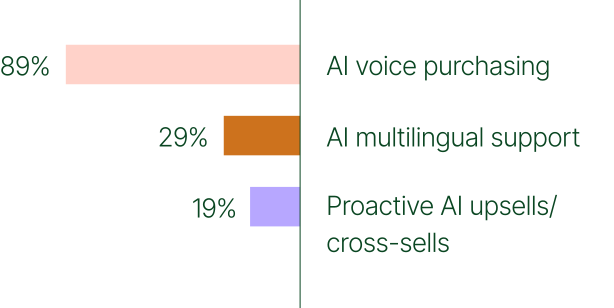
Looking beyond 2026, the conversational commerce landscape will expand in two major directions: voice-based purchasing and proactive AI engagement.
Currently, only 7% of brands use voice assistants for commerce. But nearly 90% anticipate it to be standard by 2030. The big bet is that voice-powered tools will enable customers to shop, reorder, and manage subscriptions and orders entirely through spoken conversations over the phone.
Proactive AI expectations signal an important shift in the ecommerce shopping journey to one that mirrors the in-store, personal shopping experience.
Rather than waiting for customers to initiate contact, AI will anticipate needs based on browsing behavior, purchase history, and lifecycle stage.
While brands are investing across multiple AI use cases, three areas dominate: customer support automation, AI-powered recommendations, and AI-powered personalization.
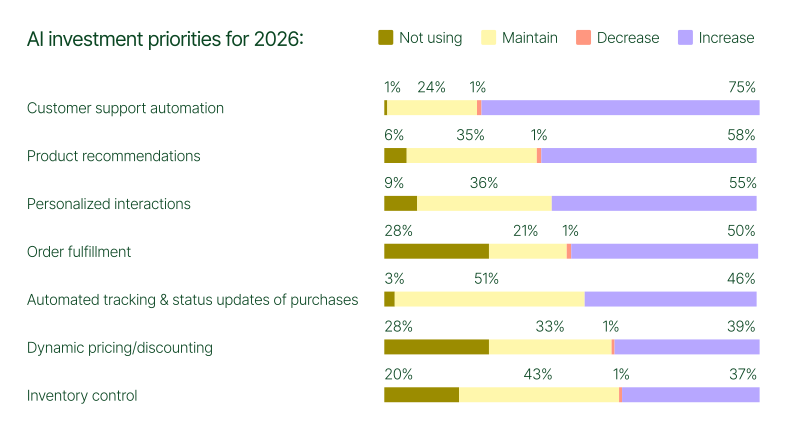
Customer support automation is the clear top AI use case, with 75% of brands planning to increase usage and virtually none planning to roll it back.
Revenue-generating use cases, such as AI-powered product recommendations and personalization, are the next highest priority.
58% of businesses plan to increase investments in AI product recommendations, and 55% are focusing on AI-powered personalization. Brands recognize that conversational AI can do more than save costs; it can actively drive sales.
The strategic framing around conversational AI has fundamentally shifted. Early adoption was motivated by cost reduction and operational efficiency. In 2026, the conversation has moved to revenue growth and competitive positioning.
Ecommerce leaders are no longer justifying AI investments by only calculating support cost savings. They're presenting conversational commerce as a scalable growth driver that can increase conversion rates, boost AOV, lower cart abandonment, accelerate buying cycles, and improve customer lifetime value.