

72% of Gorgias Uses AI for Decisions: How We Did It
Four months ago, our analysts were dealing with a barrage of questions. "What's our ARR by segment?" "Build me a dashboard for this quarter's pipeline." Quick asks piled up behind complex deep dives. Stakeholders waited for answers that should have taken seconds, and analysts spent their time fielding requests instead of doing the strategic work that creates the most value.
Today, anyone at Gorgias can ask a question in plain language and get an accurate, contextualized response in seconds. Not from a colleague or dashboard, nor from a generic answer from the internet. But a response built on our business context. We call it Cortex, our flagship internal AI agent.
In two months, Cortex went from an idea to fielding thousands of questions every week, recommending actions across the business, and deprecating the need for manual dashboard creation. While most companies right now are treating AI as an initiative — at Gorgias, AI is already part of how we work. 72% of Gorgias employees use Cortex each week, and that number is only growing.
We didn’t achieve this by simply plugging a large language model into our stack. LLMs are a critical part of the equation, but they aren't the driving force — it’s everything else under the hood: the infrastructure, context, platform architecture, and the team that brings it all together.
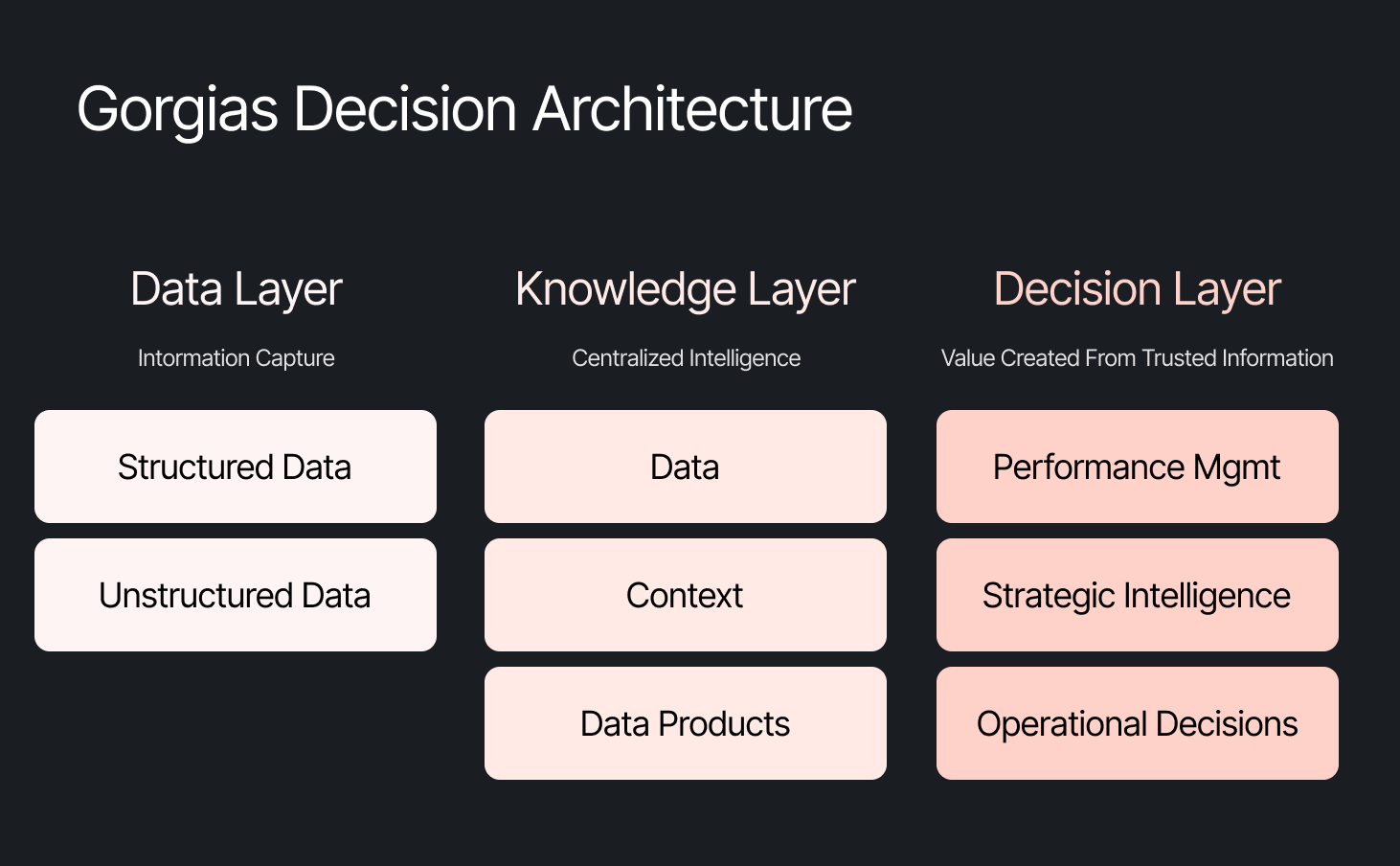
The framing problem most companies get wrong
The instinct across many companies today is to start with the model, pick a provider to solve a specific challenge, or invest heavily in getting the data right. All reasonable starting points, but most of them solve for one use case. Underneath that approach is a framing problem: seeing AI as an initiative — something you assign and measure. Seeing AI as another tool your company uses versus how your company operates.
We started somewhere different. Every company is built on four pillars: customers, people, product, and decisions. AI investments tend to place heavy emphasis on the first three. We started with the fourth. Our bet was that if we built everything around the need to make effective decisions first, asking what Gorgias needed to know to operate well, then our AI would become dramatically more powerful.
Cortex is that philosophy in practice
Cortex is our flagship internal AI agent, and the product where we established the tenets that now run through everything else we build: composable and modular infrastructure, governed context, and accessible from wherever decisions happen. Cortex lives in Slack, as well as across LLM vendors, in its own browser extension, and even on its own dedicated internal site.
Cortex doesn’t stop at answering questions. It can read and write to Notion, file Linear tasks, create HTML apps, automate signal delivery, and more. It operates across every layer of our stack, from dashboards to data pipelines, because we designed it as one integrated system. It is this connection that adds remarkable depth to what people can ask, and what they get in return.
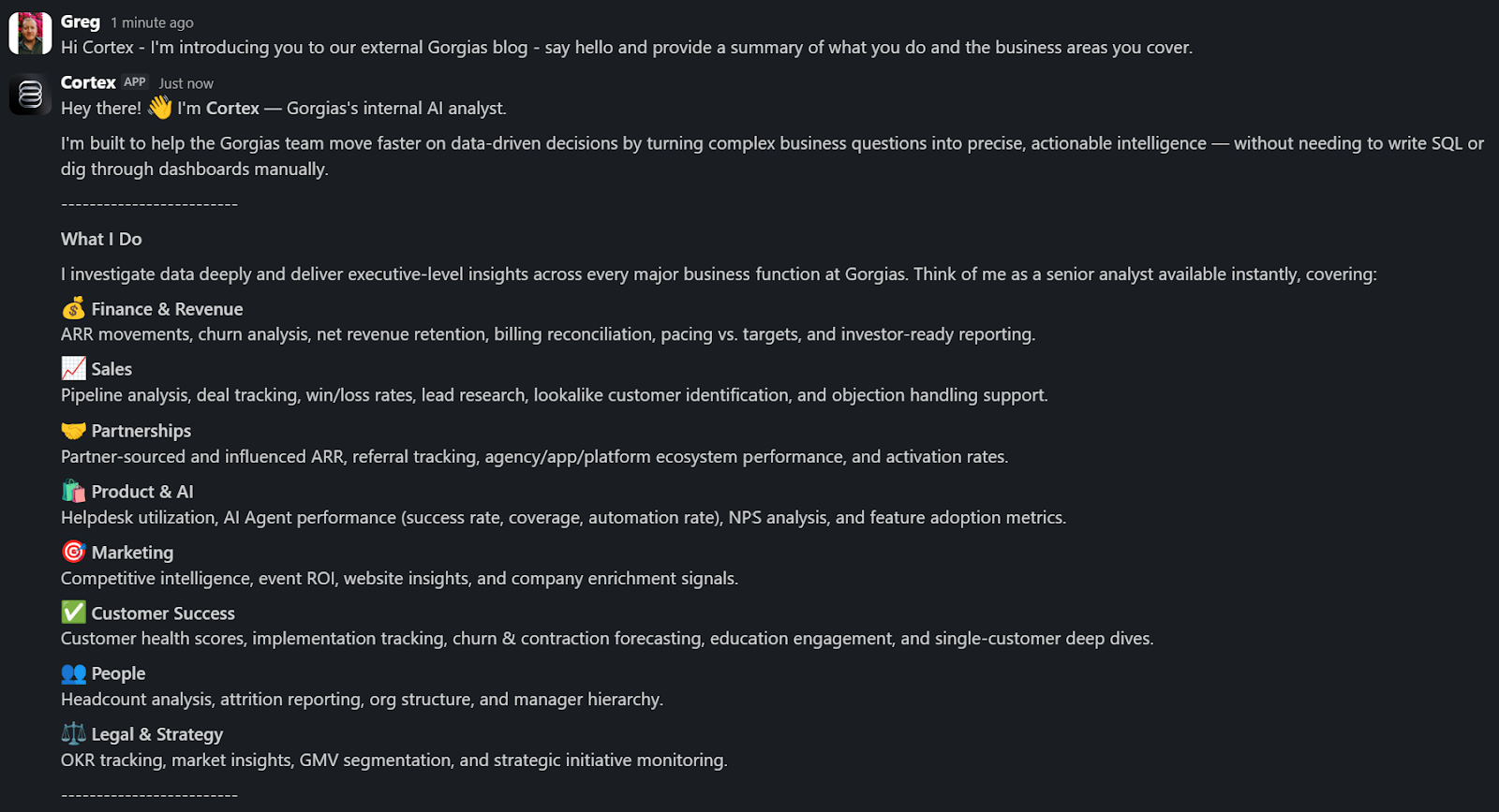
A Sales Lead is pitching and asks Cortex for the full picture of the merchant. In a customized PDF, Cortex lists coverage gaps, pre-sale intent signals, and product fit options. Everything the sales lead needs to walk in with confidence.
A Senior Product leader asks, "How are we performing against OKR #1, and what can my team do to help accelerate it?" Cortex returns a full ARR breakdown, projected end-of-month attainment, segment-level findings, and connects it all back to company-level strategies. A suite of recommendations customized to the leader, the performance, and the signals that bridge how they can support our goals. The kind of answer that used to take someone a week to put together.
These aren't simple lookup queries. They require deep business context spanning multiple areas. Cortex handles these because its Decision Engine gives it the information to reason against governed data, metric definitions, and business context, turning a generic answer into a credible one.
Overnight, teams have built Cortex into how they work. They’re spending less time searching and more time finding answers, not because they were told to, but because Cortex reduced the distance between question and decision.
Flexibility as the foundation
Cortex’s modular infrastructure allows us to experiment and add new capabilities freely. We’ve already built two more internal AI agents made for entirely different use cases, but using the same Decision Engine as Cortex.
GAIA, our internal experimentation AI Agent, helps our customers identify opportunities in their AI Agent Guidance design. It takes institutional knowledge across our teams and turns it into a scalable system that drives automation and value to our customers. Our CEO, Romain Lapeyre, has been its most vocal advocate since day one.
When we needed a platform for investor readiness and board preparation, we built Oracle. Our board decks and talk tracks are informed and built with the same AI, and our numbers are validated every step of the way.
We’re continuing to expand new AI agents internally, exploring how they can create value for customers and our own teams.
AI has transformed how data teams create value, and we’ve already shifted to account for it
When AI handles thousands of analytical questions each week, the highest-value work for a data team shifts permanently. Late 2025, we repositioned from a Data Analytics function into a Decision Intelligence function — a structural change in what we own and how we operate.
Today, our analysts focus on the most sensitive, complex, and forward-looking decisions and analyses. They partner more deeply with stakeholders by driving next steps from signals. They're even building entirely new capabilities that didn't exist in their role descriptions months ago. Things like AI skills for Cortex, context curation, and insight and recommendation delivery. The role of the analyst hasn't diminished. It's expanded to encompass the most meaningful work an analyst can do: driving outcomes and ensuring those decisions can achieve them.
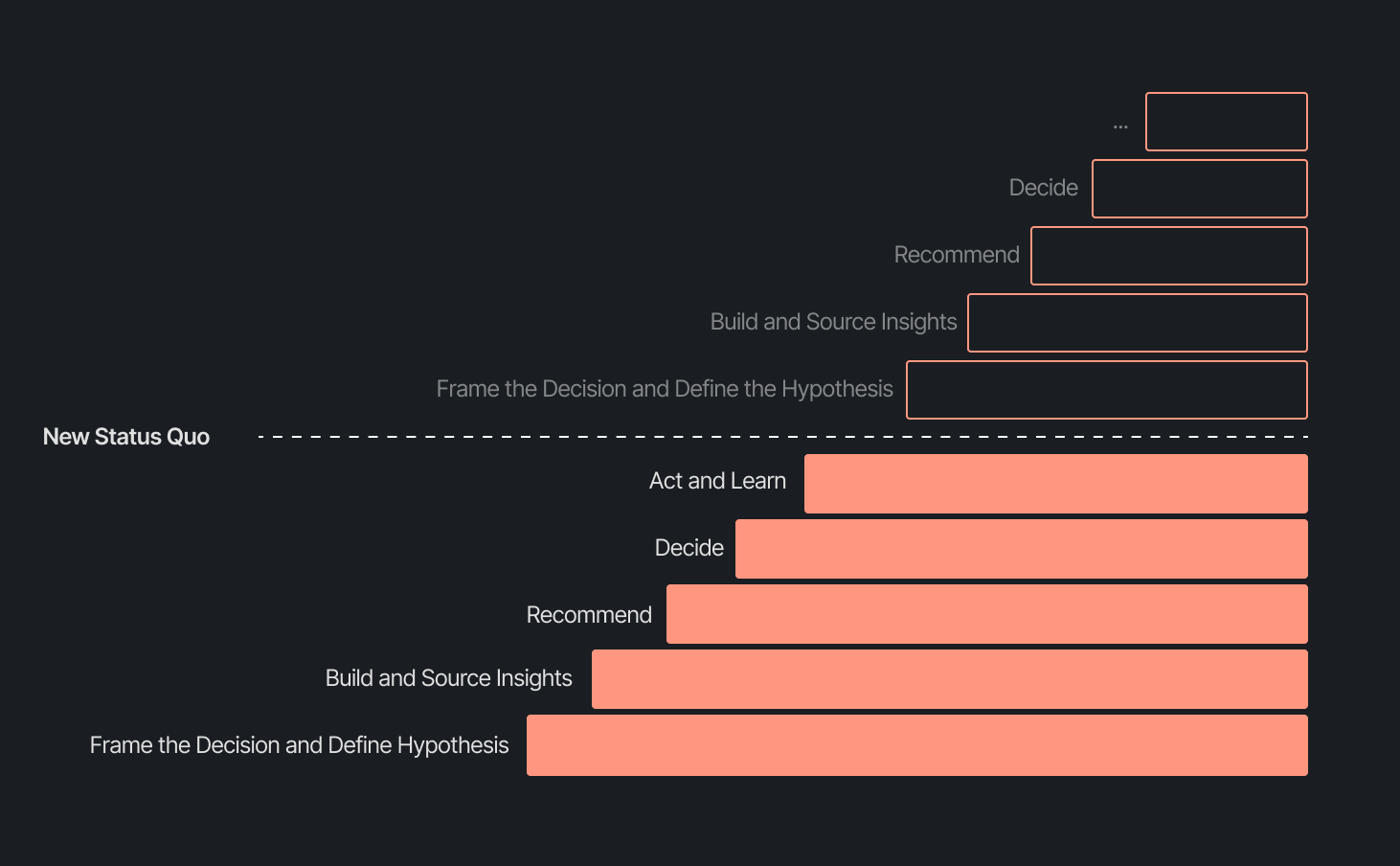
Our business support model has changed, too. Instead of embedding analysts and dedicated engineers within functional teams, we align capacity to the highest-impact company objectives and move fluidly across them. This model works even better because Decision Intelligence brings together both analytics and engineering teams under one roof.
Elliot Trabac leads our Data, Context and AI Engineering teams. The Decision Engine, Cortex, GAIA, and the platforms I've described exist because of the infrastructure his team innovated and built from the ground up. Noemie Happi Nono leads our Decision Strategy and Operations team, driving decision outcomes with stakeholders, advancing the development of Cortex skills and capabilities, and pushing into new areas of analysis every day.
Together, they're shaping what a modern data function looks like when AI becomes a standard building block for how a company operates.
What’s next for the Decision Intelligence team
The question of ROI is long gone. AI has opened the floodgates to more trusted and meaningful signals than ever. The natural next evolution is Proactive Intelligence, signals surfaced toward what you need to know, before you ask. And we're already building this because our architecture is designed to support it.
In the coming weeks, members of the Decision Intelligence team will go deeper into themes I've touched on here. Yochan Khoi, a Senior Analytics Engineer on our team, recently published a technical walkthrough of our context layer and will go further into building context strategies that scale. Others will cover infrastructure, analytical partnerships, evolving data assets into decision assets, and the cost and efficiency gains that make sustained AI investment viable.
AI hasn't changed the most important element of data and analytics functions — delivering outcomes — but it has raised the bar for what it looks like and how far we can take it. We’re just getting started.
TL;DR:
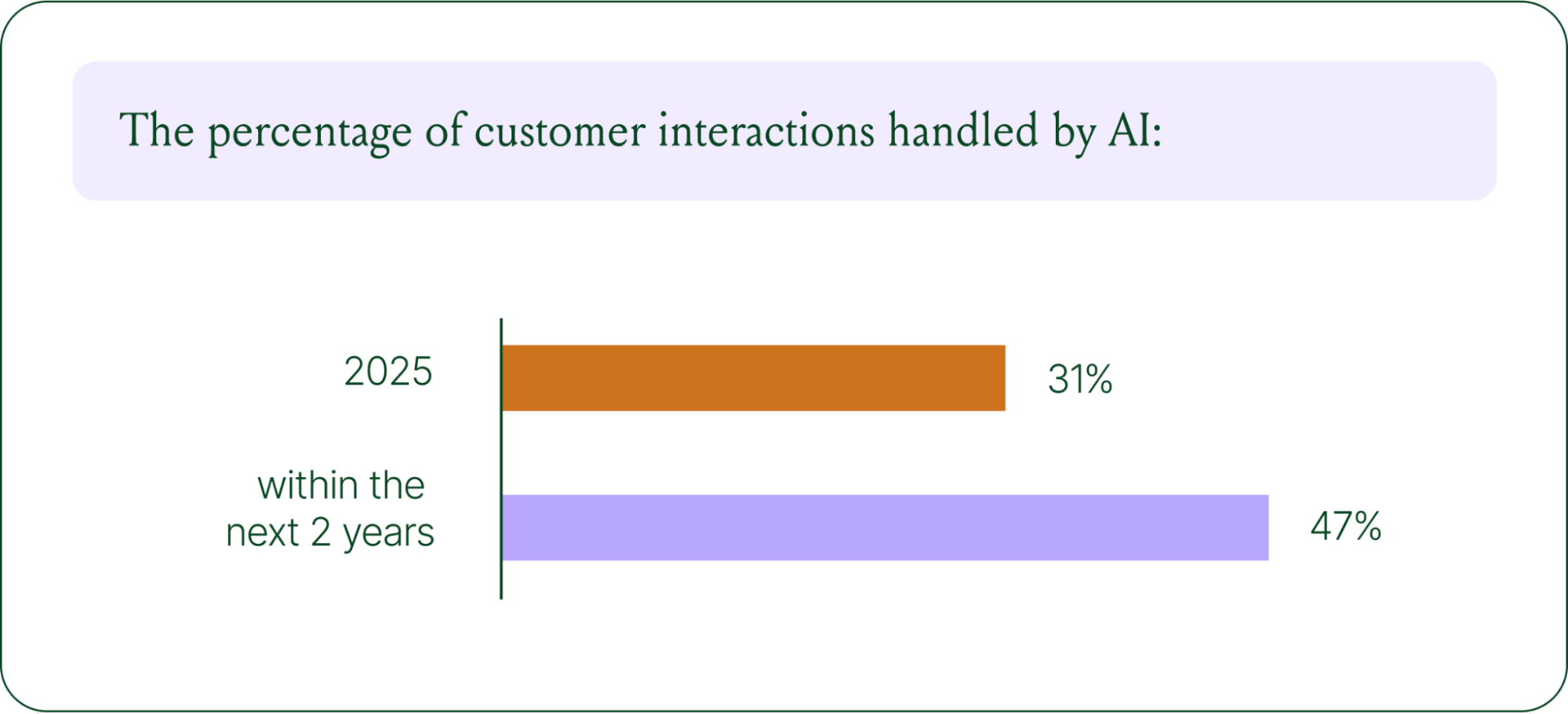
- AI is resolving tickets, not just replying. AI now handles 31% of customer interactions for ecommerce brands, and that number is expected to nearly double within two years.
- Every channel is becoming a storefront. Conversations are replacing the traditional browse-and-buy journey, with 79% of brands reporting sales from AI-driven interactions.
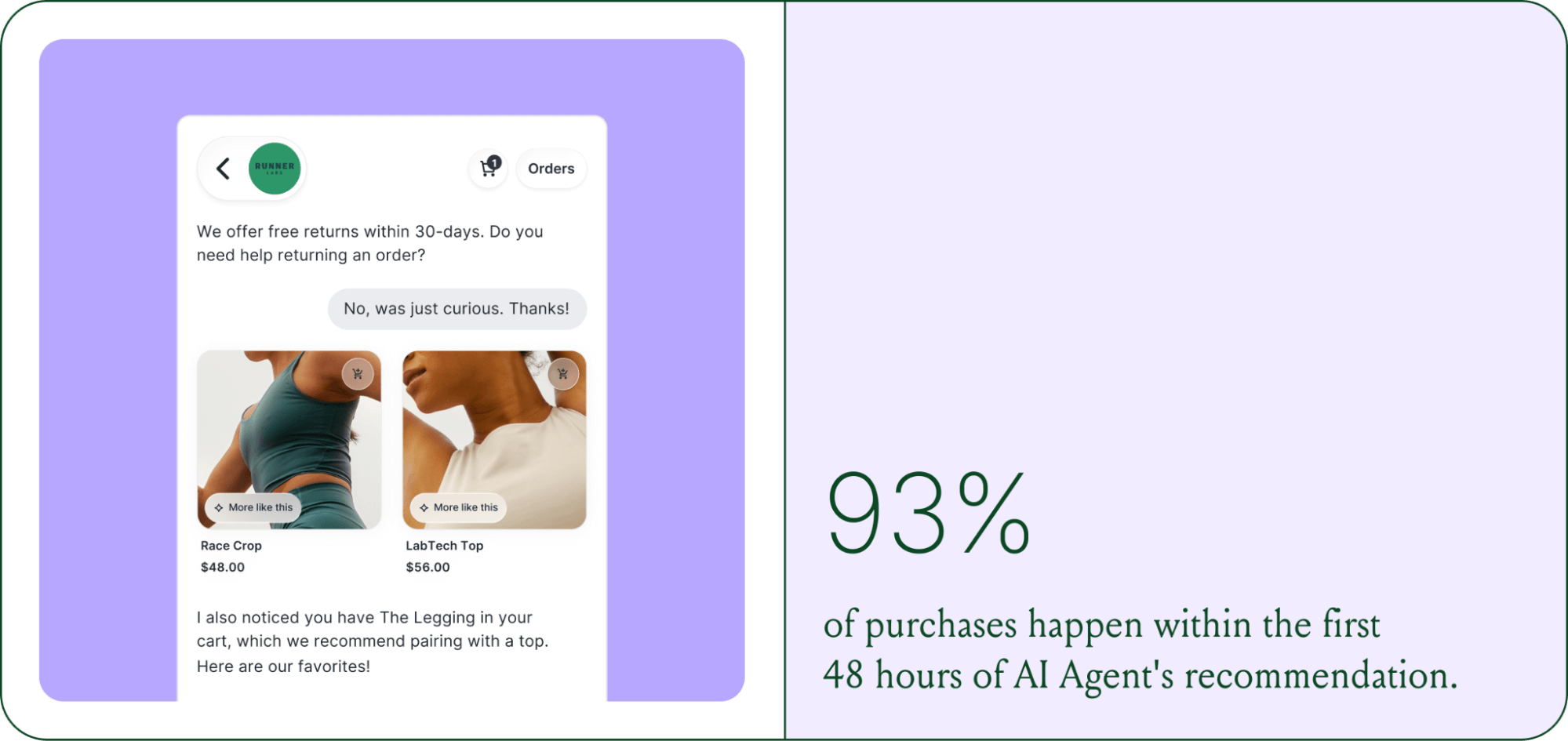
- AI is shortening the buying cycle. 93% of AI-influenced purchases happen within the first 48 hours of the conversation.
- CX teams are changing, not shrinking. Ecommerce brands are actively hiring for more technical roles to implement, coach, and maintain AI.
- The winning model is hybrid. AI handles volume and speed, while humans handle complexity and judgment.
The way shoppers buy online has shifted and customers are at the center.
They no longer want to scroll through product pages, dig through FAQs, or wait 24 hours for an email reply. They open a conversation, ask a specific question, and expect a useful answer in seconds. Brands that can’t deliver these experiences at scale are seeing customer hesitation turn into abandoned carts and lost revenue.
This shift has a name: conversational commerce. It's the practice of using real-time, two-way conversations as your primary sales channel, through chat, AI agents, messaging apps, and voice.
What started as an experiment for early adopters has become a key growth lever, with 84% of ecommerce brands treating conversational commerce as a strategic pillar this year vs. last year.
We surveyed 400 ecommerce decision-makers across North America, the U.K., and Europe to understand how conversational commerce and AI are reshaping the ecommerce landscape. These findings are complemented by aggregated and anonymized internal Gorgias platform data from 16,000+ ecommerce brands.
The State of Conversational Commerce in 2026 trends report breaks down all of the findings, including five key trends shaping the ecommerce landscape.
{{lead-magnet-1}}
Trend 1: AI is table stakes for ecommerce and it’s no longer just about efficiency
A few years ago, adding an AI chatbot to your site that could provide tracking links and Help Center article recommendations was a differentiator. Today, it's table stakes. McKinsey found that 71% of shoppers expect personalized experiences, and 76% get frustrated when they don't get them.
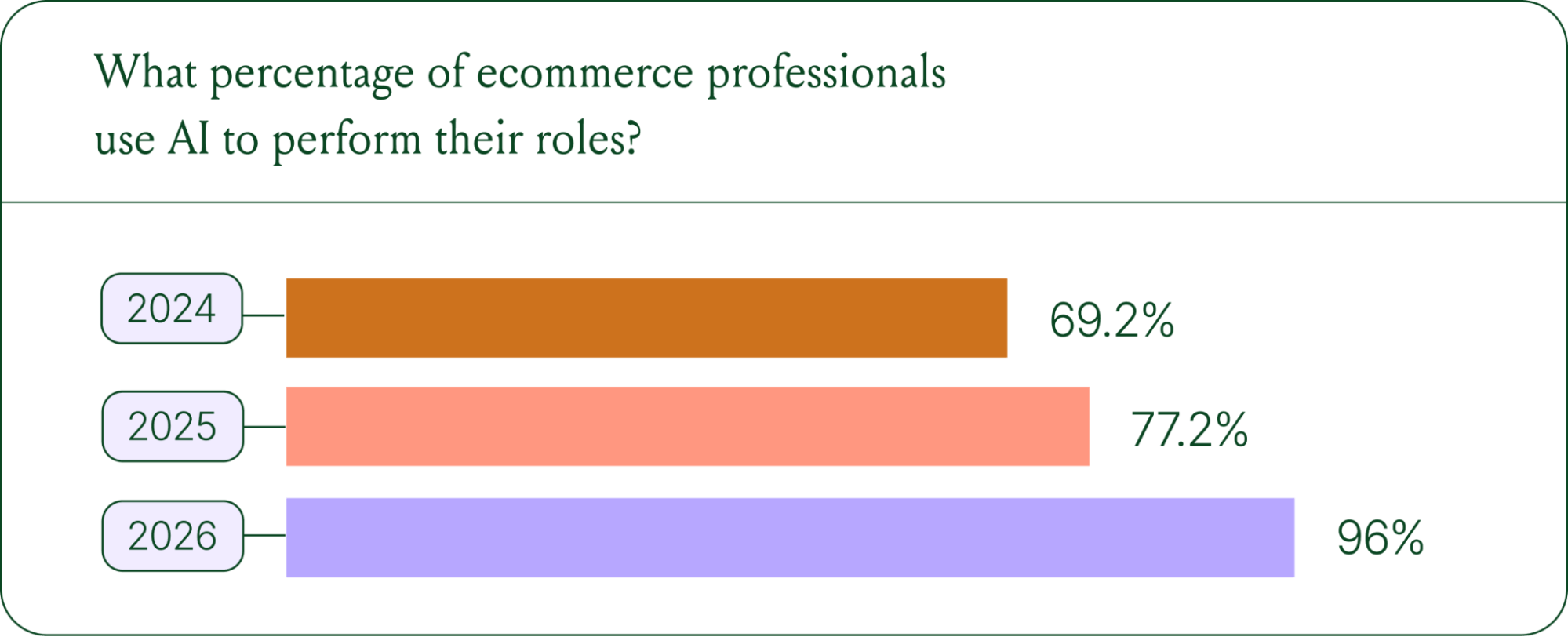
Right now, most ecommerce professionals use AI, with 93% having used it for at least 1 year. Enthusiasm is accelerating quickly, with only 30% of ecommerce professionals rating their excitement for AI at 10/10 in April 2025. Similarly, while AI adoption rose steadily year over year, it reached a clear peak in 2026.
The use cases driving this adoption are practical and high-volume:
- Order tracking and status updates
- Returns, exchanges, and refund requests
- Shipping FAQs and delivery estimates
These are the tickets that flood brands’ inboxes every day. AI agents resolve them instantly, without pulling teams away from conversations that actually require human judgment.
Explore AI adoption and use case data in more depth in the full report.
Trend 2: Conversations are the new path to checkout
The traditional ecommerce funnel, visit site, browse products, add to cart, check out, is losing ground. Shoppers now discover products on Instagram, ask questions via direct message, and complete purchases without ever visiting a website.
Conversational AI is actively increasing revenue, with 79% of brands reporting that AI-driven interactions have increased sales and conversion in their business.

The practical implication is that every channel is becoming a storefront. Creating personalized touchpoints with customers earlier in the journey, through proactive engagement, is impacting the bottom line.
Read the full report to explore how AI conversions have increased QoQ by industry.
Trend 3: AI is accelerating the purchase cycle
Pre-purchase hesitation is one of the biggest conversion killers in ecommerce. A shopper lands on your product page, has a question about sizing or compatibility, can't find the answer quickly, and leaves. That's a lost sale that had nothing to do with your product.
Conversational AI changes that dynamic. When a shopper can ask a question and get an accurate, personalized answer in real time, the friction disappears.
Brands using Gorgias saw this play out at scale in 2025. When AI Agent recommended a product, 80% of the resulting purchases happened the same day, and 13% happened the next day.
Brands are further accelerating the buying cycle through proactive engagement. On-site features such as suggested product questions, recommendations triggered by search results, and “Ask Anything” input bars drove 50% of conversation-driven purchases during BFCM 2025.
Explore how AI is collapsing the purchase cycle in Trend 3 of the report.
Trend 4: AI is making CX teams more technical
There's a persistent narrative that AI is making CX teams redundant. The data tells a different story. 62% of ecommerce brands are planning to grow their teams, not cut them. But the scope of those teams is changing.

New roles are emerging around AI configuration and quality assurance. Teams are investing in technical members to write AI Guidance instructions, develop tone-of-voice instructions, and continuously QA results.
CX teams are also bridging the gap between support goals and revenue goals, as the two functions increasingly overlap.
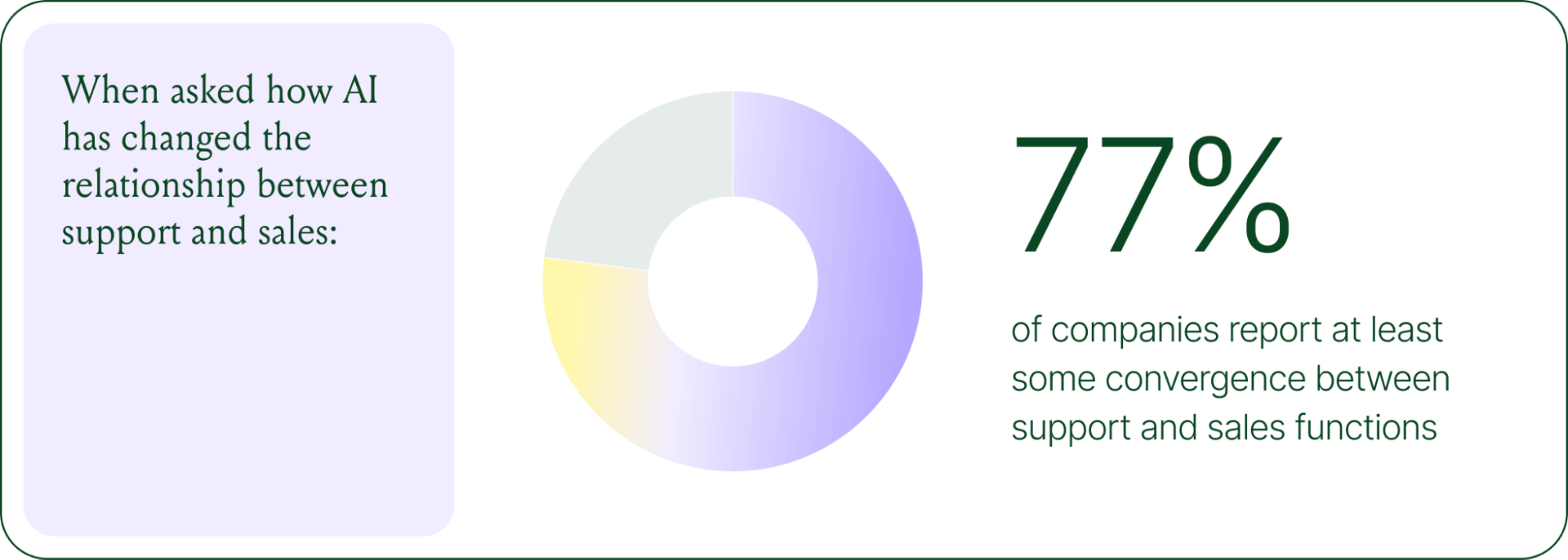
The result is CX teams that are more technical than they were before. Agents who once spent their days answering repetitive tickets are now spending that time on higher-value work: complex escalations, VIP customer relationships, and improving the AI systems and knowledge bases that handle the volume.
Learn more about the evolution of CX roles in Trend #4.
Trend 5: The future is hybrid: AI-first, humans when it counts
Despite increasing AI adoption, data shows that ecommerce brands shouldn’t strive for 100% automation. Winning brands are building systems in which AI handles repetitive tier-1 tickets, and humans handle complex, sensitive cases.

AI handles speed and scale. It resolves order-tracking requests at 2 a.m., processes return-eligibility checks in seconds, and answers the same shipping question for the thousandth time without compromising quality.
Human agents handle conversations that require context, empathy, or decisions that fall outside the standard playbook. There are several topics where shoppers still prefer human support.
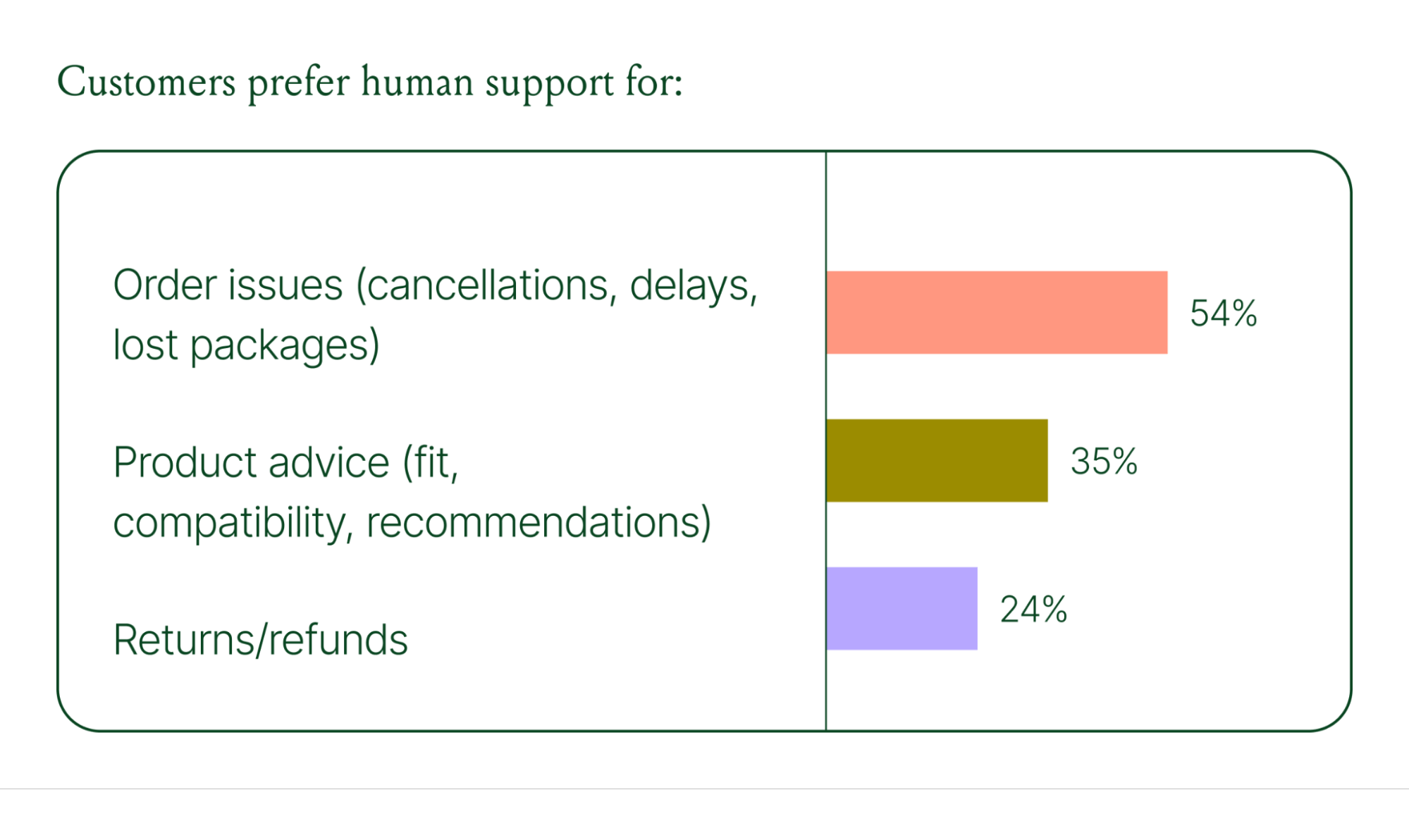
Successful hybrid systems require continuous iteration, meaning reviewing handover topics, Guidance, and reviewing AI tickets on a weekly basis.
Discover how leading brands are balancing human and AI systems in Trend #5.
Where conversational commerce is heading by 2030
The 2026 trends are about expansion and standardization. The 2030 predictions are about what comes next.
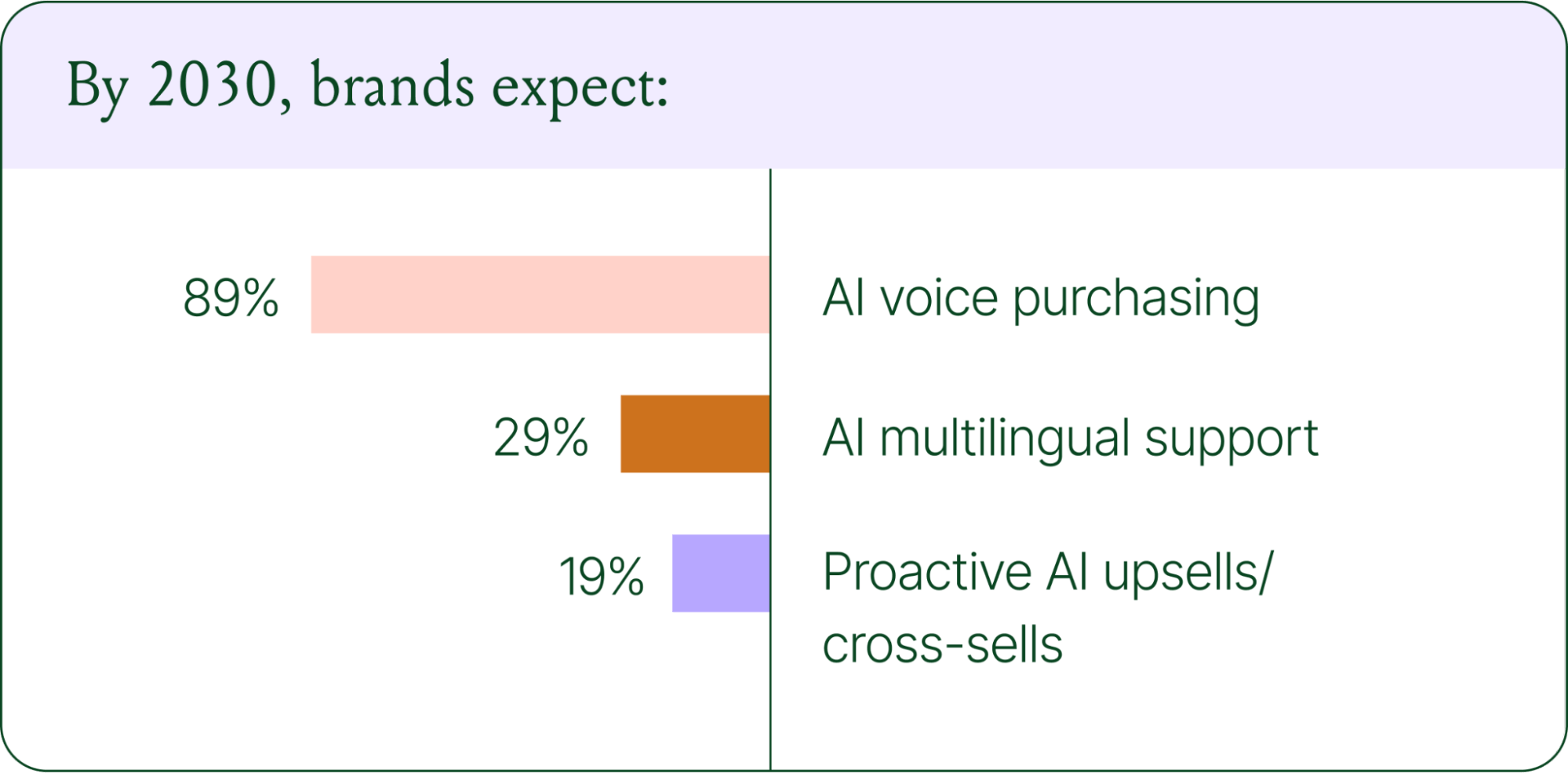
Voice-based purchasing is the biggest bet on the horizon. Only 7% of brands currently use voice assistants for commerce, but 89% expect it to be standard by 2030. The vision is a customer who can reorder a product, check their subscription status, or manage a return entirely over the phone.
Proactive AI is the other major shift. Rather than waiting for a customer to reach out, AI will anticipate needs based on browsing behavior, purchase history, and where someone is in their relationship with your brand. Think of it as the digital equivalent of a sales associate who remembers what you bought last time and knows what you're likely to need next.
Explore where ecommerce brands are allocating their AI budgets in the full report.
Start building your conversational commerce strategy today
The brands winning in 2026 are creating smart, scalable systems where AIhandles volume and humans handle nuance. They’re treating every conversational channel as an opportunity to serve and sell.
The data is clear: AI adoption is accelerating, customer expectations are rising, and the revenue impact of getting this right is measurable.
{{lead-magnet-1}}
Newsletter Signup
The best in CX and ecommerce, right to your inbox
Featured articles

Conversations Are Becoming a Revenue Channel: The Data Proves It
TL;DR:
- Customer journeys are collapsing to a single conversation. The traditional browse-and-buy journey is giving way to AI-guided shopping that moves from discovery to purchase in a single exchange.
- 79% of brands say AI-driven conversational commerce has increased their sales and purchase rates.
- AI-only influenced orders grew 63% in a single year, from 2.7 million in Q1 to 4.4 million in Q4.
- Brands treating conversation as a revenue channel. They’re not just a support function, generating higher AOV, shorter buying cycles, and stronger retention.
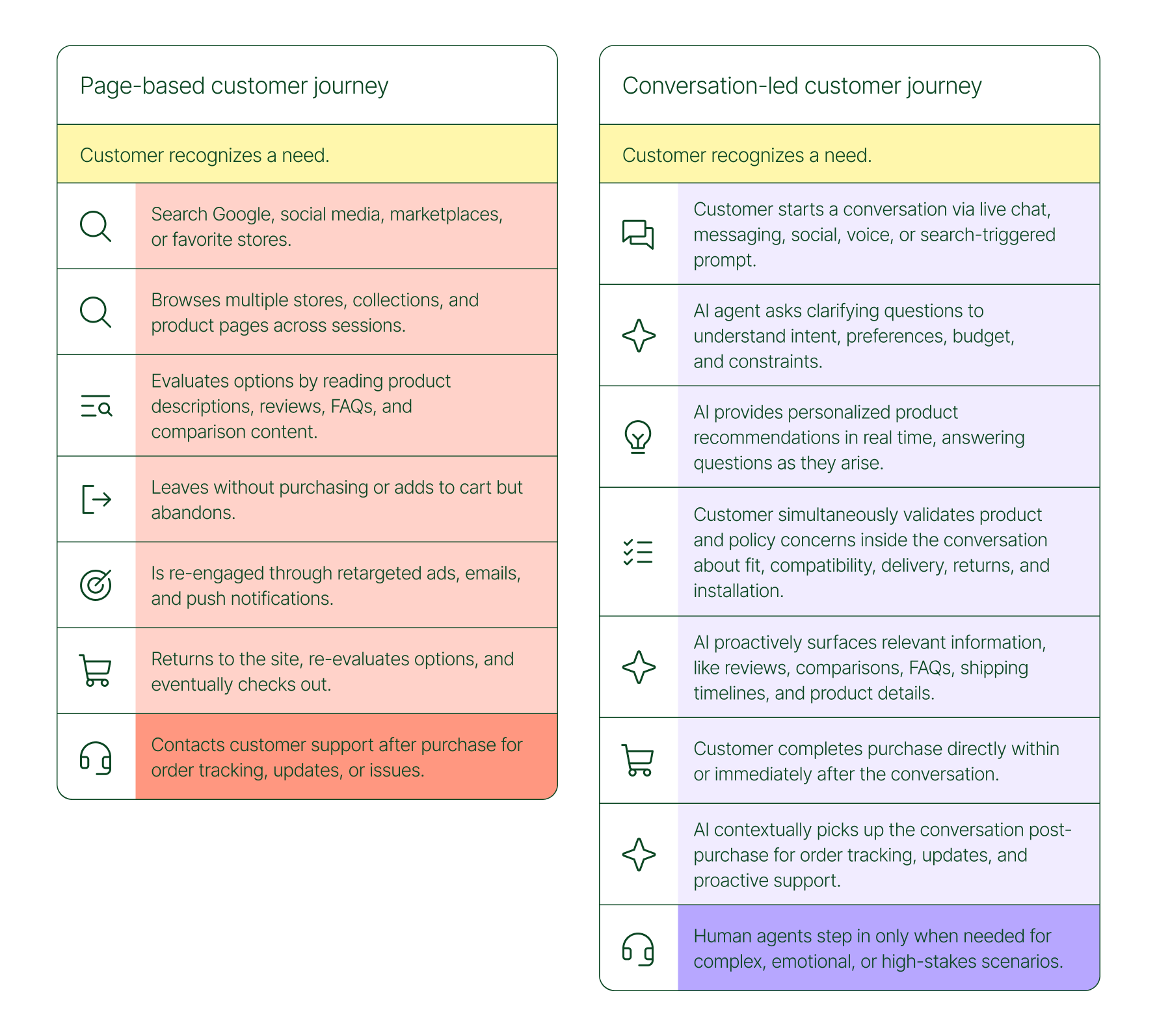
The page-based shopping experience dominated for decades. Customers would search, browse, compare, abandon, get retargeted, return, and eventually buy (sometimes).
That journey is no longer the only option.
Shoppers are turning to chat, messaging, and AI-powered tools to find what they need. Instead of clicking through product pages or reading static FAQs, they ask questions, have back-and-forth conversations, and get answers that move them closer to a purchase in real time. The path to checkout has changed, and the brands that recognize this are pulling ahead.
Read our 2026 State of Conversational Commerce Report to learn more about conversation commerce trends from 400 ecommerce decision-makers and 16,000+ ecommerce brands using Gorgias.
{{lead-magnet-1}}
The shopping journey has collapsed into a single thread
The traditional shopping journey was a solo experience. A shopper had a need, searched for options, browsed across sessions, and eventually made a decision — often days later, after being retargeted multiple times. Support only entered the picture after the purchase.
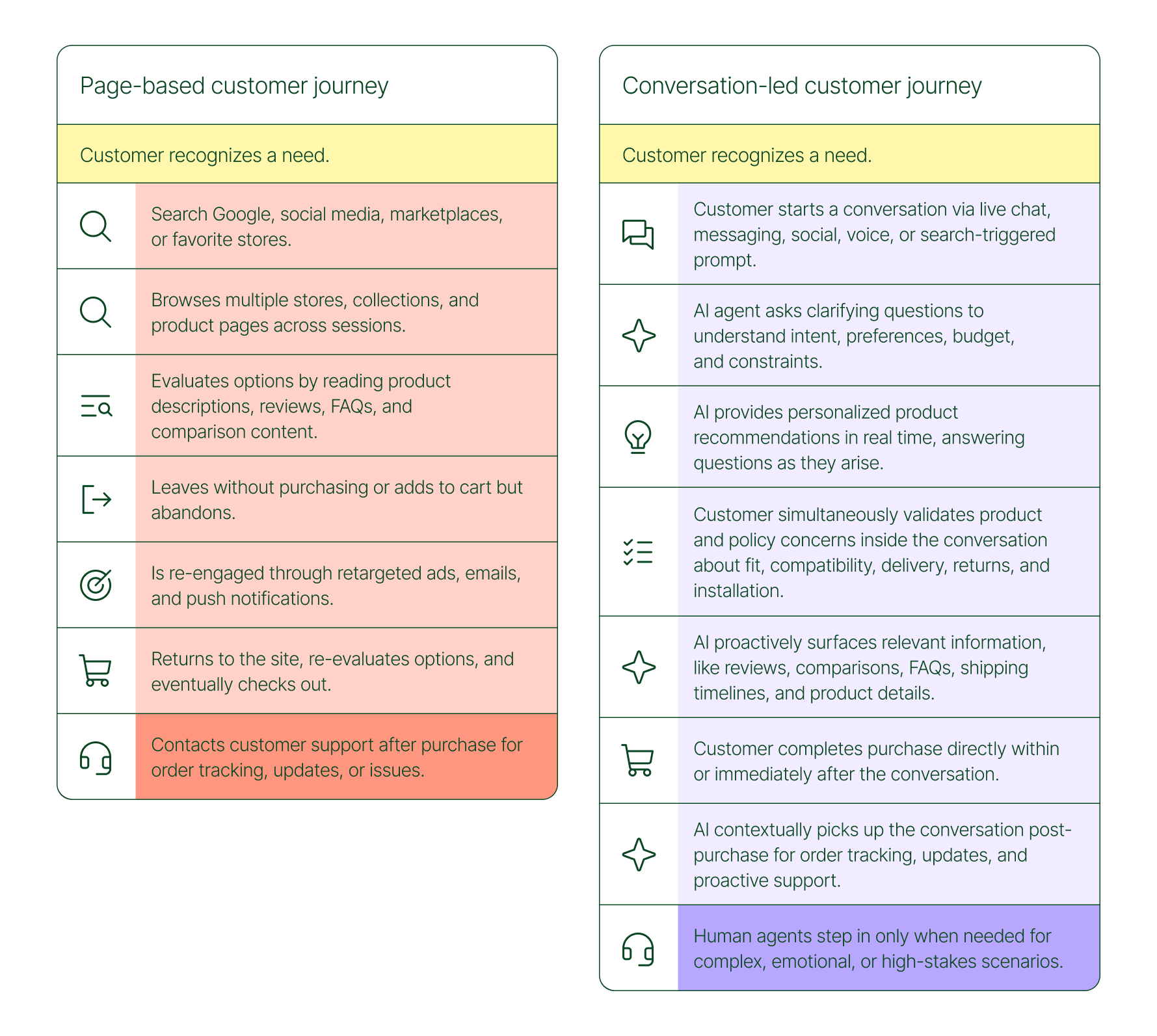
The conversation-led journey collapses that timeline:
- A shopper recognizes a need and starts a conversation via chat, messaging, or a search-triggered prompt
- An AI agent asks clarifying questions about preferences, budget, and constraints
- The AI provides personalized product recommendations in real time
- The shopper validates concerns about fit, compatibility, delivery, and returns, all inside the conversation
- The shopper completes the purchase directly within or immediately after that exchange
- The AI picks up the conversation post-purchase for order tracking and proactive support
- A human agent steps in only when the situation calls for it
What used to take days now takes minutes. Discovery, evaluation, and purchase happen in a single thread.
Conversation is a revenue strategy, not a support upgrade
79% of brands agree that AI-driven conversational commerce has increased sales and purchase rates in their business. When brands were asked to rank the highest-return areas:
- 38% cited improved customer support efficiency
- 23% pointed to higher customer retention and loyalty
- 20% saw improved purchase rates
Those numbers reflect something important: the value of conversation compounds. Faster support reduces friction. Better retention raises lifetime value. More confident shoppers buy more often and spend more per order.
The brands seeing the biggest returns aren't just using AI to deflect tickets. They're using it to create one-to-one shopping experiences at scale.
What the data shows about AI-influenced orders
Looking at AI-only influenced orders across key verticals like Apparel and Accessories, Food and Beverages, Health and Beauty, Home and Garden, and Sporting Goods, the growth across a single year was significant.
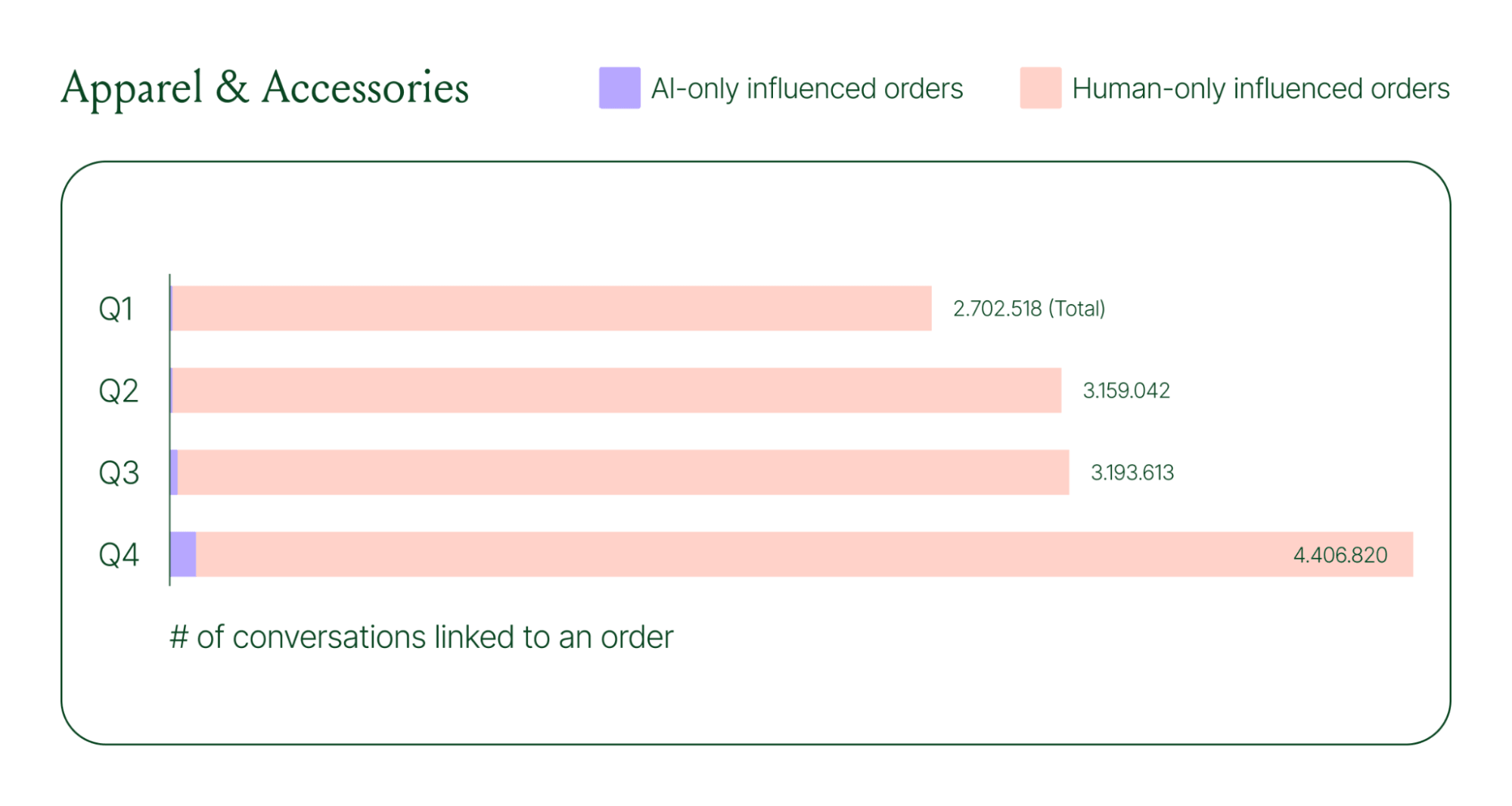
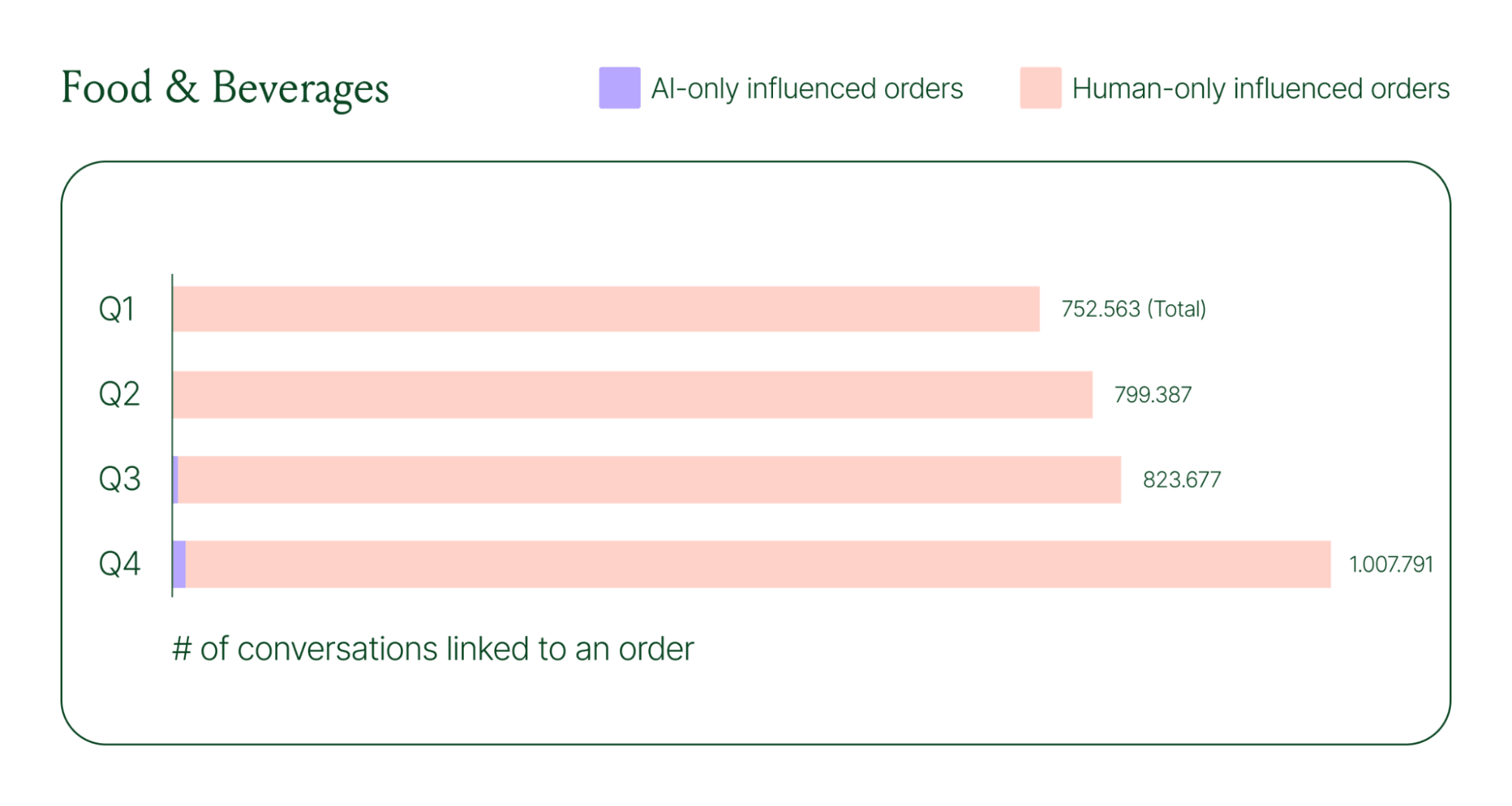
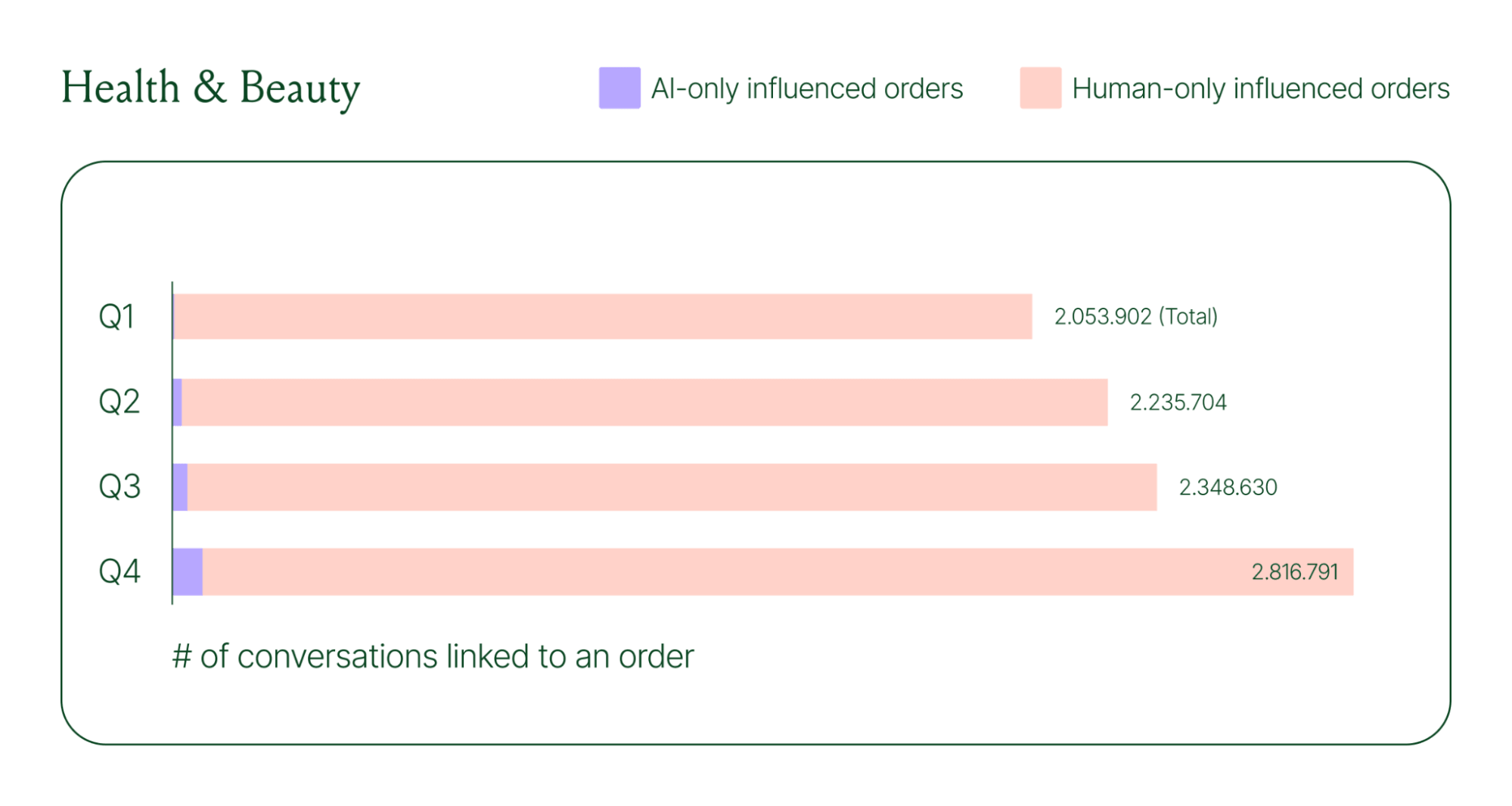
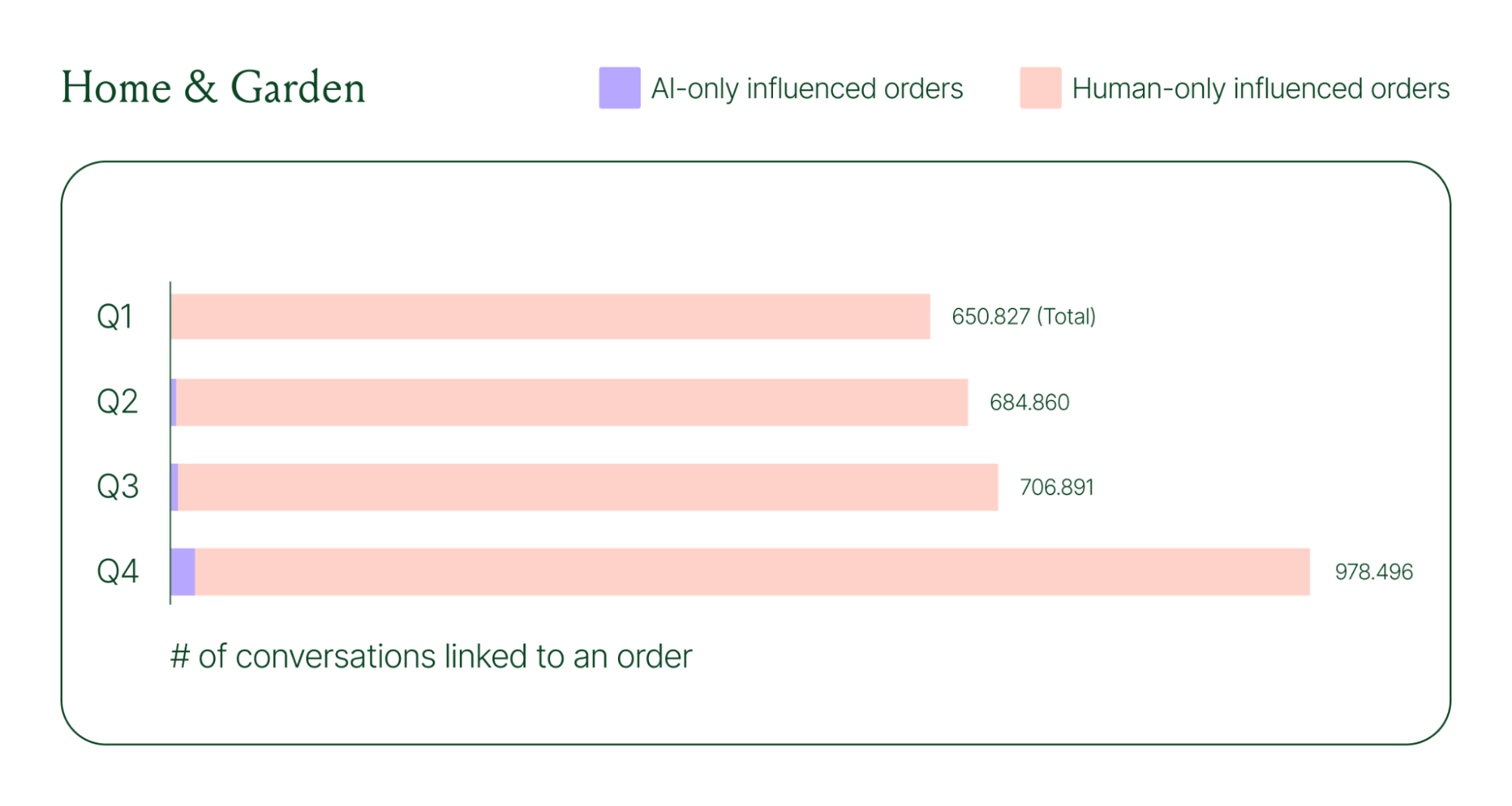
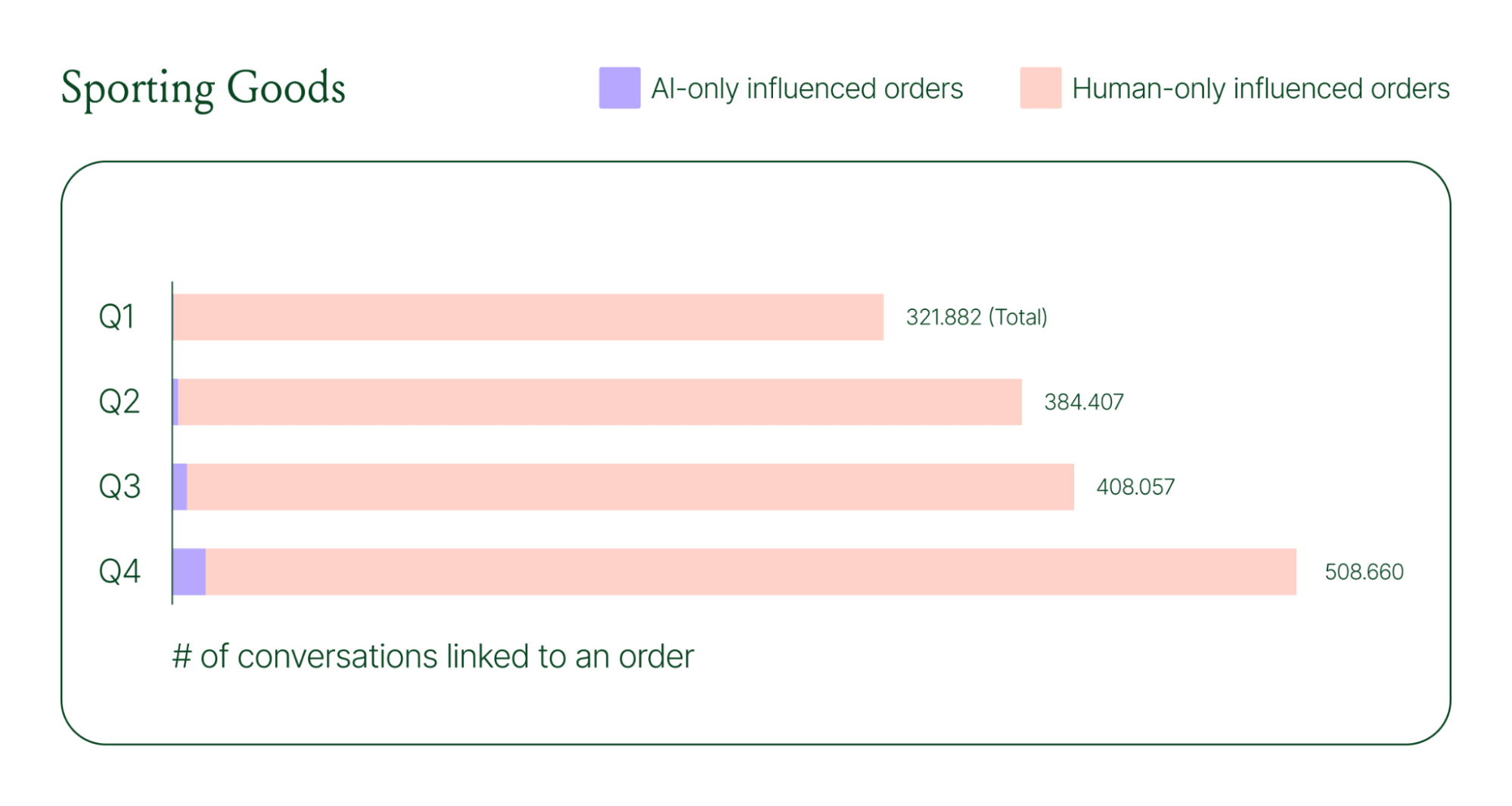
Across industries, ecommerce brands saw AI step into conversations, reduce shopper hesitation, and drive higher QoQ conversion rates.
Learn more about AI-powered revenue generation in the full 2026 Conversational Commerce Report.
Why brands are making this a strategic priority
84% of brands say the strategic importance of conversational commerce is higher than it was a year ago. 82% agree it will be mainstream in their sector within two years.
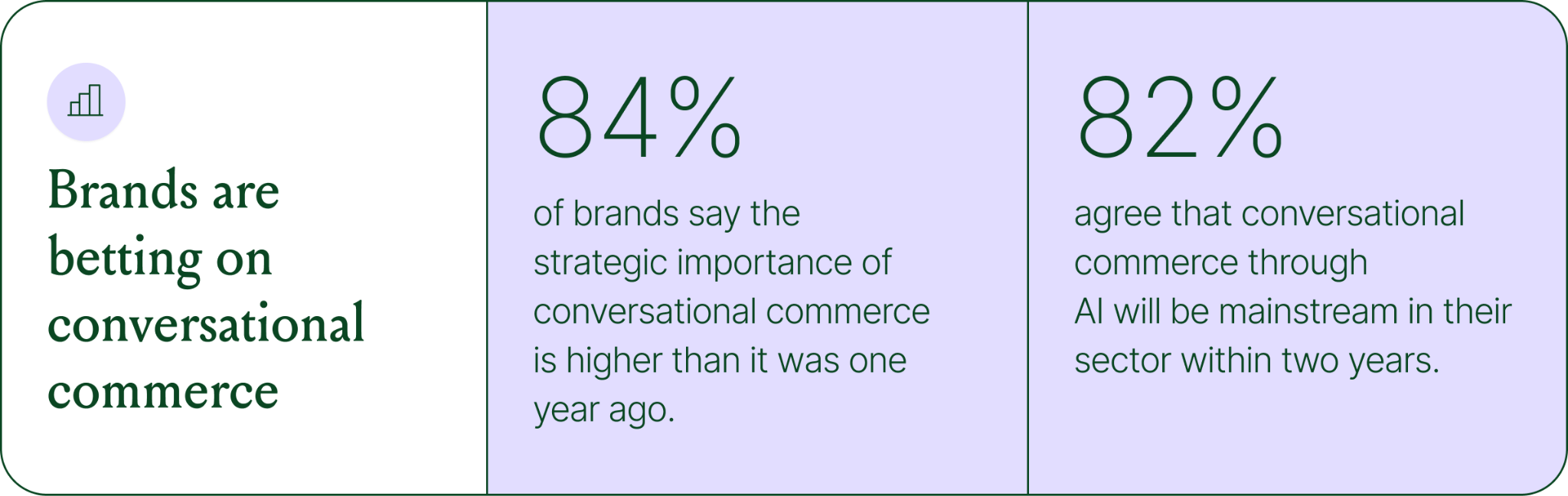
That shift is registering at the leadership level because of what conversational commerce does to the buying experience. Creating one-to-one touchpoints earlier in the journey drives higher AOV, shorter buying cycles, and stronger purchase rates. Shoppers who get real-time answers to their questions are more confident.
What this looks like in practice: TUSHY
TUSHY, known for eco-friendly bidets and bathroom essentials, is a useful example of what happens when you take conversational commerce seriously.
Bidets aren't an impulse purchase. Shoppers have real questions about fit, compatibility, and installation. Those questions used to go unanswered until the CX team could respond, often after the customer had abandoned the cart.
TUSHY used Gorgias's AI Agent and shopping assistant capabilities to automate pre-sales support. AI Agent engaged shoppers in real-time conversations, addressed their concerns directly, and built confidence at the moment of highest intent.
This resulted in a 190% increase in chat-based purchases, a 13x return on investment, and twice the purchase rate of human agents.
How to apply this to your strategy
You don't need to overhaul your entire operation to start seeing results. The most effective approach is to start where the impact is clearest and expand from there.
A few places to begin:
- Pre-sales chat. Identify your most common pre-purchase questions (sizing, compatibility, shipping timelines) and ensure your AI can answer them confidently and promptly.
- Product page engagement. Use proactive chat prompts triggered by page behavior to start conversations before shoppers leave.
- Post-purchase follow-up. Let AI pick up the conversation after checkout with order updates and proactive support, reducing inbound volume and building trust.
- Human escalation. Define clearly which situations require a human agent – complex issues, emotional exchanges, high-stakes decisions.
Want to see the full picture of where conversational commerce is headed in 2026? Read the full report to explore the data, trends, and strategies shaping the next era of ecommerce.
{{lead-magnet-1}}
AI Is Table Stakes for Ecommerce: What the Data Tells Us About 2026
TL;DR:
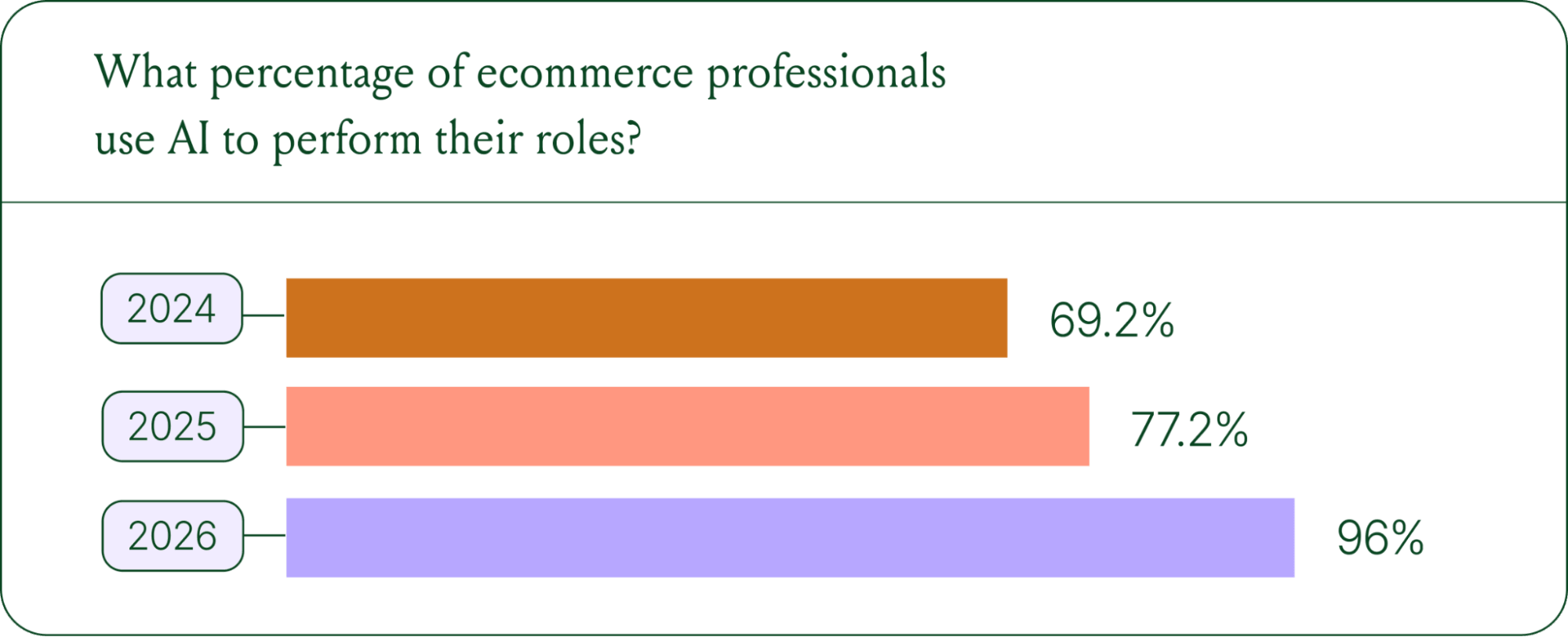
- AI adoption is rapidly accelerating. 96% of ecommerce professionals now use AI in their roles, up from 69% in 2024.
- AI has moved beyond support automation. Use cases have evolved into revenue generation, personalization, and logistics.
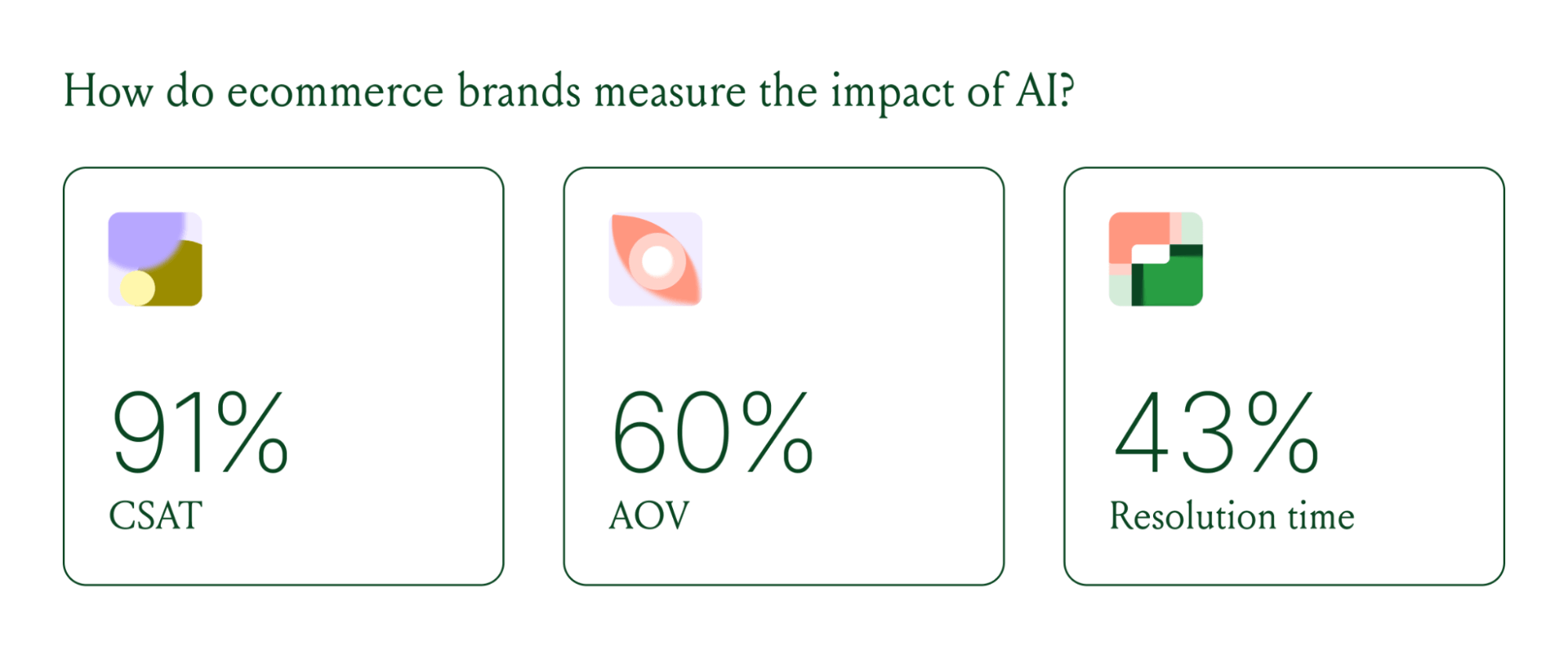
- Brands are tying AI success to profit-and-loss outcomes. 60% of brands consider AOV a top indicator of AI effectiveness.
A year ago, ecommerce brands were still debating whether AI was worth the investment. That debate is over. Today, nearly every ecommerce professional uses AI to do their job.
The shift isn't just about adoption. It's about what AI is used for and how brands measure its impact. Support automation was the entry point. Now, AI is embedded across the full operation, from product recommendations to inventory control to real-time shopping conversations.
In our 2026 State of Conversational Commerce Report, we break down trends on AI usage among 400 ecommerce decision-makers and 16,000+ ecommerce brands using Gorgias.
{{lead-magnet-1}}
AI adoption has reached a tipping point
If we rewind 12 months ago, the industry was still split on AI. Some ecommerce professionals were excited, but most were still hesitant. In 2024, 69% of ecommerce professionals used AI in their roles. By 2025, that number reached 77%. In 2026, it hit 96%.
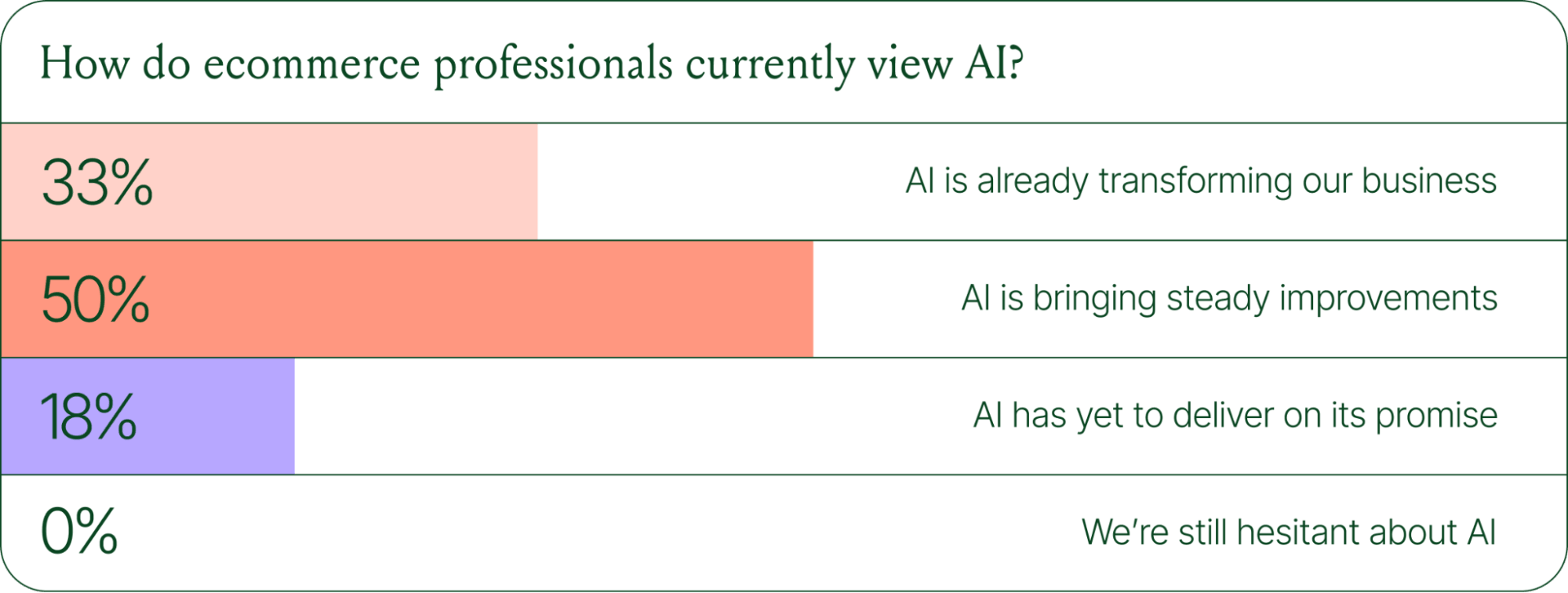
The confidence numbers back it up. 71% of brands say they are confident using AI for ecommerce, and 73% are satisfied with its business impact.
In early 2025, only 30% of ecommerce professionals rated their excitement for AI at 10/10. Today, zero percent of respondents describe themselves as hesitant about AI.
AI use cases now span the full ecommerce stack
Using AI in ecommerce is not new. In fact, it dates back to the 1980s with the invention of algorithms and expert systems. And if you’ve ever leveraged similar product recommendations or chatbots, you’ve already integrated AI into your ecommerce stack.
Modern AI is far more sophisticated.
With the rise of agentic commerce and conversational AI, brands began leveraging AI agents to automate the processing of repetitive support tickets. That’s still happening today, but the scope has expanded beyond the support queue.
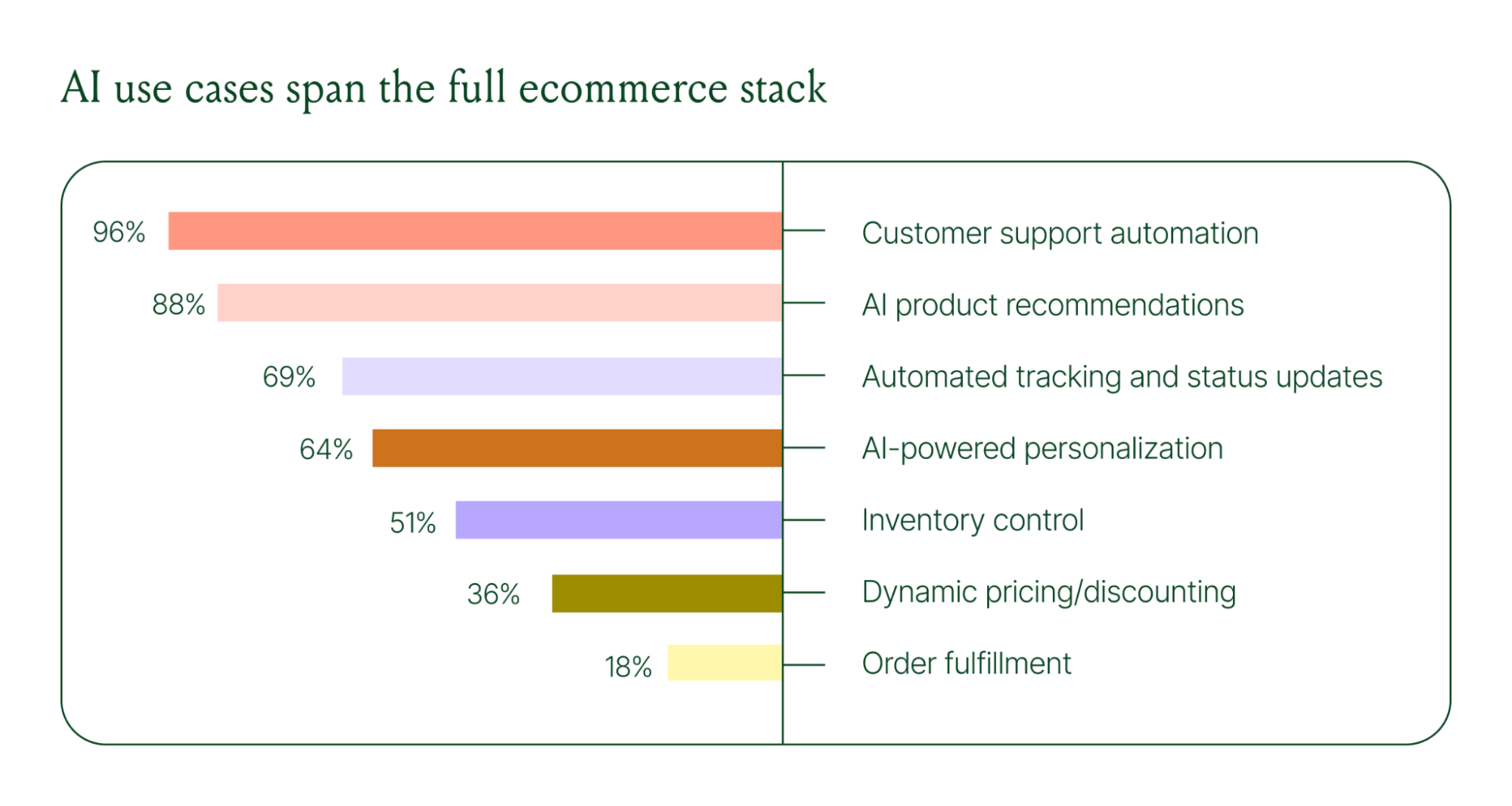
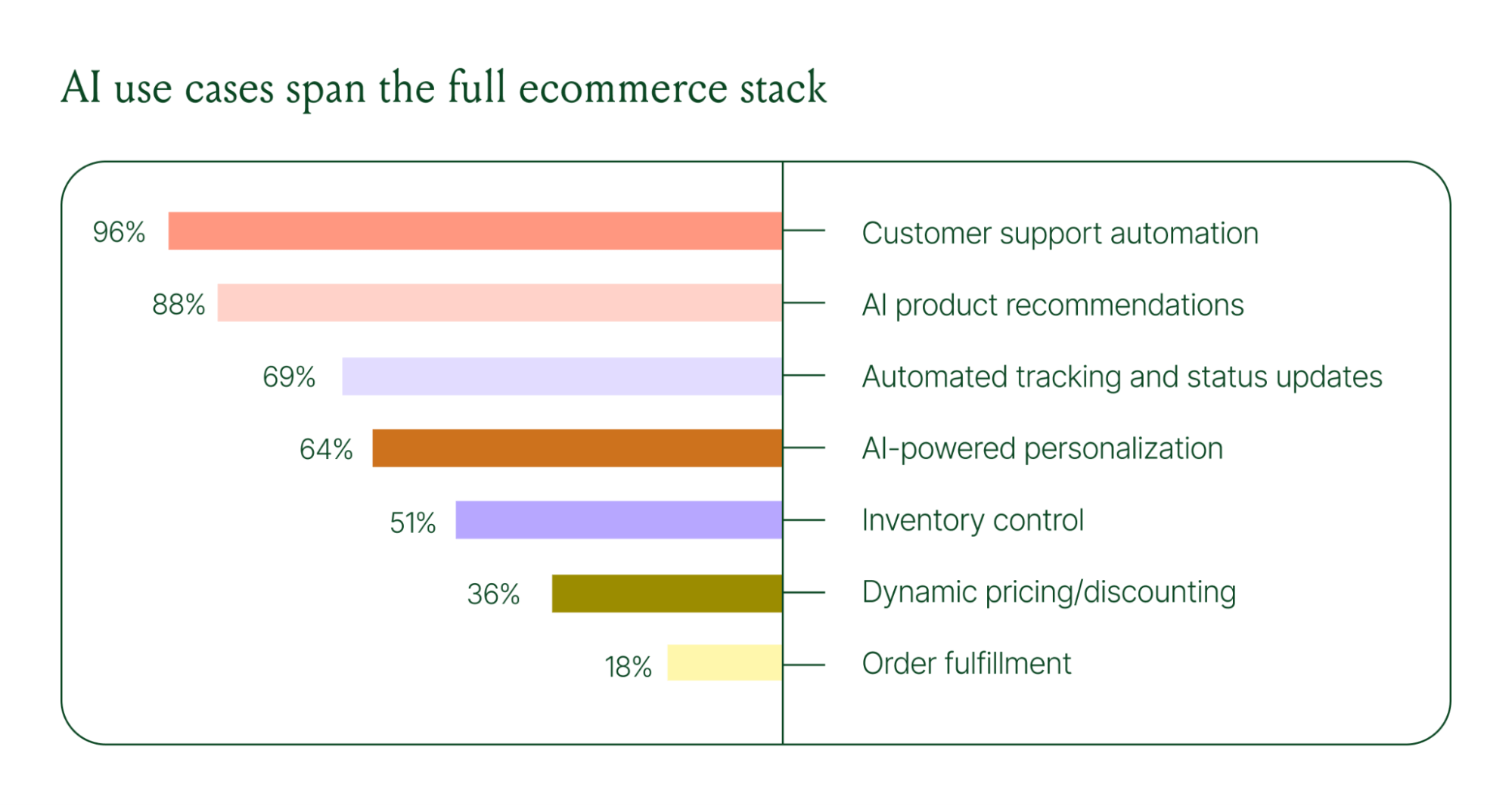
Ecommerce brands are deploying AI across every layer of their operation:
- Customer support automation: 96%
- Product recommendations: 88%
- Automated tracking and status updates: 69%
- Personalization: 64%
- Inventory control: 51%
- Dynamic pricing and discounting: 36%
- Order fulfillment: 18%
When brands were asked which channels contribute most to their AI success, conversational channels dominated. Social media messaging led at 78%, followed by SMS at 70%, and website live chat at 51%. Shoppers want fast, personal conversations, and AI is the best way to deliver that at scale.
Learn more about AI adoption, perception, and use case trends in the full 2026 Conversational Commerce Report.
How AI is changing CX success metrics
For decades, customer support success meant fast response times and high satisfaction scores. Those are still important indicators of success, but leading brands are adding revenue-focused metrics to their dashboards.
91% of brands still track CSAT as a measure of AI's impact. But 60% now include AOV as a top indicator, and higher-revenue brands earning $20M+ are focusing on metrics like total operating expenses, cost per resolution, incremental revenue, and one-touch ticket rate.
AI can now start a conversation, ease customer doubts, sell, upsell, and recover abandoned carts in a single conversation. When you’re only measuring CSAT, you’re ignoring the real ROI of conversational AI investment.
AI makes every conversational channel a storefront
Virtual shopping assistants now proactively engage shoppers, adapt to their needs in real time, and offer contextual product recommendations and upsells. When the moment calls for it, they can close the deal with a targeted discount.
Gorgias brands using AI Agent's shopping assistant capabilities nearly doubled their purchase rates and converted 20–50% better than those using AI Agent for support only.
Orthofeet, the largest provider of orthopedic footwear in the US, is a concrete example of this in practice. Using Gorgias, they achieved:
- 56% of support tickets automated in 2 months
- Email response times down from 24 hours to 35 seconds
- Double-digit revenue growth without adding headcount.
What this means for your AI strategy
The data tells a clear story: AI has evolved beyond a tool for handling tier 1 support tickets. It’s a core part of your revenue generation strategy.
57% of brands are already using AI for 26–50% of all customer interactions, and 37% expect that share to rise to 51–75% within the next two years. The brands building toward that range now are the ones who will have the operational advantage when it matters most.
The practical question isn't whether to invest in AI. It's where to focus first. Based on where brands are seeing the most impact, three priorities stand out:
- Start with high-volume, low-complexity tickets. WISMO (where is my order) inquiries, return policy questions, and order status updates are where AI delivers the fastest return. Automate these first.
- Expand into conversational channels. Social messaging and SMS are where AI is driving the most success right now.
- Connect AI performance to revenue metrics. If you're only measuring CSAT and response time, you're missing half the story. Add AOV, conversion rate, and incremental revenue to your reporting.
Want to go deeper on the full 2026 conversational commerce trends? Read the complete report for data across every major AI use case in ecommerce.
{{lead-magnet-1}}




Further reading

How Campaign Messaging Can Increase Conversions
TL;DR:
- Shoppers' attention spans are short, so your messaging needs to hit fast and resonate. Gorgias Convert helps brands launch personalized, timely campaigns that engage visitors and increase conversions.
- Personalization is key to winning over customers. Use tailored product recommendations, exclusive offers, and personalized messaging to boost order value and lower bounce rates.
- Educational and conversational campaigns build shopper confidence. Quick tutorials, quizzes, and live chat support reduce support tickets and help convert unsure visitors.
- Test your messaging to find what works best. A/B testing within Convert allows you to refine campaigns based on real data, helping you consistently capture more interest and drive purchases.
With so many distractions across platforms, it’s getting trickier to hold shoppers’ attention — even on your own website. You’re lucky to get even a couple of seconds of their time. But don't worry, we've got the perfect bait for your brand.
Gorgias Convert is specially designed to capture shoppers at the right time with the right messaging. This onsite conversion strategy tool launches subtle yet compelling campaigns, allowing ecommerce brands to engage customers like never before.
In this article, we'll dive into how you can refine your messaging to increase conversion rate, boost order value (AOV), reduce bounce rates with clever exit intent triggers, and educate customers through engaging quizzes and informative content.
Get ready to craft campaign messaging that truly connects and drives customers to buy.
{{lead-magnet-1}}
Why should you care about campaign messaging?
Compelling campaigns matter if you want to drive engagement and conversions. If your message doesn’t resonate with shoppers, they’ll exit without taking action.
Customize your content to your shopper's specific needs — it can make all the difference in capturing attention and winning over a new customer.
The top 6 ways to create captivating & compelling campaigns
Different goals call for different campaigns. Here are the top six methods to create compelling campaigns that resonate with your customers.
1. Put a face to your stories
Relatability is the magnet that pulls shoppers closer to considering your product. It’s why brands highly incentivize social proof like customer reviews and influencer endorsements.
Combine stories with social proof through relatable customer story campaigns or behind-the-scenes campaigns. When your customers see someone who genuinely enjoys your product, it nudges them one step closer to the checkout.
How STYLEST did it
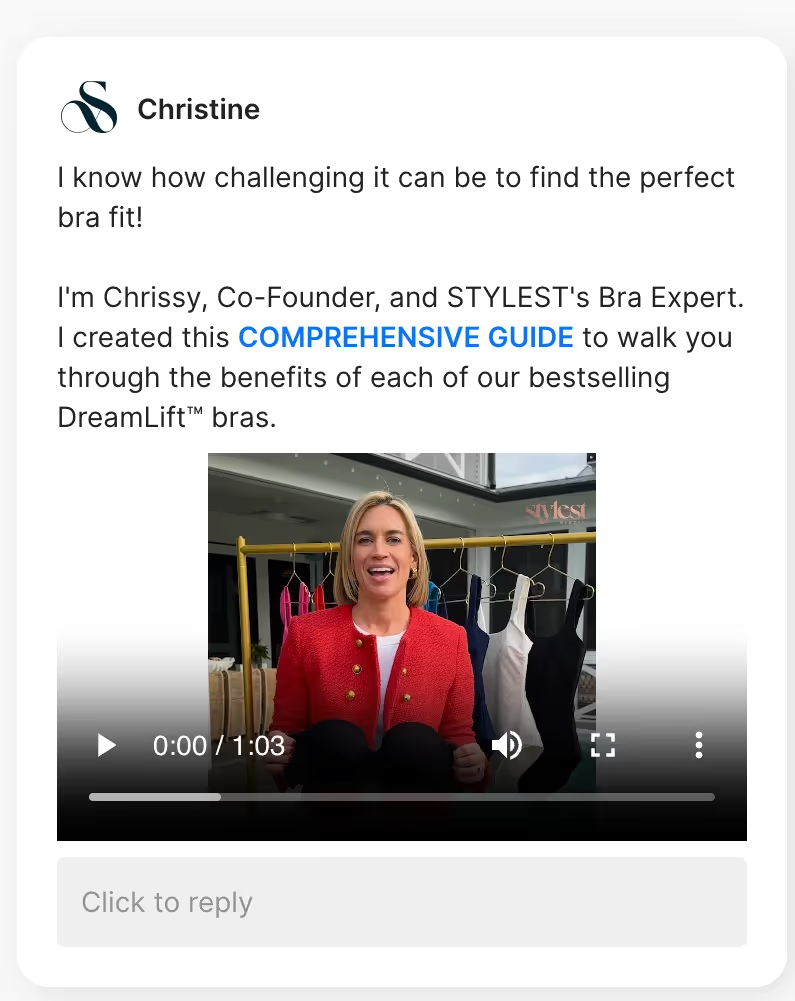
Innovative swimwear brand STYLEST gives customers a VIP shopping touch with a campaign that shows their co-founder Chrissy talking about the benefits of their bras. For shoppers unaware of the brand, a firsthand account from the creator leads to a deeper connection to the brand’s mission and products.
STYLEST created a total of eight campaigns made for different scenarios and customers. At its peak, their campaigns drove 18% of the brand’s total revenue — a remarkable achievement since pop-ups typically influence only 2-5% of revenue.
2. Incorporate visuals
Plain text campaigns can be easy to gloss over. Instead, add visuals to your campaigns, like images, infographics, emojis, or videos, to easily break up text and capture attention.
However, make sure not to overload visuals or text with information. For instance, if you’re making a video tutorial, keep it short and on message. Meandering can cost you engagement.
How Kreyol Essence did it
Haircare brand Kreyol Essence’s welcome campaign is simple but eye-catching: a greeting with a sparkle emoji. Friendly language is a fantastic way to invite shoppers to connect with your support team and find what they’re looking for.
Kreyol Essence created welcome campaigns, product recommendation campaigns, and promo campaigns to lower the barrier to entry for new customers. In three months, they reached an incredible average conversion rate of 11.47% — 8% more than the industry benchmark.

3. Offer personalized product recommendations
According to 1,100+ survey responses, customers want personalized experiences. With product recommendation campaigns, you can deliver just that. Feature a selection of products to upsell and cross-sell in targeted campaigns, then choose which kinds of shoppers receive them.
Three effective scenarios to use product recommendations:
- For visitors viewing a specific product or collection: Suggest product bundles or add-on products that align with what they’re already browsing to increase purchase likelihood. For example, if someone is viewing a shampoo product page, a campaign can suggest a conditioner to go with it.
- For first-time visitors: Showcase best-sellers or trending products to new visitors, helping them discover items they might like.
- During seasonal sales: Feature related products in your holiday or special sale campaigns, promoting bundles or discounted add-ons to boost overall sales.

How LSKD did it
Australia-based sportswear brand LSKD puts eyes on their three newest products by appearing to shoppers with empty carts. This condensed list of recommendations makes buying easier for customers who don’t know where to start.

4. Provide incentives that are unique to the shopper
Give shoppers a reason to stay longer. Exit intent campaigns can be the last-ditch effort to retain customers who are about to leave. Make sure these campaigns are enticing, down to the selling point and message.
Here are the four essential elements to getting your campaign messaging right:
- Offer value: Provide an irresistible offer, such as a discount code or free gift, to persuade customers to stay. Convert enables users to select a generic discount code or a personalized, unique discount code, which can be more enticing and drive higher clickthrough rates (CTR).
- Highlight the benefits: Highlight what customers will gain shopping with you, like free shipping, discounts, or exclusive gifts on top of their order.
- Personalize the message: Customers like to feel seen. Use customer profiles (i.e., subscriber vs. not) or reference items they've viewed to make the offer more relevant.
- Keep it concise: Use clear, direct language and a strong call to action.
How Impact Dog Crates did it
Premium dog crate retailer Impact Dog Crates anticipates uncertain customers by allowing one free exchange per order. They show off this perk to browsing customers in just a couple of sentences — simple and effective.

5. Educate customers with fun, engaging material
Businesses win 28.9% more new customers when they implement customer education programs, according to Intellum.
For browsing shoppers, you don’t need a formal program, just a quick educational campaign that appears while they look through your products. Empowering shoppers with information about product knowledge can lead to better buying decisions and, in turn, decrease return rates.
Educational campaign ideas:
- Interactive quiz campaign: Do you have a product line for specific needs and customers? Point customers to your sizing guide or product matching quiz for a personalized shopping experience that helps them find exactly what they need.
- Informative blog campaign: Share educational advice through a campaign and link out to a relevant blog post.
- Product tutorial campaign: Do customers often struggle with using your product? Demonstrate how to use your products by including a short video tutorial in the campaign.
- Product comparison campaign: Provide a side-by-side comparison of your products to help customers choose the best option.
How TUSHY did it
TUSHY, a leading bidet brand, recognized that many customers were concerned about bidet installation, leading to a spike in support tickets and abandoned carts. Their solution is an educational video campaign that proactively guides customers through installation.
The campaign contributed to 25% of their revenue and a 37% drop in bounce rate. Most importantly, it cleared away installation anxieties and repetitive support inquiries and provided customers with a more confident buying experience.

6. Offer VIP support by having real-time conversations
Use conversational campaigns to show customers you're there to make shopping easier. Plus, personalized advice helps hesitant buyers make decisions.
Actionable tips:
- Offer human support: Ensure seamless integration with human agents for more complex questions and personalized assistance.
- Leverage AI Agent: If your support agents can’t handle the conversation due to business hours, leverage Gorgias’s conversational AI tool, AI Agent, to handle pre-sales questions.
How Glamnetic did it
Accessory brand Glamnetic lets customers know they can call for help anytime, just by using Chat. Quick access to a customer support agent is a simple way to alleviate customer concerns.
Glamnetic’s strategic use of Convert campaigns drove an 18.39% on-ticket conversion rate for their top exit intent campaign and up to 49% more sales for new product promotions. They even saw a 12% increase in average order value.

💡 Pro Tip: Unsure which message will resonate most with your audience? Use A/B testing to experiment with different messages, designs, or calls to action to see which version drives the best results. This data-driven approach takes the guesswork out of your content strategy so you can generate strong interest.
Get their attention with Gorgias Convert
Ready to take your campaigns to the next level? Gorgias Convert offers powerful tools to engage customers at the right moment with personalized, compelling messaging.
If you’re looking to boost conversions, reduce bounce rates, or offer VIP support, Convert makes it easy to create campaigns that truly speak to your audience. Start capturing attention and driving results today with Gorgias Convert. Book a demo now.
{{lead-magnet-2}}

How These Top Ecommerce Brands Respond to Difficult Customers
TL;DR:
- Start with empathy, especially in high-stakes situations. Understanding the emotional weight of events helps agents respond with compassion and urgency.
- Choose your battles wisely. Obvi defuses tension by letting customers keep the product while still receiving a refund, boosting goodwill and lifetime value.
- Trust and empower your CX team. Glamnetic’s agents are given autonomy to resolve issues creatively to avoid bottlenecks.
- Ask customers what went wrong. Jaxxon finds that asking for feedback directly can defuse angry customers and turn complaints into insights.
- AI can help turn negative experiences around. Tools like Gorgias AI Agent support these strategies by delivering fast, thoughtful service at scale.
Strategies for handling difficult customers can sometimes feel like vague, generalized advice. If you’re dealing with these types of customer interactions daily, you need specifics.
At CX Connect 2024 in LA, four leaders in the ecommerce and customer experience space shared their tips for managing demanding customers with empathy, strategy, and a dash of creativity.
In this panel recap, learn how leaders at Princess Polly, Obvi, Glamnetic, and Jaxxon navigate complex customer interactions while maintaining high levels of customer satisfaction.
Watch the full panel discussion:
Start from a place of empathy
Customer experience agents: The baseline is empathy, says Alexandria Collis, Senior Director of Operations at fashion brand Princess Polly. Having a reset point — empathy and understanding — can be valuable for agents to remember, especially in the middle of heated exchanges.
In particular, Alexandria points out that significant life events can be tricky because customers expect a high level of service. These milestones are often sentimental, coming with more emotional investment from the customer’s end than your run of the mill WISMO requests.
Alexandria on empathetic customer experiences:
For example, if a customer receives a damaged graduation dress, Alexandria understands it would be best to replace their item as soon as possible. “Figuring out how to integrate empathetic responses into understanding the actual customer is so important,” Alexandria emphasizes.
Bearing in mind the circumstances and emotions around a customer’s issue, mainly when the stakes are high, is the key to finding a sound resolution.
Don’t fight until you have to fight
Ronak Shah, CEO and co-founder of collagen supplement brand Obvi, advocates for a measured approach when dealing with difficult customers. His philosophy is simple: choose your battles wisely. Obvi’s CX team aims to avoid unnecessary conflict, especially when it comes to returns.
"We don’t make people ship the product back. Instead, we say, 'Hey, you can keep the product. We’ll give you the refund,'" Ron explains. This method defuses potential tension and turns a refund into the potential for better customer lifetime value.
Ron on returns:
Ron acknowledges that not all businesses have the budget to approach returns in this way, so they add a bonus: customers can receive a $10 discount if they share the product with a family member or friend.
However, there’s a limit. "When you have abuse, that’s where you have to fight," Ron adds. His team draws the line when repeat offenders try to exploit the system, ensuring fairness for all customers.
Trust your agents, give them autonomy
Kevin Gould, co-founder of beauty brand Glamnetic, believes in empowering his customer experience team with the freedom to make decisions. He understands that micromanaging can lead to inefficiencies, so he trusts his agents to delight customers in their own ways.
"We try to be very lenient. We give our CX team lots of autonomy to operate because you need to give [them] a lot of leeway, or else everything just gets escalated up to the head of customer experience,” Kevin says. His approach ensures that issues are resolved quickly and effectively.
Kevin on trusting his support team:
For example, Glamnetic often resolves lost package issues by sending out new products or adding an extra "just because" item. They don’t view these as unnecessary expenses. Rather, they’re a way to build trust and improve overall customer satisfaction.
This strategy has paid off, especially in situations where offering a little extra can turn a negative experience into a positive one. Kevin’s trust in his team has proven to be a key component of Glamnetic’s customer service success.
Ask, ‘What did we do wrong?’
When facing unhappy customers, it’s easy to get defensive. But instead of pushing back, Jaxxon’s Director of Customer Experience, Caela Castillo, suggests a different approach: self-reflection. Her advice to the team is to always ask customers, “What did we do wrong?”

“There are customers who aren’t going to be happy with anything,” Caela says. “I try to ask, was there something we could have done that would have made this a better experience?” This basic question shifts the focus from blame to understanding, helping to diffuse tension.
In one case, a customer complained to Jaxxon’s support team because they missed a key detail on the website. Rather than dismissing the complaint, Caela’s team asked how they could make the information more visible. Listening may be a minor solve, but it shows customers that their input matters, which can often guide the interaction toward a peaceful outcome.
Caela on defusing angry customers by asking the right questions:
Turn their frown upside down with AI Agent
Every business faces the challenge of dealing with tough customers, but the strategies shared by these industry leaders offer clear paths for handling those thorny situations. Leading with empathy, picking your battles, trusting your team to make decisions, and reflecting on what could have been done better all lead to stronger customer relationships.
It’s time to level up your customer experience strategy. Explore how Gorgias AI Agent can help your team deliver exceptional service. Book a demo today to see the difference it can make to your support.
{{lead-magnet-1}}

What Makes a Great Knowledge Base for AI?
TL;DR:
- AI is only as smart as your knowledge base. A rich, up-to-date Help Center is what powers accurate, fast, and helpful AI responses.
- A good knowledge base speeds up AI onboarding. The more info your AI has, the quicker it can handle customer questions.
- Keep your content current and on-brand. Regular updates and consistency in tone make AI more trustworthy and accurate.
- Gorgias AI Agent thrives with the right foundation. With strong Help Center content, AI Agent can autonomously resolve issues, boost automation, and save your team time.
According to our recent survey, 69.2% of respondents already use AI and automation in their roles, with support leaders and agents being the highest adopters.
However, in order to be successful, AI needs a robust knowledge base to learn from. The more knowledge and context, the smarter AI will be.
Below, find the tips you need to set up a great customer knowledge base in order to use AI most effectively.
{{lead-magnet-1}}
The role knowledge bases play for AI
Aside from acting as a self service resource for customers, knowledge bases now serve a dual purpose — they also act as a data source that provides AI with the training it needs to accurately answer questions from your customers.
That’s the case for Gorgias AI Agent, a conversational AI team member who can resolve customer inquiries without the involvement of humans. While teams also provide the AI with Guidance during the setup process, your knowledge base is the primary source for AI Agent to be onboarded, have a consistent source of truth, and provided faster and complete resolutions.
Helps your AI get up and running quickly
The more information you provide your AI with, the faster it will be able to deliver accurate responses — and the sooner your customer support team can move onto more important things than answering another WISMO request.
Building a quality knowledge base is essentially the first onboarding step for using AI in your customer service operations. It’s the main data source for AI, sort of like a handbook or manual. The more thorough the Help Center is, the less agents will have to tweak and guide AI at the start.
Provides a consistent source of answers
The more up-to-date and accurate your knowledge base is, the more accurate your AI’s responses to your customers will be. Errors or inconsistencies in knowledge bases can lead to flawed AI behavior.
The benefit of that is that AI will consistently intake any new information you add as long as your Help Center articles are updated. For example, brands who have new or different policies won't have to worry about setting aside time for AI to digest the new info –– it will automatically pull them from the Help Center.

📚 Further reading: How your CX Team will evolve with AI
Allows it to better provide full resolutions
An AI customer support rep can resolve tickets 99.4% faster than human agents –– and that’s full resolutions, not just first responses! But those full resolutions will only be as helpful as your knowledge base is.

Benefits of a high-quality knowledge base
- More accurate responses
- Improved learning and adaptation
- Increased trust and usability
- Effective self-service resource
More accurate responses
Quality data improves AI accuracy and efficiency. For CX, that quality data comes from a robust knowledge base.
For example, clothing brand Psycho Bunny was able to successfully implement AI Agent in part because of their thorough knowledge base.

They have articles that cover: Shipping & Delivery, Order Status, Returns & Exchanges, Buy Online Pick Up in Store, products & FAQs, and Payment & Billing.
“AI Agent helps immensely with data reporting and reducing human error, because it tags tickets accurately and follows processes consistently,” says Mary Mundy, Technical Support Specialist at Psycho Bunny.

Improved learning and adaptation
Knowledge bases also enable AI systems to learn and adapt over time, especially if they’re consistently edited and updated to reflect new or changing policies or product information.
Adaptability is crucial for a high-performing CX team, and your AI tool needs to be able to rise to that challenge. That was the case for premium sport and travel accessory brand Vessel.
“I was a little bit hesitant about using AI Agent initially,” says Lauren Reams, their Customer Experience Manager.
“We knew that we were interested in more automation because we have had more customers reaching out, but weren’t sure that it would be able to meet their growing needs.
“It’s been incredible to see how adaptable AI Agent is, and how it can quickly pick up on the small things — for example, if something is a hot topic for us, you can see AI Agent start talking about it, and knowing when it’s something that needs to be handed off to our team.”
Now, Vessel boasts a 20% automation rate and a resolution time of just 1.06 minutes.

Increased trust and usability
A reliable knowledge base fosters trust in AI systems. It’s a cycle: the better the information in your knowledge base is, the better your AI Agent can speak on your behalf.
For example, fine jewelry brand Baby Gold has built trust with customers through a more personalized AI experience.
“What I like about AI Agent is that the responses are so different, and it makes it sound like it's an actual agent,” says Sindi Melgar, Baby Gold’s Customer Service Manager.
“We've gotten feedback from customers who say, Michelle, has been helping me, Michelle did this for me, Michelle did that for me — so that's awesome. We provide personalized items, so we should provide a personalized experience and journey for our customers.”
Effective self-service resource
Aside from being AI’s most knowledgeable sidekick, your Help Center is a prime self-service hub for customers.
They should be able to locate policies like shipping and returns and answers to product FAQs. If you want to go the extra mile like Baby Gold does, create a portal where shoppers can start a return, track or cancel an order, or report an issue.

Best practices for developing a quality knowledge base
- Include your most important policies
- Identify your FAQs
- Leverage pre-existing templates
- Keep it consistent with your brand’s voice and tone
- Establish a regular cadence for maintenance
Include your most important policies
This might go without saying, but customers won’t know your policies if you don’t clearly list them on your website. A policy section helps set expectations upfront and builds trust.
Some common policies to include are:
- Shipping times and costs
- Returns and exchanges
- Defective or broken merchandise
- Support or in-store operating hours
- Promotions
- Warranty
- Order processing and fulfillment
Identify your FAQs
🛑 Challenge: Identifying your frequently asked questions manually, especially if you have a ton of tickets that come in on the daily, a wide variety of questions, or topics that require super personalized responses. Yes, you can source your brand’s specific FAQs manually by speaking to your agents, but you might not cover everything.
✅ Solution: Some frequently asked questions are pretty standard across ecommerce stores. Your shoppers will always need to know your shipping information, return and exchange policies, order cancellation windows, the status of their most recent order, and where they can reach out for 1:1 support.
If you use a helpdesk, you’ll likely be able to see an aggregate of top questions. With Gorgias AI Agent, it's easy. You can find customers' most asked questions listed in your dashboard, with an option to automatically create a Help Center article for each, answer included.

📚 Further reading: FAQ Pages: Examples, Benefits, and When to Add a Help Center
Leverage pre-existing templates
🛑 Challenge: Scaling your knowledge base to answer all relevant questions can be a daunting task, especially at the beginning.
✅ Solution: You don’t have to create your knowledge base from scratch! You can use an AI tool like ChatGPT to create it or, check out the 50 Help Center templates in this article to establish a solid foundation.
Keep it consistent with your brand’s voice and tone
🛑 Challenge: If your knowledge base doesn’t accurately reflect how your brand engages with customers or how it shows up online, your AI won’t sound like you either.
✅ Solution: If your brand is all about personalization, for example, include that in a “Who we are” article in your Help Center like Baby Gold does.

“Sometimes agents forget personal details to call out when communicating with our customers, like birthdays or weddings,” says Sindi Melgar, Baby Gold’s Customer Service Manager, “But I noticed on a few different occasions where the AI Agent is highlighting these things and is saying, congratulations on your wedding! Just the tone of voice that our AI Michelle is able to adopt is definitely on brand for us.”
Establish a regular cadence for maintenance
🛑 Challenge: Continuously updating the knowledge base to ensure it remains relevant can be time-consuming, especially the longer you wait to review it.
✅ Solution: Because AI is such a huge time saver, your team should have more time available to edit and maintain your knowledge base, as well as coach any AI tools you use. For example, Psycho Bunny sees 26% of all tickets resolved by AI Agent.
Schedule time each month or quarter, depending on how often your policies or products change to keep your knowledge base current and relevant. If your knowledge base has outdated information, your AI most certainly will, too.
📚 Further reading: The Gorgias AI Approach: Onboard, Automate, Observe, and Coach
How AI Agent can help
AI Agent learns your policies and brand voice to autonomously handle support queries via email –– just like a human agent.
Our customers have found that it often doesn't matter if an agent or AI responds to a customer so long as a resolution is reached quickly.
That was the case for Ron Shah, CEO of health and wellness brand Obvi:
“People just want to know things fast; they want things quickly. As long as they're getting accurate responses, most people don't care how.”
Within the first four weeks of its launch, AI Agent supported 300 brands, 60 of which reached a 20% automation rate. It was able to process 10,000 messages in one week.
“These might look like modest numbers on a screen, but they’re translating to significant benefits for the people who monitor, manage, and innovate on ways to deliver exceptional customer experiences — and we feel grateful to be able to facilitate this shift,” says Gorgias CEO and Co-founder Romain Lapeyre.

Investing in and prioritizing high-quality knowledge bases will support both your CX team and your customers. Give your team time back, create better customer experiences, and get on the cutting edge of AI for customer support.
See AI Agent in action and book a demo.
{{lead-magnet-2}}

The Hidden Power and ROI of Automated Customer Support
TL;DR:
- Automating simple customer requests saves major time. AI Agent and automation features helped reduce response times by up to 69%.
- Obvi handled 27% of tickets with just two agents. Within two weeks of using AI Agent, their team saw major efficiency gains.
- Psycho Bunny resolved tickets 99.4% faster using AI Agent. The conversational AI tool boosted speed and reduced manual workload.
- Kirby Allison saw 46% more sales with AI Agent. They used Flows to guide customers and drive purchases more effectively.
Guess what? Automating your customer support doesn’t mean you don't care about every customer interaction—it’s quite the opposite.
Think about it… if someone wants to cancel an order, they simply want it done without any attempts at a personalized upsell. This type of response usually doesn’t require any additional flair.
Automation allows you to meet customers' needs promptly for straightforward requests. At the same time, it gives your team the bandwidth to invest more time and energy into solving intricate problems and building stronger customer relationships.
Many brands using Gorgias AI Agent are saving both time and money, reducing response times, and even increasing sales generated directly from support.
{{lead-magnet-1}}
First, who benefits from Gorgias AI Agent?
As a solopreneur, it’s pretty self-explanatory. You’re busy with all aspects of your business, so automating what you can is going to help you prioritize and focus on more important things.
But what about those who have customer support teams? This might sound counterintuitive, but Gorgias AI Agent isn’t geared toward any specific type of brand.
It benefits everyone at every stage of growth, whether you’re a single founder who wears many hats or lead a large CS team at an enterprise business.
Take Obvi—this mid-market health and wellness brand has a lean CX team of only two support agents. Although surprising, given their size and stage of growth, they’ve been able to automate the tedious and repetitive parts of CX.
For example, during BFCM 2023, Obvi’s CEO Ron Shah decided to use AI Agent to boost CX efficiency even further while still providing excellent customer support.
“I told our team we were going to onboard AI Agent for BFCM, so a good portion of tickets would be handled automatically. There was a huge sigh of relief knowing that customers were going to be taken care of.”
—Ron Shah, CEO and Co-founder at Obvi
Obvi now handles 150+ tickets per day without adding any headcount, thanks to a 27% automation rate—which they achieved within two weeks of onboarding AI Agent.
Even for enterprise brands with larger CX teams, AI Agent helps them deal with the huge influx of queries that don’t require a human response—things like, “Where’s my order?” or “Can you cancel my order?”
And it’s also more than the support teams who benefit. With more time given back to agents for strategic thinking, support teams can share helpful advice across the entire organization:
- For the product team: Report on which products are causing the most tickets to identify and address issues. When the product team can directly reference customer pain points, it becomes easier to improve product quality and reduce future support inquiries.
- For the marketing team: Analyze which campaigns may have been misleading by tracking customer complaints and dissatisfaction to improve future promotions. Customer insights can help refine messaging that resonates better with your audience.
- For the operations team: Identify big spikes in lost or delayed packages to streamline order fulfillment logistics and improve delivery processes.
- For the sales team: Provide insights on customer feedback related to pricing and product preferences to refine sales strategies.
This way, customer support becomes less about the speed of ticket resolution and more about providing high-quality customer service that returns the favor with higher CLTV. How? Let’s review a few stories from brands using AI Agent.
💡 Pro Tip: Deflect WISMO tickets and let customers track their order by activating Order Management in your AI Agent settings. Go to Settings > Productivity > Order Management and toggle Track Order on.
AI Agent resolves tickets 99.4% faster than human agents
Every brand eventually faces a common dilemma: how to scale efficiently while keeping customer experience high and costs low.
This was no different for Psycho Bunny, the vibrant menswear brand known for its edgy twist on classic styles and its iconic skull-and-crossbones rabbit logo. As the company grew, so did the challenge of maintaining top-notch customer support without skyrocketing overhead costs.
"As we continue to grow this multi-million dollar company, the most important thing is maintaining or improving our current KPIs and CSAT, but without raising our customer support overhead. And being able to maintain this for the next 5–10 years."
—Tosha Moyer, Senior Customer Experience Manager at Psycho Bunny
Recognizing the need for innovation, the team turned to AI for a solution, specifically through Gorgias. Quickly after setup, the team began trialing AI Agent and named it Lisa.
Gorgias’s conversational AI tool, AI Agent, is an extension of your team. Just like a new support agent, AI Agent can:
- Learn all your support processes and policies
- Answer tickets in your brand’s tone of voice
- Perform Actions in Shopify and other tools for full resolutions
- Escalate tickets it cannot confidently answer
For Psycho Bunny, AI Agent quickly became a vital member of the team, resolving 26% of customer tickets with lightning speed—99.4% faster than human agents.
By handling repetitive questions like order status and returns, Lisa freed up human agents to tackle more complex and high-value customer interactions.
One of its standout features is its ability to respond with empathy and personalization, reflecting the specific information customers provide.
"We love the empathy in AI Agent’s responses," said Mary Mundy, Technical Support Specialist at Psycho Bunny. "Replacing a generic automated reply with a response that identifies the issues and has empathy, while communicating the key information the customer needs, is awesome."
The impact was immediate and impressive. Lisa answered queries 10 times faster than the team average, typically resolving tickets in under 2 minutes compared to the 4+ hours it took human agents.
Within the first two months, AI Agent shot to the top of Psycho Bunny’s customer support leaderboard for first response and resolution times, all while generating higher CSAT scores (4.67) than the team average (4.6).
💡 Pro Tip: Give your AI Agent some personality to match how your human agents speak. Go to AI Agent > Settings tab, and in the Tone of Voice menu, choose from Friendly, Professional, Sophisticated, or Custom tones.
Kirby Allison generated 46% more sales from answering pre-sales questions
Kirby Allison, the luxury shoe and garment care retailer, has been a staple for well-dressed customers since 2011. However, their growing success came with a hefty challenge: an overwhelming influx of customer support inquiries.
With just two dedicated team members handling a surge of repetitive questions and manual processes, Kirby Allison’s customer support team was stretched thin.
The pressure was on Addison Debter, Head of Customer Service, who not only managed customer queries but also juggled inventory management, product information updates, and website development.
"We were inundated with simple, repetitive questions: 'Where is my order?' 'What kind of shoe polish do I need?' We had to keep repeating similar answers to similar questions. And we were doing the exchanges and returns manually, one by one. We were losing so much time. We couldn't follow up with customers as quickly as we wanted," Addison shared.
The team wanted a better way to handle these tickets, so they switched from Zendesk to Gorgias, specifically for the automation features.

"Our favorite features are definitely Flows and Article Recommendations," Addison said. "They drive so much automation for us. Shoppers get answers to their questions by themselves: what's the right size hanger, where is my order, what shoe polish would you recommend, etc."

Flows allow you to display up to six commonly asked questions directly in your chat widget. If a customer clicks on one of those questions, they’re redirected to articles from your knowledge base where they get the answer quickly. It’s an entirely self-serve experience.

Auto responses have also been impactful for this team. These work by using Rules to automatically reply to emails and messages based on the context of the customer's message.
The results? Within just two months, Kirby Allison saw a 23% increase in conversions and a staggering 46% boost in sales from support.
Automating responses to pre-sales questions freed up the team to engage in conversations that led to sales, improving both revenue and efficiency.
💡 Not sure which FAQs to include in your Chat? Check out our list of 50+ FAQ templates here.
Boost holiday efficiency with 69% faster resolution times
The holidays are always difficult for support teams. The stakes are high, and so is the influx of support tickets.
Thankfully, customers can get the answers and guidance they need faster and more easily via self-serve order management, Flows, and AI-driven Article Recommendations.
Shinesty, the brand that’s all about making the world take itself less seriously, started out selling wacky vintage suits. Nowadays, they’re best known for their men’s underwear range, including the signature Ball Hammocks, which promise booty bliss and scrotal serenity.
Shinesty also offers a subscription service, delivering a fresh pair of underwear each month with exclusive prints and discounts.
As with many ecommerce brands, Shinesty’s peak sales period spans from Black Friday through Christmas. The year-round customer support team of three builds up to 20 agents during the holidays to handle this surge.
For the 2023 holiday season, Molly Kerrigan, Senior Director of Retention, aimed to boost efficiency through automation. The goal? Help the CX team work smarter, not harder, and maintain their stellar customer satisfaction without increasing headcount.
“We get a lot of praise from our customers, and they talk highly of our CX team after 1:1 interactions. We can’t lose that as we scale,” Molly emphasized.
The team was swamped with repetitive questions about order status, discounts, and account management—all important queries but ones that don’t necessarily build customer relationships. Self-service solutions seemed like the answer, but previous tools struggled with Shinesty’s subscription model complexities

“Other tools required a high level of customization to handle the subscription element. But Gorgias AI Agent has been straightforward,” said Molly.
After seeing the impact early, Molly and her team doubled down on optimizing their use of AI Agent:
- One-step Flows offer customers instant answers to common questions. When customers ask questions in Chat, AI checks Shinesty’s Help Center for relevant articles and shares them, often resolving the query without agent interaction.
- Multi-step Flows guide shoppers through a more interactive experience for picking the right undies, managing their subscriptions, and applying discounts.
- Self-serve order tracking and management have become extremely popular. Customers can get instant updates on their orders and report issues through the Help Center or Chat.
These automations are accessible via Chat, the Help Center, or the Contact Form, giving customers fast answers without needing to speak to an agent.
📚 Read more: Offer more self-serve options with flows: 10 use cases & best practices

Shinesty’s Flows are so effective that many have an automation rate of over 90%, meaning they resolve customer inquiries 90% of the time without human intervention.
AI Agent helped Shinesty significantly save on recruitment, training, and overtime costs. Shinesty’s first response time has dropped by 65% and resolution time by 69%. This has resulted in the fastest resolution times Shinesty has ever seen, with the smallest CX team they’ve ever had—just five agents for the 2023 peak season, compared to 20 in 2021 and 12 in 2022.

Why you need a knowledge base for automation
Today, shoppers expect a high-quality shopping experience, and we know that they love having the power to solve problems on their own, on their schedule. In fact, 84% say a company's customer experience is as important as its products and services.
While we’ve seen how AI Agent can help you meet those expectations, a core component to making all of the flows work effectively is a customer knowledge base. This is crucial for any effective customer support automation strategy. Why?
A few reasons:
- Customers get the answers they need quickly and easily, leading to a better overall experience.
- By deflecting common queries to the knowledge base, your support team can focus on more complex issues, improving efficiency.
- Providing detailed product information helps customers make informed purchase decisions, leading to higher conversion rates.
- Educated customers are less likely to make returns, saving your business time and money.
A knowledge base is an interactive portal that connects your customers to both sales and customer service. That means making it easy for them to find answers before making a purchase and helping them troubleshoot any possible issues afterward.
Here’s a helpful example from BrüMate
This brand’s Help Center shines with its customer-focused design.
At the top of the page, it addresses common questions like returns policy and product compatibility, allowing customers to find answers quickly without scrolling. To enhance the shopping experience, BrüMate offers an interactive quiz that guides customers to the perfect product, saving them the hassle of extensive research.

The Help Center also includes easily accessible links for package tracking and returning to the main site, with a chat bubble for immediate assistance. When the customer service team is offline, customers can still access helpful articles.
💡 Did you know? You can teach AI Agent information from specific URLs. Simply go to AI Agent > Knowledge > Public URL sources.
“We’ve started pushing people towards resources that are in our Help Center. We're trying to help our customers self-solve.”
—Colin Waters, leading at The Feed & former Associate Director of Customer Experience at BrüMate
Automate 50% of support volume in 50 days
By integrating AI into your customer support strategy, you can significantly reduce your team's workload. Gorgias AI Agent is proven to be able to handle 30% of inquiries autonomously within just 30 days.
Curious about how conversational AI can benefit your business? Book a demo to learn about the advantages of AI Agent and see firsthand how they can transform your customer support operations.
{{lead-magnet-2}}


Our AI Approach: Onboard, Automate, Observe, and Coach
TL;DR:
- Gorgias views AI as an extension of CX teams, treating it like a human support agent by onboarding it with your policies, automating ticket handling, observing its response quality, and coaching it with continuous feedback.
- AI Agent uses a combination of GPT-4o, brand-owned data, and third-party integrations like Shopify to provide accurate responses while limiting hallucinations.
- AI Agent can fully resolve requests and perform actions to improve first response and resolution times without sacrificing support quality.
- Human feedback continuously refines AI Agent performance to keep it effective and on-brand.
Chances are, you’ve had at least one frustrating experience with AI in customer support. Even with 69.2% of customer support professionals using AI, you’re still skeptical about making AI a permanent part of your customer support operations.
At Gorgias, building AI has been a thoughtful process. We insist on only shipping AI features that improve customer experiences, not degrade them.
To help you understand how we’re approaching AI, we’ll walk through the four pillars that ensure a positive AI experience for you and your customers: Onboard, Automate, Observe, and Coach.
- Onboard: Teach the AI your processes and brand voice.
- Automate: Let the AI start handling tickets in your inbox.
- Observe: Keep a close eye on the quality of the AI’s response.
- Coach: Give feedback to continually improve the AI’s accuracy.
Putting it all together: we view AI as the ultimate assistive tool for customer experience (CX) teams.
AI changes the way CX teams operate
Before diving into the four pillars, let’s set the stage. Two major changes have occurred in the past few years:
- Customer expectations for instant answers across channels are growing.
- We have the technology to answer hundreds of tickets simultaneously, each in <1 minute — without breaking the budget on uncapped hiring.
As AI removes the grunt work from support teams’ plates, repetitive tasks such as providing order status updates, processing returns, and answering frequently asked questions can be offloaded to AI.
AI can even handle the mental work of reading, summarizing, categorizing, prioritizing, and tagging, even when a human needs to step in.
Agents can then focus on higher-impact tasks, like speaking to VIP customers on the phone, offering new support channels, driving upsells and cross-sells, and much more. This is how CX teams evolve.
Brands using Gorgias AI Agent in the alpha testing phase are already automating as much as 30% of email tickets. By the end of 2024, we envision over half of brands’ customer tickets to be handled by AI Agent.

The 4 pillars of AI at Gorgias
Our overall goal is to make CX tools, including AI, that are great for customers and their overall business goals. We follow four pillars when it comes to AI at Gorgias.
Onboard: Teach the AI your processes and brand voice
Bringing AI into your support team is like onboarding a new agent. Like any agent, AI should know:
- How to talk like your brand, using brand-specific voice and language
- Your policy, products, and FAQs
- How your helpdesk processes work, i.e. tagging tickets for organization
- Which topics should be handed over to a superior (in the case of AI, a human)
AI should model the most efficient support reps who know their brand inside and out — while being able to empathize with customers at lightning speed. That is the future of great customer service.
How it looks in Gorgias
AI Agent’s main knowledge reference is your owned data, including your Shopify storefront and backend, Help Center articles, order data, brand voice, conversation history, and other URLs where your brand content is stored.
When adding AI Agent to your Gorgias account, you can sync each of these resources to empower your AI Agent with the knowledge it needs to answer questions and resolve basic issues.
To enhance AI Agent’s answering power, the Guidance feature allows you to provide detailed instructions on how AI Agent should interact with customers.
While the prior resources are centered around brand knowledge, Guidance is more like team processes. You can instruct AI Agent to ask follow-up questions, confirm details, and treat customers one way or another depending on factors like whether:
- Their order was placed within the last XX days
- They have spent more than $XX with your brand
- They are domestic or international customers
- And so much more

Tosha Moyer, Senior Customer Experience Manager at menswear brand Psycho Bunny, highlights the value of our internal guidance feature. “Guidance is so important because we have a lot of internal processes that we do not need to be described in a customer-facing article, but we want AI Agent to be able to access that information and manage tickets accordingly.”
Last, you can instruct AI to speak in your brand’s voice. When setting up AI Agent, you can provide your team’s tone of voice guidelines, brand bible, and other resources to ensure your agent represents your brand identity.

Automate: Let the AI start handling tickets in your inbox
AI can do so much more than restate your brand policies. At Gorgias, we believe AI should fully resolve inquiries — and that means taking action.
According to a report by Gartner, 82% of customers say quick resolutions influence their decision to stay loyal to a brand. When we empower AI to take action, customers have better experiences and are more likely to keep doing business with a brand.
How it looks in Gorgias
AI Agent uses the latest model of ChatGPT, 4o, combined with the content you already have to send human-like answers to customers.
But AI Agent doesn’t only regurgitate your Help Center content. It goes one step further by updating customers’ orders, changing addresses, sending order and return statuses, and more.
Native integrations with Shopify and other apps in the Gorgias ecosystem allow AI Agent to fully resolve basic inquiries by pulling customer-specific data and performing actions in other tools.
Our goal is to make connecting these tools as simple as possible, minimizing the need for technical setups like configuring API calls.

Of course, AI’s decisions on when to execute these Actions should come from your team. That’s why you can set up conditions for each Action, specifying when (and for whom) the Action can fire.

AI Agent includes a variety of pre-built Actions from popular ecommerce apps like Shopify, Recharge, and Loop Returns — with many more on the way. You can also build Custom Actions with any 3rd-party tool.

Within two months, AI Agent outranked Psycho Bunny’s human agents’ resolution times. It resolved tickets in under 2 minutes, compared to the human average of 4+ hours. Customers even gave AI Agent a 4.67/5 CSAT score — nearly 0.1 points higher than human agents’ average CSAT score.
Observe: Keep a close eye on the quality of the AI’s response
AI is a new technology — we humans are still building trust and comfort. In fact, only 3 in 10 Americans are able to identify AI use in digital use cases, according to the Pew Research Center. This suggests a lack of transparency in how companies use AI.
In a problem-solving service like customer support, AI’s role and decision-making should be transparent: Agents should know which tickets are handled by AI, what exactly the AI did, and why.
How it looks in Gorgias
Agents can see the logic of AI Agent right in the ticket view. This includes the knowledge source it used, the specific actions it took, and the exact responses it generated. All actions made by AI Agent are highlighted in purple or symbolized by the purple sparkle AI Agent icon.

Being able to discern AI responses from human ones allows brands to:
- Ensure the accuracy of AI responses to provide speedy resolutions.
- Quickly correct AI missteps to maintain high standards of service.
- Build customer trust by being transparent about AI’s role in the customer support process.
We highly recommend nominating one human agent to review AI Agent’s responses. Set aside time each week to review to understand how it behaves, when it responds vs hands over, and the most common knowledge resources it pulls from.
Coach: Give feedback to continually improve the AI’s accuracy
Inevitably, AI won’t be perfect from day 1. Just like a new agent, AI needs coaching. That’s why the final pillar of our AI philosophy is improving AI’s knowledge and performance through coaching.
When AI makes a mistake, you should have the power to correct it so that future errors are avoided. When AI acts correctly, you should also be able to encourage and reinforce its positive behavior.
A continuous cycle of coaching helps AI become more aligned with your brand’s standards.
How it looks in Gorgias
Feedback is built into AI Agent. Every decision AI Agent makes can be rated with a thumbs-up/down system. Encourage AI Agent to continue making the same actions with a thumbs up, and change behavior with a thumbs down.
You can see how AI handles every situation in detail, giving you full transparency. Reviewing these decisions leads AI to better align with your brand’s standards.

In addition, you can easily instruct AI Agent to pull from different Guidance instructions and Help Center articles or execute different Actions — with the easy ability to create or edit those resources in just a few clicks.

Empower your team with AI
At Gorgias, we designed AI to enhance your customer support experience. By leveraging the pillars of Onboard, Automate, Observe, and Coach, we ensure that AI Agent is an effective and reliable partner for your team.
With AI handling low-priority repetitive questions, your team can focus on creating more meaningful connections. This includes prioritizing VIP customers and escalated tickets, upselling, and engaging in higher-impact activities.
The future of AI at Gorgias is bright, with continuous improvements and new features on the horizon. Embrace the power of AI and see how it can transform your customer service team.
Book a demo today to experience the benefits of AI Agent for yourself.
{{lead-magnet-1}}

Eliminating Pre-sales Friction with Effective Educational Campaigns
TL;DR:
- Revisit your data: Use data from historical support tickets and customer feedback to identify common concerns.
- Encourage real-time conversations: Use live chat support with specific CTAs to entice customers and provide personalized assistance.
- Optimize timely messaging: Deliver campaign messages at the right moment based on browsing patterns.
- Educate to reduce returns: Clear and thorough product information helps set accurate expectations, leading to fewer misunderstandings and returns.
In the competitive ecommerce landscape, turning browsers into buyers is like… trying to get a cat to take a bath (if you know, you know). You can activate various website campaigns until something sticks, but without relying on concrete data, you may never see the conversions you want.
This is where addressing pre-sales friction points comes into play. In other words, resolving concerns that customers face before making a purchase.
Once you’ve determined the problem areas, you can use Convert campaigns to lead customers to the checkout. These onsite campaigns have proven to enhance customer engagement, drive conversions, and significantly reduce return rates.
Ready to gain new customers? Let’s deep dive into identifying pre-sales friction points and resolving them with Convert campaigns.
{{lead-magnet-1}}
How to identify pre-sales friction points
Creating campaigns that convert requires identifying your top pre-sales barriers. These are obstacles in the buying journey that prevent customers from proceeding with a purchase.
Some sale-preventing questions could be:
- How do I know which size will fit me best?
- What are the shipping costs and delivery times for my location?
- What is your return policy if the product doesn't meet my expectations?
- What are other customers saying about this product?
Proactively addressing these friction points can remove customers' hesitation when purchasing.
Take a look at three data sources to identify your brand’s specific friction points.
- Historical Tickets: Review your past customer support tickets, especially those in the product or pre-sale categories, to find valuable insights into customer concerns. For instance, TUSHY, a leading bidet brand, discovered that many shoppers had questions about toilet compatibility. After they targeted this concern with a campaign, they reduced customer hesitation and boosted the conversion rate by 10%.
- Customer Feedback: Surveys, reviews, and customer interactions are rich sources of data. Collecting and analyzing customer feedback can help identify recurring issues and areas where additional information or support is needed.
- Website Analytics: Use tools like Google Analytics to determine when visitors drop off or spend excessive time on certain pages. For example, if many visitors exit on the product detail page, they might need more information or reassurance before making a purchase.
3 solutions to reduce friction points using Convert
After you’ve identified the obstacles in customers’ buying journeys, the next step is to resolve them.
Targeted onsite campaigns with Convert are an excellent way to tackle these issues.
Here are three effective strategies to address common pre-sales friction points and enhance the shopping experience for your customers.
Solution #1: Use real-time messaging on the cart page
As of 2024, 70% of customers worldwide end up abandoning their online shopping carts. Price, value, competitors — there are many reasons why customers choose not to checkout. The solution is to engage with customers in real time while deep in shopping mode.
Conversational campaigns are among the highest-performing Convert campaign strategies, allowing brands to address customer questions and provide personalized assistance instantly.
TUSHY enhances product education by launching an educational campaign for shoppers browsing their product pages. The campaign features a video demonstrating how easy it is to install their bidets, reassuring customers about the simplicity of using their products.
 |
Tips for Effective Real-Time Engagement:
- Compelling Call to Action (CTA): A generic CTA like “Let us know if you have any questions” is good, but specificity can resonate more with shoppers. For example, if you sell linen pants, try a CTA such as: “Ask our team below if you have any questions on linen care instructions or how you can expect the fit to adjust after washing.”
- Bandwidth Management: If 24/7 live chat support isn’t feasible, consider implementing different versions of the campaign for business hours and off-hours. Offer options for future scheduling or provide offline resources like quizzes, guides, or FAQs to keep customers engaged and informed. Brands can also leverage AI Agent to handle email conversations.
Solution #2: Capture customer attention at the right time using historical data
Timing is a critical factor in the success of onsite campaigns. Messages should be delivered at the right moment to ensure visitor attention without interrupting their browsing experience.
Fortunately, with Convert, you can target an audience based on the time spent on a visit or specific page.
Check out how cosmetics brand Glamnetic appeals to browsing customers who spend more than a minute on their page:
 |
Strategies for Timely Messaging:
- Analyze Browsing Patterns: Study the typical browsing time on your target pages. Campaign messages should appear after the visitor has had enough time to process the content but before they move on to another page. This balance is essential to maximize engagement without causing frustration.
- A/B Testing: Experiment with different delay times and message formats to identify what works best for your audience. Continuous testing and optimization can refine your approach and improve overall campaign performance.
Solution #3: Proactively assist shoppers in the product page
Educating customers is about providing information and empowering them to make confident purchasing decisions.
If customers are hesitant to buy from you, consider creating educational campaigns for:
- Product installation
- Product use
- Sizing/fitting guide
- Product comparison guide
Glamnetic runs focused educational campaigns to provide customers with helpful product info and tutorials, like how to apply lash extensions. These campaigns make shopping easier and answer customers' specific questions, helping them make better buying choices.
The results? +27% higher conversation rate and +12% AOV.
 |
Convert campaigns success: compelling data
Numbers don’t lie, and these impressive data points highlight the impact of well-crafted educational campaigns:
- 6%+ Engagement Rate: Convert educational campaigns have an average engagement rate of 9.09%, compared to the 1-3% benchmark. This means customers are more engaged with relevant and informative content.
- 11%+ More Conversions: 31% of tickets in these campaigns are converted, far exceeding the industry benchmark of 5-20%. Educational content helps resolve customer queries and moves them closer to making a purchase.
- 3%+ Boost in Conversion Rate: Convert campaigns have an overall conversion rate of 12.52%, compared to the 3-9% benchmark. Educated customers are more likely to complete their purchases, boosting sales.
Experience the true meaning of conversions with Gorgias Convert
Making the leap from browser to buyer is no easy feat. By addressing the friction points in the buyer journey, brands can smooth the path for their customers. These strategies not only enhance the shopping experience but also build customer confidence and trust.
The data speaks for itself: well-crafted educational campaigns drive higher engagement, better conversion rates, and significantly reduce returns. Remember, you're not just selling a product — you're providing a solution, building relationships, and fostering long-term success in your brand.
Let the campaigns do all the work, and book a demo with Gorgias if you’re not leveraging Convert campaigns already.

Customer Expectations Have Changed — Here’s What You Can Do
TL;DR:
- Ecommerce sales are expected to rise by 8.8% in 2024, presenting new growth opportunities.
- Longer consideration times mean businesses need to engage customers at every stage of their buying journey.
- SEO remains crucial for growth, with over half of consumers using search for pre-purchase information.
- Ethical AI and well-managed returns can boost customer trust and loyalty while driving sales.
Let’s stop with the doom and gloom ecommerce trends and talk about what’s really up: growth.
Yep, you read that right.
Ecommerce sales are set to soar by 8.8% in 2024, and the digital marketplace is ripe with opportunity.
Sure, we’ve all been budget-conscious for the past year or more—businesses and consumers alike. And we’re not saying you shouldn’t be.
Despite that, there is a ton of opportunity to grow your sales this year. It’s just time to understand how consumer behavior is shifting and how you should adapt to it.
So, what’s changing? We shared six trends to know about below.
{{lead-magnet-1}}
1. Consideration times are longer
There’s no denying that the more budget-conscious mindset is creating longer consideration times.
According to a 2023 consumer behavior report from Knocommerce, only 23.4% of shoppers reported discovering a brand and making a purchase on the same day.
Meanwhile, 15.3% reported buying in the first week, and 61.3% of people reported taking longer than a week to make their first purchase.
What this data tells us
It's imperative to adopt a full-funnel approach and strategically engage customers at every stage of their buying journey.
How? First, you must understand what they need to learn about your products, when they need to learn it, and which customer service channels and content formats they prefer for learning about your products.
Part of the issue is knowing how to simply be available for your customers. They shouldn’t feel like they’re on a scavenger hunt on your website, trying to track down your product FAQs and contact information.
Helpdesks are a great way to solve both issues. For example, with Gorgias onsite campaigns, you can recommend products to shoppers in a subtle way, typically at various stages of their buying cycle like:
- Personalized messages on product pages that resonate with individual shopper preferences and browsing history.
- Recommending complementary products or upgrades based on the customer's current cart selection.
- Capitalizing on the excitement of new product launches to capture the attention of browsers.
- Implementing winback campaigns targeted at customers who have previously engaged with your brand but haven't made a purchase recently.
- Using browse and cart abandonment strategies to re-engage customers who have shown interest in your products but haven't completed the purchase process.
- Providing valuable educational content that addresses common pain points, showcases product benefits, and guides customers towards informed purchasing decisions.
- Sending targeted holiday campaigns around seasonal trends and shopper preferences to drive conversions.


2. Search still matters
Over half of consumers (55% to be exact) rank search as their top source for pre-purchase information.
Despite what some marketing gurus share online, SEO is still an essential part of any brand’s growth strategy. Don’t sleep on SEO as an acquisition channel.
What to do about this
Don’t forget the basics of SEO.
We know it’s easy to forget when to set up an internal link or use a specific keyword, but there are a few best practices you should use to make sure your SEO engine is chugging alone:
- Conduct keyword research to identify high-value keywords related to your products or services and integrate them strategically into your website content, meta tags, and headings.
- Focus on creating high-quality, relevant content that addresses user queries and provides valuable information to enhance your search visibility and rankings. I.e. don’t try to “game” the system.
- Use customer knowledge bases to improve your website's visibility in search engine results and attract organic traffic. Incorporate targeted keywords and search-friendly formatting into your knowledge-base articles to maximize their SEO impact.
- Keep your website content fresh, relevant, and up-to-date to maintain search visibility and engage users effectively.
- Track and analyze key SEO metrics, such as keyword rankings, organic traffic, and conversion rates, to measure the effectiveness of your SEO efforts. If possible, do this at least every few months (we know you’re busy!).
Remember, SEO takes time to build. Two things you should know:
- Traffic reflects past efforts (often taking at least 6 months to show results).
- Your success 6 months from now depends on your work from 6 months ago.
Essentially, what you do today will shape your results next year, which is why it’s worth investing ASAP.
3. Customers expect AI safeguards. Prioritize an ethical AI strategy
According to a report by Salesforce, 74% of customers express concerns about the unethical use of AI. Additionally, 80% emphasize the importance of human validation of AI output.
Can shoppers be any more clear about the fact that we need a human-centered approach to AI implementation?
AI is impacting how customers trust businesses. Plain and simple, you need to implement an ethical strategy and make sure it’s managed by humans.
What this data tells us
There’s a fine balance between speed to resolution and adding a human element to every customer message. And you can have both automation and humans running the show.
Businesses that take this approach meet customer expectations for AI safeguards while driving operational efficiency and delivering exceptional customer experiences.
The proof is in the pudding: According to Gorgias data, within just 28 days, merchants who automated up to 20% of tickets experienced an impressive 8-point increase in repeat purchase rates.
Automation goes beyond keyboard shortcuts or macros; it serves as a hands-off assistant capable of engaging customers and impacting revenue significantly—while making it easy for a human to jump in at any point for more specific customer inquiries.
TL;DR: Don’t be afraid to embrace automation as a strategic tool for customer engagement and growth.
4. Returns are becoming a profit driver, not a cost center
Returns are an inevitable part of ecommerce, with up to 30% of sales potentially resulting in returns.
Contrary to common belief, returns are not a cost center—they can be transformed into a profit driver and a valuable touchpoint for enhancing customer loyalty and retention.
In fact, 91% of consumers actively track their packages, indicating a high level of interest and engagement in the returns process.
By making it easy for customers to track returns and exchanges directly from the order tracking page, you reduce return-related support tickets while providing a transparent experience for buyers.
TL;DR: A well-handled return can start a new chapter in the customer's relationship with a brand, not the final page.
What to do about this
At the end of the day, returns can be costly… Unless you customize the returns experience based on shopper segments and save time to re-allocate to other growth-related initiatives.
Some tips:
- Customize the returns experience: Only offer free returns exclusively to VIP customers to incentivize loyalty and increase customer satisfaction.
- Understand return reasons: Collect data on return reasons to gain insights into areas for improvement. For example, customers will tell you how to improve product quality, refine the buying experience, and tailor messaging to better meet expectations.
- Empower customers: Provide customers with the autonomy to initiate returns independently. By enabling self-service returns, businesses can streamline operations, reduce resource-intensive support tickets, and enhance overall efficiency.
- Use integration solutions: Leverage integrated platforms such as Gorgias and Loop Returns to streamline returns management and customer support processes. With two-way integration, merchants can access comprehensive returns data directly within their Gorgias admin interface, enabling faster ticket resolution and improved customer service.

Read more: Ecommerce returns: 10 best practices for taking your online store to the next level
5. Customers expect connected journeys: Break down your business silos
A staggering 79% of customers expect consistent interactions across different departments. Unfortunately, only 45% of customers feel that companies currently provide such consistency.
Additionally, 56% of customers report the frustration of having to repeat or re-explain information to different representatives, highlighting the disconnect between departments within organizations.
PwC states that 44% of consumers are willing to engage with chatbots to seek product information before making a purchase, making it even more important to have consistency across departments.
Today, customer support teams play a dual role as both problem solvers for post-purchase inquiries and guides for customers exploring products before buying.
What this data tells us
Your support team must understand how to provide consistent support, pre-sale and post-sale. No matter where a buyer is in their journey, every message should feel consistent with the rest of the brand’s ethos.
Our recommendation?
First, develop templates and macros for customer communication to ensure consistency in tone of voice. By providing standardized responses, businesses can maintain a cohesive brand identity and deliver a seamless experience to customers.
Second, keep all customer information in one centralized location to avoid the need for repetitive inquiries and ensure a holistic view of each customer's interaction history with the brand. No one should have to repeat themselves when trying to get support.
Last, promote a customer-first mindset across the entire organization by prioritizing the needs and preferences of customers in all decision-making processes. For a real-life example of what this looks like, Amanda Kwasniewicz, VP of Customer Experience, shares the strategies she uses at Love Wellness in this article here.
(Teaser: the team shares customer feedback directly in Slack for the whole company to see.)

6. Email is harder, time to diversify
You’re likely already aware that Gmail, Yahoo, and others are imposing stricter rules for inbox placement, making it harder for marketing emails to reach their intended recipients.
Not only that, but according to Klaviyo's benchmark report, email-placed order rates have remained stagnant, with only a minimal increase from Q1-Q3, reaching just 0.8%, and a slight rise to 0.9% in Q4.
PWC also shares that TV and social ads remain highly influential in customers’ purchase decisions, whereas email is closer to the bottom. This doesn’t mean you should stop investing in email marketing, but connecting with customers in other ways is a good idea to supplement your email efforts.
What to do about this
You can explore many other channels—SMS, direct mail, mobile apps. Even voice marketing is a super unique and niche way to connect with audiences today.
Here at Gorgias, we’re experts at customer experience marketing, and using conversational customer service is a great way to engage with customers directly and personally—without hoping the message hits their inbox and not the spam folder.
This communication style engages customers using various channels, including live chat, messaging apps, chatbots, and even voice support.
For example, skincare brand Topicals increased sales by 78% using conversational customer support. Specifically, the brand uses Flows to automate answers to common questions, such as:
- How should I use the Faded Serum?
- Where do you ship?
- How do I apply to the Ambassador Program?
- How do I find the right products for my skin type?
All of this takes place within a self-service chat. These chat flows also guide shoppers to additional helpful resources in Topicals' Help Center or product pages. If a customer still has unanswered questions, a customer support agent can take over the conversation and chat with them directly.

Change can be good — embrace it
If there’s one thing we’ll leave you with, it’s this:
Embrace the shifts, leverage the trends, and explore new avenues of engagement.
You don’t have to be scared of new customer expectations, and thankfully, there are a ton of awesome tools out there now that make it easier than ever before to connect with your buyers.
With Gorgias, you can set up conversational marketing across your website, connecting with customers in ways that resonate and drive results. You can try it out for yourself here.
{{lead-magnet-2}}
Building delightful customer interactions starts in your inbox
