

72% of Gorgias Uses AI for Decisions: How We Did It
Four months ago, our analysts were dealing with a barrage of questions. "What's our ARR by segment?" "Build me a dashboard for this quarter's pipeline." Quick asks piled up behind complex deep dives. Stakeholders waited for answers that should have taken seconds, and analysts spent their time fielding requests instead of doing the strategic work that creates the most value.
Today, anyone at Gorgias can ask a question in plain language and get an accurate, contextualized response in seconds. Not from a colleague or dashboard, nor from a generic answer from the internet. But a response built on our business context. We call it Cortex, our flagship internal AI agent.
In two months, Cortex went from an idea to fielding thousands of questions every week, recommending actions across the business, and deprecating the need for manual dashboard creation. While most companies right now are treating AI as an initiative — at Gorgias, AI is already part of how we work. 72% of Gorgias employees use Cortex each week, and that number is only growing.
We didn’t achieve this by simply plugging a large language model into our stack. LLMs are a critical part of the equation, but they aren't the driving force — it’s everything else under the hood: the infrastructure, context, platform architecture, and the team that brings it all together.
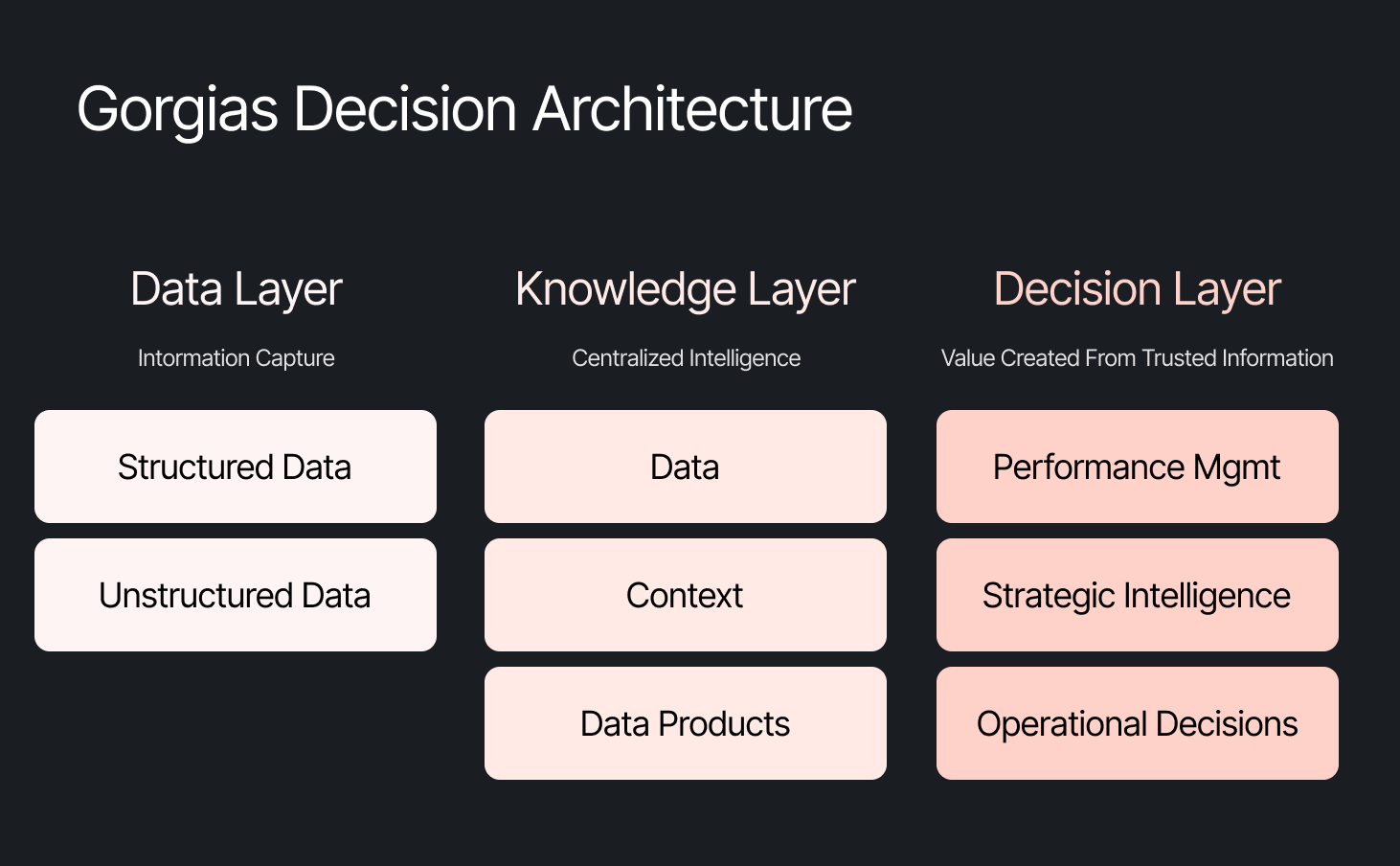
The framing problem most companies get wrong
The instinct across many companies today is to start with the model, pick a provider to solve a specific challenge, or invest heavily in getting the data right. All reasonable starting points, but most of them solve for one use case. Underneath that approach is a framing problem: seeing AI as an initiative — something you assign and measure. Seeing AI as another tool your company uses versus how your company operates.
We started somewhere different. Every company is built on four pillars: customers, people, product, and decisions. AI investments tend to place heavy emphasis on the first three. We started with the fourth. Our bet was that if we built everything around the need to make effective decisions first, asking what Gorgias needed to know to operate well, then our AI would become dramatically more powerful.
Cortex is that philosophy in practice
Cortex is our flagship internal AI agent, and the product where we established the tenets that now run through everything else we build: composable and modular infrastructure, governed context, and accessible from wherever decisions happen. Cortex lives in Slack, as well as across LLM vendors, in its own browser extension, and even on its own dedicated internal site.
Cortex doesn’t stop at answering questions. It can read and write to Notion, file Linear tasks, create HTML apps, automate signal delivery, and more. It operates across every layer of our stack, from dashboards to data pipelines, because we designed it as one integrated system. It is this connection that adds remarkable depth to what people can ask, and what they get in return.
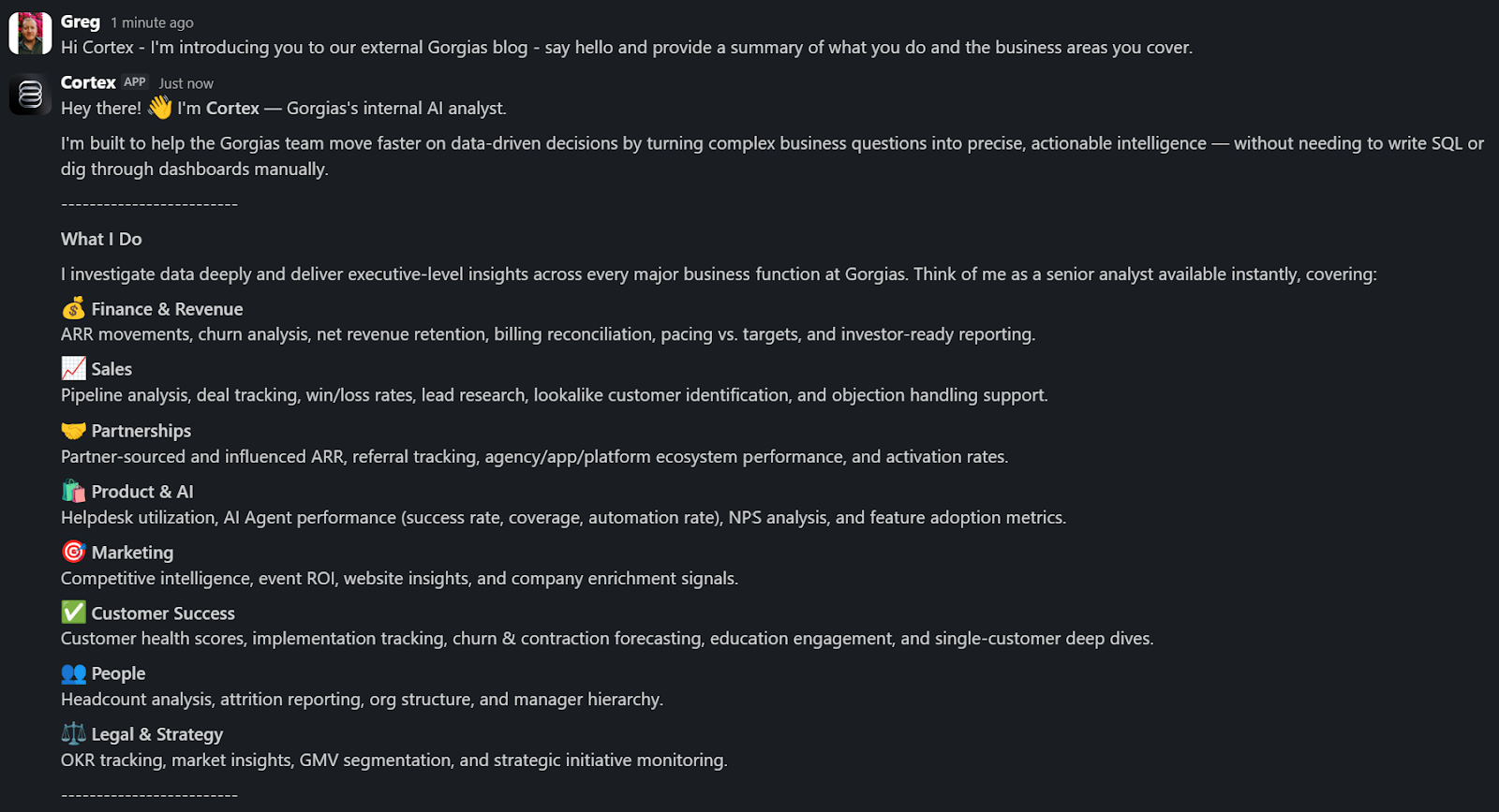
A Sales Lead is pitching and asks Cortex for the full picture of the merchant. In a customized PDF, Cortex lists coverage gaps, pre-sale intent signals, and product fit options. Everything the sales lead needs to walk in with confidence.
A Senior Product leader asks, "How are we performing against OKR #1, and what can my team do to help accelerate it?" Cortex returns a full ARR breakdown, projected end-of-month attainment, segment-level findings, and connects it all back to company-level strategies. A suite of recommendations customized to the leader, the performance, and the signals that bridge how they can support our goals. The kind of answer that used to take someone a week to put together.
These aren't simple lookup queries. They require deep business context spanning multiple areas. Cortex handles these because its Decision Engine gives it the information to reason against governed data, metric definitions, and business context, turning a generic answer into a credible one.
Overnight, teams have built Cortex into how they work. They’re spending less time searching and more time finding answers, not because they were told to, but because Cortex reduced the distance between question and decision.
Flexibility as the foundation
Cortex’s modular infrastructure allows us to experiment and add new capabilities freely. We’ve already built two more internal AI agents made for entirely different use cases, but using the same Decision Engine as Cortex.
GAIA, our internal experimentation AI Agent, helps our customers identify opportunities in their AI Agent Guidance design. It takes institutional knowledge across our teams and turns it into a scalable system that drives automation and value to our customers. Our CEO, Romain Lapeyre, has been its most vocal advocate since day one.
When we needed a platform for investor readiness and board preparation, we built Oracle. Our board decks and talk tracks are informed and built with the same AI, and our numbers are validated every step of the way.
We’re continuing to expand new AI agents internally, exploring how they can create value for customers and our own teams.
AI has transformed how data teams create value, and we’ve already shifted to account for it
When AI handles thousands of analytical questions each week, the highest-value work for a data team shifts permanently. Late 2025, we repositioned from a Data Analytics function into a Decision Intelligence function — a structural change in what we own and how we operate.
Today, our analysts focus on the most sensitive, complex, and forward-looking decisions and analyses. They partner more deeply with stakeholders by driving next steps from signals. They're even building entirely new capabilities that didn't exist in their role descriptions months ago. Things like AI skills for Cortex, context curation, and insight and recommendation delivery. The role of the analyst hasn't diminished. It's expanded to encompass the most meaningful work an analyst can do: driving outcomes and ensuring those decisions can achieve them.
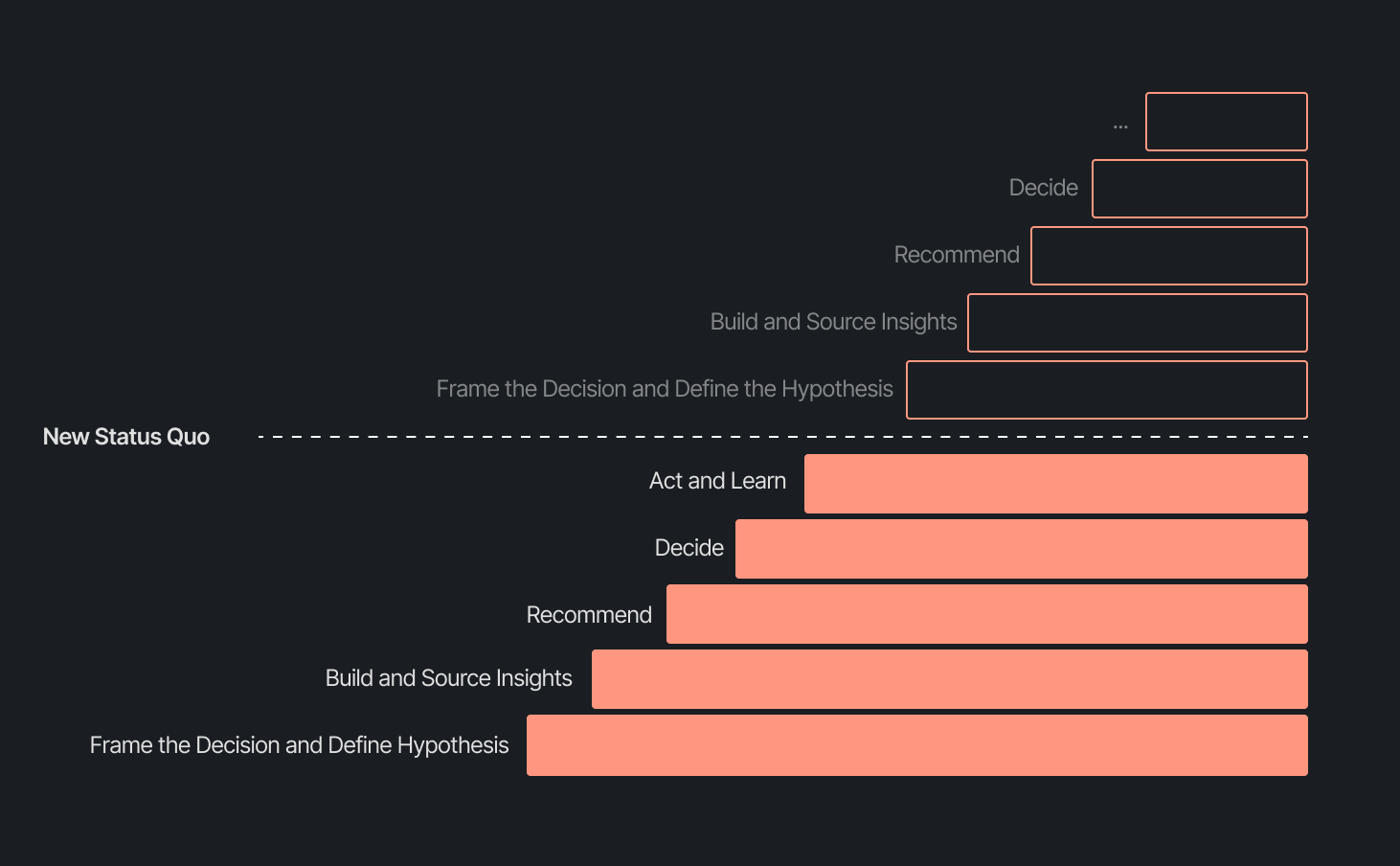
Our business support model has changed, too. Instead of embedding analysts and dedicated engineers within functional teams, we align capacity to the highest-impact company objectives and move fluidly across them. This model works even better because Decision Intelligence brings together both analytics and engineering teams under one roof.
Elliot Trabac leads our Data, Context and AI Engineering teams. The Decision Engine, Cortex, GAIA, and the platforms I've described exist because of the infrastructure his team innovated and built from the ground up. Noemie Happi Nono leads our Decision Strategy and Operations team, driving decision outcomes with stakeholders, advancing the development of Cortex skills and capabilities, and pushing into new areas of analysis every day.
Together, they're shaping what a modern data function looks like when AI becomes a standard building block for how a company operates.
What’s next for the Decision Intelligence team
The question of ROI is long gone. AI has opened the floodgates to more trusted and meaningful signals than ever. The natural next evolution is Proactive Intelligence, signals surfaced toward what you need to know, before you ask. And we're already building this because our architecture is designed to support it.
In the coming weeks, members of the Decision Intelligence team will go deeper into themes I've touched on here. Yochan Khoi, a Senior Analytics Engineer on our team, recently published a technical walkthrough of our context layer and will go further into building context strategies that scale. Others will cover infrastructure, analytical partnerships, evolving data assets into decision assets, and the cost and efficiency gains that make sustained AI investment viable.
AI hasn't changed the most important element of data and analytics functions — delivering outcomes — but it has raised the bar for what it looks like and how far we can take it. We’re just getting started.
TL;DR:
- AI is resolving tickets, not just replying. AI now handles 31% of customer interactions for ecommerce brands, and that number is expected to nearly double within two years.
- Every channel is becoming a storefront. Conversations are replacing the traditional browse-and-buy journey, with 79% of brands reporting sales from AI-driven interactions.
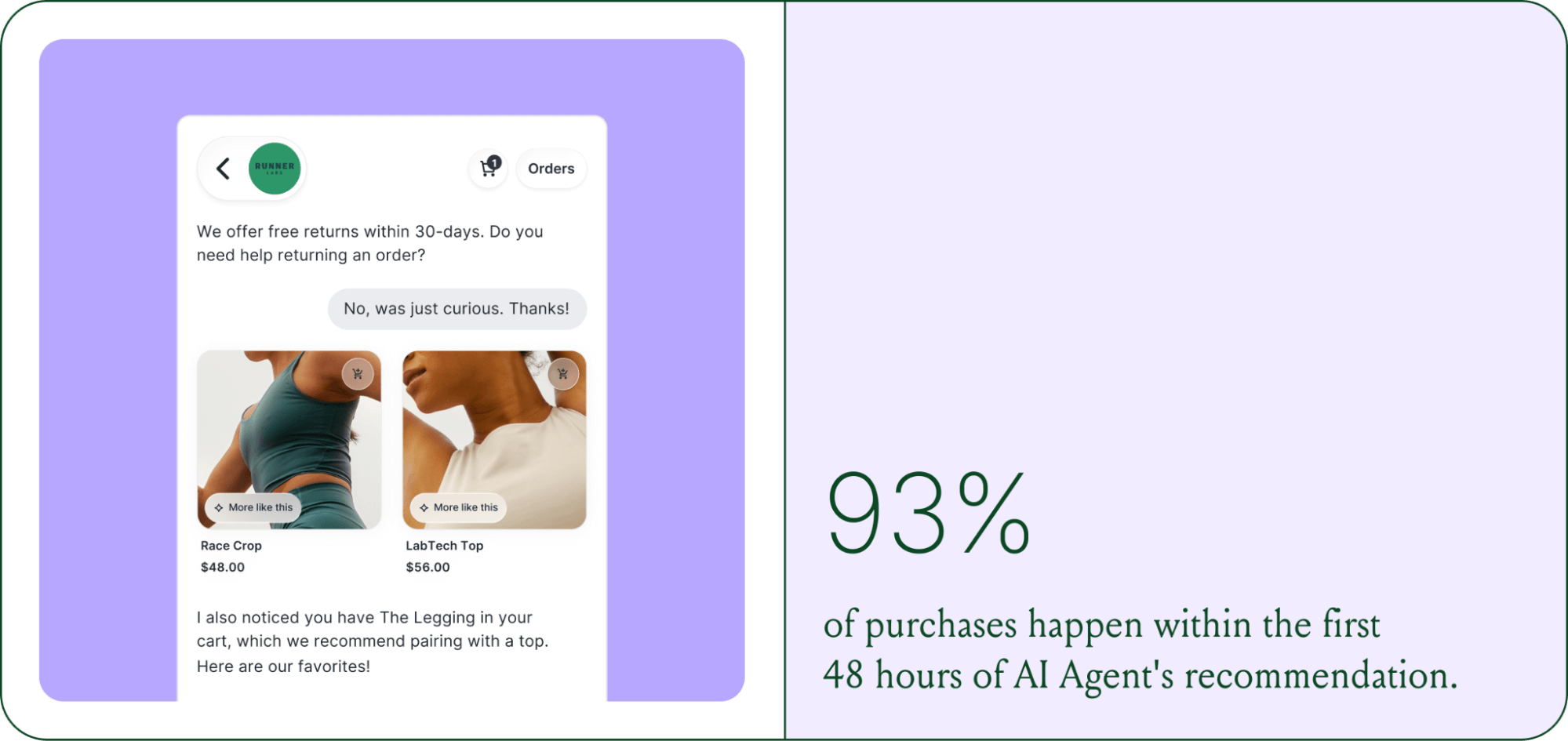
- AI is shortening the buying cycle. 93% of AI-influenced purchases happen within the first 48 hours of the conversation.
- CX teams are changing, not shrinking. Ecommerce brands are actively hiring for more technical roles to implement, coach, and maintain AI.
- The winning model is hybrid. AI handles volume and speed, while humans handle complexity and judgment.
The way shoppers buy online has shifted and customers are at the center.
They no longer want to scroll through product pages, dig through FAQs, or wait 24 hours for an email reply. They open a conversation, ask a specific question, and expect a useful answer in seconds. Brands that can’t deliver these experiences at scale are seeing customer hesitation turn into abandoned carts and lost revenue.
This shift has a name: conversational commerce. It's the practice of using real-time, two-way conversations as your primary sales channel, through chat, AI agents, messaging apps, and voice.
What started as an experiment for early adopters has become a key growth lever, with 84% of ecommerce brands treating conversational commerce as a strategic pillar this year vs. last year.
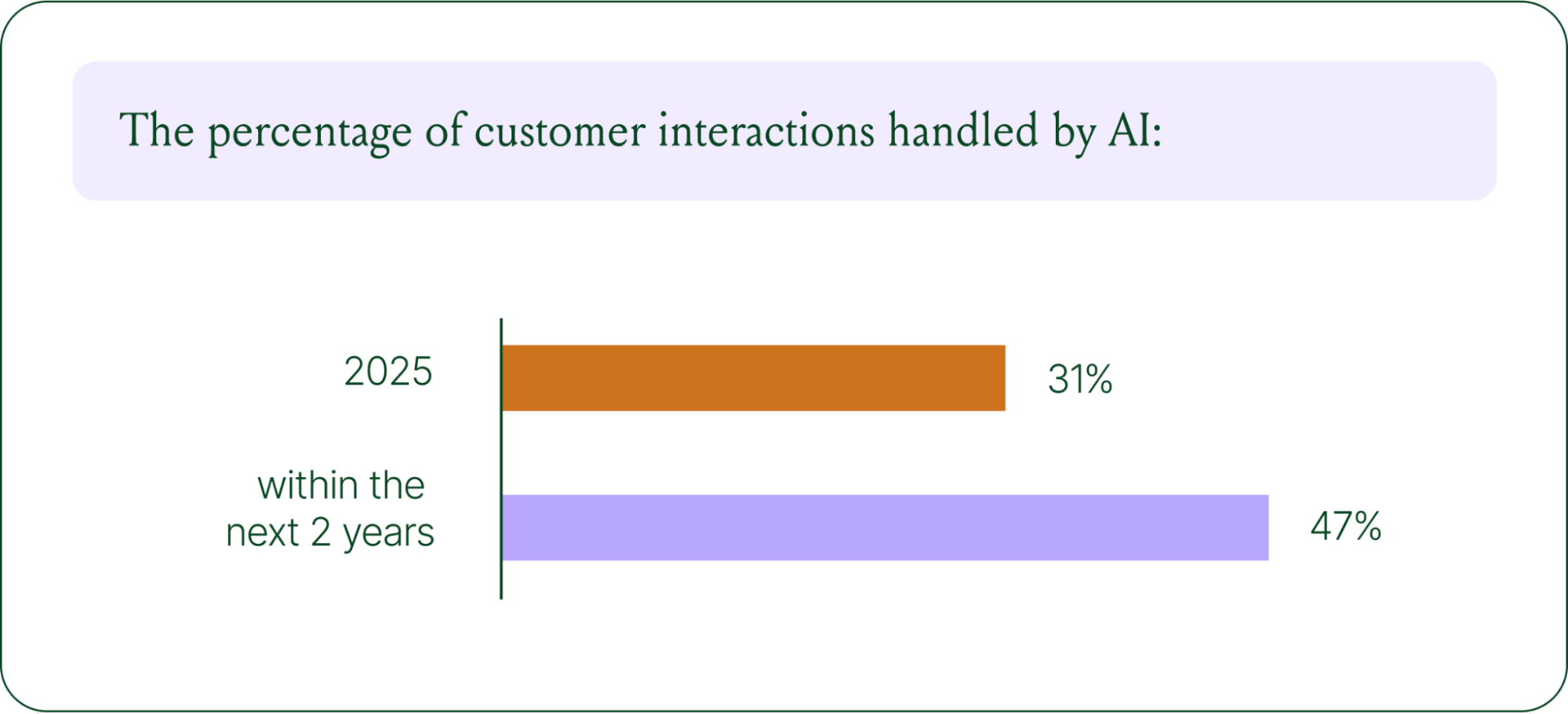
We surveyed 400 ecommerce decision-makers across North America, the U.K., and Europe to understand how conversational commerce and AI are reshaping the ecommerce landscape. These findings are complemented by aggregated and anonymized internal Gorgias platform data from 16,000+ ecommerce brands.
The State of Conversational Commerce in 2026 trends report breaks down all of the findings, including five key trends shaping the ecommerce landscape.
{{lead-magnet-1}}
Trend 1: AI is table stakes for ecommerce and it’s no longer just about efficiency
A few years ago, adding an AI chatbot to your site that could provide tracking links and Help Center article recommendations was a differentiator. Today, it's table stakes. McKinsey found that 71% of shoppers expect personalized experiences, and 76% get frustrated when they don't get them.
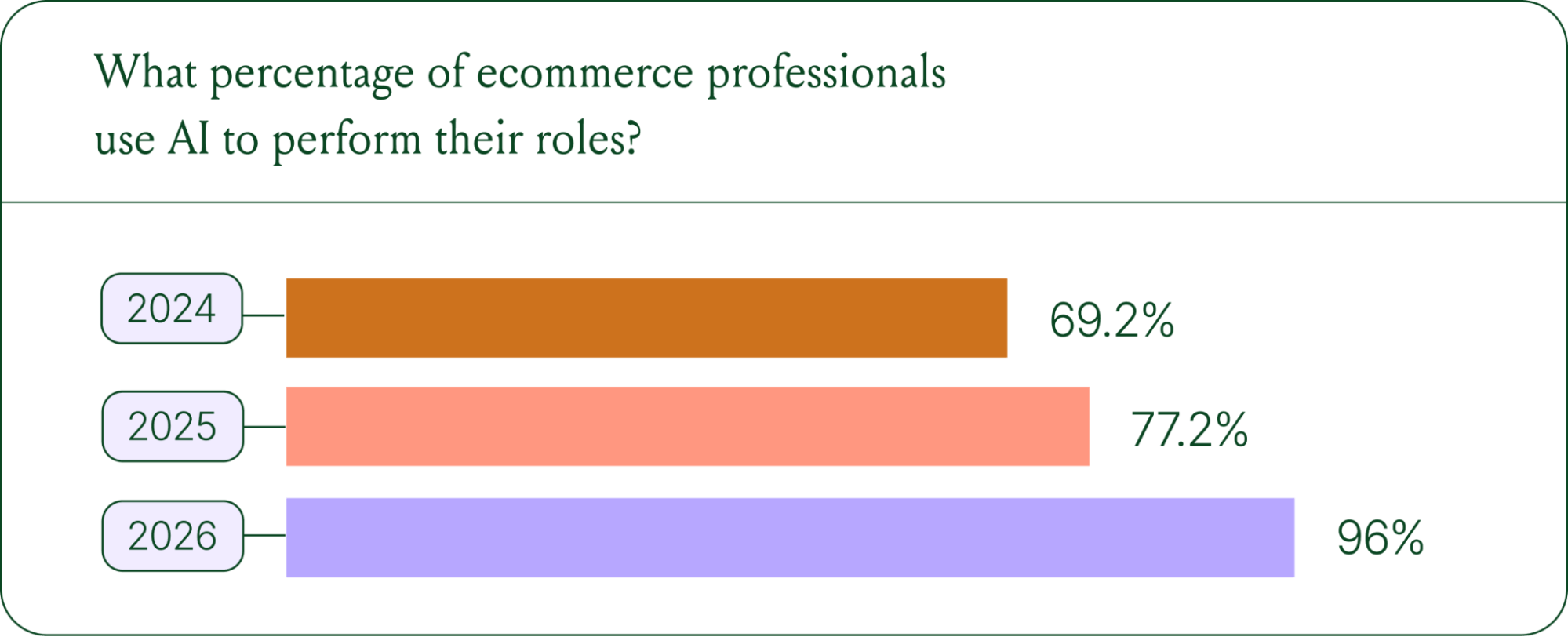
Right now, most ecommerce professionals use AI, with 93% having used it for at least 1 year. Enthusiasm is accelerating quickly, with only 30% of ecommerce professionals rating their excitement for AI at 10/10 in April 2025. Similarly, while AI adoption rose steadily year over year, it reached a clear peak in 2026.
The use cases driving this adoption are practical and high-volume:
- Order tracking and status updates
- Returns, exchanges, and refund requests
- Shipping FAQs and delivery estimates
These are the tickets that flood brands’ inboxes every day. AI agents resolve them instantly, without pulling teams away from conversations that actually require human judgment.
Explore AI adoption and use case data in more depth in the full report.
Trend 2: Conversations are the new path to checkout
The traditional ecommerce funnel, visit site, browse products, add to cart, check out, is losing ground. Shoppers now discover products on Instagram, ask questions via direct message, and complete purchases without ever visiting a website.
Conversational AI is actively increasing revenue, with 79% of brands reporting that AI-driven interactions have increased sales and conversion in their business.

The practical implication is that every channel is becoming a storefront. Creating personalized touchpoints with customers earlier in the journey, through proactive engagement, is impacting the bottom line.
Read the full report to explore how AI conversions have increased QoQ by industry.
Trend 3: AI is accelerating the purchase cycle
Pre-purchase hesitation is one of the biggest conversion killers in ecommerce. A shopper lands on your product page, has a question about sizing or compatibility, can't find the answer quickly, and leaves. That's a lost sale that had nothing to do with your product.
Conversational AI changes that dynamic. When a shopper can ask a question and get an accurate, personalized answer in real time, the friction disappears.
Brands using Gorgias saw this play out at scale in 2025. When AI Agent recommended a product, 80% of the resulting purchases happened the same day, and 13% happened the next day.
Brands are further accelerating the buying cycle through proactive engagement. On-site features such as suggested product questions, recommendations triggered by search results, and “Ask Anything” input bars drove 50% of conversation-driven purchases during BFCM 2025.
Explore how AI is collapsing the purchase cycle in Trend 3 of the report.
Trend 4: AI is making CX teams more technical
There's a persistent narrative that AI is making CX teams redundant. The data tells a different story. 62% of ecommerce brands are planning to grow their teams, not cut them. But the scope of those teams is changing.

New roles are emerging around AI configuration and quality assurance. Teams are investing in technical members to write AI Guidance instructions, develop tone-of-voice instructions, and continuously QA results.
CX teams are also bridging the gap between support goals and revenue goals, as the two functions increasingly overlap.
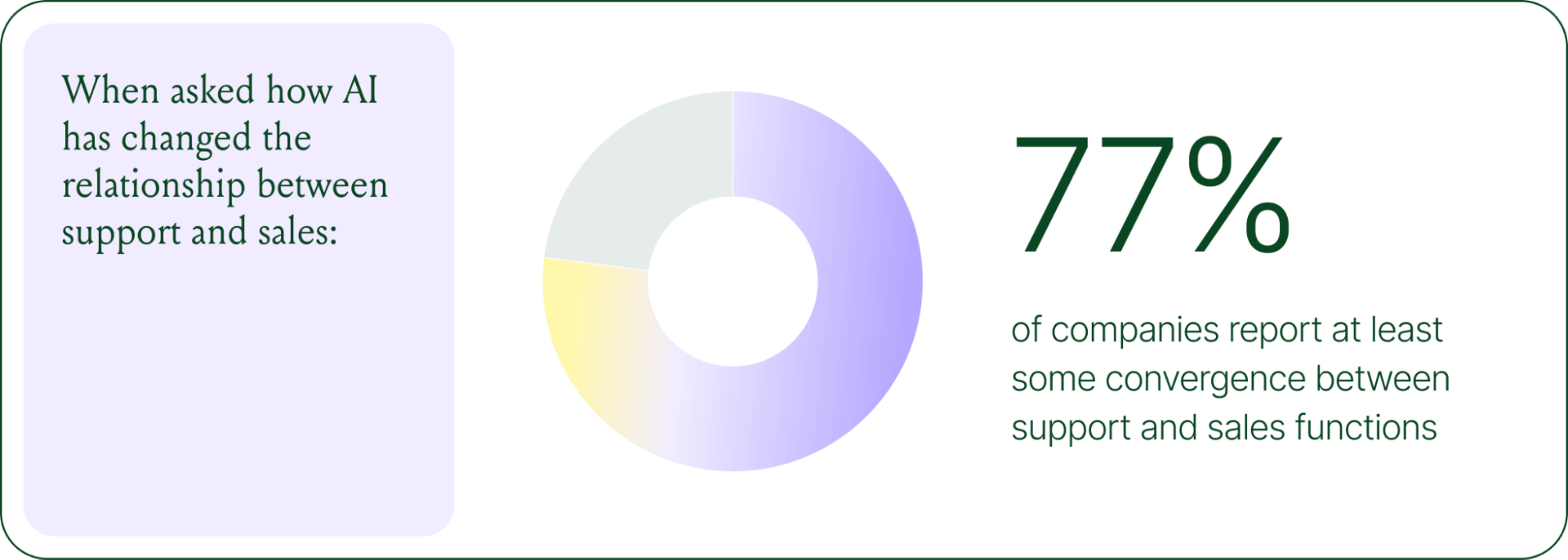
The result is CX teams that are more technical than they were before. Agents who once spent their days answering repetitive tickets are now spending that time on higher-value work: complex escalations, VIP customer relationships, and improving the AI systems and knowledge bases that handle the volume.
Learn more about the evolution of CX roles in Trend #4.
Trend 5: The future is hybrid: AI-first, humans when it counts
Despite increasing AI adoption, data shows that ecommerce brands shouldn’t strive for 100% automation. Winning brands are building systems in which AI handles repetitive tier-1 tickets, and humans handle complex, sensitive cases.

AI handles speed and scale. It resolves order-tracking requests at 2 a.m., processes return-eligibility checks in seconds, and answers the same shipping question for the thousandth time without compromising quality.
Human agents handle conversations that require context, empathy, or decisions that fall outside the standard playbook. There are several topics where shoppers still prefer human support.
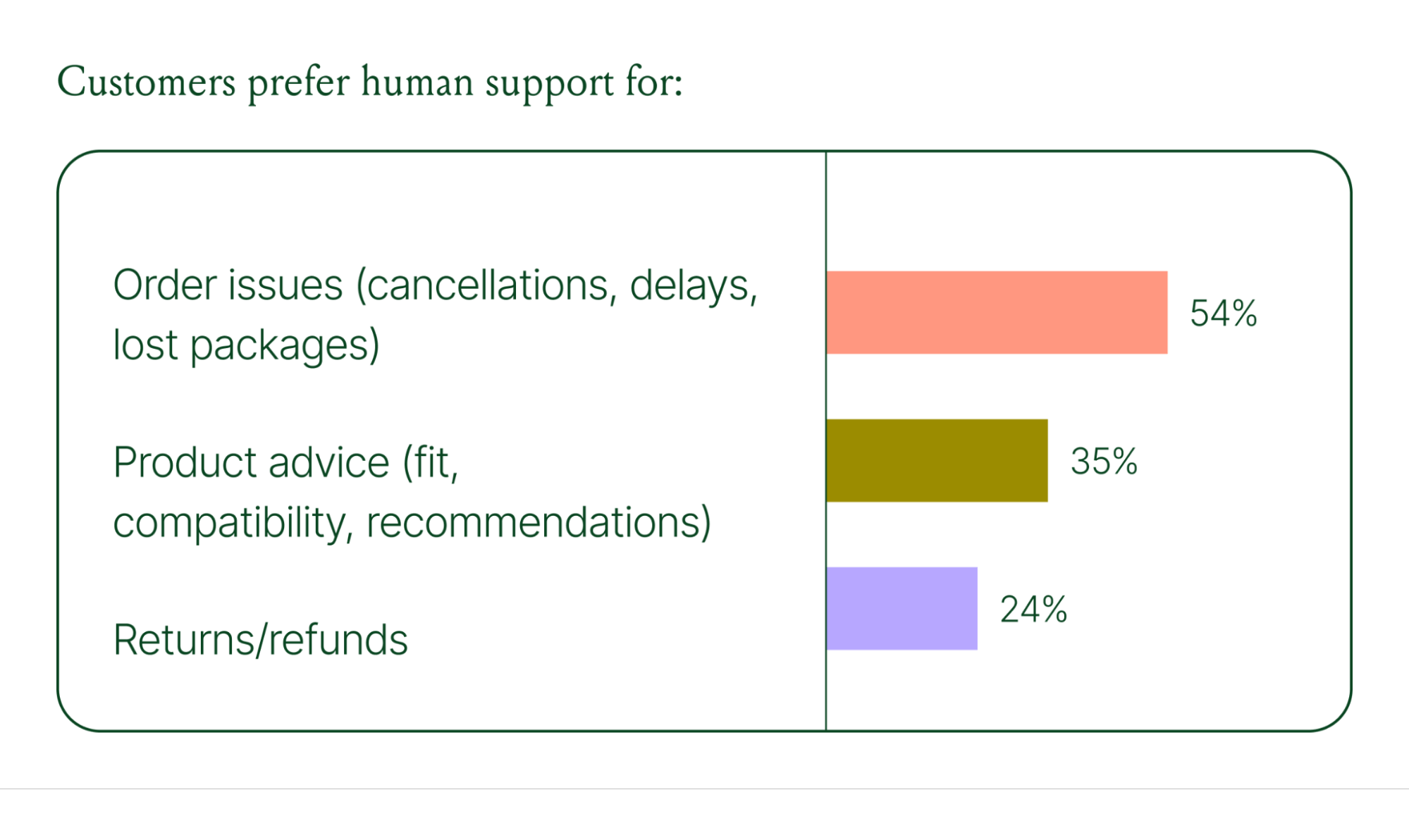
Successful hybrid systems require continuous iteration, meaning reviewing handover topics, Guidance, and reviewing AI tickets on a weekly basis.
Discover how leading brands are balancing human and AI systems in Trend #5.
Where conversational commerce is heading by 2030
The 2026 trends are about expansion and standardization. The 2030 predictions are about what comes next.
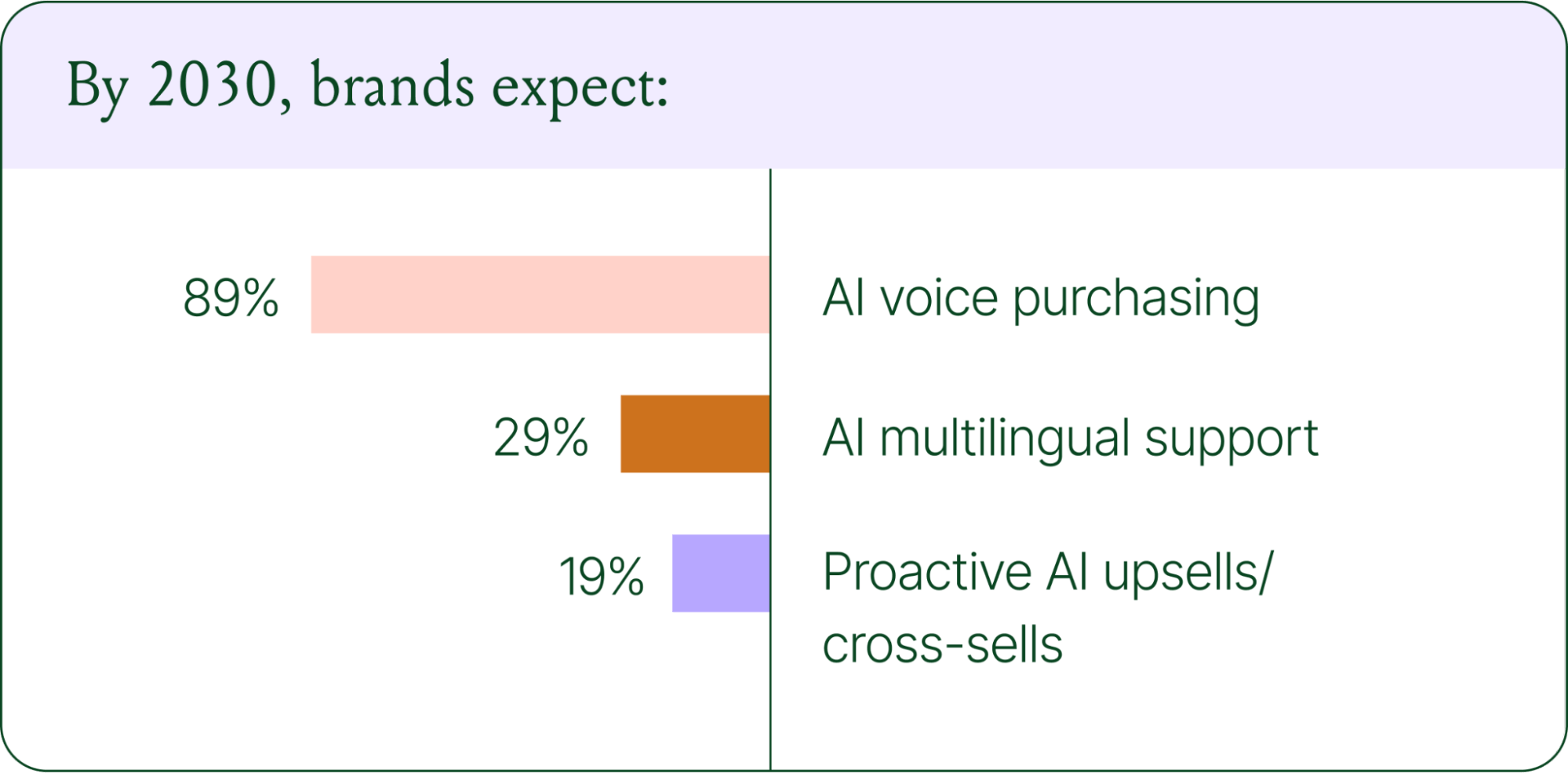
Voice-based purchasing is the biggest bet on the horizon. Only 7% of brands currently use voice assistants for commerce, but 89% expect it to be standard by 2030. The vision is a customer who can reorder a product, check their subscription status, or manage a return entirely over the phone.
Proactive AI is the other major shift. Rather than waiting for a customer to reach out, AI will anticipate needs based on browsing behavior, purchase history, and where someone is in their relationship with your brand. Think of it as the digital equivalent of a sales associate who remembers what you bought last time and knows what you're likely to need next.
Explore where ecommerce brands are allocating their AI budgets in the full report.
Start building your conversational commerce strategy today
The brands winning in 2026 are creating smart, scalable systems where AIhandles volume and humans handle nuance. They’re treating every conversational channel as an opportunity to serve and sell.
The data is clear: AI adoption is accelerating, customer expectations are rising, and the revenue impact of getting this right is measurable.
{{lead-magnet-1}}
Newsletter Signup
The best in CX and ecommerce, right to your inbox
Featured articles

Conversations Are Becoming a Revenue Channel: The Data Proves It
TL;DR:
- Customer journeys are collapsing to a single conversation. The traditional browse-and-buy journey is giving way to AI-guided shopping that moves from discovery to purchase in a single exchange.
- 79% of brands say AI-driven conversational commerce has increased their sales and purchase rates.
- AI-only influenced orders grew 63% in a single year, from 2.7 million in Q1 to 4.4 million in Q4.
- Brands treating conversation as a revenue channel. They’re not just a support function, generating higher AOV, shorter buying cycles, and stronger retention.
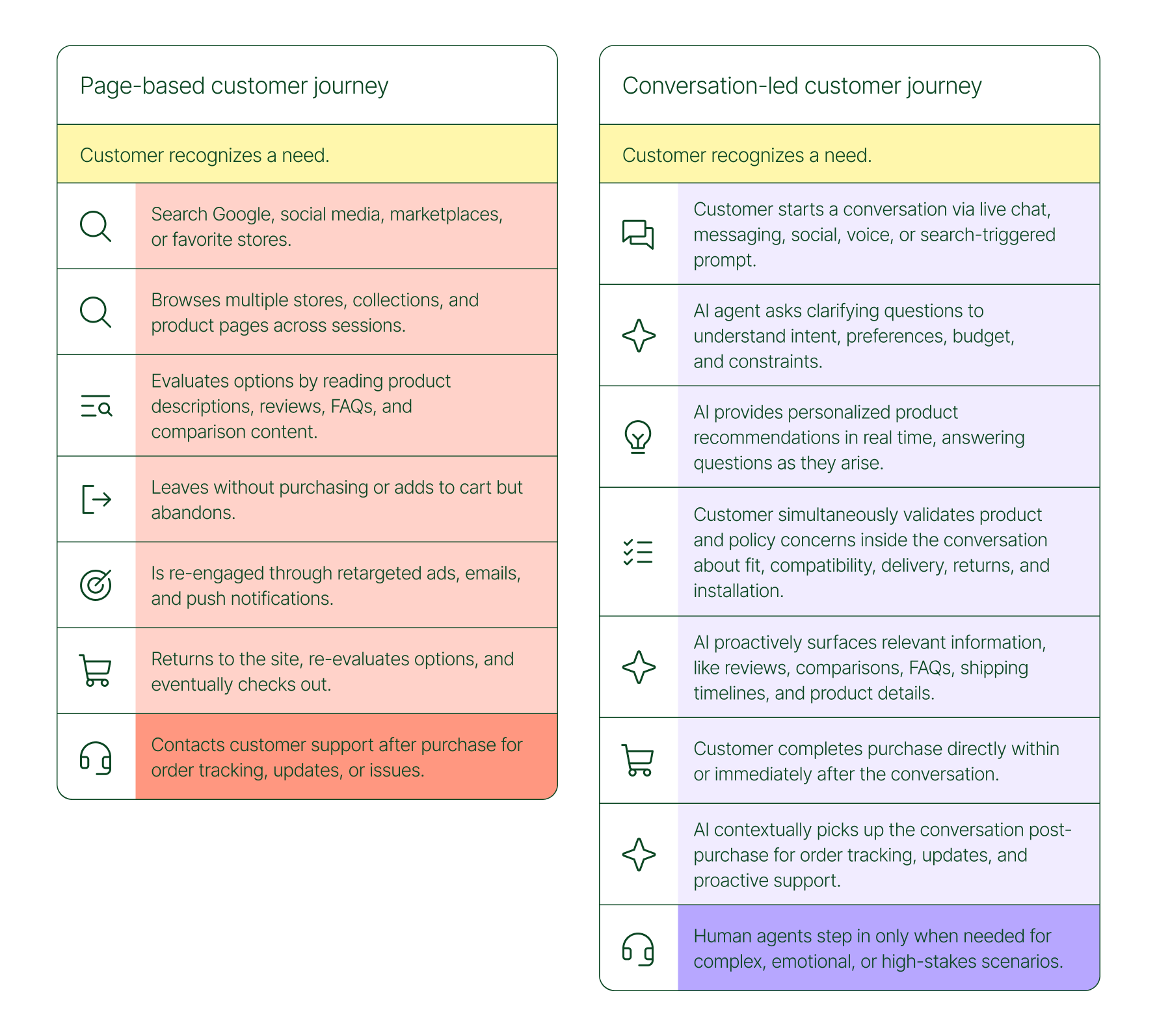
The page-based shopping experience dominated for decades. Customers would search, browse, compare, abandon, get retargeted, return, and eventually buy (sometimes).
That journey is no longer the only option.
Shoppers are turning to chat, messaging, and AI-powered tools to find what they need. Instead of clicking through product pages or reading static FAQs, they ask questions, have back-and-forth conversations, and get answers that move them closer to a purchase in real time. The path to checkout has changed, and the brands that recognize this are pulling ahead.
Read our 2026 State of Conversational Commerce Report to learn more about conversation commerce trends from 400 ecommerce decision-makers and 16,000+ ecommerce brands using Gorgias.
{{lead-magnet-1}}
The shopping journey has collapsed into a single thread
The traditional shopping journey was a solo experience. A shopper had a need, searched for options, browsed across sessions, and eventually made a decision — often days later, after being retargeted multiple times. Support only entered the picture after the purchase.
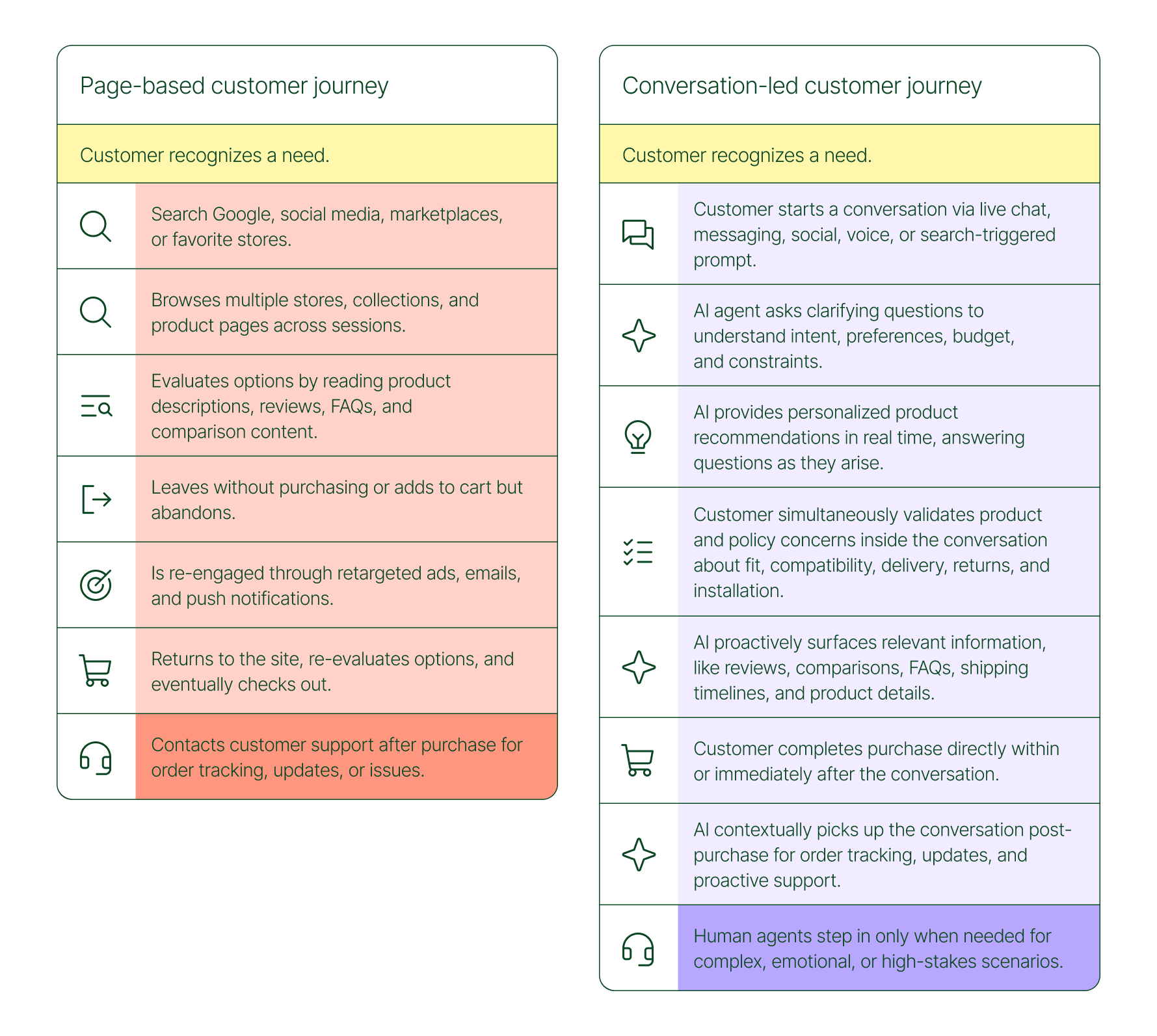
The conversation-led journey collapses that timeline:
- A shopper recognizes a need and starts a conversation via chat, messaging, or a search-triggered prompt
- An AI agent asks clarifying questions about preferences, budget, and constraints
- The AI provides personalized product recommendations in real time
- The shopper validates concerns about fit, compatibility, delivery, and returns, all inside the conversation
- The shopper completes the purchase directly within or immediately after that exchange
- The AI picks up the conversation post-purchase for order tracking and proactive support
- A human agent steps in only when the situation calls for it
What used to take days now takes minutes. Discovery, evaluation, and purchase happen in a single thread.
Conversation is a revenue strategy, not a support upgrade
79% of brands agree that AI-driven conversational commerce has increased sales and purchase rates in their business. When brands were asked to rank the highest-return areas:
- 38% cited improved customer support efficiency
- 23% pointed to higher customer retention and loyalty
- 20% saw improved purchase rates
Those numbers reflect something important: the value of conversation compounds. Faster support reduces friction. Better retention raises lifetime value. More confident shoppers buy more often and spend more per order.
The brands seeing the biggest returns aren't just using AI to deflect tickets. They're using it to create one-to-one shopping experiences at scale.
What the data shows about AI-influenced orders
Looking at AI-only influenced orders across key verticals like Apparel and Accessories, Food and Beverages, Health and Beauty, Home and Garden, and Sporting Goods, the growth across a single year was significant.
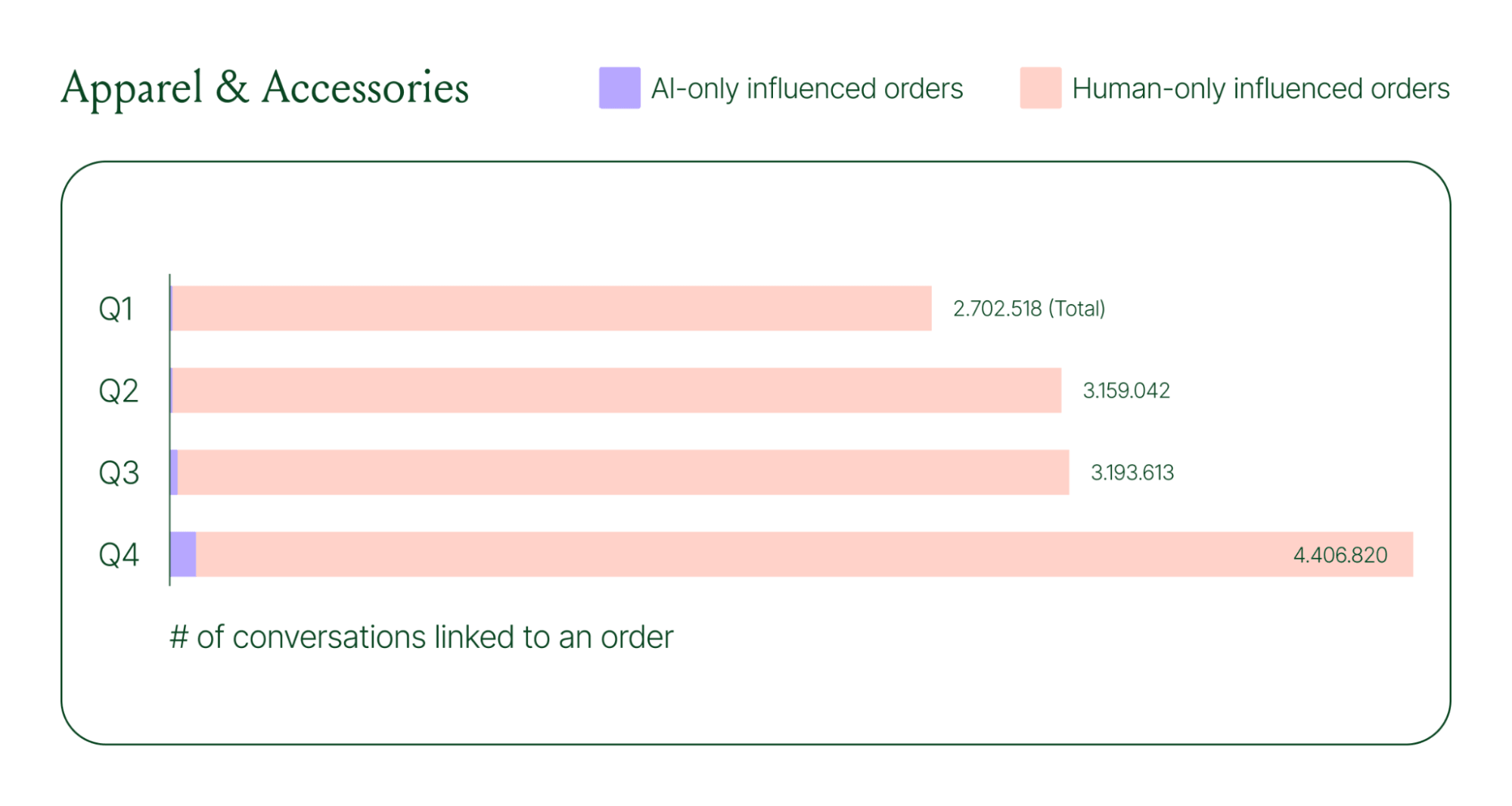
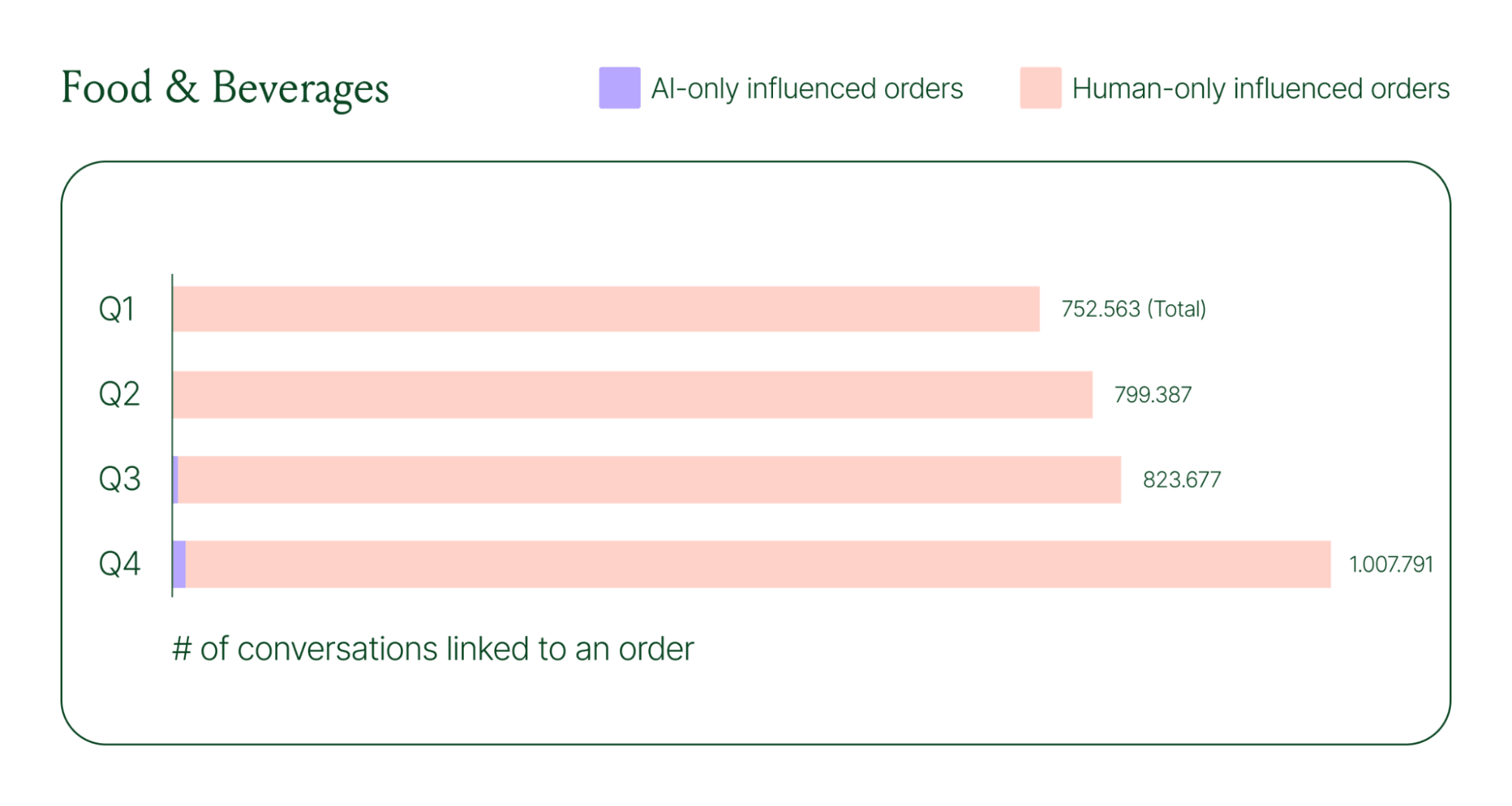
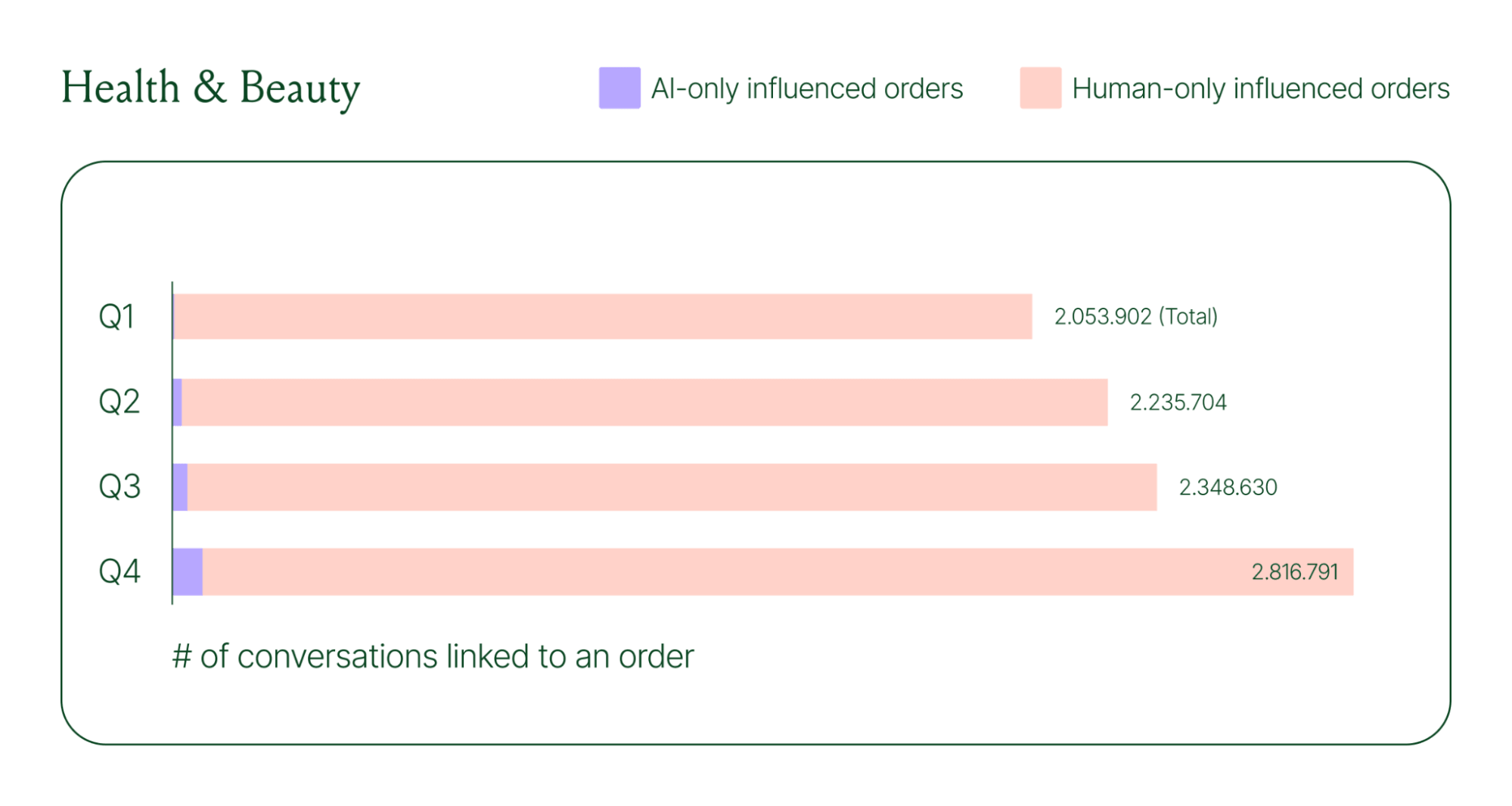
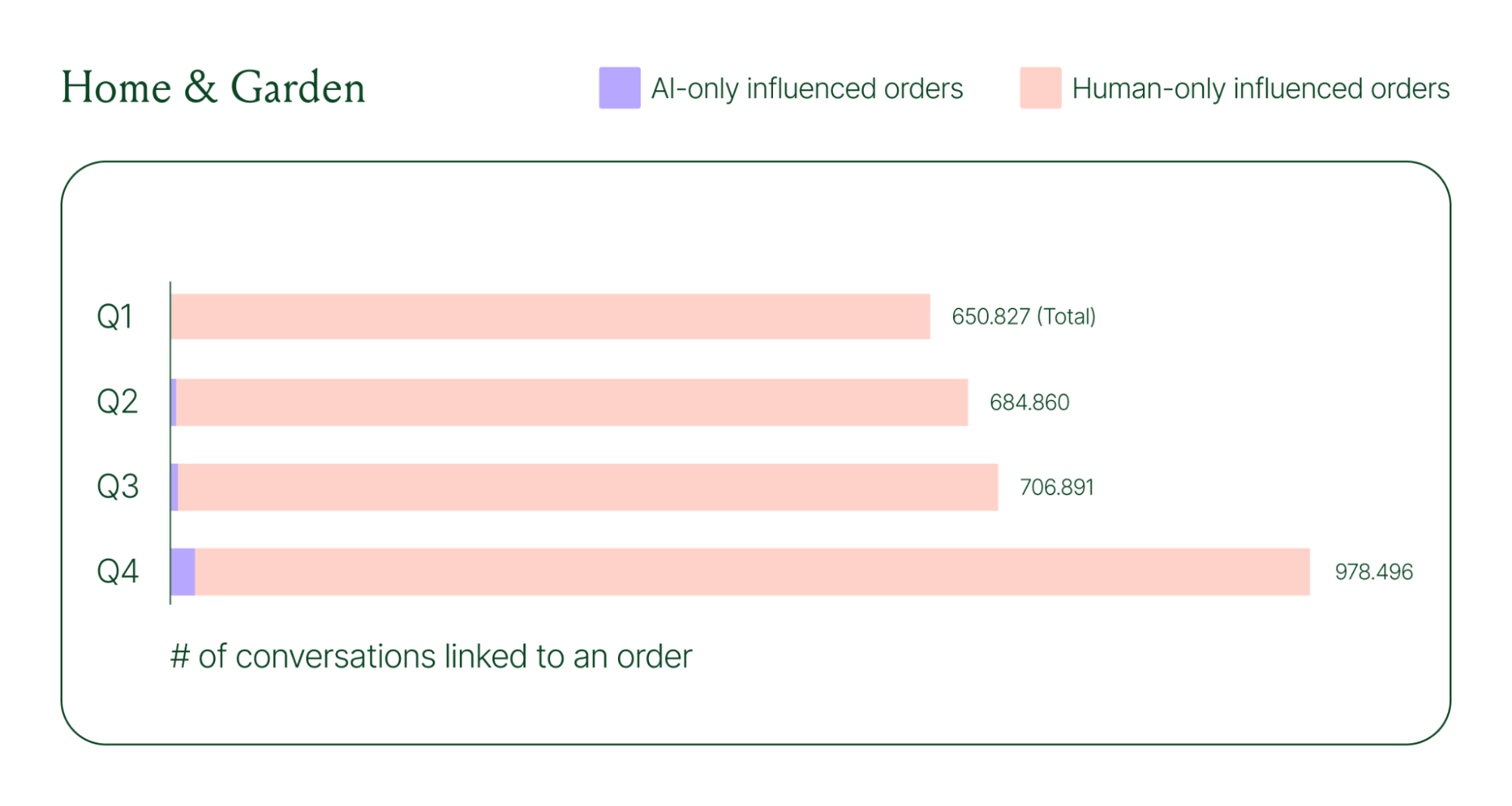
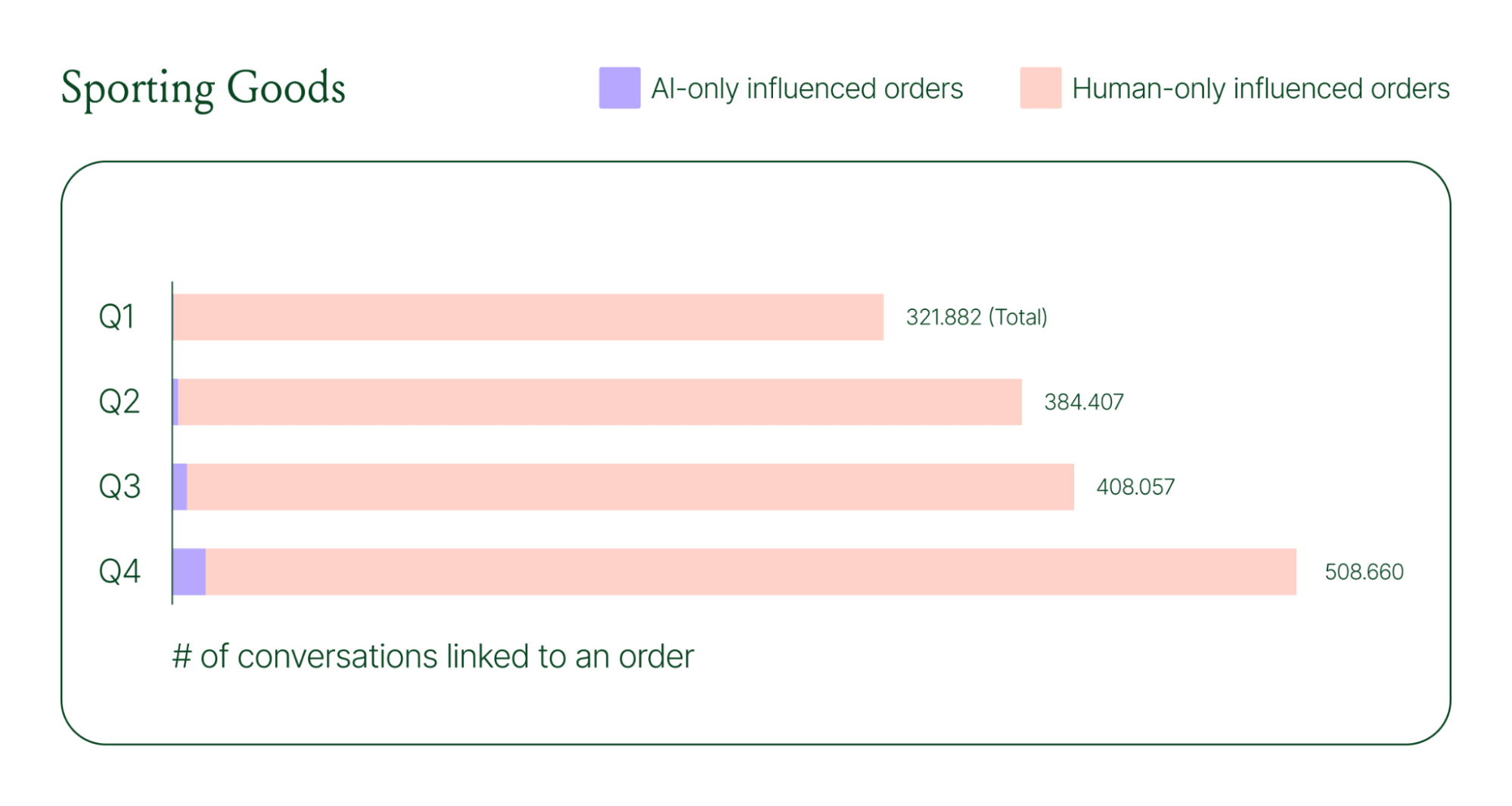
Across industries, ecommerce brands saw AI step into conversations, reduce shopper hesitation, and drive higher QoQ conversion rates.
Learn more about AI-powered revenue generation in the full 2026 Conversational Commerce Report.
Why brands are making this a strategic priority
84% of brands say the strategic importance of conversational commerce is higher than it was a year ago. 82% agree it will be mainstream in their sector within two years.
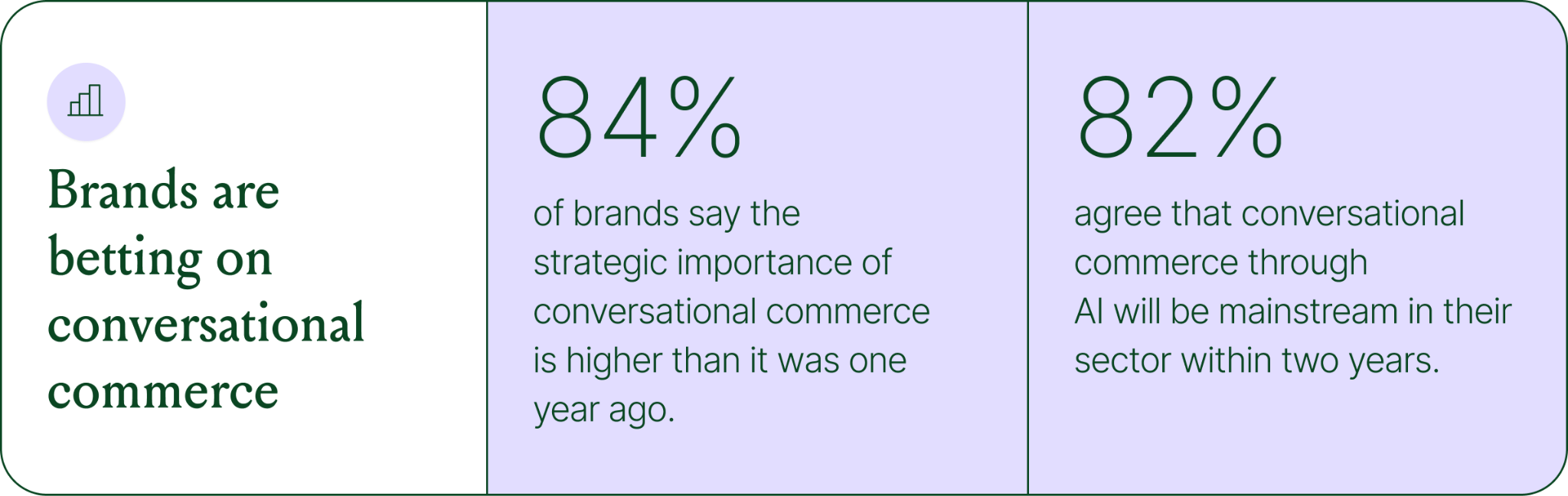
That shift is registering at the leadership level because of what conversational commerce does to the buying experience. Creating one-to-one touchpoints earlier in the journey drives higher AOV, shorter buying cycles, and stronger purchase rates. Shoppers who get real-time answers to their questions are more confident.
What this looks like in practice: TUSHY
TUSHY, known for eco-friendly bidets and bathroom essentials, is a useful example of what happens when you take conversational commerce seriously.
Bidets aren't an impulse purchase. Shoppers have real questions about fit, compatibility, and installation. Those questions used to go unanswered until the CX team could respond, often after the customer had abandoned the cart.
TUSHY used Gorgias's AI Agent and shopping assistant capabilities to automate pre-sales support. AI Agent engaged shoppers in real-time conversations, addressed their concerns directly, and built confidence at the moment of highest intent.
This resulted in a 190% increase in chat-based purchases, a 13x return on investment, and twice the purchase rate of human agents.
How to apply this to your strategy
You don't need to overhaul your entire operation to start seeing results. The most effective approach is to start where the impact is clearest and expand from there.
A few places to begin:
- Pre-sales chat. Identify your most common pre-purchase questions (sizing, compatibility, shipping timelines) and ensure your AI can answer them confidently and promptly.
- Product page engagement. Use proactive chat prompts triggered by page behavior to start conversations before shoppers leave.
- Post-purchase follow-up. Let AI pick up the conversation after checkout with order updates and proactive support, reducing inbound volume and building trust.
- Human escalation. Define clearly which situations require a human agent – complex issues, emotional exchanges, high-stakes decisions.
Want to see the full picture of where conversational commerce is headed in 2026? Read the full report to explore the data, trends, and strategies shaping the next era of ecommerce.
{{lead-magnet-1}}

AI Is Table Stakes for Ecommerce: What the Data Tells Us About 2026
TL;DR:
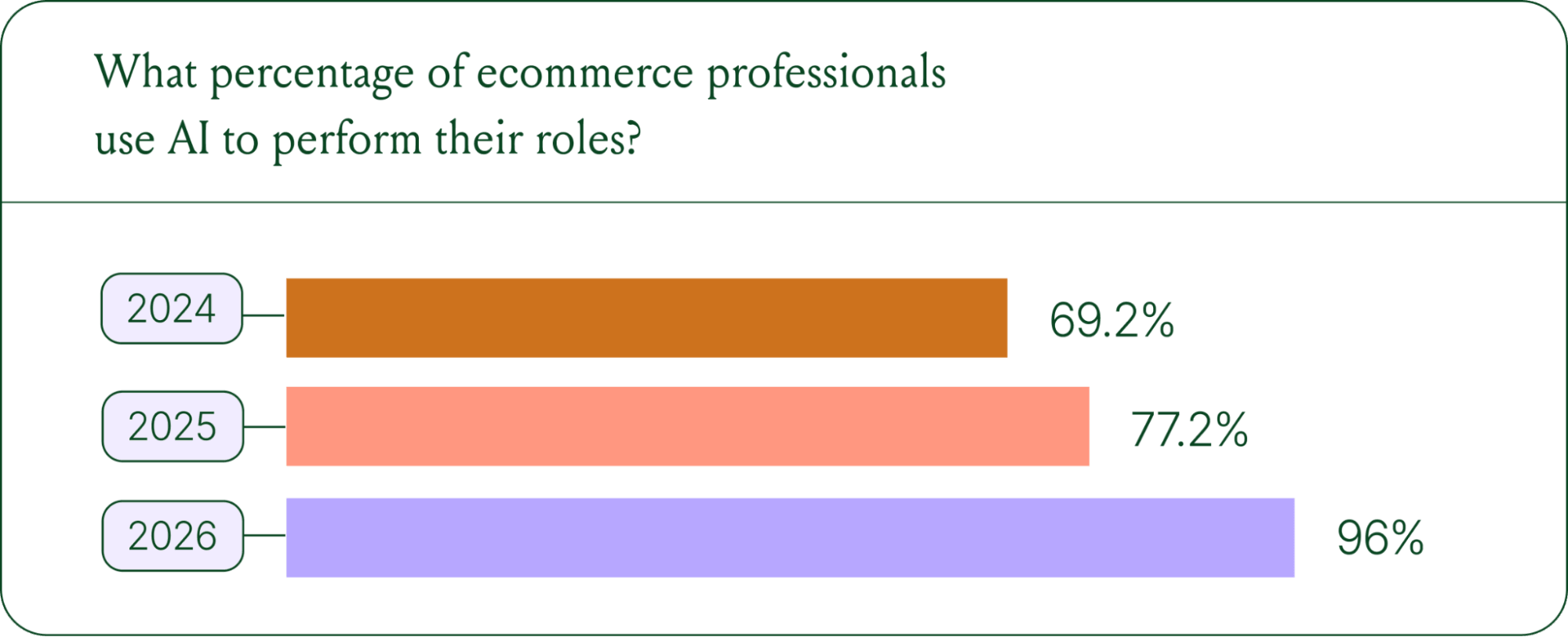
- AI adoption is rapidly accelerating. 96% of ecommerce professionals now use AI in their roles, up from 69% in 2024.
- AI has moved beyond support automation. Use cases have evolved into revenue generation, personalization, and logistics.
- Brands are tying AI success to profit-and-loss outcomes. 60% of brands consider AOV a top indicator of AI effectiveness.
A year ago, ecommerce brands were still debating whether AI was worth the investment. That debate is over. Today, nearly every ecommerce professional uses AI to do their job.
The shift isn't just about adoption. It's about what AI is used for and how brands measure its impact. Support automation was the entry point. Now, AI is embedded across the full operation, from product recommendations to inventory control to real-time shopping conversations.
In our 2026 State of Conversational Commerce Report, we break down trends on AI usage among 400 ecommerce decision-makers and 16,000+ ecommerce brands using Gorgias.
{{lead-magnet-1}}
AI adoption has reached a tipping point
If we rewind 12 months ago, the industry was still split on AI. Some ecommerce professionals were excited, but most were still hesitant. In 2024, 69% of ecommerce professionals used AI in their roles. By 2025, that number reached 77%. In 2026, it hit 96%.
The confidence numbers back it up. 71% of brands say they are confident using AI for ecommerce, and 73% are satisfied with its business impact.
In early 2025, only 30% of ecommerce professionals rated their excitement for AI at 10/10. Today, zero percent of respondents describe themselves as hesitant about AI.
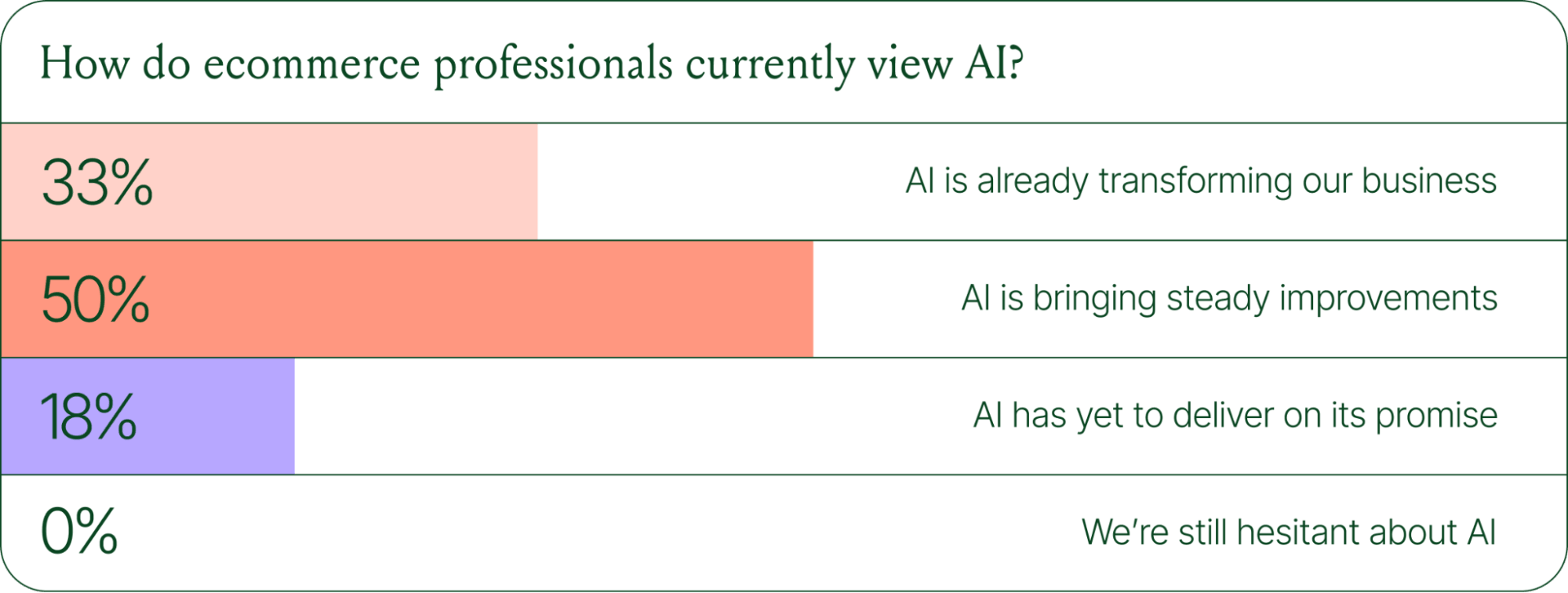
AI use cases now span the full ecommerce stack
Using AI in ecommerce is not new. In fact, it dates back to the 1980s with the invention of algorithms and expert systems. And if you’ve ever leveraged similar product recommendations or chatbots, you’ve already integrated AI into your ecommerce stack.
Modern AI is far more sophisticated.
With the rise of agentic commerce and conversational AI, brands began leveraging AI agents to automate the processing of repetitive support tickets. That’s still happening today, but the scope has expanded beyond the support queue.
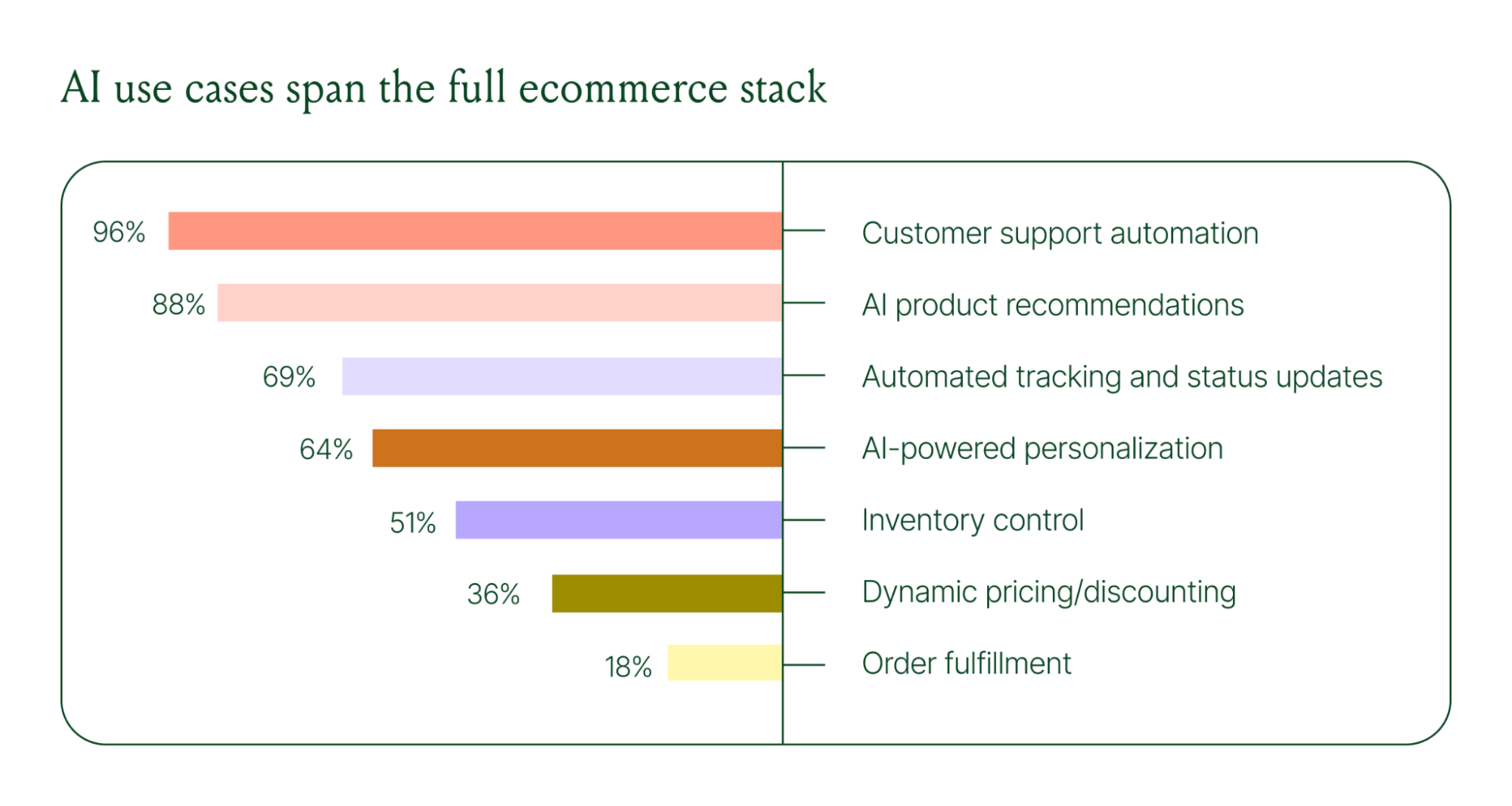
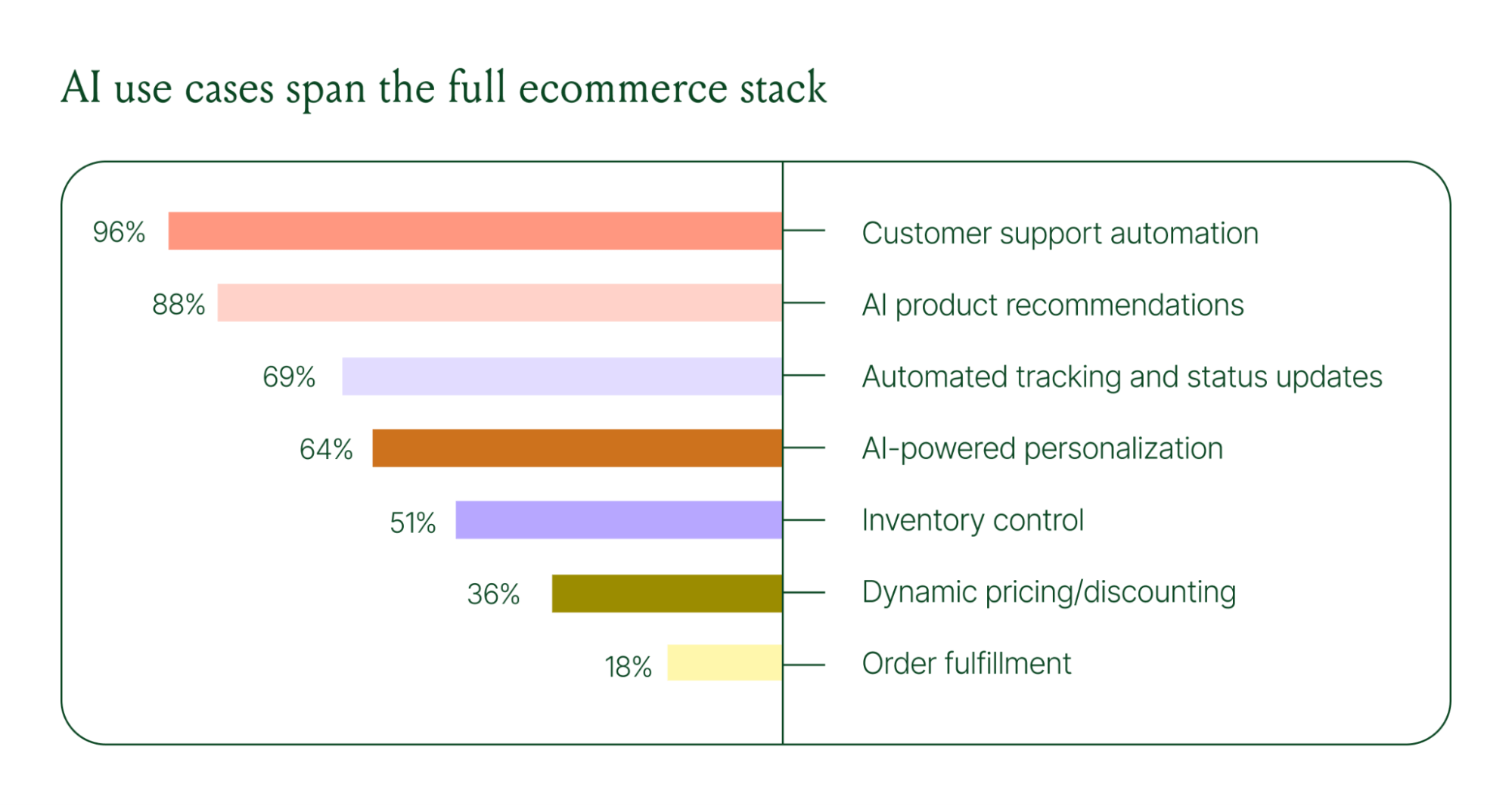
Ecommerce brands are deploying AI across every layer of their operation:
- Customer support automation: 96%
- Product recommendations: 88%
- Automated tracking and status updates: 69%
- Personalization: 64%
- Inventory control: 51%
- Dynamic pricing and discounting: 36%
- Order fulfillment: 18%
When brands were asked which channels contribute most to their AI success, conversational channels dominated. Social media messaging led at 78%, followed by SMS at 70%, and website live chat at 51%. Shoppers want fast, personal conversations, and AI is the best way to deliver that at scale.
Learn more about AI adoption, perception, and use case trends in the full 2026 Conversational Commerce Report.
How AI is changing CX success metrics
For decades, customer support success meant fast response times and high satisfaction scores. Those are still important indicators of success, but leading brands are adding revenue-focused metrics to their dashboards.
91% of brands still track CSAT as a measure of AI's impact. But 60% now include AOV as a top indicator, and higher-revenue brands earning $20M+ are focusing on metrics like total operating expenses, cost per resolution, incremental revenue, and one-touch ticket rate.
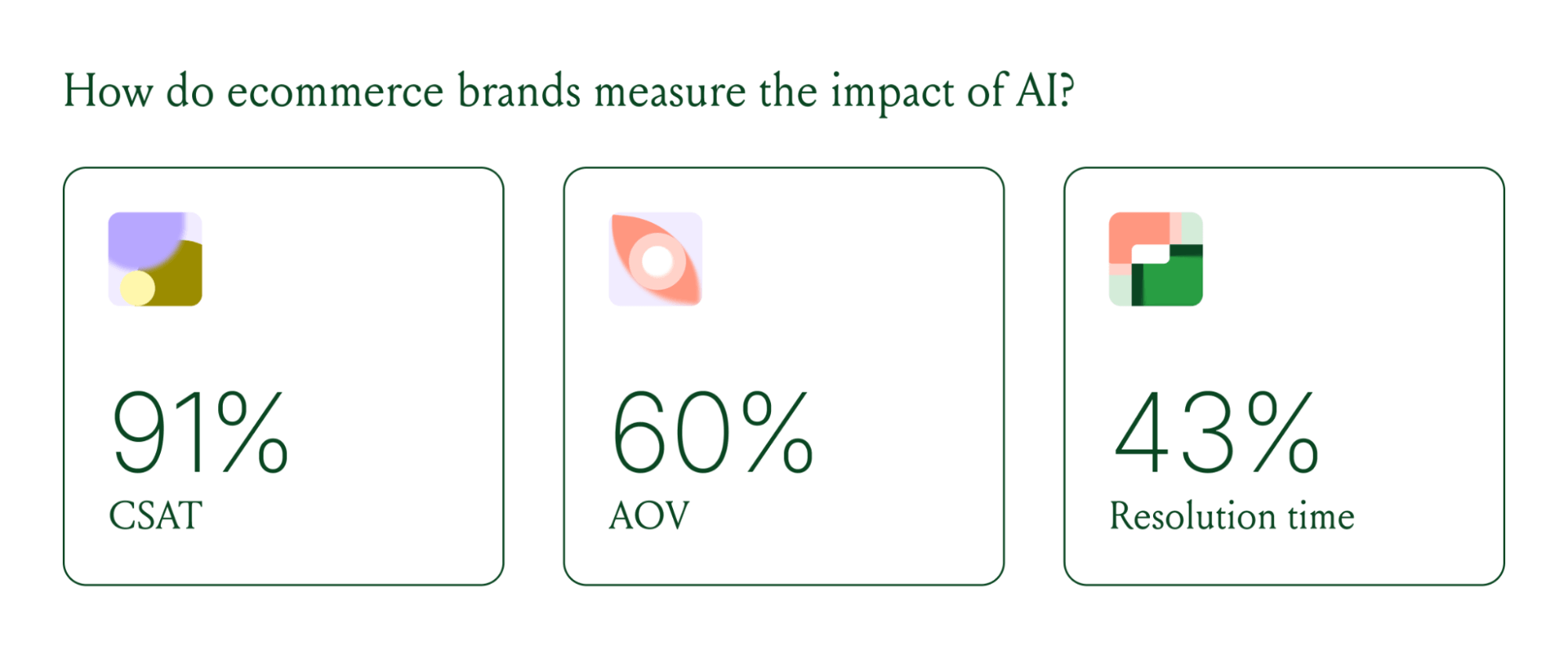
AI can now start a conversation, ease customer doubts, sell, upsell, and recover abandoned carts in a single conversation. When you’re only measuring CSAT, you’re ignoring the real ROI of conversational AI investment.
AI makes every conversational channel a storefront
Virtual shopping assistants now proactively engage shoppers, adapt to their needs in real time, and offer contextual product recommendations and upsells. When the moment calls for it, they can close the deal with a targeted discount.
Gorgias brands using AI Agent's shopping assistant capabilities nearly doubled their purchase rates and converted 20–50% better than those using AI Agent for support only.
Orthofeet, the largest provider of orthopedic footwear in the US, is a concrete example of this in practice. Using Gorgias, they achieved:
- 56% of support tickets automated in 2 months
- Email response times down from 24 hours to 35 seconds
- Double-digit revenue growth without adding headcount.
What this means for your AI strategy
The data tells a clear story: AI has evolved beyond a tool for handling tier 1 support tickets. It’s a core part of your revenue generation strategy.
57% of brands are already using AI for 26–50% of all customer interactions, and 37% expect that share to rise to 51–75% within the next two years. The brands building toward that range now are the ones who will have the operational advantage when it matters most.
The practical question isn't whether to invest in AI. It's where to focus first. Based on where brands are seeing the most impact, three priorities stand out:
- Start with high-volume, low-complexity tickets. WISMO (where is my order) inquiries, return policy questions, and order status updates are where AI delivers the fastest return. Automate these first.
- Expand into conversational channels. Social messaging and SMS are where AI is driving the most success right now.
- Connect AI performance to revenue metrics. If you're only measuring CSAT and response time, you're missing half the story. Add AOV, conversion rate, and incremental revenue to your reporting.
Want to go deeper on the full 2026 conversational commerce trends? Read the complete report for data across every major AI use case in ecommerce.
{{lead-magnet-1}}




Further reading


An Ecommerce Guide to Customer Experience Automation
TL;DR:
- Customer experience automation (CXA) can enhance revenue and increase customer satisfaction.
- CXA platforms convert manual tasks into automatic processes, improving customer service operations.
- Implementing CXA improves ROI, resolves issues faster, and delivers personalized experiences at scale.
- Real-world examples show how automation can improve customer experience and boost conversions.
The thought of automating repetitive customer service tasks has likely crossed your mind. But often, that consideration is followed by a train of concerns: Will automation eliminate personal touch? Will it reduce the quality of customer service? Will it replace human agents?
In reality, customer service automation (CXA) can enhance your revenue and increase customer satisfaction.
Read on to learn more about CXA and get four easy ways to automate. We'll also share a story of how one company successfully implemented CXA and gained 23% more conversions.
{{lead-magnet-1}}
What is customer experience automation (CXA)?
Customer experience automation (CXA) refers to the process of automating and enhancing the interactions that customers have with a business. It involves using automation tools like a helpdesk, Macros, Rules, and artificial intelligence to automate various aspects of customer engagement, from pre-sales and support to the post-purchase stage.
What is a customer experience automation platform?
A customer experience automation platform is a tool that can convert manual customer experience tasks into automatic processes. CXA platforms aim to alleviate the workload of human customer service agents while optimizing customer service operations.
Gorgias, for instance, is a leading example of a CXA platform, offering a wide range of powerful features, such as:
- Efficient ticket triage
- Automated responses across various channels
- Automated order management
- Automated emails
- Smart Article Recommendations via Chat and email
- Powerful integrations with ecommerce platforms
The impact that CXA can have on your customer experience (and bottom line)
Implementing CXA is not just about lightening your team's workload, it's a transformative strategy that greatly influences how customers interact with and perceive your brand. CXA ensures that your team can focus on more intricate interactions, resulting in an improved ROI, increased customer loyalty, and offering personalized experiences at scale.
Improve ROI for your support & experience teams
Customer service agents who have poor impressions of their companies say they don’t have all the tools they need to do their job. Factors like clunky software and insufficient training and processes all contribute to their experience, which, in turn, affects the overall customer experience.
The solution is to equip agents with powerful tools, like CXA, that will make their jobs easier and your customers’ experiences more enjoyable. Automation and an improved customer service ROI go hand in hand, leading to faster and more profitable customer experiences.
Help customers resolve issues faster
One of the immediate benefits of CXA is faster resolution times. With automation handling routine tasks like resolving where is my order (WISMO) requests and answering pre-sales questions, agents have more time to attend to complex support tickets and meet customer expectations with precise answers.
Deliver more personalized experiences at scale
Most automation skeptics fear losing the human touch once you bring automation into the picture. However, the reality is quite the opposite. A comprehensive CXA strategy allows support teams to express their brand voice and personality through adjustable features like pre-written templates or Macros. If your CXA platform restricts you from customizing default responses, you should find a tool that can adapt to you and your customers.
CXA in action: 4 easy ways to use automation to improve the customer experience
Now that we've covered the theory, it's time for your support team to implement CXA. Below are the top four ways to quickly incorporate customer experience automation using Gorgias Automate. We'll provide details on each feature, offer tips to get the most out of them, and showcase examples of how these strategies have worked for actual merchants.
1) Use Quick Responses to give customers instant answers to simple questions
Quick Responses are predefined replies automatically triggered when customers ask specific questions in Chat.
When to use: For teams who receive a daily flow of frequently asked questions that require them to copy and paste the same responses.

Tips:
- Quick Responses are best for answering FAQs that have straightforward answers and don’t need elaborate explanations
- Infuse your brand messaging and vocabulary into your Quick Responses to maintain natural interactions with shoppers
- Always provide a route back to live support channels through email, live chat, phone, SMS, or social media in case customers need more assistance
Real-world results: The stationery company Ohh Deer achieved an impressive average 4.95 CSAT score and generated about $12,500 per quarter after implementing Gorgias Chat alone.
📚 Related: Why customer service chatbots aren’t a great fit for ecommerce
2) Use Tags and Rules to organize and prioritize customer tickets
Take advantage of efficient ticket triage by using Tags and Rules to ensure the most important tickets are addressed and complex tickets are routed to your most knowledgeable agents.
When to use: If urgent tickets (billing issues, product defects, and inquiries from returning customers) are getting buried in your inbox, you have a low retention rate, a high churn rate, or your inbox is disorganized.

Tips:
- Create “Urgent” and “Not Urgent” Tags to establish a streamlined prioritization process for agents to follow
- Use Rules to direct complex tickets to more experienced agents so you avoid compromising resolution times and customer satisfaction
- Create a Rule to remind agents to follow up on customers who have recently contacted your contact center
Real-world results: Drinkware brand BrüMate cut down their first response time from 5 hours to 1 minute and 30 seconds and drove $9M in revenue after they made use of Chat Campaigns and a Help Center (Gorgias’s customer knowledge base).
Colin Waters, BrüMate’s former Associate Director of Customer Experience, highlights that organizing Tags and Macros by their proper names keeps team onboarding running smoothly. He adds, “I'm very steady with naming conventions. I mean, my team must hate it. But anybody could come in and figure out what it all means without having a doctorate in CX."
3) Automate the order management, tracking, and returns process
Order management, including order creation, tracking, returns, and exchanges, is one of the aspects of customer service that is best suited to automation because of its repetitive nature.
When to use: If you get an influx of WISMO tickets and/or return-related inquiries in your inbox or need to streamline your order workflow.

Tips:
- Enable tracking, returning, and canceling in Chat to allow customers to quickly check their orders
- Automate order status notification emails to trigger after hitting milestones in the entire customer journey, such as order confirmations, order delivery, and post-purchase customer feedback requests
- Integrate Loop Returns with Gorgias to automate your returns process and create a returns portal
Real-world results: Jaxxon includes their Return Policy in Chat via Quick Responses and maintains an easily accessible Return Portal. By maximizing their self-service resources, they brought in a staggering 46% more in revenue.

4) Use AI to recommend Help Center articles
Your articles shouldn’t only be found in your Help Center; make the most out of your resources by sharing them on multiple channels like Chat and email. Making your articles widespread gains you two benefits: an educated customer base and faster resolution times.
When to use: If you have a high return rate and negative customer reviews or sense a lack of understanding from your customers about your product.

Tips:
- Insert Help Center articles into customer communications to build anticipation and proactively address issues
- Create Chat Campaigns to automate the customer education process, offering targeted information and support
- Scenarios where you can use chat campaigns: holidays and limited-time offers, for customers browsing high-value products, at checkout to reduce cart abandonment
Real-world results: After creating Chat Campaigns that displayed welcome discounts and toilet compatibility checkers to shoppers, TUSHY achieved an impressive 25% increase in revenue and improved customer satisfaction. They also brought their bounce rate down by 37%.
Success story: How Kirby Allison boosted conversions by 23% with CXA

If the previous real-world examples weren’t enough to convince you about automation’s integral role in CX, here’s another success story.
Kirby Allison, a luxury garment care business, struggled to handle a growing volume of repetitive and time-consuming tasks. Surviving on a minuscule two-person customer support team, they were drowning in tickets outside business hours.
Once they enlisted the help of Automate, it was a weight off their shoulders. Gorgias’s multifunctional Chat provided 24/7 support with Quick Responses, self-service Order Management, and Article Recommendations.
Immediately, Kirby Allison saw a 46% increase in sales, a 23% increase in conversions, and drastically reduced response times.
If you want to make huge successes easy wins — take the first step towards transforming your customer service and book a Gorgias Automate demo today.
{{lead-magnet-2}}

Why You Need To Monitor Customer Effort Score (& How To Do It)
It’s true that a great customer experience is key to winning happy customers — but to keep a pulse on customer satisfaction, you need to dig a little deeper.
To understand the quality of a customer’s experience with your brand, you need to track Customer Effort Score (CES). This metric lets you evaluate your customer service efforts by tracking the level of effort a shopper must exert to fix an issue with your customer support team.
In this article, you’ll learn exactly how to track and monitor CES, as well as how to optimize your support strategy to minimize customer effort as much as possible.
{{lead-magnet-1}}
What is Customer Effort Score (CES)?
Customer Effort Score (CES) is a way ecommerce brands can accurately measure how much effort a customer has to exert in order to interact with your support resources.
This metric is relevant to any interaction a shopper might have that touches your customer support strategy, like:
- Talking with a rep through Live Chat
- Navigating a return
- Answering tricky product questions
- Canceling an order in progress
The easiest way to measure customer effort score is by sending customers a survey after their interaction with customer success ends. In this survey, ask them to rate their service experience on a 1-10 point scale.
We’ll dive into the details behind how to create a survey to measure the amount of effort your customers take shortly.
📚 Related: 13 live chat support metrics
Why customer effort is the key to customer loyalty
No shopper wants a high-effort experience. According to The Effortless Experience, 96% of high-effort customer experiences drive a customer to be disloyal to your brand — making retention nearly impossible.
 |
Clearly, it's worth the effort to make life a little easier for your customers — doing so will convince many of them to shop with your brand again.
When you calculate your customer effort score, you’re able to keep a pulse on exactly what it takes to create seamless experiences that lead to increased loyalty. The metric is a strong predictor of customer retention and can help identify pain points in your customer support strategy.
A quick-start guide to measuring CES with surveys
As we mentioned earlier, you can measure customer effort by sending customers a customer effort survey.
In this survey, customers are asked to rate their experience with customer support on a Likert scale from “less effort” to “a lot of effort”.
Let’s walk step-by-step through how to build a CES survey and how to send them to your customers. Then, we’ll look at how to interpret results once you’ve compiled enough data.
When to send a CES survey
You can send a CES survey immediately after any customer interaction, like post-purchase.
To zoom in even more on customer effort, consider only sending a CES survey once a shopper has a service interaction with your support strategy, like chatting with a live agent, visiting a self-service portal, or clicking through an interactive FAQ page.
This way, you’re able to get an accurate idea of how easy, or how frustrating, your support touchpoints are.
How to create a CES survey
A CES survey typically has one simple question that asks, “How easy was it to solve your problem today?”
Every brand tracks responses a little differently, using a scaled system. Here’s a few examples of different kinds of scales you can choose from:
Word-based scale
A word-based scale lets respondents share their experience by choosing a word or phrase ranging from “very easy” to “very difficult.”
 |
Sentiment scale
A sentiment scale gives customers the option to share their experience using angry, happy, or sad faces to depict the emotion they felt while seeking support from your brand.
 |
Numerical scale
A numerical scale lets customers share their experience using a scale of 1 to any number of your choosing. Some brands like a scale of 1 to 10, while others prefer scales of 1 to 5.
No matter what thresholds you set, 1 should always be the lowest, meaning the worst, and your end number should be the highest, meaning the best.
It's important to note that no option is better than another. The survey type you choose all depends on your shop’s needs.
Some brands might also ask an open-ended question as a follow-up so customers can share specific details about their experience.
You can send a CES survey question through email, SMS, or a similar channel to customers who recently reached out to your support team.
Of course, you can send a customer effort score question manually, but it takes precious time away from your reps who are busy handling active tickets. Automating the process means your agents can focus on more meaningful work, like following up with disgruntled shoppers.
Gorgias integrates with Delighted to provide easy-to-use survey templates to automatically distribute customer surveys, including for CES. Once a customer makes a purchase, it triggers Gorgias to automatically send a customer effort score survey to that customer.
 |
How to calculate your CES score
Like many other customer service metrics, you want to calculate your average CES in order to get a snapshot view of how most customers perceive their experience with your support resources.
If you want to calculate customer effort manually, start by tracking response data from your CES surveys over a given period of time.
The timeframe all depends on your goals. You can look at a month, quarter, half-year, etc. Ultimately, it's more important to be consistent with the timeframes you measure. That way, you can accurately track how your CES changes over time.
Once you’ve collected enough data, plug it into this simple formula:
Divide the number of customers who agree the interaction was easy by the total number of responses.
 |
To put it in actual numbers, if 100 people responded to your CES survey, and the total sum of their scores amounts to 800, that means your CES score is 8 (out of 10).
What drives a high CES?
Like most other customer service metrics, there is no such thing as a standardized “perfect” benchmark for customer effort.
That’s because it all goes back to your brand and its goals. What makes sense for your customer effort might not translate to another ecommerce shop.
As a general rule of thumb, when it comes to CES you want your score to be as high as possible.
A high CES shows that your support strategy is clear cut and that customers have to exert minimal effort to have their problems resolved. Conversely, a low CES means customers find their experiences with your support resources arduous — putting your brand at risk of a high churn rate.
The best way to drive a high CES is to provide a painless and straightforward experience. If your CES isn’t quite as high as you’d like it to be, start by asking yourself these questions:
- How many touchpoints did the customer have before their issue was resolved?
- How long did it take for an agent to respond to a customer ticket?
- Are all your links up-to-date for important self-service options like a knowledge base, forum, or FAQ?
- Do you agents have access to the resources they need to make well-informed decisions?
From there, you can look into ways to optimize your support strategy to boost your customer effort score.
How to improve your Customer Effort Score
To improve your customer effort score, you need to build pathways to make it as easy as possible for customers to find the answers they’re looking for. That means decreasing the number of steps it takes for a customer to complete a task and optimizing your first response time.
Research from Genesys shows that 94% of customers intend to make a purchase after a low-effort experience — versus 4% of customers after a high-effort experience.
Clearly, it’s worth the effort to optimize your customer experience.
Let’s look at some of the easiest ways ecommerce brands can lower their CES using functions commonly found in helpdesks.
1) Build out a thorough knowledge base
 |
A knowledge base is a portal, of sorts. It connects your shoppers to both sales and customer service so they can make an empowered purchasing decision.
The beauty of a knowledge base is that is goes way beyond just a static library of articles.
BrüMate's Help Center is a learning environment where customers can go to in-depth knowledge about their products.
 |
2) Lean on self-service
 |
Customers might not reach out to your agents immediately.
According to Gartner, 70% of customers seek out self-service options before contacting support.
Offering more self-service options also means you can deflect low-priority tickets so your agents can focus on solving more challenging customer issues.
We’ve already discussed a popular self-service option: knowledge bases. Here are some other examples of what customer self-service might look like:
- FAQ page: Answer your customers’ most frequently asked questions with key information like operating hours, product availability, pricing, return policy, basic troubleshooting, and more.
- Forums: Build community among your shoppers and encourage them to talk to each other about their experiences so that they can empower themselves to resolve low-effort problems.
- On-demand webinars: Educate your customers with step-by-step tutorials about your brand’s products. Record webinars so that you can publish them as evergreen content on your website for customers to access anytime.
- In-product tutorials: Give customers step-by-step instructions in the moment its needed. In-product tutorials are effective at helping customers get value out of your product quickly.
3) Harness automation
 |
Many of the tickets your agents handle are repetitive.
Sure, tracking a customer’s order is important, but automation can handle these kinds of straightforward questions for your team.
In customer service, automation likely won’t replace your hardworking support reps. Rather, automation can work with your teams to improve workflows and optimize communication with your customers by tackling redundant manual work.
A helpdesk like Gorgias can help you completely automate 60% of repetitive tickets with a 0-second response time.
 |
4) Auto-prioritize tickets to reduce response times
 |
Assigning ticket priorities is a best practice to empower your team to become more efficient. But you could spend all day on this task alone.
Ticket prioritization is another useful form of automation, assigning low-, medium-, and high-value to every incoming request. This way, your team can handle the higher-priority issues first.
Gorgias comes with advanced intent and sentiment detection features to automatically assign value to incoming tickets based on Rules that you can set.
 |
5) Use Macros to streamline responses
Macros are another form of automation that optimize a customer support team’s workflow.
Macros are pre-written, automatic responses to incoming customer requests.
Gorgias Macros automatically pull customer data into your messages, like name, order number, and shipping addresses. This makes for a more efficient conversation and helps customers get to a resolution with minimal effort for both the customer and the agent.
 |
Other important customer experience metrics to consider
Customer effort is a big slice of the pie when it comes to monitoring your customer experience, but it can’t show the whole picture on its own.
We recommend bolstering your CES efforts with additional metrics in order to add helpful context to your customer support strategy.
Customer satisfaction metrics such as CSAT score, Net Promoter Score (NPS), and customer churn rate (CCR) can all provide helpful insights into how your support team is performing.
Plus, it gives you a better look into the customer’s journey, so you can see how shoppers experience your brand — and give you ideas for how to boost satisfaction and drive loyalty.
Customer Satisfaction (CSAT)
 |
Customer satisfaction score (CSAT) is a metric to measure your customer base’s level of satisfaction with their experience.
The metric is one of the most important measurements your support team can track. Satisfied customers are the key to unlock loyalty, reviews, and referrals, along with returning customers that boost revenue for your brand.
With Gorgias, you can automatically send a customer satisfaction survey after each interaction with customer support:
 |
Net Promoter Score (NPS)
 |
Net Promoter Score (NPS) is a commonly tracked metric that lets you learn how likely your customers are to recommend your brand to their friends and family.
This metric likely correlates closely with your CES. A customer who has had a great experience is likely to want to hype you up to their networks, versus a customer who had to put in a ton of effort to resolve an issue.
If you optimize your NPS, there’s a good chance your CES will also improve — which can lead to more repeat customers and a boost in customer loyalty.
Ecommerce Churn Rate
 |
Ecommerce churn rate is the percentage of lost customers your business sees over a given period of time.
This metric is similar to Customer Churn Rate (CCR), which is typically measured by SaaS or subscription-based B2B companies. These companies can easily see when a customer cancels their subscription, making this data easy to monitor.
Ecommerce, or online stores, can measure churn rate by looking at negative customer feedback, like a high CES, in order to identify customers at risk for churn.
Gorgias: Your ecommerce helpdesk to lower Customer Effort Score
A helpdesk like Gorgias has the power to immediately optimize your customer service team — which, as we’ve learned, directly impacts the effort a customer has to exert with your brand.
Because Gorgias has purpose-built automation features like Chat, Macros, and ticket prioritization, it can empower your customers to find a resolution to their problems as fast as possible.
Sign up for Gorgias or book a demo to start tracking and improving your customer effort score today!
{{lead-magnet-2}}

Customer Service Management: A Complete Guide for Managers
Your first priority as a customer service manager should ensure fast, consistent, high-quality support.
However, good customer service management can be very complex, requiring technical skills and an understanding of many interconnected operational tasks. Strong people and team management skills are the foundation for success.
In this guide, you’ll learn customer service management and how to improve as a leader. Here’s everything we cover below:
- What is customer service management?
- What a smoothly functioning customer service team looks like.
- How to measure your customer service team’s performance.
- Four essential tools and resources for customer service managers.
{{lead-magnet-1}}
What is customer service management?
Customer service management is the role of running a customer service team in a way that ensures customer satisfaction, loyalty, and long-term retention.
This involves various tasks, from hiring agents to ensuring everyone on the team has the necessary tools and resources to do their job.
We can organize these tasks into two broad categories:
- People and team management, which we’ll discuss in the next section.
- Operational management and optimization, which we’ll discuss later in this guide.
What is customer service team management?
Customer service team management is the collection of actions the customer service manager takes to consistently enable agents to perform their job well. This can include a whole range of activities, including:
- Hiring agents with the right customer service skills and attitude
- Training them on how to deal with different customer inquiries
- Setting standards for individual agents and the team as a whole
- Providing regular feedback and constructive criticism when necessary
- Establishing targets, metrics, and KPIs for the customer service team and analyzing agents’ performance based on them
What a smoothly functioning customer service team looks like
As a customer service manager, most of the success of the customer service team rests on you. It’s your job to build the team and the rules, systems, and guidelines agents will use daily.
A helpful starting point is to learn what a smoothly functioning customer support team should look like. This will help you lay the foundation for effective customer service management.
Easy interdepartmental communication
As with all other team activities, internal communication is the key to success. In a good customer service operation, agents are ready to communicate and have the tools to do so.
For example, Slack, Microsoft Teams, and other chat and video conferencing software should always be available for real-time communication in urgent situations. Asynchronous communication methods like email should be encouraged in other cases.
As a manager, it’s your job to set clear rules around communication methods in different situations (e.g., no real-time calls where an asynchronous email or Slack message will do). Good communication rules can guarantee that everyone values their colleagues' time and attention.
Clearly defined workflows
A good customer service manager ensures each agent knows:
- How to handle common inquiries, e.g., where to look for information, when to escalate the issue, etc.
- What to do in abnormal situations.
- What’s expected of them in terms of response and resolution times.
The key here is that agents should have this information before they need it.
💡 Tip: Build a detailed hub of all the essential documents and information your agents need. This can include your customer service policy, refund and return policies, escalation rules, video walkthroughs of challenging situations, and much more.
“Remember, you can't pour from an empty cup –– taking care of yourself is beneficial for you and crucial for your ability to support your customers effectively.” - Eli Weiss, CX Unlocked
Low stress and less risk of burnout
High-stress environments and burnout are all too familiar in customer service. This often stems from understaffing, poor training, or confusing workflows.
Eli Weiss provides a few great tips for avoiding burnout in his CX Unlocked Guidebook:
- Practice mindfulness. Train your team to recognize when they’re starting to feel frustrated. That might look like realizing when a customer’s harsh tone is beginning to bother them, taking a moment, and responding calmly (rather than acting on impulse).
- Create and respect boundaries. Designate “work-free” zones in your life. These could be certain hours of the day, specific locations, or even mental spaces.
- Celebrate every win, no matter how small. Boost morale and motivation by reminding your team how amazing they're doing.
Performance tied to specific KPIs
A big part of customer service management is evaluating your team’s performance. The only way to do that fairly is to use specific, measurable key performance metrics (KPIs). This ensures you’re evaluating agents objectively, giving them clarity and goals to aim for.
For example, response and resolution times are two of the most critical metrics for any support team. Keeping them consistently low shows a well-managed, prepared, appropriately trained team. It also shows that there are enough agents to handle the incoming inquiries.
The better your agents’ time management skills, the faster their response and resolution times will be. As a manager, you can help your team prioritize tickets and reduce the time spent on repetitive tasks with automation (like Rules) and pre-made template resources (like Macros).
Also, remember that while industry-standard KPIs are helpful, you shouldn’t use them just because other organizations do so. All KPIs should be tailored to your customer service and business goals — whether that’s higher customer satisfaction, better customer engagement, more revenue, higher on-site conversion rates, or anything else.
Five most important tips for first-time customer service managers
First-time managers can easily find themselves overloaded with information about customer service management. So, we’ve gathered five essential tips to help you get started.
1) Put your team first
This doesn’t just mean monitoring agents’ performance. It means being there for them when they need you, whether it’s about work or their personal lives. Team members must know they can count on you when it matters.
That’s also why regular 1:1s are essential. They allow you to check in on everyone and detect potential problems early on.
2) Don’t neglect customer self-service
Customer self-service combines technology and resources, allowing current and new customers to resolve issues independently. For example, FAQ pages, articles, videos, self-service chatbot flows, and other resources can help massively reduce repetitive support tickets.
Besides being beneficial for your agents, offering self-service is a must for customers. According to Statista, 88% of customers in the US expect companies to provide a self-service support portal.
3) Fill the valleys before creating the peaks
Eli quotes this tip from The Power of Moments by Dan and Chip Heath in his guidebook.
The premise? Focus on finding and fixing the problems your customers face before trying to wow them with exceptional customer service experiences. That way, you’re laying a good foundation for your customer service strategy.
Any customer journey has its low points (i.e., valleys). You can identify these with data analytics or customer feedback. Once you’ve addressed the problems, you can move on to creating the “peaks” that form a truly memorable experience and build customer loyalty.
4) Give agents the techniques, tools, and guidance they need for success
Agents can’t be expected to do their job well without the necessary resources. As their manager, it’s your job to give them:
- Impactful customer support tools, like a powerful and versatile helpdesk (like Gorgias).
- Clear and specific standards and goals, like each customer service channel's expected response and resolution times (if you take an omnichannel approach).
- Extensive training materials during their onboarding, like articles, videos, workshops, webinars, and more. These should be tailored to each team since call center agents will need different institutions for handling customer requests than ones providing support via written communication channels like email or SMS.
- Regular feedback, like how well they’re performing, their strengths, and where they can improve.
5) Analyze results and base decisions on reliable data
Customer service is ultimately about people, which makes it easy to let subjective opinions affect your judgment. However, accurate data is a much more reliable gauge of how your team is performing.
It allows you to avoid biases and enables key outcomes like customer satisfaction, loyalty, and retention to guide your decisions. We’ll explore some key metrics that can help you in this regard below.
How to measure your customer service team’s performance
Evaluating the impact of a customer service team can be a complex and nuanced task. There are many factors and metrics to consider, which can easily overwhelm first-time managers.
Below, we’re keeping things simple by focusing on three key ways to gauge your team’s performance.
Tie support tickets to revenue
The best way to get buy-in from stakeholders for your customer service program is to prove its impact on business outcomes. That’s why it’s a good idea to track metrics related to revenue, including:
- Customer retention rate
- Conversion rate from customer service conversations
- Customer satisfaction metrics, which we’ll discuss later in this guide
This will help you prove customer service ROI and get buy-in for future new hires, software, or training.
Get direct customer feedback
Support interactions can massively impact customers’ overall experience with your brand. It’s crucial to keep a pulse on your customers’ opinions of them, especially since people who rate their experience with a company as very good are 94% more likely to buy again, according to Qualtrics.
You can do this by running regular customer satisfaction surveys. For example, you can run a quick, low-friction survey by asking customers, “On a scale from 1 to 5, how satisfied are you with your experience today?”.
Taking the total number of 4- or 5-star responses, dividing it by the total number of responses, and multiplying the result by 100 will give you a customer satisfaction (CSAT) score — a key metric for measuring support performance.
 |
Track key customer service performance metrics
You can use many quantifiable metrics to gauge your team’s performance. Here are some of the most widely used ones:
- First response time (FRT) is the time that elapses between a customer's question and your team’s initial response. Aim to keep FRT as short as possible, especially on real-time channels like live chat and SMS.
- Resolution time is the amount of time a customer spends interacting with a business’s customer support, helpdesk, or customer service team before their issue is solved. Like with FRT, the lower your resolution times, the better.
- Support performance score, which represents the overall performance of your team (or an individual agent). This unique metric we developed for our in-house team at Gorgias combines average first response time, average resolution time, and CSAT. The result is a score between 1 and 5, representing the team’s (or an individual agent’s) performance.
 |
Like with CSAT scores, Gorgias can track these metrics for you and give you a more nuanced view of them. For example, you can use our software to analyze average resolution time by channels, agents, time frames, and more.
 |
Four essential tools and resources for customer service managers
1) Helpdesk
Helpdesks are platforms that help manage all of your customer service interactions. Collaborate on managing, organizing, responding to, and reporting on customer tickets. Or, set up automation for key processes like ticket prioritization.
For example, Gorgias can enable your team to:
- Manage tickets. This can include simple actions like closing, assigning, and resolving tickets. It can also involve more complex automation around ticket tagging, categorizing, and more.
- Centralize customer communications from multiple channels — like email, SMS, social media, WhatsApp, and live chat. This can drastically simplify agents’ workflows by giving them a unified view of all customer interactions and relevant customer data in one place, so they don’t have to constantly switch between tabs.
- Implement proactive customer service. For example, your agents can proactively contact customers via a live chat widget to walk them through the purchase process. They can even automate this process and trigger a live chat only in certain situations, e.g., when customers reach specific cart values or linger on a purchase page.
 |
- Track key metrics and measure support performance. Gorgias can help you monitor response and resolution times, open and closed tickets, CSAT scores, and more.
 |
2) Self-service tools
Customer self-service combines technology and resources that let customers resolve issues independently.
Self-service is great for your support team and your customers because:
- Agents don’t have to deal with as many repetitive tickets, which reduces their stress and ensures their focus is on high-value activities.
- Customers don’t have to wait for a response from a live agent.
Common self-service resources include:
- Frequently asked questions (FAQ) pages. One of the simplest resources to create, FAQ pages provide straightforward answers to customer questions. These pages are often grouped together so customers can find what they need by browsing categories or using a search function, as shown in the example below.
 |
- Knowledge bases. These interactive portals make it easy for customers to find answers before making a purchase and help them troubleshoot any possible issues afterward. Process Polly’s knowledge base is a good example here — it’s well-organized, helpful, and consistent with the overall brand.
 |
- Self-service flows. Good self-service flows can help you deflect up to a third of all tickets. They’re projected to save companies $11 billion this year. For example, Gorgias’ self-service flows let you create multistep automated responses to customer questions without engaging an agent.
 |
3) Customer service policies and SLAs
Customer service policies and service level agreements (SLAs) are among the first documents new agents should learn.
- A customer service policy is an internal document containing your customer service team's fundamental guidelines, rules, and standards. It includes steps for handling common workflows (e.g., refund or return requests), ticket prioritization rules, and standards for response and resolution times.
- An SLA is an external document that defines the expected service level between your business and your customers. SLAs contain information about your support team’s working hours and their expected response and resolution times on different channels.
Without these documents, customer service agents can’t be expected to do their job well. That’s why ensuring they’re detailed, well-written, and included in each agent’s mandatory training is essential.
4) Practical courses and other training materials
All agents need a solid foundation of knowledge before they can start resolving problems quickly and consistently.
The specific training topics will differ depending on your business. However, most support courses and training should cover:
- In-depth product knowledge. All agents should be experts in what your business is selling.
- Policy and process knowledge, like how to handle return requests, when to grant refunds, and what to do when customers ask for an exchange.
- Customer service tools used in your company, like your helpdesk software, live chat, customer relationship management (CRM) system, and so on.
- Tone of voice, phrases to avoid, and other brand-related considerations.
- Technical skills, like following internal escalation rules.
 |
Become a better customer service manager with specialized training (and Gorgias)
As you can see, a lot goes into being a good customer service manager. This guide will give you a good foundation for success in your journey, and you can get even more valuable tips in:
- The CX Unlocked Guidebook by Eli Weiss. Eli is known for his work around customer experience and retention at DTC brands like OLIPOP and Jones Road Beauty. This book will give you his first-hand experience and help you become a better customer service manager.
- These 19 best customer service certifications. In this article, you’ll find 19 customer service certifications for different use cases, including certifications for helpdesks, leadership, call center service, and more.
- The support leader’s guide to customer service training. This guide will walk you through the basics of customer service training and show you 15 practical training activities to try with your team.
Finally, Gorgias can be your centralized customer service software that lays the foundation for a successful customer service management strategy. Our software can help your agents prioritize tickets, save time with automation, drive revenue with proactive customer service, and much more.
{{lead-magnet-2}}

Ecommerce Customer Service Guide: Scale Without Sacrifice
TL;DR:
- Ecommerce customer service is support across email, chat, social, phone, and self-service before, during, and after purchase
- Great support drives more sales, repeat purchases, and positive word-of-mouth
- Common challenges include seasonal spikes, high expectations, and limited resources
- Best practices: omnichannel continuity, speed, personalization, and AI automation
- Measure success with key performance indicators (KPIs) like first response time (FRT), customer satisfaction score (CSAT), and contact rate
Ecommerce customer service is a collection of resources and communication channels that assist shoppers before, during, and after they buy from an online store. It spans every channel where customers reach you — email, chat, social media, phone, and self-service — and every stage of their journey.
Unlike brick-and-mortar retail, you can't read body language or offer a handshake. You need smart systems, fast responses, and the right tools to build trust at scale.
Great support turns browsers into buyers and buyers into loyal fans. This guide covers what ecommerce customer service is, why it matters, and how to build a strategy that drives growth.
What is ecommerce customer service?
Ecommerce customer service combines the power of support agents with self-service resources to assist online shoppers throughout their experience with a brand. It includes everything from pre-sale questions and purchase assistance to post-purchase support like returns, exchanges, and order tracking.
This omnichannel approach means meeting customers where they are across multiple channels:
- Live chat
- Social media
- Phone
- Self-service
Unlike physical retail, ecommerce support relies entirely on digital channels. Instead, you need organized systems to deliver seamless customer experiences at scale. This includes clear ticketing and escalation paths, defined service level agreements (SLAs), and effective self-service deflection strategies.
Why ecommerce customer service matters for growth
Customer service dictates your customers' entire experience with your brand. Pairing a memorable experience with a product that resonates with people is the key to attracting repeat customers. Great support isn't just a cost center. It's a revenue driver that impacts your bottom line in measurable ways.
More sales and higher average order value
Real-time support answers questions that prevent cart abandonment and helps browsers complete their purchases. When agents engage shoppers during key decision moments, they can recommend complementary products or higher-tier options, directly increasing your AOV (average order value) and conversion rate.
Repeat customers and loyalty
Positive support experiences drive repeat purchases and build long-term customer relationships. This directly impacts customer lifetime value (CLTV) and retention rates. Repeat customers also cost less to serve than new acquisitions, making them more profitable over time.
Social proof and word-of-mouth
Exceptional service leads to positive reviews, testimonials, and referrals. This social proof builds brand reputation and drives organic growth through word-of-mouth recommendations. Happy customers become your most effective marketing channel.
Competitive differentiation
In crowded ecommerce markets where many brands compete solely on price or product features, exceptional customer service becomes a key differentiator. When customers can buy similar products anywhere, the quality of support often determines where they choose to shop.
What customers expect (+ common challenges)
Modern shoppers have high expectations shaped by experiences with industry leaders. Understanding what customers want and the obstacles support teams face helps you build a strategy that delivers.
Understanding modern customer expectations
Today's customers expect:
- Fast responses, especially on real-time channels like chat
- Consistent experience across all channels (omnichannel parity)
- Personalized support based on order history and past interactions
- Transparent policies on shipping, returns, and refunds
Common challenges for ecommerce support teams
Support teams regularly face:
- Seasonal volume spikes during BFCM (Black Friday, Cyber Monday) and holidays (peak seasonality)
- Product issues outside the team's control, like supplier defects or shipping delays
- High return rates requiring efficient processing
- Limited staffing and budget constraints
Core ecommerce support channels
Effective ecommerce customer service means meeting customers where they are. Each channel serves different needs and customer preferences, and the best support strategies use multiple channels in coordination.
Live chat and messaging
Live chat provides real-time, widget-based conversations on your website, ideal for shoppers with immediate questions during browsing or checkout. Asynchronous messaging through platforms like WhatsApp, Facebook Messenger, and Instagram DMs lets customers reach you on their preferred apps and continue conversations over time. Chatbots offer always-on support for common questions, deflecting simple inquiries and freeing human agents for complex issues.
Email and social media
Email remains the traditional asynchronous channel for detailed inquiries, order issues, and documentation. Social media platforms like Instagram, Facebook, and X serve as public-facing support channels where response speed matters — slow replies are visible to potential customers. This social care requires balancing helpfulness with brand reputation management.
Phone and SMS
Phone support (voice) works best for complex or high-value issues where real-time conversation adds value. SMS serves different needs — order updates, shipping notifications, and quick check-ins. CTI (computer telephony integration) connects your phone system with your helpdesk, giving agents full customer context during calls and enabling features like click-to-call and automatic call logging.
Self-service and FAQs
Self-service options like a Help Center, knowledge base, or FAQ section empower customers to find answers independently. When done well, self-service reduces ticket volume significantly (deflection) while giving customers instant answers. The key is making content searchable, well-organized by category, and easy to access from anywhere on your site.
Ecommerce customer service best practices
I'm Eli Weiss, the Senior Director of Customer Experience & Retention at Jones Road Beauty and a proud Gorgias Ambassador. After working in customer experience roles for almost a decade, I've learned the best ways to build strong customer relationships and teach teams to do the same. Below are the core practices that separate good support from great support.
Omnichannel continuity
Customers expect to start a conversation on one channel and continue it on another without repeating themselves. This requires omnichannel orchestration — a unified customer view that tracks conversation history, order details, and preferences across all touchpoints. Tools that provide a unified inbox make this possible by centralizing all customer conversations in one place, regardless of where they originated.
Speed and personalization
Fast response times matter. Track your first response time (FRT) and set realistic SLAs based on channel and team capacity. Use Macros — pre-written response templates — to handle common questions quickly without sacrificing quality.
But speed alone isn't enough. Personalization using order history and customer data dramatically improves your customer satisfaction score (CSAT). Regular quality assurance (QA) ensures your team maintains high standards, even when automating responses.
How AI and automation scale ecommerce support
AI and automation handle repetitive tasks so human agents can focus on complex, high-value interactions. The key is knowing which tasks to automate and how to maintain quality through proper guardrails.
Core use cases include:
- Auto-triage: Automatically routing tickets to the right team based on content and urgency
- Intent detection: Identifying what customers need from their message (refund, tracking, product question)
- Deflection through self-service: Surfacing relevant Help Center articles before creating a ticket
- AI drafts: Generating response suggestions based on knowledge base content and past interactions
Effective automation includes escalation rules that route sensitive topics to human agents and excluded topic lists for issues requiring personal attention. This ensures customers get the right level of support for their specific needs.
CarParts.com used centralized automation to cut response times and handle millions of global customer inquiries without adding headcount.
Choosing your ecommerce help desk and tool stack
Your help desk serves as mission control for customer conversations. The right platform makes everything easier — the wrong one creates bottlenecks and frustration.
Look for these key features:
- Ticketing and routing
- Automation and Macros
- Reporting and analytics
- Omnichannel support (email, chat, social, phone)
- Ecommerce integrations (Shopify, shipping, returns)
Strong integrations with your ecommerce platform, shipping providers, returns management, and subscription tools are essential. A unified inbox consolidates all customer messages regardless of channel. Order context — the ability to view and edit order details directly from tickets — eliminates tab-switching and speeds up resolution times.
If you're in search of ecommerce customer service software, give Gorgias a try. Gorgias is designed specifically for ecommerce businesses and their customer support needs, with deep Shopify integration and purpose-built tools for online retailers.
MyBoatStore consolidated all marketplace messages into one dashboard, restoring their pre-pandemic customer service reputation during a support surge.
Key performance indicators (KPIs) to track ecommerce customer service performance
You can't improve what you don't measure. Track these core metrics to understand performance and identify areas for improvement:
- First response time (FRT): How quickly your team replies to new inquiries
- Average response time (ART): Average time to respond across all messages
- Average handle time (AHT): Total time to resolve a ticket from start to finish
- First contact resolution (FCR): Percentage of tickets resolved on first reply
- Customer satisfaction score (CSAT): How satisfied customers are with support
- Net promoter score (NPS): How likely customers are to recommend your brand
- Customer effort score (CES): How easy it is for customers to get help
- Contact rate (tickets per order): Number of support tickets per order placed

Find out if excellent customer service is paying off with Gorgias's Revenue Statistics which shows you stats in real time.
Your ecommerce customer service strategy: where to start
Building a customer service strategy from scratch can feel overwhelming. Focus on these foundational steps:
- Document SOPs (standard operating procedures) and runbooks for common scenarios like refunds, exchanges, and shipping delays
- Define coverage hours and response time goals (SLAs) based on your team capacity and customer expectations
- Set up systems to collect customer insights through tagging, surveys, and feedback loops
- Choose KPIs to track progress and identify trends over time
- Decide whether to outsource or build an in-house team based on complexity, volume, and budget
Examples of great ecommerce customer service
Learning from brands that excel at support helps you understand what's possible and identify tactics worth adopting.
Glossier offers omnichannel support across email, chat, direct messages, and even FaceTime consultations. They personalize experiences by including product samples based on past purchases, turning support interactions into discovery moments.
Zalando provides localized support in multiple languages across European markets with policies tailored to each region. This market-specific approach accounts for different customer expectations and regulatory requirements.
ASOS maintains a comprehensive self-service help center with clear navigation and search functionality, complemented by straightforward escalation to human support when customers need more help.
It starts with one improvement, the rest will follow
Great ecommerce customer service drives growth, not just satisfaction. It turns browsers into buyers, buyers into repeat customers, and satisfied customers into brand advocates. The brands winning on customer experience treat support as a strategic advantage, not an operational necessity.
Start by auditing your current support setup. Identify gaps in your channel coverage, response times, and automation capabilities. Choose one improvement area and implement it systematically before moving to the next.
Ready to scale your ecommerce customer service without sacrificing quality? Book a demo to see how Gorgias helps brands automate support and drive revenue.
{{lead-magnet-2}}

Customer Service Strategies: The Practical Guide for High-Growth CX Teams
TL;DR:
- Customer service strategies are comprehensive plans that align people, processes, and technology to deliver consistent, high-quality support
- Modern strategies balance human expertise with AI automation to scale efficiently
- Key focus areas include agent training, omnichannel support, personalization, and continuous improvement
- Success requires measuring the right KPIs and acting on customer feedback
- Ecommerce brands need strategies tailored to high-volume, digital-first customer interactions
Customer service strategies are comprehensive plans that guide how your team interacts with customers across every touchpoint. In ecommerce, where customer expectations are higher than ever, a clear strategy is what separates brands that scale from brands that struggle. This guide covers the core elements of an effective customer service strategy. We'll explore the people that power your team, the tools that enable great service, and the metrics that help you improve. For ecommerce brands, that means strategies built around high-volume support, AI-enabled automation, and deep integration with your commerce stack.
{{lead-magnet-1}}
Why customer service strategies matter
Customer expectations in ecommerce have shifted. Shoppers expect fast, personalized, and seamless support across every channel.
When you deliver that experience, you build loyalty and drive repeat purchases. When you don't, customers leave.
A clear customer service strategy connects your support operations to business outcomes. It ensures every interaction moves the needle on metrics that matter, from customer satisfaction to retention to revenue.
For ecommerce brands, the stakes are even higher. Your customers have endless options, and switching costs are low. Great service is often the only thing that keeps them coming back.
Business impact: CSAT, NPS, retention, and CLV
CSAT (customer satisfaction score) measures how satisfied customers are with a specific interaction. It's typically measured via post-interaction survey and gives you immediate feedback on service quality.
NPS (net promoter score) measures customer loyalty and likelihood to recommend. It's a leading indicator of growth — customers who are promoters stick around and bring others with them.
Retention rate and CLV (customer lifetime value) show the long-term impact of service quality. Customers who have great support experiences are more likely to stay and spend more over time. In Gorgias's data from 12,000+ merchants, repeat customers make up 21% of buyers but contribute 44% of revenue and 46% of orders.
People and process
Your technology stack matters, but your people matter more. The best customer service strategies invest in training, coaching, and creating a culture where agents feel empowered to solve problems and delight customers.
Agent training and coaching
Ongoing training ensures agents stay sharp on product knowledge, policies, and tools. It's not a one-time onboarding task — it's a continuous investment.
Coaching is where training meets performance. Use QA reviews and call monitoring to identify coaching opportunities, then work with agents to close gaps in knowledge or skills.
Great training programs cover both hard and soft skills. Agents need to know your products and systems, but they also need to know how to communicate clearly, de-escalate tense situations, and solve problems creatively.
Training topics:
- Product and policy knowledge
- System and tool proficiency
- Communication and de-escalation techniques
- Upselling and cross-selling fundamentals
Soft skills and empathy
Technical skills get agents in the door, but soft skills keep customers happy. Empathy, active listening, and clear communication are what turn a transactional support interaction into a relationship-building moment.
Empathy doesn't mean agreeing with every customer complaint. It means understanding where they're coming from and showing that you care about solving their problem.
Invest in soft skills training just as much as product training. Role-play tough conversations, practice active listening, and create space for agents to reflect on what's working and what's not.
Key soft skills:
- Active listening
- Empathy and emotional intelligence
- Clear communication
- Problem-solving and critical thinking
- Patience and composure
Tools and tech stack
The right tools amplify your team's impact. A modern customer service tech stack centralizes customer data, automates repetitive tasks, and gives agents the context they need to deliver fast, personalized support.
AI and automation for efficiency
AI and automation handle the repetitive work that bogs down your team. Chatbots answer common questions, intent detection routes tickets to the right agent, and agent assist tools suggest replies based on past interactions.
The goal isn't to replace human agents — it's to free them up for the work that requires judgment, creativity, and empathy. AI handles the routine, humans handle the complex.
For ecommerce brands, AI can also drive revenue. Chatbots can recommend products, upsell based on purchase history, and even process orders directly in chat. Gorgias AI Agent, for example, automates up to 60% of support interactions while maintaining the brand voice and accuracy that customers expect.
AI use cases:
- Automated responses to common questions
- Intent detection and ticket routing
- Agent assist and suggested replies
- Self-service through chatbots
- Sentiment analysis and escalation
CRM integration and personalization
Personalization starts with data. When your helpdesk integrates with your CRM and ecommerce platform, agents see a complete view of each customer: past purchases, support history, preferences, and more.
That context lets agents tailor their responses. Instead of generic replies, they can reference specific orders, recommend products based on past purchases, and adjust their tone based on customer segment.
CRM integration also connects support to revenue. Agents can upsell and cross-sell based on purchase history, offer personalized discounts, and even create orders directly from the helpdesk.
Personalization tactics:
- Reference past purchases in conversations
- Tailor product recommendations
- Adjust tone based on customer segment
- Proactive outreach for high-value customers
- Upsell and cross-sell based on history
Channels and self-service
Customers expect to reach you on their terms—whether that's email, chat, social media, or SMS. A strong channel strategy meets them where they are and maintains context across every interaction.
Omnichannel support
Omnichannel support means providing consistent service across every channel your customers use. It's not just about being present on multiple channels — it's about preserving context when customers switch between them.
For ecommerce brands, that typically means email, live chat, social media, SMS, and voice. Each channel has its own expectations: customers expect fast responses on chat, detailed answers on email, and public-facing replies on social.
The key is routing and context. Use automation to route tickets to the right team based on channel, topic, and priority. Make sure agents can see the full conversation history, no matter where it started.
Key channels:
- Live Chat
- Social media (Instagram, Facebook, Twitter)
- SMS and messaging apps (WhatsApp)
- Voice
Ohh Deer specializes in creating quirky, eye-catching stationery, gifts, and homeware. To provide a seamless customer experience, they integrated Gorgias Chat to centralize support channels like Instagram, Facebook, Twitter, email, phone, and Live Chat, increasing efficiency and revenue. This omnichannel approach contributed to a high average CSAT score of 4.95 and an additional $12,500 USD quarterly revenue.

Knowledge base and community
Self-service empowers customers to find answers on their own, without waiting for an agent. A well-organized Help Center, searchable FAQs, and community forums let customers solve simple problems instantly.
Self-service also reduces ticket volume, which frees up your team to focus on complex issues. The goal is ticket deflection — answering questions before they become tickets.
Keep your knowledge base up to date. Use support ticket data to identify gaps, then create articles that address those topics. Consider adding video tutorials, community forums, and chatbots that recommend relevant articles.
Self-service components:
- Searchable Help Center
- FAQ pages
- Community forums
- Video tutorials
- Chatbot with article recommendations
Loop Earplugs leverages Gorgias to improve their customer self-service experience. This automation has decreased WISMO ("where is my order") inquiries from 17% to 5%, allowing customers to independently check shipping statuses, freeing up customer service agents for more complex issues and revenue-generating activities.

Loop Earplugs automatically answers customer questions with Gorgias's chat widget and Flows feature.
Measure and improve
You can't improve what you don't measure. Track the right KPIs, run regular QA reviews, and build feedback loops that turn customer insights into action.
KPIs and quality assurance
Start with the metrics that matter most to your business. Common KPIs include CSAT, NPS, first contact resolution, average handle time, and customer effort score. Each one measures a different aspect of service quality.
Use QA to ensure consistency. Review a sample of tickets each week, score them against your quality standards, and share feedback with agents. QA also helps you identify coaching opportunities and process gaps.
Don't just track metrics — act on them. If CSAT drops, dig into the root cause. If AHT spikes, look for process inefficiencies or knowledge gaps.
SMART goals and VoC loop
Set specific, measurable goals using the SMART framework: Specific, Measurable, Achievable, Relevant, and Time-bound. Instead of "improve CSAT," aim for "increase CSAT from 85% to 90% by end of quarter."
VoC (voice of customer) programs capture feedback from multiple sources: post-interaction surveys, social media, review sites, and support ticket analysis. The goal is to understand what customers really think and feel.
Close the loop by acting on feedback. If customers complain about slow response times, prioritize speed. If they mention confusing policies, update your Help Center. VoC is only valuable if you use it to drive change.
VoC feedback sources:
- Post-interaction surveys
- Social media monitoring
- Review sites
- Support ticket analysis
- Customer interviews
See how Gorgias helps ecommerce brands implement these strategies at scale. Our platform centralizes customer interactions, automates repetitive work, and gives your team the context they need to deliver personalized support.
Book a demo to learn more.
{{lead-magnet-2}}

Repeat Customer Rate: Your Guide to Track & Improve the Metric
Written in partnership with Okendo.
Repeat customers are a revenue-boosting engine in the world of ecommerce.
According to data from Gorgias’s merchants, repeat customers generate 300% more revenue than first-time customers. The small act of winning back a customer has a huge impact on your brand.
That’s why it's important for brands to understand repeat customer rate (RCR), or the percentage of customers who shop with your brand beyond a one-time transaction.
In this article, you’ll learn how to track and measure repeat customer rate for your brand, along with tips to boost purchase frequency and improve RCR among your shoppers.
 |
What is repeat customer rate?
Repeat customer rate (RCR) is a key metric used by retailers to measure the percentage of shoppers who make multiple transactions over their customer lifetime.
In ecommerce marketing, you may see this metric go by a few other names, including returning customer rate, customer retention rate, or repeat purchase rate.
Why winning repeat customers is so critical in ecommerce
If you want a major revenue win for your brand, look no further than your own customer base.
The benchmarks for a typical RCR vary by market, but data collected from Gorgias's 12,000+ merchants shows that repeat customers account for only 21% of customers but generate 44% of revenue and 46% of orders.
 |
If that wasn’t compelling enough, retaining an existing customer is five times less expensive for a brand than finding a new customer.
📚 Recommended reading: 25 customer support metrics to measure your team’s impact & how to calculate
 |
{{lead-magnet-1}}
What drives repeat customer rate?
To entice customers to come back, brands work to provide incredible experiences throughout a customer’s entire journey.
“My biggest piece of advice is to really understand the customer journey for your business,” says Bri Christiano, Director of Customer Support at Gorgias. “Which touchpoints are going to drive the most revenue?”
For online stores, customer support acts as a vital touchpoint. Build an iron-clad retention strategy, and you’ll see customer satisfaction soar, including boosted conversion rates and repeat business.
How to calculate repeat customer rate
Repeat customer rate is very simple to calculate, but getting started takes a little pre-work.
To calculate RCR, you first need to track the number of repeat customers you have over a specific time period.
Of course, this can be done manually by combing through transactional data, but it would mean days of looking through customer information with a fine-tooth comb. Plus, since customer data is always coming in, you might never see the full picture.
A helpdesk like Gorgias can automatically find repeat customer data for you so you can focus your energy on ways to improve your RCR.
Once you’ve collected your returning customers, divide the number of repeat customers by your total number of customers. Then, multiply that number by 100.
The formula for RCR looks like:
(Total repeat customers / total paying customers) x 100 = RCR
Here’s what calculating RCR looks like using real numbers:
(80 repeat customers / 230 paying customers) x 100 = 34.78%
What is a “good” repeat customer rate in ecommerce?
Like many customer support metrics, there’s no specific benchmark for a “good” repeat customer rate. Ultimately, it all comes down to your brand’s goals, along with factors like industry, audience needs, and the size of your ecommerce business.
The key to returning customer rate is to strike a balance between customer acquisition of new shoppers and re-engaging with existing customers.
Based on Gorgias’s own first-party data with our merchants, we estimate that a 20% increase in customer base can boost your brand’s revenue by 6%.
RCR works well in tandem with a few other metrics to determine the actual value of your marketing efforts:
- Customer Lifetime Value (CLV): How much money a customer will likely spend on your products over a specific timeframe.
- Customer Acquisition Costs (CAC): How much it costs your brand to obtain a new customer versus retaining existing ones.
- Average Order Value (AOV): The amount of money your customers spend per transaction.
- Churn Rate: The percentage of customers your brand loses over time.
6 steps to improve your repeat customer rate
In a recent study, HubSpot found that 93% of customers were more likely to become repeat customers with brands they believe have excellent customer service.
What characterizes excellent customer service? These days, it’s personalization that incentivizes customers to keep coming back.
Let’s look at six tried-and-true steps to create a positive, personalized shopping experience that will encourage your customers to return for more.
1) Build a strong post-sales experience
A customer’s journey doesn’t end when they click checkout.
The post-sales, or post-purchase, experience is a prime moment to keep a customer thinking about your brand or products long-term.
Post-sales can also lead to better brand trust, a critical factor in gaining loyal customers. Bri says, “You're catching that person at a point where they're feeling really energized about the brand.”
The customer service team at TUSHY realized a post-sales strategy was exactly what they needed to close a knowledge gap around their bidets. They found customers who bought a bidet needed help understanding how to install them.
 |
Reps were able to communicate with customers that installing a TUSHY bidet wasn’t a major plumbing project by creating an omnichannel support strategy with email, social media, SMS, live chat, FAQs, and a robust Help Center.
2) Reduce response times
We noticed an interesting customer service trend: 90% of US customers say an immediate customer service response is “important” or “very important.”
To give your customers a near-instant response, consider these ideas that not only boost customer satisfaction but can reduce the load on your support team.
Automate repetitive questions
According to McKinsey, 71% of shoppers want personalized interactions with support teams, and 76% are frustrated when they don’t receive one.
But a team stuck repeating return policies or tracking down orders doesn’t have much time to personalize a well-thought-out response.
Gorgias Automate can help deflect up to 60% of your chat ticket volume by automating responses to repetitive questions. It works by sending personalized answers to customers based on their unique Shopify data.
Use a helpdesk to prioritize tickets
You never want to leave a frustrated customer waiting. A helpdesk like Gorgias can automatically assign priority levels to your incoming tickets so agents know exactly which tickets to respond to first.
Quickly resolving a frustrated customer’s problem could be just the thing to turn the negative interaction into a positive one that makes the customer want to come back again.
 |
Drive support traffic to your preferred channels
Customers prefer to have multiple ways to get in touch with your support team. However, some channels have longer response times than others.
Customers who send a support request via email might fear their problem is lost in the void. Use slower channels as a springboard to push customers to faster channels, like SMS or Live Chat.
 |
📚 Recommended reading: First response time: your guide to understand + lower the metric
3) Collect customer feedback
Customer feedback is your golden ticket to creating great experiences that encourage repeat shopping.
Customers have high expectations for brands these days — and without customer feedback, you’re stuck in the dark about how to meet those expectations.
Here are a few ideas for your team to collect customer feedback and improve your brand experience:
- Monitor customer reviews to find out what actual customers are saying about you. Gorgias customers can manage reviews by integrating with Yotopo, which allows users to track and respond to reviews in a central space. If the feedback you see is positive, that’s a sign your team is in the right direction. If it’s negative, use the feedback to look for areas of improvement.
- Send out surveys to shoppers using a customer marketing platform like Okendo. CSAT helps gather general customer satisfaction. Likewise, you can offer an NPS survey to determine how likely customers would recommend your brand to their friends.
- Build questions into your customer support scripts so agents can talk directly to customers about their experience. Your agents can find out if there are any gaps in the customer journey or reasons why the customer had a negative experience.
- Implement a customer feedback loop to tie your tactics into a cohesive strategy.
4) Create loyalty programs
Customer loyalty programs encourage customers to stay engaged with your brand after their initial purchase — which can dramatically boost your repeat customer rate.
A loyalty program works by rewarding customers for shopping with your brand and incentivizing them to want to come back. It also shows your customers that you value the relationship.
Consider also offering incentive-based referral programs to reward customers for sharing your brand and products with their friends.
Software solutions such as Smile.io and LoyaltyLion make it incredibly easy to build a customer loyalty program from the ground up. Best of all, these options both integrate with Gorgias to pull loyalty customer data into your helpdesk.
5) Offer discounts
So many people hear the word “discount” and get scared for their bottom line. In reality, a sale or deal is just the thing to sweeten the pot and entice a customer to return for more.
That’s because a discount creates the perception of value in the hearts and minds of your customers. Remember how often you offer a deal since many customers will only buy with a discount.
A helpdesk, like Gorgias, can help you automate the process of giving a discount once you pinpoint great moments to offer them to customers.
- Add a discount to your confirmation email to send to customers who recently completed a transaction.
- Leverage SMS messaging to send a small discount to customers who purchased in the last month.
- Use live chat to message a customer who added an item to their carts but moved it to “saved for later” or outright deleted it.
Find out what went wrong, offer a new product recommendation, and a small discount to entice the customer to return to their cart and complete a new transaction.
6) Upsell and cross-sell relevant products
For ecommerce brands, upselling is a tactic to encourage customers to purchase a higher-priced item instead of the one they initially selected.
At its simplest, it’s a way to convince a customer to spend more money on an item.
 |
Cross-selling is a similar sales tactic where you can strategically recommend add-ons related to whatever the customer has put in their cart.
 |
With upselling and cross-selling, the goal is the same: create higher ticket value, encourage greater sales, and improve customer satisfaction.
Okendo recently launched a feature called Quizzes to provide personalized shopping experiences.
With Quizzes, brands can ask their shoppers questions to make product recommendations and help customers make fast purchasing decisions.
Invest in a helpdesk to win more repeat customers
You could spend hours scrolling through transaction lines, physically track repeat customers, and manually build marketing campaigns to follow up with customers.
Or, invest in a helpdesk to automate these processes for you. That way, you can focus on building a customer experience that incentivizes customers to shop beyond their first purchase.
Ready to learn how to optimize your returning customer rate and maximize your company’s bottom line? Check out our CX growth playbook, a free resource that dives into:
- 18 tactics to boost profitability by 44%
- 25+ interviews with top ecommerce stores
- Analysis of +12,000 Gorgias customers.
{{lead-magnet-2}}

How to Prep for Peak Season: BFCM Automation Checklist
TL;DR:
- Start by cleaning up your Help Center. Update your articles based on last year’s data, using plain language and clear policy details to boost self-service.
- Use automations to streamline ticket routing and support efficiency. Set rules for tagging, escalation, and inbox views, so your team can respond faster.
- Prep your macros, AI, and staffing plan in advance. Build responses for top FAQs, train AI on the right sources, and forecast agent needs to avoid burnout.
- Automate logistics, upselling, and QA to stay ahead. From showing shipping timelines to flagging low-quality responses, automation ensures smooth operations and more revenue during peak season.
Getting ready for that yearly ticket surge isn’t only about activating every automation feature on your helpdesk, it’s about increasing efficiency across your entire support operations.
This year, we’re giving you one less thing to worry about with our 2025 BFCM automation guide. Whether your team needs a tidier Help Center or better ticket routing rules, we’ve got a checklist for every area of the customer experience brought to you by top industry players, including ShipBob, Loop Returns, TalentPop, and more.
{{lead-magnet-1}}
2025 BFCM automation checklist
- Tidy up your Help Center
- Audit your docs
- Review last year’s BFCM data to find your must-have articles
- Update your policy details
- Edit content using easy-to-understand language
- Expedite your ticket routing automations
- Set up automated ticket tags
- Create an inbox view for each category
- Set escalation rules for urgent tickets
- Set up mandatory Ticket Fields
- Prep your macros and AI agent
- Write macros for your top FAQs
- Train your AI on the right sources
- Define the limits of what AI should handle
- Forecast your BFCM staffing needs
- Use ticket volume to estimate the number of agents
- Plan extra coverage with automation or outsourcing
- Run agent training sessions on BFCM protocols
- Map out your logistics processes
- Negotiate better rates and processing efficiencies
- Automate inventory reorder points
- Build contingency plans for disruptions
- Show shipping timelines on product pages
- Maximize profits with upselling automations
- Guide shoppers with smart recommendations
- Suggest alternatives when items are out of stock
- Engage hesitant shoppers with winback discounts
- Keep support quality high with QA automations
- Automate ticket reviews with AI-powered QA
- Track both agent and AI responses
- Turn QA insights into coaching opportunities
Tidy up your Help Center
Your customer knowledge base, FAQs, or Help Center is a valuable hub of answers for customers’ most asked questions. For those who prefer to self-serve, it’s one of the first resources they visit. To ensure customers get accurate answers, do the following:
- Audit your docs
- Review last year’s BFCM data to find your must-have articles
- Update your policy details
- Edit content using easy-to-understand language
1. Audit your docs
Take stock of what’s currently in your database. Are you still displaying low-engagement or unhelpful articles? Are articles about discontinued products still up? Start by removing outdated content first, and then decide which articles to keep from there.
Related: How to refresh your Help Center: A step-by-step guide
2. Review last year’s BFCM data to find your must-have articles
Are you missing key topics, or don’t have a database yet? Look at last year’s tickets. What were customers’ top concerns? Were customers always asking about returns? Was there an uptick in free shipping questions? If an inquiry repeats itself, it’s a sign to add it to your Help Center.
3. Update your policy details
An influx of customers means more people using your shipping, returns, exchanges, and discount policies. Make sure these have accurate information about eligibility, conditions, and grace periods, so your customers have one reliable source of truth.
Personalization tip: Loop Returns advises adjusting your return policy for different return reasons. With Loop’s Workflows, you can automatically determine which customers and which return reasons should get which return policies.
Read more: Store policies by industry, explained: What to include for every vertical
4. Edit content using easy-to-understand language
Customers want fast answers, so ensure your docs are easy to read and understand. Titles and answers should be clear. Avoid technical jargon and stick to simple sentences that express one idea. To accelerate the process, use AI tools like Grammarly and ChatGPT.
No time to set up a Help Center? Gorgias automatically generates Help Center articles for you based on what people are asking in your inbox.

Expedite your ticket routing automations
Think of ticket routing like running a city. Cars are your tickets (and customers), roads are your inboxes, and traffic lights are your automations and rules. The better you maintain these structures, the better they can run on their own without needing constant repairs from your CX team.
Here’s your ticket routing automation checklist:
- Tag every ticket
- Create views for each category you need (VIP, Returns, Troubleshooting, etc.)
- Set escalation rules for urgent tickets
- Set up mandatory Ticket Fields
1. Set up automated ticket tags
Instead of asking agents to tag every ticket, set rules that apply tags based on keywords, order details, or message type. A good starting point is to tag tickets by order status, returns, refunds, VIP customers, and urgent issues so your team can prioritize quickly.
Luckily, many helpdesks offer AI-powered tags or contact reasons to reduce manual work. For example, Gorgias automatically detects a ticket’s Contact Reason. The system learns from past interactions, tagging your tickets with more accuracy each time.

2. Create an inbox view for each category
Custom or filtered inbox views give your agents a filtered and focused workspace. Start with essential views like VIP customers, returns, and damages, then add specialized views that match how your team works.
If you’re using conversational AI to answer tickets, views become even more powerful. For example, you might track low CSAT tickets to catch where AI responses fall short or high handover rates to identify AI knowledge gaps. The goal is to reduce clutter so agents can focus on delivering support.
3. Set escalation rules for urgent tickets
Don’t get bogged down in minor issues while urgent tickets sit unanswered. Escalation rules make sure urgent cases are pushed to the top of your inbox, so they don’t risk revenue or lead to unhappy customers.
Tickets to escalate to agents or specialized queues:
- Lost packages
- Damaged items
- Defective items
- Failed payments
- Open tickets without a follow-up
4. Set up mandatory Ticket Fields to get data right off the bat
Ticket Fields add structure by requiring your team to capture key data before closing a ticket. For BFCM, make fields like Contact Reason, Resolution, and Return Reason mandatory so you always know why customers reached out and how the issue was resolved.
For CX leads, Ticket Fields removes guesswork. Instead of sifting through tickets one by one, you’ll have clean data to spot trends, report on sales drivers, and train your team.
Pro Tip: Use conditional fields to dig deeper without overwhelming agents. For example, if the contact reason is “Return,” automatically prompt the agent to log the return reason or product defect.
Prep your macros and AI agent
Macros and AI Agent are your frontline during BFCM. When prepped properly, they can clear hundreds of repetitive tickets. The key is to ensure that answers are accurate, up-to-date, and aligned with what you want AI to handle.
- Write macros for your most common FAQs
- Train your AI on the right sources
- Define the limits of what AI should handle
1. Write macros for your top FAQs
Customers will flood your inbox with the same questions: “Where’s my order?” “When will my discount apply?” “What’s your return policy?” Write macros that give short, direct answers up front, include links for details, and use placeholders for personalization.
Bad macro:
- “You can track your order with the tracking link. It should update soon.”
Good macro:
- “Hi {{customer_firstname}}, you can track your order here: {{tracking_link}}. Tracking updates may take up to 24 hours to appear. Here’s our shipping policy: [Help Center link].”
Pro Tip: Customers expect deep discounts this time of year. BPO agency C(x)atalyze recommends automating responses to these inquiries with Gorgias Rules. Include words such as “discount” AND “BFCM”, “holiday”, “Thanksgiving”, “Black Friday”, “Christmas”, etc.
2. Train your AI on the right sources
AI is only as good as the information you feed it. Before BFCM, make sure it’s pulling from:
- Your Help Center with updated FAQs and policies
- Internal docs on return windows, promos, and shipping cutoffs
- Product catalogs with the latest details and stock info
- BFCM-specific resources like discount terms or extended support hours
Double-check a few responses in Test Mode to confirm the AI is pulling the right information.

3. Define the limits of what AI should handle
Edge cases and urgent questions need a human touch, not an automated reply. Keep AI focused on quick requests like order status, shipping timelines, or promo eligibility. Complex issues, like defective products, VIP complaints, and returns, can directly go to your agents.
Pro Tip: In Gorgias AI Agent settings, you can customize how handovers happen on Chat during business hours and after hours.
Forecast your BFCM staffing needs
Too few agents and you prolong wait times and miss sales. Too many and you’ll leave your team burned out. Capacity planning helps you find the balance to handle the BFCM surge.
1. Use ticket volume to estimate the number of agents
Use your ticket-to-order ratio from last year as a baseline, then apply it to this year’s forecast. Compare that number against what your team can realistically handle per shift to see if your current staffing plan holds up.
Read more: How to forecast customer service hiring needs ahead of BFCM
2. Plan extra coverage with automation or outsourcing
You still have options if you don’t have enough agents helping you out. Customer service agency TalentPop recommends starting by identifying where coverage will fall short, whether that’s evenings, weekends, or specific channels. Then decide whether to increase automation and AI use or bring in temporary assistance.
3. Run agent training sessions on BFCM protocols
Before the holiday season, run refreshers on new products, promos, and policy changes so no one hesitates when the tickets roll in. Pair training with cheat sheets or an internal knowledge base, giving your team quick access to the answers they’ll need most often.
Map out your logistics processes
Expect late shipments, low inventory, and more returns than usual during peak season. With the proper logistics automations, you can stay ahead of these issues while reducing pressure on your team.
ShipBob and Loop recommend the following steps:
- Negotiate better rates and processing efficiencies
- Automate your reverse logistics
- Connect your store, 3PL, and WMS
- Automate inventory reorder points
- Show shipping timelines on product pages
1. Negotiate better rates and processing efficiencies
Shipping costs add up fast during peak season. Work with your 3PL or partners like Loop Returns to take advantage of negotiated carrier rates and rate shopping tools that automatically select the most cost-effective option for each order.
2. Automate inventory reorder points
To maintain a steady supply of products, set automatic reorder points at the SKU level so reorders are triggered once inventory dips below a threshold. More lead time means fewer ‘out of stock’ surprises for your customers.
3. Build contingency plans for disruptions
Bad weather, delays, or unexpected demand can disrupt shipping timelines. Create a playbook in advance so your team knows exactly how to respond when things go sideways. At minimum, your plan should cover:
- Weather disruptions - Do you have a backup plan if carriers can’t pick up shipments due to storms or severe conditions?
- Carrier overloads - Which alternative carriers or routes can you switch to if primary partners are at capacity?
- Inventory shortages - How will you handle overselling, low stock alerts, or warehouse imbalances?
- Demand drop-offs - How will you reallocate inventory if BFCM sales don’t match forecasts?
4. Show shipping timelines on product pages
Customers want to know when their order will arrive before they hit checkout. Add estimated delivery dates and 2-day shipping badges directly on product pages. These cues help shoppers make confident decisions and reduce pre-purchase questions about shipping times.
Pro Tip: To keep those timelines accurate, build carrier cutoff dates into your Black Friday logistics workflows with your 3PL or fulfillment team. This allows you to avoid promising delivery windows your carriers can’t meet during peak season.
Maximize profits with upselling automations
You’ve handled the basics, from ticket routing to staffing and logistics. Now it’s time to go beyond survival. Upselling automations create an end-to-end experience that enhances the customer journey, shows them products they’ll love, and makes it easy to buy more with confidence. To put them to work:
- Guide shoppers with smart recommendations
- Suggest alternatives when items are out of stock
- Engage hesitant shoppers with winback discounts
1. Guide shoppers with smart recommendations
BFCM puts pressure on customers to find the right deal fast, but many don’t know what they’re looking for. Make it easier for them with macros that point shoppers to bestsellers or curated bundles. For a more advanced option, conversational AI like Gorgias Shopping Assistant can guide browsers on their own, even when your agents are offline.
2. Suggest alternatives when items are out of stock
No need to damage your conversion rate just because customers missed the items they wanted. Automations can recommend similar or complementary products, keeping customers engaged rather than leaving them empty-handed.
If an item is sold out, set up automations to:
- Suggest similar items like another size, color, or variation of the same product.
- Highlight premium upgrades such as a newer model or higher-value version that’s in stock.
- Cross-sell and offer bundles to keep the order valuable even without the original item.
- Notify customers about restocks by letting shoppers sign up for back-in-stock alerts.
3. Engage hesitant customers with winback discounts
Automations can detect hesitation through signals like abandoned carts, long checkout times, or even customer messages that mention keywords such as “too expensive” or “I’ll think about it.” In these cases, trigger a small discount to encourage the purchase.
You can take this a step further with conversational AI like Gorgias Shopping Assistant, which detects intent in real time. If a shopper seems uncertain, it can proactively offer a discount code based on the level of their buying intent.
Keep support quality high with QA automations
During BFCM, speed alone is not enough. Customers expect accurate, helpful, and on-brand responses, even when volume is at its highest. QA automations help you prioritize quality by reviewing every interaction automatically and flagging where standards are slipping. To make QA part of your automation prep:
- Automate ticket reviews with AI-powered QA
- Track both agent and AI responses
- Turn QA insights into coaching opportunities
1. Automate ticket reviews with AI-powered QA
Manual QA can only spot-check a small sample of tickets, which means most interactions go unreviewed. AI QA reviews every ticket automatically and delivers feedback instantly. This ensures consistent quality, even when your team is flooded with requests.
Compared to manual QA, AI QA offers:
- Full coverage: Every ticket is reviewed, not just a sample.
- Instant feedback: Agents get insights right after closing tickets.
- Consistency: Reviews are unbiased and use the same criteria across all interactions.
- Scalability: Works at any ticket volume without slowing down your team.
2. Track both agent and AI responses
Customers should get the same level of quality no matter who replies. AI QA evaluates both human and AI conversations using the same criteria. This creates a fair standard and gives you confidence that every interaction meets your brand’s bar for quality.
3. Turn QA insights into coaching opportunities
QA automation is not just about grading tickets. It highlights recurring issues, unclear workflows, or policy confusion. Use these insights to guide targeted coaching sessions and refine AI guidance so both humans and AI deliver better results.
Pro Tip: Pilot your AI QA tool with a small group of agents before peak season. This lets you validate feedback quality and scale with confidence when BFCM volume hits.
Give your ecommerce strategy a boost this holiday shopping season
The name of the game this Black Friday-Cyber Monday isn’t just to get a ton of online sales, it’s to set up your site for a successful holiday shopping season.
If you want to move the meter, focus on setting up strong BFCM automation flows now.
Gorgias is designed with ecommerce merchants in mind. Find out how Gorgias’s time-saving CX platform can help you create BFCM success. Book a demo today.
{{lead-magnet-2}}
Building delightful customer interactions starts in your inbox
